1. Introduction
Cave deposits such as calcitic speleothems, which form in geochemically open systems layer by layer over a considerable time span, are important proxies used in detailed study of long-term environmental variations (temperature, fluid chemistry, major- and trace-element mobility, etc.) (McDermott, Reference McDermott2004; Fairchild et al. Reference Fairchild, Smith, Baker, Fuller, Spotl, Mattey and McDermott2006; Lachniet, Reference Lachniet2009). Cave deposits are typically composed of Ca carbonate phases (aragonite and/or calcite) precipitated at ambient temperatures from seeping meteoric water carrying dissolved Ca2+ and carbonate species. The carbon and oxygen stable isotope composition of carbonate precipitates in cave deposits is controlled by mass-balance of different sources providing carbon and oxygen, the temperature-dependent isotopic fractionation and in-cave kinetic effects (e.g. Genty et al. Reference Genty, Baker, Massault, Proctor, Gilmour, Pons–Branchu and Hamelin2001; Fairchild et al. Reference Fairchild, Smith, Baker, Fuller, Spotl, Mattey and McDermott2006; Feng et al. Reference Feng, Banner, Guilfoyle, Musgrove and James2012). Carbon isotope composition is a particularly important indicator of the source of dissolved CO2. The carbon inherited by speleothem calcite during its precipitation records the contribution of atmospheric CO2, isotopically light carbon from the oxidation/respiration of organic materials and the dissolved carbon from fluid–rock interactions between the host rocks and the water fluid passing through fracture systems. The oxygen stable isotope composition of calcite, however, reflects the origin composition and temperature of the formation fluid, at least at low rock/water ratios (Fairchild et al. Reference Fairchild, Smith, Baker, Fuller, Spotl, Mattey and McDermott2006).
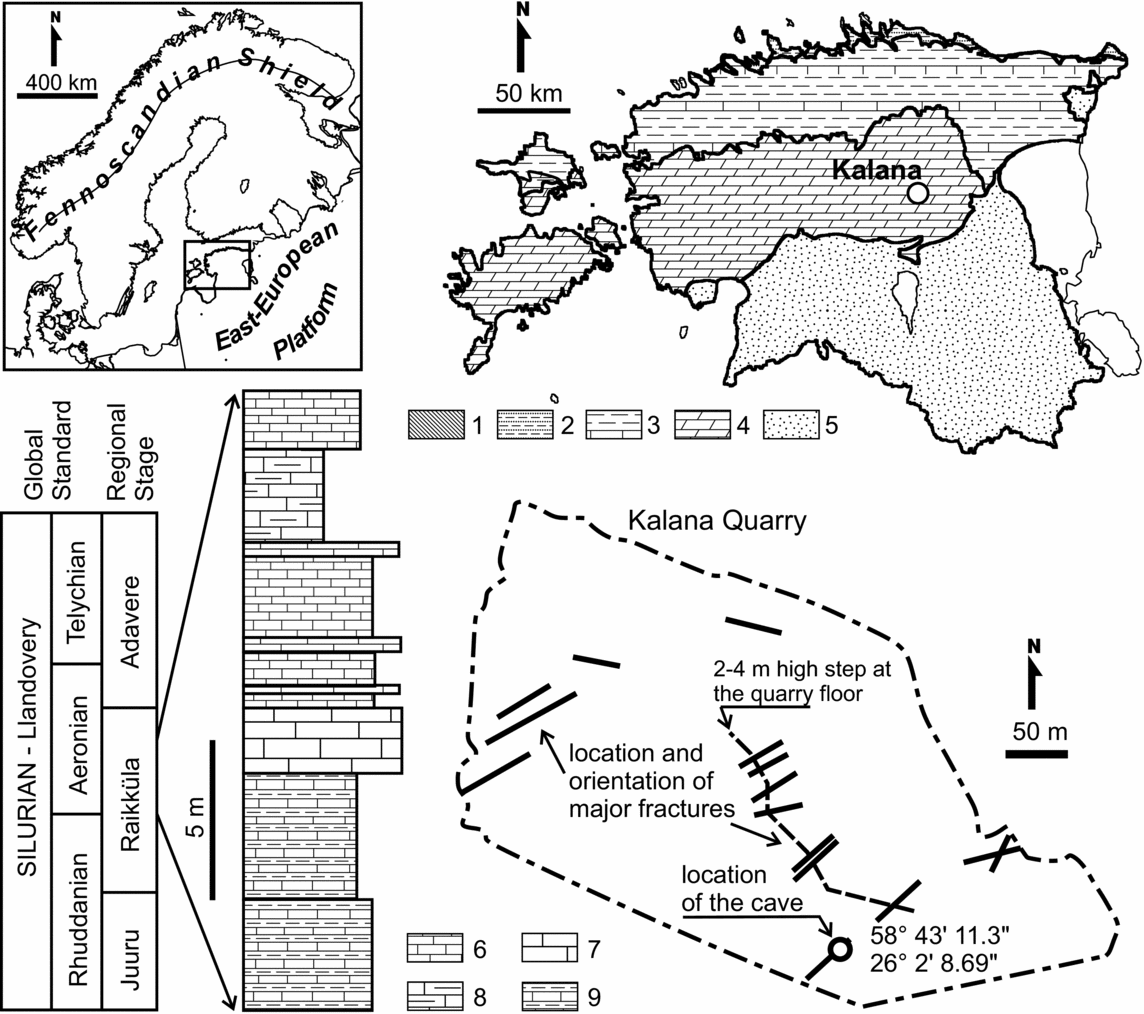
The Aeronian (Silurian Period) carbonate rocks exposed in Kalana quarry, central Estonia (Fig. 1), contain small-size palaeokarst features (cave and fracture structures) filled with calcitic botryoidal and stalactite-stalagmite speleothem deposits. Karst features that developed in Estonia during Quaternary post-glacial time are widely distributed in Ordovician–Silurian- and Devonian-aged carbonate rocks cropping out on the ground surface (e.g. Kink, Reference Kink, Raukas and Teedumäe1997). Karst processes are typically constrained to a vadose zone of a few metres thickness above the relatively high groundwater level in a generally flat topography. Although buried palaeokarst occurrences have been described in Ordovician (Bauert, Reference Bauert1989) and Silurian (K. Kelp, unpublished MSc thesis, University of Tartu, 2014) sequences, significant authigenic cave precipitates/deposits are commonly absent. In this contribution we study the C and O stable isotope composition of these speleothems in order to elucidate fluid evolution during the precipitation of authigenic calcite.
Location and stratigraphic position of the Kalana quarry section. 1, Ediacaran; 2, Cambrian; 3, Ordovician; 4, Silurian; 5, Devonian; 6, limestone (wackstone, packstone); 7, limestone (grainstone); 8, argillaceous limestone (wackestone); 9, intercalation of mudstone–grainstone beds with kerogenous laminae. Modified after Tinn et al. (Reference Tinn, Meidla, Ainsaar and Pani2009).

2. Geological setting
Cave structures were studied in Kalana quarry in central Estonia (Fig. 1). The carbonate succession exposed in the quarry is represented by Aeronian (c. 440 Ma) rocks that belong to the Raikküla Regional Stage and are characterized by a series of shallowing-upwards shelf carbonates (Tinn et al. Reference Tinn, Meidla, Ainsaar and Pani2009). As evidenced by lenses of (occasionally cross-bedded) carbonate grainstones and calcareous tempestite beds, the shelf carbonates deposited at or close to wave-base depths in the middle–upper part of the succession.
Limestones in the quarry are partly dolomitized. The dolomitized zones are mainly aligned along SW–NE-oriented fractures and fracture zones (Fig. 1). Palaeomagnetic studies on Silurian carbonate rocks in Kalana quarry (Preeden et al. Reference Preeden, Plado, Mertanen and Puura2008) point to late Palaeozoic and Triassic overprinting on rock magnetization, probably in relation to tectonically derived low-temperature hydrothermal fluids activated by tectonic processes during the formation of the Pangea supercontinent.
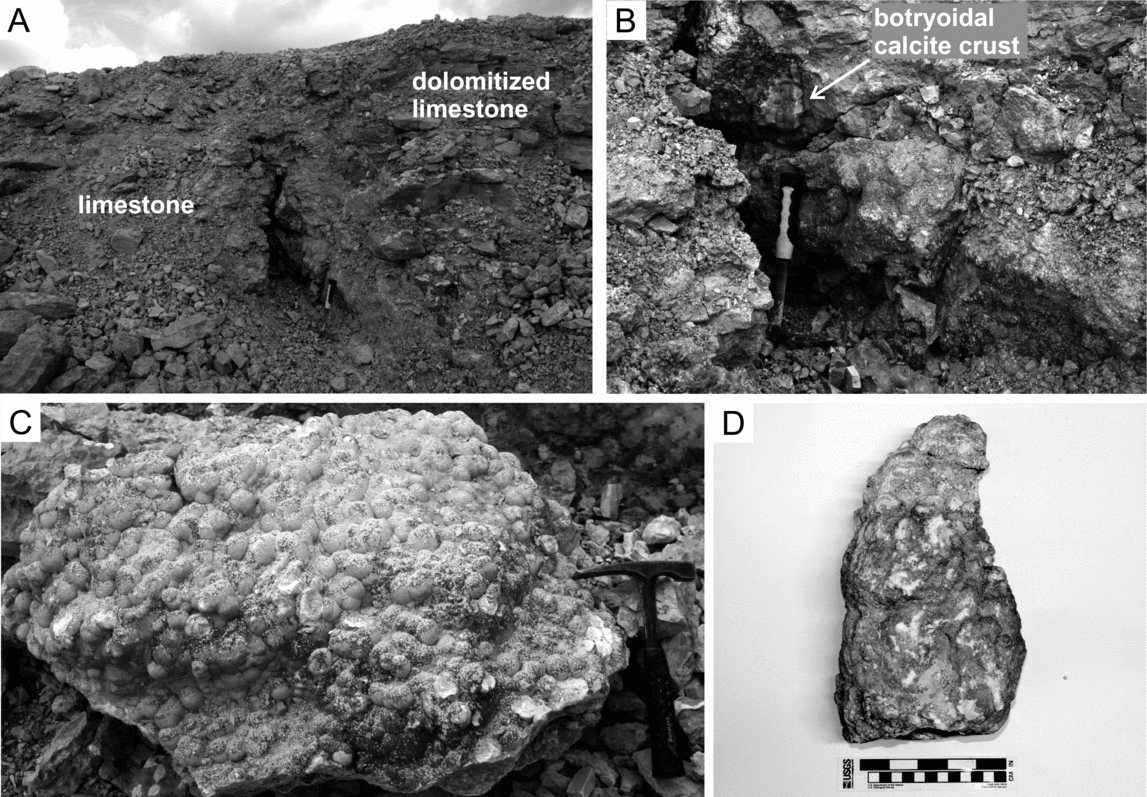
The cave and fracture structures are mostly found in the central and southern parts of the quarry in subvertical contact zones between limestone and dolomite bodies (Fig. 2), in a c. 2 m high zone at the base of the 10–15 m high quarry wall. The cave structures are typically small, up to 0.5–1 m wide, up to 15 m long and 1.5 m in height. Larger structures are filled with calcite speleothem-type deposits in association with spar calcite and euhedral barite crystal aggregates, and locally pyrite mineralization (Fig. 3).
(a) Photograph of the cave structure as discovered in the Kalana quarry wall in 2009; (b) close-up of the cave entrance and in situ botryoidal crust on the cave wall; (c) large block of the botryoidal aggregate in loose excavated material; and (d) stalagmitic form from loose excavated material.

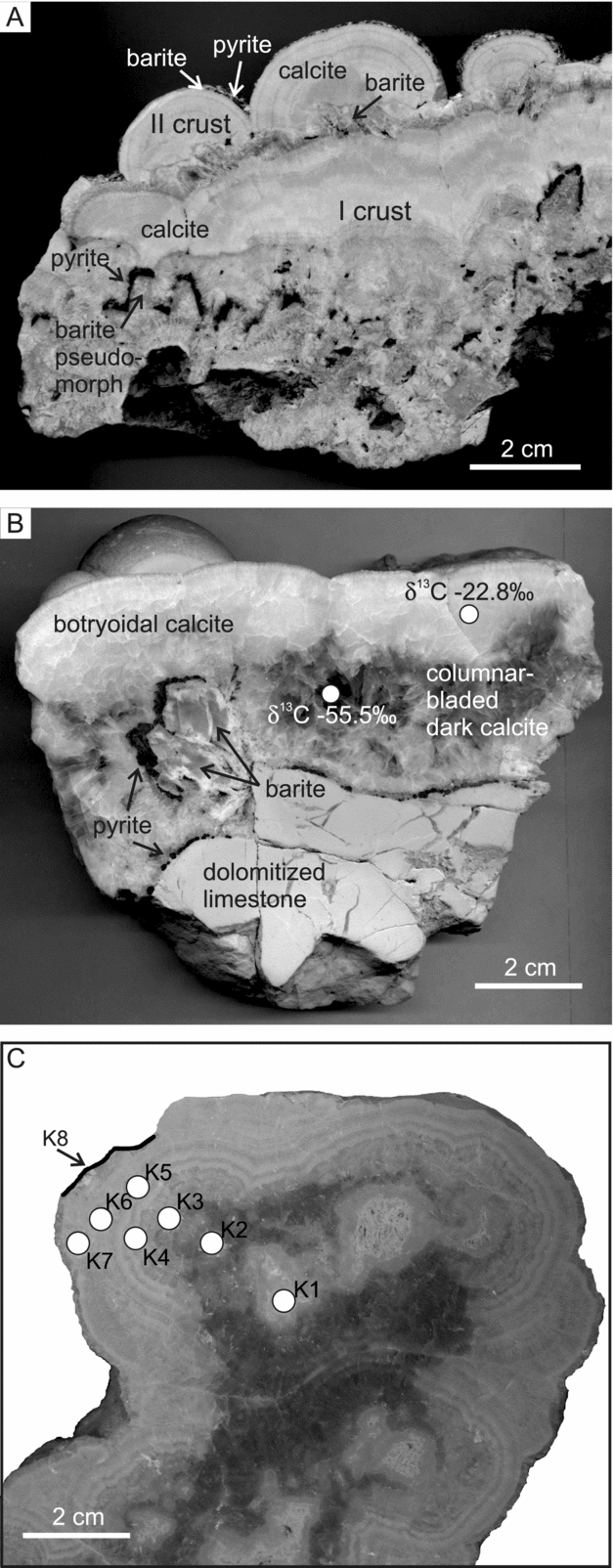
(a) Cross-section of the botryoidal crust showing the cyclic character of barite-pyrite and calcite precipitation; (b) paragenetic relationships of phases and variation in the measured calcite δ13C values (white dots indicate the location of microdrilled samples); and (c) cross-section cut perpendicular to a stalagmitic form. Dots indicate the location of microdrilled stable isotope samples (see data in Table 2 and Fig. 5).

3. Material and methods
Calcite precipitates for this study were collected in the southern part of the quarry (Fig. 1) where a 0.5–0.7 m wide, 1.5 m high and c. 10 m long cave-like structure (Fig. 2) was opened in 2009. As Kalana quarry is in active operation, the cave structure is not preserved. However, a representative collection of different speleothems and wall-rock material is deposited and available at the Natural History Museum and Department of Geology, University of Tartu (collection No. 1690). In addition to speleothems, the limestone-dolomite host rocks were sampled.
Macroscopic inspection, petrographic and analytical scanning electron microscopic (SEM), X-ray diffractometry (XRD) and stable isotope studies of carbonate minerals were made to investigate the composition of speleothem carbonate and vein minerals and host rock. Stable isotope ratios of δ18O and δ13C in calcite and dolomite were measured in powdered samples on a Thermo Scientific Delta V Advantage continuous-flow isotope ratio mass spectrometer with the precision (2σ) of 0.1‰. Reproducibility was better than ±0.1‰ for δ18O and ±0.1‰ for δ13C. The results are expressed in per mil deviation relative to the Vienna PeeDee Belemnite (VPDB) scale for oxygen and carbon. The fluid temperatures at the time of carbonate precipitation were estimated using the isotope fractionation–temperature equation:
 $$\begin{equation*}
10^{3}\ {\rm ln}\ \alpha_{\rm mineral-water} = {\rm a} (10^{6}/{\it T}^{2}) + {\rm b} (10^{3}/{\it T}) + {\rm c},
\end{equation*}$$
where α is the fractionation factor between mineral and water (the fluid); T is the fluid's temperature in Kelvin (K); and a, b and c are equation constants. The constants a = 2.78, b = 0, and c = –2.89 for the calcite–water system (O’Neil, Clayton & Mayeda, Reference O’Neil, Clayton and Mayeda1969) were used. The HCO3 − state of carbon was assumed.
Chemical analyses and imaging of polished carbonate rock slabs and thin-sections of speleothem crusts were carried out with the Zeiss EVO 15MA scanning electron microscope equipped with Oxford X-Max energy dispersive (EDS) and IncaWave700 wavelength dispersive (WDS) detectors. Chemical analyses were made using the WDS detector based on a calibration with mineral standards Ca (calcite), Mg (dolomite), Mn (rodonite), Fe (hematite), Ba (barite) and Sr (celestite). Counting times were 300 s at the peak and 200 s for the background. The detection limits were 100 ppm for Ca and Mg, 50 ppm for Mn and Sr, 60 ppm for Ba and 80 ppm for Fe.
X-ray diffraction (XRD) patterns of speleothem and vein carbonate minerals were analysed in powdered unoriented preparations with the Bruker D8 Advance diffractometer using Johannson-type primary monochromator filtered Cu–Kα radiation and the LynxEye detector system. Rietveld analysis of XRD patterns was made using the Siroquant 3.0 code (Taylor, Reference Taylor1991).
4. Results
4.a. Petrography
The authigenic calcite crystals in dolomitized limestone cave walls of Kalana quarry have diverse shapes (equant-blocky, bladed and fibrous). In most part the cave walls are covered by an up to 10 cm thick speleothem crust of fine-crystalline calcite (Figs 2c, 3a). The outer part of the crust is covered by centimetre-sized botryoidal (mammalies) calcite speleothems. Loose material from excavated cave walls include a few up to 40 cm high botryoidal ‘stalagmites’ 15 cm in diameter (Fig. 2d). The original position of the stalagmites within the cave is not known.
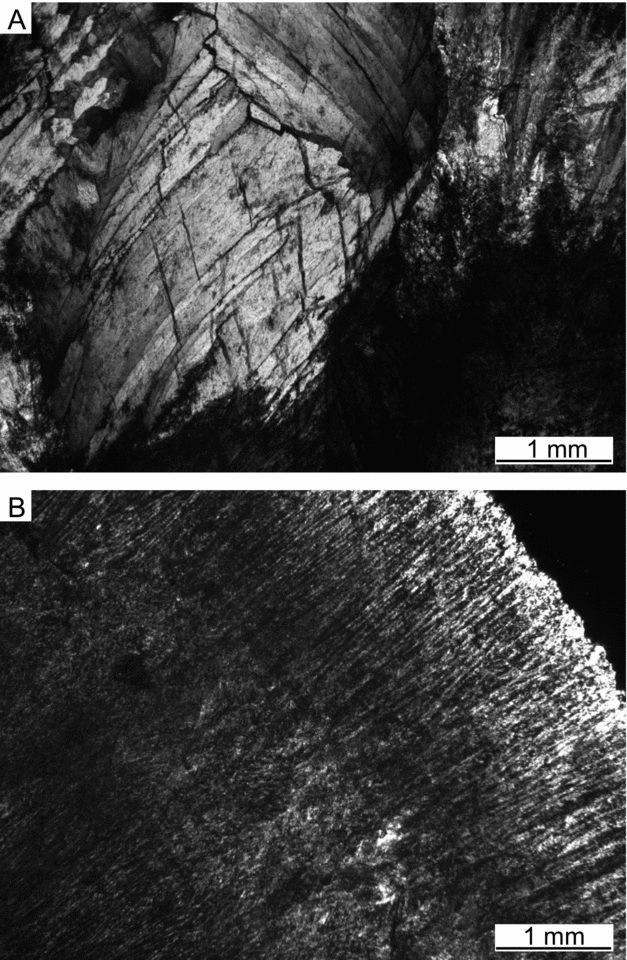
The paragenetic sequence of the cave/fracture wall precipitates starts with sparsely placed bladed-euhedral barite crystal aggregates growing on the host rock substrate (Fig. 3). The barite crystals and wall rock are encrusted with a 1–4 mm thick layer of microcrystalline pyrite aggregates. These aggregates are all covered by curved-face columnar-bladed calcite showing sweeping extinction and grading into finely laminated calcite aggregate (Figs 3, 4). Laminated calcite aggregates form botryoidal surfaces that coalesce into distinct layers. About 0.3–2.5 mm thick laminae are composed of epitaxially overgrown acicular/thin-bladed calcite crystals oriented perpendicular to the layering (Fig. 4). Sequences of laminated botryoidal calcite occur in at least three repeated cycles (Fig. 3a). The boundaries of the cycles are marked by a thin layer of bladed calcite and occasionally covered by sparse aggregates of thin-bladed barite and/or pyrite. The succeeding cycle is built by sparsely spaced small mammalies nucleated at these boundaries and coalescing into the next layer. The columnar-bladed calcite in the central parts of the botryoidal aggregates and margins of coalescing mammalies have brownish-dark colouring caused by abundant impurities and microscopic gas–fluid inclusions (Fig. 4).
Photomicrographs of (a) curved-face columnar-bladed calcite in the lower/central part of the crust (dark calcite) and (b) laminated calcite aggregate composed of acicular crystallites arranged perpendicular to layering. Crossed polars.

4.b. Mineralogy and geochemistry
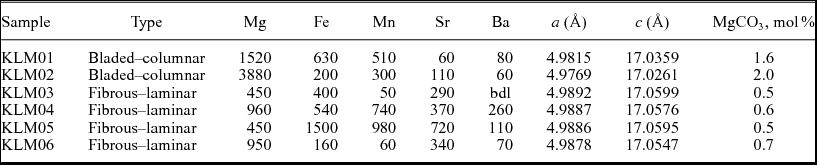
X-ray diffraction analysis shows that different types of calcite in the studied speleothem samples are represented by low-Mg calcite with less than 3 mol% MgCO3. The low Mg content is further confirmed by microprobe analyses (Table 1). However, Mg content is up to 3880 ppm in columnar-bladed calcite and 450–990 ppm in finely laminated botryoidal calcite (Table 1). Strontium content in speleothem calcite ranges from 60 to 720 ppm, being somewhat higher in laminated botryoidal crusts (Table 1). Barium content is 60–260 ppm in the laminated crusts/mamelons and 60–80 ppm in the bladed crystal aggregates in the lower part of the crust. The Fe and Mn contents of different calcite types are 200–630 ppm and 150–740 ppm, respectively (Table 1).
Trace-element composition and unit cell parameters of authigenic calcite in Kalana speleothems. Element concentrations are in ppm. MgCO3 mol% is estimated from unit cell parameters. bdl – below detection limit.

4.c. Stable isotope composition
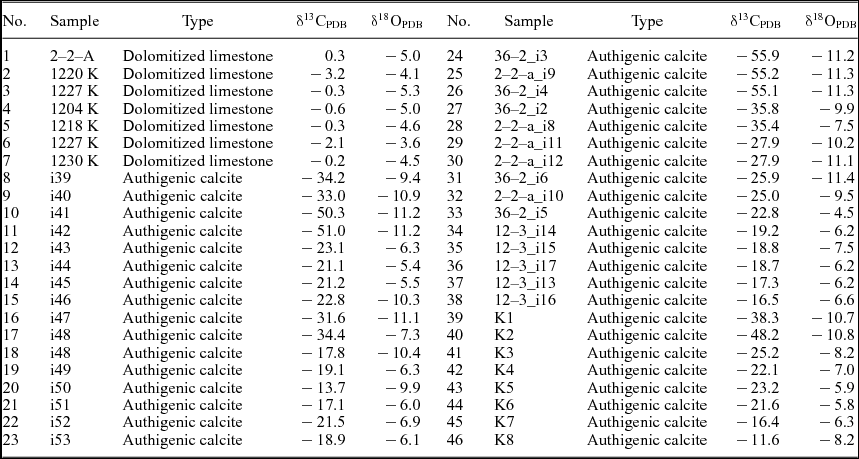
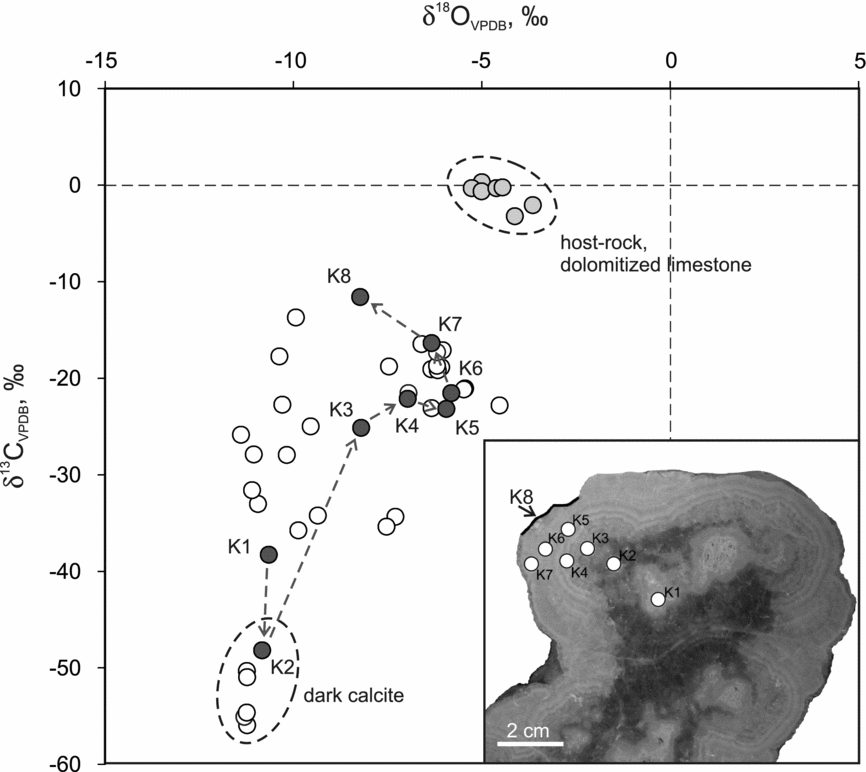
Stable carbon and oxygen isotopes were measured on seven bulk wall-rock samples and 39 authigenic speleothem carbonate samples (Table 2, Fig. 5). The δ13C and δ18O values of wall-rock limestone and dolomite range from 0.3 to –3.2‰ and –3.6 to –5.3‰, respectively, corresponding to the stable isotope composition of the Llandoverian carbonate rocks in the Baltic Basin (e.g. Kaljo & Martma, Reference Kaljo and Martma2000). The speleothem calcites, however, show extreme depletion in 13C and large variations in δ13C values from –11.6 to –55.9‰, while δ18O values range from –4.5 to –11.4‰ (Table 2, Figs 3a, b, 5). Some of the wall rocks sampled close to the cave/fracture surface are also depleted in 18O and have slightly lower δ13C values. The δ13C values decrease towards the early growth stages of the botryoidal crusts, whereas the strongest 13C depletion was measured in the dark-brownish columnar-bladed calcite (Figs 3a, b, 5).
Stable isotope composition of dolomitized limestone host rock and authigenic calcite in Kalana quarry. The δ13C and δ18O values are in ‰ against the Vienna PeeDee Belemnite standard.

Cross-plot of δ18O and δ13C values in authigenic calcite from the cave and the host rock (dolomitized limestones). Dark grey dots show the values of samples taken through the layering of a polished slab shown in Figure 3c.

5. Discussion
5.a. Origin of 13C-depleted calcite
The carbon isotopic composition of a low-Mg calcite speleothem is mainly controlled by the carbon isotopic composition of dissolved inorganic carbon (DIC), given that the fractionation between DIC and the calcium carbonate precipitating in the system is small and kinetic effects are negligible (Romanek, Grossman & Morse, Reference Romanek, Grossman and Morse1992; Frisia et al. Reference Frisia, Fairchild, Fohlmeister, Miorandi, Spotl and Borsato2011). The main sources for the different DIC species in percolating water are soil CO2 produced by root respiration, decomposition of organic matter and the dissolution of carbonate host rock, and atmospheric CO2. Because of the nearly complete equilibration between soil CO2 and dissolved bicarbonate (HCO3 −), soil CO2 dominates in speleothem carbon in an open system but its estimated contribution would be c. 85% if the flux of CO2 through the vadose zone was not large enough (e.g. Genty et al. Reference Genty, Massault, Gilmour, Baker, Verheyden and Kepens1999). Soil CO2 (assuming C3-dominated origin of organic matter) has a δ13C value of –30 to –20‰ and, considering fractionation between CO2 – bicarbonate – calcite (e.g. Breecker et al. Reference Breecker, Payne, Quade, Banner, Ball, Meyer and Cowan2012), speleothem calcite would display the ratios of –14 to –6‰ without a host-rock contribution (Cerling, Reference Cerling1984; McDermott, Reference McDermott2004).
The δ13C values of dolomitized limestone bedrock in Kalana vary between –3.2 and 0.3‰ (Table 2). Taking a host-rock contribution of 15% with an average δ13C value of –1‰ into account, the speleothem calcite in Kalana should display δ13C ratios between c. –13 and –5‰. However, analyses of the carbon isotopic composition of the speleothem calcite from Kalana yielded δ13C values generally lower than –15‰, reaching as low as –56‰ (Fig. 5). Such low δ13C values are atypical of speleothem carbonates, but commonly encountered in modern and ancient carbonate precipitates at methane seeps (e.g. Paull et al. Reference Paull, Chanton, Neumann, Coston, Martens and Showers1992; Peckmann et al. Reference Peckmann, Thiel, Michaelis, Clari, Gaillard, Martire and Reitner1999; Aloisi et al. Reference Aloisi, Pierre, Rouchy, Foucher, Woodside and Party2000; Peckmann & Thiel, Reference Peckmann and Thiel2004; Campbell, Reference Campbell2006; Himmler et al. Reference Himmler, Freiwald, Stollhofen and Peckmann2008; Roberts, Feng & Joye, Reference Roberts, Feng and Joye2010; Natalicchio et al. Reference Natalicchio, Dela Pierre, Clari, Birgel, Cavagna, Martire and Peckmann2013). The 13C-depleted carbon source for the precipitation of authigenic seep carbonates is supplied by microbially mediated anaerobic oxidation (AOM) of hydrocarbons such as methane, higher hydrocarbons or oil (e.g. Boetius et al. Reference Boetius, Ravenschlag, Schubert, Rickert, Widdel, Gieseke, Amann, Jørgensen, Witte and Pfannkuche2000; Joye et al. Reference Joye, Bowles, Samarkin, Hunter and Niemann2010), typically within shallow subsurface sediments. At these settings the hydrocarbons rising through unconsolidated sediments are anaerobically oxidized at the lower boundary of the sulphate reduction zone either by microbial consortia of archaea and sulphate-reducing bacteria that convert sulphate to hydrogen sulphide (HS−) (e.g. Whiticar, Reference Whiticar1999; Boetius et al. Reference Boetius, Ravenschlag, Schubert, Rickert, Widdel, Gieseke, Amann, Jørgensen, Witte and Pfannkuche2000; Orphan et al. Reference Orphan, House, Hinrichs, McKeegan and DeLong2002), or just by anaerobic methanotrophic archaea that oxidize methane and also produce disulphide (HS2 −) (Milucka et al. Reference Milucka, Ferdelman, Polerecky, Franzke, Wegener, Schmid, Lieberwirth, Wagner, Widdel and Kuypers2012). Alternatively, AOM can be driven by nitrate dismutation and/or be coupled to metal-oxide reduction (Beal, House & Orphan, Reference Beal, House and Orphan2009; Ettwig et al. Reference Ettwig, Butler, Le Paslier, Pelletier, Mangenot, Kuypers, Schreiber, Dutilh, Zedelius, de Beer, Gloerich, Wessels, van Alen, Luesken, Wu, van de Pas–Schoonen, den Camp, Janssen–Megens, Francoijs, Stunnenberg, Weissenbach, Jetten and Strous2010). All of these different modes of AOM increase pore-water alkalinity and consequently the precipitation of carbonates (e.g. Joye et al. Reference Joye, Boetius, Orcutt, Montoya, Schulz, Erickson and Lugo2004).
Carbon isotopic values vary systematically, ranging from –35 to –56‰ in the dark-brownish columnar-bladed calcite in the lower/central part of the botryoidal crusts to progressively less 13C-depleted laminated calcite and the outermost thin columnar layer of the crust with δ13C values of –30 to –20 ‰ and –12 to –9‰, respectively. This may reflect (1) the variation in the source of methane, for example microbial v. thermogenic origin, or (2) mixing of different sources into the DIC pool, for example dilution of microbial and thermogenic methane carbon by seawater DIC.
Microbial methane is formed in anaerobic conditions typically via CO2 reduction and/or acetoclastic methanogenesis, whereas thermogenic methane is generated during organic matter maturation (e.g. Whiticar, Reference Whiticar1999). Biogenic methane formed by methanogens is strongly depleted in 13C and its δ13C values vary from –110 to –50‰ (typically 60±5‰; Schoell, Reference Schoell1988; Whiticar, Reference Whiticar1999; Sapart et al. Reference Sapart, Monteil, Prokopiou, van de Wal, Kaplan, Sperlich, Krumhardt, van der Veen, Houweling, Krol, Blunier, Sowers, Martinerie, Witrant, Dahl–Jensen and Rockmann2012). On the other hand, thermogenic methane is typically characterized by higher δ13C values over –50‰ (up to –22±3‰ in pyrogenic methane; Whiticar, Reference Whiticar1999; Sapart et al. Reference Sapart, Monteil, Prokopiou, van de Wal, Kaplan, Sperlich, Krumhardt, van der Veen, Houweling, Krol, Blunier, Sowers, Martinerie, Witrant, Dahl–Jensen and Rockmann2012). In this sense the low δ13C values of calcite precipitates in the centre of botryoidal crusts clearly indicate AOM-derived carbon dominating in the DIC pool from which the carbonate precipitated. However, the less-depleted isotopic composition of carbon in paragenetically following laminated calcite may either reflect a change in the primarily thermogenic methane source or indicate the mixing of different sources into the DIC pool. Alternatively, assuming a closed DIC pool, the relative enrichment in calcite 13C would reflect an isotopically heavier composition of the residual methane remaining after the biological consumption of the isotopically lighter fraction of the initial methane (Whiticar, Reference Whiticar1999) during AOM in methane-limited but sulphate-rich environment (Yoshinaga et al. Reference Yoshinaga, Holler, Goldhammer, Wegener, Pohlman, Brunner, Kuypers, Hinrichs and Elvert2014).
The source and origin of methane in Kalana rocks are unknown. Unlike modern and fossil methane seep carbonates, precipitating or being precipitated at the (shallow) seafloor at passive continental margins via biogenic methane seeping through soft, yet unconsolidated, organic-rich sediments, the 13C-depleted carbonates in Kalana were precipitated in a cave–fracture system developed in lithified diagenetically recrystallized carbonate rocks. Deep-seated AOM activity, possibly driven by autoendolithic life (Marlow, Peckmann & Orphan, Reference Marlow, Peckmann and Orphan2015) and resulting in the precipitation of AOM-related 13C-depleted carbonate phases, have been described in few case studies both in fractured crystalline and sedimentary rocks (e.g. Drake et al. Reference Drake, Astrom, Heim, Broman, Astrom, Whitehouse, Ivarsson, Siljestrom and Sjovall2015). In most cases the subsurface AOM is found in the transition zone of deep methane-carrying fluids and sulphate-rich surface water (Pedersen, Reference Pedersen2013). However, a reversed system has been proposed for fractured granite in Sweden, where the most extremely 13C-depleted calcite reached a δ13C value of –125‰ (Drake et al. Reference Drake, Astrom, Heim, Broman, Astrom, Whitehouse, Ivarsson, Siljestrom and Sjovall2015).
Clayey carbonates rich in disseminated algal organics as well as complete algae fossils preserved in the lower part of the Aeronian rocks exposed in the Kalana section (Tinn et al. Reference Tinn, Meidla, Ainsaar and Pani2009), with a Corg content up to 3 wt% (K. Kirsimäe, unpublished data, 2014), could have been possible source rocks for methane. Thermogenic methane is produced by thermocatalytic degradation of kerogen at temperatures of >120°C (Tissot & Welte, Reference Tissot and Welte1984). Considering the typical geothermal gradient in the old and tectonically stable cratonic Baltic Basin (c. 20 °C km−1; Kirsimäe & Jørgensen, Reference Kirsimäe and Jørgensen2000), the formation of thermogenic methane would require burial depths greater than 3–4 km. This would contradict the immature state of organic matter (e.g. Talyzina, Reference Talyzina1998) and uncompacted clayey sediments (e.g. Kirsimäe, Jørgensen & Kalm, Reference Kirsimäe, Jørgensen and Kalm1999) in the lower part of the Palaeozoic sedimentary sequence of the northern Baltic Basin. Shallow burial of the basin at its northern margin is also implied by apatite fission track ages of 800–500 Ma in crystalline basement rocks at the northern margin of the basin in southern Finland (Hendriks et al. Reference Hendriks, Donelick, O’Sullivan and Redfield2007), suggesting that the sequence was not deeply buried and/or regionally heated up for the thermogenic methane production during Phanerozoic time. Nevertheless, the diagenetic grade of clay minerals and palaeomagnetic remagnetization of sediments hint at a series of basin-wide (hydrothermal) fluid intrusions/thermal perturbations during the evolution of the Baltic Basin (e.g. Plado et al. Reference Plado, Preeden, Puura, Pesonen, Kirsimäe, Pani and Elbra2008; Preeden et al. Reference Preeden, Plado, Mertanen and Puura2008; Somelar, Kirsimäe & Srodon, Reference Somelar, Kirsimäe and Srodon2009; Somelar et al. Reference Somelar, Kirsimäe, Hints and Kirs2010). The cave structures in Kalana developed along the fracture systems where hydrothermal fluids could have been capable of locally heating up the organic-rich sediments and thermogenic methane production. Nevertheless, although the AOM of thermogenic methane with δ13C values between –20 and –50‰ (Sapart et al. Reference Sapart, Monteil, Prokopiou, van de Wal, Kaplan, Sperlich, Krumhardt, van der Veen, Houweling, Krol, Blunier, Sowers, Martinerie, Witrant, Dahl–Jensen and Rockmann2012) could explain the isotopic composition of calcite precipitated in the outer part of the botryoidal speleothems, the most 13C-depleted bladed-columnar calcite would have required the oxidation of biogenic methane as the source for carbon.
5.b. Evolution of the fluid
Oxygen isotopic values of authigenic calcite (within the range of typical speleothem oxygen isotope values) are controlled under equilibrium conditions by the isotopic composition of the dip water, and the temperature (Lachniet, Reference Lachniet2009). The δ18O values of –4.5 to –11.4‰ in 13C-depleted carbonates in Kalana are atypical of authigenic cold-seep carbonates that were precipitated in equilibrium or in near equilibrium with seawater and have δ18O values between –2 and 8‰ (Campbell, Reference Campbell2006). The oxygen isotope composition of calcite precipitated in equilibrium with Phanerozoic seawater varies from –2.0 to –5.0‰ (e.g. Veizer et al. Reference Veizer, Bruckschen, Pawellek, Diener, Podlaha, Carden, Jasper, Korte, Strauss, Azmy and Ala1997). Authigenic seep carbonates may also show slightly positive δ18O values (up to 2–3‰ higher than equilibrium values), interpreted as being caused by the dissociation of the locally abundant gas hydrate (e.g. Feng et al. Reference Feng, Birgel, Peckmann, Roberts, Joye, Sassen, Liu, Hinrichs and Chen2014). The oxygen isotope composition of Kalana speleothem-like structures therefore suggests that the authigenic calcite was precipitated from fluids with δ18O values much different from those of normal marine seawater. It is also particularly interesting that the most negative oxygen isotope composition of Kalana speleothem calcite is coupled with the most negative δ13C values (Fig. 5).
Low oxygen isotopic values can point to either: (1) the influence of meteoric water; or (2) inflow of high-temperature fluids. Alternatively, low-temperature alteration of volcanic glass has been suggested as a source of 18O-depleted fluids (e.g. Hein, O’Neil & Jones, Reference Hein, O’Neil and Jones1979). Numerous altered volcanoclastic layers (bentonites) are found in the Silurian stratigraphic succession in the Baltic Basin (Kiipli, Kallaste & Nestor, Reference Kiipli, Kallaste and Nestor2010). However, the alteration of volcanic glass would have a significant effect only at low water/rock ratios (<1; e.g. Banner & Hanson, Reference Banner and Hanson1990; Jacobsen & Kaufman, Reference Jacobsen and Kaufman1999), which is not probable in an open system such as the caves and open fractures in Kalana.
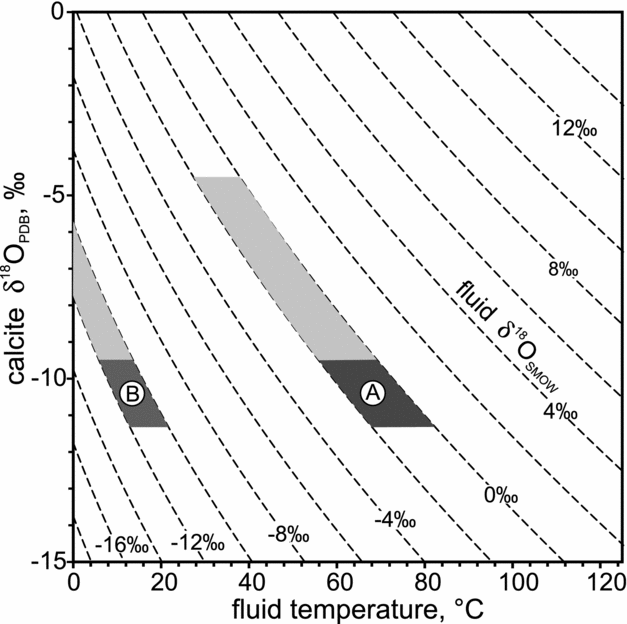
The average annual δ18OSMOW value of modern meteoric water and shallow groundwater in Estonia is c. –11.5‰ (Punning, Toots & Vaikmae, Reference Punning, Toots and Vaikmae1987). The expected δ18O value of calcite precipitated from fluid in equilibrium with meteoric water at a temperature of 7°C (mean annual temperature in Estonia, Jaagus et al. Reference Jaagus, Briede, Rimkus and Remm2014) is –8.2‰, which is in the range of the observed δ18O values of bladed-columnar calcite (Table 2). However, in this case the laminated botryoidal calcite with δ18O values higher than –6‰ must have been precipitated at temperatures close to or even below 0°C (Fig. 6), which is not plausible. In contrast, if a fluid with the oxygen isotopic composition of Phanerozoic seawater is assumed, –2‰ VSMOW (e.g. Veizer et al. Reference Veizer, Ala, Azmy, Bruckschen, Buhl, Bruhn, Carden, Diener, Ebneth, Godderis, Jasper, Korte, Pawellek, Podlaha and Strauss1999), the δ18O values increasing from –11‰ in the central parts of the botryoidal aggregates to –5‰ in their outer parts would indicate the presence of low-temperature hydrothermal fluids, with temperatures decreasing from c. 70°C during the precipitation of columnar-bladed calcite to c. 20°C during the precipitation of laminated calcite (Fig. 6). A similar shift towards lower δ18O and δ13C values in altered carbonate bedrock has been reported from caves influenced by thermal waters (e.g. Bottrell, Crowley & Self, Reference Bottrell, Crowley and Self2001; Spötl et al. Reference Spötl, Dublyansky, Meyer and Mangini2009). In addition, meteoric water as well as shallow groundwater in Estonia are low in dissolved sulphate (Raidla et al. Reference Raidla, Kirsimae, Ivask, Kaup, Knoller, Marandi, Martma and Vaikmae2014) and therefore do not represent a favourable fluid environment for sulphate-reducing bacteria anaerobically oxidizing methane. However, 13C-depleted calcite speleothems in Kalana are associated with the precipitation of abundant pyrite and euhedral barite that specifically point to a fluid system rich in dissolved sulphur species. The age of calcite precipitation in the Kalana cave system cannot be assessed at the present state of knowledge. Still, the hydrothermal signature in the oxygen isotope composition in AOM calcite suggests that its formation could be tentatively tied to either late Palaeozoic – Triassic low-temperature hydrothermal overprinting on rock magnetization revealed in carbonate rocks in Kalana (Preeden et al. Reference Preeden, Plado, Mertanen and Puura2008), or to far-field hydrothermal influences of the latest phase of Caledonian Orogeny (425–400 Ma), expressed in the Baltic Basin in late Silurian – Devonian K–Ar isotope ages of illite-smectite in K-bentonites (Somelar, Kirsimäe & Srodon, Reference Somelar, Kirsimäe and Srodon2009; Somelar et al. Reference Somelar, Kirsimäe, Hints and Kirs2010).
Oxygen isotope fractionation curves for authigenic calcite from the Kalana cave. Dark grey shading represents the spread of δ18O values in columnar-bladed dark calcite, and the light grey area shows variation in δ18O values of laminated botryoidal calcite. Field A illustrates the possible fluid temperatures assuming (sea)water δ18OSMOW values of –2 to 0‰; field B illustrates possible fluid temperatures assuming modern meteoric water (δ18OSMOW = –12 to –10‰) as the fluid source during calcite precipitation.

Deep origin of methane-bearing fluids is further supported by the presence of barite. Barite is known to form at sulphate–methane interfaces (Castellini et al. Reference Castellini, Dickens, Snyder and Ruppel2006) where mixing of different fluids containing barium and sulphate, respectively, occurs (Griffith & Paytan, Reference Griffith and Paytan2012). Barite and 13C-depleted authigenic carbonate precipitation co-occur at low-temperature hydrothermal springs and/or cold methane/hydrocarbon seeps, where fluids from deeper layers containing methane and Ba2+ (leached mainly from K-minerals such as K-feldspar and K-mica) mix with seawater near the seafloor (Hanor, Reference Hanor, Alpers, Jambor and Nordstrom2000; Canet et al. Reference Canet, Prol–Ledesma, Melgarejo and Reyes2003; Aloisi et al. Reference Aloisi, Wallmann, Bollwerk, Derkachev, Bohrmann and Suess2004; Griffith & Paytan, Reference Griffith and Paytan2012). On the other hand, the formation of the most 13C-depleted calcite is more consistent with biogenic methane produced in the shallow subsurface than with thermogenic methane that does not agree with hot, deeply sourced hydrothermal fluids (Natalicchio et al. Reference Natalicchio, Birgel, Dela Pierre, Martire, Clari, Spotl and Peckmann2012).
5.c. Implications for the formation of AOM calcite
The formation of 13C-depleted calcitic speleothems in Kalana could be viewed not as a common karstic feature in the vadoze zone of the fractured carbonate strata, but rather as a hypogenic-hydrothermal (karst) system (e.g. Klimchouk, Reference Klimchouk2009; Spötl et al. Reference Spötl, Dublyansky, Meyer and Mangini2009; Palmer, Reference Palmer2011), developed in the phreatic zone of facture systems at the mixing front of sulphate-rich seawater or groundwater and low-temperature methane-bearing hydrothermal fluids. The phreatic (underwater) environment of calcite precipitation is supported by columnar to fibrous fabrics of authigenic calcite in Kalana caves, which suggests calcite precipitation in continuously wet, low hydrodynamic conditions from a water fluid at low supersaturation with respect to calcite (Frisia et al. Reference Frisia, Borsato, Fairchild and McDermott2000). Moreover, Palmer (Reference Palmer2011) pointed out that hypogenic caves are typically formed at mixing fronts of two or more waters of contrasting chemistry, for example when rising H2S-rich water encounters oxygen-rich water, or at the cooling of rising thermal water carrying aggressive solutions generated by the maturation of hydrocarbons and/or metamorphism of carbonate rocks. In this case, the carbon and oxygen isotopic composition of the speleothem calcite in Kalana reflects the cooling of a warm fluid (maximum up to 70°C), containing carbon derived from anaerobic oxidation of biogenic methane gradually replaced by thermogenic methane and/or other hydrocarbon source, or a mixed fluid diluted by inorganic carbon dissolved by seawater. It is particularly interesting that ‘stalagmitic’ forms found in Kalana in loose material of unknown original position would then represent not true dipping water build-ups, but chimney-like structures marking the up-flow points of thermal water at the floors of the caves. This interpretation is supported by the porous, channel-like appearance of the central parts of stalagmitic forms in cross-section (Fig. 3c). These structures may represent remnants of the fluid conduits.
6. Conclusions
Our study of Silurian carbonate rocks in Kalana quarry, Estonia, revealed speleothem calcite atypically depleted in 13C. The δ13CPDB values ranged down to –56‰ in a fracture–cave system exposed in the quarry, indicating anaerobic methane oxidation as the carbon source. The precipitation of calcite in speleothems is associated with pyrite and barite, suggesting calcite formation at the mixing front of sulphate-rich water with methane- (and Ba-) bearing fluid. The δ18OPDB values of the most 13C-depleted calcite range from –10 to –12‰, hinting at precipitation at elevated temperatures. Systematic variation in δ13CPDB and δ18OPDB values in the layered precipitates indicates a change from an initially biogenic methane source to either thermogenic methane or hydrocarbon source in the low-temperature hydrothermal fluid. Calcite speleothems in Kalana possibly developed at the mixing front of sulphate-rich seawater and/or groundwater and low-temperature (<70°C) methane-bearing hydrothermal fluids in the phreatic zone of a hypogenic-hydrothermal (karst) system.
Acknowledgements
We are grateful to the staff of Kalana (Otissaare) quarry for their patience and full support. We thank an anonymous reviewer as well as J. Peckmann, whose comments significantly helped improve the manuscript, and A. Noor for linguistic help. This work was supported by Estonian Science Agency project No. ETF9169 and PUT696.