On Wednesday, August 15, 2007, a magnitude 8.0 earthquake hit the Peruvian provinces of Ica, Lima, and Huancavelica, devastating the southwestern coastal areas. The epicenter of the earthquake was located 60 km west of the city of Pisco and 40 km deep in the Pacific Ocean. The earthquake caused 596 deaths, with 383 people dying in the city of Pisco itself, where 70% of the houses were destroyed.Reference Diaz-Fuertes1 In addition, the electricity, water, and sewage systems supplying the city collapsed. Of the city's 2 hospitals, 1 was destroyed, and only the building housing the emergency department of the other was able to provide services to the injured. After the disaster, the most severely injured survivors were transported to Lima, and medical teams including mental health specialists—from the Ministry of Health and other national and international organizations sped to the area.Reference Fraser2 However, 5 months after the earthquake only 2 Ministry of Health psychiatrists remained in the area to handle psychopathologic disorders that might have been related to the disaster.
Posttraumatic stress disorder (PTSD) is the most studied psychopathologic disorder after a disaster.3 Survivors of traumatic events who persistently reexperience the event, avoid stimuli associated with it, and have increased arousal for at least 1 month and whose symptoms cause distress or impair normal functioning fulfill the current diagnostic criteria for PTSD.Reference Norris, Friedman, Watson, Byrne, Diaz and Kaniasty4 Other psychiatric conditions such as major depressive disorder and generalized anxiety disorder are also common after a natural disaster.Reference Foa, Stein and McFarlane5 Moreover, comorbidity is a common feature. McFarlane and PapayReference McFarlane and Papay6 reported that 54 of 70 firefighters with PTSD had an additional diagnosis, and Kar and BastiaReference Kar and Bastia7 studied PTSD, major depressive disorder, and generalized anxiety disorder among Indian adolescents exposed to a cyclone in 1999 and found that 39% of subjects with a psychopathologic disorder had more than 1 disorder. People with both PTSD and a major depressive disorder may have a worse recovery rate than people affected by PTSD alone.Reference Onder, Tural, Aker, Kiliç and Erdoğan8
Globally, people in poor countries are more likely to suffer the worst effects of natural disasters. Between 1999 and 2008, there were 450 natural disasters in countries with a low human development index vs 1,420 among countries with a high human development index; however, natural disasters in the former group of countries affected more than twice as many people and caused 3 times more deaths than did natural disasters in countries with a high human development index.9 Most of the early literature on PTSD after a disaster has comefrom the developed countries, but since the 1990s, there has been an increasing number of reports from poor and middle-income countries.Reference Norris10
Outside the United States and Western Europe, the earthquakes of Spitak in Armenia, Marmara in Turkey, and Chi-Chi in Taiwan have been extensively studied. After the Spitak earthquake of 1988, Armenian and othersReference Armenian, Morikawa and Melkonian11 reported a 50% prevalence of PTSD 24 months following the event, whereas Goenjian et alReference Goenjian, Steinberg, Najarian, Fairbanks, Tashjian and Pynoos12 found PTSD prevalences of 60% and 53% after 18 and 54 months, respectively. Literature on the effects of the 1999 Marmara earthquake showed different results. Tural et alReference Tural, Coşkun and Onder13 and Onder et alReference Onder, Tural, Aker, Kiliç and Erdoğan8 found PTSD prevalences of 25% and 12% during the first year and 3 years after the earthquake, respectively. Başoğlu et al,Reference Başoğlu, Kiliç, Salcioğlu and Livanou14 in a random sample of people at the epicenter of this earthquake, found that 23% had PTSD, but PTSD rates of 43%, 39%, and 40% were found in other samples.Reference Başoğlu, Salcioğlu and Livanou15Reference Salcioğlu, Başoğlu and Livanou16Reference Salcioglu, Basoglu and Livanou17 Karamustafalioglu et alReference Karamustafalioglu, Zohar and Güveli18 described decreasing rates of PTSD in a cohort from an area 100 km from the epicenter of the Marmara earthquake. Three reports on psychiatric morbidity within 1 year of the 1999 Chi-Chi earthquake found PTSD prevalences of 8% to 11%.Reference Chou, Wu and Chou19Reference Lai, Chang, Connor, Lee and Davidson20Reference Yang, Yeh and Chen21 Other groups reported higher rates among specific groups such as bereaved survivors (37%),Reference Kuo, Tang, Tsay, Lin, Hu and Chen22 adolescents (22%),Reference Hsu, Chong, Yang and Yen23 and displaced people (21%).Reference Chen, Tan and Liao24 In China, Cao et alReference Cao, McFarlane and Klimidis25 reported a PTSD prevalence of 9% after the Yu Nan earthquake of 1988, and Wang et alReference Wang, Zhang and Wang26 reported a 38% rate of probable PTSD among displaced survivors after the Sichuan earthquake of 2008. Certain groups such as women,Reference Tural, Coşkun and Onder13Reference Başoğlu, Kiliç, Salcioğlu and Livanou14Reference Başoğlu, Salcioğlu and Livanou15Reference Salcioğlu, Başoğlu and Livanou16Reference Salcioglu, Basoglu and Livanou17Reference Karamustafalioglu, Zohar and Güveli18Reference Chen, Tan and Liao24Reference Wang, Zhang and Wang26Reference Kiliç, Aydin and Taşkintuna27 ethnic minorities,Reference Wang, Zhang and Wang26 people who lost a family member or friend,Reference Tural, Coşkun and Onder13Reference Başoğlu, Kiliç, Salcioğlu and Livanou14Reference Başoğlu, Salcioğlu and Livanou15Reference Salcioglu, Basoglu and Livanou17Reference Chou, Wu and Chou19Reference Wang, Zhang and Wang26Reference Kiliç, Aydin and Taşkintuna27 and people with a low level of educationReference Armenian, Morikawa and Melkonian11Reference Başoğlu, Salcioğlu and Livanou15Reference Salcioglu, Basoglu and Livanou17Reference Chen, Tan and Liao24Reference Wang, Zhang and Wang26 have been found to have a higher risk of developing PTSD after an earthquake. These findings are consistent for studies in developed and developing countries.Reference Norris, Friedman, Watson, Byrne, Diaz and Kaniasty4
Certain social characteristics and interventions can ameliorate the emergence of psychopathologic disorders following a natural disaster. Wang et alReference Wang, Gao, Shinfuku, Zhang, Zhao and Shen28 found that the PTSD prevalence was lower in a village close to the Zhangbei, China, earthquake's epicenter than in a more distant and less damaged village. The authors argued that this difference could be explained by the greater level of government support given to the more affected town.Reference Wang, Gao, Shinfuku, Zhang, Zhao and Shen28 Similarly, social networks may decrease levels of distress after a disaster. People with low social support were more likely to have PTSD in the aforementioned studies.Reference Tural, Coşkun and Onder13Reference Wang, Zhang and Wang26
Because of its geography, Peru is prone to natural disasters. The South American and Nazca plates advance against each other along its Pacific coast, causing seismic events. In addition, El Niño, a weather phenomenon, affects the country periodically. Many of the Peruvian rivers are prone to floods, especially in our times, when global weather changes are melting Andean glaciers.Reference Coudrain, Francou and Kundzewicz29 Nevertheless, to our knowledge, there are no postdisaster PTSD studies from Peru published in peer-reviewed journals. In 2002, 3 surveys of Peru's general population by the Instituto Nacional de Salud Mental (National Mental Health Institute) found prevalences of PTSD of 6%, 13%, and 9% in the capital city of Lima, the Andean region, and the Amazon Basin, respectively.303132 These studies were not done after any specific catastrophic event, but at that time Peru was emerging from 20 years of political violence that killed 70 000 people.Reference Fraser33
The objectives of our study were to estimate the prevalence of PTSD among adult residents of Pisco 5 months after a major earthquake and to identify any relationships between this diagnosis and demographic and disaster-related factors.
METHODS
Setting
Our study was conducted in the city of Pisco, which has a population of 53 000 and is located 260 km southeast of Lima. Initially following the earthquake, a sizable portion of the Pisco population moved into as many as 23 shelters operated by the government and other institutions. But 5 months after the earthquake, the population in shelters was decreasing rapidly. Most of the people returned to their property or went to live with relatives.
Study Design
We used the most current maps (last updated in 2005) of the city of Pisco and its annexes, the villages of San Miguel, Los Molinos, and Pachingas. We codified numerically each of the 774 city blocks. We did not include public squares or small sport fields. We included the large sport fields and parks where there were known shelters. Finally, we took a random sample of 150. In selecting each block, we counted and numbered each house and randomly chose 2 of them by using a lottery system. In each selected house, we asked the first consenting adult to join the study. Interviewers visited the houses at different times of the day and night and on different days of the week.
If there were fewer than 2 houses in the randomly selected block, we enrolled subjects in the next consecutive block; if there were no available houses there, we sought to enroll subjects in the block previous to the randomly selected one. In addition, if there were no people inside the randomly selected house on at least 2 occasions at different times of the day or if the people refused to participate, we sought to enroll people in the next consecutive house. If there were no other houses to visit in that block, we went to the next consecutive block.
Participants and Sample Size
We enrolled adults aged 18 years or older who were in the disaster area during the earthquake and were able to give verbal informed consent. No personal identifiers were recorded. We did not offer any economic incentive to study participants. The study was approved by the Griffin Hospital Institutional Review Board (Derby, Connecticut).
We calculated that a sample of 141 subjects had a power of 95%, with an α of .01, to detect a hypothesized PTSD prevalence of 25% without falsely finding a prevalence of 11.2% or less, as has been reported previously in urban citizens in Mexico.Reference Norris, Murphy, Baker, Perilla, Rodriguez and Rodriguez34 To account for the effect of cluster sampling, we doubled the sample size to 282 subjects and rounded it to 300 to ensure sufficient power for the study.
Survey Tool
The survey tool consisted of the following: demographic questions (age, sex, marital status, religion, place of birth, and education level), a Spanish translation of the civilian version of the PTSD Checklist (PCL), and a translation of the traumatic events section of the Harvard Trauma Questionnaire. We also asked the participants to rate the degree of support they perceived from their family and friends on a 1 (none) to 5 (complete) scale.
The civilian version of the PCL asks about 17 PTSD symptoms. Questions can be worded generically referring to “a stressful experience from the past” (PCL-C) or they can refer to a specific event in the past (PCL-S). Answers are rated on a scale ranging from 1 (not at all) to 5 (extremely). We used a score of 44 or higher to indicate a diagnosis of PTSD. This cutoff had 94% sensitivity and 86% specificity for the diagnosis of PTSD in a sample of survivors of motor vehicle accidents.Reference Blanchard, Jones-Alexander, Buckley and Forneris35 Ventureyra et alReference Ventureyra, Yao, Cottraux, Note and De Mey-Guillard36 validated a French version of the PCL-S on subjects with PTSD after different kinds of trauma—including motor vehicle accidents, armed robbery, and physical and sexual assault—and found a sensitivity of 97% and a specificity of 87%.Reference Ventureyra, Yao, Cottraux, Note and De Mey-Guillard36
A Spanish version of the questionnaire published by MilesReference Miles, Marshall and Schell37 has been used among Latinos in the United States who had experienced community violence or penetrating or blunt trauma.Reference Miles, Marshall and Schell37Reference Orlando and Marshall38Reference Marshall39 The same version was used in Spain among cancer patients.Reference Costa-Requena and Gil40 We used the PCL-C questionnaire translated to Spanish by Balmas and others. Israelski et alReference Israelski, Prentiss and Lubega41 used this version with Spanish-speaking patients with human immunodeficiency virus/AIDS in California. Although the Balmas version is worded generically, asking about stressful events of the past, all 6 of our surveyors were trained to ask each question using the earthquake as the specific event.
We translated a version of the trauma events section of the Harvard Trauma Questionnaire, which we had previously used in our PTSD assessment in Pakistan.Reference Hashmi42 A bilingual Peruvian physician trained in the United States made the first translation, and the questionnaire was back-translated by another bilingual Peruvian physician unrelated to the study and unaffiliated with our institution. An English native-speaking physician then compared the original and back-translated versions and suggested a few changes. We used the final translated version of the questionnaire in Peru.
Statistical Methods
The population was described according to relevant demographic features such as place of birth, sex, and education level, as well as features of exposure to trauma. We set a PTSD diagnosis (PCL score, ≥ 44) as our dependent variable and studied its relationship to each demographic and trauma-related variable using the χ2 test. We added the scores for all of the categorical traumatic experiences during and immediately after the earthquake, as well as current deficits in basic necessities and living conditions (1 if present, 0 if absent), to create a composite trauma score for each subject, and we tested its correlation with the PCL score using the Pearson correlation test. All of the individual factors found to be significantly associated with PTSD, using the χ2 and Fisher exact test when appropriate, were included as potential predictors of outcome in a logistic regression model. We also tested our composite trauma score in place of the individual variables in the logistic regression model. We analyzed the data using SAS software, version 9.1 (SAS Institute Inc, Cary, NC). Statistical tests were 2-sided with a level of significance set at a P value of .05 or less.
RESULTS
From January 16 to January 27, 2008, 5 months after the earthquake, we enrolled and surveyed 298 subjects in the city of Pisco and its annexes. The mean age of the subjects was 41.2 years, with a standard deviation (SD) of 15.4 years.
Of 298 subjects, 75 (25.2%; 95% confidence interval, 20.2%-30.1%) subjects had a PCL score of 44 or more, achieving the diagnosis of PTSD. The mean PCL score was 35.2 (median, 34; SD, 10.8). The PCL score in this population did not follow a normal distribution (Shapiro-Wilk = 0.98; P < .0001).
Most of our subjects were women (203/296 [68.6%]) and were married (220/297 [74.1%]) at the time of the interview. Of the 297 subjects who reported a place of birth, 248 (83.5%) came from Pisco or nearby towns. The education level of the sample had a wide range, although most subjects had at least some high school education. The majority (248/294 [84.4%]) was Catholic, and 46 (15.6%) subjects belonged to other Christian groups (including Mormons and Jehovah's Witnesses). Four subjects did not report a religious preference.
Most of the subjects (179 of 293, 61.1%) were unable to find appropriate shelter immediately after the earthquake, and nearly half (136 of 291, 46.7%) faced food and drinking water shortages in the days following the disaster. Almost a third of the subjects lost their jobs after the earthquake (85 of 285. 29.8%). Of our subjects, 150 (50.7%) lost their homes, and 119 (40.2%) met with a government representative to request financial aid for reconstructing their houses.
Of the people in the sample, 254 (87.0%) reported losing their church during the earthquake. Most subjects found their close relatives a few hours after the earthquake. A separation was considered significant when a subject was unable to locate or obtain information about his or her relatives for at least 12 hours after the earthquake. In our sample, 59 of 296 (19.9%) subjects fell into this category. A relative or a friend was lost by 204 subjects; however, only 20 (6.8%) subjects lost first-degree relatives, whereas 184 (62.4%) lost a more distant relative or a friend. Of 293 subjects, 18 (6.1%) witnessed the death of a relative or friend, whereas 83 of 292 (28.4%) witnessed someone being injured.
A small proportion of subjects were injured (34 of 295, 11.5%) or temporarily trapped inside their houses or other buildings (46 of 291, 15.8%). Only 7 of 34 (21%) injured subjects received medical treatment for their injuries. Eighty of 295 (27.1%) subjects lived in a shelter at least once after the earthquake. During the study, we interviewed people inside one shelter that was randomly selected among the city blocks.
Of 290 people in our sample, 49 (16.9%) were hosted by relatives at the time of the interview, whereas most of the people were in their own homes—although “home” at that time, for many of them, consisted of a prefabricated module or a self-made shack on their property. Most of the subjects had adequate washing (257 of 296) and cooking (276 of 294) areas and a clean drinking water supply (274 of 296) at the time of the interview.
Bivariate Analysis
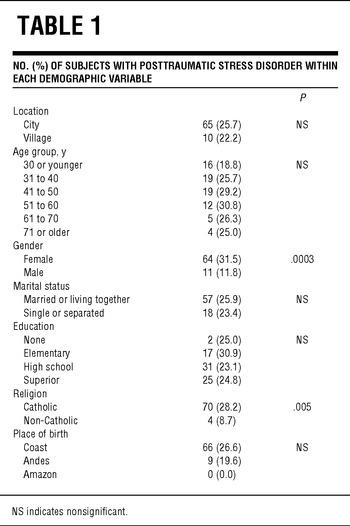
We describe the relationship between a PTSD diagnosis and categorical demographic variables inTable 1. Women were more likely to have PTSD than men (64 of 203 women vs 11 of 93 men; P = .0003). Being Catholic and losing a church were both associated with a PTSD diagnosis (70 of 248 Catholics vs 4 of 46 non-Catholics; P = .005; 73 of 254 church destroyed vs 1 of 38 not destroyed; P = .0006). Moreover, almost all Catholics (98.0%) lost their church compared with 25.0% of Protestants who lost theirs (χ2 = 174.5; P < .0001).We found no association between other demographic variables, such as age group and interviewees' place of birth, and a PTSD diagnosis.
No. (%) of Subjects With Posttraumatic Stress Disorder Within Each Demographic Variable

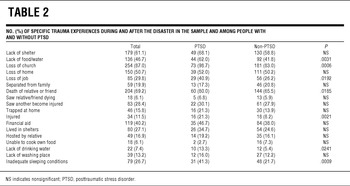
A PTSD diagnosis was more common among people who lost a relative or a friend than among people who did not (60 of 204 vs 15 of 91; P = .0185). The trend in the distribution of PTSD diagnoses according to whom a subject lost during the disaster (none, first-degree relative, or distant relative or friend) was significantly different from what would be expected from chance alone (χ2 = 5.8; P = .0557; Mantel-Haenszel χ2 = 5.7; P for trend = .017).
Temporary lack of food and water during the days following the earthquake, job loss, current lack of clean drinking water supply, and inadequate sleeping conditions were associated with a PTSD diagnosis in the bivariate analysis (Table 2). Of 34 subjects injured during the earthquake, 16 (47%) had PCL scores indicating PTSD, whereas 59 of 261 (22.6%) subjects who reported no injuries during the earthquake had scores indicating PTSD (P = .0021). Our composite trauma score of all traumatic experiences and current deficits in living conditions correlated significantly with the PCL score (Pearson correlation coefficient = 0.342; P < .0001).
No. (%) of Specific Trauma Experiences During and After the Disaster in the Sample and Among People With and Without PTSD

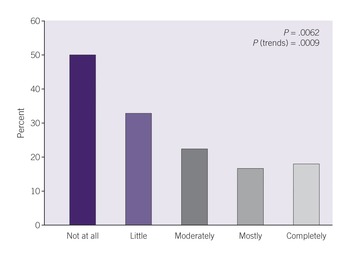
There was a significant and inverse association between self-rated perceived support from family and friends and PTSD (Figure 1).
Percentage of subjects with PTSD according to their stated family support.

Multivariate Analysis
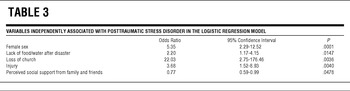
A multiple logistic regression model using the variables significantly associated with PTSD in the bivariate analysis found that female sex, lack of food or water immediately following the disaster, loss of church, and personal injuries were independent predictors of a PTSD diagnosis; the inverse relationship between perceived social support and PTSD was also significant in the multivariate analysis (Table 3). Of our observations, 78% were concordant with this model.
Variables Independently Associated With Posttraumatic Stress Disorder in the Logistic Regression Model

Our composite trauma score was also independently associated with PTSD when replaced in this model, instead of each trauma-related variable included separately.
DISCUSSION
Our results indicate an overall PTSD prevalence of 25% among survivors of the earthquake in the city of Pisco and its annexes. Norris et alReference Norris, Friedman, Watson, Byrne, Diaz and Kaniasty4 defined a 25% PTSD prevalence as the cutoff between moderate and severe impact of a disaster in their review of 160 samples of disaster survivors worldwide. Our calculated PTSD rate is moderate compared with other worldwide and Latin American studies. Tapia Conyer et alReference Tapia Conyer, Sepúlveda Amor, Medina Mora, Caraveo and de la Fuente43 reported a PTSD prevalence of 32% among displaced survivors 2 months after the 1985 Mexico City earthquake. Piña Barba et alReference Piña Barba, Torres Cosme, Prawda Witemberg and Pérez Reséndiz44 found that 16% of their sample had persistent psychological symptoms—including anxiety, obsessions, insomnia, nightmares, and irritability—8 months after that disaster. Also in Mexico, Norris et alReference Norris, Murphy, Baker and Perilla45 found a 24% PTSD prevalence 6 months after the 1999 floods. Following the 1987 Napo earthquake in Ecuador, Lima et alReference Lima, Chavez and Samaniego46Reference Lima, Santacruz and Lozano47 found a 38% prevalence of emotional distress among survivors who visited health clinics. Further evaluation of those cases showed that the most common diagnosis was PTSD.Reference Lima, Chávez, Samaniego and Pai48 Another study found a 56% prevalence of emotional distress among survivors of the 1985 Nevado del Ruiz volcanic eruption in Armero, Colombia.Reference Lima, Pai, Santacruz, Lozano and Luna49 Following the 1999 Armenia, Colombia, earthquake, Scott et alReference Scott, Knoth, Beltran-Quiones and Gomez50 found no diagnosable psychopathologic disorder among displaced adolescents, who had psychological test results similar to those of a control group.Reference Scott, Knoth, Beltran-Quiones and Gomez50 After Hurricane Mitch, which struck Central America in 1998, Kohn et alReference Kohn, Levav, Donaire, Machuca and Tamashiro51 in Honduras (the hardest hit country) and Caldera et alReference Caldera, Palma, Penayo and Kullgren52 in Nicaragua found PTSD prevalences of 11% and 6%, respectively. However, Goenjian et alReference Goenjian, Molina and Steinberg53 reported an overall prevalence of 53% of PTSD among Nicaraguan adolescents.
Female sex has been documented as a risk factor for PTSD in developed and developing countries.Reference Tural, Coşkun and Onder13Reference Başoğlu, Kiliç, Salcioğlu and Livanou14Reference Başoğlu, Salcioğlu and Livanou15Reference Salcioğlu, Başoğlu and Livanou16Reference Salcioglu, Basoglu and Livanou17Reference Karamustafalioglu, Zohar and Güveli18Reference Chen, Tan and Liao24Reference Wang, Zhang and Wang26Reference Kiliç, Aydin and Taşkintuna27Reference Tapia Conyer, Sepúlveda Amor, Medina Mora, Caraveo and de la Fuente43Reference Kohn, Levav, Donaire, Machuca and Tamashiro51Reference Kessler, Sonnega, Bromet, Hughes and Nelson54Reference Ranasinghe and Levy55 including Peru.303132 Such a consistent finding would hardly be explained by underreporting among men alone; we would expect that at least in certain settings, men would report symptoms at the same rate as women. Similarly, sex discrimination or other chronic stressors are probably less common in developed countries. Solomon et alReference Solomon, Smith and Fischbach56 explained that in disaster situations, society may expect women to provide support to others; this demand may overwhelm some of them.
Being Catholic and the loss of one's church were strongly associated with PTSD in our bivariate analysis. Only loss of church remained significant when used in the logistic regression model. We believe that the disproportionate prevalence of PTSD seen among Catholics was most likely secondary to the destruction of the city's 3 Catholic churches during the earthquake. In addition to the churches providing a place to worship, religious congregations can provide an important resource for coping with the negative impact of a disaster. It is possible that Catholics in Pisco had less of an opportunity to participate in religious ceremonies or to receive the support they needed than did members of other religious groups.
People who lost a relative or a friend were more likely to develop PTSD than were people who did not experience such a loss. Other PTSD studies after earthquakes showed the same relationship.Reference Tural, Coşkun and Onder13Reference Başoğlu, Kiliç, Salcioğlu and Livanou14Reference Başoğlu, Salcioğlu and Livanou15Reference Salcioglu, Basoglu and Livanou17Reference Chou, Wu and Chou19Reference Wang, Zhang and Wang26Reference Kiliç, Aydin and Taşkintuna27 In our study group, the people who lost a distant relative or a friend had a higher proportion of PTSD than people who lost a first-degree relative, but the relatively small number of subjects who lost a first-degree relative may explain this finding. The survey did not include relevant categories such as loss of grandchildren, and this may have hidden some of the impact of the disaster on some families and senior survivors.
Survivors who faced food and drinking water shortages immediately after the earthquake were more likely to have PTSD. Probably, those shortages increased their level of trauma exposure. Exposure to more traumatic events was associated with a higher risk of developing PTSDReference Goenjian, Molina and Steinberg53 and with its severityReference Kohn, Levav, Garcia, Machuca and Tamashiro57 after Hurricane Mitch. Alternatively, people who lacked food and water immediately after the earthquake were probably mostly poor, and low socioeconomic status is a known risk factor for PTSD.Reference Foa, Stein and McFarlane5
As in previous studies,Reference Wang, Zhang and Wang26Reference Kuo, Wu, Ma, Chiu and Chou58 PTSD was more common among people injured during the Pisco earthquake than among people who were not injured. We noticed that many of the subjects who were physically injured during the earthquake did not receive medical attention. It is unclear whether they had no access to health care or did not seek medical attention. One fifth of Hurricane Katrina survivors with chronic health problems were found to have stopped or cut back on their treatments.59 It is possible that in developing countries, people face similar barriers to treatment after a natural disaster, even when they require acute care. Our sample did not include any seriously injured people; they received treatment at hospitals in Lima and may have a higher rate of PTSD than the general population of Pisco.
Perceived support from family and friends was inversely associated with PTSD in bivariate and multivariate analyses, which was consistent with previous studies.Reference Tural, Coşkun and Onder13Reference Wang, Zhang and Wang26 Our cross-sectional method could not distinguish if a low level of perceived social support contributed to the development of PTSD, if people with psychological symptoms were less welcome in their social networks, or if those symptoms affected people's perceptions of their social interactions. Kaniasty and NorrisReference Kaniasty and Norris60 assessed prospectively 557 survivors of the 1999 floods in Mexico and found that low perceived social support predicted PTSD between 6 and 12 months after the disaster, but between 18 and 24 months, PTSD symptoms influenced the perceived social support.Reference Kaniasty and Norris60 Given the timing of our study, 5 months after the earthquake, it is likely that low perceived social support may have contributed to the development of PTSD rather than the converse.
Although our study adds to the limited information on PTSD after natural disasters in Latin America, it also has certain limitations. Although we attempted to perform the interviews in late afternoon or at night, many men at were not at home. We did not sample separately people still living in shelters; probably they had a different risk of PTSD than most people living at their own properties. We asked about injury but did not measure its severity, and we did not ask about prior trauma. It will be appropriate to address those exposures in future research.
CONCLUSIONS
Up to one quarter of the adult citizens in Pisco who experienced the earthquake on August 15, 2007, may have fulfilled the criteria for a diagnosis of PTSD, which makes the earthquake's impact moderate to severe when compared with other natural disasters worldwide and in Latin America. The prevalence of PTSD was higher among women, injured people, people who experienced food shortages, people who lost their church, and people with low perceived social support, which is consistent with previous studies.
Further exploration of PTSD rates over time in the area hit by the disaster will also contribute to the literature on the trajectory of PTSD. Similarly, we recommend an assessment of psychopathologic disorders among children and severely injured survivors of this earthquake. We also suggest a closer look at the relationship of psychopathologic disorders and social networks and the effect of the disruption of such networks after a disaster, as occurred with the destruction of churches in Pisco.