INTRODUCTION
The northern sector of the Neuquén Cordillera (~36.5°S–38°S) corresponds to a transition zone between the southern Central Andes and the North Patagonian Andes (Fig. 1). Its Neogene tectonic activity has been determined by the presence of the Guañacos fold and thrust belt (Folguera et al., Reference Folguera, Ramos, Díaz and Hermanns2006), located in the retroarc, and active since the Late Miocene. This fold and thrust belt presents evidence of neotectonic activity with dextral transpressive and transtensive deformation along the complex Antiñir-Copahue Fault System (ACFS; Folguera et al., Reference Folguera, Ramos, Hermanns and Naranjo2004; Colavitto et al., Reference Colavitto, Sagripanti, Jagoe, Costa and Folguera2020; Fig. 2).
Location of the study area and regional tectonic setting based on Cembrano et al. (Reference Cembrano, Hervé and Lavenu1996) and Sagripanti et al. (Reference Sagripanti, Colavitto, Jagoe, Folguera and Costa2018). Black solid lines indicate traces of Quaternary structures. LOFZ, Liquiñe-Ofqui Fault Zone.

Plio-Holocene volcanic rocks and main structures of the Antiñir-Copahue Fault System (ACFS) area. Structures are summarized from Folguera et al. (Reference Folguera, Ramos, Hermanns and Naranjo2004), Melnick et al. (Reference Melnick, Rosenau, Folguera and Echtler2006), and Rojas Vera et al. (Reference Rojas Vera, Orts, Folguera, Zamora Valcarce, Bottesi, Fennell, Chiachiarelli, Ramos, Folguera, Naipauer, Sagripanti, Ghiglione, Orts and Giambiagi2016). Paleomagnetic sampling sites correspond to this paper and to Milanese et al. (Reference Milanese, Rapalini, Sagripanti, Geuna, Dekkers, Feo and Folguera2023). Modified from Milanese et al. (Reference Milanese, Rapalini, Sagripanti, Geuna, Dekkers, Feo and Folguera2023). CACFS, central AFCS; LOFZ, Liquiñe-Ofqui Fault Zone; NACFS, northern ACFS; SACFS, southern ACFS.

Folguera et al. (Reference Folguera, Ramos, Hermanns and Naranjo2004) showed that the ACFS constitutes the eastern orogenic front of the Andes in this region and is interpreted as the northernmost extension of the dextral strike-slip Liquiñe-Ofqui Fault Zone (LOFZ; Figs. 1 and 2). It has been active during the Pliocene and Pleistocene, since eastward migration of the front at the end of the Miocene. From then on, tectonic shortening occurred in the easternmost areas of the Guañacos fold and thrust belt directly associated with the ACFS activity. Deformation in the region did not progress farther east of the major high-angle west-verging Trocomán-Nahueve Rivers thrust faults (Fig. 2).
Throughout the 90–100 km length of the ACFS, three sections are distinguished (Fig. 2). The northern section (NACFS) exposes NW-trending dextral transpressive structures, the central section (CACFS) is characterized by N-trending dextral transtensional structures and subordinate transpressive faults, and the southern section (SACFS) corresponds to a complex zone with NE-trending dextral oblique reverse faults and a series of transfer faults between the ACFS and the northern LOFZ. The LOFZ is a 1100-km-long strike-slip fault zone that accommodates the oblique convergence between the Nazca and South American plates and dominates the present tectonics and volcanism in the Andean arc, between 38°S and 48°S (Cembrano et al., Reference Cembrano, Schermer, Lavenu and Sanhueza2000; Cembrano and Lara, Reference Cembrano and Lara2009). This system has been active from the Neogene (Cembrano and Hervé, Reference Cembrano and Hervé1993), displaying present-day seismic activity (Lange et al., Reference Lange, Cembrano, Rietbrock, Haberland, Dahm and Bataille2008).
Paleomagnetic studies carried out along the LOFZ reported tectonic rotations around vertical axes from ~44.3°S to 37.7°S (García et al., Reference García, Beck, Burmester, Munizaga and Hervé1988; Cembrano et al., Reference Cembrano, Beck, Burmester, Rojas, García and Hervé1992; Rojas et al., Reference Rojas, Beck, Burmester, Cembrano and Hervé1994; Beck et al., Reference Beck, Burmester, Cembrano, Drake, García, Hervé and Munizaga2000; Hernandez-Moreno et al., Reference Hernandez-Moreno, Speranza and Di Chiara2014, Reference Hernandez-Moreno, Speranza and Di Chiara2016; Siravo et al., Reference Siravo, Speranza, Hernandez-Moreno and Di Chiara2020). A pattern of large magnitude and complex tectonic rotations in Chilean territory, along the northern areas of the LOFZ, was recently proposed (Hernandez-Moreno et al., Reference Hernandez-Moreno, Speranza and Di Chiara2014, Reference Hernandez-Moreno, Speranza and Di Chiara2016; Siravo et al., Reference Siravo, Speranza, Hernandez-Moreno and Di Chiara2020). However, Milanese et al. (Reference Milanese, Rapalini, Sagripanti, Geuna, Dekkers, Feo and Folguera2023) cast doubts on the statistical validity of such results. They also proposed that possible tectonic rotations in the NACFS should be further investigated based on their paleomagnetic study on Plio-Pleistocene lavas near the Andacollo locality (Fig. 2), that yielded clockwise rotation values of 8.1° ± 8.4°, marginally insignificant at 95% confidence. Furthermore, preliminary results obtained from Miocene volcanic rocks exposed at the El Moncol locality (Fig. 2) suggest a 25.1° ± 18.3° clockwise rotation (Escosteguy et al., Reference Escosteguy, Geuna and Fauqué1999; Milanese et al., Reference Milanese, Rapalini, Sagripanti, Geuna, Dekkers, Feo and Folguera2023), statistically significant despite the large uncertainty.
In particular, the NACFS is characterized by dextral transpression and shows the clearest evidence of recent deformation along the whole ACFS (Folguera et al., Reference Folguera, Ramos, Hermanns and Naranjo2004). Strong Pleistocene tectonic activity in this region has been widely documented with high- and low-angle thrust faults affecting Pleistocene lavas and sediments (Folguera et al., Reference Folguera, Ramos, Hermanns and Naranjo2004, Reference Folguera, Ramos, Díaz and Hermanns2006). These authors registered several cases of well-developed small-scale dextral strike-slip faults trending N to NNE. This includes the presence of sets of faults determining adjacent blocks in a domino pattern. Neotectonic deformation has also been documented by several large rockslides in the latest Pleistocene and Holocene (Penna et al., Reference Penna, Hermanns, Niedermann and Folguera2011). Colavitto et al. (Reference Colavitto, Sagripanti, Jagoe, Costa and Folguera2020) questioned the relevance of the strike-slip components in most neotectonic structures, suggesting that compression dominated the evolution of the Guañacos thrust and fold belt in recent times. Shallow earthquake data (Milanese et al., Reference Milanese, Rapalini, Sagripanti, Geuna, Dekkers, Feo and Folguera2023), although scarce, show dominantly N-S dextral strike-slip focal mechanisms in the study region similar to the seismic activity along the northern LOFZ. Unfortunately, no local seismic networks have been deployed in our study area to determine microseismicity.
Milanese et al. (Reference Milanese, Rapalini, Sagripanti, Geuna, Dekkers, Feo and Folguera2023) found anomalously low angular standard deviation (ASD) for virtual geomagnetic poles (VGPs) derived from reverse-polarity sites that do not replicate those of normal polarity. We note this result because Quidelleur et al. (Reference Quidelleur, Carlut, Tchilinguirian, Germa and Gillot2009) also found evidence of very low paleosecular variation in a study of Pleistocene lavas of reverse polarity (Matuyama chron) exposed some 150 km to the NE of our study zone.
With the aim of contributing to a better understanding of possible anomalous paleosecular variation in the region and whether Andean deformation involved crustal block rotations along the northern Antiñir-Copahue fault zone (NACFZ) in the Late Pliocene and Pleistocene, additional paleomagnetic sampling was carried out on Late Pliocene volcanics exposed 16 km northwest of Andacollo (Bella Vista section; Figs. 2 and 3). We also added to this study a set of samples previously collected along the southern margin of the Huaraco River (Río Huaraco section; Fig. 3), from which only preliminary results were available (Rovere et al., Reference Rovere, Caselli, Tourn, Leanza, Hugo, Folguera and Escosteguy2004). This area is a transition zone between two different regional tectonic dynamics: the strike-slip LOFZ dynamics south of ~38°S and the mostly compressive tectonics of the Central Andes to the north. Although the northern limits of the LOFZ are currently under investigation, they are expected to be around this area. Our data are of interest for those regional tectonic studies carried out along the Central-Southern and Patagonian Andes. On the other hand, the geomagnetic implications of paleosecular variation values for this region in the Late Pliocene and Pleistocene may shed light on the evolution of the Earth's magnetic field on global and regional scales.
Geologic map of the study area (based on Rovere et al., Reference Rovere, Caselli, Tourn, Leanza, Hugo, Folguera and Escosteguy2004) with the location of the sampling sites. Sites BV1 to BV22 correspond to the Bella Vista section. Sites NH1 to NH8 correspond to the Río Huaraco section. Sampling sites of Milanese et al. (Reference Milanese, Rapalini, Sagripanti, Geuna, Dekkers, Feo and Folguera2023) are also shown.

GEOLOGIC SETTING
The study area is in the northern Neuquén Cordillera, in the southern part of the Central Andes of Argentina. This area underwent a complex tectonic evolution in the Cenozoic, with alternating periods of crustal shortening and extension (Folguera et al., Reference Folguera, Ramos, Hermanns and Naranjo2004, Reference Folguera, Ramos, Díaz and Hermanns2006, Reference Folguera, Ramos, Zapata and Spagnuolo2007, Reference Folguera, Rojas Vera, Spagnuolo, Orts, Sagripanti, Mariot, Ramos, Bottesi and Ramos2011; Rojas Vera et al., Reference Rojas Vera, Orts, Folguera, Zamora Valcarce, Bottesi, Fennell, Chiachiarelli, Ramos, Folguera, Naipauer, Sagripanti, Ghiglione, Orts and Giambiagi2016). These have been mainly associated with changes in the subduction angle of the Nazca plate under the Andean margin (Ramos et al., Reference Ramos, Mosquera, Folguera and García Morabito2011).
An extensional basin (between 36.50°S and 39.00°S and between 71.50°W and 70.50°W, up to 3000 m thick) developed in the study region in an intra-arc setting in the Late Oligocene–earliest Miocene (25–19 Ma; Jordan et al., Reference Jordan, Burns, Veiga, Pángaro, Copeland, Kelley and Mpodozis2001; Folguera et al., Reference Folguera, Ramos, Hermanns and Naranjo2004, Reference Folguera, Ramos, Díaz and Hermanns2006; Rosselot et al., Reference Rosselot, Hurley, Sagripanti, Fennell, Iannelli, Orts, Folguera, Kietzmann and Folguera2020), known as the lower section of the Cura Mallín basin (Jordan et al., Reference Jordan, Burns, Veiga, Pángaro, Copeland, Kelley and Mpodozis2001; Folguera et al., Reference Folguera, Ramos and Melnick2003). In the Late Miocene (16–6 Ma), an episode of shortening led to the uplift of the Principal Cordillera at this latitude and the closure of the Cura Mallín basin (Melnick et al., Reference Melnick, Rosenau, Folguera and Echtler2006). This tectonic episode developed the Guañacos fold and thrust belt, which has been active since then, in the inner-axial sector of the Neuquén Cordillera. After this tectonic phase, a period of extension took place between 37.50°S and 39.00°S, opening the Cola de Zorro basin (Folguera et al., Reference Folguera, Ramos and Melnick2003) in the Plio-Pleistocene (Folguera et al., Reference Folguera, Yagupsky and Melnick2002).
Plio-Pleistocene volcanic rocks have a large areal distribution in the study region (Figs. 2 and 3). This work follows the criteria of Folguera et al. (Reference Folguera, Ramos, Díaz and Hermanns2006) and Penna (Reference Penna2010), who incorporate this volcanism within the Cola de Zorro Formation. This unit was defined by González Ferrán and Vergara Martínez (Reference González Ferrán and Vergara Martínez1962) as referring to volcanic rocks of andesitic–basaltic composition with horizontal to subhorizontal attitude. Its type section is exposed in the Cola de Zorro ravine (~36.45°S, 71.09°W), north of our study area. In the retroarc, this volcanic sequence is made up of subhorizontal successions that constitute extensive plains or plateaus, formed by basalts, andesitic lavas and ignimbrites, volcanic breccias, and subordinate sedimentary rocks. The age of this sequence has been radiometrically dated between 5.7 and 1.0 Ma (López-Escobar et al., Reference Lopez-Escobar, Vergara and Frey1981; Vergara Martínez and Muñoz Bravo, Reference Vergara Martínez and Muñoz Bravo1982; Niemeyer and Muñoz, Reference Niemeyer and Muñoz1983; Suárez and Emparán, Reference Suárez and Emparán1997; Linares et al., Reference Linares, Ostera and Mas1999; Folguera et al., Reference Folguera, Ramos, Hermanns and Naranjo2004; Rovere et al., Reference Rovere, Caselli, Tourn, Leanza, Hugo, Folguera and Escosteguy2004; Burns et al., Reference Burns, Jordan, Copeland and Kelley2006).
Basalts and basaltic andesites sampled in this study are interpreted to have been erupted from the central Centinela volcano (Fig. 3) and other monogenetic cones. Rovere et al. (Reference Rovere, Caselli, Tourn, Leanza, Hugo, Folguera and Escosteguy2004), using stratigraphic data and K-Ar radiometric dates, defined the main stage of activity of the central Centinela volcano at 2.8 ± 0.1 to 2.9 ± 0.2 Ma. They also obtained K-Ar radiometric dates corresponding to lavas coming from monogenetic cones in a time interval between 3.2 ± 0.2 and 2.6 ± 0.1 Ma. Based on this, we assigned them to the Cola de Zorro Formation, although Rovere et al. (Reference Rovere, Caselli, Tourn, Leanza, Hugo, Folguera and Escosteguy2004) labeled Cerro Centinela Formation those lavas interpreted to come from the Centinela volcano, and Bella Vista Formation those assigned to monogenetic cones. Our choice follows the same criteria used by Milanese et al. (Reference Milanese, Rapalini, Sagripanti, Geuna, Dekkers, Feo and Folguera2023). The numerical age data obtained from nearby areas of this unit correspond to K-Ar whole-rock dates (Folguera et al., Reference Folguera, Ramos, Hermanns and Naranjo2004) from the Guañaco (1.7 ± 0.2 Ma) and Ñireco (3.1 ± 0.2 and 4.0 ± 0.5 Ma) valleys and a date of 3.8 ± 0.4 Ma (40Ar/39Ar in hornblende; Burns et al., Reference Burns, Jordan, Copeland and Kelley2006) from the Lileo River valley (Fig. 2).
The Bella Vista section (Fig. 3) is about 136 m thick, while the Río Huaraco is about 160 m thick. Macroscopically, these rocks from the Cola de Zorro Formation generally show a porphyritic texture, with phenocrysts of plagioclase and mafic minerals in an aphanitic groundmass.
Pleistocene basaltic volcanic cones from the Guañacos Formation were formed on top of the Plio-Pleistocene plateau and are composed of olivine basalts and basaltic andesites. Rovere et al. (Reference Rovere, Caselli, Tourn, Leanza, Hugo, Folguera and Escosteguy2004) obtained whole-rock K-Ar dates of 1.4 ± 0.2 and 1.1 ± 0.1 Ma in the Lileo-Guañaco block and of 0.9 ± 0.1 Ma in the Trohunco-Lileo block (Fig. 2). These lavas were not sampled in this study, but some of those exposures were studied by Milanese et al. (Reference Milanese, Rapalini, Sagripanti, Geuna, Dekkers, Feo and Folguera2023) and are included in the tectonic analysis.
The drainage network in the study area shows conspicuous structural and lithologic control. Main rivers run along straight valleys with an E-W orientation, probably controlled by nearly rectilinear faults (Reñileuvú, Guañaco, Lileo, etc.; Rovere et al., Reference Rovere, Caselli, Tourn, Leanza, Hugo, Folguera and Escosteguy2004; Folguera et al., Reference Folguera, Ramos, Díaz and Hermanns2006; Fig. 2). Milanese et al. (Reference Milanese, Rapalini, Sagripanti, Geuna, Dekkers, Feo and Folguera2023) speculated that these rivers define rectangular crustal blocks some 5 km N-S by 10–15 km E-W that may have experienced clockwise tectonic rotation in a domino-type pattern in the last few million years. Although a mean estimate of paleomagnetic data from this area hinted at about 8° rotation, the large uncertainty in the angular parameters rendered this estimate not statistically significant.
METHODS
Oriented samples from 25 paleomagnetic sites from Bella Vista and Río Huaraco sections (Fig. 3), located in the northern areas of the ACFS (Fig. 2), were studied. All correspond to the Plio-Pleistocene volcanic rocks of the Cola de Zorro Formation, dated in the study area at 3.2 to 2.6 Ma (Rovere et al., Reference Rovere, Caselli, Tourn, Leanza, Hugo, Folguera and Escosteguy2004).
Samples were collected from 17 paleomagnetic sites along the Bella Vista section (Fig. 3). At each site, at least 8 cores were obtained with a gas-powered portable drill and oriented with clinometer and magnetic and sun compasses. A total of 145 oriented samples were collected in this locality. The Río Huaraco section (Fig. 3) comprises 8 sampling sites. At each site, two or three block samples oriented with magnetic and sun compasses were collected, resulting in 21 block samples in total. At least 2 standard, 2.54-cm-diameter (1-inch-diameter) cores per block sample and at least two specimens per core were cut, providing a total of 103 oriented specimens.
Laboratory procedures and analyses were carried out at the Daniel A. Valencio Paleomagnetism Laboratory of the Instituto de Geociencias Básicas, Aplicadas y Ambientales de Buenos Aires (IGEBA). All cores were sliced into standard-size specimens (2.2 cm in height by 2.54 cm in diameter). The direction and intensity of the natural remanent magnetization were measured with a JR-6 spinner magnetometer. The usual demagnetization techniques (alternating magnetic fields and thermal approaches) were applied to one pilot specimen per site to select the optimum experimental procedure to determine the magnetic remanence components.
Stepwise demagnetization at elevated temperatures was accomplished with an ASC TD48-SC thermal demagnetizer, in steps of 100°C, 150°C, 200°C, 250°C, 300°C, 350°C, 400°C, 450°C, 475°C, 500°C, 525°C, 550°C, 575°C, 600°C, 625°C, and 650°C. An alternating field (AF) demagnetization routine was carried out with an ASC D-2000 tumbler demagnetizer in steps of 3, 6, 9, 12, 15, 20, 25, 30, 35, 40, 50, 60, 75, 90, 105, 120, 140, and 160 mT. After analysis of the results of the pilot procedures, AF demagnetization was considered the most effective and was applied to the rest of the samples. Results from a previous pilot study on 37 specimens from the Río Huaraco section were added to our results. In that pilot study, one specimen from each site was subjected to AF demagnetization up to 20 mT followed by thermal demagnetization (11 increasing stages from 100°C to 580–650°C) and two or three specimens were subjected to an initial thermal demagnetization at 150°C followed by AF demagnetization (13 stages from 3 to 110 mT). In that case, remanence measurements were carried out with a 2G–550R cryogenic magnetometer, AF demagnetization with a static three axes degausser attached to the magnetometer, and high-temperature demagnetization with a Schonstedt TS-1 demagnetizer.
Each specimen's behavior was analyzed using the Remasoft (AGICO) program. Components were defined by principal component analysis (PCA; Kirschvink, Reference Kirschvink1980).
Rotations along vertical axes (R), inclination anomalies (IA), and their uncertainties were calculated following Demarest (Reference Demarest1983) and Beck (Reference Beck1989).
The bulk susceptibility (km) of the specimens was measured with a Kappabridge MKF1-A (AGICO) susceptibilimeter. The same instrument was used to measure k as a function of the intensity of the applied magnetic field, for a representative specimen per site. Plots of bulk susceptibility as a function of field intensity (5 to 700 A/m) at a fixed frequency (f1) of 976 Hz were obtained. In addition, susceptibility measurements at 200 A/m with two different frequencies, f1 (976 Hz) and f3 (15,616 Hz), were obtained from the same specimens.
The variations of the magnetic susceptibility with respect to the intensity and frequency of the applied magnetic field were studied to help in the identification of the ferrimagnetic (s.l., sensu lato) minerals carried by the rocks and their domain state, respectively.
Five specimens were selected, three from the Bella Vista section and two from the Río Huaraco section, to perform magnetization and remanence hysteresis cycles with a vibrating sample magnetometer (Molspin) as well as high-temperature thermomagnetic curves (k vs. T) with a MFK.1A susceptibilimeter and a CS-3 device in an Ar-rich atmosphere.
RESULTS
Magnetic properties
The bulk magnetic susceptibility of the Bella Vista cross-section ranges from 9.48 to 42.11 × 10⁻³ SI (International System of Units), while the Río Huaraco section shows values between 1.30 and 37.10 × 10⁻³ SI.
Normalized bulk susceptibility variation (K/Kmin) versus intensity of applied field for samples from all sites is shown in Figure 4. Two groups are distinguished. Sites BV3, BV7, BV11, BV13, BV20, NH1, NH5, and NH6 do not show significant variations in susceptibility with the applied field. The other group presents an increase in susceptibility with the applied field. A subgroup (BV2, BV9, BV22, and NH8) increases its susceptibility significantly more than the other and most numerous subgroup (BV1, BV4, BV5, BV6, BV10, BV12, BV14, BV17, BV21, NH2, NH3, NH4, and NH7) with relatively minor increases of 1–6%.
Bulk magnetic susceptibility as a function of the intensity of the applied magnetic field, from 5 to 700 A/m, at a frequency of 976 Hz.

Field intensity dependence of the magnetic susceptibility was quantified by Eq. 1:

where kx is the susceptibility measured in the respective amplitude field, expressed in A/m (Chadima et al., Reference Chadima, Cajz and Týcová2009).
KHD values range from 0% to 4.8% (Table 1). This means that the increase in susceptibility with the magnetic field from 20 A/m to 200 A/m does not exceed 5%. Therefore, the magnetic susceptibility of these samples is likely dominated by (Ti-poor) magnetite.
Dependence of bulk susceptibility on the applied magnetic field quantified by means of KHD, for each site

It can be inferred from Figure 4 that magnetite is the likely magnetic carrier in the group that does not show significant variations in susceptibility with the applied field (sites BV3, BV7, BV11, BV13, BV20, NH1, NH5, and NH6). The remaining samples are probably dominated by Ti-poor titanomagnetite, with higher Ti content in those samples with a greater increase in susceptibility (Chadima et al., Reference Chadima, Cajz and Týcová2009).
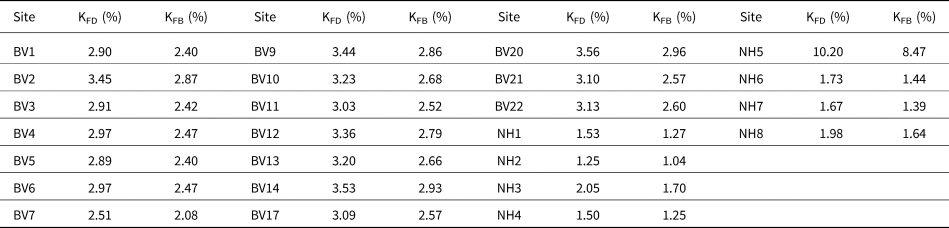
The frequency dependence of magnetic susceptibility is characterized as:

where k F1 and k F3 are susceptibilities at frequencies F1 (976 Hz) and F3 (15,616 Hz), measured in a field of 200 A/m (Dearing et al., Reference Dearing, Hay, Baban, Huddleston, Wellington and Loveland1996).
As Hrouda (Reference Hrouda2011) proposes, the KFD parameter was normalized, obtaining the KFB:

where fm is the operating frequency.
Regarding the dependence of susceptibility with frequency, the KFD parameter was used, obtaining values between 2.5% and 3.6% for the Bella Vista section and between 1.2% and 10.2% for the Río Huaraco section (Table 2). This means a very weak dependence of k with frequency, except for the NH5 site. This suggests an insignificant contribution of superparamagnetic grains, except at the NH5 site, where a large percentage of small particles can be inferred. Furthermore, this is the site with the lowest susceptibility, on the order of 1 × 10⁻³ SI.
Values of percentage of KFD and KFB frequency dependence, for each site

Thermomagnetic curves (Fig. 5) show irreversible behavior, due to the formation of new minerals from heating. Heating curves show main magnetic phase with Curie temperatures between 580°C and 600°C, with the exception of site NH5, whose Curie temperature is about 640°C. Therefore, magnetite is the principal magnetic phase, with possible subsidiary contribution of hematite or maghemite.
Thermomagnetic curves of samples from Bella Vista (sites BV1, BV7, and BV14) and Río Huaraco (sites NH4 and NH5) sections.

Samples from Bella Vista (sites BV1, BV7, and BV14) and Río Huaraco (sites NH4 and NH5) present similar hysteresis curves (Fig. 6). These samples exhibit strong ferrimagnetic behavior with low coercive force values (HC between 3.6 and 9.6 mT), except for the NH5 site, where the coercive force is higher (HC: 28.9 mT) and shows a larger paramagnetic influence. In addition, NH5 has a wasp waist, probably due to the presence of superparamagnetic minerals or to the mixture of one phase with high coercivity (hematite?) and the other with low coercivity (magnetite?). Hematite is a likely product of deuteric alteration.
Hysteresis cycles of samples from Bella Vista (sites BV1, BV7, and BV14) and Río Huaraco (sites NH4 and NH5) sections, after subtracting the paramagnetic component (black curve) and before performing the subtraction (blue curve). Hc is the coercive field in mT and Ms is the saturation magnetization in Am2/kg.

On the other hand, all samples reach saturation by 600 mT, with saturation magnetization values (Ms) between 0.13 and 1.77 Am2/kg. This indicates that ferrimagnetic phases dominate all hysteresis loops. Paramagnetic as well as occasional anti-ferromagnetic contributions look subordinate.
Isothermal remanence acquisition curves show the dominance of ferrimagnetic (sensu lato) minerals, with remanence coercive force values (Hcr) between 21.6 and 59.9 mT (Fig. 7). Specimens reach saturation at fields around 600 to 700 mT. Site NH5 sample does not reach saturation and is the one with the greatest coercive force, which confirms contribution of both magnetite and hematite.
Isothermal remanence acquisition curves of samples from Bella Vista (sites BV1, BV7, and Bv14) and Río Huaraco (sites NH4 and NH5) sections.

Demagnetization results
A total of 247 demagnetized specimens yield characteristic remanent magnetization (ChRMs) that can be interpreted and computed by PCA (Kirschvink, Reference Kirschvink1980); 144 specimens correspond to Bella Vista and 103 to Río Huaraco. There is no significant difference between directions of the ChRMs obtained by thermal demagnetization versus those from AF demagnetization at any site from the Bella Vista section (Fig. 8). However, samples from the Río Huaraco site do not respond well to thermal demagnetization.
Orthogonal demagnetization diagrams (Zijderveld, Reference Zijderveld, Collinson, Creer and Runcorn1967) for six samples of the Bella Vista section and two samples of the Río Huaraco profile. The specimens from BV1, BV7, BV14, and NH5 sites were demagnetized by thermal methods and those from BV1, BV11, BV17, and NH4 sites by AF methods.

Because most specimens of the Bella Vista section are completely unblocked at temperatures near 575°C (Fig. 8), the most likely carrier of the magnetization is (Ti-poor) magnetite, as strongly suggested by the rock magnetic studies. Two components were observed, with the presence of hematite in only in a few samples, such as that of BV1 site (BV1-9.2; Fig. 8), with the highest laboratory unblocking temperature found on samples at this site about 650°C. For the Río Huaraco section, hematite is more frequent, as shown by full unblocking at temperatures close to 650°C (Fig. 8) and to a lesser extent at 575°C. Therefore, the likely carriers of magnetization at this section are interpreted to be both hematite and magnetite. A thermoremanent magnetization was likely acquired by magnetite during cooling, while hematite could have formed at early stages during deuteric alteration (e.g., Geissman and Van der Voo, Reference Geissman and Van der Voo1980).
Paleomagnetic directional analysis
Bella Vista
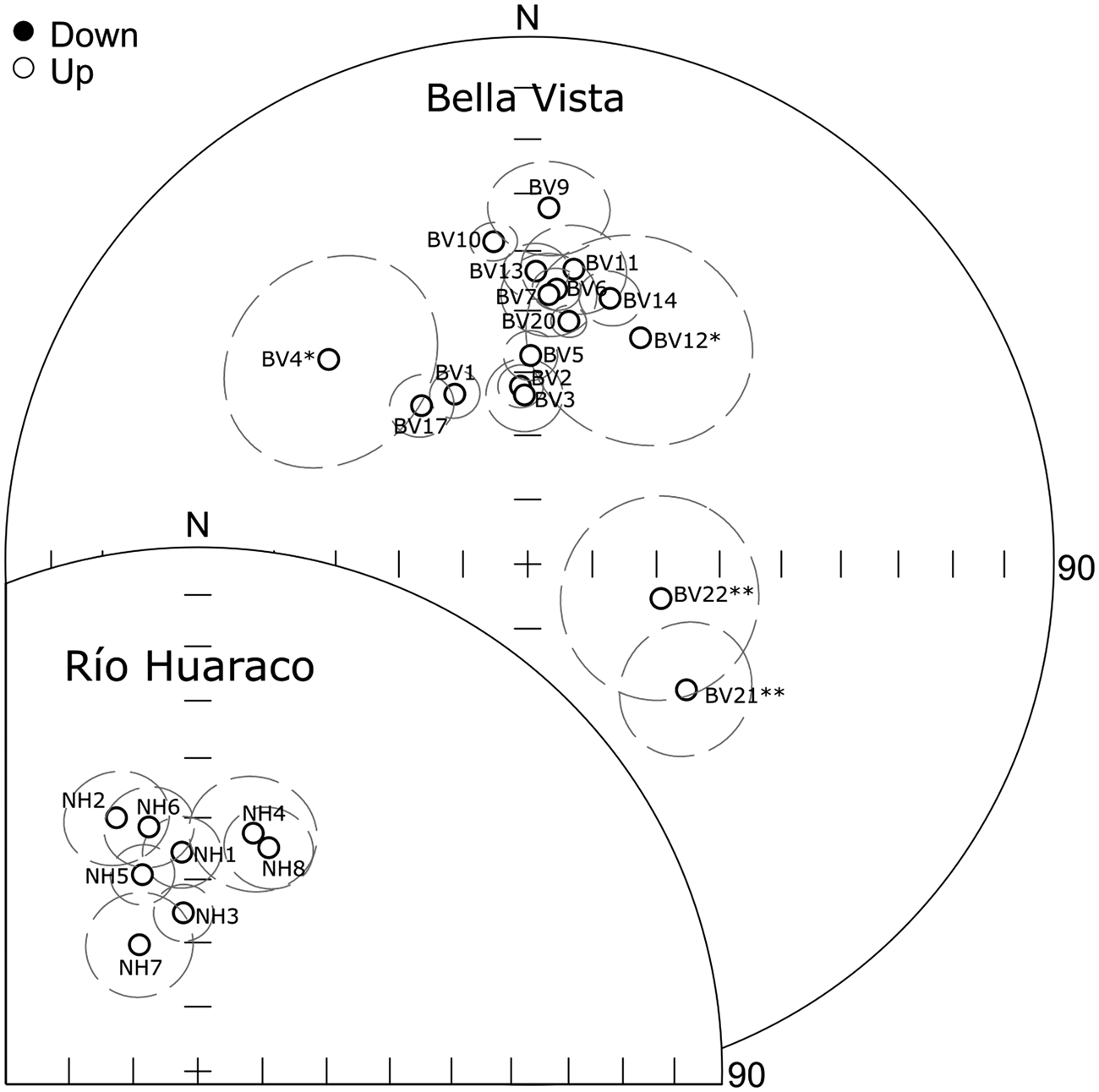
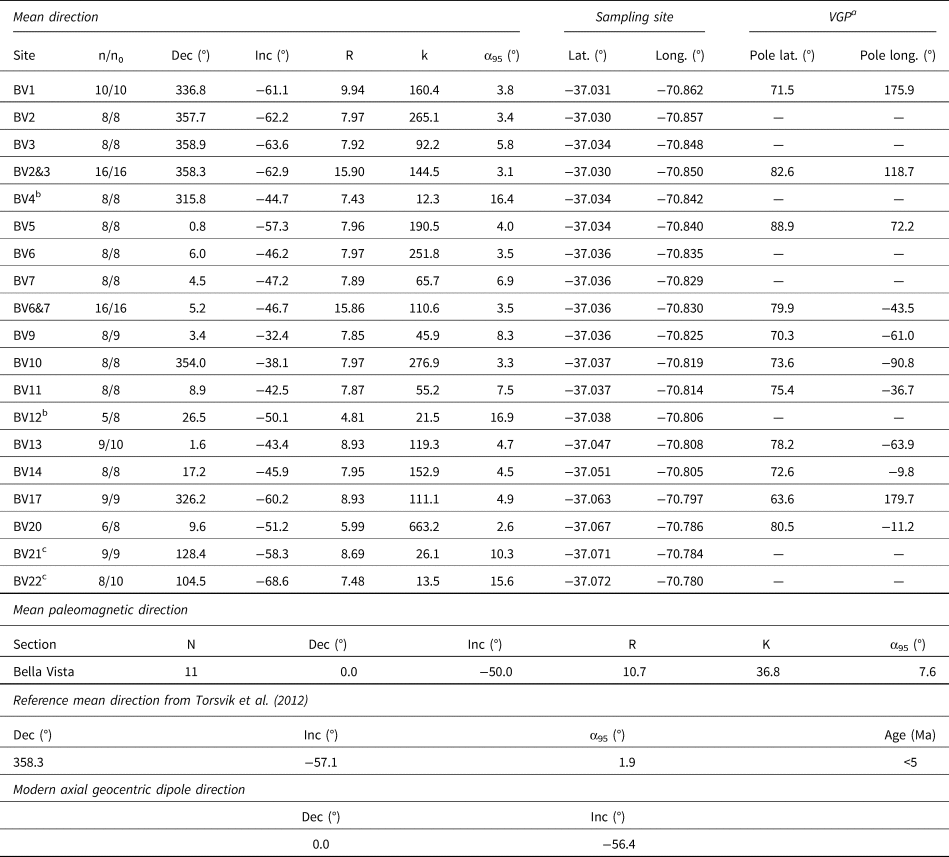
Estimated mean directions were determined for ChRMs at each site. Of the 17 sampling sites (Fig. 9), two were rejected due to their high within-site dispersion (sites BV4 and BV12). The other sites have within-site directional consistency, with α95 < 10°, and in most cases α95 < 5° (Table 3).
Equal area projection of estimated mean directions of the sites from the Bella Vista (BV) and Río Huaraco (NH) sections and their corresponding projected α95 values. *Sites rejected due to high intra-site dispersion. **Sites excluded for presenting anomalous directions.

Characteristic remanent magnetization estimated mean directions per site for the Bella Vista section

a Virtual geomagnetic poles (VGPs) calculated for each site of the Bella Vista section.
b Site excluded due to high intra-site dispersion.
c Site excluded for having anomalous directions.
All sites have estimated mean directions of negative inclination indicating the recording of a geomagnetic field of normal polarity. No bedding correction was applied to the characteristic directions, because the flows were determined as horizontal in the field.
VGPs were calculated from the estimated site mean directions (Fig. 9, Table 3). The BV21 and BV22 site directions are anomalous (Fig. 9), suggesting that they record a transitional magnetic field. These sites were also excluded from estimating the grand mean of the Bella Vista section.
Directions from sites BV2 and BV3, as well as BV6 and BV7, are grouped into single estimated mean directions, as they cannot be statistically distinguished from each other and are interpreted as representing the same cooling units (Fig. 9).
From the 11 VGPs computed from the independent lavas sampled along this section (Table 3), the calculated pole is located at 289.3°E and 83.7°N (K = 28.8 and A95 = 8.7°).
Río Huaraco
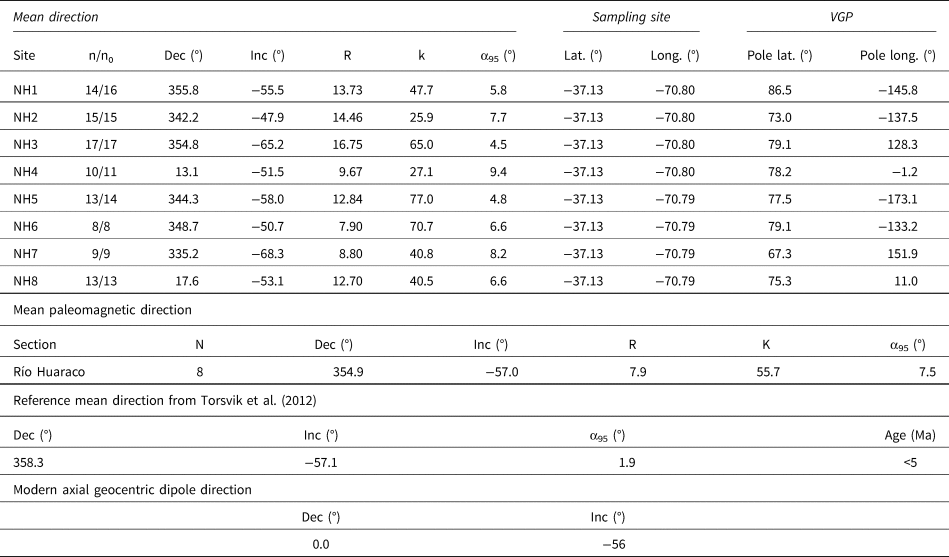
The eight sites yield good within-site directional consistency, with α95 < 10° (Table 4). As in the Bella Vista case, all sites show mean ChRM directions of negative inclination corresponding to a normal polarity field (Fig. 9). No bedding correction was applied, as the flows are horizontal.
Mean direction per site for the ChRM component of the Río Huaraco section and virtual geomagnetic poles (VGPs) for each site at Río Huaraco

Mean directions per site and the corresponding VGPs are shown in Table 4 and Figure 9. From the eight VGPs, a mean VGP located at 189.1°E and 85.9°N (K = 55.7 and A95 = 7.5°) is obtained.
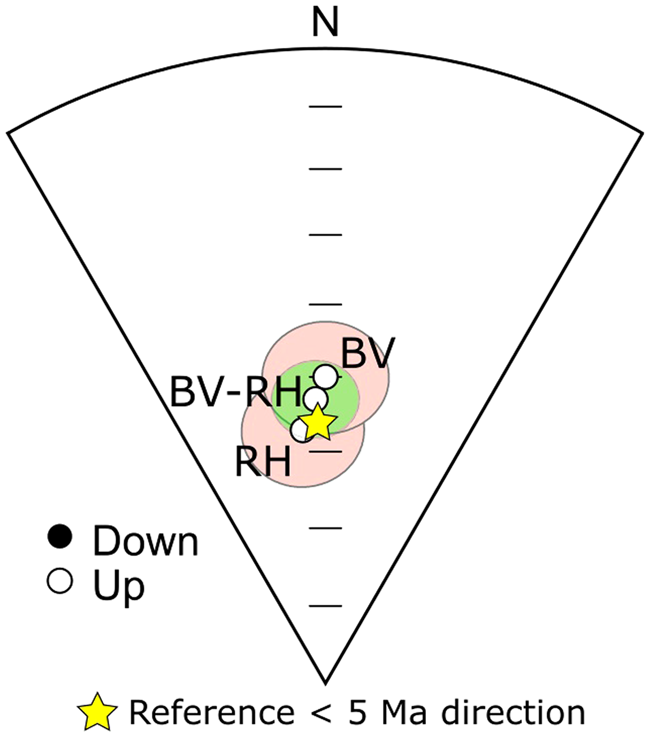
The estimated mean site ChRM directions for the Bella Vista and Río Huaraco sections (Fig. 10) are roughly consistent with the expected mean direction for the locality from the <5 Ma global paleomagnetic pole obtained by Torsvik et al. (Reference Torsvik, Van der Voo, Preeden, Mac Niocaill, Steinberger, Doubrovine and Cocks2012), located at 88.5°N and 353.9°E, corresponding to Dec = 358.3°, Inc = −57.1°, and α95 = 1.9°. Mean estimated directions from each section cannot be statistically distinguished according to the F-test of Watson (Reference Watson1956) with a 95% confidence (Fig. 10).
Grand mean estimated directions from the Bella Vista (BV) and the Río Huaraco (RH) sections. The star represents the reference direction calculated from the reference South America pole for <5Ma (Torsvik et al., Reference Torsvik, Van der Voo, Preeden, Mac Niocaill, Steinberger, Doubrovine and Cocks2012).

For both sections, an overall estimated mean direction with N = 19, Dec = 358.0°, Inc = −53.0°, R = 18.6, K = 41.0, and α95 = 5.3° was calculated. The 19 VGPs (Tables 3 and 4) yield a mean paleomagnetic pole located at 263.8°E and 86.2°S (K = 30.1 and A95 = 6.2°).
DISCUSSION
Age of the studied flow sequences
Although ages of the Cola de Zorro Formation span from 5.7 ± 0.1 Ma (Linares et al., Reference Linares, Ostera and Mas1999) to 1.0 ± 0.1 Ma (López-Escobar et al., Reference Lopez-Escobar, Vergara and Frey1981), these values came from sites distributed over a vast area of the Andes, from ~35°S to 40°S. As mentioned in “Geologic Setting,” numerical ages of the studied lavas in the Nahueve-Huaraco-Trohunco block (Fig. 3) range between 3.2 and 2.6 Ma (Rovere et al., Reference Rovere, Caselli, Tourn, Leanza, Hugo, Folguera and Escosteguy2004). The exclusive normal polarity yielded by all studied sites is consistent with the recording of the field during the Gauss normal polarity chron (3.596–2.595 Ma; Gradstein et al., Reference Gradstein, Ogg, Schmitz and Ogg2020).
Geomagnetic implications
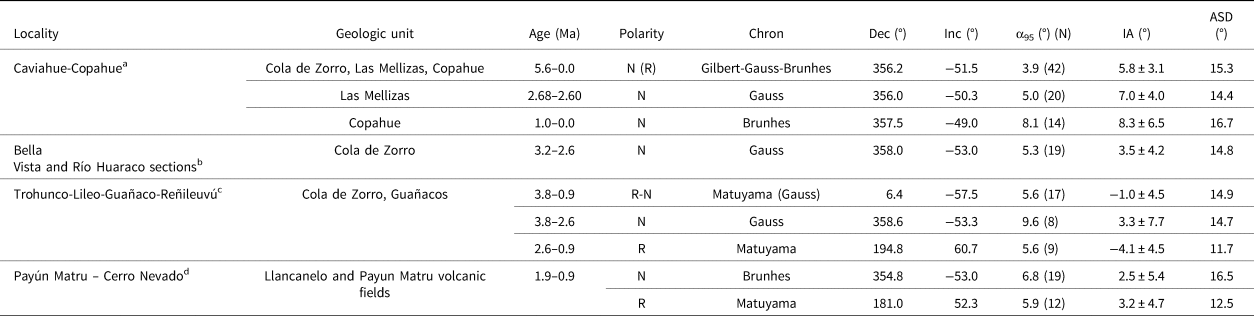
The Río Huaraco section has a mean inclination consistent with that corresponding to the global reference paleomagnetic pole of Torsvik et al. (Reference Torsvik, Van der Voo, Preeden, Mac Niocaill, Steinberger, Doubrovine and Cocks2012) and the modern geocentric axial dipole (GAD) direction (Table 4). The inclination anomaly is virtually null (IA = 0.1° ± 6.2° with respect to the former, and −0.5° ± 6.0° with respect to the latter). Positive (negative) IA values imply lower (higher) inclinations than the reference. However, the Bella Vista section mean direction has a slightly significant shallower inclination value than expected, based on the same reference pole (IA = 7.1° ± 6.2°) and the modern GAD (6.4° ± 6.1°; Table 3). Averaging results from both sections yields no significant inclination anomaly with respect to the reference direction (IA = 4.1° ± 4.5°) and the GAD (IA = 3.5° ± 4.2°), suggesting adequate average of paleosecular variation (Table 5). The reason for a greater IA in Bella Vista than in Río Huaraco could be due to a very minor undetected tilting of the lavas. As discussed later, an incomplete paleosecular average does not seem to be an adequate explanation. Milanese et al. (Reference Milanese, Rapalini, Sagripanti, Geuna, Dekkers, Feo and Folguera2023) also determined no significant IA in the mean direction from 17 Late Pliocene and Pleistocene lavas of both polarities exposed immediately to the south of our study localities (Fig. 11). Similar results were obtained by Quidelleur et al. (Reference Quidelleur, Carlut, Tchilinguirian, Germa and Gillot2009) on Early Pleistocene lavas of reverse polarity and on <300 ka lavas of normal polarity, around 150 to 250 km to the NE of our sites (Fig. 11). Moncinhatto et al. (Reference Moncinhatto, de Oliveira, Haag, Hartmann, Savian, Poletti and Trindade2023) carried out a paleomagnetic study about 80 to 100 km south of our study area (Fig. 11) on Early Pliocene to Late Pleistocene lavas, with most of their results corresponding to Gauss and Brunhes chrons. They found no IA when computing the mean direction from all sites with k > 100. A separate analysis of the Late Pliocene (Gauss chron) and the Middle to Late Pleistocene (Brunhes chron) data set shows virtually identical mean directions from lavas from both chrons (see Table 5) and a very minor to insignificant IA.
Mean paleomagnetic data from Plio-Pleistocene volcanics in the southern Central Andes region of Argentina

a Moncinhatto et al. (Reference Moncinhatto, de Oliveira, Haag, Hartmann, Savian, Poletti and Trindade2023).
b This study.
c Milanese et al. (Reference Milanese, Rapalini, Sagripanti, Geuna, Dekkers, Feo and Folguera2023).
d Quidelleur et al. (Reference Quidelleur, Carlut, Tchilinguirian, Germa and Gillot2009).
Inclination anomaly (A) and VGP angular dispersion (B) data of different South American paleomagnetic studies. Argentina: Mejia et al. (Reference Mejia, Opdyke, Vilas, Singer and Stoner2004), Brown et al. (Reference Brown, Singer, Pickens and Jicha2004), Cañón-Tapia (Reference Cañón-Tapia, Herrero-Bervera and Walker1994), Quidelleur et al. (Reference Quidelleur, Carlut, Tchilinguirian, Germa and Gillot2009), Moncinhatto et al. (Reference Moncinhatto, de Oliveira, Haag, Hartmann, Savian, Poletti and Trindade2023), and Milanese et al. (Reference Milanese, Rapalini, Sagripanti, Geuna, Dekkers, Feo and Folguera2023); Chile: Roperch et al. (Reference Roperch, Chauvin, Lara and Moreno2015); Brazil: Leonhardt et al. (Reference Leonhardt, Matzka and Menor2003); Ecuador: Opdyke et al. (Reference Opdyke, Hall, Mejia, Huang and Foster2006); Colombia: Sánchez-Duque et al. (Reference Sánchez-Duque, Mejia, Opdyke, Huang and Rosales-Rivera2016). The blue star represents the summary of data from Bella Vista and Río Huaraco sections. (C) The ASD values of this work, corresponding to the normal Gauss chron, and the data of Quidelleur et al. (Reference Quidelleur, Carlut, Tchilinguirian, Germa and Gillot2009), Moncinhatto et al. (Reference Moncinhatto, de Oliveira, Haag, Hartmann, Savian, Poletti and Trindade2023), and Milanese et al. (Reference Milanese, Rapalini, Sagripanti, Geuna, Dekkers, Feo and Folguera2023), whose normal polarities (black filled circle) correspond to Brunhes and Gauss chrons and the reverse polarities (unfilled circles) to the Matuyama chron. The locations of these studies are in D. Based on Moncinhatto et al. (Reference Moncinhatto, de Oliveira, Haag, Hartmann, Savian, Poletti and Trindade2023).

Angular dispersion values estimated from Bella Vista and Río Huaraco sections VGPs were compared with a global data set for 0–5 Ma (compiled by Moncinhatto et al., Reference Moncinhatto, de Oliveira, Haag, Hartmann, Savian, Poletti and Trindade2023) and with the models proposed by McFadden et al. (Reference McFadden, Merrill and McElhinny1988), Bono et al. (Reference Bono, Biggin, Holme, Davies, Meduri and Bestard2020), Brandt et al. (Reference Brandt, Constable and Ernesto2020), and de Oliveira et al. (Reference de Oliveira, Hartmann, Terra-Nova, Brandt, Biggin, Engbers and Moncinhatto2021; Fig. 11). When comparing the ASD of the VGPs calculated for each section with the global database for 37°S, ASDs for the Bella Vista (15.2°) and the Río Huaraco (14.2°) sections are consistent with expected values. Considering both sections together, the angular dispersion (ASD = 14.8°) also is close to the expected values from all recent geomagnetic models (Fig. 11). As discussed by Moncinhatto et al. (Reference Moncinhatto, de Oliveira, Haag, Hartmann, Savian, Poletti and Trindade2023), our data support the hypothesis that the GAD can account for most of the paleodirections reported in this area of South America for the period studied and that if a contribution from non-dipole components is required to model time-averaged field determinations, this should be rather small.
These data are comparable to those obtained by Quidelleur et al. (Reference Quidelleur, Carlut, Tchilinguirian, Germa and Gillot2009), at ~36°S (see Table 5), who reported an ASD = 14.8° for Pleistocene lavas of both polarities in the Payún Matrú and Cerro Nevado volcanic massifs. However, their study reported an ASD = 16.5° for normal polarity (Brunhes chron) VGPs and an ASD = 12.5° for reverse-polarity data (Matuyama chron; Table 5). The latter value is lower than those predicted by traditional and recent paleosecular variation models for these latitudes. Low paleosecular variation during the Matuyama reverse chron found by Quidelleur et al. (Reference Quidelleur, Carlut, Tchilinguirian, Germa and Gillot2009) for this region was recently confirmed by Milanese et al. (Reference Milanese, Rapalini, Sagripanti, Geuna, Dekkers, Feo and Folguera2023) in their study of lavas of Cola de Zorro and Guañacos Formations, a few tens of kilometers south of our study locality (Fig. 11). They found ASD = 14.7° for the normal polarity VGPs and ASD = 11.7° for the reverse population.
Table 5 summarizes that in the southern Central Andes region of Argentina, VGPs of the normal polarity Gauss (Late Pliocene) and Brunhes (Middle and Late Pleistocene) chrons show expected ASD, while reverse-polarity Matuyama (Early Pleistocene) chron VGPs show anomalously low ASD, suggesting low paleosecular variation. This enigmatic behavior of the regional magnetic field in the Early Pleistocene needs further investigation.
Tectonic implications
From comparison between mean direction of ChRM and reference direction for 0–5 Ma (Torsvik et al., Reference Torsvik, Van der Voo, Preeden, Mac Niocaill, Steinberger, Doubrovine and Cocks2012) for the Bella Vista section (R = 1.7° ± 9.7°, IA = 7.1° ± 6.2°) and for Río Huaraco (R = −3.4° ± 11.3°, IA = 0.1° ± 6.2°), no significant tectonic rotation around a vertical axis occurred in the study area, since around 2.6 Ma. Merging results from both sections show very similar results (R = −0.3° ± 7.3° and IA = 4.1° ± 4.5°).
Milanese et al. (Reference Milanese, Rapalini, Sagripanti, Geuna, Dekkers, Feo and Folguera2023) sites were distributed from near the Trohunco River, less than 2 kms to the south of the Río Huaraco section, to the Reñileuvú River, over 20 km to the south (Fig. 2).
Sites at the Bella Vista locality are situated north of the Río Huaraco and the northern boundary proposed by Milanese et al. (Reference Milanese, Rapalini, Sagripanti, Geuna, Dekkers, Feo and Folguera2023) for the northernmost block potentially affected by a clockwise tectonic rotation. On the other hand, sites belonging to the Río Huaraco section correspond to the northernmost of Milanese et al. (Reference Milanese, Rapalini, Sagripanti, Geuna, Dekkers, Feo and Folguera2023) hypothetical blocks (the so-called Huaraco-Trohunco block; Fig. 10). In fact, the northernmost sites reported by Milanese et al. (Reference Milanese, Rapalini, Sagripanti, Geuna, Dekkers, Feo and Folguera2023; i.e., A5, A13, A21, and A22) are in the same block as those from our Río Huaraco section (Fig. 3). Combining them with those from the Río Huaraco section yields an estimated locality mean for the Huaraco-Trohunco block of Dec = 355.7°, Inc = −57.0°, N = 12 sites, K = 70.0, α95 = 5.2°. Compared with the expected direction from the 0–5 Ma reference paleomagnetic pole (Dec = 358.3°, Inc = −57.2°, A95 = 1.9°; Torsvik et al., Reference Torsvik, Van der Voo, Preeden, Mac Niocaill, Steinberger, Doubrovine and Cocks2012), the mean direction for the block shows insignificant rotation (−2.6° ± 7.9°; Fig. 12) with an irrelevant IA = 0.2° ± 4.4°.
(A) Calculated rotations (R) with their uncertainties for the Bella Vista section (northernmost block), the Huaraco-Trohunco block, and the integrated Trohunco-Lileo, Lileo-Guañaco, and Guañaco-Reñileuvú blocks (Milanese et al., Reference Milanese, Rapalini, Sagripanti, Geuna, Dekkers, Feo and Folguera2023). The clockwise rotation informed by Escosteguy et al. (Reference Escosteguy, Geuna and Fauqué1999) and recalculated by Milanese et al. (Reference Milanese, Rapalini, Sagripanti, Geuna, Dekkers, Feo and Folguera2023) was obtained from upper Miocene volcanic rocks from the Mitrauquén Formation near the El Moncol locality. (B) Simplified tectonic scheme of the northern Antiñir-Copahue fault zone (NACFZ) with the proposed in-domino clockwise-rotated blocks. HR, Huaraco River; TR, Trohunco River; LR, Lileo River; GR, Guañaco River; RR, Reñileuvú River.

The remaining sites from Milanese et al. (Reference Milanese, Rapalini, Sagripanti, Geuna, Dekkers, Feo and Folguera2023) correspond to other three blocks located to the south (Fig. 12). The number of sites in each individual block is not enough to compute useful individual mean directions to evaluate small tectonic rotations, as already acknowledged by these authors. Considering the three blocks together, 12 independent mean paleomagnetic directions are available, from both Guañacos and Cola de Zorro Formations. Nine correspond to a reverse-polarity field (five from Guañacos Formation and four from Cola de Zorro Formation) and only three to normal polarity (two from Cola de Zorro and one from Guañacos). The grand mean of those 12 site directions is Dec = 192.7°, Inc = 56.7° (N = 12, K = 41.0, α95 = 6.9°). Computation of R and IA values yields a statistically significant clockwise rotation of R = 14.4° ± 10.3° (Fig. 12) and IA = −0.5° ± 5.7°.
The roughly E-W, nearly rectilinear, Huaraco, Trohunco, Lileo, Guañaco, and Reñileuvú Rivers are undoubtedly structurally controlled (e.g., Rovere et al., Reference Rovere, Caselli, Tourn, Leanza, Hugo, Folguera and Escosteguy2004). Their narrow valleys show abrupt negative relative topographic reliefs of 100 to 200 m with respect to the plateau-like surface of the blocks they limit. They also function as boundaries for several of the Andean faults that constitute the NACFS, as well as producing changes in the dip angles and/or horizontal displacements of some of the major faults that cut across them (Folguera et al., Reference Folguera, Ramos, Hermanns and Naranjo2004). They also seem to work as limits for outcrops of Plio-Pleistocene units that do not continue from one block into the next (Fig. 2). Milanese et al. (Reference Milanese, Rapalini, Sagripanti, Geuna, Dekkers, Feo and Folguera2023) were the first to propose that these parallel faults define a series of nearly rectangular, around 5 km × 15 km, adjacent crustal blocks (Fig. 12). These blocks are limited to the east by the major backthrust of the Nahueve, Neuquén, and Tocomán Rivers. The western boundary of the blocks is less clear, as several thrusts affect them, and the E-W lineaments progressively fade away (Rovere et al., Reference Rovere, Caselli, Tourn, Leanza, Hugo, Folguera and Escosteguy2004).
Paleomagnetic data indicate a minimum clockwise tectonic rotation of 4.1°, which can be explained by a domino-type pattern of the three crustal blocks delimited by the Trohunco, Lileo, Guañaco, and Reñileuvú Faults (Figure 12b). On the other hand, the northernmost block, limited by the Huaraco and Trohunco Faults, as well as the area to the north of the Río Huaraco, did not rotate since the Early Pleistocene. It is interesting to note that those three blocks correspond to the area with higher tectonic deformation along the ACFS (Folguera et al., Reference Folguera, Ramos, Hermanns and Naranjo2004) and where the Nahueve-Neuquén-Tocomán backthrust shows a pronounced curve toward the east. Passive rotations of, rigid or non-rigid, in-domino crustal blocks in compressive and transpressional tectonic environments have been shown as an efficient way to accommodate at least a fraction of overall tectonic shortening (Garfunkel, Reference Garfunkel, Kissel and Laj1989; Nur and Ron, Reference Nur and Ron2003; Zuza and Yin, Reference Zuza and Yin2016). In our model, progression of transpressive deformation in the NACFS included the passive clockwise rotation of the aforementioned blocks in Pleistocene times. Our data also suggest that this process was localized in the three blocks south of Trohunco River and did not affect areas to the north. No paleomagnetic data are available for several tens of kilometers to the south of the Reñileuvú Fault, so the southern limits of the tectonic rotations are still unknown, and their definition awaits the obtention of paleomagnetic data in such areas.
The transpressive nature of the NACFS seems to be further confirmed by a clockwise rotation of 25.1° ± 18.3° determined in upper Miocene volcanic rocks exposed in the El Moncol area (some 35 km SW of our study area; Milanese et al., Reference Milanese, Rapalini, Sagripanti, Geuna, Dekkers, Feo and Folguera2023; Fig. 12). This result, together with the small clockwise rotation determined for the area between the Reñileuvú and Trohunco Rivers in the easternmost part of the Guañacos fold and thrust belt in Plio-Pleistocene times supports a model that demonstrates that strike-slip deformation along the ACFS should be taken into account when modeling the Pleistocene structural evolution of this region.
CONCLUSIONS
New paleomagnetic data from Late Pliocene basaltic lavas exposed along two sections in the northern sector of the Neuquén Cordillera (southern Central Andes) suggest normal paleosecular variation during the Gauss normal chron, similar to results found some 80 to 100 km to the south of this area. Anomalous low dispersion of the VGPs in the southern central Andes seems to be limited exclusively to the reverse Matuyama chron. This behavior of the geomagnetic field in this region should be further studied.
Our and previous paleomagnetic results suggest no significant tectonic rotation of either the Huaraco-Trohunco tectonic block or the areas located north of it. However, the overall mean paleomagnetic direction for the Trohunco-Lileo, Lileo-Guañaco, and Guañaco-Reñieuvú blocks shows a Pleistocene minor clockwise rotation around a vertical axis (R = 14.4° ± 10.3°) interpreted as occurring in a domino-style pattern of such blocks during the Pleistocene.
These and previous results from the nearby area of El Moncol indicate that strike-slip deformation along the ACFS should be taken into account when modeling the Pleistocene structural evolution of this region.
Acknowledgments
Matías Naselli was extremely helpful with rock magnetic experiments. Thorough and constructive reviews by J. Geissman, an anonymous reviewer, and associate editor J. Urrutia Fucugauchi were extremely useful for improving the earlier versions of the article.
Data Availability Statement
Demagnetization data, isolated paleomagnetic components and mean directions are available at: https://data.mendeley.com/datasets/fngbxjwgx2/1.
Financial Support
This study was supported by Consejo Nacional de Investigaciones Científicas y Técnicas (CONICET) via a research grant to A.E.R. (PIP 11220200100476CO) and by the Agencia Nacional de Promoción de la Investigación, el Desarrollo Tecnológico y la Innovación via a research grant to F.N.M. (PICT-2020-01397).