



1 Introduction
The unbounded norm convergence (un-convergence) in Banach lattices was first introduced by Troitsky in [Reference Troistky7], and has been the subject of several studies, such as [Reference Kandić, Marabeh and Troitsky4, Reference Deng, O’Brien and Troitsky2]. This convergence is a recent extension of the unbounded order convergence, which has also been studied in recent papers, including [Reference Kandić, Marabeh and Troitsky4], and has found applications not only in applied mathematics but also in finance, especially in coherent risk measures.
Among the operators defined on Banach lattices, the class of Dunford–Pettis operators is one of the most extensively studied in the functional analysis literature. The notion of unbounded absolute weak convergence (uaw-convergence) was introduced by Zabeti in [Reference Zabeti9].
The class of unbounded Dunford–Pettis operators, first defined in [Reference Ouyang, Chen, Chen and Wang6], is clearly inspired by the definition of Dunford–Pettis operators and these two types of convergence.
The aim of this article is to present new and useful results related to the class of unbounded operators. We provide some characterizations of
 $\sigma $
-unbounded Dunford–Pettis operators. Additionally, we study some properties of this class and explore its relationship with other classes of operators. Several other interesting results are also obtained. Specifically, we will examine the following topics:
-
(1) We characterize
 $\sigma $
-unbounded Dunford–Pettis operators in terms of
$\sigma $
-uaw-compact operators.
-
(2) We characterize order continuous Banach lattices in terms of relatively
$\sigma $
-uaw-compact sets. -
(3) The class of
$\sigma $
-unbounded Dunford–Pettis operators does not form a two-sided ideal. Hence, we investigate conditions under which the class of
$\sigma $
-unbounded Dunford–Pettis operators forms a two-sided ideal.


We begin by presenting a new characterization of order continuous Banach lattices using the notion of relatively
 $\sigma $
-uaw-compact sets (Theorem 3.2). After that, we provide a characterization of
 $\sigma $
-unbounded Dunford–Pettis operators based on the concept of
 $\sigma $
-uaw-compact operators (Theorem 3.5).
In Theorem 3.7, we provide conditions under which the composition of a positive
 $\sigma $
-unbounded Dunford–Pettis operator and a dominated lattice homomorphism is itself a
 $\sigma $
-unbounded Dunford–Pettis operator.
2 Preliminaries
The positive cone of E is denoted by
 $E^{+}$
.
 $B_{X}$
is the closed unit ball of the Banach space X. We will use the term operator between two Banach spaces to mean a bounded linear mapping.
A norm bounded subset A of E is said to be:
-
• Relatively sequentially unbounded norm compact (relatively
$\sigma $
-un-compact, shortly) if every sequence in A has an un-convergent subsequence (see [Reference Kandić, Marabeh and Troitsky4]). -
• Relatively sequentially unbounded absolutely weakly compact (relatively
$\sigma $
-uaw-compact, shortly) if every sequence in A has a uaw-convergent subsequence (see [Reference Erkursun-Ozcan, Anil Gezer and Zabeti3]).


Let us recall that an operator
 $T:E\longrightarrow F$
is said to be:
-
• Sequentially unbounded absolutely weakly compact (
$\sigma $
-uaw-compact, shortly) if
$T(B_{E})$
is
$\sigma $
-uaw-compact in F. Equivalently, for every norm bounded sequence
$(x_{n})$
in E its image has a subsequence which is uaw-convergent (see [Reference Erkursun-Ozcan, Anil Gezer and Zabeti3]). -
• Sequentially unbounded norm-compact (
$\sigma $
-un-compact, shortly) if
$T(B_{E})$
is
$\sigma $
-un-compact in E. Equivalently, for every norm bounded sequence
$(x_{n})$
in E its image has a subsequence that is un-convergent (see [Reference Kandić, Marabeh and Troitsky4]). -
•
$\sigma $
-unbounded Dunford–Pettis (
$\sigma $
-uDP, shortly) whenever
$x_{n} \overset {uaw}{\longrightarrow }0$
implies
$T(x_{n}) \overset {un}{\longrightarrow }0$
for any bounded sequence
$(x_{n})$
in E (see [Reference Ouyang, Chen, Chen and Wang6]).


To state our results, we need to fix some notations and recall some definitions. A Banach lattice is a Banach space
 $(E,\Vert \cdot \Vert )$
such that E is a vector lattice and its norm satisfies the following property: for each
 $x,y\in E$
such that
 $|x|\leq |y|$
, we have
 $\Vert x\Vert \leq \Vert y\Vert $
. If E is a Banach lattice, its topological dual
 $E^{\prime }$
, endowed with the dual norm, is also a Banach lattice. A norm
 $\Vert \cdot \Vert $
of a Banach lattice E is order continuous if for each generalized sequence
 $(x_{\alpha })$
such that
 $x_{\alpha }\downarrow 0$
in E, the net
 $(x_{\alpha })$
converges to
 $0$
in the norm
 $\Vert \cdot \Vert $
, where the notation
 $x_{\alpha }\downarrow 0$
means that the net
 $(x_{\alpha })$
is decreasing, its infimum exists and
 $\inf (x_{\alpha })=0$
.
Let
 $(X, ||.||)$
be a normed space. Then,
 $x_{n} \overset {||.||}{\longrightarrow } 0$
if and only if, for any subsequence
 $(x_{n_{k}})$
, there exists a further subsequence, which we shall denote by
 $(x_{n_{k}})$
again, such that
 $(x_{n_{k}}) \overset {||.||}{\longrightarrow } 0$
.
The uaw-convergence was first introduced by Zabeti [Reference Zabeti9]. A sequence
 $(x_{n})$
is unbounded absolutely weakly convergent (uaw-convergent, shortly) to a vector x in E if and only if
 $(|x_{n}-x| \land u)$
is weakly convergent to zero for every
 $u \in E^+$
; we write
 $x_{n} \overset {uaw}{\longrightarrow } x$
.
The un-convergence was first introduced by Troitsky [Reference Troistky7]. A sequence
 $(x_{n})$
is said to be unbounded norm convergent (un-convergence, shortly) to a vector x in E if and only if
 $\| |x_{n}-x| \land u \|$
converges to zero for every
 $u \in E^+$
; we write
 $x_{n} \overset {un}{\longrightarrow } x$
.
Clearly, the un-convergence implies the uaw-convergence, but the converse is false in general. The standard unit sequence
 $(e_{n})$
in
 $\ell ^\infty $
is uaw-null but not un-null. However, according to [Reference Zabeti9, Theorem 4], un-convergence coincides with the uaw-convergence in E if and only if E is order continuous. From [Reference Zabeti9, Theorem 7], for every norm-bounded net
 $(x_{\alpha })$
in E,
 $x_{\alpha } \overset {uaw}{\longrightarrow } 0$
implies that
 $x_{\alpha } \overset {w}{\longrightarrow } 0$
if and only if
 $E^{\prime }$
is order continuous.
The notion of unbounded absolute weak Dunford–Pettis operator was introduced and investigated in [Reference Erkursun-Ozcan, Anil Gezer and Zabeti3]. For all unexplained terminology and standard facts on vector and Banach lattices, we refer the reader to the monographs [Reference Aliprantis and Burkinshaw1].
3 Main results
In order to give our next results, we need the following lemma.
Lemma 3.1 Let
 $(x_{n})$
be a sequence of a Banach lattice E and y, z are in E. If
 $x_{n} \overset {uaw}{\longrightarrow }y$
and
 $x_{n} \overset {un}{\longrightarrow }z$
then,
 $y=z$
Proof This follows from [Reference Zabeti9, Lemma 1] and the fact that un-convergence implies uaw-convergence.
The following proposition gives a new characterization of order continuous Banach lattices.
Theorem 3.2 Let E be a Banach lattice. The following statements are equivalent:
-
(1) every relatively
$\sigma $
-uaw-compact set in E is relatively
$\sigma $
-un-compact; -
(2) for every
$\sigma $
-uaw-null sequence
$(x_{n})$
in E, the set
$\{x_{n}; n \in \mathbb {N}\}$
is relatively
$\sigma $
-un-compact; -
(3) E is order continuous.


Proof
(1)
 $\boldsymbol {\Longrightarrow }$
(2) Let
 $(x_{n})$
be a
 $\sigma $
-uaw-null sequence in E. It is clear that the set
 $\{x_{n}; n \in \mathbb {N}\}$
is relatively
 $\sigma $
-uaw-compact. By our hypothesis, the set
 $\{x_{n}; n \in \mathbb {N}\}$
is relatively
 $\sigma $
-un-compact in E.
(2)
 $\boldsymbol {\Longrightarrow }$
(3) Following [Reference Zabeti9, Theorem 4], it suffices to show that every
 $\sigma $
-uaw-null sequence in E is un-null in E.
Let
 $(x_{n}) \subset E$
such that
 $x_{n} \overset {\text {uaw}}{\longrightarrow } 0$
. Suppose that
 $(x_{n})$
is not un-null. Then, there exist some
 $\eta> 0$
,
 $u \in E^{+}$
, and a subsequence
 $(x_{n_{k}})$
of
 $(x_{n})$
such that
 $$\begin{align*}\| |x_{n_{k}}| \wedge u \|> \eta \quad \text{for all } k. \end{align*}$$
By hypothesis, the set
 $\{x_{n_{k}}; k \in \mathbb {N}\}$
is relatively
 $\sigma $
-un-compact. Hence, by Lemma 3.1, there exists a subsequence of
 $(x_{n_{k}})$
(which we denote again by
 $(x_{n_{k}}),$
that is un-null in E. This leads to a contradiction. Therefore, we conclude that
 $x_{n} \overset {\text {un}}{\longrightarrow } 0.$
(3)
 $\boldsymbol {\Longrightarrow }$
(1) Let A be a relatively
 $\sigma $
-uaw-compact subset of E. Then, for every sequence
 $(x_{n})$
in A, there exists a subsequence
 $(x_{n_{k}})$
of
 $(x_{n}),$
that is, uaw-convergent in E. From [Reference Zabeti9, Theorem 4], we know that the subsequence
 $(x_{n_{k}})$
is un-convergent in E, and thus the set A is relatively
 $\sigma $
-un-compact in E.
Remark 3.3 In general, a
 $\sigma $
-un-compact operator is not necessarily a
 $\sigma $
-uDP operator. To illustrate this, consider the operator
 $S: \ell ^{1} \longrightarrow \ell ^{\infty }$
defined by
 $$\begin{align*}S( \alpha_{n} )_{n} = \left( \sum_{n=1}^{\infty} \alpha_{n}, \sum_{n=1}^{\infty} \alpha_{n}, \dots \right). \end{align*}$$
Clearly, S is
 $\sigma $
-un-compact (since it is compact), but it is not
 $\sigma $
-uDP. To see this, consider the standard basis
 $(e_n)_n$
of
 $\ell ^1$
. Then, we have
 $$\begin{align*}S(e_n) = (1, 1, 1, \dots), \end{align*}$$
a constant sequence with all values equal to 1, which is not un-null convergent in
 $\ell ^{\infty }$
.
Moreover, a
 $\sigma $
-uDP operator is not necessarily
 $\sigma $
-un-compact. For example, as shown in [Reference Erkursun-Ozcan, Anil Gezer and Zabeti3, Example 2.31], the inclusion
 $J: L^{\infty }[0,1] \longrightarrow L^{1}[0,1]$
is
 $\sigma $
-uDP (since every uaw-Dunford–Pettis operator is
 $\sigma $
-uDP), but it is not
 $\sigma $
-un-compact.
Proposition 3.1 Let E, F, and G be Banach lattices. The following assertions hold:
-
(1) If E is an atomic KB-space, then every
$\sigma $
-uDP operator
$T: E \to F$
is
$\sigma $
-un-compact (and therefore
$\sigma $
-uaw-compact). -
(2) If
$T: E \to F$
is both
$\sigma $
-un-compact and
$\sigma $
-uaw-continuous, then T is
$\sigma $
-uDP. -
(3) If
$T: F \to G$
is
$\sigma $
-uDP and
$S: E \to F$
is
$\sigma $
-uaw-compact, then the composition
$T \circ S$
is
$\sigma $
-un-compact (and thus
$\sigma $
-uaw-compact).


Proof (1) Let
 $(x_n)$
be a norm-bounded sequence in E. By [Reference Kandić, Marabeh and Troitsky4, Theorem 7.5], there exists a subsequence
 $(x_{n_k})$
such that
 $x_{n_k} \xrightarrow {un} x$
for some
 $x \in E$
. It follows that
 ${x_{n_k} \xrightarrow {uaw} x}$
. Since T is
 $\sigma $
-uDP, we obtain
 $T(x_{n_k}) \xrightarrow {un} T(x)$
. Therefore, T is
 $\sigma $
-un-compact.
(2) Let
 $(x_n)$
be a norm-bounded sequence in E with
 $x_n \xrightarrow {uaw} 0$
. Because T is
 $\sigma $
-uaw-continuous, it follows that
 $T(x_n) \xrightarrow {uaw} 0 (*)$
.
Now, since T is
 $\sigma $
-un-compact, then every subsequence of
 $(T(x_n))$
has a un-converging subsequence in E. By Lemma 3.1 and from
 $(*)$
, we conclude that
 $ T(x_n) \xrightarrow {\text {un}} 0, $
which implies that T is
 $\sigma $
-uDP
(3) Let
 $(x_n)$
be a norm-bounded sequence in E. Since S is
 $\sigma $
-uaw-compact, there exists a subsequence
 $(x_{n_k})$
such that
 $S(x_{n_k}) \xrightarrow {uaw} x$
for some
 $x \in F$
. As T is
 $\sigma $
-uDP, we have
 $T(S(x_{n_k})) \xrightarrow {un} T(x)$
. Hence,
 $T \circ S$
is
 $\sigma $
-un-compact.
Remark 3.4 If S is a
 $\sigma $
-uaw-compact operator from an arbitrary Banach lattice G to E, and T is an operator from E into F, the fact that the product operator
 $T \circ S$
is
 $\sigma $
-un-compact does not imply that T is
 $\sigma $
-uDP.
Indeed, let
 $E = \ell ^{\infty }$
,
 $F = \ell ^{\infty }$
,
 $G = \ell ^{1}$
, and
 $T = \text {Id}_{\ell ^{\infty }}$
. Consider the operator
 ${S: \ell ^{1} \to \ell ^{\infty }}$
defined by
 $$\begin{align*}S( (\alpha_n)_{n} ) = \left( \sum_{n=1}^{\infty} \alpha_n, \sum_{n=1}^{\infty} \alpha_n, \dots \right). \end{align*}$$
S is compact (its rank is one), and hence S is both
 $\sigma $
-un-compact and
 $\sigma $
-uaw-compact. Thus, the operator
 $\text {Id}_{\ell ^{\infty }} \circ S = S$
is
 $\sigma $
-un-compact. However,
 $\text {Id}_{\ell ^{\infty }}$
is not
 $\sigma $
-uDP.
To see this, consider the standard basis
 $(e_n)$
in
 $\ell ^{\infty }$
. It is clear that
 $e_n \overset {\text {uaw}}{\longrightarrow } 0$
. Now, consider
 $(1,1,1,\dots ) \in \ell ^{\infty }$
. It is evident that
 $$\begin{align*}\| e_n \land (1,1,1,\dots) \| = 1. \end{align*}$$
Thus,
 $e_n {\overset {\text {un}}{\not {\longrightarrow }}} 0$
.
Theorem 3.5 Let E and F be two Banach lattices such that E is an atomic KB-space, and let
 $T: E \to F$
be a
 $\sigma $
-uaw-continuous operator. The following assertions are equivalent:
-
(1) T is
$\sigma $
-uDP; -
(2) T maps relatively
$\sigma $
-uaw-compact subsets of E into relatively
$\sigma $
-un-compact subsets of F; -
(3) for every Banach lattice G, and every
$\sigma $
-uaw-compact operator
$S: G \to E$
, the composition
$T \circ S$
is
$\sigma $
-un-compact; -
(4) for every
$\sigma $
-uaw-compact operator
$S: \ell ^1 \to E$
, the composition
$T \circ S$
is
$\sigma $
-un-compact.


Proof (1)
 $\Rightarrow $
(2) Let
 $W \subset E$
be a relatively
 $\sigma $
-uaw-compact set, and let
 $(x_n)$
be a sequence in W. Then, there exists a subsequence
 $(x_{n_k})$
such that
 $x_{n_k} \xrightarrow {uaw} x$
in E. Since T is
 $\sigma $
-uDP, it follows that
 $T(x_{n_k}) \xrightarrow {un} T(x)$
. Thus,
 $T(W)$
is relatively
 $\sigma $
-un-compact.
(2)
 $\Rightarrow $
(3) Let
 $B_G$
denote the closed unit ball of G. Since S is
 $\sigma $
-uaw-compact, the image
 $S(B_G)$
is relatively
 $\sigma $
-uaw-compact in E. By assumption,
 $T(S(B_G))$
is relatively
 $\sigma $
-un-compact in F, which implies that
 $T \circ S$
is
 $\sigma $
-un-compact.
(3)
 $\Rightarrow $
(4) This implication is immediate, as
 $\ell ^1$
is a particular case of a Banach lattice G.
(4)
 $\Rightarrow $
(1) Let
 $(x_n) \subset B_E$
be a sequence with
 $x_n \xrightarrow {uaw} 0$
. Define the operator
 $$\begin{align*}S: \ell^1 \to E, \quad (\alpha_n) \mapsto \sum_{n=1}^\infty \alpha_n x_n. \end{align*}$$
Since E is an atomic KB-space, Theorem 7.5 of [Reference Kandić, Marabeh and Troitsky4] guarantees the existence of a subsequence
 $(x_{n_k})$
such that
 $x_{n_k} \xrightarrow {un} y$
in E, and hence
 $x_{n_k} \xrightarrow {uaw} y$
. It follows that the identity operator
 $\mathrm {Id}_E$
is
 $\sigma $
-uaw-compact.
By Proposition 2.32 of [Reference Erkursun-Ozcan, Anil Gezer and Zabeti3], the operator
 $S = \mathrm {Id}_E \circ S$
is
 $\sigma $
-uaw-compact. By assumption,
 $T \circ S$
is then
 $\sigma $
-un-compact. Consider the canonical basis
 $(e_n)$
of
 $\ell ^1$
, so that
 $S(e_n) = x_n$
. Since
 $e_n \xrightarrow {uaw} 0$
in
 $\ell ^1$
and T is
 $\sigma $
-uaw-continuous, it follows that:
 $$ \begin{align} T(S(e_n)) = T(x_n) \xrightarrow{uaw} 0. \end{align} $$
Because
 $T \circ S$
is
 $\sigma $
-un-compact, every subsequence of
 $(T(x_n))$
admits a un-convergent subsequence. Combining this with (*) and applying Lemma 3.1, we conclude that
 $T(x_n) \xrightarrow {un} 0$
, hence T is
 $\sigma $
-uDP.
Remark 3.6 In Theorem 3.5, the assumption that E is a KB-space is essential. Indeed, consider the example in Remark 3.4. We observe that
 $E = \ell ^\infty $
, and
 $\ell ^\infty $
is not a KB-space, yet the identity operator
 $Id_{\ell ^\infty }$
is
 $\sigma $
-uaw-continuous. However,
 $Id_{\ell ^\infty }$
is not
 $\sigma $
-uDP.
The class of
 $\sigma $
-uDP operators does not form a two-sided ideal. In fact, it follows from [Reference Zabeti9, Theorem 4] that the operator
 $Id_{c_0}$
is
 $\sigma $
-uDP, but the operator
 $i \circ Id_{c_0} = i$
(where
 $i: c_0 \longrightarrow \ell ^\infty $
is the canonical injection) is not
 $\sigma $
-uDP.
We now present the following results.
Theorem 3.7 Let
 $ E $
,
 $ F $
, and
 $ G $
be Banach lattices, where
 $ F $
is order continuous and atomic. If
 $ T: E \rightarrow F $
is a positive
 $\sigma $
-uDP operator and
 $ S: F \rightarrow G $
is an onto lattice homomorphism and a dominated operator, then
 $ S \circ T $
is
 $\sigma $
-uDP.
Proof Let
 $ (x_n) \subset E $
be a sequence such that
 $ x_n \overset {\text {uaw}}{\longrightarrow } 0 $
. We aim to show that
 $ S \circ T(x_n) \overset {\text {un}}{\longrightarrow } 0 $
.
Let
 $ u \in G^{+} $
be an arbitrary element. We must prove that
 $ \| S \circ T(x_n) \land u \| \to 0 $
.
Since
 $ S $
is onto, there exists some
 $ v \in F^{+} $
such that
 $ S(v) = u $
. Now, we have
 $ |T(x_n)| \wedge v \leq v $
, which implies that the sequence
 $ (|T(x_n)| \wedge v) $
is order bounded in
 $ F $
.
On the other hand, since
 $ T $
is
 $\sigma $
-uDP, we know that
 $ T(x_n) \overset {\text {un}}{\longrightarrow } 0 $
, and hence
 $ \| |T(x_n)| \land v \| \to 0 $
.
Now, since
 $ F $
is atomic and order continuous, by Lemma 5.1 of [Reference Deng, O’Brien and Troitsky2],
 $ |T(x_n)| \wedge v $
is null order convergent. Therefore, there exists an order null convergent sequence
 $ (h_n) \subset F $
such that
 $$\begin{align*}|T(x_n)| \wedge v \leq h_n \quad \text{for all } n. \end{align*}$$
Since
 $ S $
is a dominated operator, there exists an operator
 $ R: F \rightarrow G $
satisfying the following inequality:
 $$\begin{align*}S(|T(x_n)| \wedge v) \leq R(|T(x_n)| \wedge v). \end{align*}$$
As
 $ S $
is a lattice homomorphism, by [Reference Aliprantis and Burkinshaw1, Theorem 2.14], we have
 $$\begin{align*}|S(T(x_n))| \land u = S(|T(x_n)| \land v) \leq R(h_n) \quad \text{(}\!\kern-1pt\star\!\kern-1pt\text{)}. \end{align*}$$
Since
 $ F $
is order continuous, by [Reference Aliprantis and Burkinshaw1, Theorem 4.9], we know that
 $ \| h_n \| \to 0 $
. It follows from Theorem 4.3 of [Reference Aliprantis and Burkinshaw1] that
 $ \| R(h_n) \| \to 0 $
.
Thus, from inequality
 $(\star )$
, we conclude that
 $ \| |S(T(x_n))| \land u \| \to 0 $
. Since this holds for every
 $ u \in G^{+} $
, we conclude that the composed operator
 $ S \circ T $
is
 $\sigma $
-uDP.
Proposition 3.2 Let
 $ E $
,
 $ F $
, and
 $ G $
be Banach lattices. If
 $ T: E \rightarrow F $
is a
 $\sigma $
-uaw-continuous operator, and
 $ S: F \rightarrow G $
is
 $\sigma $
-uDP, then
 $ S \circ T $
is
 $\sigma $
-uDP.
Proof Let
 $ (x_n) $
be a sequence in
 $ E $
such that
 $ x_n \overset {uaw}{\longrightarrow } 0 $
. Since
 $ T $
is
 $\sigma $
-uaw-continuous, we have
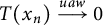 $ T(x_n) \overset {uaw}{\longrightarrow } 0 $
. Moreover, since
 $ S $
is
 $\sigma $
-uDP, it follows that
 $ S \circ T(x_n) $
is null un-convergent. Therefore,
 $ S \circ T $
is
 $\sigma $
-uDP.
Now, we present the following domination result for
 $\sigma $
-uDP operators.
Theorem 3.8 Let
 $ S, T: E \rightarrow F $
be two positive operators between Banach lattices satisfying
 $ 0 \leq S \leq T $
. Then,
 $ S $
is a
 $\sigma $
-uDP operator whenever
 $ T $
is one.
Proof Let
 $ (x_n) $
be a sequence in
 $ E $
such that
 $ x_n \overset {uaw}{\longrightarrow } 0 $
. On the one hand, by Lemma 1 of [Reference Zabeti9], we have
 $ |x_n| \overset {uaw}{\longrightarrow } 0 $
. Since
 $ T $
is
 $\sigma $
-uDP, we know that
 $ T(|x_n|) \overset {un}{\longrightarrow } 0 $
.
On the other hand, since
 $ 0 \leq S \leq T $
, we have
 $ |S(x_n)| \leq S(|x_n|) \leq T(|x_n|) $
. This implies that:
 $$\begin{align*}|S(x_n)| \wedge u \leq T(|x_n|) \wedge u, \quad \forall u \in E^{+}. \end{align*}$$
Thus, we obtain:
 $$\begin{align*}\| |S(x_n)| \wedge u \| \leq \| T(|x_n|) \wedge u \|, \quad \forall u \in E^{+}. \end{align*}$$
Therefore,
 $ S(x_n) \overset {un}{\longrightarrow } 0 $
, and consequently,
 $ S $
is
 $\sigma $
-uDP.
Definition 3.1 [Reference Erkursun-Ozcan, Anil Gezer and Zabeti3]
Let
 $ E $
be a Banach lattice and
 $ X $
be a Banach space. An operator
 $ T: E \longrightarrow X $
is said to be unbounded absolutely weak Dunford–Pettis (uaw-Dunford–Pettis, shortly) if for every norm-bounded sequence
 $ (x_n) $
in
 $ E $
,
 $ x_n \overset {uaw}{\longrightarrow } 0 $
implies
 $ \| T x_n \| \longrightarrow 0 $
in
 $ X $
.
Every uaw-Dunford–Pettis operator is
 $ \sigma $
-uDP, but the converse is not true in general. Indeed, the identity operator on
 $ \ell ^1 $
is
 $ \sigma $
-uDP but fails to be uaw-Dunford–Pettis.
In fact, let
 $ (x_n) $
be a sequence in
 $ \ell ^1 $
such that
 $ x_n \overset {\text {uaw}}{\longrightarrow } 0 $
. By Theorem 4 of [Reference Zabeti9], we have
 $ \text {Id}_{\ell ^1}(x_n) = x_n \overset {\text {un}}{\longrightarrow } 0 $
. Hence,
 $ \text {Id}_{\ell ^1}: \ell ^1 \rightarrow \ell ^1 $
is
 $ \sigma $
-uDP.
Now, consider the standard basis
 $ (e_n) $
of
 $ \ell ^1 $
. We have
 $ e_n \overset {\text {uaw}}{\longrightarrow } 0 $
, but
 $ \| \text {Id}_{\ell ^1}(e_n) \| = \| e_n \| = 1 $
. Hence,
 $ \text {Id}_{\ell ^1} $
is not uaw-Dunford–Pettis.
By the same proof, we can easily see that the identity on
 $ c_0 $
is
 $ \sigma $
-uDP but fails to be uaw-Dunford–Pettis.
Proposition 3.3 Let
 $ E $
be a Dedekind
 $ \sigma $
-complete Banach lattice. The following assertion holds.
Every
 $ \sigma $
-uDP operator
 $ T: E \longrightarrow c_0 $
is uaw-Dunford–Pettis. Then,
 $ E $
is reflexive.
Proof Suppose not. By [Reference Meyer-Nieberg5, Theorem 2.4.15],
 $ E $
contains a lattice copy of either
 $ \ell ^1 $
or
 $ c_0 $
. Moreover, by [Reference Meyer-Nieberg5, Proposition 2.3.11], there exists a positive projection
 $ P: E \longrightarrow \ell ^1 $
.
Since
 $ P $
is
 $ \sigma $
-uDP, in fact, let
 $ (x_n) $
be a disjoint sequence in
 $ E $
then
 $ P(x_n) $
is disjoint in
 $ \ell ^1 $
. By Lemma 2 of [Reference Zabeti9], we have
 $ P(x_n) \overset {\text {uaw}}{\longrightarrow } 0 $
. Also, by [Reference Zabeti9, Theorem 4],
 $ P(x_n) \overset {\text {un}}{\longrightarrow } 0 $
in
 $ \ell ^1 $
. Therefore, by
 $ P $
is
 $ \sigma $
-uDP [Reference Wang and Chen8, Theorem 3].
The restriction of
 $ P $
to
 $ \ell ^1 $
is the identity operator on
 $ \ell ^1 $
, which is not uaw-Dunford–Pettis.
Furthermore, by [Reference Meyer-Nieberg5, Theorem 2.4.12], there exists a positive projection
 $ P: E \longrightarrow c_0 $
.
It is easily seen that
 $ P $
is
 $ \sigma $
-uDP, while the restriction of
 $ P $
to
 $ c_0 $
is the identity operator on
 $ c_0 $
, which is not uaw-Dunford–Pettis.
Proposition 3.4 If
 $ F $
has a strong unit, then each
 $ \sigma $
-uDP operator
 $T: E \to F$
is uaw-Dunford–Pettis.
Proof If
 $ F $
has a strong unit, then by Theorem 2.3 of [Reference Kandić, Marabeh and Troitsky4],
 $ T(x_n) \overset {\text {un}}{\longrightarrow } 0 $
implies
 $ T(x_n) \overset {\|.\|}{\longrightarrow } 0 $
. This completes the proof.



