In 1921 Congress passed the Promotion of the Welfare and Hygiene of Maternity and Infancy Act by overwhelming majorities in both houses—279 to 39 in the House and 63 to 7 in the Senate. The “Sheppard-Towner” Act, as it was commonly known, provided federal matching grants to states to spend on public health programs targeted at reducing infant and maternal mortality. Its passage occurred at a critical juncture in U.S. history: women's enfranchisement. The lobbying in favor of the program by women's magazines like Good Housekeeping and the Ladies Home Journal, and women's organizations like the League of Women Voters had defined it as a “woman's issue” and legislators feared the unknown power of the woman's vote.Footnote 1 Speaking only a few months after Harding signed the bill into law, Senator Kenyon (R-Iowa) claimed, “If the members could have voted on that measure secretly in their cloak rooms it would have been killed as emphatically as it was finally passed in the open under the pressure of the Joint Congressional Committee of Women.”Footnote 2
Recent research has viewed Sheppard-Towner as just a more visible manifestation of a general phenomenon. John R. Lott, Jr. and Lawrence W. Kenny find that the extension of suffrage to women generated large and permanent increases in state government spending in the areas of education, sanitation, and hospital expenditures.Footnote 3 Grant Miller also finds that suffrage laws were followed by large, sudden increases in local public health spending and points to the passage of Sheppard-Towner as indicative of this effect.Footnote 4 However, historians such as Stanley J. Lemons, Richard Meckel, Theda Skocpol, Molly Ladd-Taylor, and Kriste Lindemeyer suggest that the influence of suffrage faded over time and did not lead to permanent increases in spending.Footnote 5 In particular, they argue that the results of the 1922 and 1924 elections taught politicians that women did not vote as a bloc, undercutting the support for programs linked to women's issues.Footnote 6
The historiography of Sheppard-Towner suggests that when it came up for renewal in 1926, politicians no longer feared the women's vote and were willing to let the program die. However, this explanation ignores other changes that occurred over the time period. The initial passage of Sheppard-Towner was met with opposition from (among others) the American Medical Association (AMA) and anti-suffragists. When Sheppard-Towner came up for renewal in 1926, the opposition had also grown and become better organized. The AMA fought with renewed vigor, charging that Sheppard-Towner was the first step down the path towards socialized medicine. Anti-suffragists continued to oppose the act, and some Catholic organizations saw it as unnecessary and unwanted interference of the government in home and family. Further, part of the congressional debate focused on the original intent of the program. Opponents argued that the law was initially authorized for a period of five years because its purpose was to provide states with the infrastructure for these programs so that they could continue them on their own after the program ended. The battle ended in a compromise: funding was extended for two years in exchange for the automatic repeal of the program on June 30, 1929.
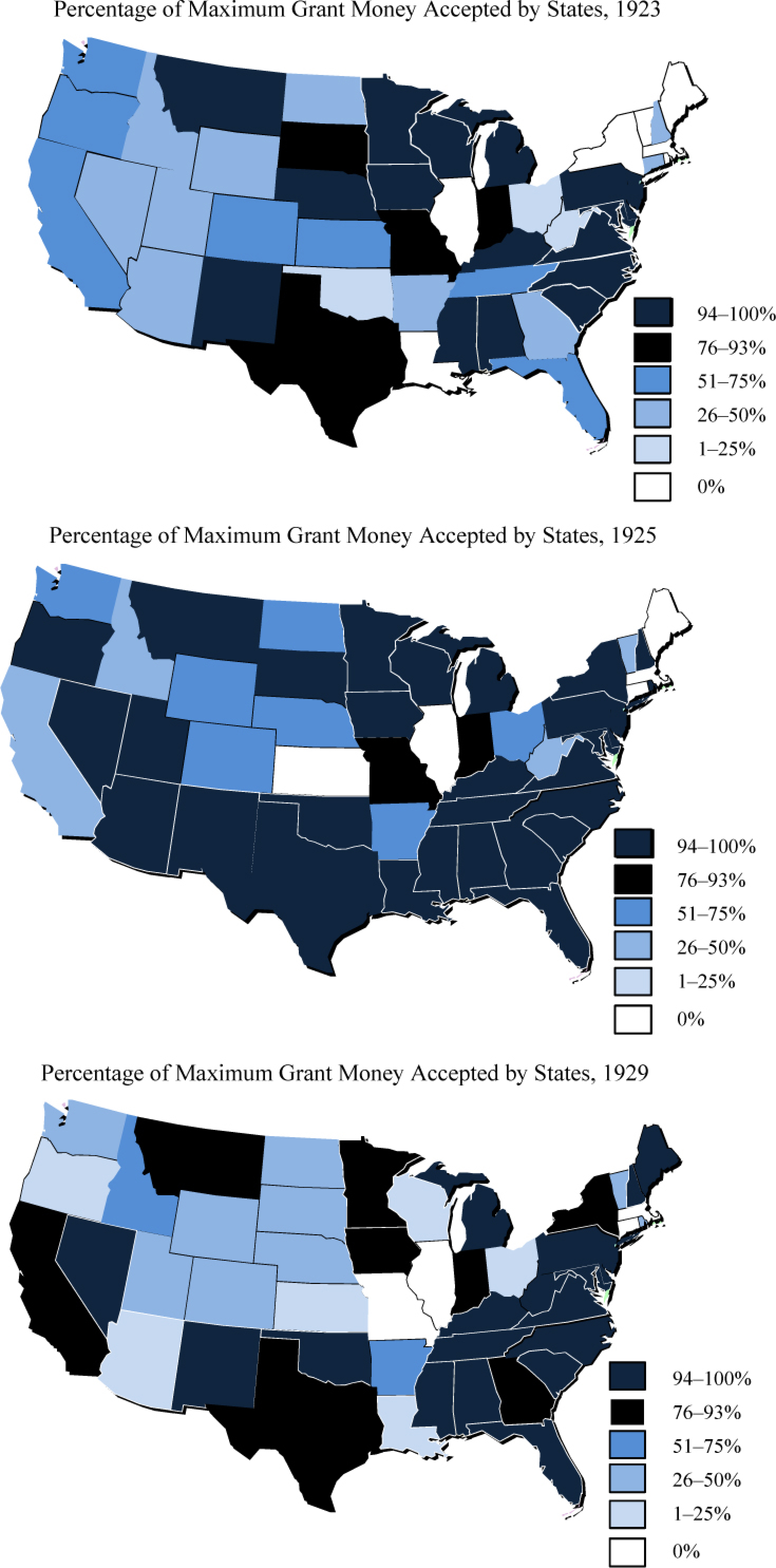
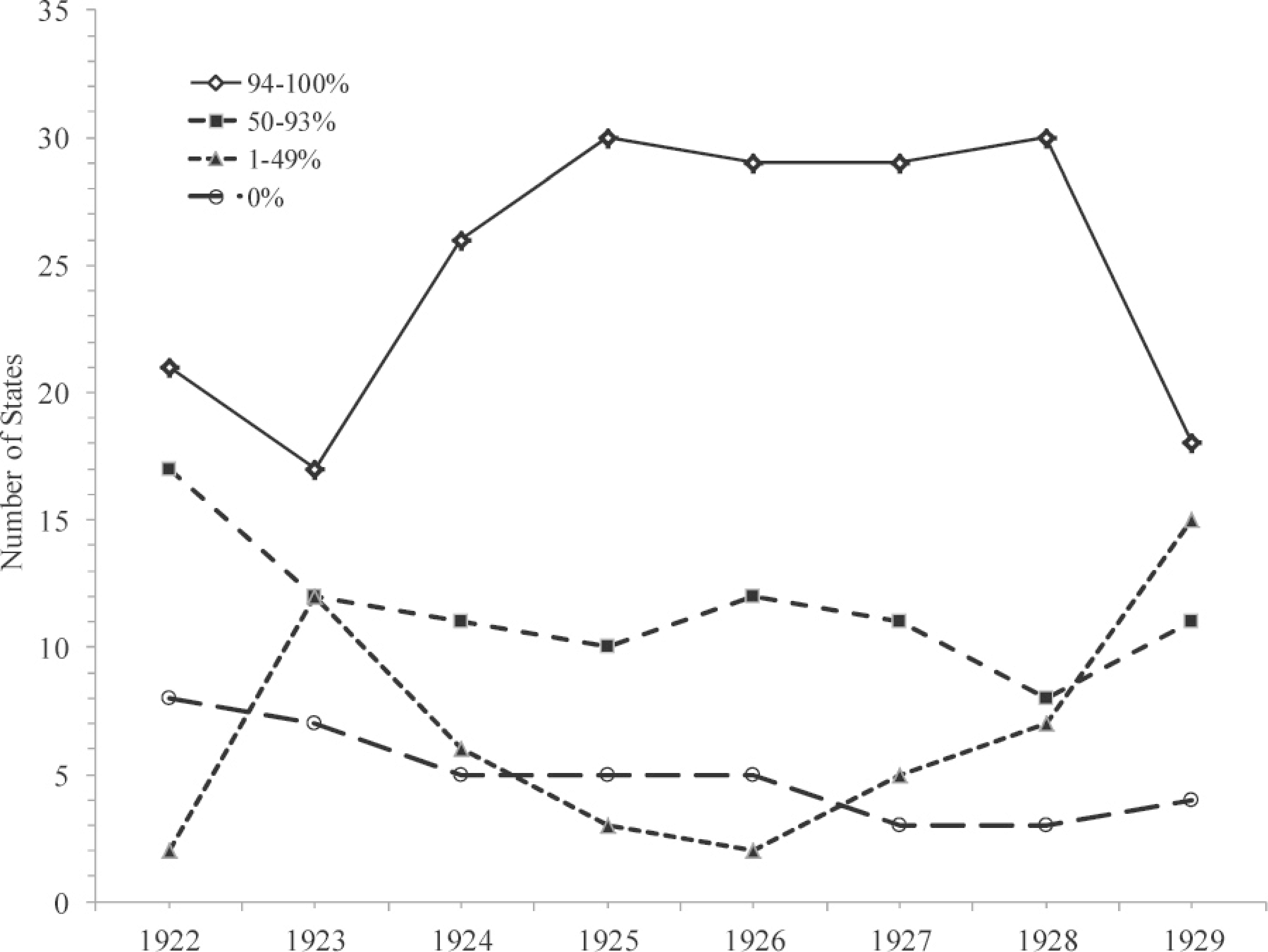
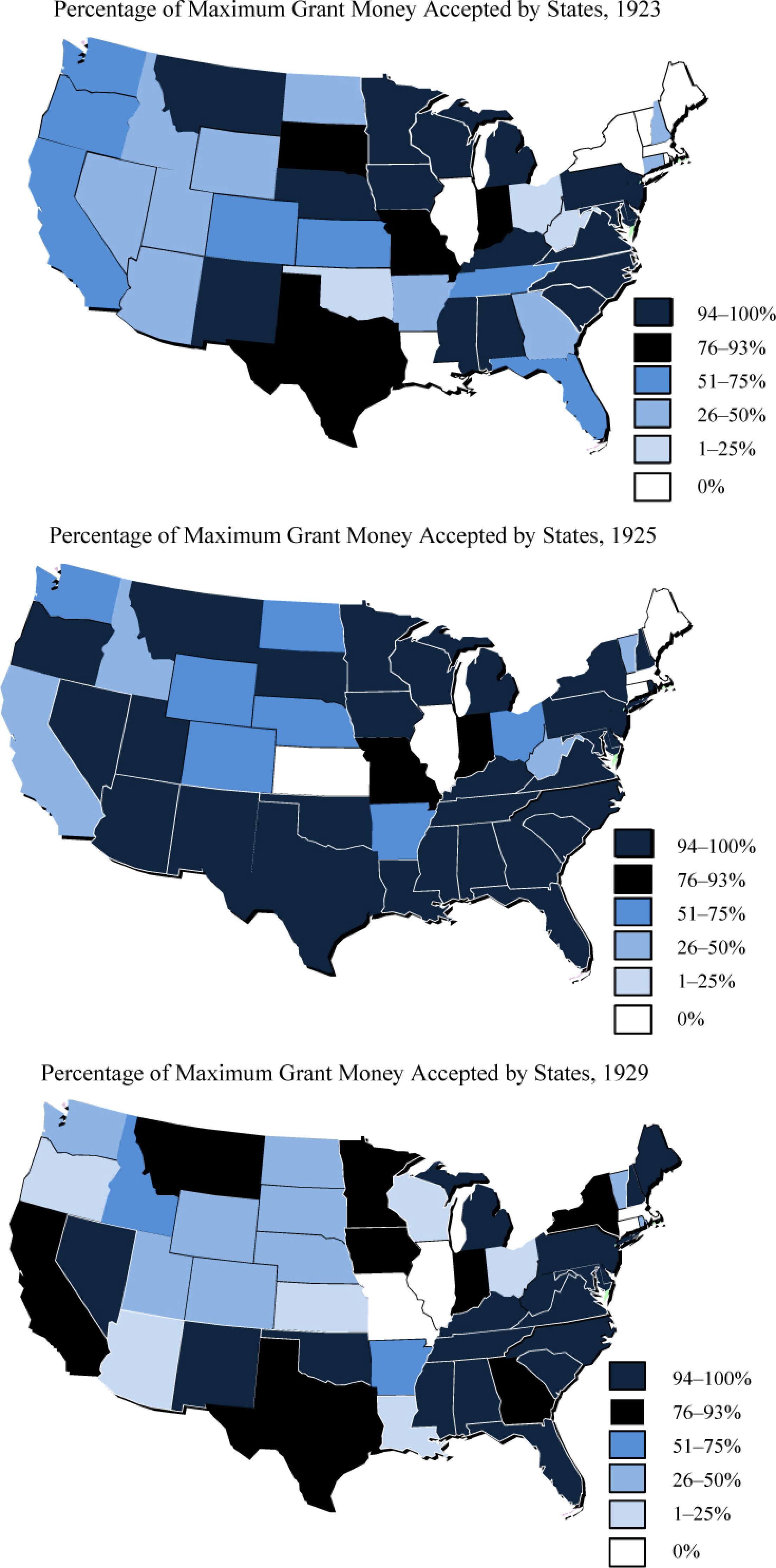
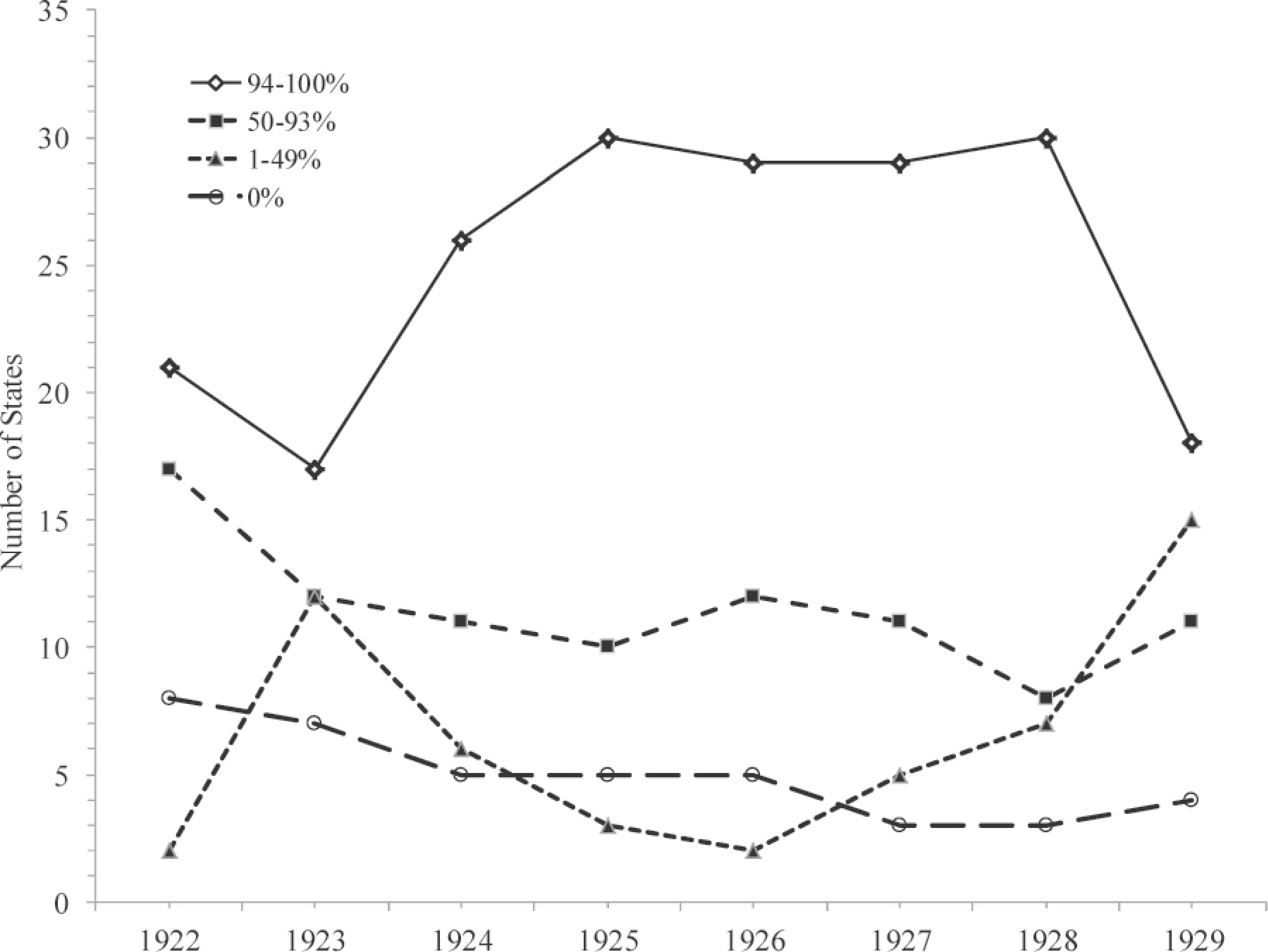
The debate over Sheppard-Towner's extension reflects the debates that played out in state legislatures after its enactment. To receive funds, a state had to enact enabling legislation and appropriate the required resources, since all but the first $5,000 of the federal grant had to be matched with state monies. While some states quickly passed legislation and put up the cash to get their maximum federal appropriation, other states delayed and limited their participation. In fact, many states took far less than the maximum amount. Figure 1 shows the large amount of both geographic and intertemporal variation in the amount of the Sheppard-Towner grants accepted. Some states (CT, IL, and MA) never participated; others participated fully in some years and less in others, and some states never fully participated. Along these same lines, Figure 2 shows that in no year of the program did more than one-third of the states take the full federal appropriation.
The large number of states not taking the maximum grant contrasts sharply with the experiences of most other “closed-ended” federal matching programs in U.S. history. For instance, most states took their full allocation of federal grants for agricultural extension work under the Smith-Lever Cooperative Extension Act of 1914. What made states respond so differently to Sheppard-Towner than they did to other matching grant programs? This article examines the factors underlying state participation in the program, including suffrage, politics, demographics, and prior state expenditures on child health. We also take advantage of the program's repeal to analyze another issue relevant to modern policy: did the matching grant program motivate states to spend their own money on these initiatives after Sheppard-Towner ended? We find that suffrage did have an important impact on determining the level of state participation in Sheppard-Towner. However, contrary to Lott and Kenny and Miller, we find no evidence of a permanent effect; suffrage did not influence public health spending on these activities after the program's repeal. Moreover, even after controlling for the uncertain economic climate that followed the stock market crash, we find no evidence of a demonstration effect. On average, the states that continued activities after Sheppard-Towner ended were those that had had large public health budgets before the program had even begun, suggesting that it had little long-run impact on public expenditures on child health.
PERCENTAGES OF MAXIMUM SHEPPARD-TOWNER GRANT ACCEPTED BY STATES, 1923, 1925, AND 1929
NUMBER OF STATES BY PERCENTAGE OF MAXIMUM SHEPPARD-TOWNER GRANT ACCEPTED, 1922–1929
FACTORS THAT INFLUENCED STATE PARTICIPATION IN THE SHEPPARD-TOWNER PROGRAM
Politics
At the national level, Sheppard-Towner faced opposition from the AMA, anti-suffragists, and eventually, the Catholic Church. Supporters included women's groups such as the League of Women Voters and the Women's Joint Congressional Committee (WJCC). These same groups debated over enabling legislation in statehouses across the country. The AMA organized campaigns against the program claiming it was the first step down the slippery slope to socialized medicine. It strongly opposed government control over medical service, and viewed the provision of care for individuals as best achieved “… through voluntary self-taxation of voters in a political unit to pay for the necessary local facilities for the prevention of disease and the promotion of health.”Footnote 7 While the AMA had been slow to mobilize its opposition to the federal legislation, it gained momentum just when state legislatures were considering their enabling legislation. Opposition to Sheppard-Towner was particularly strong among the state medical societies of Ohio, New York, Indiana, Massachusetts, and Illinois.Footnote 8
Many opponents claimed that Sheppard-Towner violated states’ rights. Such arguments were particularly prevalent in the debates in the three nonparticipating states. The Chicago Tribune took the position that the program promoted the evils of “the centralization of government, the development of bureaucracy, (and the) weakening influence of paternalism.”Footnote 9 An editorial a few days earlier had claimed that the act was a “trick” to “deceive” taxpayers who thought they were receiving a gift from the federal government but who would in reality just pay for it through their taxes.Footnote 10 The Commonwealth of Massachusetts filed suit against Treasury Secretary Andrew Mellon, arguing that the law infringed on state sovereignty. A similar lawsuit was filed by Harriet A. Frothingham, president of the Woman Patriots, who argued that the act imposed an unfair fiscal burden.Footnote 11 The U.S. Supreme Court ruled on both together, dismissing Massachusetts’ lawsuit, and affirming the dismissal of the Frothingham suit in a lower court, arguing that her injury was not serious enough to warrant a lawsuit.Footnote 12 Ironically, some of the states that argued that the federal government had no right to intervene in matters of state policy were happy to take state aid in other forms. At the same time Massachusetts was suing to preserve its rights under Sheppard-Towner, it was accepting federal money under 22 other programs. Connecticut's appropriations committee declined Sheppard-Towner money as a matter of principle, but then voted to accept federal aid for an airplane squadron.Footnote 13
The inconsistencies of these states’ responses to other federal grant programs and their stated opposition to Sheppard-Towner suggest that “states’ rights” may have been just a convenient excuse to vote against a program that was unpopular with politically influential groups. For example, suffragists were in favor of the bill, so anti-suffragists were opposed and organized early against it.Footnote 14 At the congressional committee hearings in 1921, Mrs. Albert Leatherbel of the Massachusetts Anti-Suffrage Association had testified that Sheppard-Towner would lead to “bureaucratic control of family life.”Footnote 15 Anti-suffragists also linked the program to socialism and communism. Mary Kilbreth, president of the National Association Opposed to Woman Suffrage (the predecessor to the Woman Patriots), wrote a six-page letter to President Harding condemning his signing of the bill and claiming that many American men and women believed it to have been “inspired by foreign experiments in Communism, and backed by radical forces in this country.”Footnote 16
More generally, one can ask what role did women's suffrage play in these debates? Historians usually assign the starring role for the passage of the federal act to new women voters. In their view, the fear of these voters and how they might vote in the future prompted the nearly all-male Congress to pass Sheppard-Towner overwhelmingly.Footnote 17 At first blush, this story would seem to have little applicability to the state-level debates since after the ratification of the 19th Amendment in 1920 all states extended suffrage to women. For many legislatures, however, women were not a “new bloc” of voters, since more than few states, in fact, had given the vote to women long before. A state's experience with women voters may have influenced how it responded to Sheppard-Towner. However, it is not clear in what direction that relationship would go. Lott and Kenny, and more recently Miller found that the extension of the vote to women led to a positive and permanent shift in a state's expenditures, particularly its expenditures on welfare and health.Footnote 18 These findings could be interpreted as implying that states that enacted women's suffrage earlier would participate more fully in the Sheppard-Towner program, holding all other factors equal, because they had larger and more organized constituencies promoting public health programs. But the correlation could instead have the opposite sign. The influence of women voters may have been greatest right after the extension of suffrage and politicians were uncertain about how women would vote. Over time, as politicians gained experience with women voters and realized that they split along party lines in much the same way as male voters, they would cease to support programs targeting women voters. This argument is consistent with the traditional historiography about why the reauthorization of Sheppard-Towner failed: by 1926 national politicians had learned that women were not one-issue voters and did not vote as a bloc.Footnote 19
In some states, Catholics played a key role in the debate over Sheppard-Towner. When representatives from the United Organization of Women's groups traveled to Albany in 1921 to encourage the New York legislature to pass Sheppard-Towner enabling legislation, they were met by Katherine Maloney who said she represented 35,000 Catholic women in the state who opposed the program. Maloney argued that Sheppard-Towner “opens the door to all kinds of vicious propaganda, including birth control and sex hygiene” and “fosters the empty cradle by pressing young people to prevent the coming of children whom they fear that they cannot properly rear.”Footnote 20
Initially, however, the Catholic Church did not have an official stance on Sheppard-Towner. Some Catholic organizations such as the National Council of Catholic Women and the National Catholic Welfare Council even favored the bill.Footnote 21 The tide began to turn in 1924 when Boston Cardinal O'Connell publicly voiced his opposition to government involvement in what he felt should be private family matters. Other prominent Catholics followed his lead, and by 1926 many Catholic organizations opposed the renewal of Sheppard-Towner funding.Footnote 22 It is notable that the three nonparticipants—Connecticut, Massachusetts, and Illinois—all had sizable Catholic populations as did some of the states which participated, but accepted relatively small fractions of the available federal funds—Louisiana, Rhode Island, New York, Vermont, and Maine.
So far, we have left the two major political parties of the period out of the discussion. This was not a heavily partisan issue. Politicians from both parties weighed in on the debate but party lines had limited influence on their positions. The original bill was sponsored by a bipartisan partnership: Representative Horace Mann Towner, a Republican from Iowa, and Senator Morris Sheppard, a Democrat from Texas. The opposition was bipartisan as well. Senator James Reed, Democrat from Missouri, and Senator William S. Kenyon, Republican from Iowa, provided some of the most vocal (and quotable) opposition.Footnote 23 Even after President Harding endorsed the bill and later signed it into law, not all his fellow Republicans fell in line. Notably, Nathan Miller, Republican governor of New York, lobbied successfully against his state's participation in the program.Footnote 24
Prior Engagement in Child Hygiene Programs
While the strength of different political and interest groups may help to explain variation in state participation in Sheppard-Towner, a state's prior engagement in public health and child hygiene may also have been a factor. If a state was already spending its own money on similar initiatives, it could have received the maximum grant from the federal government with little if any change in its own appropriations. Alfred C. True, a specialist in state relations for the Department of Agriculture in the 1920s, made such an argument to explain state participation in the Smith-Lever Cooperative Extension Act of 1914 which provided matching grants for agricultural extension: “Since the state and county funds available for this purpose from year to year were uniformly in excess of the required offset, there was no difficulty in carrying out this provision of the act.”Footnote 25
Some states were in a position to respond in this way to Sheppard-Towner. Two key examples are North Carolina and New Jersey. On December 8, 1921 W. S. Rankin, North Carolina's State Health Officer wrote to his counterpart in Tennessee:
I shall not find it difficult, I think, to secure the apportion for North Carolina for the reason that we are spending now practically as much as they have to apportion on infancy and maternity work. The situation, then with respect to this state will mean simply our adjusting our program to meet their approval and their matching their funds dollar for dollar for money now being expended on the same objects as provided in the Sheppard-Towner Act.Footnote 26 Rankin's prediction was correct: North Carolina took the maximum grant in every year of the program.
New Jersey also took the maximum federal grant amount from Sheppard-Towner in every year of the program. But rather than increasing its appropriations for child health programs, it scaled them back. In 1922 the New Jersey legislature appropriated almost $100,000 less for the Department of Health than it had in 1921. The department's report for that year explains this reduction in plain terms: it came from the reductions in appropriations for the Bureau of Child Hygiene and the Bureau of Venereal Disease Control, both of which would be receiving federal monies for their work and therefore it would “probably not be necessary to cut down the work of these bureaus to any great extent.”Footnote 27 The budget cut for the Bureau of Child Hygiene was repeated every year through 1929. But in 1930, after the repeal of Sheppard-Towner, the New Jersey legislature increased the appropriations to the health department to make up for the lost federal funds. The appropriations for the 1930 fiscal year were $416,978 compared to $375,249 for the 1929 fiscal year, a difference of $41,729. Notably, New Jersey's annual federal grant had been $31,284.55.Footnote 28
However, North Carolina and New Jersey were far from representative of all states. To receive the maximum possible grant, many states would have had to significantly increase their spending. In many cases, the amount states would have had to appropriate just for maternal and child hygiene to obtain the maximum grant would have been equal to a quarter or more of their spending on all public health programs in 1922.
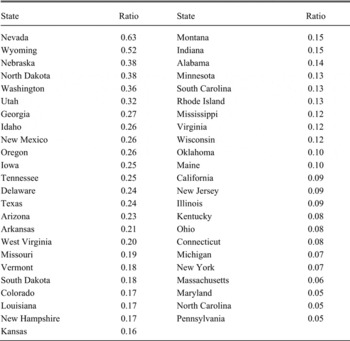
Table 1 presents data on the ratio of the appropriations necessary for a state to receive the maximum Sheppard-Towner grant to the total appropriations for its department of health in 1922. The ratios for Nevada and Wyoming are over one-half, indicating that to receive the maximum grants, these states would have had to appropriate amounts for maternal and infant health programs that were greater than half of what they had been spending on all public health programs in 1922. In contrast, North Carolina and New Jersey's ratios are less than 0.10.
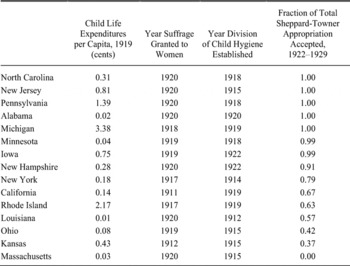
Closer examination of the data, however, casts doubt on the notion that participation in Sheppard-Towner was driven primarily by prior engagement in child health programs. Table 2 presents the fraction of the maximum possible grant received between 1922 and 1929 for states that had positive expenditures on child health programs in 1919, the last year before Sheppard-Towner for which we have data.Footnote 29 Although a number of these states took all, or nearly all, of the federal funds available, others seemingly left money on the table. New York took only 79 percent of possible Sheppard-Towner funds and California, only 63 percent. Perhaps most notable on this list is Massachusetts, which had established a division of child hygiene as part of its health department in 1915 yet refused to take any of the federal money. For these states, the cost of accepting Sheppard-Towner grants would have been relatively small because they already had the administrative infrastructure in place and were already appropriating funds for infant and maternal health programs.
RATIO OF APPROPRIATIONS NECESSARY FOR MAXIMUM SHEPPARD-TOWNER GRANT TO STATE HEALTH DEPARTMENT BUDGET, 1922

Sources:
U.S. Children's Bureau, Promotion of the Welfare and Hygiene (1931), table 1, pp. 2–3; and Moore, Public Health in the United States, pp. 446–48.
SHEPPARD-TOWNER PARTICIPATION, WOMEN'S SUFFRAGE, AND PRIOR ENGAGEMENT IN CHILD HEALTH PROGRAMS: STATES WITH COST PAYMENTS FOR THE “CONSERVATION OF CHILD LIFE” IN 1919

Sources:
U.S. Census Bureau, Financial Statistics of the States (1920), table 10; Miller, “Women's Suffrage,” p. 1292; Rude, “Status of State Bureaus,” pp. 773–74; White House Conference on Child Health and Protection, Section II, pp. 280–81; and U.S. Children's Bureau, Promotion of the Welfare and Hygiene (1931), table 1, pp. 2–3.
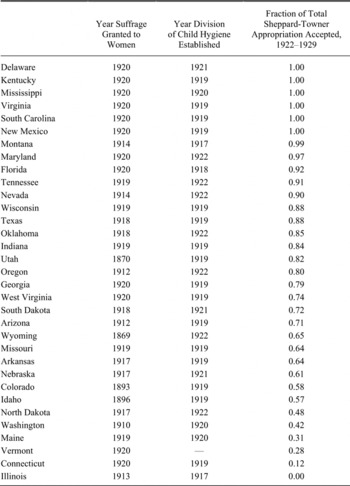
Table 3 adds another layer to this puzzle by presenting data on the states that had no expenditure on child health in 1919. When Sheppard- Towner was enacted in 1921, these states had little or no engagement in child health work and one might suspect that they would have been reluctant participants. Yet the range and variation in participation among these states is comparable to that observed in Table 2. Six of these states put up enough of their own funds to get the full federal match for all the years the program was in place, and eight more accepted 85 percent or more of their total appropriation. Some of the shortfall for these states is due to the cost of setting up the necessary bureaucratic infrastructure to run Sheppard-Towner programs.
SHEPPARD-TOWNER PARTICIPATION, WOMEN'S SUFFRAGE, AND PRIOR ENGAGEMENT IN CHILD HEALTH PROGRAMS: STATES WITH NO COST PAYMENTS FOR THE “CONSERVATION OF CHILD LIFE” IN 1919

Sources:
See Table 2.
Among the states found on the top of Table 3, the most surprising is Nevada. The state had spent nothing on child health before 1922, had a very small budget for public health programs more generally, and yet accepted more than 90 percent of its allocated total grant. Nevada established a division of child hygiene in 1922 in direct response to the new law. In the first two years of the program, Nevada only accepted the non-matched part of the federal grant. But by 1924 Nevada had ramped up its own appropriation in order to receive the full federal grant. Only in the last year of the program did Nevada accept less than the full amount as it scaled back its child health program anticipating Sheppard-Towner's repeal.
While the data in Tables 2 and 3 show no clear cut relationship between participation in Sheppard-Towner and prior engagement in child health programs, they do reveal a connection between the timing of women's suffrage and participation. In both tables, the states with the highest acceptance rates are states that only extended suffrage to women with the 19th Amendment or very shortly before. This is consistent with the view that the influence of women voters may have been greatest right after they got the vote.
MODEL AND ESTIMATION: STATE PARTICIPATION IN SHEPPARD-TOWNER
Participation in Sheppard-Towner may have been influenced by political factors such as length of time since suffrage, the percentage of a state's population that was Catholic, and the strength of the medical profession within the state, as well as prior state expenditures on public health. Statistical analysis can help us tease out the relative effects of these various factors. Participation in a government program is often measured as a binary variable; a state either did or did not join. In this case, such a simple classification would miss much of the interesting variation. Some states took only a fraction of the maximum grant and that fraction varied from year to year. Therefore, we measure participation in a given year as the ratio of the amount of Sheppard-Towner funds accepted to the maximum grant available to the state. Table 4 presents the descriptive statistics for the variables used in the analysis. On average, states accepted 73 percent of their maximum grant amounts, but the standard deviation was large, revealing the tremendous heterogeneity in the degree of participation.
DESCRIPTIVE STATISTICS VARIABLES USED IN PARTICIPATION AND EXPENDITURE MODELS, 1922–1929

aData on cost payments for child life programs are only available for 1923 to 1929. The number of observations for this variable is 336.
Sources:
See the text.
We explore the role of women's suffrage by including the length of time women had had the vote in the analysis. We divide states into three categories based on when the state enacted women's suffrage: before 1917, 1917–1919, and in 1920 under the 19th Amendment. Given that the most vocal opposition to Sheppard-Towner came from doctors and the AMA, we include the number of doctors per 1,000 in the population.Footnote 30 The U.S. Census has never collected data on the religious affiliations of individuals. However, it does collect data on the membership of churches of different denominations and other religious organizations in its Census of Religious Bodies. We use data from the 1916, 1926, and 1936 Censuses of Religious Bodies to construct state-level data on the strength of the Catholic Church. We construct a “percent Catholic” measure for each of the census years by dividing the total membership in Catholic churches in a state by the state's population. We then linearly interpolate between the three census dates to construct annual data.Footnote 31
To capture a state's prior engagement in child health programs, we include data from the Financial Statistics of States of a state's per capita cost payments on the “conservation of child health” in 1919, the last year before Sheppard-Towner for which such data are available.Footnote 32 Although the timing of this variable is determined primarily by data availability, it has the appeal of predating the federal discussion of Sheppard-Towner. Therefore, it is not “contaminated” by states scaling up their expenditures in anticipation of the federal program being passed. To capture a state's involvement in public health programs more generally, we include the per capita expenditures on the state health department in 1922.Footnote 33
We also include variables intended to capture the more general economic, social, and political characteristics of a state: the percent of the population ages 0 to 5, per capita personal income, the percent of the population that was black, the percent of the population that lived in urban areas, and South and West region indicators.Footnote 34 We also include indicators for democratic governors and a democratic majority in the House and Senate. In some specifications, we instead include the “political shift” variables that Price V. Fishback and Shawn Everett Kantor found influenced changes in the generosity of a state's workers’ compensation program, another Progressive Era social welfare initiative.Footnote 35 Finally, we allow for year fixed effects to capture any factors that may have affected all states in a given year. We report standard errors that have been adjusted to allow for the clustering of the error term by state.
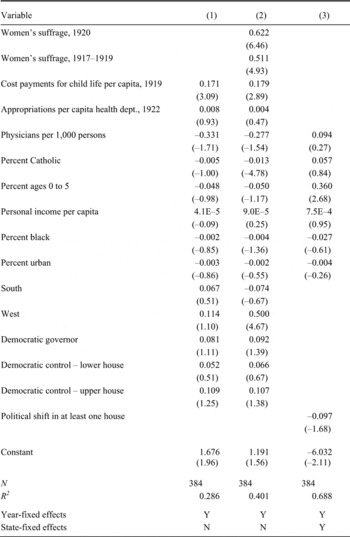
Table 5 presents the results from OLS estimation of the model, both with and without the inclusion of the women's suffrage variables.Footnote 36 A state's participation in Sheppard-Towner was strongly related to its experience with women's suffrage. States that extended the vote to women in 1917 or later accepted much larger shares of their maximum federal grants than did states that had given the vote to women before 1917. The results indicate that holding all other factors equal, the share accepted by a state that gave women the vote in 1920 was more than 62 percentage points greater than the share accepted by a state which had given women the vote before 1917. The suffrage variables also greatly increase the explanatory power of the model. The addition of these variables increases the R-squared from 0.29 to 0.40.
The models include regional dummy variables, so the “suffrage” effect cannot be simply attributed to the behavior of the Western states.Footnote 37 These findings may bolster the traditional story about Sheppard-Towner: while politicians voted in favor of Sheppard-Towner in 1921 due to their fear of new women voters, by 1926 experience had eliminated that fear and politicians were willing to vote against legislation that had formerly been labeled a “women's issue.” Indeed our analysis shows that in states with little experience with women voters, legislators were quick to vote for what was viewed as a “women's issue.” But in states with a longer history with women voters, legislators did not feel so threatened, perhaps because they knew that women's political preferences were not necessarily centered on one issue and were as heterogeneous as those of men.Footnote 38
The model also reveals that a state's prior expenditure on child life is a predictor of its later level of participation in Sheppard-Towner; a one-standard-deviation increase in per capita expenditures on child life (an increase of 0.6 cents) increased the share of the maximum grant accepted by 10 percentage points. Controlling for other factors, a state's participation did indeed reflect its underlying preferences for child health programs as represented by its pre-Sheppard-Towner expenditures. However, the alternative measure of a state's engagement in public health programs—per capita appropriations for a state's health department in 1922—did not have an impact on a state's participation in Sheppard-Towner.Footnote 39
Surprisingly, we find limited support for the notion that doctors affected a state's participation. The coefficient on the number of doctors per capita is negative but statistically different from zero at a 10 percent level only in the model excluding the suffrage timing variables. We also tried other measures of the influence of the AMA: the percent of doctors in a state who were members of the AMA, the percent of doctors who were AMA fellows, and the percent of doctors who received the Journal of the American Medical Association. These variables did not affect a state's acceptance of Sheppard-Towner grants.
The estimated effects of most of the variables are not affected by the inclusion of the suffrage variables. An interesting exception to this is the effect of percent Catholic. While this variable has no effect in the model without the suffrage variables, it is negative and significant in the model with the suffrage variables. Controlling for the timing of women's suffrage, states with larger Catholic populations had lower rates of participation in Sheppard-Towner. An increase in the percent Catholic by 12 percentage points, approximately a one-standard-deviation change, reduced the fraction of the maximum grant accepted by 16 percentage points.
OLS ESTIMATES FOR THE PERCENTAGE OF MAXIMUM GRANT ACCEPTED BY STATES, 1922–1929

Notes:
The numbers in parentheses are t-statistics. These are calculated using robust standard errors which account for clustering by state.
Sources:
See the text.
Other than the Western region indicator variable (which is positive and statistically significant in the model including suffrage), none of the other variables have statistically significant effects in the specifications without state-fixed effects. Perhaps not surprisingly given the narrative accounts of the battles over Sheppard-Towner, the political party in control of the governor's office or either of the legislative houses had no effect on a state's take-up of the federal grants. However, the models discussed so far have not allowed for shifts in the political structure to affect a state's participation in Sheppard-Towner.
In column 3 of Table 5, we present the estimates from a model allowing for state-fixed effects. We find this model less informative than the models in columns in 1 and 2 since the primary variables of interest are either truly fixed—the experience with women's suffrage —or relatively constant over the period—the number of doctors per capita and the percent Catholic—and hence get swept away when state-fixed effects are included. But the state-fixed effects model does allow us to consider how the year-to-year changes in characteristics affected a state's participation in the Sheppard-Towner program. In this specification, the coefficient on the percent of the population ages 0 to 5 is positive and statistically significant. States for which the preschool age population was growing over the 1920s increased their level of participation in Sheppard-Towner over time. The model also reveals that a change in the majority party in one of the houses of the state legislature led to a decline in the Sheppard-Towner grant accepted by the state in that year. This may be another manifestation of politicians learning about women voters. If a party with pro-women's issues policies was voted out of power, the lesson learned by its successor is that the rewards to catering to the women's vote are small (as are the penalties of going against it).
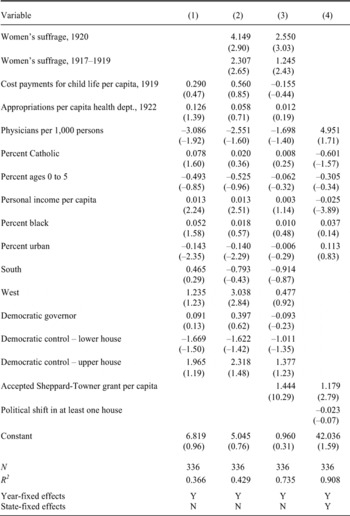
So far we have considered participation in Sheppard-Towner in a very narrow way, looking only at the fraction of the maximum grant a state accepted in a given year. An alternative approach would be to use a measure that captures more broadly a state's engagement in maternal and infant hygiene programs during the period in which Sheppard-Towner was in operation. We consider the expenditure category reported in the Financial Statistics of the States that most closely corresponds with the programs targeted by Sheppard-Towner: the cost payments for the conservation of child life. Table 6 reports the results of regressions of this measure in per capita terms on the same sets of variables included in the models presented in Table 5. The number of doctors has a negative effect on a state's expenditures on child life programs, and wealthier and more rural states had higher per capita expenditures on child life programs during the 1920s. But even after controlling for other political and demographic variables, a recent extension of suffrage to women did increase expenditure, an effect that persists even if we include the level of federal support a state received. On a per capita basis, state expenditures on child life programs increased by 1.4 cents for every cent of Sheppard-Towner subsidy, and beyond that, states with more recent suffrage had higher expenditures on these programs.
OLS MODELS FOR COST PAYMENTS FOR “CONSERVATION OF CHILD LIFE,” 1923–1929

Notes:
Dependent variable is in cents per capita. The numbers in parentheses are t-statistics. These are calculated using robust standard errors which account for clustering by state.
Sources:
See the text.
HOW DID STATES RESPOND AFTER SHEPPARD-TOWNER'S REPEAL?
In the short run, how much a state participated in Sheppard-Towner was heavily influenced by how recently it had enacted suffrage and its prior child life expenditures. However, Lott and Kenny and Miller suggest that giving women the vote led to permanent changes in state and local expenditures on public health. In order to examine the impact of suffrage in the longer run, we examine the behavior of states after the program's repeal. States could have scaled back or ended maternal and child hygiene programs when federal spending lapsed, or they could have born the fiscal cost of continuing these initiatives. Perhaps even more importantly, analyzing how states responded after Sheppard-Towner was consigned to the dustbin may inform us as to whether such federal matching programs are associated with a “demonstration effect.” That is, do programs that provide infrastructure for certain types of activities motivate states to continue the activities on their own after the federal sponsorship ends? There is certainly evidence that Sheppard-Towner was intended to do exactly this. During the debate about the act's reauthorization, opponents argued that the federal grants had always been intended to be short-lived and “inspirational.” For example, conservative anti-suffragist Senator Lawrence Phipps of Colorado led a filibuster that blocked action on the bill reauthorizing Sheppard-Towner. Phipps was a member of the Senate Committee on Education and Labor, which submitted a report on the proposed extension of the bill in May 1926. The report argued that the Sheppard-Towner Act was a “temporary” measure and that the original five-year limit on appropriations had been put in place because the program was intended to be “educational, and inspirational in order to lead the states to appreciate the value of such state activities and to undertake them, within a short period of time, entirely at the state's expense. Certainly it was not thought then that such financial aid would become a permanent function of the federal government.”Footnote 40
The House Committee on Interstate and Foreign Commerce issued a similar report that acknowledged the temporary and inspirational intent of the first law, but added, “The committee is of the opinion that the federal government should not yet withdraw from this work. To do so would mean the undoing of much of the work that has been recently initiated. A considerable portion of the work is necessarily still in a formative stage. It will take time before this work is placed upon a firm and permanent basis. Until this is more certain, the committee feels that the federal aid given in the act should be extended”Footnote 41
Thus, the goal of the Sheppard-Towner program was to encourage and to inspire states to engage in maternal and infant care work on their own. If Sheppard-Towner truly stimulated states to undertake maternal and infant care activities on their own, we would expect that many of them “replaced” Sheppard-Towner monies with their own funds after federal support for the program ended in 1929.
As with participation, states’ responses after the repeal of Sheppard-Towner were highly variable. The contrasting behavior of Nevada and Tennessee highlights this variation. Nevada had scaled up its state appropriations for child health programs dramatically in order to get the maximum federal grant. But after the repeal of Sheppard-Towner in 1929, the state abolished its department of child hygiene and eliminated all spending on the “conservation of child life.” Clearly, Nevada was not inspired by Sheppard-Towner to continue infant and maternal hygiene programs after the federal grants disappeared. Tennessee, like Nevada, had to establish a department of child hygiene so that it could begin accepting Sheppard-Towner funds. Unlike Nevada, though, Tennessee continued to increase its expenditures on child life even after Sheppard-Towner was repealed. In fact, Tennessee's per capita cost payments on child life were almost twice as high in 1930 as they were in 1925. Why were some states inspired when so many others were not? One explanation is that these states may have been ready to be inspired. That is, they may have already had the desire, either among the populace or policymakers, to expand public health programs and so were well-positioned to take advantage of the federal grant program. Some evidence in support of this argument for Tennessee comes in the response of Olin West, the Secretary of the Tennessee Board of Health to Secretary Rankin in North Carolina on December 12, 1921:
I am exceedingly anxious to get a division of public health nursing and child welfare established in my department, and it seems to me that the money which will be provided under the Sheppard-Towner Act gives me the best opportunity I will ever have to get this division started.Footnote 42
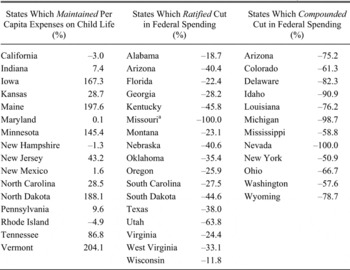
In order to analyze the extent to which Sheppard-Towner was associated with a demonstration effect, we examine the behavior of states after its repeal. Specifically, we define those states that “maintained” expenditures on child life as those states which had per capita cost payments that were 90 percent or more of per capita cost payments in 1925. As shown in Table 7, under this definition, 16 states maintained their commitment to child health programs. In order to continue funding these programs at the same level as 1925, states had to replace federal funds with their own. The data on the percent changes in per capita expenditures between 1925 and 1930 reveal, in fact, that many of these states greatly expanded their engagement in these programs. Almost all of these were states that had been engaged in child health work before Sheppard-Towner was enacted in 1921.
We divide the states that did not maintain their expenditure levels into two categories: those that “ratified” the federal spending cut and those that “compounded” it. Seventeen states “ratified” the federal cut in that they decreased per capita spending on child life between 1925 and 1930 but by less than the amount of the federal grant accepted in 1925. These states did reduce the amount spent on child health programs but not the appropriations of their own funds. In contrast, twelve states “compounded” the cut by reducing their spending by more than the grant they had received in 1925.Footnote 43 Is there a pattern among those states that replaced Sheppard-Towner funds? Table 8 presents the marginal effects from the probit model estimation of the likelihood a state replaced the lost federal funds and maintained its per capita expenditures on child life between 1925 and 1930, on several of the variables described in the section on state participation and the state unemployment rate in 1930.Footnote 44 When Congress debated the reauthorization of Sheppard-Towner in 1926, members could not anticipate the downturn in economic activity that would begin in late 1929. The average state unemployment rate in 1930 was 5.6 percent, and in most states, unemployment was relatively low. However, in a few states, like Michigan, Ohio, and New York, unemployment was already creeping towards double-digit levels. We add the unemployment rate to the analysis to see whether economic conditions played a role in how states responded to Sheppard-Towner's repeal.
STATE RESPONSES TO THE REPEAL OF SHEPPARD-TOWNER: PERCENT CHANGES IN PER CAPITA COST PAYMENTS ON THE “CONSERVATION OF CHILD LIFE,” 1925–1930

a Missouri's cost payments on child life in 1925 were less than the Sheppard-Towner grant it received that year.
Notes:
States which maintained expenditures on child life are defined as those which had per capita expenses in 1930 that were 90 percent or more of per capita expenses in 1925. States which ratified the cut in federal spending were those which decreased per capita spending by an amount smaller than the per capita grant accepted in 1925. States which compounded the federal cut were those with declines in per capita expenses greater than the 1925 per capita grant amount.
Sources:
See the text.
ESTIMATED MARGINAL EFFECTS FROM PROBIT MODELS FOR THE LIKELIHOOD OF MAINTAINING PER CAPITA COST PAYMENTS ON “CONSERVATION OF CHILD LIFE” AFTER REPEAL OF SHEPPARD-TOWNER ACT

Notes:
Dependent variable equals one if per capita cost payments on child life programs in 1930 were 90 percent or more of per capita outlays in 1925. The numbers in parentheses are z-statistics.
Sources:
See the text.
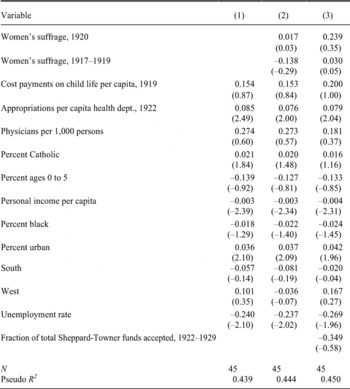
While the suffrage variables were strongly statistically significant predictors of the level of state participation, none of them are statistically significant here. If suffrage influenced the extent to which states participated in Sheppard-Towner, it played no role in whether they replaced federal money with their own. These findings reinforce historians’ arguments that Sheppard-Towner was passed early in the 1920s because politicians were afraid of new women voters, but repealed later after politicians learned that such fears were unwarranted. The variables that best predict whether a state replaced federal funds are its per capita health department appropriations in 1922 (before the start of the program) and its 1930 unemployment rate. While 1922 health appropriations did not matter for participation in the Sheppard-Towner program, it is positively and significantly related to a state's propensity to replace Sheppard-Towner funds. The magnitude of the estimated coefficient suggests that a one-cent increase in per capita public health appropriations in 1922 generated a 7 to 8 percentage point increase in the probability that a state would replace Sheppard-Towner funds with its own money.
How a state responded to the loss of federal Sheppard-Towner grants was also clearly related to its economic climate. Results show that states with higher joblessness in 1930 were much less likely to replace the federal funds with their own monies. While the failure of states to continue maternal and infant health programs in 1930 cannot be attributed solely to the emerging economic crisis since budget appropriations in many states would have been made before the economic downturn, these results clearly suggest that the failure of many states to be inspired by Sheppard-Towner reflected the onset of the Great Depression.
In column 3 of Table 8, we add the fraction of the total Sheppard-Towner appropriation accepted by a state to see if the likelihood of replacement was related to the level of participation in the program. The coefficient on this variable is negative, although it is not precisely estimated and so it not statistically different from zero. The likelihood a state continued infant and maternal health program after 1929 was not related to its participation in federal grant program. States that rushed in to accept all the federal grant money were no more likely to maintain their programming in infant and maternal hygiene than were states that participated less fully. In other words, greater participation did not lead to greater inspiration.Footnote 45
CONCLUSIONS
Enacted in 1922, the Sheppard-Towner program gave matching money to states to provide education on maternal and infant care to women. Historians argue that the program passed because politicians feared that they would be punished at the polls if newly enfranchised women felt they did not support a “women's issue.” This sentiment has been reinforced by economists, who have found that suffrage led to distinct and permanent shifts in state and local spending towards public health and education. We examine the factors underlying state participation in Sheppard-Towner in the short-run, as well as state spending on child health after the program's repeal in 1929. Our results show that suffrage did play a key role in determining the extent to which states participated in Sheppard-Towner. Contrary to other findings, however, we do not find support for the theory that women's enfranchisement led to persistent shifts in state spending. With respect to Sheppard-Towner, state spending on child health programs after the program's repeal was not influenced by the length of time since suffrage. This finding buttresses historians’ arguments that once politicians learned that women did not vote as a bloc, they were able to vote their consciences and shut down the program.
We also examine state spending on child life after the program's repeal to see if it had a demonstration effect. Politicians claimed that the purpose of the program was to provide states with the infrastructure and inspiration to continue public health education for infant hygiene after the program ended. While some states may have been inspired, others were clearly not. On average, we find no evidence of a demonstration effect. A state's participation in Sheppard-Towner had no impact on its subsequent spending after the program ended. Instead, the primary determinant of child life expenditures in the post-Sheppard-Towner era was spending on child life before the program's enactment. Ultimately, those states with a previous commitment to child health maintained this commitment, while states with no prior engagement generally did not. This suggests that short-term, federal matching grant programs intended to inspire states may not achieve their goals.