What exactly is Ingmar Bergman's The Magic Flute (Trollflöjten, 1975)? This may seem quite a simple question but the diversity of given answers shows that the opposite is true. This film has been considered, among other things, ‘a virtuoso “theater film”’,Footnote 1 a filmed opera,Footnote 2 an ‘opera-film’,Footnote 3 a film version of Mozart's opera,Footnote 4 a film adaptation of Mozart's opera,Footnote 5 ‘a filmed TV version of Mozart's opera’,Footnote 6 ‘a television film … [that] represents a landmark of filmed opera’,Footnote 7 ‘a film for television, not the movie theater … an [example of] opera as film’Footnote 8 and ‘not an opera film; it is a television opera’.Footnote 9 These descriptions refer to the film's connection to theatre, Bergman's particular take on Mozart's opera and his choice of television to express his perspective. As such, their focus ranges from the object of representation and the mode of imitation to the nature of the medium. Yet what the diversity of answers tells us is that the particularity of this film lies precisely in its blurring of categorical boundaries.
Consider the location. Bergman's film does not really show a performance of Mozart's opera in the Drottningholm Court Theatre. True, the accuracy of the reproduction of the theatrical environment creates the illusion of an actual operatic performance in that theatre. Yet it was all done in a film studio.Footnote 10 Thus, The Magic Flute is not opera as recorded by film but rather a film about an operatic performance. In particular, it is a film made for television about the experience generated by an operatic performance for the theatrical audience shown on screen.
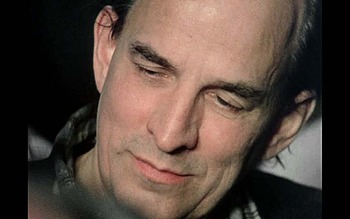
In relation to the mode of imitation, this film is not, properly speaking, an adaptation or a version of Mozart's The Magic Flute. It is not just that Bergman cut three numbers and had the performers sing in Swedish.Footnote 11 As I argue, the opera is not the end point of the film; rather, the opera is the means through which to explore the spectatorial experience.Footnote 12 Bergman articulated this experience by means of mimetic action, or what Martin Esslin called ‘the dramatic mode’, which underpins all the different media (e.g., theatre, film) and artforms (e.g., music, drama, scenography) involved in the production. As Esslin suggests, ‘a filmed version of a staged play [opera in this case] … clearly is still drama’.Footnote 13 Unlike the dominant view of cinema as a visual and narrative medium, I understand films as audio-visual and mimetic creations. I argue that films ‘tell’ by displaying actions that are articulated through both images and sounds, and so they fall into the category of drama. Furthermore, as Giorgio Biancorosso emphasises, these images and sounds require ‘a perceiving subject, who recomposes them in an imaginary world of appearances’.Footnote 14 In The Magic Flute, Bergman consciously elaborated on the mediated and mediating nature of art inspired by his own personal experiences as both spectator and creator. To make this idea explicit, he himself appears as a member of the theatrical audience in one of the shots of the montage sequence at the end of the overture (Figure 1).Footnote 15 By portraying himself among the audience in the opera theatre, Bergman is evoking childhood memories of how he had always imagined this opera at Drottningholm. At the same time, through his cameo appearance, Bergman directs our attention to his role as the manipulator of the artifice that triggers the film audience's aesthetic experience. This dual role of spectator and artist is closely related to Margaret Koskinen's observation that Bergman adopted an ‘artful approach’ in his life through the ‘self-conscious performativity of his authorial voice’.Footnote 16 I argue that in his extensive and diverse artistic productions, Bergman was interested not in conveying meaning but in delving into the process of meaning-making itself. This idea also applies to the autobiographical articulations of his work. Janet Staiger's identification of certain recurrent motifs that appear in Bergman's biographical accounts illustrates the point. One of these recurrent motifs is what she calls the ‘originary moment’, and the example she provides is the passage in his autobiography in which Bergman emphasises the enchantment that his first film projector produced in him. Staiger argues that Bergman was ‘opening the door to the famous associations of Bergman with magic and a pleasure in illusion-making’.Footnote 17 The following quote – one of Bergman's most cherished personal experiences regarding the magic of the theatrical illusion – falls into the same category (‘originary moment’), and it has a similar outcome, too. Bergman recalls that experience in The Magic Lantern as follows:
When I was 12, I was allowed to accompany a musician who was playing the celesta backstage in Strindberg's A Dream Play. It was a searing experience. Night after night, hidden in the proscenium tower, I witnessed the marriage scene between the Advocate and the Daughter. It was the first time I had experienced the magic of acting. The Advocate held a hairpin between his thumb and forefinger; he twisted it, straightened it out, and broke it. There was no hairpin, but I saw it.Footnote 18
Bergman's cameo. (colour online)

Notice how Bergman opens his recollection with an explicit reference to music: a celesta playing backstage. I find this detail relevant for several reasons: first, there is no reference to such musical accompaniment in the original play; second, the instrument itself, a celesta, is quite peculiar (particularly its magical sound); and third, Bergman's aesthetic response to what was happening on stage was not spoiled by his being aware of the backstage reality. The music of the celesta contributed to this experience, irrespective of whether it was an attribute of that particular production or the product of Bergman's own imagination and/or memory. Bergman's ‘searing experience’ was the experience of a sensorial perception taken over by his imagination, the experience of theatrical illusion. The Magic Flute became an expressive means by which Bergman elaborated on his childhood experience, and in so doing the film literally performs reality.Footnote 19
Illusion as imaginative engagement
The theorisation of aesthetic illusion has moved back and forth between the participation of the spectator and the relevance of the artwork itself in that engagement. Werner Wolf defines aesthetic illusion as a ‘pleasurable mental state that frequently emerges during the reception of many representational texts, artifacts or performances’.Footnote 20 He later argues that ‘[g]enerally, illusionist representations are accessible with relative facility. They offer potential recipients with material to lure them into the represented worlds and create a sense of verisimilitude, a prerequisite for the emergence of aesthetic illusion, although generic conventions may serve to counteract improbable elements.’Footnote 21 Wolf follows Ernst Gombrich's idea of ‘guided projection’ in the mind of the recipient, which entails taking into consideration the representation, the recipient and the context in a theory of illusion.Footnote 22 I too hold this inclusive view, although I would like to stress the significance of an element that not only partakes in all three dimensions, but also lies at their core: convention. Following Raymond Williams, conventions are ‘basic to any understanding of drama as a form’.Footnote 23 Williams also argues that the question of convention is not only based on a relation between form and performance, but ‘it is also a question of audiences; it is there, in the theatre as a social institution, that conventions are really made’.Footnote 24
As described in the preceding quote and made explicit in the film, theatrical illusion does not entail any ‘suspension of disbelief’ (after Coleridge), any confusion between reality and fiction (the psychological understanding of the term ‘illusion’), or any alternation between the states of being fully emotionally absorbed and being rationally detached during the aesthetic experience. Rather, theatrical illusion consists of a deep, conscious and voluntary engagement with representations based on being fully aware of their artificial and mimetic nature. This combination of absorption and distance has often been qualified as ‘paradoxical’,Footnote 25 or understood in terms of an ‘asymmetrical ambivalence’: for Wolf ‘aesthetic illusion is gradable according to the degrees of immersion or distance present in given reception situations and is thus unstable’.Footnote 26 Bergman's depiction of this phenomenon in the film, however, is rather closer to taking ‘an interest in appearances, while maintaining intact one's awareness of the status of the physical substrata that make those very appearances possible – be they actors, pictures, printed words, moving images, or recorded sounds’.Footnote 27 Being aware of the nature of representations and actively engaging with them entails participating in a game of make-believe.Footnote 28 By representing himself among the theatrical audience in the film, Bergman made very clear that – in Biancorosso's words – ‘[t]here is a sense, then, in which the intensity, richness, and vivacity of our absorption into a world of make-believe is evidence not of a deceptive, illusory state of mind but rather of the opposite – an all too encompassing understanding of the nature of representation and the subject's relation to it’.Footnote 29
Staging opera for the screen, in a film studio
Bergman decided to elaborate on the nature of theatrical illusion not by staging but rather by directing a film rendition of The Magic Flute.Footnote 30 His choice of film allowed him to explore and control the representation of the operatic performance and the experience it induces in an audience to an extent that would have otherwise eluded him.Footnote 31 The performance never took place. The film is in fact a mock recording of a staging. Moreover, Bergman's interest in the workings of theatrical illusion made the film medium itself transparent for the television and subsequently film audiences.
Opera on screen is as old as cinema itself, and it has continued appearing in mediated form with the advent of television as well. Despite this symbiosis between opera and film, mediated operas have been seen as derivative and therefore of lower status compared with their live counterparts. Recent scholarship has put forward different understandings of the concept and experience of liveness, and of mediated representations of opera. This shift in orientation has been triggered by a renewed focus on the spectatorial experience. Following Gadamer's idea that we engage with works of art in the present, Philip Auslander rejects both technical and spectatorial determinisms in his understanding of liveness – that is, ‘liveness’ as an intrinsic property of the object or as constructed exclusively by its audience – and adopts instead a phenomenological perspective from which ‘digital liveness emerges as a specific relation between self and other, a particular way of “being involved with something.” The experience of liveness results from our conscious act of grasping virtual entities as live in response to the claims they make on us.’Footnote 32
In relation to mediated operatic performances, Christopher Morris and Emanuele Senici each reject the ‘ideology of authenticity’ that underpins the understanding of video recordings as derivative and lower than live performances. Using a phenomenological approach similar to Auslander's, Morris argues that ‘[r]ecognized as an engagement, an encounter with a video assumes all the hallmarks we associate with spectatorship: absorption, immediacy, affect, and so on’.Footnote 33 For his part, Senici encourages us to consider ‘what can be gained by thinking about videos on their own terms rather than as poor substitutes for the live performance, and to reflect on their own poetics, their own aesthetics, and their own ways of signifying’.Footnote 34 Moreover, as Sean Cubitt argues, ‘a repeated viewing of a video is not an actual repetition: it involves not only the viewed object but a viewing subject whose engagement will never be duplicated’.Footnote 35 This idea is grounded in a deeper understanding of media and the processes of mediation they trigger. Following Emanuele Senici, ‘video does not simply mediate, or translate a live performance, but rather constructs it according to video's own technical and medial characteristics as well as to a complex set of cultural and social assumptions about its function and role’.Footnote 36
With his film of Mozart's opera, Bergman not only shared his individual experience, but also reflected on the constructed dimension of an operatic performance. The following quote from his autobiography, Images: My Life in Film, touches upon this idea:
As a boy I loved to roam around. One October I set out for Drottningholm to see its unique court theater from the eighteenth century.
For some reason the stage door was unlocked. I walked inside and saw for the first time the carefully restored baroque theater. I remember distinctly what a bewitching experience it was: the effect of chiaroscuro, the silence, the stage.
In my imagination I have always seen The Magic Flute living inside that old theater, in that keenly acoustical wooden box, with its slanted stage floor, its backdrops and wings. Here lies the noble, magical illusion of theater. Nothing is; everything represents. The moment the curtain is raised, an agreement between stage and audience manifests itself. And now, together, we'll create!
In other words, it is obvious that the drama of The Magic Flute should unfold in a baroque theatre with the efficiency and incomparable machinery of a baroque theatre.Footnote 37
It is not only the acting or the music that contributes to generating the ‘magical illusion’, but also the theatrical environment. The theatre is the physical location where the performance takes place, and also, following Gay McAuley, a spatial reality that acquires multiple functions in the construction and communication of theatrical meaning.Footnote 38 Bergman's words highlight how the theatre provides a space for the communicative and creative act between performers and audience. The crucial role of the latter is emphasised by the use of words such as ‘bewitching’, ‘magic’ and ‘illusion’, which refer to the psychological nature of the theatrical experience, based on an ‘interplay between the physical and the fictional’.Footnote 39 It is the combination of the audience's particular psychological disposition to enjoy the artifice and the careful attention paid to its crafted nature that makes the ‘magical illusion of theatre’ possible.
Much of the scholarship on the film focuses on the act of an opera being performed.Footnote 40 Ideas of theatricality and universality recur with some frequency. The former follows from the structure of the ‘play-within-a-movie’,Footnote 41 a topos in Bergman's filmography (and Bergman scholarship). Universality, for its part, is a topos in the reception of Mozart's music and resonates across Bergman's adaptation of the opera's plot.Footnote 42 My own reading of Bergman's The Magic Flute will focus on how he elaborated on the phenomenon of theatrical illusion and the artificiality that lies behind it, following the main ideas of the two earlier quotations from The Magic Lantern and Images.Footnote 43 I will examine how theatrical illusion is considered in this film from two perspectives. First, that of the theatrical audience, whose imaginative engagement becomes crucial for the artistic experience to happen, as the overture shows. Then, that of Bergman himself, who, knowing how illusion works, not only uses tricks to guide the audience's perception but also displays their artificiality in the film. I analyse the ‘constructed naturalness’ of the magic flute and of Papageno in his first aria, and the conspicuous theatricality of the first intervention of the Queen of the Night to show how awareness of the artwork's artificiality does not affect the audience's experience – in fact, quite the opposite. The display of the workings of illusion enhances the audience's engrossment with its magic.
Overture: the audience centre stage
During the overture of Bergman's The Magic Flute, music is in play on screen. There is no image of the actual orchestra playing in the Drottningholm Court Theatre, not only because the music was recorded in a studio – just like the film – but also because Bergman's aim was not to show the musical performance as such, but rather to disclose what the music does within that particular context. In this sequence, Bergman delved into the dramatic role of the overture. Through an original audio-visual choreography, he brought the music into play by weaving together a fabric of references, spaces and motifs, all revolving around the main character of the film: the audience. What this audio-visual tapestry reveals is how music activates and engages the audience's imagination even before the start of the operatic representation on stage.
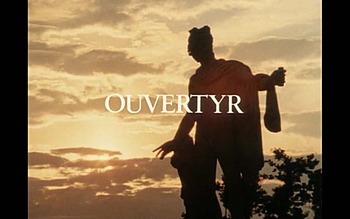
Captured from a low-angle shot, a shadowed view of the sculpture of the Apollo di Belvedere and the first E♭ major chord of the opera together introduce the overture (Figure 2). The sculpture is situated in front of the Drottningholm Court Theatre, amidst a pictorial chiaroscuro. The mythical reference to the Greek god Apollo is not accidental. Apollo's posture refers to the moment right after he has shot a death-dealing arrow to slay Python, the serpent guarding Delphi.Footnote 44 This Pythian Apollo, as this representation of the god is usually known, clearly foreshadows the first episode of the opera. In the first episode, Tamino (Josef Köstlinger) also encounters a serpent – in Bergman's film a dragon – although instead of confronting it as the Greek god did, he runs away from it asking for help. We are in a fully human domain now, even with the dragon.
Overture. Pythian Apollo. (colour online)

The second and third paired chords of the overture lead to the next two shots of the statue. From the initial full shot of Apollo, the camera angle shifts towards a medium-long shot and a medium shot. As we get closer, the lighting brightens and the bodily features of the Greek divinity come into focus. Apollo becomes a more human-like figure through a closer view of the sculpture induced by the music. Thus, by means of art – specifically, sculpture – Bergman has evoked the whole mythical world surrounding the Pythian Apollo, a world that is related to the fictional musical drama that follows. This is just an example of the agreement between stage – in this case screen – and audience that Bergman claims is necessary for the experience of theatrical illusion to take place. Only an audience who pays attention to these details and engages in the magician's art can fully enjoy the aesthetic experience (just as Bergman did during his first experience of theatrical illusion when he was twelve years old).
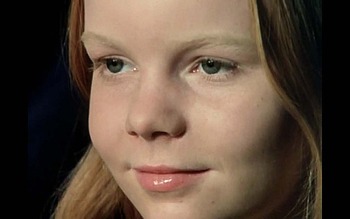
The commencement of the first melodic motif takes us to the theatre's interior. The viewer's attention is drawn towards a blond girl (Helene FribergFootnote 45) among the audience attending the opera (Figure 3). This girl stands out from the crowd due to her central position in the medium shot and as a result of the camera then zooming in on her face. She is looking down, in the direction of the orchestra pit, from where the sounds to which she is listening emerge. In perfect synchronisation with the music (b. 11, first noteFootnote 46), she raises her eyes to contemplate the painting that decorates the stage curtain. Through a shot-reverse shot we can trace the trajectory of her gaze, from the putto holding a flower garland at the centre-top of the curtain, to the goddess Minerva holding a spear at the centre of the curtain, directly below. Then, along with the sforzando in bar 13, we see a long shot of the whole scene depicted on the curtain. During the last bar of the Adagio, the girl's gaze lowers back to the orchestra pit, closing this opening section before the Allegro starts.
Blond girl in the audience in The Magic Flute. (colour online)

Close-ups of this girl will punctuate not only the overture, but also the rest of the operatic performance.Footnote 47 Both Miriam Sheer and Dean Duncan consider these recurrences as a visual leitmotif throughout the film. However, while for Sheer the girl's ‘symbolic association with the three divine messengers in the opera becomes clear after the Overture’,Footnote 48 for Duncan, the girl becomes
A visual and narrative motif that will serve as a structuring metaphor for the duration of the film. … the child will become the site of suture, the standard technique through which the film spectator is brought into the film space and brought under the rules and assumptions that inform and structure it. … we come to share her space and perspective as we see through her eyes, and finally by seeing her again we see what kind of response that is expected for us.Footnote 49
Duncan's reading of the girl's shot as a visual motif that recurs through the cinematic representation is clear, but, in my view, its narrative function as ‘the site of suture’ requires some further comment. If it is through this girl that the ‘film spectator is brought into the film space’, where was this cinematic spectator up until the first appearance of the girl? In other words, what space is the one conveyed during the film's pre-title sequence and the opening chords of the overture? Both moments show views from outside the theatre, but they are also part of the film; they happen within the film space. Furthermore, regarding Duncan's comment on how ‘we come to share her space and perspective and see through her eyes’, I would say that this is what happens during the Adagio section just analysed, but not during the rest of the film. Bergman shifts constantly between theatrical and cinematic perspectives, giving the cinematic audience access to areas of the theatre (backstage) and dimensions of the characters’ experiences (their consciousness or thoughts). He even offers shots, inaccessible to the theatrical audience (represented by the blond girl), of the audience itself. Moreover, only at very particular moments do we see the girl's reaction to what is happening on stage, and it is usually before these happenings are shown. Hence, more than guiding or modelling our reactions, the girl's changing facial expressions trigger our imagination regarding what we are listening to but cannot see (since it is happening off screen). At these moments it is the dissociation between the sounds coming from the stage and the image of the girl's reaction to them that forces us to use our mind's eye to visualise what is taking place off screen. Therefore, the film's multiplicity of spaces, perspectives and realities cannot be confined to the point of view of a girl in the auditorium of the theatre. On the contrary, it is the intermedial dialogue Bergman creates and the metatheatrical devices he uses that negate any specific ‘site of suture’ in this film (and the implications of that concept) for the experience the film generates.
The film focuses not only on the magic of the illusion, but also on the workings of it – it combines the naivety of a girl's gaze with a more sophisticated understanding of the artifice that prompts belief. This combination endows the aesthetic experience with a cognitive dimension that transforms a purely sensorial experience into an intellectual realisation. Bergman describes illusion as ‘noble and magical’.Footnote 50 Both adjectives have positive connotations and refer to realms beyond mundane reality or everyday life. In other words, illusion is not related to deception but to the faculty of imagination. Bergman is not only aware of but explicitly states the artificial – namely fictional or representational – nature of illusion. This artificiality is what requires the ‘agreement between stage and audience’. His emphasis on mutual creation clearly acknowledges the audience's crucial role in the creative and communicative process that art triggers. Bergman brings to the fore this particular idea in the next section of the overture.
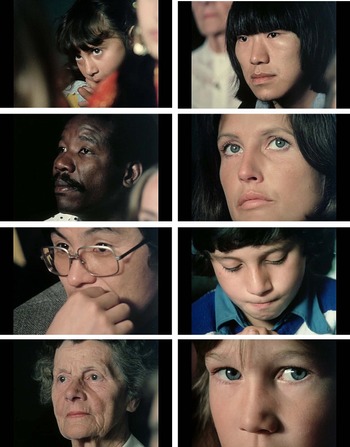
The Allegro sets the pace for a montage sequence in which the rest of the audience in the film are introduced through close-ups of their faces (Figure 4). Bergman creates an audio-visual choreography in which the images follow the music, the visual changes matching the musical sforzandi, the entrance of new instruments, their different combinations and so on. Only one shot gives us a view of a group larger than the one that opened this sequence; however, the full audience is still not depicted, and the blond girl remains in the centre. The rest of this section consists of individual close-ups of a wide and diverse range of people in terms of age, ethnicity and so on. They share an attentive listening attitude, but each listens in their own way.
Overture. Bergman's audiovisual choreography. (colour online)

This is a purely cinematic excerpt due to the use of montage (impossible in the theatre), the representation of the theatrical audience, and the blend of music and images. The emphasis here is the theatrical audience's focused attention. We assume their engagement to be aural, but we cannot partake of their listening experience. What we see, however, is that they are not only listening, but also looking at different parts of the theatre, some of them are moving slightly to the beat of the music, while others are distracted, and so on. Thus, more than a listening experience, what this sequence represents is a ‘musical experience’, a broader category which, following Georgina Born, incorporates ‘the corporeal, the affective, the collective and the located nature of musical experience’.Footnote 51
Most of the members of the theatrical audience are listening attentively to the music, but each person's facial expression is unique, just like their physical features. Despite the individuality of each person's experience, their shared behaviour constitutes them as a group – the audience of the opera – which reveals, quoting Born again, the ‘inescapably social character of what may appear to be the individual, introspective and affective modes of subjectivity engendered by aesthetic experience’.Footnote 52 Unlike Richard Evidon, who claimed that ‘there is nothing to be learnt from watching people listen to music, and besides this instance is dishonest, since we know the performance was not given before an audience’,Footnote 53 I argue that the representation of attention in this sequence shows a complex type of behaviour on the part of the theatrical audience that is crucial for their aesthetic experience.
The workings of theatrical illusion
Bergman had always imagined The Magic Flute taking place inside the Drottningholm Court Theatre in order to use the theatre's unique Baroque machinery to best advantage. Composed in 1791, Mozart's opera is a paradigmatic work of the Classical era, but it also displays features common in Baroque opera (such as the virtuosity of some of the singing and the use of machinery for spectacular effects).Footnote 54 Bergman recognised the opera's Janus-faced nature and made the most of it to serve his exploration of theatrical illusion. He adopted an informed epistemological perspective through which he produced and enjoyed the magic of illusion while revelling in the artificial nature of the representation. In what follows, I will focus on how illusion works through the magic of the magic flute and the ‘naturalness’ of Papageno's stage behaviour in his first aria.
Bergman's ‘magic’ flute
It was Rose R. Subotnik who first raised the question ‘Whose “Magic Flute?”’ in her 1991 article of the same title.Footnote 55 Some years later, Marianne Tettlebaum decided to pursue the question in her own article similarly titled ‘Whose Magic Flute?’,Footnote 56 in which she claimed to have shifted ‘the terms of inquiry from what the opera represents to the question of representation itself, from what the opera means to how it means’.Footnote 57 Although the different typography in each title is telling, in my view Subotnik had already made that turn to ‘the question of representation’. She did so by highlighting the mediated nature of the operatic representation (i.e., the reliance on conventions) and by directing our attention to the particular sonority of the opera, namely to its physicality (or the materiality of the medium).Footnote 58
Tettlebaum begins her critique by listening to the actual sound of the flute in the opera – Subotnik's main focus – and realises that the flute in the orchestra conveys two different sound statuses throughout the opera: that of the orchestral instrument and that of the magic flute, ‘a quasi-character in its own right’.Footnote 59 She also realises that the music of the magic flute does not often match with the dramatic situation taking place when the instrument is played. To Tettlebaum, this ‘fluty quality’ – her words – ‘reminds us that we are not listening to Tamino himself, but to an enchanted instrument standing in for what he cannot otherwise express.
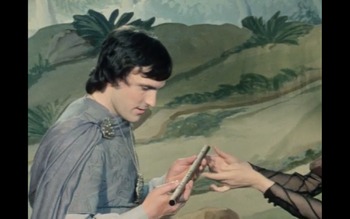
Drawing on Subotnik's focus on the sonority of the opera, I would like to propose an alternative to Tettlebaum's understanding of the magic flute's ‘fluty quality’ that is based instead on how Bergman uses the flute in the film. The ‘magic’ of the magic flute lies in the fact that it has always been seen and listened to as such, although it does not look or sound like a magic instrument at all. In other words, its magic is rooted in the audience's imagination. Bergman represents the magic flute as a rustic wooden flute, following how the instrument is described in the opera (Figure 5)Footnote 60 – indeed, the music of the magic flute does not sound magical, but rather like a normal folk instrument.Footnote 61 In fact, as Bergman's film makes clear, the magic flute does not perform wonders.Footnote 62 Tamino receives the flute to protect him in his venture to rescue Pamina. According to the Three Ladies, the music of the flute will enchant its listeners, increase human happiness and generate human love. Yet, eventually it is Papageno (Håkan Hagegård) who rescues Pamina, using the magic bells to escape from Monostatos (Ragnar Ulfung). Then, when Tamino plays the flute, the only enchanted audience is one that consists of animals. The magic flute may be seen as ‘magical’ in the same way that Papageno's pipes are when he uses them to enchant the birds he captures for the Queen of the Night (Birgit Nordin). Regarding the connection between the flute and happiness, the first time Tamino plays the flute is when he knows that Pamina is still alive. His joy has led him to play the instrument, but as he plays his doubts return, and he starts questioning everything again. Later, during one of the trials, Pamina follows the tune of the flute to Tamino's location, but Tamino's vow of silence prevents him from talking with her. Instead of increasing happiness, then, the music of the flute prompts a misleading situation for Pamina, who, in the midst of her forlorn state, considers suicide. At the end of the opera, the flute accompanies the couple through the trials of fire and water. Yet in Bergman's film it is Pamina who guides Tamino – who plays the flute with his eyes closed.
Tamino receives the magic flute. (colour online)

In other words, the magic of the flute lies in the theatrical audience's perception of the magical condition and power of the instrument. Bergman may have heard in the ‘fluty quality’ of the magic flute a ‘wink’ from Mozart, who in that transitional moment of the late eighteenth century created a whole world of fantasy out of the most mundane reality. In his fully human version of the opera, Bergman seems to tell us that, in the end, beyond the Baroque machinery, the costumes, the props and the stage scenery, the magic of this opera really lies in the music itself and in how it triggers the audience's imagination.
Papageno's ‘naturalness’
The illusion of naturalness in artworks implies some sort of transparency in the medium, one that recalls the picturesque aesthetic category in its radical blurring of the boundaries between appearances and reality, art and life.Footnote 63 According to Subotnik, this ‘transparent effect’ is based on the existence of a ‘duality of voices’, namely the natural and the artificial, or the popular and the artistic.Footnote 64 In the case of the flute, its folk-like music makes it so easy to listen to that one may forget about its lack of magic. A similar situation arises with the introduction of Papageno.
Papageno's entrance aria – aria no. 2, ‘Der Vogelfänger bin ich ja’ – is a case in point. According to Subotnik, the ‘naturalness’ of his first aria lies in the fact that it is rooted in the conventions of popular theatrical genres (opera buffa and Singspiel) while also being fully integrated into the rest of the opera.Footnote 65 Subotnik's remark that ‘however transparent the effect of this song [Papageno's first aria], its images are always to be understood as mediated rather than immediate’,Footnote 66 applies to Bergman's choreography of Papageno's entrance in the film.Footnote 67
As Papageno's first aria begins, the camera takes the film audience backstage. Papageno wakes up when he recognises his tune and runs down the stairs to get ready for his entrance. He takes his pipes and plays his motif (the five-note scale G–A–B–C–D) just in time while looking at the camera – namely at the film audience. He then runs to get his birdcage, responds to the orchestra with his pipes again, and, still from behind the scenes, starts singing. Everything is exceedingly well synchronised, and yet, the impression is one of spontaneity. The sense of immediacy is fully mediated, in this case by Bergman, who acts as the puppeteer pulling the strings backstage. Moreover, by taking the camera behind the scenes, Bergman is revealing that everything is done in a film studio, namely that this is not opera through film, but an audio-visual representation of an operatic performance. However, we may be so preoccupied with Papageno's absentmindedness that we do not pay attention to the mediated nature of the scene.
Both the display of the backstage area and Papageno's direct address to the camera are considered non-illusionistic features, since they take the film audience beyond and into (respectively) the dramatic world represented on stage. These non-illusionistic strategies are usually interpreted as instances of Brecht's alienation effect (Verfremdungseffekt). According to Joe, by breaking the illusion, Bergman ‘distances the audience from cinematic “hypnotism” – i.e. cinema's power to create an illusion of reality and to put an audience into the status of voyeuristic passivity … and, as in Brechtian epic theater, prevents it from establishing emotional empathy with the on-screen characters’.Footnote 68 Yet the relation between Brecht and Bergman may be more elusive than it seems. Bergman's sole Brecht production was his staging of The Three Penny Opera at Sweden's Gothenburg City Theatre in 1950. While it is true that Bergman frequently uses non-illusionistic devices in his work, I agree with Susan Sontag when she writes that
Bergman's intention … is quite different from – indeed, it is the romantic opposite of – Brecht's intention of alienating the audience by supplying continual reminders that what they are watching is theatre. Bergman seems only marginally concerned with the thought that it might be salutary for audiences to be reminded that they are watching a film (an artifact, something made), not reality. Rather, he is making a statement about the complexity of what can be represented.Footnote 69
To paraphrase Stephen Halliwell, while Brecht is on the side of world-reflecting mimesis (art as mirror of reality), Bergman is on the side of world-creating mimesis (art as creation of alternative realities).Footnote 70 Artworks require the active imaginative engagement of the audience for the aesthetic experience to take place. Tyrone Guthrie points out that ‘the theatre makes its effect not by means of illusion, but by ritual. People do not believe that what they see or hear on the stage is “really” happening. Action on the stage is a stylized re-enactment of real action, which is then imagined by the audience.’Footnote 71 Guthrie may not spell it out but the ritual he refers to is the ritual of spectatorship, a ritual underpinned by the audience's voluntary, active and shared participation in the meaning-making process triggered by representations. The audience is fully aware of the artificial nature and crafted dimension of illusion, and so the non-illusory moments push for a deeper or more complex engagement with representations more than break the spell for the audience. Furthermore, although Joe acknowledges that the ‘backstage life shown in the documentaristic shots [in Bergman's The Magic Flute] is not real but “staged”’, she nevertheless interprets these scenes as ‘[r]esembling the postmodern “docu-drama”, [since] these shots complicate the sense of reality and problematize the question of what is real’.Footnote 72 While it is true that Bergman's film presents many features that have been characteristic of postmodern art, we should not forget that metatheatrical and self-reflective strategies are not specifically postmodern but have a long history in artistic representations. Bergman's understanding of art is deeply rooted in its potential to create alternative realities. His use of non-illusionistic devices aims at disclosing how that potential works.
The main dramatic function of the entrance aria in an opera is to introduce the character. Embedded in the music, then, are specific dramatic hints that should be translated into the staging. In this particular case, Bergman presents a highly crafted staging of Papageno's entrance aria through cinematic means based on specific musical conventions. The aria really is a stage song, and more specifically a strophic folk-like song featuring syllabic setting, a recurring melody, duple metre and G major tonality. Together, these features convey a particular type of character and context – closer to nature than to culture. Bergman uses the long instrumental prelude of the aria to introduce Papageno's character by taking the audience backstage first. Film allows Bergman to disclose a dimension of the theatre that is not meant to be seen and is not governed by the artificiality of the performance on stage. By showing Papageno's reaction when he hears his tune from behind the scenes, Bergman reveals what kind of person he is. Yet, the too perfect synchronisation between music and ‘backstage’ action (Papageno's awakening and preparation for his entrance) is the result of a deliberate plan. Neither the music in the opera nor the staging nor, finally, the camera work attempts to hide the artifice on which they rest, but the arrangements of the parts ensure that the artifice ceases to be perceived as such.
Theatricality on display
The notion of theatricality is usually associated with a type of behaviour that, quoting Marvin Carlson, ‘seems to be not natural or spontaneous, but “composed according to this grammar of rhetorical and authenticating conventions” in order to achieve some particular effects on its viewers’.Footnote 73 Unlike the traditional approaches to theatricality, focused on the insincerity of the performance, Carlson's emphasis is on appreciating its crafted nature, namely its artificiality. Such behaviour is inherent in all human action, both on and off stage, as Elizabeth Burns pointed out in her study on this concept. Burns's main insight, however, was to locate theatricality in the spectator's perception, not in the mode of behaviour of the actor.Footnote 74
Burns's notion of theatricality may shed light on Bergman's rendition of the first aria of the Queen of the Night – aria no. 4, ‘O zitt're nicht, mein lieber Sohn’. Bergman makes the most of the film medium and provides a highly mediated representation of the aria through which the film audience becomes aware of their different perception of the Queen's behaviour compared with Tamino's. In this aria, the Queen resorts to rhetorical means in order to manipulate Tamino's feelings, and thus to move him into action: recovering Pamina. While Tamino is fully engrossed in the Queen's words and behaviour, and the theatrical audience may also believe her story at this point of the opera, Bergman lets the film audience see the constructed nature of her intervention, as well as the effect such efficiency of crafted artificiality has on Tamino. Through the use of camerawork and editing, Bergman offers a different perspective of the actions on the stage to the film audience.Footnote 75
The first intervention of the Queen of the Night is an example of a perlocutionary speech act, through which the Queen aims to trigger an action, in this case Tamino's saving of Pamina. Mozart transforms the speech act into a musical act by means of a carefully structured combination of musical form and rhetorical convention.Footnote 76 In turn, Bergman stages this musico-dramatic act of persuasion as a carefully crafted seduction scene. The Queen starts bewitching Tamino by sending him the portrait of her daughter. Tamino is fully enthralled by Pamina's magical beauty, which makes him fall in love at first sight, and then long for her physical presence. What the ensuing aria of the Queen of the Night does in the film is to let the music flesh out – almost literally – Tamino's desire.
The entrance of the Queen on stage is conspicuously theatrical. A distant clap of thunder warns the Three Ladies about her arrival, which is marked by the orchestral prelude to her opening recitative and a complete change of scenery and lighting. This is shown from the vantage point of the theatre audience, so that we can appreciate the scene changes in plain sight.Footnote 77 Not only do we see the edges, backcloths and wings all moving simultaneously, but we also hear the sounds this change entails. This is important because this was the first time a stereo soundtrack was used for a TV production. In most filmed operas, lip movements match the words heard on the soundtrack, but image scale and sound scale do not match. Here, on the contrary, the operatic voice (dialogue in narrative cinema) and sound effects are endowed with a sound perspective that locates them on a specific point of the stage, creating the impression of a three-dimensional space that draws the audience directly into the drama. Yet, Bergman's accurate rendition of this magical theatrical transformation is ultimately an illusion, since it is a recreation done in a film studio.Footnote 78 Bergman is deceiving us ironically, just as he is exposing the artificiality that underpins the theatrical performance.
The Queen's intervention is musically divided into two parts, recitative and aria, but it is dramatically determined by the function of her presence before Tamino, namely to persuade him by means of seduction to rescue Pamina. In order to do so, she resorts to the tools of classical rhetoric to organise her delivery.
First, the captatio benevolentiae (winning of goodwill), integrating words, gestures and actions, all perfectly synchronised to the music, in B♭ major. The almighty Queen of the Night shows a fully human appearance and a friendly attitude towards Tamino. She exhorts him not to fear anything, addresses him as her ‘dearest friend’, and kneels down to be at the same level as he is – all to capture his goodwill for specific ends. Bergman conveys the Queen's closeness through medium close-ups of both characters and frames these images as point-of-view shots of the Queen and Tamino, respectively. The mismatch between the Queen's attitude and words on the one hand, and who she really is and her plans on the other hand, seems to be revealed by a shocking discord in the distance captured by the shot-reverse shot between the Queen and Tamino. The following medium shot that includes both of them shows that they are physically closer than the former shot-reverse-shot set-up had implied.
The Queen clearly tries to seduce Tamino by means of words (exalting his strength and power) and gestures (sensual caresses from his arm to his face) that create the perfect framework for her aria. The roles seem completely upside down: the almighty Queen is now a helpless mother, and the helpless Tamino who opened the opera is now a strong and powerful candidate to assist her.
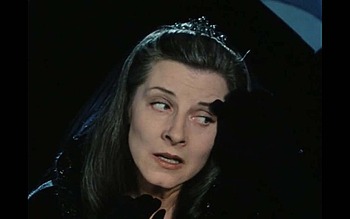
Following the recitative, the beginning of the aria introduces the section of the narratio (selective telling of the facts). The Larghetto part (in Mozart's meaningful key of G minor, 6/8) opens with a descending D–C–B♭–A–G motif that sets the tone for her plaintive melody.Footnote 79 Bergman draws our attention to this moment of introspection with a medium close-up of the Queen's face, which registers a wide range of emotions from sadness to anger, sorrow and despair. She expresses her current feelings verbally and recalls past memories, even turning to direct speech – the cries of ‘Help!’ in the high register – to underline how much she is still haunted by them. In addition, she resorts to carefully calculated gestures, such as staring blankly, closing her eyes and nodding her head. The result is the perfect image of a weak, powerless and grieving mother. The music embodies and makes manifest the Queen's emotions and memories: her sorrow through the descending melodic lines, Pamina's trembling through the offbeat semiquavers in the strings and the latter's cries for help echoed by the Queen. Her (apparently) absorptive state conveys a sincerity that runs counter to what she is doing – namely, performing. Tamino is fully taken in by her and does not notice her side-glance at him during the silence right before the last verse of this section of the aria (Figure 6). Bergman hears the Queen's trickery in the musical pause, and he stages it accordingly. Her side-glance is so subtle, however, that only the film audience (not the theatrical one) can notice this gesture via the medium close-up.
The Queen of the Night's performance (side glance at Tamino). (colour online)

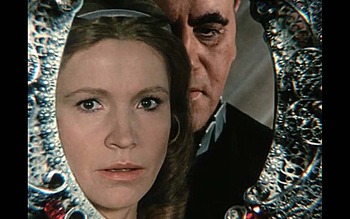
The final Allegro Moderato section depicts a completely different scene. After the mourning comes the resolution. The focus of attention shifts from the Queen's lament to her command to Tamino, and thus, we are back to B♭ major, and instead of the medium close-up focused on her face, we have an over-the-shoulder shot of both characters. While the first two lines of this last stanza express the main point of the whole passage (i.e., the Queen's command for Tamino to rescue her daughter), the aria concludes with what in rhetoric would be the peroratio (conclusion marked by emotional appeals to the audience). After making Tamino feel pity for her, she focuses on the reward: Pamina. The close-up of both Tamino's and the Queen's hands holding the locket, as well as the proximity of their faces, somehow gives presence to the otherwise absent Pamina. Leaving him fully absorbed in the portrait again, the Queen starts the coloratura passage in which language dissolves to give the musical sounds full prominence. The winding melodic design combined with the ascending scales that lead to the broken staccato chord seem to conjure up Pamina's cry for help in Tamino's mind. His furrowed brow makes visible what are otherwise images from his mind's eye. Bergman lets the cinematic audience partake in Tamino's thoughts through the moving images of Pamina and Monostatos that the locket magically displays (Figure 7).
Tamino's visualisation of Pamina and Monostatos as moving images in his locket. (colour online)

The aria concludes with the Queen veiling her face. She approaches Tamino until she touches his face with hers. For a moment the whole shot is darkened. The Queen engulfs both Tamino and the cinematic audience with her body and leaves him with a caress on his lips, an act that constitutes the sensual climax of the aria and corroborates the physical dimension that the music has summoned up.
Instead of diminishing the aesthetic experience, the display of artificiality in Baroque operas aimed at enhancing it. Bergman's audio-visual rendition of the first aria of the Queen of the Night is based not only on the allure of artifice, but also on the enhanced experience that being aware of artifice may entail. By displaying the artificiality that constitutes theatrical illusion in plain sight alongside its alluring power, Bergman allows the film audience to realise that artifice ultimately lies in the rhetoric and conventions used to manipulate human emotions, be they those of the characters on stage or of the theatrical and film audiences.
The magic of music
The inspiration for this article was Jerome Bruner's idea that ‘it is far more important, for appreciating the human condition, to understand the ways human beings construct their worlds … than it is to establish the ontological status of the products of these processes’.Footnote 80 As I hope I have made clear, it is precisely art's fictional status that accounts for the generative dimension of aesthetic experience through its inherent reflexivity. Aesthetic experience is constitutive because it requires the active collaboration of the audience.
My approach to the study of aesthetic experience is based on how it is articulated in artistic expression. In The Magic Flute, Bergman realised his figment of imagination through a film that delves into the experiential dimension of the operatic performance by using a special combination of theatrical and cinematic perspectives and by making the theatrical audience the main character of the film. Bergman's emphasis on the workings of illusion, his constant blurring of boundaries between fiction and reality, and his representation of the audience in the film perfectly illustrate the complexity and constitutive dimension of the aesthetic experience.
I have provided a theoretical account of the communicative and creative act triggered by artistic representations, and the basis of my analysis lies in the metatheatrical dimension of the film. I take the representation of the audience in the film as an instance of ‘objectified spectatorship’.Footnote 81 Such representation endows my analyses with at least a degree of denotation and objectivity. I consider films as expressions through which people articulate their own experiences and regard these culturally and socially constructed expressions not as mirrors, but as interpretive devices that render the experience of spectatorship intersubjectively available. The mediating role of the audience represented on screen far exceeds the role assigned to it by ‘spectator positioning’ theory (i.e., the target of identification processes on a par with other characters).Footnote 82 Through the deliberate use of triggers, the film activates the cinematic audience's awareness of their own status as audience. This allows them to reflect on their active engagement in the aesthetic experience as well as on the highly mediated nature of the representation on screen. Such representation provides a dramatic and communicative context in which the rendition of spectatorship in the film is situated and can thus be interpreted.Footnote 83
In The Magic Flute, Bergman invites everyone to adopt the innocent gaze and active imagination that are essential for the experience of theatrical illusion to take place. At the same time, at the end of the overture, he himself appears among the audience. He appears as a mature artist who knows how to create the magic – that is, he is fully aware of its artificial nature – but nevertheless keeps enjoying it. In his fully human take on the opera, Bergman seems to tell us that, in the end, notwithstanding the Baroque machinery, the crafted naturalness of a folk song, or the rhetorical theatricality of a performance, the magic of this opera really lies in the music itself and in how it triggers the audience's imagination. The magic of Bergman's own film, as distinct from the magic of the flute, lies in maintaining, or even enhancing the aesthetic experience, while revealing how theatrical illusion works. Instead of disenchantment, witnessing the workings of illusion strengthens its grip on us.