INTRODUCTION
The genus Histodermella was erected by Lundbeck, Reference Lundbeck1910 to include H. ingolfi Lundbeck, Reference Lundbeck1910, H. coriacea Lundbeck, Reference Lundbeck1910 and H. natalensis (Kirkpatrick, Reference Kirkpatrick1903). Dendy (Reference Dendy1924) added H. australis as a fourth species. Histodermella coriacea was later transferred to the genus Zyzzya and the concept of Histodermella was narrowed to contain Coelosphaeridae with heavily spined oxeas as megascleres (Van Soest, Reference Van Soest, Hooper and Van Soest2002). Accordingly the World Porifera Database (Van Soest et al., Reference Van Soest, Boury-Esnault, Hooper, Rützler, de Voogd, Alvarez de Glasby, Hajdu, Pisera, Manconi, Schoenberg, Janussen, Tabachnick, Klautau, Picton, Kelly and Vacelet2011) acknowledges three valid species in the genus Histodermella: Histodermella australis Dendy, Reference Dendy1924 from New Zealand waters in the South Pacific, H. ingolfi Lundbeck, Reference Lundbeck1910 from deep waters of the North Atlantic south of Iceland and H. natalensis (Kirkpatrick, Reference Kirkpatrick1903) from off the Tugela River mouth, KwaZulu-Natal, South Africa in the Indian Ocean. The genus Histodermella is a small genus with three members widely distributed over the world's oceans. This paper adds a fourth species of Histodermella which was collected in the Gulf of Alaska where it seems to be locally abundant and one specimen collected in the central Aleutian Islands. A recent review of all deep-water sponges known from Alaska is given by Stone et al. (Reference Stone, Lehnert and Reiswig2011).
MATERIALS AND METHODS
Specimens from the Gulf of Alaska were collected with a research trawl during annual fish stock assessment surveys. The Aleutian specimen was collected with a mechanical manipulator from the submersible ‘Delta' during an investigation of deep-sea coral habitat. Trawl-caught specimens were dried. The Aleutian specimen was kept frozen at −10°C and was later transferred to 95% ethanol. This is the largest specimen collected, better preserved as the dried specimens and was consequently chosen as holotype. Semi-thin sections were made with a razor blade, dried and embedded in Canada balsam. For spicule preparations sponge fragments were boiled in nitric acid, cleaned in distilled water and ethanol, dried and finally embedded in Canada balsam. For scanning electron microscope investigations dried spicules were coated with gold. An Amray 1810 was used for scanning electron microscopy. The systematic hierarchy follows the protocol of Hooper & Van Soest (Reference Hooper and Van Soest2002).
RESULTS
SYSTEMATICS
Phylum PORIFERA
Class DEMOSPONGIAE
Order POECILOSCLERIDA
Family COELOSPHAERIDAE
Genus Histodermella Lundbeck, Reference Lundbeck1910
Histodermella kagigunensis sp. nov.
TYPE MATERIAL
The type material is deposited at the Zoologische Staatssammlung (ZSM) in Munich. The holotype (ZSM20120233) is the largest specimen and stored in 95% ethanol. It was collected by Patrick Malecha on 4 July 2003 at 51°21.042′N 179°30.483′W in southern Amchitka Pass, approximately 26 km west-north-west of Amatignak Island, Delarof Islands in the central Aleutian Islands. This specimen was attached to hard rock substrate at a depth of 115 m, a water temperature of 4.9°C, and a salinity of 33.3 psu. Five dry specimens (paratypes: ZSM20120234, ZSM20120235, ZSM20120236, ZSM20120237 and ZSM20120238) were collected by R.N. Clark on 10 June 2005 at 54°35.389′N 158°47.106′W, near the Shumagin Islands in the Gulf of Alaska. These specimens were attached to pebbles collected at a depth of 155 m and a water temperature of 4.8°C.
DESCRIPTION
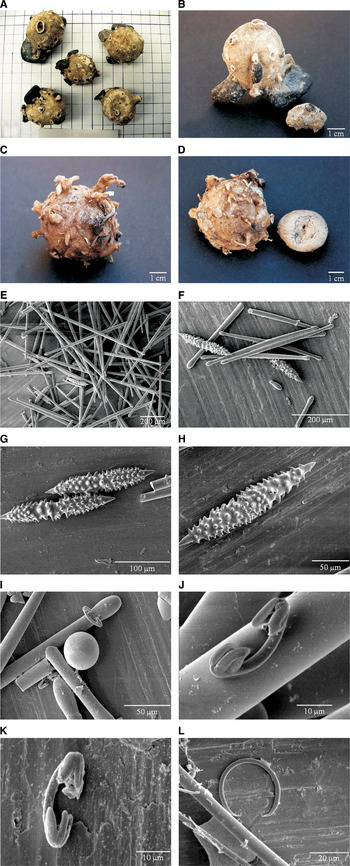
The sponges are ochre yellow to light brown (Figure1A–D), dried and in ethanol. The consistency is moderately inelastic and firm. The largest specimen (holotype Figure1C & D) has a maximum outer diameter without fistules of 46 mm. On its almost globular surface approximately 32 fistules arise to a maximum height of 38 mm; small fistules are only 3–4 mm high. Many fistules are broken and are hollow, intact fistules are closed. Outer fistule diameter may reach 6 mm with an inner diameter of 4.5 mm; small fistules have outer diameters of 2 mm. Fistules may be forked in the upper third or may branch off smaller, secondary fistules (Figure1C & D). Cross-sections are round to strongly oval. We cannot tell if the fistules bear oscules at the ends which contracted upon collection or if fistules are always closed. No other oscules are visible. The cavity of the hollow fistules is separated by a membrane from the choanosome or inner sphere of the globular ectosome. This membrane contains spicules of all categories without particular orientation. We cannot tell if this membrane closes when the sponge is disturbed or if this canal is always closed. Assuming a sphere-like surface of this largest specimen and evenly distributed fistules there is a surface area of 208 mm2 per fistule. The rough surface of the sponge is overgrown with a thin layer of bryozoans and a few brachiopods (Laqueus sp.) attached to fistules. The thickness of the wall of the outer bladder-like sphere is 1–1.5 mm, within the hollow interior is a smaller, roughly globular part of the sponge, which is unattached to the outer bladder in our preserved specimens, but must have had a, presumably weak, connection to the outer ectosomal part. Dry specimens rattle when shaken, due to the unattached, moving choanosome of the sponge. All parts of the sponge include all occurring spicule types but the size and abundance of categories differs between the ectosome and choanosome. Small-sized megascleres and microscleres are more abundant in the inner, choanosomal part of the sponge. The five dried specimens from the Gulf of Alaska (Figure 1A & B) are smaller (diameters from 29–39 mm) and appear more worn probably due to abrasion in the trawl net upon collection. There are no fistules visible on the surface of these specimens but, there are circular openings at the surface with slightly raised rims and it seems highly probable that fistules were attached there which broke off during collection. There are 15–20 assumed fistules on the surface of each specimen. The Gulf of Alaska specimens were all attached to small, black pebbles and we regard the side with pebbles as the ventral side of these specimens. The Aleutian specimen does not show any sign of attachment but was pried from hard rock substrate when collected.
(A) Five dried specimens from the Gulf of Alaska (paratypes). All are attached to black pebbles. Fistules are probably broken off because specimens were collected with a bottom trawl. Circular, slightly elevated rims are regarded as remnants of fistules. Grid size is 1 cm2; (B) one of the paratypes with attached pebbles. Choanosome removed from globular ectosome on the right. Base of fistules is closed with a membrane; (C) holotype from the Aleutian Islands. Different sized fistules, some branched, some broken; (D) holotype from the Aleutian Islands. No sign of attachment is visible but it was physically removed from hard substrate. Different sized fistules, some branched, are visible. Choanosome removed from globular ectosome of this specimen is pictured on the right; (E) large tylotes and acanthoxeas; (F) smaller tylotes with smooth tyles and acanthoxeas with smooth points, isochela on the right above scale bar; (G) acanthoxeas with smooth ends. Middle of spicules with fewer spines; (H) more heavily spined acanthoxea; (I) smooth heads of tylotes, isochela and siliceous sphere. Spheres are rare but present. They might be foreign bodies or malformations; (J) close-up of isochela; (K) arcuate isochela. Note furrow in upper frontal ala; (L) sigma. Sigmas are almost circular or C-shaped as the one shown here.

The arrangement of the tylotes in the outer parts consists of short polyspicular tracts lying in different directions in several layers with acanthoxeas and relatively few microscleres in between. The choanosome contains longer polyspicular tracts, often curved with many acanthoxeas and microscleres in between. The density of spicule tracts is much higher than in the inner parts. Spicules are tylotes (Figure 1E, F & I) with smooth ends, thickest parts of the shaft in the middle, 195–743.7–1187 × 9–22.4–32 µm, acanthoxeas (Figure1F, G & H) with large spines, sometimes curved and spineless points, 156–192.1–215 × 19–26.4–32 µm, arcuate isochelae (Figure 1J & K), 18–21.9–26 µm and thin sigmas (Figure1L), 23–27.1–36 µm. Sphere-like spicules (Figure1I) are rare, 39–41 µm in diameter and of unsure origin.
ETYMOLOGY
Most specimens of the new species were collected near the Shumagin Islands which were discovered in 1741 by the Danish navigator Vitus Bering (1681–1741) and named after Nikita Shumagin, a sailor who died of scurvy shortly before the discovery of the Island. The native Aleut people call this group of islands Kagigun. In honour of the Aleut people we name the new species Histodermella kagigunensis.
DISCUSSION
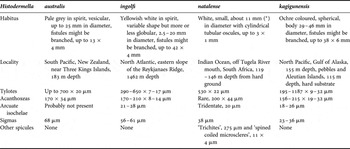
All four species (Table 1) of Histodermella are similar in colour, described as yellowish, whitish, ochre coloured or pale grey. All are more or less globular and have fistules which can be branched in all but H. natalense. Histodermella kagigunensis is the largest species; the smallest known specimens are larger than the largest known specimens of all other species. All species of Histodermella occur in relatively deep water, with a depth-range from 115–1462 m. All known species of Histodermella have tylotes of similar thickness but tylotes differ considerably in length amongst species with H. kagigunensis having the longest tylotes known within the genus. Acanthoxeas and isochelas are similar in dimensions in all known species with the exception of H. australis, lacking isochelas. Sigmas occur in two distinct size-groups within the genus: H. australis and H. ingolfi with large sigmas (56–68 µm) and a second group consisting of H. natalensis and H. kagigunensis with small sigmas (23–38 µm). Other spicule types only occur in H. natalensis. These unusual microscleres, described by Kirkpatrick (Reference Kirkpatrick1903), do not seem to fit into known categories of microscleres.
Characters of all species of Histodermella.

*, Dendy (Reference Dendy1924) p. 251 gives as size: ‘The free specimen is 11 µ in total length, …'. We assume this is a misspelling and he meant 11 mm. This is supported by the size of the largest tube (= fistule) which is given by 3 × 1 mm and by the fact that the spicules would not fit into a sponge of the size of 11 µm.
ACKNOWLEDGEMENTS
We thank Roger N. Clark and Patrick Malecha for collecting the specimens and William Austin for providing a first identification. H.L. was supported by a contract from the Alaska Fisheries Science Center of NOAA/NMFS. We thank the Institut für Prozessmaschinen und Anlagentechnik (IPAT), Universität Erlangen for providing access to a scanning electron microscope.