By the early twentieth century the centenary was a well-established cultural phenomenon. The Victorians had adopted, with growing enthusiasm, the French custom of celebrating the centenary of an event or of the birth, death, or chef-d'oeuvre of a national or local figure.Footnote 1 In particular, it had become a common form of civic celebration. It offered a vehicle for identifying a town or city with some major achievement, and an opportunity to introduce new secular ceremonies into urban cultures that had either lost their traditional and religious rituals or were too recent to have ever had any. The centenary (and its offshoots, the half-centenary, bicentenary and so on) quickly became such a regular event that some people thought its currency was in danger of devaluation. Already in 1881 an Edinburgh correspondent of The Times complained that since ‘the Burns centenary was observed in 1859 the custom of holding these festivals of the dead has grown rather too common in Scotland’.Footnote 2 By 1909 even Frederic Harrison, that great positivist proponent of heroic history and himself the organizer of several centenary celebrations, was pleading for restraint.Footnote 3 Some of the most spectacular events commemorated the lives and achievements of inventors and engineers. On 9 June 1881, for example, thousands of people from across the north-east of England and the south of Scotland flocked to Newcastle upon Tyne to celebrate the centenary of George Stephenson's birth with a full programme of processions, exhibitions and lectures, fireworks and feasting.Footnote 4 Even more ostentatiously, during three days in August 1912, Glasgow celebrated the centenary of Henry Bell's Comet, the Clyde's first steamboat. ‘Immense numbers’ of Glaswegians went to watch a ‘naval pageant’ of sixty vessels at the mouth of the Clyde, to which the Admiralty contributed a squadron of first-class battleships and a division of destroyers, all ‘inspected’ by a procession of boats from the city.Footnote 5
It was no surprise, therefore, when Birmingham announced that it would commemorate the centenary of James Watt's death on 25 August 1919.Footnote 6 In the previous century Watt had been widely celebrated as a British national hero, to an exceptional degree for a commoner and a civilian. He had become the quintessential inventor and engineer. His life and inventions were recorded in numerous histories and biographies. His features were familiar from a plethora of monuments, plaques and portraits. His name was in common parlance.Footnote 7 Birmingham's plans were highly ambitious. Not only would the city host a three-day festival of talks, exhibitions and lavish entertainments, but it would also launch a massive fund-raising drive which had as its primary aim the endowment of a research chair in mechanical engineering at the University of Birmingham. The former proved a great success, the latter a major disappointment. Despite enormous efforts and an outlay of £4,000, the campaign attracted less than 10 per cent of its target figure of £150,000. Birmingham's plans had to be severely scaled down.Footnote 8 With less fanfare the Institution of Engineers and Shipbuilders in Scotland (IESS) also used the occasion of Watt's centenary to raise an endowment for two ‘James Watt’ chairs in the engineering faculty of the University of Glasgow. By December 1920 over £30,000 had been subscribed.Footnote 9 Although more than double the amount that Birmingham raised, it was still £20,000 short of its target. Glasgow accordingly dropped its third objective, to refurbish the university's James Watt Engineering Laboratories.Footnote 10
If these financial disappointments provoked suspicion that the era of the centenary had past, the enthusiastic celebration in 1931 of the centenary of Michael Faraday's ‘discovery’ of electromagnetic induction undoubtedly quashed any such suspicion.Footnote 11 It was, however, a very different type of occasion, in both its goals and its programme of events.Footnote 12 While pageantry and spectacle were not entirely banished, there was much greater emphasis on educational activities, such as lectures, conferences, exhibitions and publications. Their reach extended through coverage in the press and on radio. Naturally the electricity companies were eager to promote their goods and services; professional scientists were equally keen to achieve recognition.Footnote 13 Rather than attempt to use Faraday as the figurehead of a fund-raising exercise, the scientists mounted a more subtle campaign for better funding. They seized the opportunity to educate policy-makers and the public not only about Faraday's specific discovery but also about the value to society of scientific research in general. In so doing, the rhetoric of leading scientists was forcefully articulating an ideology of innovation that, in replacing Watt with Faraday, elevated the importance of ‘pure’ science over both its industrial application and the engineering tradition that Watt had come to represent.
While important research on the history of scientific commemorations has been published in recent years, relatively little attention has been paid to the commemoration of invention and inventors.Footnote 14 Ironically, the political role that the scientists honed for Faraday's posthumous reputation in 1931 was similar to that which their predecessors had rehearsed for Watt's a century earlier in 1824, when men of science had joined with leading politicians to elevate Watt to the status of a national hero. On that occasion, Sir Humphry Davy, president of the Royal Society, had described Watt as ‘equally distinguished as a natural philosopher and a chemist’.Footnote 15 Both in 1824 and in 1931 they suggested that the demonstrable utility of their hero's investigation of natural phenomena should prompt the state greatly to increase its funding as a sure means to promote the nation's prosperity and power. By 1931 Watt's much-contested reputation had long been retired from that particular role. Now only rarely described as a ‘philosopher’ or ‘man of science’, he had ceased to be the doyen of the Royal Society.Footnote 16 As his centenary celebrations were to demonstrate, Watt's memory was now cherished primarily by the engineering trades and professions. Naturally it redounded to their credit to portray Britain's most famous inventor as an engineer and, in some quarters, a craftsman. Moreover, as we can see from the grandiose centenary celebrations of George Stephenson and Henry Bell, Watt's was by no means the sole engineering reputation to give currency to that image.
To many professional scientists, however, this prevailing image of the heroic inventor was both a travesty and a liability. Not only did they believe that this empirical engineering tradition obscured the important contribution of their own research to technical progress, especially in more theoretical fields, but in celebrating autodidacts and ‘self-made’ men it also tended to encourage complacency with regard to scientific and technical education. Furthermore, it threatened to undermine the purely intellectual pursuit of scientific knowledge, which they believed to be of cultural importance independent of any technical utility it might possess.Footnote 17
The early British Association for the Advancement of Science had struggled to accommodate engineers and industrialists within its ranks of amateur and academic philosophers. Having formed in 1836 a new section ‘G’ devoted pointedly to mechanical science, the BAAS disingenuously continued to boast of its members’ practical achievements.Footnote 18 ‘Technology was nurtured not only to embody an ideology about the relation between superior theory and subordinate practice, but also to render visible the Association's attachment to the idea of progress.’Footnote 19 Yet during its first few decades the BAAS did not undermine the glory of its inventive ‘practical men’ – if practice were both dependent on and subordinate to theory, nonetheless invention was acknowledged to be an achievement in its own right, demanding specialist skills that the theorists lacked. This changed in a subtle but important way. From the 1860s some leading men of science (mostly physicists) resumed the campaign for increased state and private provision for science.Footnote 20 Their rhetoric tended to downplay, even disparage, the role of the ‘mere’ inventor who lacked a scientific education. Growing use of the term ‘applied science’ threatened to overtake ‘invention’. When the BAAS celebrated its golden jubilee in 1881, Sir John Lubbock's presidential speech exhaustively surveyed the progress made in every branch of science during the previous fifty years. This included, said Lubbock, ‘the innumerable applications of science to practical life – as, for instance, in photography, the locomotive engine, the electric telegraph, the spectroscope, and more recently the electric light and the telephone’.Footnote 21
Subsequent presidents of the BAAS went further. They began to reiterate William Whewell's assertion, first made nearly half a century earlier, that scientific research was valuable in its own right and should be promoted irrespective of its immediate practical ‘application’. In any case, they assured the public, the latter would inevitably follow in its wake. In 1885 Sir Lyon Playfair prioritized the teaching of science over technology ‘because, when the seeds of science are sown, technics as its first fruit will appear at the appointed time’.Footnote 22 Six years later Oliver Lodge suggested that ‘practical applications [could] … be left to take care of themselves’. These were the mundane, minor pickings, he said (quoting T. H. Huxley), the ‘flotsam and jetsam of the tide of investigation’ that kept workers employed, capitalists wealthy, and the population as a whole contented; meanwhile, ‘the crest of the wave of scientific investigation is far away on its course over the illimitable oceans of the unknown’.Footnote 23
That same year, 1891, happened to be the centenary of the birth of Michael Faraday. As we shall see, leading men of science finally recognized the potential value of Faraday's reputation to their campaign. They began to present him as the quintessential experimenter whose ‘blue-sky’ research, conducted with no utilitarian intent, lay at the heart of modern technology, epitomized by electricity. At last they had found a powerful icon with which to challenge the engineers.Footnote 24 In 1931, with the recently constructed national grid extending electrical power to homes and businesses throughout Britain, their successors cast Faraday, born in 1791, as the personification of modernity, the pure scientist responsible for ‘the fuel of the future’ and the brighter, happier, more prosperous tomorrow that it seemed to promise.Footnote 25 It was a trick that Watt's supporters in 1919 had missed.
The Watt centenary in Birmingham, 1919
First let us give a brief résumé of Birmingham's campaign to commemorate the Watt centenary. The collective memory of the British engineering community had been jolted in 1914 by Professor Conrad Matschoss, the German author of a two-volume work on the history of the steam engine. But any centenary projects that his promptings had initiated were stalled by the outbreak of war.Footnote 26 In February 1919 the initiative came instead from the West Midlands branch of the Junior Institution of Engineers (JIE). Their prime mover was William Mills, a local engineer who had arrived in Birmingham from Teesside in the 1890s. During the First World War his company (Mills Munitions Ltd) had significantly improved the hand grenade, a recent Belgian invention, and manufactured it in massive quantities for the British army. This was to secure him a knighthood in 1922.Footnote 27 Between 1919 and 1921 Mills devoted a major part of both his time and his fortune to the Watt centenary campaign. His donation of £1,000 was by far the highest from an individual, matched only by the four largest corporate donations. The JIE intended to erect an international memorial to Watt which would, in Mills's hubristic words, ‘make Birmingham to Watt what Mecca was to Mahomet and Stratford to Shakespeare’.Footnote 28 A public meeting attended by over two hundred people in May 1919 heard their proposals outlined by Mills and seconded by Sir Oliver Lodge, who had been principal of the University of Birmingham since 1900.Footnote 29 It proceeded to elect a large general committee, comprising representatives of a wide range of engineering and scientific bodies (headed by the Royal Society, the Institutions of Civil, Mechanical and Electrical Engineers, and the Institution of Engineers and Shipbuilders in Scotland) and of the cities and universities of Birmingham and Glasgow.Footnote 30
The formal celebrations were scheduled for 16–18 September with a view to using them as a springboard for the financial appeal. Birmingham was well supplied with Watt ‘relics’ around which to develop a programme of activities. The commemoration was to be inaugurated by a civic ceremony and a morning of lectures. After lunch, ‘a special choral service’ would be held in Handsworth parish church, the burial place of Watt, Matthew Boulton and William Murdoch. Visitors could then inspect the imposing statue of Watt, commissioned from Francis Chantrey in 1820 by his son, James Watt Jnr. There would be a garden party in the grounds of Heathfield Hall (Watt's home for nearly thirty years) and a rare opportunity to view the garret workshop, which had remained undisturbed since Watt's death.Footnote 31 The second day's programme would consist of lectures on ‘the history and development of the application of science to industry’, followed by visits to three Watt engines in the Birmingham area, before a dinner to be hosted by the lord mayor.Footnote 32 The final morning was to start with a visit to the Soho Foundry, formerly the dedicated engine foundry opened by Boulton and Watt in 1796 in order to manufacture the majority of their engine parts and occupied by the firm until its demise in 1894. It would conclude with a visit to the exhibition in the Birmingham Art Gallery of Watt engine drawings, manuscript correspondence, portraits and artefacts both personal and professional that had belonged to Watt and his associates.Footnote 33 Everything apparently went smoothly. Indeed it was so uneventful and conventional that Pathé destroyed the film it had made ‘because nothing sufficiently important took place to be of value to them’.Footnote 34
Both the midweek timing and the high price of admission to these events (a suggested ‘contribution’ of £2 10s.) are indicative of the social classes at which they were targeted. The ‘List of visitors’ printed at the back of the centenary programme confirms their elevated social standing. Many of these 250 official visitors subsequently subscribed to the appeal, which by January 1921 had raised £14,035. It was a respectable sum by contemporary standards.Footnote 35 Over one-third of the total came from five gifts of £1,000, four of them corporate (two local, two national).Footnote 36 A further thirty-eight donations of at least £100 were responsible for 46 per cent of the total, and eighty-eight of £10 to £100 accounted for 16 per cent; the majority of donations – 156 of less than £10 – provided the remaining 3 per cent. Most major donors were firms in the heavy-industrial sector – shipbuilders, engineers, iron- and steelmakers, railway companies – based principally in Birmingham and the West Midlands. Overall, however, the committee was disappointed by the lack of local support, referring more than once to Birmingham's ‘apathy’.Footnote 37 In all there were 184 individual donations (the majority of £10 or less) and eleven from engineering societies (three of them based overseas), headed by the American Society of Mechanical Engineers, which raised £262 10s. Apart from the generosity of the ASME, the appeal had looked in vain across the Atlantic; its approach to Henry Ford, for example, was politely brushed off.Footnote 38 The sixth-largest subscription was a collective £608, from the engineer-in-chief of the Fleet and engineering officers of the Royal Navy. It had been orchestrated by Engineer-Captain E. C. Smith, who was subsequently the author of a book and many articles on the history of engineering.Footnote 39 As expected, the engineering officers apparently appreciated the importance of Watt's role in bringing the steam-powered Navy ‘to its present state of efficiency and power’.Footnote 40
There is, however, another side to this story. Saturday 20 September was a day for working men and their families. The official programme announced ‘A procession’ marshalled by Birmingham's engineering trade unions. It would be headed by ‘a model of a James Watt engine’, closely followed by members of the centenary committee and ‘representatives of engineering science’. Following well-established traditions the trade unions were to march behind their banners to the sound of brass bands, displaying their machinery, tools and products. There would also be ‘tableaux … depicting the processes of manufacture’ and the impact of machinery on industry. The procession was to terminate in the Botanical Gardens, where one shilling would secure admission to a gala of ‘bands, entertainments, and numerous other attractions’.Footnote 41
This procession almost certainly contained the majority of Watt's most devoted disciples in Birmingham and the West Midlands. By far the largest category of donors to the appeal comprised workers in engineering and metalworking firms throughout the Birmingham region. Their financial contribution was omitted from the official subscription list because it was by purchase not by subscription. Local firms had readily agreed to the centenary committee's request to allow workplace sales of commemorative ‘flags’ or ‘bannerettes’ at 2d. each. These sales raised a total of £218 1s. 6d. At 2d. each, this translates into over 26,000 individual purchases. Nor was 2d. a trivial sum in 1919; skilled engineering workers were earning £4–5 per week and feeding their families for approximately £2 per week.Footnote 42 Whatever feelings of pride or gratitude may have motivated these workers to contribute to the commemoration of James Watt, it is evidence not only of their continuing awareness of the man and his inventions but probably also of the persistence of a mid-nineteenth-century phenomenon, the importance that many skilled working men attached to the achievement of heroic status for certain inventors and engineers.Footnote 43 They were the successors of those working men who, in 1868, were credited with being responsible for ‘no small share’ of the subscriptions that commissioned Alexander Munro to sculpt the statue of Watt for a site outside Birmingham's town hall.Footnote 44 The subtext of such commemorations for men of both generations was a demand that their own contribution to the nation's prosperity be recognized, that it was the skills and ingenuity of working men, with Watt as their cynosure, that made Great Britain ‘great’, in peace as well as war.
Watt commemorated in Scotland
The other centre of interest in Watt was in Scotland, especially Glasgow. It had been in Glasgow that Watt, then instrument-maker to the university, had conceived the idea of the separate condenser to improve the fuel efficiency of the atmospheric (‘Newcomen’) engine. In 1824 the citizens of Glasgow mainly ignored the national campaign to commemorate Watt in Westminster Abbey. Instead, they subscribed nearly £3,500 to commission their own bronze statue of him from Francis Chantrey, which was unveiled eight years later in George Square.Footnote 45 All Glasgow's subsequent statuary of Watt resulted from private acts of homage. By 1900 seven of the city's buildings and a full-size model of a beam engine in West End (Kelvingrove) Park commemorated the man and his most famous invention.Footnote 46 Glasgow's engineers helped to preserve Watt's memory with their annual ‘James Watt Anniversary Dinner’.Footnote 47 The University of Glasgow also continued to celebrate its historical connection.Footnote 48 Tickets for the honorary degree ceremonies, which marked the University's 450th anniversary in 1901, carried portraits of Watt and of Adam Smith – both were the subject of laudatory orations; Watt's was delivered by Lord Kelvin.Footnote 49 As Kelvin proudly but erroneously stated, in about 1843 Glasgow had become the first university in Britain (and ‘perhaps the world’) to have a school and a chair of engineering. He expected it soon to have a new building, ‘the James Watt Engineering Laboratory’.Footnote 50 It was presumably this heritage that facilitated the campaign in 1919 to fund the two new chairs in engineering.
Further down the Clyde, Greenock, Watt's native town, benefited repeatedly from its association with him and cultivated his memory assiduously. Having raised a subscription of £1,703 for a marble statue by Chantrey in the 1820s, the town was rewarded with a gift of £2,000 from James Watt Jnr, to build a library that would house it properly.Footnote 51 The Greenock Literary Society, founded in 1813, changed its name in 1820 to the Watt Club and started to organize an annual ‘public commemoratory dinner’.Footnote 52 When it discovered that the ‘Greenock Tavern’, where it held its meetings, was the site of the great man's birthplace it persuaded the tavern-keeper to rename his premises the ‘James Watt’.Footnote 53 In 1856 the club published a laudatory biography and announced plans to erect a two-hundred-foot campanile in testimony ‘to the genius of Watt’.Footnote 54 The newly established Greenock Philosophical Society (1861) held a conversazione and exhibition in honour of Watt's birthday; from these sprang a museum (‘now an integral part of the Watt Institution’) and the Watt Anniversary Lecture given by a succession of scientific luminaries, eminent engineers and shipbuilders.Footnote 55 The society's long-running ambition to erect ‘a suitable international memorial to James Watt, in his native town’, eventually caught the imagination of Andrew Carnegie, the émigré steel magnate turned philanthropist. A great admirer and biographer of Watt, Carnegie funded the establishment in Greenock of the James Watt Engineering and Navigation School.Footnote 56
In short, the west of Scotland aspired to closer and stronger links with Watt's reputation than did Birmingham. There civic and professional pride was enhanced by his place in the national pantheon. He was still regarded as a Scottish hero whose deeds claimed the gratitude of Britain and its empire. Throughout the nineteenth century he represented a pinnacle of Scottish achievement, the most tangible expression of what Scotland contributed to the union of nations that since 1707 was Great Britain.Footnote 57 Moreover, the region's heavy industry comprised a much higher density of potential contributors from firms engaged in engineering and shipbuilding than did Birmingham's diverse manufacturing economy, where far fewer firms had direct links to steam technology. If in Scottish eyes Watt remained ‘a celebrated natural philosopher and civil engineer’,Footnote 58 elsewhere in the United Kingdom by 1919 he normally personified the Smilesean concept of the inventor: the skilled craftsman, probably from one of the engineering trades, who, perhaps with a smattering of science, develops a new machine or tool. It was an image perpetuated by the title of H. W. Dickinson's biography, James Watt, Engineer and Craftsman (1935).Footnote 59 Watt's scientific interests and achievements, which Davy had trumpeted in 1824 and which his supporters in the nineteenth-century ‘Water Controversy’ had assiduously defended, were now generally overlooked except by professional engineers, whose education and practice were increasingly rooted in university-based engineering science.Footnote 60
Electricity, the missing connection
There was an obvious reason why both financial appeals missed their targets: bad timing. First, the Great War had only just ended. Following the armistice in November 1918 commemoration of the fallen became a major preoccupation in towns and villages throughout Europe and other combatant countries across the world. The local war memorial was about to become a ubiquitous testimony to loss and grief.Footnote 61 Not only were financial resources and emotional energy being directed to this collective commemoration everywhere in the UK, but the sharp downturn in the national economy would have vitiated any fund-raising drive between 1919 and 1921. These years saw the fastest plummet into depression in British history; hardest hit were the export industries, including engineering and shipbuilding, which laid off a quarter of their workforce.Footnote 62 As the chairman of Birmingham's committee, William Mills, wrote in 1921, ‘a tremendous slump in finance has crippled all efforts’.Footnote 63
There may also have been a serious problem at the heart of Birmingham's fund-raising campaign: its aims were ill-defined and unconvincing and its publicity ineffective if not offensive. The official brochure, issued in the autumn of 1919, specified a tripartite ‘international memorial’: first, the endowment at Birmingham University of the James Watt Chair ‘for the promotion of Research in the fundamental principles underlying the production of Power, and the study of the conservation of the natural sources of energy’; second, a James Watt Memorial Building with the dual purpose of a museum to house the artefacts of Watt, Boulton and Murdoch and ‘a meeting-place and library for Scientific and Technical Societies’; and third, ‘the publication of a Memorial Volume’.
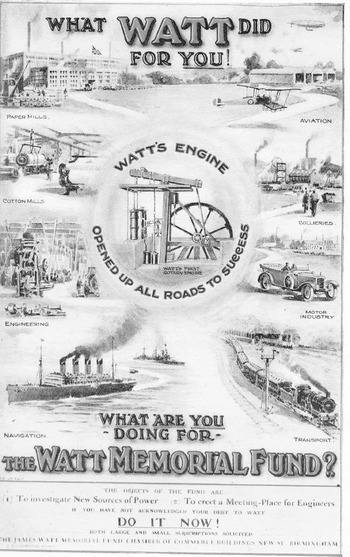
‘What WATT did for YOU!’ shouted the twenty thousand promotional leaflets that Birmingham distributed (Figure 1).Footnote 64 Illustrated with coloured pictures of major industries that relied on steam power, the leaflets demanded to know ‘What are YOU doing for the WATT MEMORIAL FUND?’, and ordered, ‘If you have not acknowledged your debt to Watt, DO IT NOW!’ A crude appeal to the duty of the engineering community, they read today as an insensitive near replica of the recruitment posters that had recently shamed so many young men into volunteering for military service. Overleaf, the text explained the rationale for the campaign's appeal to raise £150,000, in terms primarily of the necessity to emulate Watt's achievement, to discover new sources of energy ‘by systematic research’. It played again on readers’ sense of duty, enjoining them in the language of the wartime recruitment campaigns to ‘do your share to safeguard yourself and posterity’, and ended with another uncomfortable resonance: ‘Lest you forget, this Appeal is made TO YOU.’Footnote 65 The leaflet's emphasis on duty, gratitude and necessity was at the expense of another more attractive feature to which it might have appealed instead – the excitement of discovery and invention. Supervised probably by a committee of engineers and not as it might now be by a professional designer, the publicity failed to inspire subscribers beyond a narrow engineering constituency.Footnote 66
Publicity leaflet issued by the Watt Memorial Committee, Birmingham, 1919.

There is, moreover, a strange omission from a campaign whose primary aim was to promote research into ‘the fundamental principles underlying the production of Power’: there is no mention, not even a hint, of electricity – reputedly ‘the fuel of the future’. It is especially remarkable that the leaflet made no reference to the crucial role of steam power in generating electricity, since Birmingham's appeal enjoyed the support of Sir Charles Parsons, the patentee and manufacturer of steam turbines.Footnote 67 The promotional illustrations showed an early Watt engine surrounded by paper mills, cotton mills, an engineering workshop, collieries, land and maritime transport (a locomotive, and an ocean liner with a battleship in the background) and, more tangentially, aviation and the motor industry, two other symbols of modernity that used a different generic power system, the petrol engine. But they did not illustrate electricity. The style was conventional, unimaginative and dehumanized. There are only a few, tiny and barely noticeable male industrial workers and the ‘motor industry's’ chauffeur – its design was redolent of the late Victorian or Edwardian period. Its iconography represented ‘the triumph of engineering’, production and war-fighting capacity, not consumption and the ‘brave new world’ of the 1920s.
The text also had a Victorian flavour and begged major questions. It repeated laudatory phrases that were far more questionable than when they had been coined a century earlier. Was it still conceivable that the benefits of Watt's improvements to the steam engine ‘have never been equalled, before or after that time’? Moreover, if it were indeed the case that the greatest problem that Britain faced ‘in the race for industrial efficiency and supremacy’ was ‘undoubtedly “cheap power”’, the omission of electricity is all the more surprising. Some economists may have worried about the long-term viability of Britain's coal reserves, from which most of the country's electricity was generated using steam turbines, but that was scarcely sufficient reason to continue as though there still existed no alternatives to Watt's beam engines: ‘Nature has given us unlimited resources, but at present she keeps her secret. However engineers are convinced that by systematic research other sources of Energy will be tapped.’Footnote 68 By contrast, Glasgow identified itself unambiguously with modern technology – one of its two projected ‘James Watt’ chairs would be in electrical engineering.Footnote 69
Some potential donors had already expressed disquiet. The vice-chancellor of Oxford University had refused to endorse the scheme. He queried ‘in what sense it would be international’.Footnote 70 Viscount Weir, the Scottish industrialist and minister in Lloyd George's wartime government, had questioned ‘the necessity for any permanent memorial’. Weir doubted that ‘it would in any way deepen the veneration and respect with which the name of James Watt is regarded’. There were already memorials to him in several cities, including Birmingham, and any attempt to raise a national or international memorial would fail, he predicted, ‘owing to the equally legitimate claims of other districts’, not least Glasgow.Footnote 71 We might discount Weir's dissent as lacking objectivity, but similar concerns were subsequently voiced by Professor Charnock of the Bradford Engineering Society in justifying that society's unenthusiastic response to the appeal. Not only did Charnock consider a chair an unsuitable memorial, since its origin would in course of time ‘be overlooked, if not forgotten’, he also reported having met with the frequent objection among his members ‘that Birmingham is rich enough to provide for its own University, and that what is wanted is a memorial of a national character’.Footnote 72 Such reservations were no doubt strengthened when Heathfield Hall came on the market in October 1920. The urge to preserve it prompted some members of the committee to propose that the second objective be amended to allow it to become the memorial building and museum of Watt's life and work.Footnote 73 To other supporters this smacked even more of a purely Birmingham function: two miles from the city centre, Heathfield Hall could not be regarded as providing a viable national, let alone an international, meeting place for the engineering profession.Footnote 74
Watt's devotees in Birmingham had failed to detect some significant cultural shifts, not least of course the general need to cope with the traumatic aftermath of total war and perhaps the widespread rejection of the Victorian era, which had begun even before the queen had died and was now becoming stronger under the influence of the Modern Movement.Footnote 75 The goals of their fund-raising campaign were ill-conceived and their publicity inept. Glasgow, by contrast, was able to draw on both well-established civic loyalties and a revival of nationalist fervour which still looked to Watt as one of its heroes. This strong local and national identification was sufficient to overcome the difficult financial circumstances that further undermined Birmingham's aspirations. Birmingham could afford neither the endowment of a chair nor the construction of a memorial building. Heathfield Hall, having been offered for sale to interested parties, was demolished and Watt's workshop rescued by the Science Museum in South Kensington.Footnote 76 After many deliberations the committee used £5,000 to endow a research fellowship at the University of Birmingham.Footnote 77 The only part of Birmingham's original ambitious, tripartite scheme to be fully achieved was the memorial volume, produced in 1927 by H. W. Dickinson and Rhys Jenkins. James Watt and the Steam Engine remains an authoritative, classic work, a scholarly monument to the great inventor–engineer, though it was published so long after the centenary that probably few people were aware of its provenance.
The Faraday Centenary, 1931
The centenary of Michael Faraday's ‘discovery’ of electromagnetic induction in 1931 was of a quite different nature. It was metropolitan, intellectual and very carefully crafted to present scientific research in a positive and patriotic light. Its audience was to be educated in the benefits of electricity and science generally, not exhorted to reach into their pockets. Not only did the electricity industry seize the opportunity to promote its products, but academic scientists astutely pressed the centenary into service, with a view, as ever, to eliciting more financial support from the state.
There were, indeed, three centenaries for scientists to celebrate in 1931: it was a hundred years since both the birth of James Clerk Maxwell and the foundation of the British Association for the Advancement of Science, but Faraday's discovery stole the limelight. The Times published an eighteen-page ‘Faraday’ supplement and, in a leading article, emphasized the importance of his discovery of electromagnetic induction:
on it is founded the whole fabric of modern electrical engineering. If it had never been made, the part played by electricity in the service of civilized life would be only the shadow of what it is today, and many vast industries that minister to the needs of man, in providing him with light and power, in transporting him from place to place, in enabling him to speak to the ends of the earth, and in many other ways, would not be in existence.Footnote 78
The supplement's front page featured a large portrait of Faraday and two imaginary scenes of him at work, one lecturing at the Royal Institution, the other in his laboratory. On an inside page it reproduced Faraday's portrait from the painting by Thomas Phillips, surrounding it with a border of electrical coils. At the top, it added drawings of a generator and electricity pylons; at the bottom were an electric train and a ship. It was a technological hero's ‘laurel wreath’, comparable to that with which the Illustrated London News had mourned the death of I. K. Brunel in 1859. Real laurel wreaths were placed on Faraday's tomb in Highgate Cemetery, in a ceremony led by representatives of the Royal Institution and the Institution of Electrical Engineers.Footnote 79
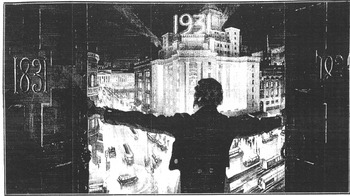
The most eye-catching part of the supplement was the full-page advertisement placed by the Incorporated Association of Electric Power Companies (IAEPC) on behalf of fifteen regional electricity supply companies (Figure 2).Footnote 80 The contrast with Birmingham's publicity leaflet is stark: the iconography is bold and dramatic; the text, in a few punchy sentences, sets out the electric power companies' function, achievements and future prospects. A drawing of Faraday throwing open the doors (numbered 1831) onto the brightly lit London streets of 1931 dominates the page. The date is in enormous lights atop the building in the centre of the picture, from which floodlights illuminate the night sky. Far below, an orderly procession of electric trams interspersed with a few motor vehicles glides along the glowing streets. With this advertisement the IAEPC was seizing the opportunity presented by the centenary to address the major restraint on the electricity industry's expansion, which had been pinpointed by the Weir Committee in 1926: the neglect of its ‘commercial side’ and the necessity to stimulate demand.Footnote 81 While encouraging the readers of The Times to consider the electrification of their homes, the IAEPC was also seeking to improve the corporate image of the electricity suppliers, which had incurred the outrage of many people who deplored the visual impact of transmission lines carried on pylons across previously unspoilt countryside, erected when the national grid was constructed in the 1920s.Footnote 82 A second drawing at the bottom of the advertisement shows a beautiful, wild landscape of hills and lakes, through which runs a shining line of disingenuous telegraph wires – a familiar and uncontested sight – rather than the controversial pylons.
Advertisement placed by the Incorporated Association of Electric Power Companies in The Times, 21 September 1931, to mark the centenary of Faraday's ‘discovery’ of electromagnetic induction.

The Times announced the remaining programme of commemorative events. Already, London had been floodlit spectacularly for three weeks, ‘one aspect of the immense superstructure of applied invention that has been erected upon the foundation of his researches’.Footnote 83 That evening the ‘Faraday Celebration’ at the Queen's Hall, featuring various speakers and music from the BBC Symphony Orchestra, would be broadcast on the wireless (itself, of course, another aspect of that ‘immense superstructure of applied invention’). Over the next ten days there was to be a Centenary Exhibition at the Royal Albert Hall organized by the Royal Institution and the Institution of Electrical Engineers. The Wellcome Historical Medical Museum had erected a reproduction of Faraday's laboratory and there would be displays both of personal relics and of representations of ‘the manifold applications of [his] electrical and chemical researches’. A week of talks and soirées was being held which would culminate in a dinner hosted by the government and addressed by the prime minister, Ramsey Macdonald.Footnote 84
From this matrix of spectacle and education Britain's elite scientific institutions seized the occasion to communicate to policy-makers and the public the importance of their research. In particular, they used the example of Faraday to insist that ‘pure science’ was ultimately, if neither immediately nor obviously, of fundamental economic value. Approximately one-third of the Times supplement was devoted to a series of articles by specialists who explored the development of different sectors of the electrical and chemical industries and reiterated the point that industry was increasingly dependent on scientific research. Among the most explicit was the physicist Sir Richard Gregory: ‘The characteristic of the new age is the utilization in industry of principles, properties and products revealed by scientific research, whether carried on solely in the pursuit of knowledge or with a practical purpose in mind.’Footnote 85 A few days later, at a service in Westminster Abbey, ‘attended by distinguished men of science’, the Cambridge physicist Sir J. J. Thomson unveiled memorial tablets to Faraday and Maxwell. These were in the nave, beside the tombs of Newton and Lord Kelvin, near to what was rapidly becoming ‘Scientists’ Corner’.Footnote 86 Thomson's speech promoted the importance of ‘researches in pure science … [for] our industries and … the amenities of life’. He contended that in the current context of mass unemployment it was important to remember ‘what the patient research for scientific truth, without any thought of industrial application, had done in creating new industries and thereby creating employment’. Thomson's speech cannot have endeared him to the engineers, who were sponsoring many of the celebrations. He suggested that, while research directed to improving the efficiency of existing processes always tended to reduce employment, ‘a new industry required new men to work it’. This crude distinction allowed him to conclude triumphantly that there was ‘a kind of battle between the men of pure science, who were establishing these new industries, and the engineers, who were improving the old ones’ and implicitly bore some responsibility for mass unemployment.Footnote 87
Faraday, the pure scientist
It was not a new role that the physicists had discovered for Faraday. By 1931, indeed, it was at least forty years old. Their rhetoric at the centenary celebrations of his birth in 1891 had been calculated to demonstrate the utilitarian value of ‘pure’ science. As the Times editorial remarked,
It was the burden of Sir William Thomson's and Sir Gabriel Stokes's speeches … that Faraday loved science for the sake of science … All of us are now enjoying the material results of Faraday's researches. The electric light, the telephone, the Atlantic cable, are the direct outcome of his patient experiments. But … his eye was fixed upon truth itself, and not upon the useful results that might come from the knowledge of it.Footnote 88
Punch published a cartoon entitled ‘A scientific centenary’ that gently satirized the grandiosity of the claims being made for ‘science’. It depicts Faraday the laboratory chemist, at a bench with test tubes and retort beside him, ‘encountering the ubiquitous wonders of late Victorian electro-technology’. Behind him are a microphone, a telephone and a map of the global telegraph network. He is listening to Edison's phonograph and saying to the classical figure before him, ‘Well, Miss Science, I heartily congratulate you; you have made marvellous progress since my time!’Footnote 89 However, Faraday's iconic role as the pure scientist at the heart of modern electrical technology could hardly be better encapsulated than in Sir Norman Lockyer's paradoxical remark in Nature in 1903: ‘Years ago we had Faraday apparently wasting his energies and time in playing with needles; electricity now fills the world.’Footnote 90 Never before had there been such a material manifestation of the utility of disinterested scientific research that could be associated with a man of Faraday's towering reputation. Unlike Watt, whose philosophical researches were stimulated by a technical conundrum and subsequently materialized in his own industrial enterprise and fortune, Faraday had famously decried the profit motive and sacrificed wealth to the selfless quest for knowledge.Footnote 91
Although even during his lifetime senior fellows of the Royal Society recognized the value to the wider scientific community of Faraday's public image as ‘the hero of chemistry’, this was at first of a different tenor to what it subsequently became in the hands of the physicists.Footnote 92 Faraday's death on 25 August 1867 (exactly forty-eight years after Watt's) prompted the rapid publication of a number of books and articles, including John Tyndall's biography, whose ‘Romantic construction of Faraday’ presents him as ‘the exemplary pure scientist’.Footnote 93 An appeal to the government for a state-funded memorial having been rebuffed as it had also been in Watt's case, a public meeting was called in June 1869 in the theatre of the Royal Institution to launch a subscription for a memorial. The chair was taken by the Prince of Wales and the elite of British science turned out in force.Footnote 94 The speeches emphasized Faraday's personal qualities and his ‘genius’. Nothing hinted at his future appropriation for the cause of ‘pure science’. By February 1870 only £1,400 had been subscribed, ‘chiefly among men of science’, which led the Medical Times and Gazette to reflect that ‘this is all the present generation of Englishmen seem inclined to do to perpetuate the memory of the greatest philosopher of their time’.Footnote 95
It may have been a lawyer who inadvertently alerted the physicists to Faraday's iconic value. John Coryton's all-out attack on the patent system in 1874 used Faraday as the prime example of the ‘patient and unselfish workers’ in scientific occupations, who were responsible for ‘discoveries of great principles’. Such men, said Coryton, were the ‘true improvers of our manufactures’ and it was to them ‘that the patentee is indebted for the invention of which he has obtained the exclusive use’.Footnote 96 He advocated the abolition of the patent system as the first step to ‘marshalling our scientific power’ and to employing men such as Faraday where they would be most effective.Footnote 97 Coryton's argument was echoed in an editorial in The Times in 1880:
Men of science have, perhaps, most reason to complain. What ingenious chemist has not seen his ideas utilized by others and become the basis of a lucrative patent? … It is not wonderful that men of science grumble much at the patent law when they see it so often rewards, not the discoverer or the ‘true and first inventor’, but the copyist, imitator, or plagiarist.Footnote 98
A shift in the public perception of the relationship between ‘invention’ and ‘science’ was occurring during the final quarter of the nineteenth century. It is visible primarily in the increasing use of the terms ‘applied science’ or ‘practical applications of science’ instead of ‘invention’ and in a range of contemporary comments.Footnote 99 According to The Times, for example, the role of the International Inventions Exhibition of 1885 was ‘not to bring together a mere collection of models of inventions, but rather to illustrate the progress which has been made in the practical application of science during the past twenty years’.Footnote 100 The inventor disappeared completely from view when Benjamin Kidd pronounced that since ‘the beginning of the century applied science has transformed the world.’Footnote 101
The success of the scientists' takeover of the credit for industrial innovation is demonstrated in the recommendation of the Committee on Natural Science Education in 1918 that science lessons for 16–18-year-olds should include ‘the lives and work of scientific men, for example, Leonardo da Vinci, Galileo, Newton, Lavoisier, Cavendish, Faraday, Clark Maxwell, Kelvin, Pasteur, Darwin, Helmholtz’, and ‘the bearing of scientific invention on industrial progress’.Footnote 102 The ‘pure’ scientists still needed to be on their guard that in ‘applied’ science's elimination of the ‘mere’ inventor they too did not fall by the wayside. While the Commission for Education had found no place for Watt, it was vital that Faraday should be regarded as the figurehead of ‘pure’ science, his research conducted with no technological goal in view. In 1931 academic physicists played a major role in staging the centenary of his discovery of electromagnetic induction in order to press that image home.
Conclusion
English engineering institutions rallied to Birmingham's call in 1919, as did engineers overseas and in the Navy. Watt remained one of the heroic founders of their profession, resonant equally with its mechanical, civil, electrical, mining and naval branches. He also continued to be held in high regard among skilled working men in the engineering trades. Both groups made financial sacrifices in order to perpetuate Watt's memory, but the cause failed to resonate far beyond engineering circles. In Scotland both national and local pride in Watt probably extended the range of donors more widely and helped to make the financial appeal more successful than Birmingham's. Nonetheless, it was again the engineering profession, under the aegis of the IESS, that had taken the initiative. And so it was to continue: in 1969 the Institution of Mechanical Engineers promoted the bicentenary celebrations of Watt's patent for the separate condenser (and of Arkwright's for the water frame) in both Birmingham and Glasgow. In Glasgow the historian Eric Robinson gave the commemorative lecture, entitled ‘James Watt, engineer by act of parliament’; the remaining papers at the two-day symposium discussed ‘condenser technology’.Footnote 103
Many famous nineteenth-century inventors had been engineers. At their head was ‘the immortal Watt’. By the late nineteenth century, however, professional scientists had begun to appreciate the propaganda value of promoting an alternative model of innovation, one that downplayed the role of the inventor and emphasized the importance of basic scientific research. In Michael Faraday they found the perfect icon for their campaign. In 1931 the centenary of Faraday's discovery of electromagnetic induction provided a golden opportunity for academic physicists to make common cause with the newly formed electrical-supply companies, eager to recruit new customers onto the national grid. In celebrating this discovery, they marginalized all the inventive activity and technical know-how that had been needed to bring it into commercial use. They also marginalized the engineer whose invention of the separate condenser had once seemed the epitome of science in the service of technology. The steam engine, its important new role in generating electricity overlooked even by its admirers, had been relegated to the back of the stage. All eyes now focused on the versatile, clean source of power that Faraday and ‘pure science’ had given the modern world.