Significant outcomes
• Severe depressive symptoms in patients with epilepsy (PWE) may be associated with left temporal dysfunction even in patients without left temporal epilepsy.
Limitations
• This is a retrospective study. There are many confounding factors, e.g. side effects of anti-epileptic drugs, seizure frequency and different epileptic syndromes.
Introduction
In patients with depression verbal and non-verbal memory deficits have been described (Reference Beblo and Herrmann1). Particularly, deficits in delayed recall and recognition of verbal material were found. But in other domains of memory performance study results differ from each other. This may be explained by the hypothesis that different subgroups of patients have been studied. Additionally executive functions have been found to be impaired in patients with depression as well. In a meta-analysis of neuropsychological studies in depressive disorders it was recently concluded that the most consistent findings are those related to memory disturbances as a result of attention deficit and of executive functions that highlight a certain rigidity in shifting the focus (Reference Marazitti, Consoli, Picchetti, Carlini and Faravelli2). In PWE, memory deficits are found especially in correlation to temporal lobe lesions. Depression was found to be related to mesial temporal sclerosis (Reference Quiske, Helmstaedter, Lux and Elger3). Since depressive comorbidity occurs in up to 65.7% of PWE (Reference Rösche, Uhlmannn, Nüssle and Fröscher4) there might be a correlation of depressive symptoms with memory deficits as well, especially in patients with temporal lobe epilepsy.
Patients with temporal lobe epilepsy and depression have been studied for neuropsychological deficits with different results. In patients with left temporal lobe epilepsy an association with high-perseverative response levels in the Wisconsin Card Sorting Test was found. But in patients with right temporal lobe epilepsy it was just the other way round (Reference Seidenberg, Hermann, Noe and Wyler5). These findings were specific to the Wisconsin Card Sorting Test and were not seen when the performance on two control tasks was examined. Additionally in patients with temporal lobe epilepsy adverse effects of depression on measures of intelligence, language, visuospatial ability, memory and executive function were described (Reference Paradiso, Hermann, Blumer, Davies and Robinson6). These adverse effects were greater in patients with left temporal lobe compared with those with right temporal lobe epilepsy. In another study cognitive deficits were found only in patients with left temporal lobe epilepsy and depression. These deficits were restricted to measures of verbal short-term memory and working memory (Reference Sonntag-Dillender, Elger and Helmstaedter7). In two studies which included mainly patients with minor depressive symptoms (i.e. a score of 11–17 in the Beck Depression Inventory (Reference Beck and Steer8)) no adverse effects of depressive mood on cognitive function in patients with temporal lobe epilepsy could be detected (Reference Quiske, Wagner, Fring and Schulze-Bonhage9,Reference Tracy, Lippincott and Mahmood10).
Mild symptoms of depression in PWE may be a reaction to chronic disability and may therefore represent only a subthreshold disorder, which is not necessarily associated with certain cognitive deficits. Since in patients with major depression even without epilepsy memory deficits and deficits in executive function have been described, the adverse effects of major depression on cognitive function in PWE may not occur only in patients with special involvement of the temporal lobes.
Aims of the study
In this retrospective study, we tested the hypothesis that PWE with moderate to major depression have more severe memory deficits than PWE with mild depression or no depression.
Patients and methods
This is a retrospective study in accordance with the ethical standards of the Helsinki Declaration of 1975. We took into account only the data which were obtained as a routine procedure in a multi-modal therapy monitoring performed in a specialised epilepsy ward from January 2000 to December 2002. For most of the patients the indication for ward admission was the need for intensive therapeutic drug monitoring while changing their anti-epileptic medication. As a part of the multi-modal therapy monitoring all patients without mental retardation were studied with the Self-Rating Depression Scale (SDS) (Reference Zung11) and a neuropsychological-screening battery (Reference Rösche, Uhlmann, Nüssle and Fröscher12) the day after admission on a specialised ward for PWE. For this study, the data from the Memo-test for verbal memory (Reference Schaaf, Kessler, Grond and Fink13) and from the Benton-test for non-verbal memory (Reference Benton Sivan and Spreen14) were taken into account. The Memo-test consists of a selective reminding paradigma (Reference Buschke and Fuld15) with a list of 10 words and five trials and a recall after 15 min. Scores below 2.5 standard deviations of the published age-specific mean score (Reference Schaaf, Kessler, Grond and Fink13) of the mean recall during the five trials (immediate recall) and of the delayed recall after 15 min were regarded as pathological. Since no age-specific mean scores with standard deviation are published for the consistent long-term retrieval in this test, this measure was not taken into account in this study. In the Benton visual reproduction test (Reference Benton Sivan and Spreen14) the presentation time of each figure was reduced to 5 s (version B). According to the recommendation of Benton Sivan and Spreen (Reference Benton Sivan and Spreen14), the age-specific cut-off for pathological results (mean = 2.5 standard deviations) was set one point below the cut-off published by Steck et al. (Reference Steck, Beer, Frey, Frühschütz and Körner16) for version A. Analogously, the cut-off for a pathological number of mistakes was set one point higher.
The results of the SDS were compared to clinical diagnoses of depressive syndromes at discharge. To estimate the influence of different epilepsy syndromes we performed a subgroup analysis of the patients with generalised idiopathic epilepsy and looked for an association of temporal lobe epilepsy syndromes with different degrees of depressive mood according to SDS.
Statistical analysis
All data were stored and analysed using the SPSS statistical package, version 17.0 (SPSS Inc. Chicago, IL, USA).
The statistics computed included means and standard deviations for continuous variables, and frequencies and relative frequencies for categorical variables. For quantitative parameters we present the results as mean ± standard deviation. Testing for differences of continuous variables between study groups created by score in the SDS was realised by one-way analysis of variance (ANOVA) and post hoc LSD comparisons or non-parametric Kruskal–Wallis tests and the Mann–Whitney U tests, respectively. Test selection was based on evaluating the variables for normal distribution employing the Kolmogorov–Smirnov test. For categorical variables comparisons were done by using the chi-square test.
All p-values resulted from two-sided statistical tests and values of p < 0.05 were considered to be statistically significant. If necessary, adjustments of alpha level were carried out by Bonferroni correction.
Results
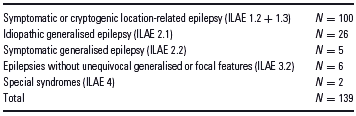
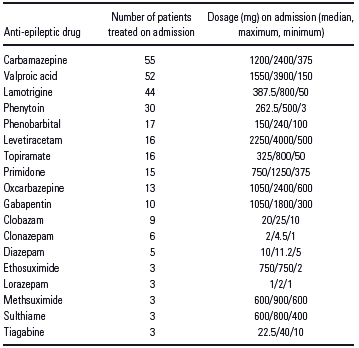
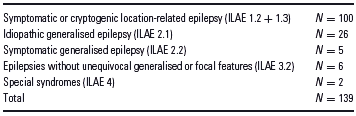
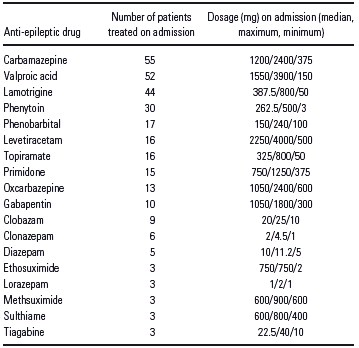
The data of 139 patients (73 male and 66 female) derived from the neuropsychological and psychometric investigation and the information about the number of anti-epileptic drugs and the age at the first non-provoked seizure were available. On average the patients were 38.8 ± 13.4 years old and had experienced their first non-provoked seizure at the age of 15.3 ± 13.8 years. So the duration of the disorder was 23.5 ± 15.8 years on the average. Most of the patients had symptomatic or cryptogenic location-related epilepsy (for details of diagnoses see Table 1). On the average the patients took 2.2 ± 1.1 different anti-epileptic drugs (for details of drugs see Table 3).
Diagnoses according to the classification of the International League against Epilepsy (ILAE) 1981
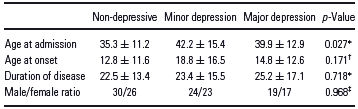
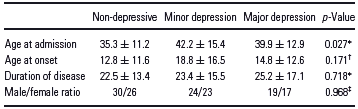
Patients were grouped according to their score in the SDS (i.e. ≤50 = no depression, 50–59 = minor depression, ≤60 = moderate to major depression). 56 patients (40.3%) had a normal score in SDS, 47 patients (33.8%) had a score indicating minor depression and 36 patients (25.9%) showed symptoms of moderate to major depression in SDS. Patients without depression were younger than patients with minor depression (35.3 ± 11.2 years, vs. 42.2 ± 15.4 years, p = 0.009 post hoc LSD test) and were not statistically significant younger than patients with moderate to major depression (39.9 ± 12.9 years; p = 0.100, post hoc LSD test). There were no significant differences in age on onset (Kruskal–Wallis test, p = 0.171), in duration of disease (one-way ANOVA, F-test, p = 0.718) and in gender distribution between the three groups (chi-square test, p = 0.968) (for details see Table 2). For the medication in the whole group see Table 3.
Demographic differences between non-depressive patients with epilepsy and patients with minor or major depression and epilepsy
* One-way ANOVA.
† Kruskal–Wallis test.
‡ Chi-square test.
Anti-epileptic medication of 139 patients with epilepsy on admission
In the subgroup of patients with generalised idiopathic epilepsy (n = 26) 10 patients (38.5%) had a normal score in the SDS, 10 patients (38.5%) had a score indicating minor depression and 6 patients (23%) showed symptoms of moderate to major depression in SDS. There were no significant differences on any demographic or cognitive measure or on the SDS score between the subgroup of patients with generalised idiopathic epilepsy and the other patients.
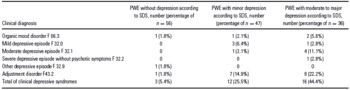
At discharge 31 patients (22.3%) were clinically classified as having a depressive syndrome (e.g. organic mood disorder, depressive episode or adjustment disorder). The clinical diagnosis of a depressive syndrome was significantly associated with a pathological score in the SDS on the day after admission (chi-square test, p = 0.00005) (for details see Table 4). But nevertheless even in the group of patients with moderate to major depression according to SDS only 44.4% were clinically classified as having a depressive syndrome at discharge.
Number of clinical diagnoses (ICD 10) of depressive syndromes (Reference Zung11)

In 61 patients (44%) a seizure onset in the temporal lobes was suspected. There was no significant association between the temporal lobe locations of seizure origin and the depressive mood according to SDS (for details see Table 5).
Association of temporal lobe seizure origin and depressive mood according to SDS (Reference Zung11)

The neuropsychological results are shown in Table 6 and Table 7. When all patients with a pathological score in the SDS were taken into account, the patients with depression did not differ on any memory measure from those without depression. The only significant association in our study was found between pathological results in immediate verbal recall and a score in the SDS for moderate to major depression (chi-square test, p = 0.038). In the subgroup of patients with idiopathic generalised epilepsy two patients with moderate to major depression according to SDS and one patient in each other group had pathological results in immediate verbal recall. Due to the small sample size this association was not significant.
Number of pathological results in memory measures

Raw scores of memory measures

Discussion
On the whole memory deficits in PWE and depression were not more pronounced than in PWE without symptoms of depression. Minor depressive symptoms or subthreshold depressive disorder may be a common response to chronic illness without any impact on cognitive functioning. Especially the experience of essentially random episodes of loss of consciousness in PWE may lead to an attributional style, which may predispose the patient to a depressive syndrome (Reference Herman, Trenerry and Colligan17). Nevertheless an increased prevalence of verbal memory deficits associated with major depression according to the SDS was observed in our study even in the presence of many confounding factors like different epilepsy syndromes and seizure frequencies, different medications and different premorbid cognitive abilities. That this result was only seen in the immediate recall task may be due to the used selective reminding paradigm. Here during the learning trials only the items not recalled are presented again, so that a low score in immediate recall leads to more presentations of the items during the learning trials. This may enhance the long-term storage so that in some patients deficits in delayed recall may be not as pronounced as in immediate recall. We decided not to perform a correlation analysis, because we were not looking for correlations between memory performances in the normal range und subthreshold depressive symptoms. Since there are published age-specific mean scores for both memory tests used in this study (Reference Schaaf, Kessler, Grond and Fink13,Reference Benton Sivan and Spreen14), non-categorical group comparisons would have to be corrected for the influence of the age of the patients. We wanted to show an association between clinically significant depressive mood and clinically significant memory deficits. Nevertheless even in our group of patients with moderate to major depression according to SDS only 44.4% were clinically classified as having a depressive syndrome at discharge. On the one hand this may be due to the fact that depressive symptoms were subsumed under other psychiatric syndromes as personality disorders or anxiety disorders. On the other hand the SDS score reflects the mood in the week before admission whereas our clinical classification at discharge refers to the symptoms shown during the treatment on our epilepsy ward with a holistic approach. In two previous studies, we showed that coping strategies (Reference Rösche, Uhlmann and Weber18) and depression scores in the SDS (Reference Rösche, Meyer, Weber, Uhlmann and Fröscher19) improved during the treatment on our ward even without a specific antidepressive medication (Reference Rösche, Meyer, Weber, Uhlmann and Fröscher19). In another previous study (Reference Rösche, Uhlmann, Nüssle and Fröscher12), we examined the relationship between the results of our neuropsychological-screening battery and behavioural deficits in patients with refractory epilepsy. In this study, the nursing staff evaluated the patients' behaviour with the Nurses Observation Scale for Inpatient Evaluation (NOSIE) (Reference Honigfeld and Pichot20). Immediate verbal recall was significantly correlated (p < 0.001) with the social adaptability subscale of NOSIE. This correlation was due to two items of the social adaptability subscale-concerning memory deficits. Therefore the deficits in immediate verbal recall now seen in 22% of our patients with moderate to major depression according to SDS may be a hint for memory deficits, which may be observed in everyday life. Since verbal memory deficits are usually associated with left temporal dysfunction, our finding may be another hint for an association of severe depressive symptoms with left temporal dysfunction in PWE. Since verbal memory deficits have been described in patients with major depression without epilepsy, the left temporal dysfunction in PWE with depression may not exclusively be seen in patients with left temporal epilepsy. Since depression and cognitive deficits are strong predictors of quality of life not only in epilepsy but also in several other neurological conditions (Reference Mitchell, Kemp, Benito-León and Reuber21) screening for depression and cognitive deficits should be an integral part of the diagnostic work up of patients with chronic neurological disease.
Acknowledgements
During their work, Dr J. R. and Dr C. U. were supported by a grant given by the Department of Social Affairs of the Land Baden-Württemberg, Germany. Dr J. R. received travel grants from Eisai GmbH and UCB GmbH, speakers honorarium from GlaxoSmithKline and UCB GmbH, financial support for an investigator initiated trial from Pfizer GmbH and was medical advisor for UCB GmbH. Professor Dr W. F. received speakers honorarium from UCB GmbH. The other authors confirm that they have nothing to disclose.