Introduction
The Xinjiang Uighur Autonomous Region is situated in northwest China, in the hinterland of the Eurasian Continent. It borders eight countries: Mongolia, Russia, Kazakhstan, Kyrgyzstan, Tajikistan, Afghanistan, Pakistan, and India. A place where the famed Silk Road connected ancient China with the rest of the world, this region is where diverse cultures gathered.Footnote 1 Due to its dry climate, many excavated textile artifacts have been preserved in China’s Xinjiang region. These textiles, as material carriers of culture, not only depict the lifestyles of people from various countries connected by the Silk Road, but also reflect the mutual exchange and integration of Chinese, Persian, Arabic, and other cultures along the Silk Road.
There are currently two pieces of hunting-themed silk tapestry in existence, one produced during China’s Yuan dynasty (1271–1368 CE) and the other during the Tang dynasty (618–907 CE).Footnote 2 This Tang dynasty silk tapestry is known to be the earliest in a Central Asian style.Footnote 3 In the eyes of historians of ancient China, Central Asia was regarded as part of the “Western Regions” (西域), a broad geographical designation formed during the Western Han dynasty (202–8 BCE).Footnote 4 As a hub of the Silk Road, the Western Regions promoted the integration of civilizations from different countries in many fields. Sogdian, as the historical and cultural center of Central Asia, has also made tremendous contributions. Owing to business activities and wars, Sogdians migrated to China in large numbers along the Silk Road between the Han and Tang dynasties.Footnote 5 Their immigrant settlements were widely distributed in the Tarim Basin, Mongolian Plateau, and northern China. At the same time, in the large and small oases in the Sogdian region, when the rule of various ethnic groups was relatively weak, the Sogdians gradually gathered into city-states of different sizes. Among them, the Kang State (康国) in Samarkand was the largest. In addition, there was also the An State (安国) in Bukhārā, the East Cao State (东曹国) in Sutrūshana/Ushrūsana, the Cao State (曹国) in Kapūtānā, the West Cao State (西曹国) in Ishitikhan, the Mi State (米国) in Māymurgh, the He State (何国) in Kushanika, the Shi State (史国) in Kashāna, and the Shi State (石国) in Chach. In different periods, these city-states were sometimes divided and sometimes united, historically known as the “Nine Surnames of Zhaowu.”Footnote 6 Central Asia selectively adapted decorative arts from Western Asia and even ancient Greece according to its own aesthetic preferences, whereas China, in absorbing these artistic patterns transmitted through Central Asia, further reinterpreted them on the basis of their distinct cultural background.
This hunting-pattern fabric unearthed in Xinjiang is the only piece of Tang dynasty silk tapestry in the world that presents Central Asian themes using Chinese silk tapestry techniques. Most Central Asian animal brocades are weaved with red, yellow, and blue silks.Footnote 7 This hunting-pattern silk fabric is large in size and well preserved, with only a few minor flaws and oxidation. The silk craftsmanship is exquisite, with delicate silk threads that are thin and dense. Under sunlight, both the front and back sides shimmer with a silky luster, telling the story of its noble origins and value at the time of its creation. The figures in the hunting-pattern fabric examined in this paper have a typical Western style, and the geometric patterns in the auxiliary motifs are mostly pentagrams and hexagons, which do not originate from China’s indigenous cultural genes. The development of and changes in hunting patterns in ancient China logically progressed. Excavated or handed-down artifacts with hunting patterns are not uncommon. Silk tapestry with cut designs, as a valuable category of silk fabric, also has many existing pieces.
International scholars’ research on Xinjiang’s unearthed silk textiles has focused primarily on the period before the establishment of the People’s Republic of China in 1949, and often relies on textile data obtained by Western explorers during their investigations in Xinjiang and Gansu. In terms of geometric patterns, Western scholars have conducted extensive research, such as Eric Broug’s comprehensive study of Islamic art in Islamic Geometric Design.Footnote 8 This text mentions that pure Islamic art stems from Muslims’ reverence for and understanding of the Quran, and reveals the complexity of this artistic tradition’s development over more than 900 years in the Middle East and Central Asia. Geometric proportions: The underlying structure of the design process for Islamic geometric patterns by LM Dabbour discusses the critical role of geometry and its relationship with proportions in Islamic patterns.Footnote 9 Daud Sutton’s Islamic Design: A Genius for Geometry explores the sixfold patterns and deductions of hexagons in Islamic art, which are valuable references.Footnote 10
Chinese scholars’ research on textiles unearthed in Xinjiang has focused mainly on relics excavated after the founding of the People’s Republic of China in 1949. For instance, Wu Min (Xinjiang Museum) inferred—from the name, weaving techniques, and pattern style—that the original location of these textiles lay in Central and West Asia, west of Xinjiang.Footnote 11 Zhang Mingyu’s Diversity of Western Regions’ Culture in the Han and Tang Dynasties as Seen from Unearthed Textiles in Xinjiang systematically analyzes and summarizes the diversity and multiple sources of the culture of the Western Regions in the Han and Tang dynasties, reevaluating these regions’ historical role in cultural exchange between China and other countries.Footnote 12 In the book Persian and Islamic Art, coauthored by renowned scholars Luo Shiping and Qi Dongfang, Persian art is described as exhibiting diverse features of cultural exchange and ethnic integration, possessing unique charm and vitality.Footnote 13
As the fragment analyzed in this paper is privately owned and was only exhibited to the public in 2018, no scholars have conducted relevant research. This paper contains three sections. Section one discusses the rich pattern elements on this fabric by classifying and comparing them with related graphic elements. Section two then focuses on analysis of the fabric’s colors and craftsmanship to solidify and clarify its background, followed by speculations about the use and origin of this piece of silk. Following on, section three analyzes the fabric’s artistic characteristics and cultural essence, verifying its historical value.
Overview of the hunting-pattern silk tapestry
On 18 December 2018, Northwest University Museum in Xi’an, China, held the “Silk Road Treasures: Interwoven Artistic Flowers – Silk Fabrics” exhibition.Footnote 14 The exhibition showcased 130 exhibits, all of which were collected by Mr. Li Binli, the curator of the Qujiang Silk Road Treasures Museum in Xi’an, over the past thirty years. The exhibition was divided into three sections based on the dynasties from which the exhibits hailed. In the “Tang Dynasty Textiles” section, there was an unnamed and unstudied hunting-pattern fabric (Figures 1 and 2). The fabric is well-preserved, with bright colors and clear and unique patterns, making it very culturally and artistically valuable.
Basic information about the fabric (photos taken by the author)

Fabric inspection (photo taken by the author)

The artistry and craftsmanship of the silk tapestry are comparable to those of the Tang dynasty relics of the Shosoin temple. The piece was identified by C14 as a Tang dynasty fabric, 39 centimeters long, 31 centimeters wide, and approximately 0.8 millimeters thick, with hexagonal units measuring approximately 12 centimeters in length and width. The fabric is woven from silk in colors such as brown, dark blue, sapphire blue, white, and phoenix flower red. This silk tapestry features a lattice pattern formed by staggered rows of lobed medallions. Each compartment is filled with hunting and floral motifs. The hunters depicted on the fabric have exotic features with prominent eyes and high noses, and the horses are tall, powerful, and equipped with various types of saddlery. The hunters and prey are intentionally separated in the composition, omitting specific hunting scenes and focused on depicting the heroic posture of the knights. The hexagonal patterns are filled with floral patterns, with intertwined branches forming a special turtle-back-like skeleton. The patterns are delicate, exquisite, and lively. The overall color tone is stable and atmospheric, with camel colors as the main tone and red and blue as secondary colors. The main pattern is relatively asymmetrical, presenting a free and elegant temperament.
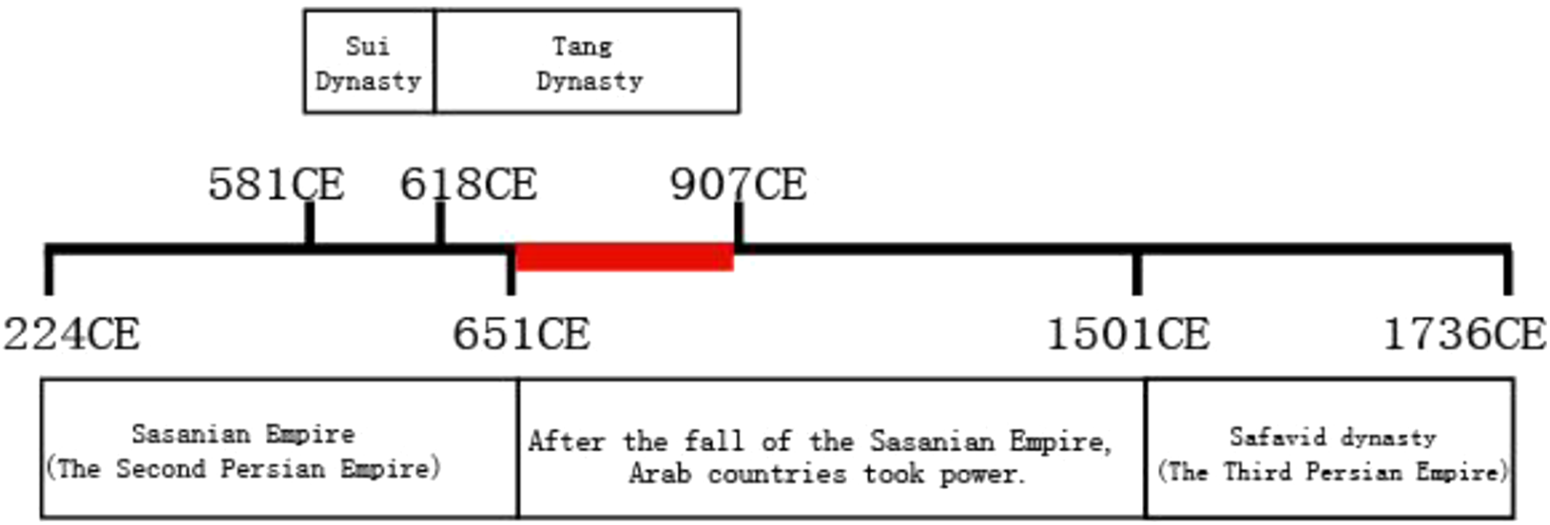
The convenience of transportation brought by the Silk Road and the Tang dynasty’s open policy created opportunities for cultural exchange between China and various regions, such as Persia, Sogdian, Byzantium, Tianzhu, and Arabia. The art of the Persian Sassanid dynasty had great influence on the gold, silverware, and polychrome patterned jin-silk of the Tang dynasty, forming a new decorative style of arts and crafts.Footnote 15 As shown in Figure 3, the timespan we are looking at is the Middle Ages, i.e., the 5th to 15th centuries, vis-à-vis the history of cultural exchange between China, Persia, and Arabia in West Asia.
Timeline of the relevant period (author’s own drawing)

Iran’s longstanding relationship with China dates back to approximately the 2nd century BCE. The first official Chinese exchange with Iran can be traced back to the time of the Parthian king Mehrdad II (124–88 BCE), when a Parthian prince traveled to China and stayed at a Chinese court for twenty years studying Buddhism. The relevant records can be found in the Chinese historical book Records of the Grand Historian: Biographies of Dayuan.Footnote 16 During the Middle Ages, the Persian region underwent both political and religious changes. The Sassanian Empire (224–651 CE) succeeded the Parthians and was the last pre-Islamic Persian empire. The Sassanians are known for their cultural achievements, advancements in architecture, and strong central administration. Zoroastrianism was the official religion of the empire.
The arrival of Islam in the 7th century transformed Iran’s religious, cultural, and political landscape. Islam and Arabic, which originated in the Arabian Peninsula, gradually replaced Zoroastrianism and Middle Persian. Islamic civilization rapidly replaced Byzantine, Persian, and Sogdian civilizations, becoming the mainstream culture in Mesopotamia and Central Asia.
Arabs were originally nomads who, for a long time, lived in barren desert areas and had a low level of civilization. Thus, at the beginning of its rise, Islamic culture mainly incorporated the arts and cultures of ruled ethnic groups in various parts of the Arab Empire. For example, the “White Robe and Great Food”—the Umayyad dynasty—established its capital in Damascus, which was greatly influenced by Byzantine culture. The Abbasid dynasty established its capital in Baghdad, benefiting from ancient Persian culture. The Samanite dynasty established its capital in Bukhara and actually inherited the Sogdian culture and its 1,000-year-old civilization. Owing to the profound influence of the Byzantine, Persian, and Sogdian cultures, early Islamic culture was sometimes difficult to distinguish from the above three. Professor Lin Meicun of Peking University identified a batch of early Islamic brocades from burial objects in Tubo Tomb, of the Tang dynasty, in the capital of Qinghai, enabling us to realize that the formation of Islamic art was influenced not only by Byzantine, Persian, and Sogdian cultures, but also distant Chinese culture.Footnote 17 The term “lslamic art” suggests a unity of style and purpose, and these works are in fact instantly recognizable for their subtlety of line and sumptuous detail.Footnote 18
The prohibition against the making of images gained strength among Muslims, as the word in Arabic for “painter,” and by extension “sculptor,” is musawwir, meaning “forming, fashioning, giving form,” all powers reserved for the deity alone. Indeed, the word musawwir is used in the Quran as an epithet for Allah himself: “He is God, the Creator, the Maker, the Fashioner.”Footnote 19 Small wonder, then, that many pious Muslims were disposed to heed later theologians’ calls against the making of images in any way, whether carved, painted, or even woven. The Prophet is said to have allowed figural-decorated textiles to be used on cushion-covers in his home, but not on hanging curtains, while images on carpets were acceptable because they were consistently walked on.Footnote 20 The Islamic religion did not accept idolatry, so the figurative plastic arts of man or god gradually weakened, replaced by a variety of geometric or patterned decorations and even variations of Arabic calligraphy. As such, textiles began to incorporate geometric shapes and holy verses of the Quran.Footnote 21 Islamic designs and motifs influenced the design of Iranian carpet weaving. As the carpet was a vehicle for cross-cultural reconfiguration, such revealed ambiguity and conflicting attitudes towards Islamic material culture. Both pre- and post-Islamic Iranian art was influenced by symbolism and, during this period, Persian and Islamic art interacted and fused to form the later, more integrated style of the Safavid dynasty (Third Persian Empire), which was both inclusive and unique in its mix of traditional Sasanian and powerful Arabic art.
Iran played an important role in the international exchange of silk. Although the lack of surviving evidence obscures understanding of the advent of sericulture in Iran, silk production in this region likely began in the 6th century. Silks from Iran were prized luxury goods in China during the Sui (581–618 CE) and Tang (618–907 CE) dynasties, with some of their decorative patterns incorporated into Chinese ornaments. During the Tang dynasty, wool and cotton fabrics were imported from the west, their artistic style dominated by naturalism and geometric decorations, differing greatly from the artistic products of the Central Plains in content and form. The appearance of the hunter on the silk tapestry under discussion here has a distinct Central Asian style, and the floral patterns are realistic. The excavation site and brocade weaving techniques can be attributed to the Tang dynasty. The main hunting motif is derived from the pattern system of Western Asia. Thus, its cultural background and historical scenes are very interesting.
Content inference and analysis of the silk tapestry
Pattern analysis
Hunting pattern
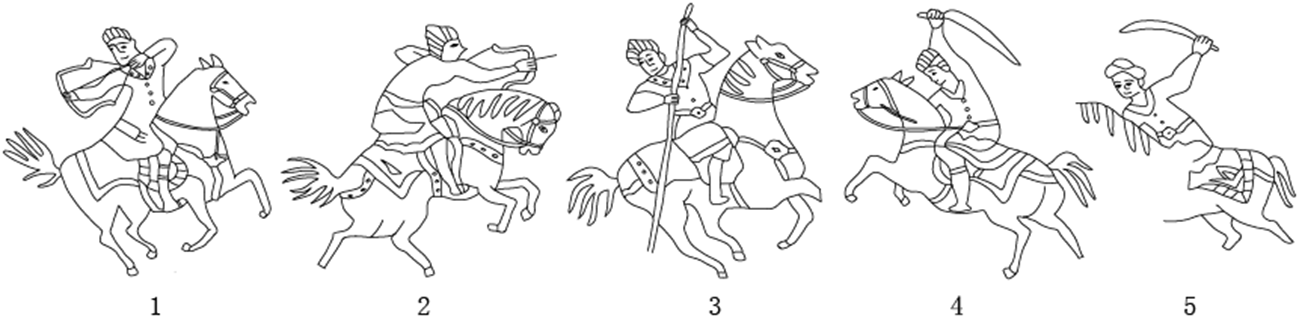
The fabric fragment studied in this article depicts a series of hunters riding horses. All the figures are depicted in vivid colors, with high noses and blue eyes, displaying Central Asian features. The horses are depicted running in opposite directions, with the occasional appearance of manes between the necks, drooping stirrups on the horses’ backs, and loose horse tails. Some hunters hold bows, some hold spears, and some carry knives (Figure 4). The archers have two shooting positions: forward and turn around. The swordsmen hold the reins with their right hands while raising the blade aloft with their left. The spearmen, in contrast, grip their weapons with both hands positioned at the body’s right flank. The hunting targets are medium-sized animals, with deer ears standing upright, round eyes looking back, hooves kicking out, and running at full speed. Despite the hunters pulling bows and shooting arrows, the picture does not depict a state of conflict. In many cultures, scenes of hunting on horseback denoted happiness and good fortune. The hunters and their prey are consciously placed in different hexagons. The overall surroundings are filled with flowers and plants, creating a relaxed and lively atmosphere and giving a sense of harmonious pleasure.
Hunters on the silk tapestry (author’s own drawings)

In terms of patterns, the main hunting pattern had already appeared on pottery and bronzeware in China during the Warring States period (475–221 BCE) and Han dynasty (202 BCE–220 CE). However, the hunters’ clothing and headdress, the tools they carry, and the image of the horses all clearly differ from those of the Central Plains culture, indicating strong foreign cultural characteristics. For example, the posture of the hunter shooting a bow and arrow is consistent with popular hunting depictions during the Sasanian Empire (224–651 CE), and the direction and arrangement of the figures are similar to the layout of carpets during the Persian Safavid period (1501–1736 CE) (Figure 5).
Safavid period carpetsFootnote 25

Hunting activities during the Sasanian Empire of Persia held significant political, economic, military, and religious importance, and such scenes were often depicted on silver plates and carpets.Footnote 22 Hunting images across different mediums not only served as religious symbols in Persian epics but also represented the struggle between good and evil in Zoroastrianism and met the needs of political propaganda and imperial visions. The repetition of visual arts and the praise of Persian kings’ hunting activities in classical literary works enabled the hunting pattern to persist, even after Islamization, reinterpreted by various dynasties on the Iranian plateau. Despite passing through different dynasties, the metaphorical meanings of bravery, strength, authority, and good fortune inherent in hunting activities have always been the core of its development. These metaphorical meanings are consistent with the dualism of good and evil in the Zoroastrianism of ancient Persia. In ancient Persia, the dualism of good and evil underscored its mythology, religion, and subsequent cultural development.Footnote 23 The weapons and various animals used in hunting images carry strong symbolic meanings. The unsheathed sword, thrown wolf’s fang club, shot feathered arrows, and hurled spears in hunting images are all powerful weapons that helped the king, representing “good” to overcome the forces of evil.Footnote 24
The Department of Islamic Art at the Metropolitan Museum of Art has a collection of many hunting motif textiles, including one piece from the 8th century (Figure 6). This silk fragment depicts a mounted hunter aiming at a leaping panther in an oval roundel with scrolling vegetation. This is closely related to early Byzantine examples woven in Egypt. The pattern of hunters on horseback with bows and arrows originated in Sasanian Iran but made its way into Byzantine heraldry, where it was adapted and classicized. The inclusion of an Arabic inscription (the bismillah) places it securely in the early Islamic period. This is a testament to the longevity of the motif and the synthesis of pre-Islamic designs in the early Islamic period. The official description of the hunting pattern textile in Figure 6 suggests that it is a new pattern form generated by the combination of the Sassanid hunting pattern from Iran and early Islamic inscriptions. This is an example of the combination of Islamic and local art forms after conquest, which supports the possibility that the hunting pattern in this article also emerged during the process of Islamization in Iran and the Islamization of Iran, namely, the new pattern form of the hunting pattern itself combined with geometric decorative patterns.
Textile fragment with hunting sceneFootnote 26

Owing to the prohibition of idol worship and religious restrictions in Islam, the development of hunting patterns in Iran faced difficulty. Indeed, hunting patterns were often combined with geometric patterns or decorative themes such as Arabic calligraphy. It was not until the rise of the Safavid dynasty that the hunting pattern returned to the arts and crafts of Iran.
Due to trade and cultural exchange via the Silk Road, hunting became a popular theme for textiles in China’s Xinjiang region.Footnote 27 We found that hunting motifs were painted on archaeological artifacts from the Eastern Zhou dynasty (770–256 BCE), the Warring States period (476–221 BCE), the Han dynasty (202 BCE–220 CE), the Wei, Jin, Southern, and Northern dynasties (220–589 CE), and the Tang dynasty (618–907 CE), among other historical periods (Table 2-1). Before the Tang dynasty, hunting murals began to gain popularity; for instance, in burial murals, typical hunting patterns had already emerged. While retaining some of the old traditions, the hunting patterns of the Tang dynasty also became more realistic, exhibiting a more elegant style. From the hunting murals of the Tang dynasty, we understand the royal family’s enthusiasm for hunting and observe that, unlike ceremonial images, hunting scenes appear to be very relaxed. Hunting patterns are a typical theme in Persian Sasanian art. While hunting is also a traditional theme in Chinese art, it is not commonly seen in silk patterns. However, with the continuous eastwards spread of Central Asian culture, hunting patterns became an important theme in silk patterns. The Tang dynasty, known for its national strength and martial arts, was the peak period for the development of hunting patterns. During the Middle and Late Tang dynasties, hunting motifs became vivid and free. For example, the hunting lion pattern textile from the Famen Temple shows exotic influences, resembling hunting patterns from the Sasanian Empire. This indicates that the hunting patterns of textiles in the Early Tang dynasty were already influenced by the Sasanian Empire.Footnote 28
Summary of Chinese artifacts related to the hunting motif

Before the Tang dynasty, Chinese hunting patterns focused primarily on the performance of the hunting scene. However, from the Early Tang dynasty onwards, these hunting motifs began to exhibit the influence of Sassanian art, which placed more emphasis on the portrayal of characters. This particular silk tapestry discussed in this article highlights the hunters’ heroic posture and reflects the hunting practices characteristic of Persia’s Sassanian dynasty.
Floral pattern
First, as displayed in Table 2-2, the floral patterns on the hunting fabric are derived from the variations in the flowers, branches, and leaves of different plants. The patterns are intricate and have an abstract geometric sense. There are various types, including morning glories, four-petal flowers, and treasure flowers. The size of the flowers is generally the same, appearing as a string or several branches of flowers. The curling of the leaves and the rotation of the leaf veins portray vigorous vitality and dynamic feelings. The flower patterns inside the hexagons on the fabric are realistic, while the patterns outside are more abstract. The curved and spreading vine patterns, abstract treasure flower images, and star-shaped patterns fill the empty spaces. The treasure flower images are abstracted and simplified into geometric forms, with sharp petals and obvious line changes. The vine patterns resemble clouds that are full but not smooth, which is quite different from the use of curved lines during the Tang dynasty.
Summary of fabric floral patterns

Source: author’s own drawings
During the Sui and Tang dynasties, due to the prosperity of the Silk Road, goods from as far west as Iran and Byzantium reached Chang-an, the capital of China.Footnote 30 The exchange of goods also resulted in cultural exchange. Decorative patterns were created from different religious and cultural backgrounds, and transmitted and diffused through transcultural contacts.Footnote 31 Various patterns of flowers, plants, animals, and geometric shapes on goods made the plant patterns of the Tang dynasty more flexible in form, brighter in color, more symmetrical and balanced in structure, and more vivid in expression.Footnote 32 Additionally, the emergence of bird-and-flower paintings stimulated the appearance of realistic-style plant patterns. Many patterns inspired by vibrant plants and flowers from the natural world emerged, leading to the birth of patterns such as an auspicious floral roundel, scroll patterns, and round flower patterns. At the same time, in Islamic art, owing to the prohibition of idol worship, there were no specific representations of saints or idols. Instead, abstract patterns and geometric shapes were the main focus. The use of plant motifs in Islamic art was also influenced by Persian traditions and is, therefore, referred to as the “Persian faction.” Plant motifs derived from the forms of plants, especially flowers, in the natural world revealed a beautiful paradise promised by Allah to devout Muslims. Grape leaves, palm leaves, and decorative motifs derived from them, such as roses, seashells, pinecones, carnations, tulips, and peonies, were also common. In this article, we examine the comparative symbolic significance of flowers in Iranian culture and the Tang dynasty, focusing specifically on the motifs of morning glories, lotus flowers, and vines.
Regarding subject matter and symbolism, the morning glory pattern, also known as the “Arabesque pattern,” is a geometric design composed of continuous curves and straight lines. These patterns are usually arranged symmetrically, creating complex and ornate decorative effects (Figure 7). The application of the morning glory motif in Islamic art is not only a form of decoration but also a way to disseminate and convey information. Through these patterns, Islamic artists attempt to convey the values and beliefs of Islam, as well as their reverence for God. The geometric shapes and symmetry embodied in these patterns also reflect Islamic culture’s pursuit of order and harmony.Footnote 33 The history of the morning glory motif in China can be traced back thousands of years. The patterns first appeared on ancient ceramics and fabrics, but were relatively less common than other floral patterns. The Han dynasty “T-shaped silk painting from Mawangdui,” which was unearthed in Changsha, Hunan Province, China, in 1972, used many morning glory patterns as decorations.Footnote 34 This not only makes the layout of the painting reasonable, the transitions natural, and the emotions leisurely, but also better expresses the ancient belief in the cycle of heaven, earth, the underworld, and the continuous continuation of life.
a. Fabric partial. b. T-shaped silk painting 202 BCE–220 CE

The Baoxiang flower is one of the famous patterns of the Tang dynasty, and the form of decorative patterns of the Baoxiang flower gradually developed from the initial lotus pattern, incorporating patterns such as the pomegranate, peony, and honeysuckle.Footnote 35 The Baoxiang flower is an ideal flower imagined and summarized from natural floral forms, combining reality and illusion. It is extremely ornate and noble, with a strong three-dimensional decorative sense (Figures 8 and 9). It has a deep artistic origin in Buddhism, the Central Plains, and other cultures.Footnote 36 In the mid-Tang dynasty, the prevalence of peony flowers caused the pattern of the Baoxiang flower decoration to begin to resemble the shape of peony flowers, exuding a strong sense of wealth and prosperity.
Partial view of the fabric

Tang dynasty Baoxiang flower pattern

The lotus flower is the evolutionary foundation of the Baoxiang flower. The lotus flower was also one of the most famous natural symbols in the pre-Islamic period; as it grew toward the sky, it was an important element in the Middle Period.Footnote 37 In Persian carpets, the lotus flower symbolizes rebirth and immortality, but it looks very similar to peonies and palm leaves. According to Peter F. Stone’s book Oriental Rugs, the palmette–interpreted by weavers in various ways–is based on the lotus flower and its spread petals (Figure 10a).Footnote 38 The Khatai floral pattern is a famous carpet pattern from the Safavid dynasty and is said to have been inspired by the Chinese silver lotus flower (Figure 10b).Footnote 39 The plant patterns that developed in ancient West Asia have deep connections with Chinese plant patterns. In the process of dissemination and development, the forms of these patterns have continuously evolved.Footnote 40
a. Palm-leaf decoration. b. Khatai flowers

During the 8th century BCE, the custom of using lotus motifs spread from Egypt to the Phoenicians and then to Mesopotamia and Iran. The Phoenician goddess holding a lotus symbolizes the power of creation. According to Assyrian-Phoenician and Greek-Roman legends, the lotus refers to a burial and funeral ceremony, as well as rebirth and eternal life.Footnote 41 In this process, the Achaemenid dynasty of Iran, with its great imperial power and reverence for Zoroastrianism, played a crucial role in the promotion of lotus worship. With Alexander the Great’s eastern conquest, the artistic imagination of the lotus flower in Zoroastrianism was introduced into Hindu culture and then profoundly impacted Buddhism, giving the lotus flower and statue of the Buddha their ubiquitous relationship.Footnote 42 As an ancient cultural symbol indigenous to Iran, the lotus pattern initially had a single religious meaning. However, with the increasing communication and interaction between the Persian civilization and outside world, the lotus pattern was gradually integrated into expressive elements in Egypt, India, and other regions, taking on more diverse cultural connotations. In hunting or animal motifs of Ilkhanid metalware, the lotus flower appears in a more elaborate form, forming a background for the motifs with other plants and flowers and creating a natural, lively, and vital atmosphere.
The botanical patterns of Iran are closely connected to those of China in terms of dissemination and evolution, with their forms constantly changing. The lotus flower in this silk tapestry is basically identical to the lotus flower form in Iran. The transformation of the lotus flower theme demonstrates the connections and exchanges between different ethnic groups and cultures.
Geometric pattern
The geometric patterns on the fabric fragment consist of two types (Table 2-3): a border of hexagons surrounding the main pattern and pentagrams forming a continuous pattern outside the hexagons. We now explore the symbolic meanings of these geometric patterns from different cultural contexts.
Summary of fabric geometric patterns

One of the main Islamic geometric patterns is the star pattern, which embodies the concept of the fusion of heaven and earth in Islam. There are many ways to combine star patterns, such as triangles that can be transformed into pentagrams and hexagrams.Footnote 43 The Quran also contains the following quote: “I have indeed adorned the nearest heaven with stars.”Footnote 44 For Muslims, the crescent moon and stars are symbols of beauty. The sky adorned with stars is beautiful, and the shining constellations inspire devout imagination and faith, which can also explain why star patterns appear extensively as decorations on fabrics.
In addition to the pentagram, the most basic and widely used element in Islamic pattern art is the hexagon.Footnote 45 The shape evolves from a point to a line, then into a circle, and finally into a hexagon formed by six identical and overlapping circles. The point represents “the one and only God,” and the six circles represent God’s creation of heaven and earth in six days (as mentioned in chapter 7, verse 54 of the Quran).Footnote 46 The infinitely expanding hexagon can perfectly cover the entire plane (Figure 11).Footnote 47 The “Art of the Islamic World” collection at the Brooklyn Museum contains many hexagonal tiles. It is said that Muhammad used hexagonal tiles to decorate the walls of his palace. The use of hexagons began during this period and later became widely applied in architecture, painting, textiles, and other fields.Footnote 48
a. Geometric pattern of the fabric. b. Islamic hexagonal pattern

Double-layered hexagons on fabrics have also been found in decorative patterns in China. The six-petal lotus pattern of the Tang dynasty had a similar hexagonal shape. Its appearance was influenced by Buddhist culture and other foreign cultures. In addition, as shown in Figure 12, a new form of copper mirror, the six-petal diamond-flower shape, appeared during the Tang dynasty. The flower mirror evolved from the shape of the lotus flower copper mirror.Footnote 49 In addition to the newly developed six-petal lotus pattern and its variations during the Tang dynasty, there was also a popular pattern called pantao, which means a decorative border or flat ribbon woven with colored silk threads.Footnote 50 The decorative patterns of the pantao pattern are full, harmonious, clear, delicate, and often presented in a rigorous and orderly geometric arrangement. This pattern is most similar to the hexagonal patterns found on the fabric fragment under study here.
a. Part of the silk tapestry pattern. b. Tang dynasty tri-colored plate with Baoxiang flowers (Metropolitan Museum of Art, USA). c. Tang dynasty diamond-flower-shaped mirror, diameter 57 mm, weight 72 g. d. Ming dynasty brocade, 1368–1644 CE

Therefore, the stars and hexagons on the fragment under study are closely related to Islamic culture. The continuous arrangement and development of the hexagons are strongly connected to the previous flower pattern of the Tang dynasty, which further developed into the typical pantao pattern of the Ming dynasty. The geometric patterns on the fragment represent the exchange and fusion between the decorative art of China’s Tang dynasty and Islamic decorative art.
Organizational form of fabric patterns
The fabric under examination contains a combination of various patterns: the main pattern is surrounded by hexagons and the area outside the hexagons is filled with floral patterns. This is a typical type of panel decoration. Panel decoration, also known as an open window or open hall-type composition, has Islamic influences. From the simple Persian beading pattern and tuan pattern to the hexagonal curves on this fabric, all are different forms of panel decoration. Islamic panel decoration gradually formed its own style through borrowing, inheriting, absorbing, and assimilating the art of conquered regions, such as Persia, with this decoration constantly evolving from simple geometric shapes to multisided curves. A collection of fabrics with similar decorations was used for comparative analysis (Table 2-4). The velvet fabric in the collection of the Metropolitan Museum of Art is the artifact with the highest degree of similarity to the hunting pattern fabric studied here. The motifs were taken from paintings of the Safavid period. The Safavid dynasty, also known as the Third Persian Empire, was the third dynasty to completely unify the eastern and western parts of Iran after the Achaemenid and Sasanian dynasties, inheriting the legacy of the Ancient Persian Empire. The fabrics listed in the table have several similarities in artistic characteristics and cultural background, including the following: similar pattern organization; a close relationship with Persia; and Islamic cultural influences. From ancient Persia to Sasanian Persia to Islamic culture, these are all in the same lineage, and the Iranian decorative arts continued to develop and become refined and elegant in the process of interaction with Arab civilization, providing important reference and enriching the information on the historical background of this hunting pattern fragment.
Related images

In addition, this pattern conforms to the special turtle-back skeleton formed by the intertwined patterns mentioned in Silk Art of Chinese Dynasties: Liao and Jin, edited by Zhao Feng (Figure 14).Footnote 51 The definition of the turtle-back pattern in the Dictionary of Chinese Art and Culture is as follows: “A traditional geometric pattern, a continuous square pattern composed of the basic unit of a hexagonal skeleton, extremely similar to the geometric texture on the turtle’s back, hence the name.”Footnote 52 Dr. Edward Kidder, Jr. of the University of Washington argues that “hexagons have also been found in Assyrian palace decorations from the 9th and 8th centuries BCE, but the direct Chinese source is the Sassanid Persian Empire.”Footnote 53
Hexagonal skeleton and tortoise shell pattern

Brocade unearthed from a tomb in Inner Mongolia, China, Liao dynasty, 907–1125 CE

The pattern layout of the brocade unearthed from a tomb in Inner Mongolia (Figure 14) filled the gaps with chrysanthemum-shaped flowers and connected them with a small number of branches and leaves, forming a turtle-back-shaped framework.Footnote 54 In the famous painting “Court Ladies Preparing Newly Woven Silk” (Figure 15), the patterns of women’s clothing are flower and plant motifs instead of the original hexagonal wireframe structure, with popular Tang dynasty plant patterns–such as cross flowers, auspicious flowers, and blossoming flowers–embedded.Footnote 55
Part of the painting “Court Ladies Preparing Newly Woven Silk,” Zhang Xuan, Tang dynasty, now in the Museum of Fine Arts, Boston, USA

During the reign of Emperor Taizong of the Tang dynasty, the empire’s territorial area extended to the west and Persia; thus, the Tang dynasty art style combined the best art of the late Sassanid and Sultanid dynasties with themes and styles from Persia, as well as styles inherited from the Northern, Southern, and Sui dynasties. On the one hand, the introduction of Western culture brought more styles and subjects, including flowers, animals, and figures, to Tang dynasty patterns. On the other hand, the secularization of Buddhist and Taoist culture also enriched the subjects and styles of Tang dynasty patterns. During the Sui and Tang dynasties, the exchange of Buddhist and Taoist philosophies was more frequent than ever, with both religions emphasizing the pursuit of the true meaning of life and the realm of cultivation. In the legend, Shakyamuni was born with flowers spread on the ground, and after his birth, he walked seven steps, each step producing a lotus flower.Footnote 56 Therefore, flowers are always offered to the Buddha on the birthday of the Buddha Festival. Taoism, on the other hand, emphasizes longevity and health, focusing on the harmony and balance of nature. Flowers and plants not only have medicinal value in Taoist thought but also represent the vitality of life and beauty of nature. Longevity, as one of the core pursuits of Taoism, fits with the meaning of resilience and longevity implied by the turtle-back pattern. Owing to the influence of Buddhism, people’s aesthetic tastes shifted from reverence for deities to enjoying secular life. Both plants and turtles were considered natural beings, so they were combined to create a unique decorative theme at that time. Flower and plant patterns were filled and inlaid into the turtle’s back shell, forming the distinctive flower- and plant-shaped turtle-back pattern of the Tang dynasty. This pattern surrounding the main decorative theme reflected the popularity of Buddhism during the Tang dynasty, which led people to admire flower and plant patterns.
The fusion of floral and tortoise shell patterns not only made it easier for local people to accept the pattern, but also infused it with nationalistic meaning. Traditional culture, religious development, and cultural exchange with the west have all significantly impacted the development of Chinese patterns. The appearance of the floral and tortoise shell pattern in the Tang dynasty may be attributed not only to the prevalence of Buddhism but also to the inspiration of Western textiles for the development of Chinese patterns.
Color technique and functional analysis of the silk tapestry
Color analysis of the silk tapestry
The color of the fabric fragment under examination was influenced by various factors, such as regional culture and history. By analyzing color, it is possible to understand the aesthetic views and cultural influences along the Silk Road during that period. The glossiness of the fabric is clearly visible, and the hue and saturation of the color have not been greatly contaminated (Figure 16).
1. Color application characteristics
Color detail comparison

a. Wool tapestry fabric. b. Tapestry with animal motifs unearthed from the Shanpula cemetery. c. Part of the fabric pattern

First, this fabric fragment is generally presented in five color schemes: brown, red, blue, green, and white. Brown is the base color, and high-purity red and blue are interspersed, resulting in a strong color impact without losing harmony. Second, an analysis of the common colors in Persian textiles and murals reveals that most are concentrated in the four major color phases of red, blue, brown, and white.Footnote 57 He woolen fabrics in the Western Regions style unearthed in Xinjiang, such as found in the ancient Shanpula Tomb also prefer heavy color tones, mainly blue, red, yellow, brown, white, etc.Footnote 58 These colors are roughly similar to the tones in the silk tapestry we studied.
To achieve a rich variety of colors, textiles use natural dyes and different dyeing techniques. Dyeing can employ single colors, such as red, yellow, blue, and black, or a combination to create colors such as blue-purple, blue-green, pink, and grass green. Additionally, during the Tang dynasty, a specialized department called the Dyeing and Weaving Bureau was responsible for the production of dyed textiles.Footnote 59, Footnote 60 These textiles have a rich color palette, and even after the passage of time, the colors remain bright, reflecting the characteristics of dyeing technology. Table 3-1 explains the color configuration and characteristics of the textiles, as well as their sources.
2. Color-matching characteristics
Table 3-1Color Characteristics and Sources


Although the fragment under examination has been buried in the ground for a long time, its color is still vivid. There is clearly a strong post-Islamic Iranian art style, especially the pure pursuit of the beauty of color, lines, and patterns. The main pattern is colorful, sharp, and prominent, and the secondary pattern is soft. The high purity of the red and blue contrast makes the overall pattern of the main and secondary regions clear. The red color ranges from bright, vibrant scarlet to lighter, softer rose, magenta, etc., and the delicate dyeing threads of various colors together weave a colorful and stunning picture.
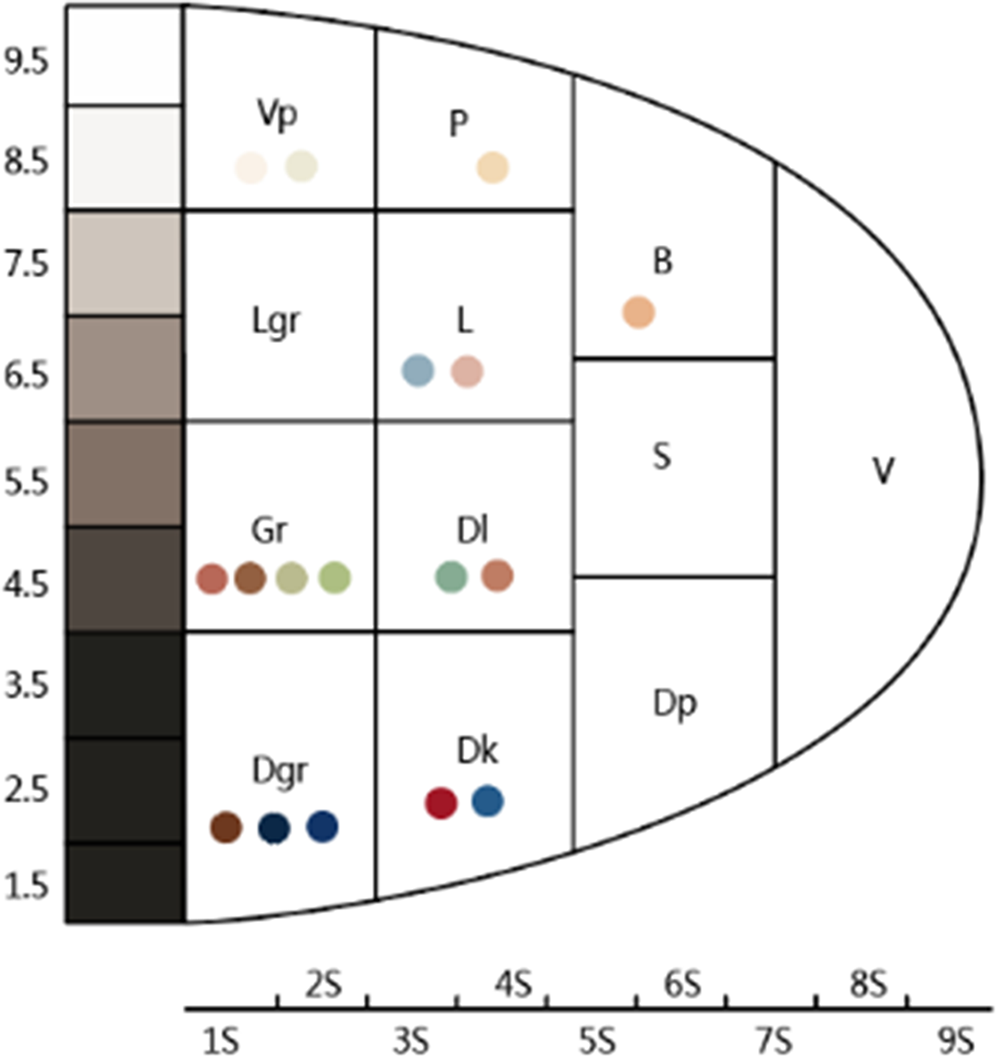
To conduct color research, we chose the Practical Color Coordinate System (PCCS) developed by the Japan Color Research Institute in 1964. The main feature of PCCS is its “Hue–Tone system.” In PCCS, a color is represented by two attributes: hue and tone.Footnote 61 The horizontal axis of the PCCS presents the color purity, while the vertical presentation the brightness. Based on the six main hues of red, orange, yellow, green, blue, and purple, the color is adjusted into twenty-four main hues with equal visual difference. Considering the strength of purity and lightness, and introducing the concept of hue, the existing color is divided into twelve hues and achromatic color is divided into five hues.
Fabric sample colors were obtained using computer image processing software and placed within the PCCS color system (Figure 18). After acquiring the hue, value, chroma, and tone of the colors, analysis revealed that the fabric colors predominantly exhibit low value and are largely pure colors, with their primary distribution concentrated within the (Dgr + Gr + Dk + Dl + L) tonal range. These tonal applications evoke natural landscapes and are characterized by a sense of primal authenticity.
Distribution of fabric colors in the PCCS color space

In addition to seeking unity in strongly contrasting colors, “dark against light” collocation was used to obtain the effect of the intensity of the shades and then, through the outline, to highlight the pattern. The juxtaposition of high-purity colors with clear contour lines makes the overall pattern vivid and lively without losing its composure and atmosphere, demonstrating the bold use of color and the ability of folk craftsmen to master it.
3. Color causation analysis
First, within Persian cultural cognition, gradient color transitions are perceived as lacking gravitas and sublimity. Solely unadulterated pure hues are imbued with supreme authority. Consequently, Persian artworks frequently employ expansive fields of flat application utilizing uncompromisingly pure pigments such as red, blue, purple, and green. These vivid, high-intensity colors are strategically juxtaposed with their complementary counterparts, resulting in bold chromatic schemes and visually arresting, luminous effects. Red, one of the most prevalent hues, frequently serves as the dominant chromatic foundation of compositions and, when coupled with its complementary color of blue, offers a balanced, stable, and permanent atmosphere.Footnote 62
Second, with respect to traditional Islamic decorative motifs’ choice of colors (mostly red, blue, and white), white is a symbol of God or absolute existence, the favorite color of the great prophet of Islam.Footnote 63 Further, combining blue, red, and green produces white, which also explains the high frequency of these colors in the fragment.Footnote 64
In addition, color carries a sense of heritage. Traditional fabrics are often dyed using natural plants and minerals, resulting in colors that are durable and long-lasting. The unique method of dyeing with agricultural crops was also an important factor reflecting the value of fabrics at that time. The skill of hand-dyeing has been passed down secretly from generation to generation by craftsmen. A piece of brightly colored fabric not only has practical value but also serves as a work of art.
Weaving process and functional analysis of the silk tapestry
The overall texture of the fabric under study here is firm, the surface is flat, the appearance of the front and back is the same, and it is very light and thin. Enlargement of the fabric fragments reveals that the weft threads are thicker than the warp threads (Figure 19a). After weaving, the warp threads were wrapped inside the weft threads so that the warp is invisible on the surface, and there are gaps between different color areas (Figure 19b). This fabric organization is consistent with the Western textile (毲) mentioned by the ancient textile expert Wu Min in the Research on Woolen Textiles Unearthed in Xinjiang in Recent Years,Footnote 65 which is also known as gilim, kilim, or open-seam tapestry weaving by Persians (Figure 19c).Footnote 66
a. Fabric details. b. Fabric details. c. Gilim fabric structure

Based on the collector’s own physical identification and description, the fragment’s textile craft was confirmed as the tapestry-weaving method. The weaving technique of silk tapestry on the Silk Road has long been a focus of research and was discussed in chapter eleven of the Thematic Collection of the Cultural Interactions along the Silk Roads: Textiles and Clothing Volume by Lee Talbot, the director of the Textile Museum in Washington, DC. This book was published in collaboration between UNESCO and the China National Silk Museum to promote knowledge of textile techniques and culture along the Silk Road. This book mentions that our tapestry is a weft-faced plain weave. The wefts are discontinuous, meaning that the weaver interlaces them with the taut, vertical warps only where they are required by the pattern. During the Sui, Tang, and Five dynasties, the combination of wool tapestry and the tapestry-weaving method introduced from the Western Regions via the Silk Road, in addition to the increasingly prosperous and mature silk production of the Central Plains, promoted the formation and development of K’o-ssu.Footnote 67 Although the timeline remains unclear, the tapestry weave technique spread eastwards to China, where tapestry-woven silk became known as kesi (K’o-ssu).Footnote 68 This method uses the popular silk thread from the Central Plains during that period, with only the weft thread used to create the patterns. This free-weaving method enables the weaver to explore various patterns and designs, making the fabric look magnificent, such as embroidery or painting, with a strong artistic appeal and decorative effect.
By the 3rd century CE at the latest, sericulture had spread from the Central Plains to Central Asia. Weavers in eastern Central Asia began to produce silk during the Tang dynasty (618–907 CE). Archaeological sites in western China, including the Dunhuang Caves in Gansu Province, Astana burial site in Xinjiang, and Dulan cemetery in Qinghai, have uncovered remnants of Tang dynasty silk brocade. These silk fabrics not only absorbed the essence of Eastern and Western textile cultures, resulting in many locally distinctive varieties of silk, but also incorporated exotic patterns from distant lands, such as grape motifs, hunting scenes, double-headed eagles, and bead patterns. These elements brought together different artistic and technical styles, portraying rich cultural connotations.
During the Tang dynasty, the demographic composition of Xinjiang was complex, with various ethnic groups and foreigners comprising most of the region’s population. At its peak, the local population in Xinjiang reached over 160,000, and the local people mentioned in the Book of Northern Dynasties included various fully integrated ethnic groups, such as the Han(汉族), Di(氐族), Xianbei(鲜卑族), Qiang(羌族), and Xiongnu(匈奴族), with the Han people primarily being soldiers stationed there.Footnote 69 Additionally, the influence of foreign populations was also significant in Xinjiang. In scholar Zang Rong’s book “Ancient People, Ancient Style, Ancient Feelings, Ancient Scenery”, there is an article “The Hu Wind of the Great Tang,” noted that many Westerners at the time were collectively referred to as “Hu people,” including envoys, students, merchants, religious messengers, artists from various countries, and foreigners employed as officials by the Tang dynasty.Footnote 70 These individuals belonged to the upper echelons of society and influenced the trends and aesthetics of the time. The poem “Twelve New Songs of the Law Tune” by Yuan Zhen, written during the Tang dynasty, states, “Hu music, Hu horses, and Hu makeup, competing for attention for fifty years,” demonstrating the immense cultural influence of foreign populations.Footnote 71
The main pattern of the hunting scene silk brocade fragment under examination features hunting motifs as the primary design, complemented by floral patterns. This theme does not originate from the Central Plains culture, but it does align well with the aesthetic preferences of nomadic peoples, who catered to the tastes of incoming populations. The Western characteristics of the hunting motifs, combined with the popularity and fusion of floral patterns under the flourishing of Buddhism and Daoism during the Tang dynasty, formed a unique style for this silk brocade. This silk was likely produced by local artisans in Xinjiang or artisans from the Central Plains, customized according to the preferences of local nobles, traveling merchants, West Asian residents, or local elites with Western backgrounds.
In the famous Chinese miscellany Jilei bian (Chicken Rib Chronicles), which was written in approximately 1133 during the Song dynasty (960–1279 CE), Zhuang Chuo described the production of silk tapestry in Dingzhou, Hebei Province.Footnote 72 In this text, Zhuang praised the flexibility of the technique in creating designs and underscored the tremendous amount of time required to weave a complete piece. Output using this technique was always greatly limited, often in short supply, and used mostly for small items. In the early stages of textile civilization, it was used mainly by the upper classes. According to Hong Hao (1088–1155), in the ancient Chinese text Songmo Jiwen volume one, from the Late Tang dynasty to the Song dynasty, the Uyghur people living in the Qin Chuan region (now Shaanxi and Gansu) used colorful silk threads to weave gorgeous clothes with high aesthetic value and used on a daily basis.Footnote 73 Archaeological discoveries have shown that, with the development of silk tapestry weaving techniques, silk tapestry was also used to produce practical items such as ribbons and Buddha banners. For example, the Shosoin Treasure House in Japan holds two silk tapestry gold ribbons, and the waistband of a female figurine was found in Astana Tomb in Turpan, Xinjiang. According to historical records, after silk tapestry craftsmanship was introduced to Tibet as early as the Tang dynasty, exquisite and luxurious silk tapestry art gradually became a craft for making Buddhist thangkas.Footnote 74 As silk tapestry craftsmanship matured, it was used mainly in practical and decorative fields.
In addition to the fabric weaving technique, the silk tapestry under examination also depicts the hunting patterns popular at that time. Hunting patterns were widely used on Tang dynasty textiles, typically appearing on high-end fabrics such as brocades and silk, as well as on court attire. Furthermore, hunting imagery from the Tang dynasty also held special symbolic significance. In the royal and noble classes, hunting was not only a form of entertainment but also an important way to showcase martial spirit and social status. Stemming from the belief of ancient people in “treating death as treating life,” the Tang dynasty royal and noble families vividly depicted their passion for hunting in the murals of their tombs. Therefore, hunting imagery as a burial item also symbolized the deceased’s social status and position during their lifetime, reflecting respect and commemoration for their past glory. This hunting pattern silk tapestry is relatively wide, well preserved, with bright colors, and shows minimal signs of use. In addition to being used as decoration for the upper classes, it may have also been used as a burial item. The mural “Hunting Expedition” from the tomb of Crown Prince Zhang Huai of the Tang dynasty (655–684 CE) reflects the hunting activities of the time as a military-themed pattern. In addition to appearing in murals depicting the world before and after death, the tomb of Princess Yongtai, Li Xianhui (685–701 CE), in Qian County, Shaanxi Province, also unearthed two painted pottery equestrian hunting figurines, while the tomb of Crown Prince Yide, Li Chongrun (682–701 CE), unearthed the “Eagle and Hound Hunting” painting and a Tang dynasty glazed pottery equestrian hunting figurine. Using hunting imagery as grave goods during the Tang dynasty was not only to commemorate the deceased’s life and status, as this practice also reflected the ancient people’s imagination and anticipation of the afterlife. Whether used as luxurious decoration for the upper classes or as burial items, this fabric accompanied the departed nobles into the depths of history, becoming a crucial clue for future generations exploring ancient cultures.
The tapestry technique came to China along the Silk Road, and silk tapestry became one of China’s most prized luxury textiles. While the earliest tapestry-woven textiles in West and Central Asia, North Africa, and the Americas were made of wool, linen, or cotton, the arrival of silk from China transformed the tapestry-weaving traditions of many cultures. The import of silk threads and the introduction of sericulture expanded the aesthetic potential of tapestry-woven textiles and elevated their social prestige, while the arrival of Chinese-patterned silks introduced new motifs that enlarged the decorative vocabulary of tapestry weavers.Footnote 75
Aesthetic characteristics and cultural value of the silk tapestry
In examining its formation, content, and form, it is clear that the silk tapestry under study displays the aesthetic characteristics of the mid-Tang period. In terms of themes, many Sasanian silver plates exhibit predominantly aristocratic hunting motifs, with very few geometric elements involved. The early patterns of hunting motifs are relatively simple and do not contain other religious symbols. However, after the Arab conquest, with the prohibition of idol worship in Islam, hunting motifs became secularized and popularized. Later, with trade along the Silk Road and the Tang dynasty’s desire for hunting activities, hunting became a popular pattern.
The fabric pattern is abstracted from a realistic representation by emphasizing the lines. The overall composition is full, on the basis of the symmetry of the hexagons, and it fills the symmetrical framework with asymmetrical shapes. This arrangement creates a visually diverse and changing sensation, but it is not uniform. The composition of the painting is relatively flexible, presenting a narrative-focused approach that differs from traditional Central Plains hunting patterns, with a stronger emphasis on decoration. Therefore, it can be concluded that the themes and structural forms originates from the Sassanian and Arab artistic systems, whereas the continuous structure is primarily based on Tang dynasty floral and tortoise shell patterns, forming a highly integrated whole. The hunting motif in the silk tapestry is simple but with excellent decorative effect; it selects content from a narrative perspective and organizes the composition for decorative purposes. It shows distinct features of Arab art while also incorporating elements of the Buddhist flora of the Tang dynasty, reflecting the complexity and aesthetic fashion of the fusion of Eastern and Western themes design.
In addition to providing visual beauty, the intricate compositions of fabrics served an aesthetic function in a religious and psychological sense. In Eva Baer’s book Islamic Ornament,Footnote 76 she provides and supports the findings of Richard Ettinghausen, who explains the function of Islamic decorative arts from a psychosocial perspective as a need for Muslims to “horror vacui.”Footnote 77 The outlying areas of cities were mostly barren, empty wilderness, where blankness meant insecurity and density bought joy. In addition, the collective consciousness of Near Eastern peoples is deeply embedded in the memory of and preference for gardens, and this sentiment for flowers and trees is displayed in Arabic literature and Persian miniatures of the Middle Ages. The sprawling descriptions and portrayals of luxuriant gardens in these works, as well as the special favor and praise for exuberant vegetation, reflect the love and reverence the Near Eastern people have for nature. The silk tapestry directly reflects the religious and psychological aesthetics of this particular group of people in its content selection and presentation. This finding also indirectly confirms that the design of the pattern under study was customized according to the preferences of traveling merchants, West Asian residents, or local aristocrats with Western backgrounds.
The choice of color of this silk tapestry is characteristic of a naturalistic style, with a clear hierarchy of spaces. The use of colors is obviously influenced by Arab culture, which favors naturalism. Red and blue form a complementary color relationship, with overall low color purity and a primitive feeling, in line with the Arab geographical influence and religious preferences. The overall effect is distinct and rich in layers. Natural colors, such as brown, green, and gray, are used to reflect the realism and naturalness of the hunting scene. These colors not only suit the hunting environment but also create a primitive and wild aura. More vibrant colors are used to highlight the focus and dynamic sense of the pattern. For example, warm colors, such as red and light red, are used to indicate the passion of the hunter, whereas cooler colors, such as blue and green, enhance the layering of the image. This silk tapestry still shows traces of Central Plains culture in terms of themes and structure, but its choice of color has basically not been influenced by Tang culture. The silk threads from the Central Plains give the Arab naturalistic color application a refined and luxurious texture, which stands in stark contrast to the matte effect and rough texture of the wool tapestry, further widening the gap between the nobility and the common people. The colors of the silk tapestry have led to a refinement in the Arab naturalistic style, and since then, the West has pursued the ultimate luster and texture brought by silk. Tapestry weaving is an art form shared by people across time and place. The international dissemination of decorative motifs through trade, travel, requests, and diplomacy enriched design vocabularies worldwide. Tapestry weaving thus provides a fascinating lens through which to explore artistic and cultural exchange along the Silk Road.
Notably, silk tapestry has received multiple influences from Islamic art, Persian culture, and the aesthetic tastes of the Tang dynasty; it functions as material evidence of cultural integration along the Silk Road. The study of this fragment has important reference value for understanding ancient Silk Road and cultural exchanges. The aesthetic harmony of different regions coexists in this fabric, providing two-way transmission of pattern design, as well as characteristics of multicultural fusion. The interaction between Persia and China had a very important effect on many forms of art of the Tang dynasty.
The complex cultural background of this fragment and the aesthetic value generated by the exquisite pattern design make this fabric highly representative of Tang dynasty cultural relics unearthed in Xinjiang. The fragment is an important carrier of traditional culture and historical inheritance, reflecting the vastness and openness of the Tang dynasty cultural system. This research and analysis confirm the inevitability of the iteration of Chinese and Western cultures in constant conflict and fusion, providing important references and insight for better understanding and passing on the valuable heritage of human civilization.
Conclusion
Textiles, especially silks, are important both aesthetically and economically. Both textiles and carpets have traveled widely and brought about cross-cultural aesthetic exchange throughout the world, becoming an integral part of ancient material culture.
The main pattern of the silk tapestry studied here is the hunting pattern popular in the early Islamic Persian Empire; the star-shaped geometric pattern in the auxiliary pattern belongs to the Arab decorative system; the lotus pattern on the fabric is the most typical floral pattern that evolved from the pre-Islamic era to the Sui and Tang dynasties; the composition of the continuous pattern consists of hexagonal patterns from Arab culture and floral patterns advocated by Buddhism and Taoism in the Tang dynasty at that time; the weaving method is the unique silk tapestry craftsmanship of China; and its color matching has obvious Arab color characteristics. This silk tapestry is the only Tang dynasty hunting pattern silk in the world and offers valuable archaeological evidence of equal exchange, mutual appreciation, and strong artistic collision between ancient Iran and China, leading to cultural integration and evolution.
During the Middle Ages, the two major centers of design in Asia—Persia and China—both had their own unique great art. They occasionally engaged in strong interactions, and these influences provided the basis for new artistic achievements in both countries. To date, much more attention has been given to the influence of Chinese art in Persia than to the reverse movement, but certain specific instances of Persian influence on the art of the Tang dynasty have been noted. This empirical study confirms that there was converging movement between the two great civilizations. The silk tapestry artifact studied in this article was unearthed in Xinjiang, which served as a cultural “melting pot.” The selection of silk tapestry patterns, weaving techniques, and colors deeply reflects the artistic exchange between Iran and China in the Middle Period. The exquisite design of the silk tapestry patterns, combined with exceptional craftsmanship, each showcase their strengths without insisting on who should influence whom or who should merge with whom. At that time, the ancients possessed an equal and symbiotic mindset in creating high-level artistic masterpieces. The appearance of silk tapestry confirms that an open and inclusive era can achieve mutual appreciation among all humanity, promoting the flourishing and prosperity of cultural arts.
Although the purpose of this study was to identify the cultural commonalities and inherent connections between Iran and China in the Middle Period, our findings also present historical and material evidence of the Islamization of Iran and the Persianization of Islam from a Chinese perspective, highlighting Iran’s great historical contributions to the world. Employing the theory of civilizational interaction and mutual learning not only enhances the objectivity and vividness of Iranian historical research but also introduces a Chinese perspective to Iranian studies. This approach deepens scholarly insight into Iranian history and raises the theoretical sophistication and international scope of cultural-historical inquiry.
Funding
The article is supported by two funding projects.
(1) 教育部人文社会科学基金 (项目编号: 24YJA760095) Humanities and Social Science foundation of Ministry of Education (project number: 24YJA760095).
(2) 陕西省社会科学基金(项目号项目编号: 2024J002) Shaanxi Provincial Social Science Fund Annual Project (project number: 2024J002)