Introduction
The World Health Organization (WHO) reports neuropsychiatric disorders, such as major depression, alcohol use disorders, schizophrenia and bipolar disorder, to be top contributors of years lost to disability (WHO, 2004). Consequently, the study of risk and protective factors for such diseases remains a crucial area of research.
The steady rise of immigration into countries such as Canada, the United States and Australia has promoted interest in the association between immigrant status and psychiatric disorders. At present, about 20% of the Canadian population (n=31 612 897) are immigrants, with one in six immigrants being visible minorities (census 2006), compared to a high percentage of immigrants coming from Europe prior to the 1970s (Chui et al. Reference Chui, Tran and Maheux2006). Immigrants to Canada generally belong to one of three classes: the economic class (67%) – 84% of whom report having a university degree and who are assessed and accepted based on a point system considering age, education, work experience, intended occupation, knowledge of Canadian languages and adaptability; the family class (27%), who are sponsored to unite families; the refugee class (6%) (StatsCan, 2003).
Immigrant status effects
There is some controversy with regard to the direction and strength of association between immigrant status and psychiatric disorder, largely the result of contrasting findings between Europe and North America. Recent adult studies, particularly from the UK, have reported immigrants and ethnic minorities to have a higher prevalence of psychiatric disorder. While findings for depressive and anxiety disorders have been less consistent and varied by ethnic groups (Hutchinson & Haasen, Reference Hutchinson and Haasen2004; Weich et al. Reference Weich, Nazroo, Sproston, McManus, Blanchard, Erens, Karlsen, King, Lloyd, Stansfeld and Tyrer2004; Swinnen & Selten, Reference Swinnen and Selten2007), this effect has been robust for psychotic disorders, particularly in the African and Afro-Caribbean groups (van Os et al. Reference van Os, Castle, Takei, Der and Murray1996; Fearon et al. Reference Fearon, Kirkbride, Morgan, Dazzan, Morgan, Lloyd, Hutchinson, Tarrant, Fung, Holloway, Mallett, Harrison, Leff, Jones and Murray2006; Bourque et al. Reference Bourque, van der Ven and Malla2010). This was delineated in a meta-analysis reporting a higher relative risk of developing schizophrenia in immigrant groups (Cantor-Graae & Selten, Reference Cantor-Graae and Selten2005). Odegaard's landmark study in the 1930s highlighted the importance of immigrant status as a risk factor for mental illness, theorized to be mediated through the selective migration of predisposed individuals and the attendant stress of adjusting to a new environment (Odegaard, Reference Odegaard1932). Other hypotheses for the increased prevalence of illness in immigrant and ethnic minority populations have included social inequalities, family fragmentation, urbanicity (Hutchinson & Haasen, Reference Hutchinson and Haasen2004) and differential referral and diagnostic practices related to ethnicity. Several aspects of these existing theories have been tied together in a proposed socio-developmental explanatory model for higher rates of psychosis in migrant and minority groups (Morgan et al. Reference Morgan, Charalambides, Hutchinson and Murray2010).
American studies examining mental illness in immigrant and ethnic minority groups have produced variable findings, perhaps due to studies focusing on particular ethnic/immigrant groups, a focus on symptoms versus diagnoses and overlap in designations of race, minority status, ethnicity and immigrant status. Some studies have reported cross-ethnic symptom differences and racial differences in diagnosis of psychosis (Strakowski et al. Reference Strakowski, Flaum, Amador, Bracha, Pandurangi, Robinson and Tohen1996; Brekke & Barrio, Reference Brekke and Barrio1997; Bresnahan et al. Reference Bresnahan, Begg, Brown, Schaefer, Sohler, Insel, Vella and Susser2007). Other studies have reported lower prevalence of psychiatric disorders in certain immigrant groups (Vega et al. Reference Vega, Kolody, Aguilar-Gaxiola, Alderete, Catalano and Caraveo-Anduaga1998; Alegria et al. Reference Alegria, Canino, Shrout, Woo, Duan, Vila, Torres, Chen and Meng2008; Breslau et al. Reference Breslau, Borges, Hagar, Tancredi and Gilman2009). American population-based studies [the National Epidemiologic Survey on Alcohol and Related Conditions (Grant et al. Reference Grant, Stinson, Hasin, Dawson, Chou and Anderson2004; Alegria et al. Reference Alegria, Canino, Stinson and Grant2006), the National Comorbidity Survey Replication (Breslau et al. Reference Breslau, Aguilar-Gaxiola, Kendler, Su, Williams and Kessler2006) and the National Latino and Asian-American Study (Alegria et al. 2007 a)] have reported an overall lower risk of psychiatric disorder (particularly mood, anxiety and substance-use disorders) in Latino and other immigrant groups, with variable findings between subgroups by country of origin and duration of time since immigration (Alegria et al. Reference Alegria, Canino, Stinson and Grant2006, 2007 b).
Similarly, lower frequencies of psychopathology have been reported in studies of immigrants to Australia (Andrews et al. Reference Andrews, Hall, Teeson and Henderson2000; McGrath et al. Reference McGrath, El-Saadi, Cardy, Chapple, Chant and Mowry2001). The Canadian population surveys have also suggested a ‘healthy immigrant effect’ (Kennedy et al. Reference Kennedy, McDonald and Biddle2006), whereby recent immigrants report being in as good or better general health than Canadian-born people, exerting similar or less demand on health services (Ali et al. Reference Ali, McDermott and Gravel2004), but then converging towards Canadian health norms with time since immigration (McDonald & Kennedy, Reference McDonald and Kennedy2004). This attenuation of good health (or increase in risk of illness) over time has also been demonstrated in US studies (Breslau et al. Reference Breslau, Borges, Hagar, Tancredi and Gilman2009; Cook et al. Reference Cook, Alegria, Lin and Guo2009) as elaborated in the ‘acculturation hypothesis’ (Vega et al. Reference Vega, Kolody, Aguilar-Gaxiola, Alderete, Catalano and Caraveo-Anduaga1998). Researchers have theorized that these health advantages may be partly due to the existence of large immigrant communities in host countries, where new immigrants can settle, and to the essentially migrant nature of these societies, whereby immigrants make up a high proportion of the population when compared to traditional European countries (Hutchinson & Haasen, Reference Hutchinson and Haasen2004). Both factors may facilitate social integration and minimize social adversity (i.e. discrimination and racism). Perhaps one of the most likely explanations for the healthy immigrant effect acting in Canada is immigration policies favoring the selective migration of healthier and wealthier immigrants (Kennedy et al. Reference Kennedy, McDonald and Biddle2006). Additional explanations for these findings may be attributable to sampling and measurement. European studies have generally not sampled from the general population but used case ascertainment from existing mental health services (Boydell et al. Reference Boydell, van Os, McKenzie, Allardyce, Goel, McCreadie and Murray2001; Veling et al. Reference Veling, Susser, van Os, Mackenbach, Selten and Hoek2008), introducing an important source of bias.
Neighborhood effects
Since the pivotal Faris & Dunham (Reference Faris and Dunham1939) study postulating the links between social factors (e.g. ethnic density, migration and poverty) with mental disorders, few North American studies have examined contextual influences or geographical variation of mood and psychotic disorders, prompting a call for further study in North American populations (Jarvis, Reference Jarvis2007). In existing American studies, there has been an emphasis placed on demonstrating the protective effect of neighborhood socio-economic status (SES) in mental illness, with many studies failing to control for additional neighborhood factors (Kim, Reference Kim2008). While review of such studies may suggest small effect sizes, it is important to recognize that effect sizes normally viewed as sufficiently large translate into small proportions of variance in individual outcomes, explained by neighborhood membership, and into small intra-neighborhood correlations (discussed in Duncan & Raudenbush, Reference Duncan and Raudenbush1999).
In contrast to North American studies that have examined neighborhood SES but not immigrant density, several European studies have reported a significant increase in the incidence/prevalence of schizophrenia in non-white ethnic minorities, as the proportion of such minorities in the local population falls (Boydell et al. Reference Boydell, van Os, McKenzie, Allardyce, Goel, McCreadie and Murray2001; Kirkbride et al. Reference Kirkbride, Morgan, Fearon, Dazzan, Murray and Jones2007; Veling et al. Reference Veling, Susser, van Os, Mackenbach, Selten and Hoek2008), suggesting that risk may be moderated by social context (March et al. Reference March, Hatch, Morgan, Kirkbride, Bresnahan, Fearon and Susser2008; Bourque et al. Reference Bourque, van der Ven and Malla2010). Specifically, it is hypothesized that social isolation, perhaps in conjunction with discrimination/racism, may exacerbate risk (Hutchinson & Haasen, Reference Hutchinson and Haasen2004) and that, conversely, in a social causation model, a high ethnic density neighborhood will be associated with less exposure to prejudice and higher support, resulting in less psychiatric symptoms (Halpern & Nazroo, Reference Halpern and Nazroo2000). These findings support the ‘person–environment fit’ model, which posits that neither the individual nor the environment are pathological on their own, but that the particular mismatch/fit between the two can produce maladjustment and pathology (Braucht, Reference Braucht1979). Accordingly, the same neighborhood may enhance the mental health of one group while having no effect or detracting from the mental health of another group (Kupersmidt et al. Reference Kupersmidt, Griesler, DeRosier, Patterson and Davis1995). This model exemplifies the potential importance of neighborhood and its differential effects on the individual according to degree of fit with individual-level characteristics (Gordon et al. Reference Gordon, Savage, Lahey, Goodman, Jensen, Rubio-Stipec and Hoven2003). In such a case, one could expect a positive benefit (i.e. reduced risk of mental disorder) for immigrants living in areas with higher concentrations of immigrants, through a mechanism of better fit between the neighborhood characteristics and the individual's characteristics. This theory would also explain poorer outcome reported for non-immigrants living in immigrant-dense neighborhoods (Georgiades et al. Reference Georgiades, Boyle and Duku2007).
The present Canadian study is population-based, minimizing the risk of sampling bias. It addresses three research questions in examining the influence of immigrant status (individual level), immigrant concentration (neighborhood level) and their interaction on 12-month prevalence of mood, anxiety and substance-dependence disorders and lifetime prevalence of psychotic disorder.
(1) Is there an association between individual-level immigrant status and prevalence of mental disorders?
(2) Is immigrant concentration at the neighborhood level associated with the occurrence of major mental disorders after adjustment for individual-level variables (age, gender, mean income, highest level of education, marital status) (fixed effects)?
(3) Is there a cross-level interaction between individual-level immigrant status and neighborhood-level immigrant concentration?
The a priori hypothesis is that, in a Canadian context, immigrants will have a lower prevalence of mental disorder with an interaction between immigrant status, immigrant concentration and psychiatric disorder, such that immigrant concentration will further enhance the protective effect of immigrant status.
Materials and method
Data for this study come from the Canadian Community Health Survey (CCHS), cycle 1.2 – a large, national health survey of the Canadian population. The objectives of the survey were to: determine general population 12-month and lifetime prevalence of selected mental disorders (those with a 12-month prevalence of at least 1%); assess the burden associated with these illnesses; determine the utilization of mental health services with regard to perceived needs. The survey was conducted in 2002, used a cross-sectional, multi-stage stratified cluster design and had a target sample of 30 000. The sample was allocated among provinces proportional to the square root of the estimated population in each province. The sampling frame included 98% of the population aged ⩾15 years in the 10 provinces. Multiple processes were implemented to minimize non-response and to ensure standardization of data collection and quality of assessments. All participants consented to the study and were guaranteed anonymity under the Statistics Canada Act.
Measurement of mental disorder and quality assurance
The diagnostic content of the CCHS 1.2 was based on the World Mental Health – Composite International Diagnostic Interview Instrument, a reliable and valid (Wittchen, Reference Wittchen1994), lay-administered psychiatric interview that generates a profile of those with a disorder according to the definitions of DSM-IV. Field interviewers, extensively trained and supervised by Statistics Canada, collected all information by way of in-person, home-based computer-assisted interviews, offering some data quality advantages (e.g. customized questions, edits for inconsistency or out of range responses, etc.). To increase coverage, questionnaires were translated into French, English, Punjabi and Chinese. At the end of data collection, a national combined response rate of 77% was achieved.
The outcomes of interest for the current study were 12-month prevalence of three classes of common mental disorders assessed in the CCHS 1.2: mood disorders (major depression and bipolar disorders); anxiety disorders (panic disorder, agoraphobia, social phobia); substance-dependence disorders (alcohol or illicit drugs). In addition, respondents were given screening questions on whether they have the chronic health conditions of schizophrenia or any other psychosis, as diagnosed by a health professional. The estimate of lifetime prevalence of schizophrenia obtained via these self-report responses was in keeping with prevalence estimates obtained via formalized diagnostic interviews in other epidemiological studies (Supina & Patten, Reference Supina and Patten2006). Given this result and the focus of the existing psychiatric literature on schizophrenia-related disorders and issues related to ethnicity, migration and neighborhood context as risk factors, psychotic disorders were included as a fourth category for comparison.
Individual-level characteristics
The primary variable of interest was immigrant status, recorded as a binary variable (yes/no) and defined as those who were born outside of Canada and not born a Canadian citizen. In addition, the following individual-level covariates were included in the analysis: age; gender; income; marital status; highest level of completed education. Several of these are common indicators of individual SES (Pickett & Pearl, Reference Pickett and Pearl2001); if are not adequately controlled for, neighborhood level effects may act as proxies for unmeasured aspects of individual SES (Geronimus et al. Reference Geronimus, Bound and Neidert1996).
Census survey for neighborhood-level characteristics and linkage to CCHS
Neighborhood characteristics were extracted from the Canadian 2001 census, which was linked with the CCHS 1.2 at the dissemination area (DA) level. On average, census DAs include a population of 400–700; formerly referred to as enumeration areas, they are the smallest geographic area for population counts. DAs provide geographic coverage for all Canadian residents, unlike census tracts – a common proxy for neighborhood analyses – which are formed only in urban areas. Because census information was unavailable in some DAs, 161 CCHS participants were excluded from the analyses.
The primary variable of interest was percent immigrant concentration, defined as the proportion of foreign-born individuals in a DA. Information was also abstracted on neighborhood income, percent moving in the past 5 years, percent rental dwellings and percent below the low income cut-off threshold (LICO – a Statistics Canada index that takes into account family income and expenditure patterns for different family-size categories resident in different community-size areas). The neighborhood information selected for extraction was based on a small body of literature examining social factors that may influence risk for mental health problems (Silver et al. Reference Silver, Mulvey and Swanson2002).
Data analysis
Factor analysis applied to neighborhood characteristics yielded a neighborhood disadvantage dimension comprising percent below the LICO, percent rentals and percent that moved in the last year. Single imputation (expectation-maximization algorithm) was used to impute values for respondents with no income data (n=5000; 14% of the sample) (Little, 2002). List-wise deletion was used for respondents missing the anxiety variable (n=951). The total sample for analysis (CCHS 1.2) was n=35 708.
This study used multi-level modeling and the statistical software MLwiN version 2.1 (Rasbash et al. Reference Rasbash, Browne, Goldstein, Yang, Plewis, Healy, Woodhouse, Draper, Langford and Lewis2000) to examine the effect of individual and neighborhood-level characteristics on the prevalence of major mental illnesses. The data for analysis form a hierarchical structure, such that individuals (level 1) are nested within neighborhoods at the DA level (level 2). A multi-level approach can account for the correlation of responses within the naturally formed groupings/levels that make up the hierarchical data structure (Kreft, Reference Kreft1994). Multi-level logistic regression was used to model associations between mood, anxiety, substance dependence or psychotic disorders and individual- and neighborhood-level characteristics. These models yield estimates of: (1) ‘random effects variances’ that quantify residual variability between DAs not accounted for by individual and neighborhood level predictors; (2) ‘fixed effects regression coefficients’ that quantify the strengths of association between disorders and each predictor variable controlling for all other model variables. For each disorder, three models were developed. The first was the null model examining the extent to which there were between-area differences in the prevalence of disorder: this confirmed significant between-area variation and the need for multi-level analysis. The second was the unadjusted model examining the primary variables of interest of immigrant status at the individual level and immigrant concentration at the neighborhood level, in addition to their interaction, unadjusted for individual- and neighborhood-level sociodemographic characteristics. The third was the full adjusted model, examining the primary variables of interest as predictors of being classified with disorder, adjusted for individual- and neighborhood-level characteristics. All models treated disorder as a binary yes/no variable. All estimates were derived using binomial, first order, marginal quasi-likelihood estimation in MLwiN (Rasbash et al. Reference Rasbash, Steele, Browne and Prosser2004). Residual variation at level 1 (individual) is assumed to have a standard logistic distribution with mean zero and variance π2/3=3.29. At the neighborhood level (DA), the intra-class correlation coefficient (ICC) is given by the estimated residual variation at that level divided by total residual variation. In these models, the regression of psychiatric disorder on immigrant status is converted from a logarithm of the odds ratio to an odds ratio with 95% confidence intervals (CI). Sampling weights, based on the inverse probability of selection, were applied in Table 1 to describe the sample characteristics, but not in the multi-level analysis (Tables 2 and 3), which take into account both clustering and the individual and environmental features of respondents.
Results
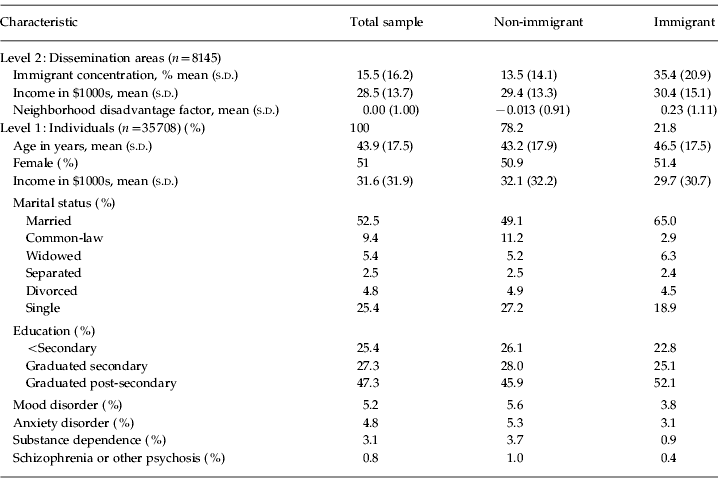
The sample is described in Table 1. The mean number of study (CCHS) respondents within a DA was 4.38 (range 1–65, s.d.= 39.8) (not shown). Among participants, 21.8% reported being immigrants, born outside of Canada and not born a Canadian citizen. Within the immigrant population, 56% had been in Canada >15 years, 8% reported their country of birth as being in Asia or Oceania and 9% in Europe. Immigrants were more likely to be married and to have a post-secondary education (Table 1).
Weighted sample demographics and characteristics

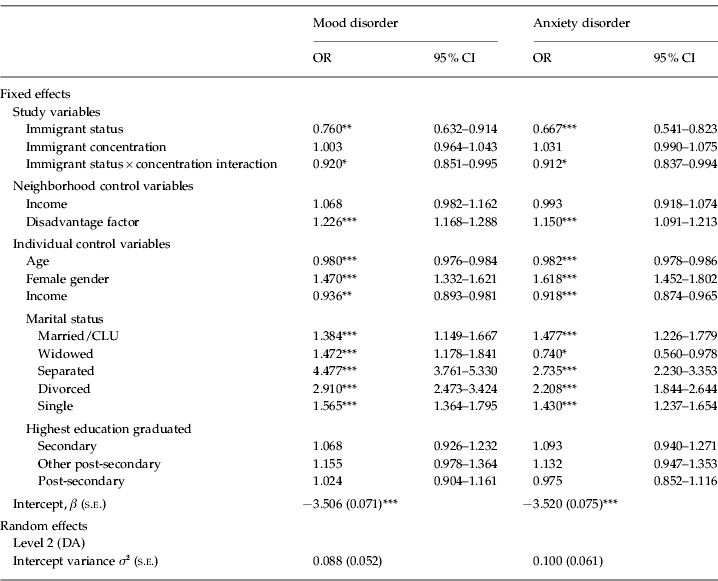
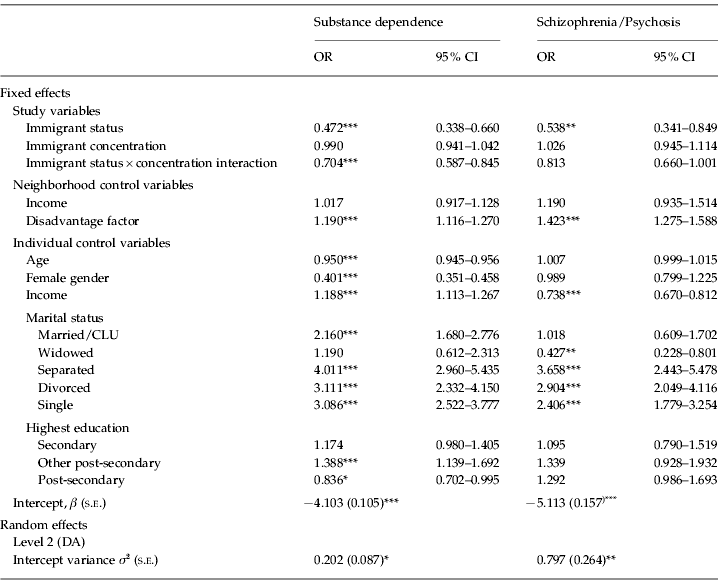
Tables 2 and 3 report the odds ratios and CI for the multi-level logistic regressions of psychiatric disorders on all study covariates. Immigrants exhibited significant reductions in prevalence of all four classes of mental disorder. For example, the odds ratio for mood disorder was 0.760 (95% CI 0.632–0.914) (Table 2). There were three statistically significant cross-level interactions. As neighborhood immigrant concentration increases, the prevalence of mood disorder, anxiety disorder and substance dependence decreases in the immigrant group (Fig. 1). The largest interaction effect occurred for substance dependence: 0.704 (95% CI 0.587–0.845) (Table 3). Although the interaction effect for schizophrenia/psychosis (0.813) was larger in magnitude than the ones observed for mood disorder (0.920) and anxiety disorder (0.912), the 95% CI was also much larger and bracketed 1.0 (95% CI 0.660–1.001) becoming non-significant at the p<0.05 level (Table 3). This reflects the very low prevalence of schizophrenia/psychosis (0.8%) and the attendant challenge to statistical power of testing for an interaction effect that involves this variable.
Interaction effect of immigrant concentration by immigrant status on prevalence of mood disorder. - - -, Immigrant; –––, non-immigrant.

Odds ratios and 95% confidence intervals for multi-level logistic regressions of mood disorder and anxiety disorder on immigrant status and neighborhood immigrant concentrationFootnote †

OR, Odds ratio; CI, confidence intervals; CLU, common-law union; DA, dissemination area.
* p<0.05, ** p<0.01, *** p<0.001.
† Adjusted for covariates.
Odds ratios and 95% confidence intervals for multi-level logistic regressions of substance dependence and schizophrenia/psychosis on immigrant status and neighborhood immigrant concentrationFootnote †

OR, Odds ratio; CI, confidence interval; CLU, common-law union; DA, dissemination area.
* p<0.05, ** p<0.01, *** p<0.001.
† Adjusted for covariates.
With the inclusion of the interaction term between immigrant status and immigrant concentration, the fixed effect for immigrant concentration at the DA level was non-significant in all analyses, indicating that immigrant concentration was not associated with elevated prevalence of disorder among non-immigrants. In analyses that excluded the neighborhood and individual variables (control variables), the fixed effect for immigrant concentration was positive for substance dependence: 1.094 (95% CI 1.052–1.138); and for schizophrenia/psychosis: 1.127 (95% CI 1.042–1.219) (not shown). However, these unadjusted effects were rendered non-significant and explained by the combination of neighborhood and individual-level characteristics controlled for in Table 3.
Finally, the random effects intercept variances [which quantify the extent to which the prevalence of disorder, aggregated to the area level (DA), differs from one area to the other] were small and non-significant for mood disorder (0.088) and anxiety disorder (0.100) (Table 2). In contrast, these estimates were larger and statistically significant for substance dependence (0.202) and schizophrenia/psychosis (0.797). The estimated ICCs associated with these random effects intercept variances were 5.8% for substance-dependence disorder and 19.5% for schizophrenia/psychosis, suggesting that these conditions exhibit considerable spatial variability.
Discussion
This Canadian study of the association between immigration factors and the prevalence of psychiatric disorder suggests lower prevalence of disorder in immigrants and an enhanced protective effect for immigrants living in higher immigrant concentration neighborhoods. This study reflects the Canadian context and may have limited generalizability to countries with substantially different immigration policies, health care systems, societal values and ethnic composition. However, the finding of a protective effect of high neighborhood immigrant concentration on prevalence of disorder in immigrants is in keeping with previously reported findings, even when immigrants themselves had higher rates of disorder. The adjustment for covariates eliminated the association between neighborhood immigrant concentration and substance dependence and schizophrenia/psychosis among non-immigrants. A possible explanation for this is that these associations may be attributable to social and economic disadvantages experienced by non-immigrants living in predominantly immigrant areas. In addition, the model of person–environment fit may have less significance in non-immigrants who are generally in the majority, even when living in high immigrant-concentration neighborhoods. This would partially explain a higher prevalence of disorder in non-immigrants, despite a high person–environment fit defined by being the majority.
The confounding effect of individual-level characteristics has been reported in the psychiatric literature (van Os et al. Reference van Os, Driessen, Gunther and Delespaul2000; Weich et al. Reference Weich, Holt, Twigg, Jones and Lewis2003) and emphasizes the importance of establishing statistical control. Despite the strong association between neighborhood disadvantage and prevalence of disorders, the adjustment for covariates did not affect the robust cross-level interaction between individual immigrant status and neighborhood immigrant concentration.
This finding of high-immigrant concentration neighborhoods conferring a protective effect for immigrants living in those neighborhoods is in keeping with other Canadian literature reporting such a protective effect (Georgiades et al. Reference Georgiades, Boyle and Duku2007). It is also consistent with European studies, which, although reporting a higher prevalence of illness in immigrants and taking a reverse focus on neighborhoods with lower immigrant concentration, do report the essentially protective effect of immigrant-dense neighborhoods on the immigrants living within.
Despite consistency between this study and European studies in the protective effect of neighborhood immigrant concentration, Canadian immigrants appear to be at much lower risk of mental disorder than European immigrants. The Canadian findings are in keeping with US reports of lower rates of psychiatric illness in immigrant (particularly Latino) groups (Breslau et al. Reference Breslau, Aguilar-Gaxiola, Kendler, Su, Williams and Kessler2006; Alegria et al. 2007 a). Findings from Australian samples have also been similar to those from Canadian samples, whereby immigrants have significantly decreased odds of having a psychotic disorder (McGrath et al. Reference McGrath, El-Saadi, Cardy, Chapple, Chant and Mowry2001). Differences in prevalence of disorder for immigrants in Europe versus North America and Australia may be due in part to immigration policies favoring healthier, more highly educated and financially stable applicants, as demonstrated by the relatively high levels of education in the Canadian immigrant group. The impact of immigration policies and selection bias was clearly demonstrated in Germany, as an increased prevalence of mental disorders in immigrants was observed after the removal of a requisite medical exam clearance prior to immigration (reviewed in Hutchinson & Haasen, Reference Hutchinson and Haasen2004). However, the robust cross-level interaction between immigrant status and neighborhood immigrant concentration suggests that while the immigrant effect is subject to selection mechanisms, the cross-level interaction is not, and may be better explained by person–environment fit.
Research has traditionally focused on risk factors at the individual level. This has been insufficient for eliciting a model of causation in mental illness. The inclusion of multiple levels of determination in the study of health outcomes permits analysis of the impact of macro-level variables on outcomes, either independent of individual characteristics or as modifiers of individual characteristics (discussed in Diez-Roux, Reference Diez-Roux1998).
Limitations
This study has some limitations. First, it is cross-sectional in design, ill-suited for making causal inferences because it cannot account for the temporal sequencing of variables and thus cannot contribute to longitudinal models, such as a developmental perspective. Additionally, the cross-sectional nature precludes examination of other potentially contributing factors, such as reverse causality and selection effects at play when non-immigrants live in high immigrant concentration neighborhoods which may, for example, be due to mental illness leading to downward drift and social adversity. Second, while the use of a general population sample is an advantage of this study, there are limitations to diagnostic screenings applied in the general population, including lack of clinical corroboration of a diagnosis, absence of non-responder information and risk of under-reporting, which can be susceptible to cultural influences. In addition, the diagnosis of psychosis was based on a screening question linked to conditions diagnosed by a health professional and not via the structured assessment used for the other diagnostic categories, limiting the reliability of the diagnosis. Fourth, defining neighborhoods via DAs is convenient but not necessarily optimal for establishing meaningful neighborhood boundaries. However, the small area size makes it more likely that sampled residents will share similar environmental exposures. Using census tracts (urban areas only) as the geographic unit of analysis produced similar results. Fifth, the high degree of overlap between immigrant status and country of birth made it difficult to control for ethnicity, raising the question of whether some of the findings may be better explained by ethnic designation rather than immigrant status. In contrast to some European studies, which have studied particular ethnic groups, such subgroup analysis was not possible with this database. Finally, the group of first generation immigrants (those born out of Canada) is very heterogeneous, including recent immigrants, older immigrants and refugees who may exhibit quite different health profiles. It is difficult to disaggregate differential effects in these heterogeneous immigrant subgroups.
Conclusion
Overall, our findings suggest that immigrants in Canada have a lower prevalence of psychiatric disorder and that this risk is lessened further as the neighborhood immigrant concentration increases. As rates of immigration to North America continue to increase, it becomes crucial to understand the mechanisms of health in the immigrant and non-immigrant groups. The person–environment fit model presents a compelling theoretical framework for understanding some discrepancies in findings around the world, including the protective effect of immigrant-dense neighborhoods for the immigrants living within. Additional work is needed to understand the mechanisms by which the concentration of immigrants in a neighborhood affects prevalence of psychopathology. Future research should include a temporal and developmental perspective clarifying the time-course and effects of person–environment fit. Understanding such person–environment interactions stands to significantly enhance our understanding of the contributory pathways to the development and, by extension, prevention of mental illnesses.
Acknowledgments
The authors gratefully acknowledge the help of James Chowhan at the Statistics Canada Research Data Center as well as the support of colleagues from HRM 790 – the Advanced Analysis of Survey Data course at McMaster University. Michael Boyle is supported by a Canada Research Chair in the Social Determinants of Child Health.
Declaration of Interest
None.