


Introduction
The physical, sexual and emotional abuse and neglect of children and adolescents is a significant global problem. To identify effective and accessible interventions to combat associated mental health problems as they arise in development, cognitive neuroscience research has advocated targeting ‘latent vulnerability factors’ mediating between adversity and symptomatic outcomes. Tendencies to selectively attend towards threat and to draw threatening, hostile interpretations of ambiguous situations are biases at two stages of information-processing known to characterize victims of childhood maltreatment in youth (Dodge et al., Reference Dodge, Pettit, Bates and Valente1995; Shackman et al., Reference Shackman, Shackman and Pollak2007). Although these information-processing biases are adaptive in dangerous, unpredictable conditions, such as growing up in adverse family environments, beyond these environments, they could contribute to persistent behavioural, emotional and social maladjustment, including clinical symptoms of internalizing and externalizing problems. Indeed, among physically abused adolescents, attention biases for angry faces correlate with anxiety symptoms (Briggs-Gowan et al., Reference Briggs-Gowan, Pollak, Grasso, Voss, Mian, Zobel and Pine2015), while in young people exposed to violence, interpretation biases correlate with aggressive tendencies (Shahinfar et al., Reference Shahinfar, Fox and Leavitt2000). Given the associations between biased information-processing and emotional and behavioural problems among young people who have experienced maltreatment, targeting these biases in interventions could be a beneficial preventative strategy.
Over the last decade, cognitive bias modification (CBM) training programmes that aim to train more adaptive styles of attention-orienting and control towards benign/positive information (CBM-A) and styles of interpreting ambiguous cues in a non-threatening manner (CBM-I) have been implemented in adults with a range of psychiatric conditions, and extended for use in children and young people, largely with anxiety and depression, but also aggression. No study has investigated the viability of CBM-A and CBM-I in adolescent victims of maltreatment. To address this gap, here we present pilot data on acceptability of a novel multi-session computerized training tool that targets attention and interpretation biases in young people with a history of victimization. A secondary aim was to describe overall changes in emotional, behavioural and social problems across participants. To enhance the generalizability of our findings across global contexts, parallel data collection initiatives took place in the UK and Nepal with young people who had experienced maltreatment.
Method
Sample
Nine young people (aged 14–17 years) from the UK and 10 young people (aged 13–16 years) from Nepal participated. UK participants (participants 1–9) were from two schools that provided alternative educational provision for young people unable to attend mainstream schools. The Nepalese participants (participants 11–20) were from three care homes, which provided residential facilities for rescued child labourers, street children, orphans, and those who had been separated from their family intentionally or unintentionally. To assess victimization history, employees working in alternate education provision units were asked to complete a 15-item measure, drawn from the Juvenile Victimization Questionnaire (JVQ) (Finkelhor et al., Reference Finkelhor, Hamby, Ormrod and Turner2005) screening questions for UK participants. Information reported in participant case files was used to facilitate completion of this measure. For Nepalese participants, as this was part of a larger study of maltreatment in rescued child labourers, modules from the self-report version of the JVQ assessed victimization history (Dhakal et al., Reference Dhakal, Niraula, Sharma, Sthapit, Bennett, Vaswani and Lau2019). Data across sites were used to generate analogous variables on the likelihood that the participant had experienced physical abuse, verbal (emotional) abuse, neglect (including guardian substance abuse, unsafe home environment), sexual exploitation, witnessed domestic violence, and exposure to conventional crime.
Procedure, training and measures
Ethical approval for data collection from the UK was sought from the Research Ethics Committee at King’s College London, and internally approved by safeguarding leads within the management structure of the educational unit. Permission for data collection in Nepal was granted by the Research Division Office of the Rector Tribhuwan University, and by the Central Child Welfare Board (CCWB) under the Ministry of Women, Children and Social Welfare. Ethical approval was sought from and given by the Nepal Health Research Council. Across both sites, informed consent was first sought from all parents and legal guardians, and from young people themselves. As most standardized measures were not available in Nepalese, we followed a rigorous process of translation and back-translation, with appropriate cultural adaptation. Permission was sought from the publishers/authors, and where appropriate, some were involved in this process.
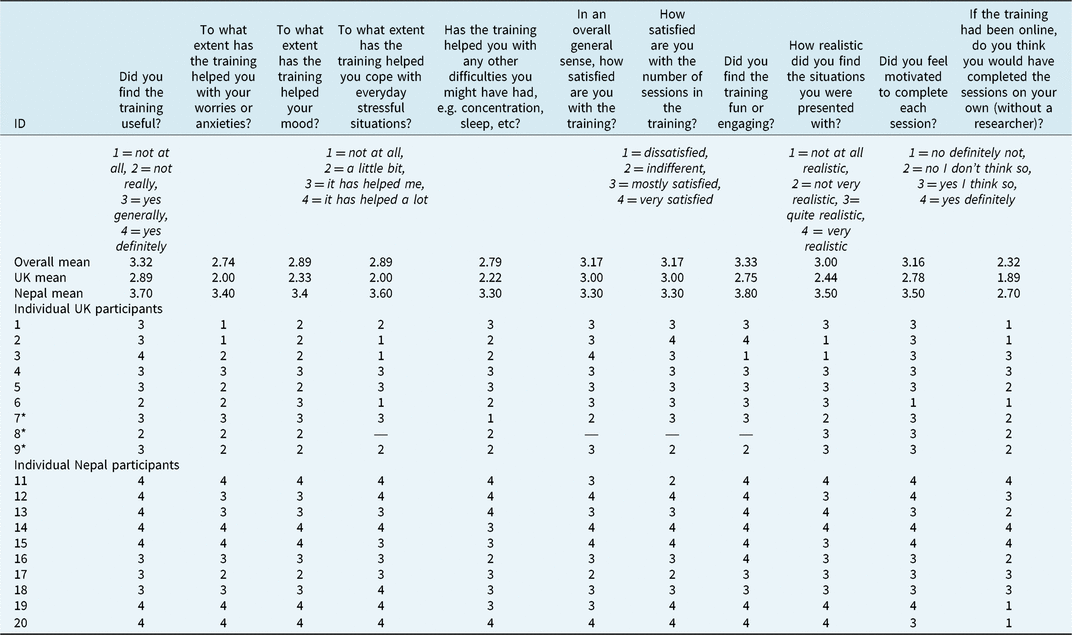
All participants were assessed across 7 days within a 2-week period that included pre-intervention, training and post-intervention assessments. Participants were tested on different days, and therefore had their own study schedules. On day 1, participants completed two subtests (Matrix Reasoning and Block Design) of the Wechsler Abbreviated Scale of Intelligence – Second Edition (WASI-II) to create a composite Perceptual Reasoning Index (PRI) of non-verbal reasoning ability; the Youth Inventory-4R to assess potential emotional and behavioural symptoms in adolescents, according to DSM-IV classification; the Strengths and Difficulties Questionnaire (SDQ) to assess ‘total difficulties’; and the General Anxiety and Social Anxiety subscales of the Screen for Child Anxiety Related Disorders (SCARED)–Child Version Short Form to assess training-relevant anxiety subtypes. Training for all participants was scheduled across days 2–6, with each 20-minute session including one module of CBM-I training and one module of CBM-A training (Lisk et al., Reference Lisk, Pile, Haller, Kumari and Lau2018). Each daily session consisted of a visual search attention training task and the ambiguous scenarios interpretation task used in earlier studies. In the attention training task, participants were instructed to repeatedly identify the only positive (smiling) face in a 4 × 4 matrix consisting of 15 other negative faces (5 fearful, 5 sad, and 5 angry). On each trial of the interpretation training task, participants read a text-based ambiguous situation that ended with a word fragment. Correct completion disambiguates the scenario in a positive/benign direction. This is then reinforced by the correct completion of a comprehension question. Training scenarios were co-produced with social work and educational professionals working with young people with histories of adversity. Although the intended number of training sessions was 5 days, two UK participants completed only two sessions due to unexpected changes in their academic timetable. After completion of training, on day 7 all participants completed the SDQ and the two SCARED subscales, and a self-report feedback questionnaire (Table 1). As well as items that were rated on continuous scales, there were open-ended questions for young people to provide feedback on aspects they found helpful, unhelpful, liked, disliked and general improvements.
Feedback questionnaire responses for UK and Nepal participants; where participants have not given a response this is marked as: *UK participants who only completed two sessions of training

Results
Sample description
All UK participants were male, while Nepalese participants were largely female (90%). Scores of the perceptual reasoning index probing non-verbal reasoning and problem solving ranged from 63 to 111 (percentile rank 1 to 77) for UK participants, while for Nepalese participants, the range was from 68 to 102 (percentile rank 2 to 55). Five and two participants from the UK and Nepal, respectively, met no diagnostic screening cut-offs on the YI-4R. However, as this was a pilot study, no diagnoses were used to exclude participation. Using 15 items from the JVQ, six of the nine young people from the UK were rated as likely to have experienced some form of physical abuse; eight to have experienced verbal (emotional) abuse; six, neglectful experiences; and none, for sexual abuse although there were three cases where the information provided in case files was uncertain. About one-third of the young people were thought exposed to domestic violence, and around half, more general violence with or without a weapon. For Nepal participants, all 10 young people had experienced physical abuse in their life, seven verbal (emotional) abuse, eight neglect, four sexual abuse, seven witnessed domestic violence; and nine witnessed general violence (according to the self-reported JVQ).
Acceptability
Responses to the first 11 questions of the training questionnaire are presented in Table 1 for participants from each site. Most UK and Nepal participants completed the intended number of training sessions, and most found the training to be at least ‘generally helpful’, with half rating it as ‘definitely’ helpful. When asked which specific areas the training was helpful at targeting, over half rated the training as useful for challenging worries, stress, and low mood. However, ratings of usefulness were lower in UK participants than Nepalese participants. Most UK participants did not believe they would be motivated to complete the training on their own, whereas over half of Nepalese participants endorsed either the ‘I think so’ or ‘definitely’ option when asked the same question.
Pre- to post-intervention measures
To describe changes in emotional and behavioural problems from pre-to-post intervention, the direction and magnitude of any differences in these measures are presented. Overall, participants 1–6 (UK) who completed five sessions of training showed a decrease in total difficulties SDQ scores with a small-to-moderate effect size (Cohen’s d = 0.28). For participants 7–9 who only completed two sessions of training, an overall increase of problem behaviours was observed but with a small effect size (Cohen’s d = 0.19). For Nepalese participants, overall, there was a decreased total difficulties SDQ score with a small effect size (Cohen’s d = 0.22). For general anxiety SCARED scores, overall, participants 1–6 (UK) who completed five sessions of training showed a decrease in scores with a small effect size (Cohen’s d = 0.12). For participants 7–9 (UK) who only completed two sessions of training, an overall increase was observed with a small effect size (Cohen’s d = –0.22). Looking at all Nepalese participants, completing training led to a slight decrease in symptoms with a small effect size (Cohen’s d = 0.09). For social anxiety SCARED scores, overall, participants 1–6 (UK) who completed five sessions of training showed a decrease in scores with a large effect size (Cohen’s d = 0.81). For participants 7–9 who only completed two sessions of training, no difference was observed. For Nepalese participants, completing training led to increased symptoms with a small effect size (Cohen’s d = 0.24).
Discussion
Cognitive training programmes that modify attention patterns and interpretational style thought to mediate between maltreatment and later emotional and behavioural problems could have preventative potential for those exposed to victimization. Our data speak primarily to the acceptability of CBM-A and CBM-I training protocols and procedures in young people with a likely history of victimization across two alternate education units in the UK and three care homes in Nepal. While most participants found the training helpful, ratings were numerically lower in UK than Nepalese participants. Yet, UK participants who received five training sessions showed more consistent improvements in emotional and behavioural symptoms, with especially large effects for social anxiety, possibly because these training techniques were adapted from procedures first used in young people with social anxiety (Lisk et al., Reference Lisk, Pile, Haller, Kumari and Lau2018). Improvements of emotional and behavioural symptoms in Nepalese participants, however, were less clear: a small reduction in total difficulties at post-intervention was found but social anxiety increased. Different results across samples could indicate cultural differences or differences in gender composition across the samples. Alternatively, even within culture, heterogeneity in maltreatment history and current psychiatric disturbances could confound clear patterns of training-related change. In sum, our data provide mixed results on the efficacy of CBM but show acceptability by maltreated samples across cultures. They thus support the potential of applying CBM to a larger global sample of victimized young people using a feasibility randomized controlled trial with other aspects of feasibility as outcomes, and anxiety and other problem behaviours as measures of change.
Acknowledgements
We would like to thank all participants who completed this study and the schools and care homes who agreed to take part.
Financial support
This work was supported by the UK Medical Research Council (MR/N006194/1) and the Department of Biotechnology, India (BT/IN/DBT-MRC/DFID/20/RP/2015-16).
Conflicts of interest
The authors have no conflicts of interest with respect to this publication.
Ethics statement
The authors have abided by the Ethical Principles of Psychologists and Code of Conduct as set out by the APA.



Comments
No Comments have been published for this article.