




No CrossRef data available.
Article contents
Reading strategy of Hong Kong school-aged children: The development of word-level and character-level processing
Published online by Cambridge University Press: 01 November 2005
Abstract
This study investigated the development of the mental representation of Chinese disyllabic words. Unlike alphabetical languages, Chinese is a logographic system where character is the basic unit of meaning. Most Chinese words are composed of two characters. Theoretically, Chinese compound word can be read either as a whole unit or as the component character. Subjects were asked to read aloud a list of two-character words, controlled for word and component character frequencies across grades. The correct percentage was analyzed using three two-way analyses of variance. Results indicated that children are able to make use of both levels of reading as early as Grade 1. Lower graders tended to use both the component character level reading processes more, while higher graders tended to read words as whole units more.
Information
- Type
- Articles
- Information
- Copyright
- © 2005 Cambridge University Press
In alphabetic languages, the basic unit of orthography is the grapheme. Graphemes correspond to phonemes, and reading is facilitated by the reader's phonemic awareness. The Chinese language is usually referred to as a morphemic system. The basic writing unit of Chinese is a graphic unit called a character, which corresponds semantically to a morpheme and phonologically to a syllable, rather than to a phoneme in the spoken language (Hoosain, 1992). Chinese words are composed of one or more characters. For example, the two-character word

/mou21 ji55/ meaning “sweater” is composed of the first character

/mou21/ (character on the left), which means “fur,” and the second character

/ji55/ (on the right), which means “clothes.” Both component characters are free morphemes in that they have consistent pronunciations and they can act as words on their own. They can also combine with other characters to form other words. For example,

/mou21/ can combine with

/kAn55/ to form

/mou21 kAn55/ (towel) and

/ji55/ can combine with

/NOi22/ to form

/NOi22 ji55/ (overcoat). Tan and Perfetti (1999) estimated that one-character words make up 34% of the Chinese words, whereas about 64% are two-character words (based on a 13,101,000 word corpus from mainland China). Based on the materials from Taiwan, Huang and Liu (1978) estimated that 66% of Chinese words are two-character words.
Unlike words in an alphabetical language such as English, there is no space demarcation in Chinese compound words in text. All characters, whether unitary or compound, appear as a continuous concatenation. Theoretically, there are two possible ways of reading Chinese compound words: reading character by character (character level reading), or reading as a whole (word level reading). For example, the compound word

/mou21 ji55/ can be read from left to right as characters

/mou21/ (fur) and

/ji55/ (clothes), or as the whole meaning “sweater.” Individual Chinese characters are not made visually more complex by inflectional markings (Li & Thompson, 1981). Spatially, each character occupies a fixed space irrespective of the number of strokes of the character. Taking all these characteristics together, one may assume that character is the primary unit of perception. However, Cheng (1981) using a forced choice task found that an individual target character was identified better as part of a two-character word than as part of a two-character nonword. This Chinese analog of word superiority effect in skilled readers indicates that component characters were not detected independently of the whole word in which they occur. Wu, Chou, and Liu (1994) revealed a word-level frequency effect in naming and lexical decision task, which provide a support to the notion suggested by Leong and Tamaoka (1988) that skilled readers might develop a holistic representation in the mental lexicon for multicharacter words.
Goswami (1999) found that skilled English readers supplement grapheme–phoneme encoding with representations of larger units for letter patterns for rhymes and representations for whole words. Goswami, Ziegler, Dalton, and Schneider (2003) further suggested that readers of inconsistent orthographies have no choice but to rely on a variety of larger orthographic units. Chinese orthography is no longer considered as being purely logographic. Only about 20% of Chinese characters are ideographic representation, which cannot be divided into components; about 80% of the characters are phonetic compounds that are made up of a semantic radical and a phonetic radical (Zhou, 1978; Zhu, 1988). Several studies confirmed the contribution of phonetic component information to character recognition (Ho & Bryant, 1997; Tzang, Lin, Hung, & Lee, 1995; Wu & Liu, 1997). Law and Leung (2000) also inferred, based on writing data, that the basic unit in constructing Chinese characters was logographemes, a unit smaller than radicals. Given this understanding, Chinese could be considered to have a less consistent orthography than English. It is reasonable to suggest that Chinese readers are likely to rely more on larger orthographic units in their reading. Mental lexicons for multicharacter word may be present in skilled Chinese readers.
Based on the suggestion that there are mental representations for individual character and are holistic representations for multicharacter words, two possible patterns of acquisition of Chinese reading may exist. The first pattern is that word level representation develops before the character level representation. The rationale is that children are usually exposed to Chinese characters as a meaningful whole. That is, children are usually introduced to multiunit words such as

/tin22 wa35/ (telephone), rather than individual character

/tin22/ (electricity) and

/wa35/ (word). Therefore, word level representations would be acquired first. The second pattern is where children develop character-level representations prior to word-level representations. The rationale is base on the observation that there is no space demarcation for words in texts. Children tend to read character by character, and hence, character representation was developed first. One of the aims of the present study was to investigate the order of acquisition (word level vs. component character level) reading strategies of Chinese multicharacter words in children.
The presence of representations at component character level was hypothesized to facilitate reading of new compound words (Liu & Peng, 1997). With representation at the single-character level, children could read aloud new compound characters through accessing the representations of component characters. The meaning of the new word could then be retrieved through the activation of the corresponding phonological lexicon that had already been developed before entering school. The development of larger orthographic unit representations is an inevitable result of reading an inconsistent orthography like Chinese (Goswami et al., 2003).
Zhang and Peng (1992) carried out two experiments to investigate the processing levels of reading Chinese words in normal adults. Subjects' response time was measured in a lexical decision task when two-character word stimuli were presented. In the first experiment, word frequency was varied while the frequency of component characters was controlled. The prediction was that, if there was word level representation, a word frequency effect would be obtained, with the speed of word recognition on high-frequency words faster than that of low-frequency words. The predicted results were obtained, indicating that whole word level processing was involved in adults' reading processing of Chinese words.
The second experiment by Zhang and Peng (1992) investigated the component character frequency effect in adult Chinese reading. Component character frequency was varied while the whole word frequency was controlled in a word decision task. The average response time for high-high (HH) words (high component character frequency on left and right positions) was found to be shorter than high-low (HL) and low-high (LH) words. Component character frequency effect was found, and the results suggested that component character level processing was involved in reading multicharacter words. Taft, Huang, and Zhu (1994), as reported by Peng, Liu, and Wang (1999), found similar results for component character frequency effect in a lexical decision task. The response time for recognizing words with HH component character frequency was shorter than that for words with HL and LH character frequency, which in turn, was shorter than words with LL component character frequency.
Based on the findings of these previous studies (Taft, Liu, & Zhu, 1999; Taft & Zhu, 1995; Zhang & Peng, 1992), Taft and Zhu (1995) and Taft et al. (1999) suggested a new model called the multilevel interactive-activation framework, to represent the reading processing of Chinese multicharacter words. In the framework, a multicharacter word is made up of units at different levels or nodes, which are hierarchically organized. Using the disyllabic Chinese word

/jin22 tOi22/ (modern) as an example, the highest level is the two-character word

/jin22 tOi22/ (modern). The next level down is the character level, made up of the first character

/jin22/ (present) and the second character

/tOi22/ (generation). The third level is the submorphemic level made up of units like

/wON21/ (the king), and

/kin33/ (see) embedded in the first character

/jin22/ of the two-character word. The lowest level is feature/stroke of the submorphemic units. When a disyllabic word is seen, activation enters the system through the orthographic subsystem and works its way up from the lowest level to the meaning level. Activation from the visual input at the stroke level passes up to submorphemic units such as the radical, and in turn, activates the characters associated with the activated radicals, then to the multicharacter word levels. At the end of the process, the meaning of the lexicon is achieved. Phonological representations of the characters and the word are also activated during the process of word recognition through the character level and the multicharacter word level, respectively. In this model, the units connect with each other across and within the levels mentioned above. In between the levels, there are excitatory connections; but the units at the same processing level inhibit the activation of the other. The strength of the connection between units and the processes of character recognition are influenced by characteristics at all of the potential processing levels (e.g., the frequency of occurrence of units at one of the levels and number of units embedded at the character or compound word level). They hypothesized that activation passes up and back down the levels of the interactive-activation system. Each level of orthographic representation, except the stroke level, is linked to its semantic representation (meaning) and its phonological representation.
Using the interactive-activation framework, Taft (1994) explained the difference found between reading low-frequency compound words and high-frequency compounds. When reading high-frequency words, representations at the word level were readily retrieved; therefore, little activation was required at the component character level. For low-frequency compound words, activation at the word level was reduced; thus, relatively more activation was required at the component character level. Consequently, component character frequency effect was found only in reading low-frequency words.
Peng et al. (1999) investigated the interaction between whole word frequency and component character frequency by measuring adults' response latency in a word decision task. They found significant main effects for word frequency and component character frequency, and a significant interaction effect between word and component character frequencies. Contrary to Taft's (1994) prediction, the component character frequency effect was found in the high word frequency condition only, instead of in the low word frequency condition. Peng et al. (1999) tried to explain the results by proposing that the connection strength from component character level to the word level representation was stronger for high-frequency words. They went on to explain that the higher the frequency of the component characters exposed in a word, the greater the association of the component characters with that word. As the connection strength between the two levels is high in high-frequency words, the access of representations at word level was affected by the component character frequency more. Even if this explanation was correct, it could not account for the nil component character frequency effect in reading low-frequency two-character words predicted by Taft's (1994) model. An alternative explanation is that either there is a methodological bias or the model is wrong.
Assuming that Taft was correct, one possible explanation for the discrepancy between Peng et al.'s (1999) results and Taft's (1994) prediction was related to the paradigm used by Peng et al. The word decision task used in the experiment required the subjects to view the two-character stimuli, and then decide whether they were words or not (lexical decision). To make a correct lexical decision on a two-character stimulus, one has to search for a mapping representation at the word level. Subjects would give a negative answer for stimuli for which they could not find a matched representation at the word level, no matter whether or not they could find a matched representation at character level. Consequently, the results of the study reflected frequency effect at the word level rather than frequency effect at the component character level. Instead of allowing subjects to process words flexibly at different levels of representations for different word frequencies and component character frequencies, the nature of the task might induce the so-called higher connection strength from component character level to the word level representation for high-frequency words. Given the above consideration, a reading aloud task with percentage correct measurement was used in this study to prevent the possible limitation on the levels of reading processing used by the subjects in Peng et al.'s (1999) study.
The first aim of the present study was to test the effects of whole word frequency and component character frequency on reading. If the subjects processed words at the word level, it was expected that there would be a significant word frequency effect. Activation thresholds of high-frequency words are lower than that of low-frequency words. Thus, better reading performance for high-frequency words was predicted. If children processed words at the component character level representation, a significant component character frequency effect would be expected. The reading performance on HH words would be better than HL and LH words, which in turn, would be better than LL words.
Although studies on reading processing in Chinese adults have been carried out (Peng et al., 1999; Taft et al., 1999; Taft & Zhu, 1995; Zhang & Peng, 1992), the developmental trend of the reading processing of disyllabic words in Chinese has rarely been investigated. The second aim of this study was to investigate the development of reading strategy in Chinese school-age children. The interaction between word frequency and component character frequency should inform us on the developmental pattern of reading acquisition. Based on Goswami et al.'s (2003) suggestion on the flexibility of choosing reading units of different size, it was expected that lower grade students would tend to rely on smaller unit (character) more, whereas the use of different size reading unit (character or two-character words) would be more flexible in older children. For skilled readers, component character frequency effect would be expected for low-frequency but not for high-frequency words. For lower grade students, a component character frequency effect would be expected to occur across word frequencies (high and low).
METHOD
Subjects
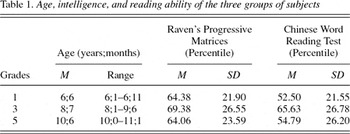
A standardized nonverbal intelligence test, Raven's Standard Progressive Matrices (Raven, 1986), and the Chinese word reading subtest of the Hong Kong Test of Specific Learning Difficulties in Reading and Writing (Ho, Chan, & Education Department, HKSAR Government, 2000) were administered to a pool of 120 Grade 1, 3, and 5 students of a primary school in Hong Kong (40 in each grade). Twenty-four children in each grade, who obtained scores between the 25th and the 75th percentile in both tests were chosen to be the subjects of the present study, giving a total of 72 children. Details of age, nonverbal intelligence, and reading ability of the three groups of subjects are listed in Table 1.

All subjects were born in Hong Kong and had attended local kindergartens where Cantonese was the teaching medium. There is no equivalent phonic system like pinyin for Cantonese, and no phonic instructions for Chinese are given in kindergarten and primary schools in Hong Kong.
Stimulus material
To study the level of reading processing of school-aged children, three sets of 80 two-character words were selected as the stimuli for subjects from Grades 1, 3, and 5, respectively, from the Hong Kong Corpus of Primary School Chinese (Leung & Lee, 2002). The sources of characters in the corpus were primary-school textbooks on Chinese language used in Hong Kong. There are a total 200,000 entries in the corpus. The criteria for word selection were based on (a) the whole word frequency and (b) the component character frequency in the corpus. The frequencies were calculated cumulatively for each grade. For example, the cumulative frequency of a word in Grade 3 was the sum of the frequencies of that word in Grade 1, Grade 2, and Grade 3. Similarly, the component character frequency of a character in Grade 5 was the sum of the frequencies of that character in Grades 1–5. The cumulative word frequencies and component character frequencies were used in the present study to estimate children's exposure to Chinese words and characters since the start of their primary school education.
The words were categorized into high-frequency and low-frequency words according to the frequencies of occurrences of words in each grade. Because the cumulative frequency of characters varied across grades, the use of an absolute frequency value for the definition of high and low frequency was impossible. Instead, all words taught in each grade were listed in the order of their frequencies of occurrence. High-frequency stimuli were selected from the list in the order of their frequencies from high to low, starting from the character with the highest frequency. The low-frequency characters were selected from the list starting from the character with the lowest frequency. The pool of characters in the corpus was also categorized into high and low frequencies in each grade using the same method. The resultant distributions of high and low word frequencies and character frequencies in the three grades are listed in Table 2.

There were four types of component character frequency constructions for the two-character words: high-frequency first and second characters (HH), high-frequency first character and low-frequency second character (HL), low-frequency first character and high-frequency second character (LH), and low-frequency first and second characters (LL). Combining whole word frequency (high vs. low) with component character frequency, there were eight frequency conditions for each grade. In each condition, 10 words were selected from the Hong Kong Corpus of Primary School Chinese (Leung & Lee, 2002) according to the word frequency and component character frequency. Three lists of 80 two-character words were generated for each of the three grades involved in the study.
Leong and Cheng (2003) pointed out that the control of frequency should not be confined just to orthographic form but should extend to phonological frequency. To control for this possible confounding variable, the number of phonologically ambiguous characters and the distribution of stroke complexity were made approximately equal across frequency conditions. Within each grade, syllable frequency (phonological frequency) of the stimuli across frequency types was controlled so that they were approximately the same. All the above the information was extracted from Hong Kong Corpus of Primary School Chinese (Leung & Lee, 2002). Across grades, the syllable frequencies of the stimuli in primary 3 and 5 were comparable but were relatively higher than those of primary one. This could be explained by the lower morpheme/syllable ratio in lower grades when exposure was more limited. Similarly, stroke complexity and phonological ambiguity were controlled. As far as the combinability of constituent characters is concerned, no binding words1
Binding words are words where the two component characters always appear together; individual component characters never exist alone, and never combines with other characters to form other compound words (e.g.,

meaning “wander”).
Most Chinese characters are made up of a phonetic radical and a semantic radical. Such a character is described as regular if the onset and rhyme of the phonetic radical is identical to the onset and rhyme of the whole character.
Each stimulus was printed in black using the “biau kai” (

) font (40 point) in the center of a piece of plain white paper with dimensions of 10× 15 cm. The default character spacing of the font was used.
Procedures
The data collection was carried out individually in a classroom at the primary school in February, 5 months after their academic year had started. Each subject was asked to read aloud in Cantonese the 80 stimuli designed for each of the grades mentioned above. One word (comprising two component characters) was presented at a time, and there was no time limit for the child to read the stimuli. When they were not sure or had no idea about the word presented, the children were instructed to read aloud as many component characters as they could. Marks were given based on the children's first response to the stimuli. However, if subjects spontaneously corrected their response, marks were given based on their subsequent productions. Children's responses were audiotaped and recorded online using a scoring form. Each of the 72 subjects did the read-aloud task once and a total of 5,760 word productions were collected. One mark was given for each correctly read component character and no mark was given to wrong production or no response. Therefore, a subject who read all the 80 disyllabic words stimuli correct will get a mark of 160. The reading productions of the subjects were audio taped for double-checking and for error production transcription.
RESULTS AND DATA ANALYSIS
Accuracy
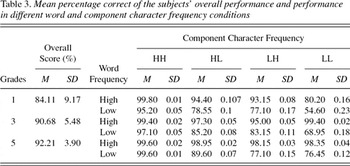
In each grade, the percentage correct in each frequency condition of each subject was calculated based on the scoring mentioned in the Procedures section. To have general understanding of the developmental trend of the primary school students' Chinese reading, the reading scores in each grade in different word frequency and component character frequency conditions is presented in Table 3. There is a general trend that the reading performance increases with grade.

The mean scores obtained for each grade were entered into a 2× 4 two-way analysis of variance (ANOVA) with repeated measures for analysis. A total of three two-way ANOVAs were run. The word frequency factor consisted of two levels, high and low word frequency. The component character frequency factor had four levels: HH, HL, LH, and LL. The mean scores of the subjects' reading performance were the dependent variable.
Significant word frequency main effects were found in all of the two-way ANOVAs. For Grade 1, F(1, 23) = 133.43, p < .001; for Grade 3, F(1, 23) = 89.60, p < .001; and for Grade 5, F(1, 23) = 83.40, p < .001. Post hoc Tukey honestly significant difference (HSD) tests showed that the reading accuracy of high-frequency words were significantly better than low-frequency words (p < .001).
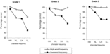
The component character frequency main effects were also found to be significant in all three grades. For Grade 1, F(3, 69) = 58, p < .001; for Grade 3, F (3, 69) = 44.21, p < .001; and for Grade 5, F (3, 69) = 44.10, p < .001. Tukey HSD test showed that the pairwise comparisons between levels of component character frequencies in Grade 1 and Grade 3 were similar with HH > HL = LH > LL (p < .001). The pattern for Grade 5 was HH > HL > LH = LL (p < .001), different from the other two grades (Figure 1).

The interaction of word frequency and component character frequency effects across grades.
Significant interaction effects were also found between word frequency and component character frequency for all grades. For Grade 1, F(3, 69) = 55.53, p < .001; for Grade 3, F(3, 69) = 33.73, p < .001; and for Grade 5 F(3, 69) = 37.59, p < .001.
In Grade 1, under high word frequency condition, performance on LL words was significantly poorer than HH, HL, and LH words (p < .001). The students in higher grades read words with high word frequency similarly well, despite the variation in component character frequencies. In the low word frequency condition, the difference in accuracy between HH and LL component character frequencies was statistically significant in all three grades (p < .001). As shown in Figure 1, the difference was largest in Grade 1 and the difference decreased across grades.
The difference between HL and LH component character frequencies was not significant for any of the word frequency conditions in Grades 1 and 3. However, Grade 5 students performed significantly poorer for LH words than HL words in the low word frequency condition (p < .001), and LH words were not significantly different from LL words.
In summary, significant main effects were found for word frequency and component character frequency. Significant two-way interaction effects were found between word frequency and component character frequency. Two interesting differences were found in the patterns of Grades 1 and 5. First, children in Grade 1 read LL words poorer than HH, HL, and LH words in the high word frequency condition, while the performance of LL words were similar to HH, HL, and LH words in other grades. Second, children in Grade 5 read LH words poorer than HL words in the low word frequency condition, while the performance of LH and HL words were comparable in other grades.
Error analysis
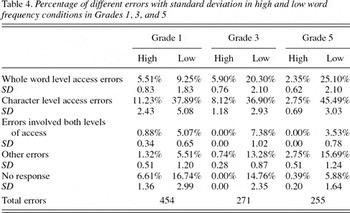
The errors made by the subjects were analyzed. Errors were assigned into five categories: whole word level access errors, character level access errors, errors that involved both levels of access, no response, and errors that could not be categorized.
A word level processing error occurred when a semantically related word was wrongly selected as the output. An example of the whole word level access error was when

/khwAi55 tsAk5/ (rule) as produced in place of the target

/tit2 tsJy22/ (order).
A processing error at the character level occurred when there was a competition between the target words and related entries at the component character level. For example, the target word

/tsiN55 sAn21/ (spirit) was replaced by

/tshiN55 sAn21/, a nonword. The appearance of the first character of the target

was orthographically similar to the error

. Phonologically, the target /tsiN55/ was also similar to the error /tshiN55/.
The third type of error involved the activations of entries at the multicharacter word level and entry at the component character level. One example of this type of error was the replacement of the target

/jAu23 Oi33/ (friendship) by

/phAn21 Oi33/, which has no meaning.
Table 4 shows that the most frequent errors made were character-level access error. When the word frequency is high, the percentages of character-level access error decrease with reading experience. When the word frequency is low, Grade 5 has higher percentage of character-level access errors than the other two grades. When the word frequency is low the percentages of whole word level access error increase from Grade 1 to Grade 5.

DISCUSSION
There was a general trend that the reading performance increases with grade, although the frequency had been controlled across grades (Table 3). The results could not be accounted for by the fact that older students have more exposure to characters. An alternative explanation was that the students in higher grades have acquired better reading skills when compared with those in lower grades.
This was consistent with the findings of previous studies on word-level reading processing (Peng et al., 1999; Zhang & Peng, 1992). The results of the present study showed that there was a word frequency effect in children's reading across grades. As mentioned in the introduction section, a word frequency effect was expected if there was processing at word level, as high-frequency words were more readily activated than low-frequency words. The significant word frequency effect in the current study supported the claim that primary school-aged children use word-level processing in reading multicharacter words.
The main effect of component character frequency found in this study was also similar to results obtained by Zhang and Peng (1992) and Peng et al. (1999). If children use whole word-level reading processing only, the component character frequency would not affect their reading performance, and high-frequency component characters would not assist their compound word reading. The presence of both word frequency as well as component character frequency effects implied that children use character-level processing as well as word-level processing in reading multicharacter words.
The significant interaction effect found in the present study between word frequency and component character frequency provides further information about the relationship between word-level processing and component character levels processing. In contrast to the findings of Peng et al. (1999), significant component character frequency effect with reading performance decreasing in the order of HH > HL = LH > LL was found in the low word frequency condition only. The results of the present study appeared to be more consistent with the multilevel interactive-activation framework proposed by Taft et al. (1999). When children read high-frequency words, they could easily access the words at the word level once activation was passed onto the word level. As a result, they read words with high word frequency equally well across different component character frequencies. When low-frequency words were encountered, representations of the words appeared to be difficult for the children to activate at the word level. Consequently, characters at the component character level were activated, resulting in significant component character frequency effect. In other words, both word-level and component character-level representations were activated in reading multicharacter words in this group of children. The word-level reading strategy was used for high frequency words while the component character-level reading strategy was applied for low-frequency words.
The development of reading strategies was investigated by looking at the results of the two-way interaction between word frequency and component character frequency across grades. Generally, students from all grades read high-frequency words more accurately than low-frequency words. Consistent with the prediction of Taft et al.'s (1999) model, a significant component character frequency effect was found in all grades in the low word frequency condition. Only the Grade 1 students showed a significant effect of the component character frequency when reading high-frequency words. This indicated that the reading performance of the Grade 1 students was affected by the component character frequency to a greater extent than for the Grade 3 and 5 students. One way of explaining this phenomenon is that either the word-level representation or the flexibility of shifting between using orthographic units of different sizes are not well established in Grade 1. As a result, Grade 1 students have to rely on component character processing more in their reading.
It was predicted that children's reading performance for low-frequency words with HH component character frequency would be as low as for other low-frequency words. However, the results showed that they read words with HH component character frequency equally well in both high and low word frequency conditions. Their success in reading low-frequency words with HH component character frequency could be explained by the processing of words at the component character level, because the whole word representations was less easy to activate for the low-frequency words. It appeared that the word level and the component character-level reading processing compensated for each other when the representations in either of the levels were difficult to activate, reflecting that there was a flexible use of processing levels for Chinese multicharacter words by children. Goswami et al. (2003) reported similar observations on the reading of English and German by skilled readers. The results of the present study lent support to the suggestion that there is a choice of the size of reading unit depending on the consistency of orthography. For an inconsistent orthography like Chinese, skilled readers were expected to rely on larger orthographic units in their reading.
Apart from the flexibility issue, another theoretical implication of the present study was the application of Taft et al.'s (1999) hierarchical model to Chinese reading. According to the framework, activations pass from radical level representations to character-level representation before reaching the multicharacter word level. It was difficult to explain the lack of a significant difference in the accuracy between HL and LH words for low-frequency words and the slight word-level dominance over character-level processing found in lower grades (78.55% accuracy for multicharacter words vs. 77.10% accuracy for characters in Grade 1, and 85.20% accuracy for multicharacter words vs. 83.15% accuracy for characters in Grade 3). Although it might be argued that the ability to employ left-side component character in word reading was not yet completely acquired in lower grades, the results did not provide a strong empirical support to the hierarchical model. In contrast to the hierarchical models was the Interactive Constituency Model of Perfetti and Tan (1999), which claims phonology as a privileged constituent, along with orthographic and semantic components, in Chinese word reading. The key assumptions of this model are that character units and polycharacter word units were organized at the same level, both in the orthographic processor and in the phonological processor; and that two characters and whole words are processed with some degree of independence. The suggestion that character entry and polycharacter entry are organized at the same level appears to offer a better explanation for the data obtained in the present experiment.
The conclusions on the reading strategy used by different grades were further supported by the error patterns obtained. The percentages of word-level errors increase across grades when the word frequency was low. This may support the suggestion that skilled readers rely on a larger orthographic unit, word, than component character in their reading. Moreover, when the word frequency was high, there was a decline in the percentages of character-level access error with reading experience. This phenomenon could be interpreted as the consequence of the tendency to use the less smaller orthographic unit, character, in reading. As a result, higher graders tended to access multicharacter words at the whole word level and were less affected by component character frequency.
If Peng et al.'s (1999) finding that component character frequency effect was found only in the high word frequency condition was correct, the component character reading strategy would be activated at high-frequency word level. Accordingly, more character level access errors would result for reading high- frequency words than low-frequency words. However, the fact that the number of character level access errors was larger for low-frequency words than for high-frequency words in the present study seemed to suggest the opposite. Evidence from the error pattern in the current study further undermined Peng et al.'s (1999) conclusion. It was likely that Peng et al.'s finding was due to a scoring bias related to the lexical decision paradigm. Subjects were required to access word-level representations to make a lexical decision at the component character level to the word level, instead of giving subjects' flexibility to choose between different levels of representations for different word frequency and component character frequencies. However, the use of response accuracy may generate a problem of ceiling effect, especially in the naming of high-frequency characters by students in higher grades. A replication using the response time paradigm may serve to clarify whether whole word frequency and character frequency have additive effects.
In conclusion, children as young as Grade 1 read multicharacter words using both whole-word level and component-character level reading strategies. Students in lower grades reading performance was affected by the component character frequency to a greater extent than higher graders. The lower graders were more dependent on the component character level reading strategy than higher graders, while the higher graders tended to read Chinese multicharacter words as meaningful wholes. Because the results of the present study revealed that children as early as Grade 1 had already developed both word-level and character-level reading strategies, the development of these reading processes was likely to occur before children entered primary school. To obtain a more comprehensive picture, studies on the development of reading strategies in preschoolers are recommended in future developmental studies on reading Chinese.
ACKNOWLEDGMENTS
We are grateful to Professor Paul Fletcher and the three anonymous reviewers for their valuable comments during the preparation of this paper. Hearty thanks to Ball Yuen, Angela Tsoi, Jackie Chan, Kiu Chan, Grace Ngan, Rebecca Cham, and Vivian Wong for their support and help in subject assessment and selection and to the Vice Principal of the Hong Kong Baptist Convention Primary School for her unconditional support. Particular thanks to all the subjects who participated in this study.
References
Cheng C. M.
1981.
Perception of Chinese characters.
Acta Psychologica Taiwanica,
23,
137–
153.Google Scholar
Goswami U.
1999.
Causal connections in beginning reading: The importance of rhyme.
Journal of Research in Reading
22,
217–
240.Google Scholar
Goswami U.,
Ziegler J. C.,
Dalton L., &
Schneider W.
2003.
Non-word reading across orthographies: How flexible is the choice of reading units?
Journal of Applied Psycholinguistics,
24,
235–
247.Google Scholar
Ho C. S.-H., &
Bryant P.
1997.
Development of phonological awareness of Chinese children in Hong Kong.
Journal of Psycholinguistic Research,
26,
109–
126.Google Scholar
Ho C. S.-H.,
Chan D. W.-O., &
2000.
Education Department, HKSAR Government.
The Hong Kong test of specific learning difficulties in reading and writing.
Hong Kong:
HKSAR Government, Education Department.
Hoosain R.
1992.
Psychological reality of the word in Chinese.
In H.-C. Chen &
O. J. L. Tzeng (Eds.),
Language processing in Chinese
(pp. 111–
130).
Amsterdam:
North-Holland.
Huang C. Y., &
Liu Y.
1978.
Effects of two-character word frequency, meaningfulness, and imagery on paired-word learning.
Chinese Journal of Psychology,
20,
1–
4.Google Scholar
Law S.-P., &
Leung M.-T.
2000.
Structural representations of characters in Chinese writing: Evidence from a case of acquired dysgraphia.
Psychologia,
43,
67–
83.Google Scholar
Leong C. K., &
Cheng P.-W
2003.
Consistency effects on lexical decision and naming of two-character Chinese words.
Reading and Writing,
16,
455–
474.Google Scholar
Leong C. K., &
Tamaoka K. (Eds.)
1988.
Reading and writing: Cognitive processing of Chinese and Japanese languages.
Dordrecht:
Kluwer Academic.
Leung M.-T., &
Lee A.
2002.
The Hong Kong corpus of primary school Chinese.
Paper presented at the 9th Meeting of the International Clinical Phonetics and Linguistics Association. Hong Kong.
Li C., &
Thompson S.
1981.
Mandarin Chinese: A functional reference grammar.
Berkeley, CA:
University of California Press.
Liu Y., &
Peng D.-L.
1997.
Meaning access of Chinese compounds and its time course.
In H.-C. Chen (Ed.),
Cognitive processing of Chinese and related Asian Languages.
Hong Kong:
Chinese University Press.
Peng D.,
Liu Y., &
Wang C.
1999.
How is access representation organized? The relation of polymorphemic words and their morphemes in Chinese.
In J. Wang,
A. W. Inhoff, &
H.-C. Chen (Eds.),
Reading Chinese script: A cognitive analysis.
Mahwah,
NJ: Erlbaum.
Perfetti C. A., &
Tan L.-H
1999.
The constituency model of Chinese word identification.
In J. Wang,
A. W. Inhoff &
H.-C. Chen (Eds.),
Reading Chinese script: A cognitive analysis
(pp. 115–
134).
Mahwah, NJ:
Erlbaum.
Raven J. C.
1986.
Hong Kong supplement to guide to the standard progressive matrices.
Hong Kong:
HKSAR Government, Education Department.
Taft M.
1994.
Interactive-activation as a framework for understanding morphological processing.
In D. Sandra &
M. Taft (Eds.),
Morphological structure, lexical representation and lexical access.
East Sussex:
Erlbaum.
Taft M.,
Huang J., &
Zhu X.
1994.
The influence of character frequency on word recognition responses in Chinese.
In H. W. Chang,
J. T. Hung,
C. W. Hue, &
W. Tzeng (Eds.),
Advances in the study of Chinese language processing
(pp. 59–
73).
Taipei:
National Taiwan University.
Taft M.,
Liu Y., &
Zhu X.
1999.
Morphemic processing in reading Chinese.
In J. Wang,
A. W. Inhoff, &
H.-C. Chen (Eds.),
Reading Chinese script: A cognitive analysis.
Mahwah, NJ:
Erlbaum.
Taft M., &
Zhu X.
1995.
The representation of bound morphemes in the lexicon: A Chinese study.
In I. B. Feldman (Ed.),
Morphological aspects of language processing.
Hillsdale, NJ:
Erlbaum.
Taft M., &
Zhu X.
1997.
Using masked priming to examine lexical storage of Chinese compound words.
In H.-C. Chen (Ed.),
Cognitive processing of Chinese and related Asian languages.
Hong Kong:
Chinese University Press.
Tan L.-H., &
Perfetti C. A.
1999.
Phonological activation in visual identification of Chinese two-character words.
Journal of Experimental Psychology,
25,
382–
393.Google Scholar
Tzang O. J.-L.,
Lin Z.-H.,
Hung D.-L., &
Lee W.-L.
1995.
Learning to be a conspirator: A tale of becoming a good Chinese reader.
In B. de Gelder, &
J. Morais (Eds.),
Speech and reading: A comparative approach.
East Sussex:
Erlbaum, Taylor, & Francis.
Wu J.-T.,
Chou T.-L., &
Liu I.-M.
1994.
The locus of the character/word frequency effect.
In H.-W. Chang,
J.-T. Jhuang,
C.-W. Hue, &
O. J. L. Tzeng (Eds.),
Advances in the study of Chinese language processing
(pp. 31–
58).
Taipei:
National Taiwan University.
Wu J.-T., &
Liu I.-M.
1997.
Phonological activation in pronouncing characters.
In H.-C. Chen (Ed.),
Cognitive processing of Chinese and related Asian languages
(pp. 47–
66).
Hong Kong:
Chinese University Press.
Zhang B., &
Peng D.
1992.
Decomposed storage in the Chinese lexicon.
In H. C. Chen &
O. J. L. Tzeng (Eds.),
Language processing in Chinese
(pp 131–
150).
Amsterdam:
Elsevier Science.
Zhou Y. G.
1978.
Xiandai Hanzihong Shenpangde Biayyin Gongeng Wenti [To what degree are the phonetics of present-day Chinese characters still phonetic?]
Zhongguo Yuwen,
146,
172–
177.Google Scholar
Zhu X.
1988.
Analysis of the cueing function of the phonetic in modern Chinese.
Proceedings of the Symposium on Chinese Language and Character.
Beijing:
Guang Ming Daily Press.
Age, intelligence, and reading ability of the three groups of subjects

Distribution of high and low word frequencies and character frequencies in the three grades
Mean percentage correct of the subjects' overall performance and performance in different word and component character frequency conditions
The interaction of word frequency and component character frequency effects across grades.
Percentage of different errors with standard deviation in high and low word frequency conditions in Grades 1, 3, and 5
 You have
Access
- 15
- Cited by