Sieglinde van de Klundert's edition of the Tractatus de tonis by Guy of Saint-Denis offers an important opportunity to reflect on the contribution of a relatively unstudied figure, concerned to combine traditional instruction about plainchant with new thinking about the emotional effect of music being developed in Paris in the early fourteenth century.Footnote 1 Of further interest is the anthology of writings, put together under the supervision of Guy of Saint-Denis and concluding with his Tractatus. The anthology is preserved in a manuscript formerly belonging to the ancient royal abbey of Saint-Denis and now kept in London, British Library, Harley 281 (hereafter referred to as: H).Footnote 2 It shows extensive autograph corrections that reveal Guy's concern to clarify his arguments in the light of contemporary thinking about what was considered permissible in the practice of chant. The present study examines Guy's attitude to each of the authors he includes within this anthology as a way of understanding the originality of his approach to liturgical chant, and the care with which he composed the Tractatus.
In particular, attention needs to be given to understanding the core criticism, which Guy makes at the end of the first of two books of his Tractatus, of the practice he attributes to ‘moderns’ of composing liturgical offices by using the eight modes sequentially, rather than choosing a mode particularly suited to the text in question. He singles out various Offices to illustrate his criticism, namely of the Holy Trinity, Mary Magdalene, St Nicholas, St Augustine, St Catherine of Alexandria and St Louis, canonised only in 1297.Footnote 3 Guy objects to the way modes were being used without specific regard for their expressive potential in relation to particular texts. He comes to this position only through careful reflection on what various authorities have said, from antiquity to his time.
The first of the two sections that make up the ninety-two leaves of the Harley manuscript (fols. 5r–38v, covering four quires) is devoted to treatises written by or attributed to Guido of Arezzo, followed by a Cistercian Tonale. The second (fols. 39r–96v, copied by the same scribe onto eight quires), begins with the Ars musice of Johannes de Grocheio (John of Grouchy), followed by the more practical Tractatus de tonis by Petrus de Cruce (fols. 52v–58r). It concludes with Guy's own synthesis of theory and practice in the heavily corrected Tractatus de tonis, which occupies much of the second section (fols. 58v–96v).Footnote 4 While van de Klundert helpfully identifies Guy's contribution to thinking about the effect of different modes on the emotions, and in particular his debt to Peter of Auvergne on the impact of music on the senses, the present study explores Guy's relationship to existing thinking about music by relating his Tractatus to the anthology as a whole. In particular, we consider how Guy's attitude to chant combines the traditional teaching of Guido of Arezzo with two distinct stages of Aristotelian reflection relating to music as it developed in Paris in the last decades of the thirteenth century. The first of these stages is represented by the zeal of Grocheio, writing most likely in the early to mid-1270s (rather than 1300 as often claimed), for describing different types of music as performed in Paris.Footnote 5 By contrast, the second stage, developed in the late thirteenth century by Peter of Auvergne, transferred the innovative ideas of Thomas Aquinas about emotions to thinking about the effects of music on the soul. Unlike Grocheio, who was concerned with contemporary practice, Guy was concerned to show how new thinking could help promote appreciation of the great authors of the past. He argued that the choice of mode for a chant should reflect the character of the particular text being sung, rather than rigidly following the standard numerical sequence of modes.
This article is structured around analysis of Guy's attitude to each of the various theorists and traditions included in this anthology, namely those of Guido of Arezzo, the Cistercians, Grocheio and Petrus de Cruce, as a way of considering his own thinking about chant. We then compare Guy to his contemporaries, including Jerome of Moravia (Hieronymus de Moravia) and Peter of Auvergne, before examining Guy's corrections to the various texts in this anthology. In a final section we compare this anthology to the Sanctilogium of Guy of Châtres, abbot of Saint-Denis between 1326 and 1342, considering whether Guy can be identified with the fourteenth-century abbot of that name.
Guy of Saint-Denis and the Guidonian chant tradition
As a monk of Saint-Denis, Guy was exposed to liturgical traditions that had evolved over many centuries. Little is known for certain, however, about whether Saint-Denis retained older Gallican chants after Romanising liturgical reforms were imposed during the reign of Pepin, crowned by Pope Stephen at Saint-Denis in 754. The attribution of Roman chant to Gregory the Great was a way of authorising its use.Footnote 6 The practice of composing Offices in modally sequential form (assigned by Guy to moderni) was in fact well established in Latin tradition. Richard Crocker has identified, in a twelfth-century liturgical manuscript of Saint-Denis, Offices that are modally sequential or ‘numerical’, such as those of the Holy Trinity, the Finding of the Cross, St Stephen and St Peter, all of which are known to have been composed in the late ninth century or later. By contrast, Crocker notes that the Offices of many Roman and local saints at Saint-Denis (such as Cucuphat, Maurice, Denis, Eustace and Martin) are not ‘numerical’ in character, perhaps a sign of their antiquity.Footnote 7 The composition of such ‘numerical’ Offices suggests that Frankish theorists were thinking in modal terms, grouping chants into the eight tones (sometimes called modes), each with a different final (D, E, F, G), as either authentic or plagal, a process that happened just as psalmody was shifting away from solo to choral recitation.Footnote 8 Tonaries helped monks and clerics to connect antiphons to the appropriate psalm tone for each mode, but did not offer reflection on their significance.Footnote 9
Traditionally, the dominant assumption, articulated for example in the Dialogus de musica (c.1000), erroneously attributed to Odo of Cluny, was that a ‘tone or mode is a rule that judges any chant by its final’, an assumption repeated by Guido of Arezzo.Footnote 10 Although Guido did comment in passing on particular qualities (pleasure, garrulity, smoothness) associated with certain modes, he did not do so systematically.Footnote 11 In the Harley anthology, Guidonian teaching (to which the Dialogus is attached) is summarised in three books, each with additional prefaces explaining that Guido of Arezzo was distancing himself from purely philosophical accounts of music to provide something of practical benefit. Thus Guido's Micrologus is introduced not just by his original verses, but also by additional sentences put into the mouth of Guido explaining that it had pleased Bishop Theodald to recall him from rest and devote himself to proving ‘whatever of musical utility’ he could offer for common benefit through rules and figured neumes.Footnote 12 After Guido's letter to Theodald there occurs an additional preface in which Guido is presented as wanting to find a better way than the Greeks had of presenting the ‘simple reasoning of this art’ for tender ears, which puts aside complex proportions of numbers:
Turning over the ancient volumes of the Greeks, I have seriously investigated long and often if, putting aside completely proportions of numbers, the simple reasoning of this art can be fully adapted to the tender ears of singers. Having considered many treatises therefore, I have found Boethius better for this, for showing what and how many are the conjunctions of pitches through modes, tropes and species of the consonances among themselves; but the way in which he strives to explain the force and nature of pitches through the science of sound (armonice) is for philosophers alone and obtuse and difficult for students. For the older treatise of philosophy, mired in excessive obscurity, sets traps for inexperienced ears by the weightiness of the words of those proffering arguments.Footnote 13
The preface illustrates the style of such treatises with a wordy statement as an example of the verbiage about cosmic music that he wishes to avoid. While presenting Guido as fully familiar with learned philosophical tradition about knowing how all things existed ‘by number, weight and measure’ (Wisdom 11:21), the pseudo-Guidonian preface emphasises that his rules are offered ‘for the sake of modulating well’. These thoughts are fully consistent with what Guy of Saint-Denis declares at the very outset of his Tractatus: that he is offering teaching about the tones culled both from the Musica of Boethius and the writings of Guido of Arezzo and from certain others in the discipline.Footnote 14 Guy uses these prefaces to show how Guido explained music theory on the basis of concrete examples as opposed to the theoretical style of Boethius. He introduces these explanatory details in the voice of Guido as a way of building up to his own synthesis in the treatise that concludes the compilation.
The second of the three books of Guidonian teaching in Harley 281 presents the Regule rhythmice, introduced by an otherwise unknown fictional dialogue between Guido and his Muse, in which this theme of rejecting abstract argument is developed further:
I do not think it at all appropriate for you, says the Muse, and no authority of reason is shown to demand this, by the same way of the philosophers, or by insisting on the same paths, that music can be passed on to untutored and new singers by hard proportions of number … For I know that tender ears cannot fully grasp older treatises of philosophy.Footnote 15
Such phrases reinforce the practical aspect of Guido's Regule rhythmice to which are attached excerpts from Guido's Prologus to the Antiphonarium and his Epistola to Michael (rendered in H as ‘Martin’).
The Harley manuscript then presents an extended version of the Dialogus, as part of a third book of Guido, along with a second part of the Epistola.Footnote 16 Guy of Saint-Denis introduces this third book with a preface that helps explain why its author has chosen the genre of dialogue:
For whatever therefore that we have been able to collect for the third part, imitating moderns by the authority of philosophers about the nature of the modes we have provided for our listeners in the form of a dialogue through great forethought of facility without the addition of deceit, removing all hateful material. For what is not understood in the aforesaid volume, either by the rule of neglect or because music has lain hidden for a long time, is in the final analysis profitably perceived in an easy collection of rules for the youthful ear.Footnote 17
This preface, like the other texts attached to the writings attributed here to Guido of Arezzo, explains the simplicity of its text as a conscious strategy to communicate the principles of chant to the young in a way that is easier to understand than the emphasis on rational proportions found in the philosophers, in particular Boethius.
Guy of Saint-Denis and the Cistercians
Guy's version of the Guidonian corpus is immediately followed by the Cistercian Tonale, introduced here, but in no other surviving manuscript, as ‘another art about the tones in the form of a dialogue which is titled by some under the name of blessed Bernard’. By juxtaposing the Cistercian Tonale with the Guidonian corpus, Guy of Saint-Denis presented two earlier examples, one Benedictine, the other Cistercian, of treatises that explained the tones. In the early twelfth century, the Cistercians sought to reform practice by mandating only what they considered to be the original forms of plainchant. As an outgrowth of Bernard of Clairvaux's involvment with a new phase of liturgical reform, Guy of Eu outlined its core principles in a treatise dedicated to his friend, William, first abbot of Rievaulx (1131–41). His Regulae are attributed to ‘abbot Guido’ in the only surviving manuscript (Paris, Bibliothèque Sainte-Geneviève 2284), a title that probably reflects his becoming abbot of Cherlieu (1132–57).Footnote 18 Rather than determining the tone of any chant by its final, Guy of Eu defined it as ‘a rule determining the nature and form of regular chants’.Footnote 19 He spoke more about the way a chant develops within certain fixed limits of pitch, as either authentic or plagal, according to its various maneriae, a term not used before the twelfth century.Footnote 20
The prescriptive Cistercian way of reforming chant differed from that developed in the eleventh and twelfth centuries by Germanic theorists such as Hermannus Contractus or Johannes Cotto, who emphasised knowledge of the modes as essential to the composition, assessment and performance of chant, rather than mathematical thinking. They saw chant as a vehicle through which monastic reform could be promoted without ever developing the same emphasis on uniformity as the Cistercians.Footnote 21 Guy of Eu did not reflect on the specific character or effect of individual tones, but sought to identify the core principles of chant as he thought they were known to Gregory the Great, without any of the corruption they had subsequently accrued.Footnote 22 His core teaching is summarised in the more widely circulated Tonale, introduced in the Harley compilation as ‘said to be by Bernard of Clairvaux’.Footnote 23 It concludes with the master responding to his student's request for clarification on the problem of differentiae and versicles seeming to be of different tones, with the comment ‘By the prohibition of the Cistercian General Chapter, neither in the Gradual nor in the Antiphonary can anything be changed’ and for further guidance ‘consult the Musica of Guy of Eu, which he wrote for his most holy master, William, first abbot of Rievaulx’.Footnote 24 In providing the Cistercian Tonale immediately after the Dialogus, Guy of Saint-Denis was enabling his readers to appreciate the difference between its definition of the modes and that of Benedictine tradition.
Guy of Saint-Denis and Johannes de Grocheio
Guy decided to balance the monastic focus of the first half of his anthology with a second section of ‘modern’ authors, beginning with Grocheio's Ars musice (without identification of its author). While Grocheio criticises Boethian assumptions about the music of the spheres espoused by John of Garland because of his lack of awareness of Aristotle's teaching in the De caelo,Footnote 25 he never refers explicitly to Aristotle's discussion of music in book eight of the Politics – a text first made known in Paris through the teaching of Thomas Aquinas during his last spell in the city, between 1269 and 1272. Yet comments that Grocheio makes about the social effects of various types of music, without any explicit discussion of their impact on the emotions, suggest that he may well have been responding to the ideas of the Politics without his having had access to the text. While Thomas started a commentary on the first two books of the Politics in the last years of his life (1272–74), he never reached Aristotle's discussion on music, only making a brief comment about the concord between the teaching of Aristotle and Boethius in his Summa Theologica.Footnote 26 It was left to Peter of Auvergne (d. 1304), a regent master in theology in Paris from 1296 to 1301 and a canon at Notre Dame, to complete this commentary, and to respond to particular questions about the impact of music on the senses, discussing these issues in a Quodlibet disputation, delivered in 1301, which was used by Guy of Saint-Denis.Footnote 27 Unlike Grocheio, who criticized John of Garland perhaps shortly after his death in 1271, Guy of Saint-Denis was writing in the first decade of the fourteenth century, when the authority of Aristotle's Politics had become fully recognised. Intellectually, they belong to distinct generations.
Grocheio's concern is more with the nature of musica in general than with the ecclesiastical modes. His focus is on the principia or foundational elements of music, which he defines as consonances (simultaneous sounds) and concords (one sound after another), rather than tones or modes. Grocheio is thus particularly interested in intervals as the consequence of harmonic ratios. Rejecting the Boethian division of music into cosmic, human and instrumental, he postulates that one branch is musica vulgalis, another regulated or measured music, and the third, ecclesiastical music, which is created out of these two branches – whether as plainchant or polyphony.Footnote 28 After describing the various liturgical offices and parts of the Mass, Grocheio criticises the traditional definition that the mode of any chant could be judged by its final. Instead he promotes the view of moderns that it was based on its beginning, middle and end, questioning the older definition because it implies that all song (cantus) can be judged from its final, when in fact this only concerns ecclesiastical chant.Footnote 29 Grocheio does not go into detail about these modes, other than suggesting that anyone could ‘find them by himself if he perused the gradual and the antiphonary and other ecclesiastical books by looking at the variations of the end, in ascent and descent. For through these 8 modes almost all chant is regulated.’Footnote 30 (The use of Arabic numerals is a distinctive feature of Grocheio's text in the Harley manuscript.)
Guy of Saint-Denis and Petrus de Cruce
The theoretically inclined treatise of Grocheio is followed by the more practical treatise about the tones of Petrus de Cruce, a composer identified by Guy of Saint-Denis as ‘someone who was an outstanding cantor at Amiens’.Footnote 31 More like a traditional tonary, this text classifies chant into its various tones without attempting any explanation of their character or effect.Footnote 32 Petrus repeats the traditional definition of a tone as a rule that judges every chant by its final.Footnote 33 Although Guy of Saint-Denis noted that Petrus de Cruce followed observances at Amiens similar to those of Saint-Denis, he may have included this tonary for its practical examples, in order to show students how they could be combined with Grocheio's analysis of music. Guy presented his monastic students with a Sic et Non of different approaches to chant as a prelude to his own effort to combine a theoretical approach to musica with a more practical identification of the tones. Once students had absorbed the monastic traditions of chant and what both Grocheio and Petrus had to say, they could appreciate Guy's synthesis of their teaching in his Tractatus de tonis.
Guy of Saint-Denis on the tones
Guy's treatise is divided into two books, the first theoretical in character, the second devoted to illustrating the practice of chant. The opening letters of the five chapters of the first book spell out the name GVIDO as an opening rubric to the Tractatus indicates, matching the acrostic that opens the Micrologus of Guido of Arezzo.Footnote 34 Tones are, for Guy, the very foundation of music, both as a way of singing and as a distance between two pitches. Grocheio never referred explicitly to the teaching of Guido of Arezzo in his Ars musica. While he does refer to discussions he had with Clement, a monk of Lessay (near Coutances), about the utility of music, there is little that is clearly monastic in his account. This makes it all the more remarkable that Guy should think that his monastic students needed to know about what Grocheio had to say about secular music in relation to both monophonic and polyphonic cantus. Guy is particularly indebted to Grocheio's understanding of tone both as the standard interval on which concord and consonance was based and as the framing substance of any chant. After mentioning the standard ecclesiastical definition of a tone as a classification based on the final of any chant, he adopts what he says is a more subtle definition: that a tone is a rule through which one can judge every ecclesiastical chant by assessing not just its beginning, but also its middle and end. He claims he is following those who observe that ‘public and civil chants, such as songs and rounds and particularly measured chants, such as motets, hockets and such like’ are neither subject to tones nor regulated by them – a clear reference to Grocheio.Footnote 35 Guy took for granted Grocheio's contribution to the art of music, but wanted to apply its principles more carefully to the chants of the church.
Perhaps the most enigmatic aspect of Guy's treatise is his claim about an account of the tones ‘which I have found in a certain truly old book, in which is also contained Guido's Micrologus, which I frequently quote in this treatise.’Footnote 36 He reproduces a story, told by Walter of Châtillon in his Alexandreis, about two sisters, Scylla and Charibdis, who became rocks in the sea.Footnote 37 Guy claims that the tones were first identified in the different types of melody created by water gushing through eight holes in the rock, by which Scylla seduced sailors. All melodies were reportedly variants of these different types. The Greeks, however, plugged these holes so that ships would not be lured to the potentially destructive rocks. ‘Subsequently, paying attention to these eight sounds and modes of singing, which are now called tones, they brought together as many arguments as possible, formulating with great certainty the ordering of the discipline of music.’Footnote 38 The eight tones comprised four authentic tones, each with its own plagal. Guy explains each authentic tone as relating to its plagal equivalent as like noieane, called from the bow of a ship, but eliciting a response, noieagis, from the other end of the ship:
But what those voices signify or of what language they may be, namely noieane or noieagis or the like, no one as yet knows, as is read in the same place, unless by chance such a voice or sound, like the tongue of man, resonates through hidden pipes from the concurrence of water and the breath of the air of the wind. Some Greeks, however, to free themselves quickly from a question of this kind, interpret these words as words of joy, just as euax is an interjection designating joy and exultation.Footnote 39
Was Guy accurately reporting what he found in this ‘ancient book’ or was this a literary fiction to enable him to offer his own explanation of the tones: not as a specific sequence of pitches, but as different forms of musical expression? No precedent can be found in the writings of any previous monastic theorist for Guy's explanation that there were holes in these rocks, through which rushing water created eight tones or types of melody, and without which no type of natural or rational song could be created. Guido of Arezzo makes no such link to classical learning. Guy of Eu similarly avoids any association with Greek mythology in his account of the modes in his Regulae, where he defines the tones as maneriae. Guy of Saint-Denis expresses his uncertainty about the author of the ‘truly old book’ only by suggesting that it must be someone who came after Guido of Arezzo, because of a sentence that it reportedly contained:
Indeed from this, insofar as I put down those things which were written from the aforesaid old little book about the origin of the tones, [it was] more to quote than assert, and I am not certain to which author they ought to be imputed or ascribed. It seems to another who was after Guido, rather than to Guido himself, especially since in the same place he expressly made mention about himself and the formulae of his tones in these words: ‘We put the formulae of Guido the abbot, a most distinguished man in music, below amongst [the section about] the tones.’ For although Boethius and other more ancient music theorists treated more acutely and profoundly of the obscure and impenetrable science of music which is clear in full to God alone, this man, however, mindful of us, composed the most lucid and useful rules of this art for singing. For the churchman instructed us about the necessary use of the church giving many examples of the responsories and antiphons of offices, since all the others were completely silent in every way.Footnote 40
The reference to the ‘formulae of Guido the abbot, a most distinguished man in music’ is perplexing because, throughout his Tractatus, Guy has referred to Guido of Arezzo as monachus. The only ‘abbot Guido’ known in the medieval period as a theorist of music was the Guido abbas identified as author of the Cistercian Regulae, now surviving in a single manuscript. According to a catalogue of the Sorbonne, these Regulae were also preserved in a manuscript once belonging to Richard de Fournival, chancellor of Amiens and given to the Sorbonne by Gerard of Abbeville (d. 1272), that also presented the Micrologus of Guido of Arezzo as by Guido Augensis.Footnote 41 It is striking, however, that Guy of Saint-Denis never makes more than a passing reference to Guy of Eu's use of the term maneriae, even though he included the Cistercian theory of tones in his own analogy.Footnote 42 The fact that he quotes a sentence referring to Guido as abbot rather than using his own words suggests that he may have had some doubts about the identity of this Guido, since he does not commit himself elsewhere to describing Guido (of Arezzo) as an abbot. Guy of Eu was identified as Guido iunior in a Cistercian treatise, perhaps from around 1300, subsequently reported by the fifteenth-century writer John Wylde.Footnote 43
In the Tractatus de tonis, Guy of Saint-Denis may relate the mythic origins of the Greek tones to entertain his reader, but he acknowledges that the story is far from certain. He explicitly contrasts the knowledge of the ancients, in particular that of Boethius, with that of Guido, whom he describes as compiling most lucid and useful rules for the art of singing. He praises Guido not as a monk or abbot, but as a churchman who provided instruction in the proper usage of the church, giving examples of liturgical responses and antiphons, something never mentioned by almost all others. Guy subsequently elucidates the discussion, found in Guido of Arezzo's Micrologus, of the distinction between authentic and plagal tones.
Guy then explores an issue not previously dealt with by theorists in any great detail, namely their ‘effect or virtue’. How can different tones provoke different passions of the soul, and thus shape behaviour? While Grocheio had repeated a tradition established by Boethius that music in general can have an effect on people, giving as an example the way different kinds of secular song can affect the young or those who work in the fields, Guy now applies this principle to the different tones.Footnote 44 As Klundert has demonstrated, Guy draws on ideas developed by Peter of Auvergne to argue that the soul's appetitive or desiring part is stimulated by the senses in the same way as the will (or intellectual appetite) follows the intellect.Footnote 45 The sensitive appetite varies in individual people according to their particular disposition of qualities.Footnote 46 Just as some people are hotter, others colder, in disposition, thus some are bold, some jealous and some wrathful.Footnote 47 By the various proportions making up different kinds of music, so is there an impact on the differing constitutions of the human soul, mediated through varying moods.Footnote 48 Thus one particular type of chant has the power to make one sad, another to make one happy. Guy is aware that this is in conformity with the teaching of both Boethius and Guido, going back to the teaching of Pythagoras, but here he explains the effect of music in Aristotelian terms. He claims that in the ‘certain truly old book’ that he mentioned in the second chapter, the third mode was described as being like a horseman riding with hair dishevelled or erect in the wind (fol. 75r). This is Guy's way of being original, identifying, as from an ancient authority, an image that illustrates the particular quality of a type of chant.Footnote 49 While Guido had commented briefly on the effect of chant, he had not gone into this level of detail about the power of different modes of chant. Even if Guy never engaged in depth with the ideas of Peter of Auvergne, he was going much further than Grocheio in reflecting on the impact of tones on the emotions.
These reflections lead Guy to conclude his first book with serious criticism of many of the chants long practised at Saint-Denis, namely the practice of ‘moderns’ in composing a liturgical office by applying modes in their numerical sequence without regard to their distinct emotive qualities. Guy prefers the compositions of an older style of liturgical office, in which he believed modes were chosen because they were appropriate to the text.Footnote 50 Just as Aristotle had written that discourse had to match its subject matter, so ecclesiastical chants had to be suited to their subject matter.Footnote 51 Although Guy referred to this practice of modally sequential offices as ‘modern’, it was originally a late ninth century practice, as Crocker and other scholars have observed in the case of the feast of the Trinity. It became widely developed for new feasts in the twelfth and thirteenth centuries.Footnote 52
Guy singled out for criticism not just the offices for the feast of the Trinity, but others that were more recent, such as those of St Nicholas, Mary Magdalene and St Louis.Footnote 53 Attuned to new currents of thinking about music, he wanted to reassert the primacy of the text in determining the choice of mode against the increasingly standard pattern of composing ‘numerical’ offices. He was responding to the compositional style adopted in offices such as the modally sequential Ludovicus decus regnantium, which was very likely the office commissioned by Philip IV from Petrus de Cruce in 1298 in honour of St Louis, observed at the royal chapel and taken over in certain court-connected Dominican houses, such as at Poissy. It can be suggested that, in his treatise, Guy was responding to the compositional practice of moderni such as Petrus de Cruce in arguing that tones should be chosen because of their appropriateness to the text rather than just adopted sequentially within an office.
In the second book of his Tractatus, Guy reflects on the distinction between the neuma (or wordless chant) that could follow an antiphon and neumes through which chants were recorded. He knew that antiphons were an ancient liturgical practice going back to the time of Ambrose. Guy was unsure whether the neumes that Guido had reportedly mentioned as transmitted by Gregory were actual records of notation.Footnote 54 While common usage ascribed the eight tones to Gregory, Guy confessed that he had been unable to find the source of his teaching in any of the ancient manuscripts of his monastery:
But I have not been able to find the book about the tones, which, as has been said, certain musicians claim was produced by him [Gregory], although I have carefully looked at a work attributed to him. Yet I have not departed from the path of Guido and the rules of other subsequent musicians, who followed the paths of the venerable doctor. Perhaps I have held the very book among the many and varied treatises that I have seen on this subject and read it carefully, ignorant however or unaware whose it was.Footnote 55
This was the lament of someone who loved to peruse the ancient treasures of Saint-Denis seeking the sources of the chant he loved. In lieu of finding the original texts of Gregory he provided samples of the chant of his abbey to demonstrate the varied character of the chants that he considered loyal to his inspiration.
Guy of Saint-Denis and Jerome of Moravia
Guy of Saint-Denis's selection of texts in Harley 281 stands in sharp contrast to that of the Dominican, Jerome of Moravia (possibly Moray, Scotland) in his Tractatus de musica, completed perhaps soon after 1271.Footnote 56 Whereas Guy focused his anthology around the teaching of Guido, Jerome refers to Guido sparingly, providing only a single quotation from his writing, and criticising him for referring to modes as tones (distorting a comment made earlier by John Cotton).Footnote 57 By contrast, Jerome gave particular authority to the De musica of Boethius, along with more recent treatises about both monophonic and polyphonic chant, notably by John of Garland, Franco of Cologne and Peter of Picardy (Petrus Picardus). Jerome's attempt to come to terms with new philosophical ways of thinking about sound is illustrated by the way he introduced the ideas of Aristotle into his compilation. He interpolated an extract from the commentary of Thomas Aquinas on a controversial passage in Aristotle's De caelo, which seemed to challenge the Pythagorean notion of music of the spheres that had been taken for granted by Boethius in his De musica.Footnote 58 Jerome, who would have been at Saint-Jacques during the years 1269–72, when Thomas was in Paris starting to work on his commentary on the De caelo, had previously quoted a series of authors who took for granted the notion of the music of the spheres. Jerome refused to offer his own view of the question, instead presenting the commentary of Thomas as the view of Aristotle. This was very different from Johannes de Grocheio who, in his Ars musice, explicitly criticised both Boethius and John of Garland for supporting the notion that cosmic music existed, even if it could not be heard.Footnote 59 Compared to Guy, Jerome was much more cautious about applying the insights of Aristotle.
Neither did Jerome expand much on the effects of music. He reports what Boethius had to say on the subject, recognising that the senses, whether of children, young people or the elderly, are stirred by sensory experience. Here, however, he speaks of the modes, as he had absorbed them from Boethius, being potentially lascivious or austere.Footnote 60 He explained these effects by allusion to the Platonic notion of the world-soul as held together by music in the same way as is the human person. Only towards the end of his treatise does he consider tones as designating the melodic categories of plainchant, judged by the finals on which they end, but without any extended analysis of their character. A section (Omnis igitur cantus) from near the end of Jerome's Tractatus, declaring that all ecclesiastical chants have to end on a specific set of finals (D, E, F, G), was subsequently attached to copies of the Dominican Antiphonal.Footnote 61 This forms part of a broader discussion of two ways of determining the tone of a particular chant that were current in his own day, namely the traditional view (for which he gives John of Garland as his authority, but which goes back to the Dialogus of Pseudo-Odo), that a tone is ‘a rule that judges every chant by its final’, the other is that it is a rule through which one can know the tone through the beginning, middle and final of any chant.Footnote 62 The terminology of analysing chant into these three elements had been promoted in the eleventh and twelfth centuries by Berno of Reichenau and other German theorists in the twelfth century, and surfaced in the Summa musice, a German treatise from before 1236.Footnote 63 The claim that one could not know a tone before hearing its beginning, middle and end was taken for granted in the Practica musice (c.1271) by Amerus, an English theorist writing in Italy.Footnote 64 A Parisian teacher, Lambert, writing perhaps in the 1260s, did not use the ‘modern’ definition but referred to ‘a certain rule by which a chant is ruled, discerned and regulated’, as if wanting to emphasise that a mode was governed by much more than its final.Footnote 65 While this tripartite analysis of any chant had a long history among German theorists, Jerome considered it as ‘modern’, perhaps because it had not been followed by John of Garland. In surviving reports of his teaching on musica plana, John summarised Boethian teaching about intervals, but never refers to tones as modes. In the Introductio musice plane secundum magistrum Johannem de Garlandia, the eight tones are mentioned in terms of their finals, summarising the teaching of the Dialogus, without any reference to any tripartite analysis of specific chants, such as was adopted by Grocheio and Guy of Saint-Denis.Footnote 66 In formulating the rules of chant, Jerome was following the Cistercian practice of laying down strict rules about the permissible pitch ranges of chants.Footnote 67 Among thirteenth-century theorists, Jerome is the most careful to acknowledge that certain chants could ‘by licence’ (licentialiter) extend both above and below the regular range.Footnote 68 This is a term that Guy of Saint-Denis would find particularly useful in his analysis of chant. His anthology of texts about music differed from that of Jerome, not just in relying on the authority of Guido of Arezzo (rather than Boethius), but also because it included Grocheio's Art of Music, with its outspoken criticism of John of Garland for not taking account of the Aristotelian criticism of Pythagorean doctrines of cosmic music. Nevertheless, Jerome's anthology of ancient and contemporary writing may well have stirred Guy to produce his own compilation of texts in Harley MS 281.
Guy's corrections in Harley 281
The hand (H2) responsible for many of the corrections made to the texts in Harley 281 certainly seems to be that of Guy of Saint-Denis. While, with a few major exceptions, the vast majority are minor, namely emending the main scribe's errors or inserting omitted words, they occur throughout the whole codex. Guy also seems to be responsible for the musical notation and the diagrams, which are drawn in red ink. Surprisingly the straight lines involved in the diagrams are not ruled but quite crudely drawn, although a compass was used to draw circles. Further, the pitch letters used in explaining musical examples are written in the same hand.Footnote 69
Guy made numerous corrections to the Micrologus (fols. 5r, 6v, 7r, 8r–v, 12rv, 13r, 14v, 15v, 16r), the subsequent Prologus (fol. 23v), the Dialogus (fols. 26r–v, 27v, 29rv, 30r–v, 31v) and to the Tonale Beati Bernardi (fols. 35v, 36v, 37r), including a gross miscalculation on fol. 38r of the spaces required for the music and text. He also added frequent corrections to the text of the Ars musice of Grocheio (fols. 40r, 41r, 42rv, 44v, 45r, 46r, 47v), usually by inserting a missing word. As a result the quality of the text in this manuscript is far superior to that found in our only other copy (Darmstadt, Universitäts- und Landesbibliothek 2663, fols. 56r–69r, copied in the mid-fourteenth century and belonging to the Carthusian abbey of St Barbara, Cologne), in which an added note reveals that its author was Johannes de Grocheio, ‘a regent master at Paris’.
Guy made one erasure that has not been corrected, namely on fol. 39v. Here Grocheio is discussing the numerical ratios corresponding to musical intervals. In writing about the diapente he says: ‘with the result that for the one in sesquialiter as 12 is to 8, which rendered the diapente’.Footnote 70 The ratio is a sesquialter one (3:2) but, although the 6 has been erased, the 8 has not been inserted, perhaps a sign that, although diligent in correcting the Latin text and music, Guy was not as adept with the newly introduced Arabic numerals. This is also consistent with his being more interested in texts and liturgical practice than with the more scientific aspects of Grocheio and Boethius. In the next text, Petrus de Cruce's Tractatus de tonis, there are two changes on fols. 52v–53r, one of them a crossing out in red ink of evovae, written above the music. He also added the detail Ambianensis on fol. 58r, immediately after the closing rubric Expliciunt toni a magistro petro de cruce, reflecting Guy's own knowledge of Petrus de Cruce's origins.
The greatest part of the activity of this correcting hand (H2) is devoted to correcting the text of the final Tractatus de tonis (fols. 61rv, 66v, 67rv, 68rv, 69r, 70rv, 72rv, 73r, 75rv, 77r, 79v, 80r, 87r, 89r, 90v, 94r, 95v) in such a way as to leave little doubt that this is the hand of its author. Some of these corrections occupy several lines, in one case a whole chapter. Further, Guy of Saint-Denis cooperated with the rubricist since he says, on fol. 58v: ‘You who read the name of the author through the five first letters of the rubricist, pray this to be written from heaven.’Footnote 71 The opening initials of the five chapters spell out GVIDO. Finally, at the end of the Tractatus (fol. 96v) is appended the note: ‘Here ends the Tractatus de tonis gathered together by brother Guido, monk of the monastery of Saint-Denis in France.’Footnote 72
When words are simply struck through with a line, it is impossible to be certain whether this was done by the main copyist (H) or the senior corrector (H2). There are so many cases, however, of H2 adding words over an erasure or adjacent to a deletion, that there can be little doubt that Guy is himself responsible not just for ensuring that his text is of the highest quality, but for introducing significant editorial modifications. These editorial changes, particularly extensive on fols. 66v–67r and 89r, deserve close attention. Given that certain passages that have been struck through contain passages that Guy had already corrected by writing over an erasure, the final manuscript must incorporate revisions made over a period of time, and reflect the author's continuing desire to improve his text.
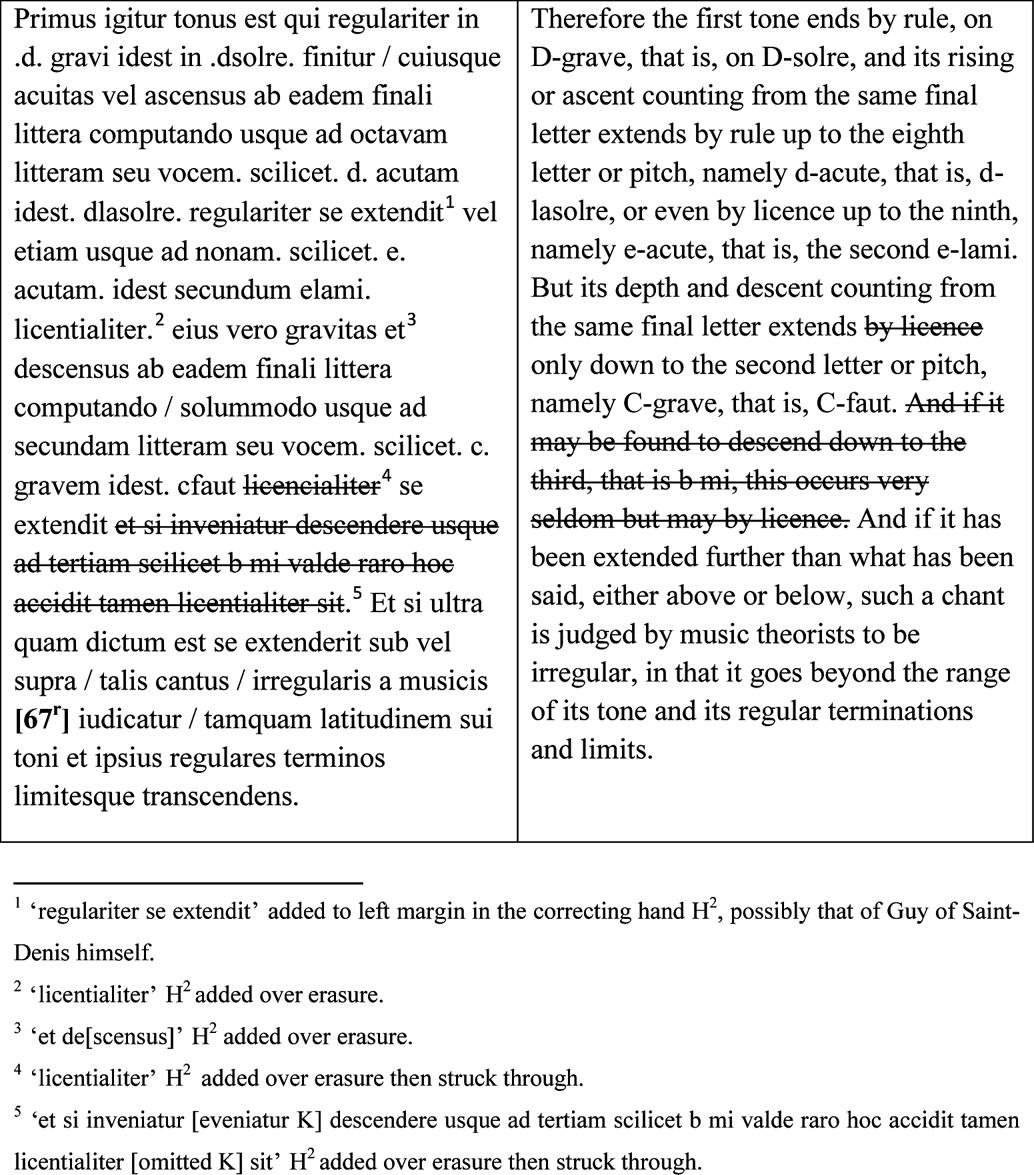
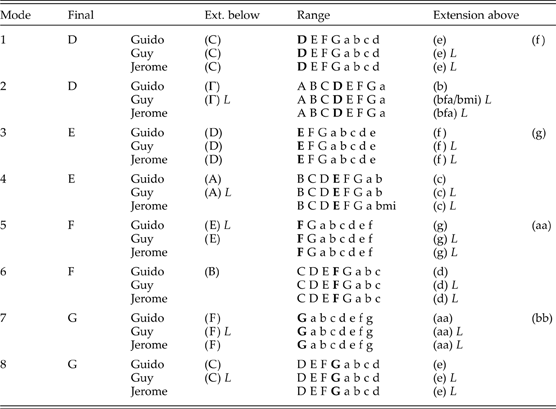
When correcting his treatise, Guy of Saint-Denis was particularly interested in the discussion, of great importance to Jerome of Moravia, about when chants could exceed by licence (licencialiter) the specific ranges to which they were conventionally (regulariter) confined. That Guy developed his ideas on this concept after the first draft of his Tractatus was complete is suggested by the fact that all but two of the seventeen appearances of the term licentialiter are added in his hand over careful erasures. He may have been a little unsure about how to work with this relatively unfamiliar concept, as can be seen from his treatment of the possible ranges for the first tone. The sample passage in Figure 1 is taken from fol. 66v of Book 1 of Guy of Saint-Denis, Tractatus de tonis, at the first appearance of the term licentialiter. As stated in the preceding section, Guy may well have been influenced by Jerome's work, particularly as it was expressed in the influential preface to the Dominican Antiphonal. Comparing Jerome and Guy on the permitted ranges of the tones shows that although they are both very particular about what is allowed by rule and what by licence, the outcome, in terms of the actual range of the tones, is little changed from the definition of Guido of Arezzo. This is demonstrated in Table 1.
Guy of Saint-Denis, Tractatus de Tonis, fol. 66v.

Modal ranges by rule and by licence: Guido, Guy and Jerome.
Note: Pitch letter names in parentheses are extensions; L marks extension by licence.
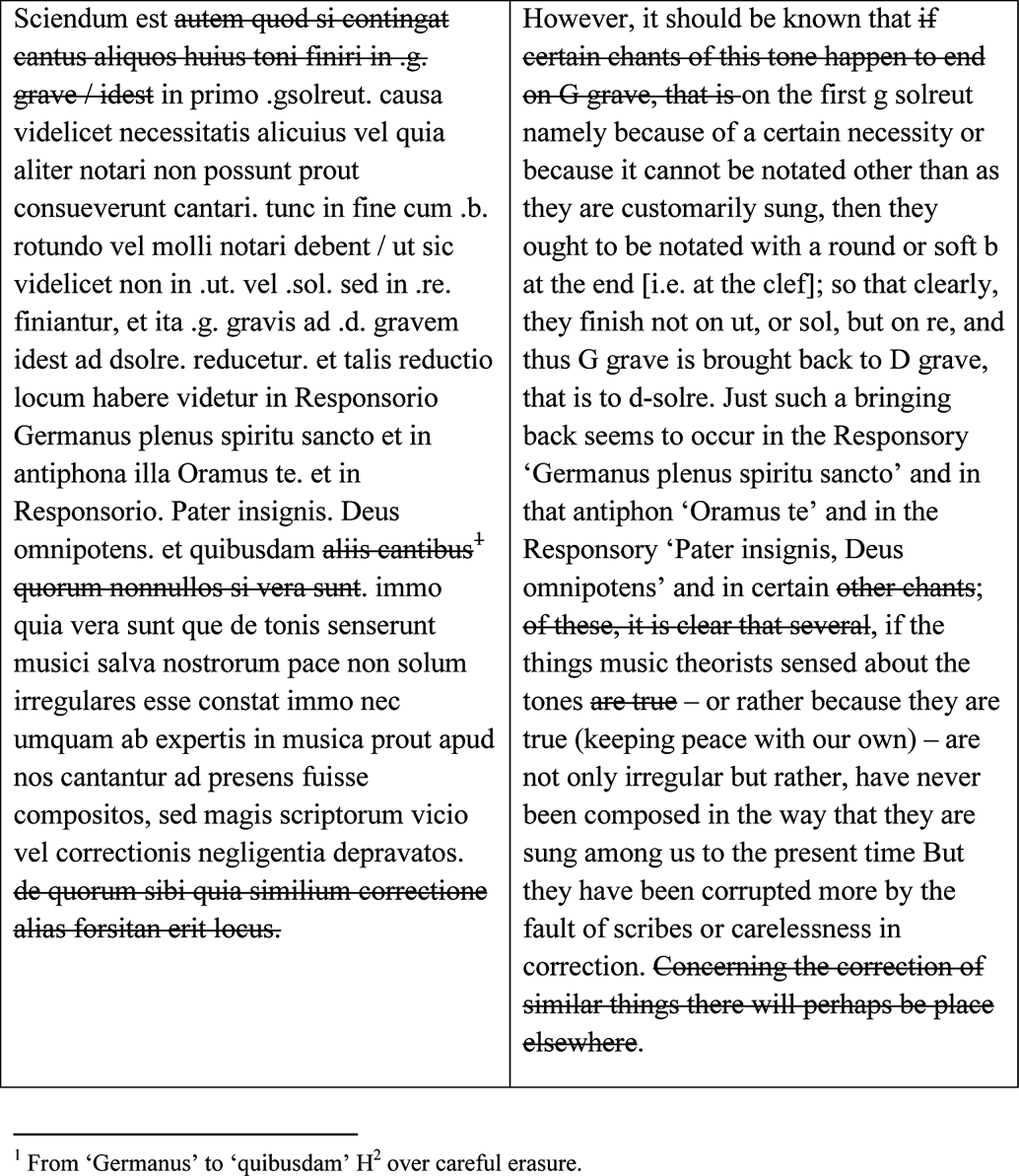
The deleted chapter in Guy's Tractatus occurs on fol. 67r within the discussion of the first tone. It demonstrates at least three layers of correction before the final decision to excise it completely was made. First a part of the text was erased, and then a long insertion over the erasure was made, but this was then separately crossed out, see Figure 2. After this, essentially the whole chapter was excised by putting lines at the top and bottom of the offending sections and drawing a very large cross spreading right across the page, together with a vertical line down the middle. While the content of this passage is difficult to interpret, it seems to mean that when any chant of the first tone ends on G, it can be brought back to its proper final on D by a transposition that is indicated by the B flat sign at the clef. This may be a response from Guy to the process of transposition of modes proposed by the Cistercian Guy of Eu in his Regulae. The Cistercian chant reform used this method to avoid all use of B flat, so perhaps Guy was nervous about his proposed use of the B flat as it would be frowned upon in the strictest circles, and thought it best to completely delete the passage. That he tried to justify his position is clear from the examples of the responsories Germanus plenus spiritu sancto and Pater insignis, Deus omnipotens and the antiphon Oramus te, all of which can be found using B flat, which he draws on. Nonetheless he comes to the conclusion that these are probably ‘irregular’ and may have acquired the B flat through the fault of scribes or carelessness in correction. That the process of correction is very much on his mind is clear from the final version, which indicates that Guy is hunting through his text, perhaps while proofreading it, as we would say, in order to pick up ‘errors’ of this kind that need to be corrected. In the succeeding passage of the Tractatus, Guy considers transposition again but this time associates it with the use of the affinal.
Harley 281, fol. 67r. The excised passage and translation. The whole of this passage, after Sciendum est is crossed out, see the main text.
Guy of Saint-Denis and Guy of Châtres, abbot of Saint-Denis
Can Guy of Saint-Denis be identified with Guy of Châtres (d. 21 February 1350), abbot of Saint-Denis from 1326 until 1342? In 1336, Guy of Châtres would be asked by Jacques Fournier (1280–1342), former master at the College of St Bernard, and now Pope Benedict XIII, to reform the Benedictine Order as a whole.Footnote 73 Guy and Jacques could well have known each other in the early fourteenth century. An illustration of Guy's educational zeal is offered by his Sanctilogium, a massive synthesis of lives of saints, preserved in London, British Library, MS Royal 13.D.IX, copied in the mid-fourteenth century, perhaps while its author was still alive. Guy of Châtres describes in his opening prologue how he had commenced the work while established in a lesser Office at the abbey, abbreviating the historical materials about the saints ‘into a better order’. The difficulty with the Legenda Aurea of the Dominican Jacobus de Voragine was that it is structured around the temporal cycle of the liturgical year, beginning with sections on Advent, Christmas to Lent, and Lent to Easter, but combines these movable feasts with the saintly cycle, according to which saints were commemorated on specific days of the year. Guy was also aware that Vincent of Beauvais had provided a large amount of historical information about individual saints, but without reference to the liturgical calendar. Guy's inspiration was to separate the saintly from the temporal cycle, by structuring his selection of various saints' lives (often, though not wholly based on Jacobus de Voragine and Vincent of Beauvais) into twelve books, structured around the days of the year, rather than the more traditional Roman calendar (defined by Kalends, etc.), as in the Martyrologium of Usuard. In the Royal MS., these twelve books are followed by an index (fols. 302ra–305ra) that provides in Roman numerals both the month and the day of the feast of any particular saint, as well as reference to those 103 saints (eighty-seven men and sixteen women) documented in book thirteen, for whom no specific feast day was recorded.Footnote 74 The fourteenth book provides extracts from the sections of the Legenda aurea relating to the feasts of the temporal season. From the perspective of someone concerned with the liturgy on a day-to-day basis, the Sanctilogium is a much more useful anthology, organised in a similar way to the later Acta Sanctorum, than the Legenda aurea. Rather like the anthology in Harley 281, the Sanctilogium updates the material offered by a traditional monastic treatise with new material. In this case, Guy updated Usuard's Martyrologium with new materials that he found, not just in the writing of two Dominicans, Vincent of Beauvais and Jacobus de Voragine, but also in his own library.Footnote 75
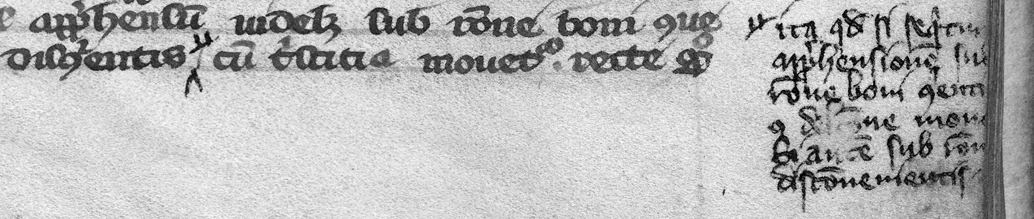
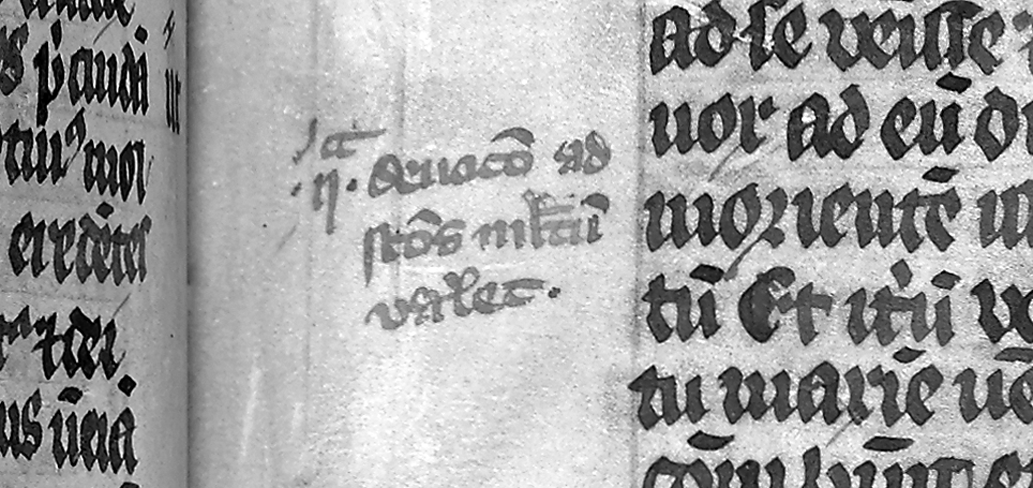
While the principal scribe of the Sanctilogium is not that of the Harley anthology, the two works share very similar decorated initials, suggesting that both were produced in the same scriptorium. On the top verso of the opening flyleaf of the Sanctilogium, a note has been added in a hand very similar to that of H2 in the Harley anthology: kalendarium librorum sequitur, quere ad finem libri xii (Figs. 3 and 4). It is also similar to the hand in which annotations to particular sections of the Sanctilogium are made, drawing attention to significant details in texts about particular saints (Fig. 5).Footnote 76 Given the difference in time (perhaps twenty or thirty years) between Guy's drafting of his Tractatus and the redaction of the Sanctilogium, it is impossible to be certain about whether a single hand is responsible for these annotations. It does seem, however, that both manuscripts were produced in the same workshop.
H2 (authorial) correction to BL Harley MS 281 f. 70r. Reproduced by permission of the British Library.
Annotation to Sanctilogium flyleaf, BL Royal 13.D.IX. Reproduced by permission of the British Library.
Annotation to Sanctilogium, BL Royal 13.D.IX f. 70r. Reproduced by permission of the British Library.
Perhaps even more important is the parallel between the Tractatus de tonis and the Sanctilogium. In both cases, an established monastic genre (the tonary and the Martyrologium) was revitalised by combining ancient texts with those that were much more modern. Just as in the Tractatus de tonis, Guy was emphasising that musical modes should be chosen to serve the subject matter of chant so, in the Sanctilogium, Guy of Châtres was providing the foundation texts to be read or studied on the occasion of any feast. Guy may not have seen himself as an innovative intellectual, but he was conscious of the contribution he could make as guardian of the treasures of Saint-Denis.
The multiplication of new liturgical offices in the twelfth and thirteenth centuries generated the composition of many new liturgical offices prior to the completion of the magnificent nave at Saint-Denis by Abbot Matthew of Vendôme in 1281.Footnote 77 Guy, troubled by the increasing use of ‘numerical’ offices, wanted to reassert the teaching of Guido of Arezzo to explain the particular emotional effect of specific modes and to urge that any mode should echo the message of the text. Guy's decision to write about the tones and include his text within an anthology of writings ranging from the treatises of Guido of Arezzo to the non-monastic Ars musice of Johannes de Grocheio reflects a parallel desire to ensure that the plainchant traditions of Saint-Denis were understood in ways that were fully consistent with the intellectual revolution of the thirteenth century.
Unlike most other surviving manuscript books from Saint-Denis, the Harley compilation does not carry any of the shelf-marks of the abbey. Possibly it was preserved at the College of Saint-Denis, an institution for which Guy of Châtres had particular concern as abbot, as revealed by its account books. These show that, since at least 1284, the monastery paid for two external masters: the magister puerorum de cantu and the magister iuvenum.Footnote 78 Whether Grocheio was a secular master employed at the College of Saint-Denis in the late thirteenth century is a possibility that cannot be pursued here. Yet it is noteworthy that Guy of Saint-Denis had access to Grocheio's Ars musice, a text that was copied a second time (much less accurately) in the mid-fourteenth century, in a manuscript that could have belonged to Heinrich von Kalkar (1328–1408), who studied in Paris in the 1350s, before becoming a Carthusian monk at Cologne in 1366.Footnote 79 The possibility arises that von Kalkar might himself have come across the original manuscript (from which H was copied) during that time, and learned the identity of the author of the Ars musice, never explicitly revealed by Guy of Saint-Denis within his anthology.
Guy was dissatisfied with liturgical offices that were composed simply by going through a cycle of different tones in sequential order, without respect for their individual character. He wanted the melodies of chant to suit the particular subject matter of the text in question. He believed that what Guido had to say about chant was fundamentally in accord with Aristotelian ideas of thinking about how our understanding is always awakened through the senses. Just as Jerome of Moravia's anthology of musical treatises may have inspired Guy to produce his own compilation of writings about chant, so he was prompted by his difficulty in using the compilations of Vincent of Beauvais and Jacobus of Voragine to create his own synthesis of texts about the saints in his Sanctilogium. In both cases he was able to incorporate treasures of monastic tradition into a synthesis that suited the needs of the monks of Saint-Denis in the early fourteenth century.
In the Harley compilation, Guy brought together classic texts of Benedictine and Cistercian tradition about chant, placing them alongside the writings of two figures with secular clerical backgrounds, Johannes de Grocheio and Petrus de Cruce. Guy emulated the Cistercians in seeking to reform the liturgical traditions of the most venerable Benedictine abbey in France by reference to the oldest sources of chant to which he had access. In particular, he sought to reassert the authority of Guido of Arezzo in the teaching of chant. Whether Guy succeeded in his desire to modify the dominance of modally sequential offices in the liturgy at Saint-Denis has still to be established. The financial records for the period in which he was abbot show that he was committed to renewing the intellectual life as well as the physical resources of its College, the Parisian home of its abbot and educational centre of its brightest students.Footnote 80 The College would continue to function in this way until the turbulent decades of the sixteenth century, when Jean Gosselin (1506–1604), keeper of manuscripts in the French Royal library, came across the compilation that Guy had put together, perhaps while it was stored (along with the treasure of the abbey) at the College of Saint-Denis.Footnote 81 By that time, the ancient traditions of Saint-Denis were in danger of becoming just a historical memory.