Implications
The factors influencing the priority of access to food (measured as an indicator of social dominance) and its effects on the carcass were investigated using 96 steers and heifers allocated with four animals in a pen. The animals’ birth dates and the maternal grandsire line were significant sources on ranking of the priority of access to food and the animals with the highest priority of access to food had the highest beef marbling score. The finding may open a new avenue for analyzing the effects of the priority of access to food on animal performance under semi-intensive beef cattle production systems.
Introduction
Social organization in animals relies on dominance relationships, regardless of whether the group is formed naturally or artificially (Hart, Reference Hart1985). It is known that cattle interact and develop relationships with each other that are of a dominant-subordinate nature, which leads to the establishment of social dominance (Hafez and Bouissou, Reference Hafez and Bouissou1975). There are many factors influencing social dominance in cattle; physical characteristics such as BW, body size and/or height and the presence of horns (Houpt, Reference Houpt2011) and physiological stages such as age, parity, pregnancy, early postpartum and lactation (Landaeta-Hernández et al., Reference Landaeta-Hernández, Rae, Kaske and Archbald2013). In multi-breed herds, breed also appears to be a factor influencing social organization (Landaeta-Hernández et al., Reference Landaeta-Hernández, Chenoweth, Tran, Rae, Randles and Chase2005).
There have been some studies investigating social dominance and physiological stress (Solano et al., Reference Solano, Galindo, Orihuela and Galina2004). Social dominance influences fear and stress response to handling of goats (Miranda-de la Lama et al., Reference Miranda-de la Lama, Pinal, Fuchs, Montaldo, Ducoing and Galindo2013a) and dominance-related interactions in cattle can cause stress, bruises and physical injuries (Fordyce et al., Reference Fordyce, Fitzpatrick, Cooper, Doogan, De Faveri and Holroyd2002). In contrast, there are a limited number of studies on the relationships between social dominance and meat quality traits. Partida et al. (Reference Partida, Olleta, Campo, Sañudo and María2007) reported that the social dominance of cattle did not affect the instrumental and sensory traits of meat in intensively managed young Friesian bulls. More recently, Miranda-de la Lama et al. (Reference Miranda-de la Lama, Pascual-Alonso, Guerrero, Alberti, Alierta, Sans, Gajan, Villarroel, Dalmau, Velarde, Campo, Galindo, Santolaria, Sañudo and María2013b) showed that, although there was a significant relationship between social dominance and stress indicators (as assessed by the cortisol concentration and neutrophil/lymphocyte ratio), significant relationships between social dominance and some sensory traits (e.g. milk odor and flavor, metallic flavor and tenderness) and interaction effects between social dominance and aging for beef odor and overall liking were found in beef bulls of the Gasconne breed.
The intensification of animal production systems has resulted in groups of animals living in close proximity to each other, often competing for limited resources (Val-Laillet et al., Reference Val-Laillet, de Passillé, Rushen and von Keyserlingk2008). The priority of access to resources (e.g. food) can express dominance as an attribute of dyadic encounters under the concept of social dominance (Drews, Reference Drews1993). Focusing on feeding behaviors, McPhee et al. (Reference McPhee, McBride and James1964) reported that high-ranking steers spent a greater total time eating and had longer meals than low-ranking steers in beef cattle. Milanda-de la Lama et al. (Reference Miranda-de la Lama, Sepúlveda, Montaldo, María and Galindo2011) also mentioned that highly dominant animals could obtain priority resources in intensive production conditions. Although Francis (Reference Francis1988) argued the inadequacy of the definition in which functional accounts of social dominance stress priority of access to resources, the information on the priority of access to food can be relatively easy to be collected by farmers under production situations, therefore, the priority of access to food (feeding order) can be used as an on-site simple attribute of social dominance in intensive beef cattle production systems.
The objective of the present study was to examine the effects of the genetic and phenotypic factors such as sire and maternal grandsire lines and the difference in the animals’ birth dates on the priority of access to food determined by farmers’ own observation in a small-scaled semi-intensive beef cattle production system in Japanese Black (Wagyu) cattle. Furthermore, as beef grade and carcass prices have been determined by carcass traits (especially beef quality) in Japanese carcass markets, the effects of the priority of access to food on carcass traits were also investigated for the production system.
Material and methods
Handling management and data collection
The data collection was carried out at a cow–calf-feedlot integrated farm of Japanese Black cattle in Shiraoi, Hokkaido (42°33′N, 141°18′E). Average monthly temperature and annual rainfall in the area were 7.2°C and 1497 mm, respectively. At the surveyed farm, 96 calves at around 3 to 4 months of age are allocated to pens with four animals per pen according to age, body size and sex; all four animals in the same pen are thus of the same sex and of similar body size. There was no special consideration on allocation of sires spread to pens. All animals are ordinarily housed in a 3.6×6.7 m pen (stocking density of ∼6 m2 per animal) until they are slaughtered. The pen includes a lying area with a roof and sawdust bedding, a 3.6-m-long trough and a water bowl. All animals in each pen were restrictively fed conventional concentrate (corn, barley, wheat bran and soybean meal) and grass silage at the growing stage (i.e. 3 to 12 months), and conventional concentrate and straw at the fattening stage (i.e. 13 to 29 months). Straw and water were provided ad libitum.
In the present study, the social rank was determined according to the priority of access to food instead of the ordinary measurements such as social dominant indexes (Langbein and Puppe, Reference Langbein and Puppe2004). In the farm, as all steers and heifers were identified by ear tags, long-term direct observation of ranking the priority of access to food for each animal in every pen were carried out until the animals were ∼13 months of age after weaning. According to our request, the farm manager observed the animals’ behavior for 60 to 90 s in every pen when feeding and he recorded the ranking for the priority of access to food for individual animals over the period. The animals that started feeding first in the pen were classified as the first rank, and subsequently, the second, third and fourth animals to feed at the trough were recorded. The rank scores used for the analyses in the present study were determined once at the beginning of the fattening period after every day direct observations, because the farm manager confirmed that the ranking for the priority of access to food had been fairly stable through the fattening period in the previous preliminary observations. In the present study, the records of the individual information (e.g. sex, sire, maternal grandsire), the priority of access to food and the carcass traits from 96 clinically healthy 60 steers and 36 heifers (4 animals×24 pens) slaughtered from January 2011 to December 2013 were used for the analyses.
Carcass traits
The carcass weight, rib-eye area, rib thickness, subcutaneous fat thickness and marbling score (Japanese beef marbling standard number: BMS) were analyzed. All carcass traits except carcass weight were graded between the sixth and seventh rib sections in accordance with the Japan Meat Grading Association (1989) certified grades. In Japan, the quality of beef carcasses (yield score) has been judged based mainly on the carcass weight and three other carcass traits (the longissimus muscle area, rib thickness and subcutaneous fat thickness) at the sixth and seventh rib sections, because these traits are relatively easy to measure and routinely collected in the carcass markets (Hirooka et al., Reference Hirooka, Groen and Matsumoto1996; Maeno et al., Reference Maeno, Oishi, Mitsuhashi, Kumagai and Hirooka2014).
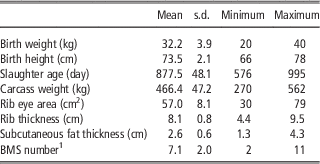
The rib-eye area was measured by grid approximation, and the rib thickness was measured as the distance between the latissimus muscle and the pleura membrane measured at the mid-point of the rib ends. The subcutaneous fat thickness was the distance between the latissimus muscle and the carcass surface measured on the orthogonal line parallel with the carcass surface from the edge of the iliocostalis muscle. The BMS number was scored using a 12-point scale used in Japanese carcass markets: from 12 (the fattest) to 1 (the leanest). Descriptive statistics of birth weight, birth height and carcass traits of the animals are shown in Table 1.
Descriptive statistics of birth weight, birth height and carcass traits of the 96 animals in the present study

s.d.=standard deviation.
1 Japanese beef marbling standard (BMS) number: a 1 to 12-point scale.
Classification of sire line and maternal grandsire line
In Japan, information on the sire (or maternal grandsire) line of Japanese Black cattle has traditionally been used by farmers to promote the growth rate and meat quality of their cattle, because growth and carcass traits are highly heritable and are genetically determined (Hirooka et al., Reference Hirooka, Groen and Matsumoto1996). In the present study, there were 27 sires and maternal grandsires, which were classified into three sire lines (Fujiyoshi, Kedaka and Tajiri) and four maternal grandsire lines (Fujiyoshi, Kedaka, Tajiri and Shigekane). Ikeda and Fujii (Reference Ikeda and Fujii2006) reported that sires of the Fujiyoshi and Kedaka lines have higher growth performance and show a higher incidence of muscular abnormalities compared with the Tajiri line. In contrast, sires of the Tajiri and Shigekane lines show superior marbling (Asada et al., Reference Asada, Hashiyada and Konishi2004).
Analysis for investigating the factors influencing the priority of access to food
To identify the factors influencing the priority of access to food, the following four models were used (Figure 1). In Model 1, ranking for the priority of access to food was represented by transformed ordinal scores (highest=4, lowest=1). In addition, binary scores were used to make clear the differences between ranks (Models 2, 3 and 4), because the four rank scores in Model 1 are ranked variables and the differences between the ranks are not equal; the difference between ranks 1 and 2 may not be the same as the difference between ranks 2 and 3. The binary scores were assigned in Model 2 (highest=1st; 2nd, 3rd and 4th=0), Model 3 (1st and 2nd=1; 3rd and 4th=0) and Model 4 (1st, 2nd and 3rd=1; lowest=0).
Classification of the priority of access to food and the score in each model. Model 1 assumes that ranking for the priority of access to food was represented by transformed ordinal scores (highest=4, lowest=1). The binary scores were assigned in Model 2 (highest=1st; 2nd, 3rd and 4th=0), Model 3 (1st and 2nd=1; 3rd and 4th=0) and Model 4 (1st, 2nd and 3rd=1; lowest=0).

The mathematical model for statistical analysis was
 $$Y_{{ijklm}} ={\rm }\mu {\plus}SL_{i} {\plus}ML_{j} {\plus}DBD_{k} {\plus}e_{{ijkl}} $$
where Y ijklm is the score for the priority of access to food and considered a continuous variable in Model 1 and a binary variable in Models 2, 3 and 4; μ the overall mean, SL i the fixed effect of the sire line (three sire lines), ML j is the fixed effect of the maternal grandsire line (four maternal grandsire lines), DBD k is the fixed effect of the difference in birth date (four categories) and e ijkl is the residual effects associated with observation ijkl. The ‘difference in birth date (days)’ of an animal born first in a pen was set as a reference date (difference=0), and subsequently the differences in birth date between the first animal and other animals were calculated for every pen.
The data were analyzed using the least squares methods of the GLM procedure of the Statistical Analysis System (SAS, 2008) fitting GLM for Model 1. The analyses in Models 2, 3 and 4 were carried out as generalized linear mixed models (GLIMMIX procedure) in SAS. The binary response variables were modeled with a binomial distribution, and the analysis was carried out with a logit transformation. If the analysis exhibited a significant difference, data were further analyzed by Tukey–Kramer least square means comparisons to discern significant differences among the means (P<0.05).
Analysis for investigating the effect of the priority of access to food on carcass traits
The least squares methods of the GLM procedure of SAS (2008) were used to determine the effect of the priority of access to food on the carcass traits, with the probability differences between the least square means tested using the Tukey–Kramer option. The mathematical model was
 $$\eqalign{Y_{{ijklmnop}} =\,&{\rm }\mu {\plus}PAF_{i} {\plus}Sex_{j} {\plus}SY_{k} {\plus}SS_{l} {\plus}SL_{m} {\plus}ML_{n} \cr &{\plus}P{\rm }\left( {Sex} \right)_{{oi}} {\plus}b{\rm }x_{{ijklmnop}} {\plus}{\rm }e_{{ijklmnop}} $$
where Y ijklmnop is the records of carcass traits, μ the overall mean, PAF i the fixed effect of ranking for the priority of access to food (four levels: 1 (highest), 2, 3 and 4 (lowest)), Sex j the fixed effect of sex (steer and heifer), SY k the fixed effect of the slaughter year (2011, 2012 and 2013), SS l the fixed effect of the slaughter season (four seasons), SL m the fixed effect of the sire line, ML n the fixed effect of the maternal grandsire line, P (Sex) oi the random effect of pen within sex (24 pens), b the partial regression coefficient, x ijklmnop the continuous variable for slaughtered age as a covariant for observation ijklmnop and e ijklmnop the residual effects associated with observation ijklmnop.
Results
Factors influencing the priority of access to food
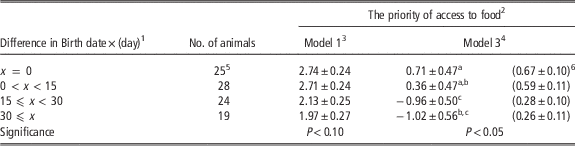
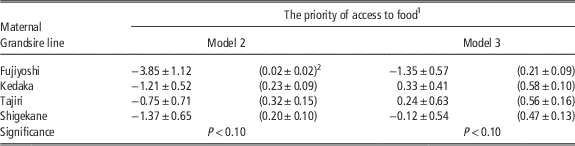
A significant effect of the difference in birth date on the establishment of the priority of access to food in Model 3 (P<0.05) was observed, whereas there were no significant differences for sire line, birth weight and birth height in all models (Table 2). The effect of the difference in birth date within a pen decreased (P=0.05) when Model 1 was assumed. As shown in Table 3, the scores for the priority of access to food of the animals with earlier birth dates were higher than those of the animals with later birth dates in Models 1 and 3. The maternal grandsire line tended to have an effect on the priority of access to food only in Models 2 and 3. The least square means by the priority of access to food for different maternal grandsire lines in the models are presented in Table 4. In Model 2, the animals with the Tajiri maternal grandsire line tended to have a higher priority of access to food compared with the animals with other maternal grandsire lines. In Model 3, the animals with the Kedaka maternal grandsire line showed slightly higher priority of access to food than those with the Tajiri maternal grandsire line. In both Models 2 and 3, the least square means of the Fujiyoshi maternal grandsire line were the lowest priorities of access to food.
Results of significances for factors influencing the priority of access to food

1 The difference in birth date (x) is represented by the differences in days between the age of the first born animal (x=0) and the remaining animals within the pen.
2 The lines of steers/ heifers’ sires. In this study, there were 27 sires classified four sire lines (i.e. Fujiyoshi, Kedaka, Tajiri and Shigekane).
3 The lines of steers/heifers’ maternal sires same as ‘sire line.’
4 See Figure 1.
The priority of access to food by the difference in birth date within a pen (means±standard errors)

a,b,cDifferent letters in the same column indicate significant differences at P<0.05.
1 The difference in birth date (x) is represented by the differences in days between the age of the first born animal (x=0) and the remaining animals within the pen.
2 No significant effect of the difference in birth date was observed in Models 2 and 4. The difference of models used is shown in Figure 1.
3 Analyzed by the GLM procedure.
4 Analyzed by generalized linear mixed model procedure.
5 In one group, the two oldest calves shared a birth date.
6
( )=Converted means
 $$\hat{\pi }_{A} $$
from logit scale
 $$\big( {\hat{\pi }_{A} ={1 \over {1{\plus}\exp ({\minus}0.84)}}=0.70} \right)$$
.
The priority of access to food by each maternal grandsire line within a pen

The data are means±standard errors.
1 These models were analyzed by generalized linear mixed model procedure. No significant effect of the maternal grandsire line was observed in Models 1 and 4. The difference of models used is shown in Figure 1.
2
( )=converted means
 $$\hat{\pi }_{A} $$
from logit scale
 $$\left( {\hat{\pi }_{A} ={1 \over {1{\plus}\exp ({\minus}3.85)}}=0.02} \right)$$
Effect of the priority of access to food on carcass traits
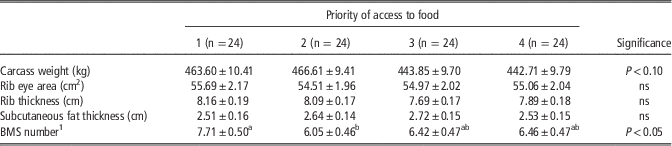
The priority of access to food was the significant source of variation in the beef marbling score (BMS; P<0.05), and it also tended to influence the carcass weight (P=0.09; Table 5). Sex and slaughter age had significant effects on five and four carcass traits, respectively, and sire line had a tendency to influence the rib thickness (P=0.09), but the other sources of variation had no effects on carcass traits. The least square means of carcass traits in each group classified by the priority of access to food are presented in Table 6. The BMS was the highest in the first group for the priority of access to food (P<0.05). The BMS of the first-rank group was 27% higher than that of the second-rank group. In addition, the priority of access to food tended to influence carcass weight (P=0.09). When the priorities of access to food were considered to be two (higher and lower) groups, the carcass weights of the first- and second-rank (two higher-rank) animals were significantly heavier than those of the third- and fourth-rank (two lower-rank) animals.
Results of significances for factors influencing carcass traits

PAF=priority of access to food; SY=slaughter year; SS=slaughter season; SL=sire line; ML=maternal grandsire line; AGE=slaughter age.
1 In this study, there were 27 sires classified four sire lines (i.e. Fujiyoshi, Kedaka, Tajiri and Shigekane).
2 Japanese beef marbling standard (BMS) number: a 1 to 12-point scale.
Least square means (±standard errors) of carcass traits of animals ranked as 1st to 4th priority of access to food

ns=not significant.
a,bDifferent letters in the same row indicate significant differences at P<0.05.
1 Japanese beef marbling standard (BMS) number: a 1 to 12-point scale.
Discussion
Factors influencing the priority of access to food
A significant effect of the difference in birth date on the priority of access to food in Model 3 was found, suggesting that animals with earlier birth dates may be more dominant in each pen. This is not a surprising finding as animals born earlier generally have larger BWs and frames and are thus likely to be dominant. A previous research revealed that social dominance correlated strongly with age (Dickson et al., Reference Dickson, Barr, Johnson and Wieckert1970). Val-Laillet et al. (Reference Val-Laillet, Guesdon, Rushen, von Keyserlingk and de Passillé2009) also reported that older multiparous animals were higher-ranking of dominance than younger primiparous ones. Moreover, several studies mentioned that BW was the most significant variable affecting social dominance (Dickson et al., Reference Dickson, Barr and Wieckert1967; Stricklin et al., Reference Stricklin, Graves, Wilson and Singh1980), whereas others showed both age and BW affected social dominance (Landaeta-Hernández et al., Reference Landaeta-Hernández, Rae, Kaske and Archbald2013). It is reasonable that larger animals take advantage of displacing smaller animals. With regard to the relationship between age and social dominance, our results agreed with the previous reports in spite of the fact that most of the differences in birth date were less than 1 month in the present study.
The maternal grandsire line showed a tendency to influence the priority of access to food in the present study. The result from Model 2 showed that animals with the maternal grandsire line of Tajiri were more likely to be in the first rank within a pen. Significant effects of breeds on social behavior and consequently social dominance in mixed-breed herds have been reported (Le Neindre, Reference Le Neindre1989; Landaeta-Hernández et al., Reference Landaeta-Hernández, Chenoweth, Tran, Rae, Randles and Chase2005). Our present results revealed that there was no significant effect of sire lines but the maternal grandsire tended to affect the priority of access to food. This finding indicates that the dam–offspring relationship may have a stronger influence on social dominance traits than the sire–offspring relationship. In recent work, MacKay et al. (Reference MacKay, Turner, Hyslop, Deag and Haskell2013) reported the effect of short-term temperament such as displacement capability on feeding behavior in the home pen for beef cattle. Huzzey et al. (Reference Huzzey, Weary, Tiau and von Keyserlingk2014) pointed out that increased social competition among cattle lead to increased physiological stress, decreased feeding time and thereby decreased dry matter intake. Although neither our study nor other published studies examined the possible maternal effect on temperament of calves in Japanese Black cattle, our present findings indicated that the difference in the maternal grandsire line could influence the social dominance of calves which might be due to the difference in temperament of calves. Further research on this issue in cattle is needed.
As for the method of the statistical analysis, it should be noted that the priority of access to food in a pen was used as a dependent variable in the present study. This type of variable is classified as categorical data with an ordinal scale. Such categorical data have often been analyzed using conventional linear model approaches after transforming or converting to a numerical scale (e.g. the present study’s Model 1). Although such a model treats ordinal rank scores as if they are continuous, it is difficult to reconstruct the underlying continuous measure (Freeman, Reference Freeman1987). Thus, the difference between ranks 1 and 2 may not actually be the same as the difference between ranks 2 and 3. Bolker et al. (Reference Bolker, Brooks, Clark, Geange, Poulsen, Stevens and White2008) argued that the generalized mixed linear model approach is the most powerful and challenging procedure, combining the properties of linear mixed models and generalized linear models (which handle non-normally distributed data). Therefore, to solve the statistical problem, the generalized linear mixed model approach was adopted after converting the ordinal scores into three types of binary (1 or 0) scores (Models 2, 3 and 4) in the present study.
Effect of the priority of access to food on the carcass traits
The result showed that animals with higher priority of access to food tended to have heavier carcass weight than animals with lower priority of access to food. This result agreed with those of Bouissou et al. (Reference Bouissou, Boissy, Le Neindre and Veissier2001) who showed that among cows that had free access to food, lower-social ranking cows ate less food and had smaller weight than higher-ranking cows. Phillips and Rind (Reference Phillips and Rind2002) found that weight gain of the dominant cows increased more than subordinates in dairy cattle.
Surprisingly, there was a significant effect between the priority of access to food and the marbling score for Japanese Black cattle in this study. Nkrumah et al. (Reference Nkrumah, Crews, Basarab, Price, Okine, Wang, Li and Moore2007) reported that the daily feeding duration had a positive genetic correlation with the marbling score in beef cattle sired by Angus, Charolais or Hybrid bulls (R=0.56), implying that animals that spent more time eating in a day generally had fatter carcasses with higher marbling. This might have been caused by the unavoidable circumstances, where higher-ranking animals could have gotten more favorable caloric concentrate preferentially. As there was no information on the feeding duration and feed intake of each animal in the present study, we could not ascertain the possibility that animals with higher priority of access to food ate a more nutritious fraction of the feed than animals with lower priority of access to food. Further research is required to elucidate this point.
Conclusions
The priority of access to food was influenced by age of animals in a pen and maternal grandsire line (i.e. genetic performance of dams), and it also tended to have an effect on carcass weight and had a significant effect on beef marbling for Japanese Black cattle under the production system of the present study. Although this study was the first report indicating the relationship between the priority of access to food and beef marbling, further research for other breeds and in other environments should be needed to assess and confirm the new findings. In addition, it should be noticed that the priority of access to food was determined by on-site direct observation by farmers, indicating that our method was quite different from ones in any other behavioral studies. However, the priority of access to food is relatively easy measurements to be ranked by farmers even under confined production circumstances, especially when the production size is comparatively small. To our knowledge, the present study was the first attempt to utilize such information on the analysis of the effect of social rank on the productive traits in beef cattle production systems. Although the present study used the records from only one representative farm in this region, the simple indicator (the ranking of access to food) of social rank can be collected easily from other farms in various regions. Hence, our study can emphasize the importance of the on-site information about the priority of access to food determined by farmers’ own observation, and may indicate a new way for improving animal managements by analyzing the effects of the priority of access to food on animal performance in confined beef cattle production systems.
Acknowledgments
The authors thank the farmer for their contribution to the field work.