Introduction
Dementia-related disorders are becoming more prevalent as the world's population ages. Of these disorders, problems with out-of-home mobility are among the more common behavioral disturbances, with 37–60% of those diagnosed with dementia developing wandering behaviors at some point during the disease (Wigg, Reference Wigg2010). This behavior is perceived as stressful and burdensome by family caregivers, who are themselves often old and in poor health (Papastavrou et al., Reference Papastavrou, Kalokerinou, Papacostas, Tsangari and Sourtzi2007; Georges et al., Reference Georges, Jansen, Jackson, Meyrieux, Sadowska and Selmes2008). Because such wandering is perceived by society as unsafe, it is frequently viewed as a medical problem requiring a medical solution. This medicalization legitimizes social control to “protect” wanderers (Wigg, Reference Wigg2010). Yet, this control places people with dementia at risk of abuse through the means caregivers use to prevent them from wandering in the community or in nursing homes – for example, caregivers may restrain or confine the elder (Alzheimer's Society UK, 2007).
Today, as research in the application of technologies continues to evolve (Westphal et al., Reference Westphall, Dingjan and Attoe2010), possibilities are emerging for using new technologies to provide individualized aid to people with dementia. Such technologies, including devices based on standard telephone communications, simple monitors and video cameras, can be used to transmit basic vital information (Hudson and Cohen, Reference Hudson and Cohen2010). Most attention has been focused on using these assistive technologies for people with dementia in residential care (Niemeijer et al., Reference Niemeijer, Fredericks, Riphagen, Legemaate, Eefsting and Hertogh2010). Few studies have focused on using such technologies to support independence and autonomy within the home (Topo, Reference Topo2009; Brittain, et al., Reference Brittain, Corner, Robinson and Bond2010). Furthermore, the ethical debate has given no priority to discussion of the use of assistive technologies in caring for elderly people in the community (Zwijsen et al., Reference Zwijsen, Niemeijer and Hertogh2011).
Unlike the assistive technologies in residential care homes or in the private sphere of people with dementia, technologies based on Global Positioning Systems (GPS) constantly give a person's position online, thus enabling caregivers to monitor people with dementia discreetly outside their home (Kearns and Fozard, Reference Kearns, Fozard, Nelson and Algase2007). Tracking devices may also be used to enhance the safety of older people, especially those with dementia, by alerting caregivers to potential dangers (Robinson et al., Reference Robinson2006; Reference Robinson2007; Reference Robinson, Brittain, Lindsay, Jackson and Olivier2009).
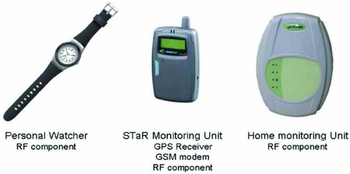
Currently, several digitally based tracking methods can be used to gather information on the spatial activity of pedestrians. The GPS consists of a series of satellites orbiting the Earth and broadcasting signals that are picked up by a network of receivers. The position of each receiver is determined by triangulating the incoming data from at least four satellites. Land-Based Tracking Systems consist of a series of antenna stations (radio frequency (RF) detectors) which are distributed throughout a given local area. Finally, hybrid systems combine elements from both these system types. The most common hybrid solution is the Assisted GPS (AGPS), which provides a much more accurate reading, particularly in enclosed areas, and allows the use of smaller handsets. One example of such a hybrid system is shown in Figure 1. This device consists of a GPS receiver with a Global System for Mobile Communications (GSM) modem, an RF transmitter contained in a wrist-watch, and a monitoring unit located in the home. This system lets the carer know whenever the individual leaves the house. Further information regarding the available technologies can be found in Shoval et al. (Reference Shoval2008).
Elements of the GPS tracking kit

Such tracking technologies may allow the elderly or individuals with dementia to be cared for within the community longer than would previously have been possible. However, some regard GPS location of a person and transmission of this information to a central computer as an inherent invasion of privacy that threatens personal autonomy and liberty (Wey, Reference Wey2008). Opponents of the technology also argue that tracking devices may diminish human contact between older people and their environments (Keating et al., Reference Keating, Nayeem, Gilmartin and O'Keeffe2005).
Ethical concerns about using the devices with elderly people were voiced even before these surveillance devices were widely developed (McShane et al., Reference McShane, Hope and Wilkinson1994). These concerns have been examined by Robinson et al. (Reference Robinson2007), Essen (Reference Essen2008), Rialle et al. (Reference Rialle, Ollivet, Guigui and Herve2008), Hughes et al. (Reference Hughes, Newby, Louw, Campbell and Hutton2008) and van Hoof et al. (Reference van Hoof, Kort, Rutten and Duijnstee2011). In the study by Robinson et al. (Reference Robinson2007), family caregivers mainly favored using electronic tracking devices to allow them to locate a wanderer more quickly and easily and thus reduce risk of harm. However, they were also concerned about the effect of such devices on the individuals’ autonomy and privacy and about the association of tagging devices with criminal offenders. McShane et al. (Reference McShane, Gedling, Kenward, Kenward, Hope and Jacoby1998), in a telephone survey of 99 caregivers, also found that only a few caregivers would give more freedom to an individual with dementia fitted with such a device. The ethical consideration is thus not the maximization of autonomy but rather reducing the time that someone is lost. In the study by Essen (Reference Essen2008), 17 of the 18 cognitively unimpaired community-dwelling elders who participated in a telemonitoring service in their homes perceived electronic surveillance to be liberating and protecting of their privacy, because it enabled them to continue living in their own homes rather than moving to a nursing home. Van Hoof et al. (Reference van Hoof, Kort, Rutten and Duijnstee2011) found that using assistive technologies increased elderly people's sense of safety and security. Similarly, in a recent qualitative study, White et al. (Reference White, Montgomery and McShane2010) discovered that the decision to use tracking was based on the carer's informal assessment of the individual's safety. All caregivers in this study found protecting the person from harm more important than issues of autonomy or privacy. Safety concerns were constantly reassessed, based on the caregiver's experience with the tracking system used, as well as changes in the wandering behavior. In contrast, Rialle et al. (Reference Rialle, Ollivet, Guigui and Herve2008) reported that a large group of respondents opposed the use of tracking devices.
In a survey of the ethical aspects of electronic tagging of people with dementia, Hughes et al. (Reference Hughes, Newby, Louw, Campbell and Hutton2008) concluded that although there is broad agreement that electronic tagging is an ethically reasonable way of dealing with wandering, there is also a real sensitivity to civil liberties, stigma and dignity. In a systematic review of the moral and practical acceptability of surveillance technologies in residential care for people with dementia, Niemeijer et al. (Reference Niemeijer, Fredericks, Riphagen, Legemaate, Eefsting and Hertogh2010) concluded that there is no ethical consensus. This lack of consensus underlines the need for clearer policies. Rialle et al. (Reference Rialle, Ollivet, Guigui and Herve2008) suggested that there should be public debate based on rigorous assessment of practices and that a strict procedure to protect against misuse should be developed.
Although dementia affects 35.6 million people worldwide (Alzheimer's Disease International, 2010), few countries have developed policies for coping with it. Most of the existing policies are intended either generally for patients or for the elderly, without specifically focusing on elderly people with dementia. More advanced policy regarding elders with dementia can be found in the England and Wales Mental Capacity Act 2005, which came into force in 2007. This Act is a milestone in that it bases in law the right to autonomy of people lacking decision-making ability (as in dementia). According to this Act, every individual is presumed to have decision-making ability until established otherwise. Decision-making capacity is estimated on a “decision-specific” basis while supporting the individual. Where individuals are unable to make a decision, any decision made on their behalf must be made in their best interest (Boyle, Reference Boyle2008). In such cases, even in the absence of a formal statement of wishes or of an advance care plan, people's views and wishes may be used to assist in planning their support.
In summary, GPS tracking devices are easily accessible but attitudes toward them are inconclusive and their use raises ethical concerns. This subject clearly needs more in-depth scrutiny and clear recommendations for their use for decision-makers, family and professional caregivers. This seems particularly important in view of Wigg's claim (Wigg, Reference Wigg2010) that allowing individuals to wander safely challenges the medicalization of this behavior.
Based on an in-depth literature review, we conducted a number of studies to answer the following questions:
1. What are the attitudes of caregivers toward the use of electronic tracking for outdoor mobility of elderly people with dementia in the community?
2. Do family and professional caregivers have different attitudes?
3. What do cognitively unimpaired older people think about using electronic tracking devices for people with dementia?
4. Who should decide whether to use GPS tracking of people with dementia?
The findings from our studies have been published in a series of articles. This paper presents an integrated summary of these findings and their implications for both stakeholders and policy-makers. We also suggest practical guidelines for family and professional caregivers when making decisions on using assistive technologies, particularly GPS.
Methods
The project aimed to obtain the perspectives of different stakeholders on GPS tracking for people with dementia. Included in the research were family and professional caregivers and elderly people without cognitive decline. Through their care of people with dementia, family and professional caregivers have first-hand knowledge of this population and are affected by their behavior. However, the involvement of the professionals differs from that of the family caregivers because of the latter's emotional involvement. The participation of cognitively intact elderly people was sought because of their closeness in age to the majority of people with dementia.
In the first phase we investigated the attitudes to GPS tracking of family and professional caregivers caring for people with dementia in the community. Qualitative data were collected from four focus groups – two professional groups and two family-based groups. One focus group of professionals consisted of experienced group facilitators from the Israeli Alzheimer's Society (N = 20), most of them women, who lead monthly meetings with Alzheimer's and other dementia patients and their families throughout the country. The second professional group (N = 12) included psychiatrists, geriatricians, nurses, social workers, dance therapists and occupational therapists, and members of a team from a psycho-geriatric center in Israel. The two family caregivers’ focus groups (N = 22 and N = 14) consisted of spouses and adult children of elderly people with dementia, who participate in support groups organized by the Alzheimer's Society. About two-thirds of them were women.
The procedure we followed was similar in all four meetings, with a vignette presented as the basis for the focus group discussion. The vignette described a 77-year-old widow whose behavior had changed over the last two years and who recently became lost on two occasions and could not find her way home. Her adult children (two daughters and a son) were offered GPS tracking of their mother to enhance her safety. One of the daughters was definitely in favor of using the tracking device on the premise that it would enhance the mother's safety, whereas the other objected to its use because of violation of the mother's privacy. The son was ambivalent toward the possibility of his mother being tracked in all of her outdoor activities. Following the presentation of the vignette, the participants received an explanation regarding the characteristics of electronic tracking using GPS systems: the need for the persons with dementia to carry a device and a watch that together provide online information about their outdoor mobility to those permitted to track them, including their family members. The detailed qualitative findings on the issue of electronic tracking of older people with dementia gathered from encounters with these four focus groups are reported in Landau et al. (Reference Landau, Auslander, Werner, Shoval and Heinik2010a).
Based on the qualitative data collected from the meetings with the focus groups, we developed a structured self-administered questionnaire to measure attitudes towards the use of GPS tracking of people with dementia. The introduction to the questionnaire included a detailed description of the GPS technology – namely, that it includes a device the size of a large cellular phone weighing 450 grams to be carried by the person with dementia who also wears a special water-resistant watch. Designated family caregivers can locate the person in real time through a password-protected internet website.
The final questionnaire included 23 items, each ranked on a 4-point Likert scale ranging from 1 = “do not agree at all” to 4 = “very much agree.” The items covered five factors: (1) respect for the elderly person's autonomy (five items; e.g. “An individual has the right to choose not to be tracked”; “Patient's wishes are more important than the family's welfare”); (2) opposition to use of the device (five items; e.g. “Tracking device should not be used as it harms patients’ privacy”; “Tracking devices should not be used since they do not solve other risky situations”); (3) use of the device in order to give caregivers peace of mind (three items; e.g. “Use the tracking device as it reduces the family's worries about the safety of the individual”); (4) use of the device for patients’ safety (five items: e.g. “Use the device as it protects patients from risk”; “Use and lock on wrist if patients have serious judgment problems and tend to wander, even if the patients do not agree”); and (5) support for restricted use (five items; e.g. “Tracking devices should be used only if there are no alternatives”; “Use of a tracking device should be mandatory only when patients have become lost more than twice”).
Using this instrument we collected data from 69 family and 96 professional caregivers of community-dwelling persons with dementia. Social workers formed the largest group among the professionals (N = 34), the remainder being nurses, doctors, psychologists, dieticians and others. Professionals’ mean age was lower than that of family caregivers (M = 43.00 years, SD = 12.89 vs. M = 61.26 years, SD = 12.91; t (158) = 8.81, p<0.001). Seventy-six percent of the study participants were female, 24% were male. Our findings on the professionals’ and family caregivers’ attitudes toward electronic tracking of people with dementia appear in Landau et al. (Reference Landau, Werner, Auslander, Shoval and Heinik2009).
We then set out to study how cognitively intact individuals aged 65 years or more view electronic tracking. Forty-two participants (29 female, 13 male) completed the structured attitudes questionnaire, and 23 participants took part in two focus groups. The procedure was similar to that used with the professional and family caregivers in both qualitative and quantitative samples. The results of this study are reported in Landau et al. (Reference Landau, Werner, Auslander, Shoval and Heinik2010b).
Our last examination focused on who should make the decision on using electronic tracking devices for people with dementia. The analysis was based on data collected from 296 participants from five selected groups: (1) cognitively intact elderly (N = 44); (2) family caregivers (spouses and children) of people with dementia (N = 94); (3) social workers (N = 51); (4) other professionals caring for people with dementia, including physicians, nurses, dieticians and occupational therapists (N = 48); and (5) social work students (N = 59). Using a 4-point scale ranging from 1 = “do not agree at all” to 4 = “very much agree,” respondents were asked to rate the importance of each of the following people or a team in making this complex decision: (1) the person with dementia, (2) his/her spouse, (3) his/her children, (4) the family member who is most involved in the care of the person with dementia, (5) the family physician, (6) a psychiatrist, geriatrician or neurologist, (7) the legal guardian of the person with dementia, (8) a social worker, or (9) a multi-disciplinary professional team, including a family member. The description of the samples and findings of this study are summarized in Landau et al. (Reference Landau, Auslander, Werner, Shoval and Heinik2011).
In this paper we synthesize the results from the studies above and also from a broad literature review into a list of recommendations. The two authors independently reviewed the relevant literature, read focus group transcripts and reviewed all quantitative results from the above studies. While reviewing the sources, the researchers searched for repeating themes that could be highlighted as recommendations. Next, the researchers together chose the most important themes for presentation. Results obtained in the various studies were used to back up and provide evidence for the recommendations.
Results: the recommendations
Recommendation 1: It is crucial to maintain balance between the needs of persons with dementia for protection and safety and their need for autonomy and privacy
All our data reveal that, in principle, there is a consensus that there must be a balance between the needs of people with dementia for protection and safety and their autonomy and privacy. Participants’ attitudes ranged from feeling obliged to use GPS tracking devices for the safety of people with dementia, through supporting using the device for the caregivers’ peace of mind, to objection to using the device in respect for a person's autonomy. Yet, in practice, both the majority of the family caregivers and cognitively intact elderly favored the value of safety for people with dementia more than the value of their autonomy. According to the family caregivers, protection of life is the single most important value in this context. In their view, safety of people with dementia and their staying in the community as long as possible are more important than their autonomy and privacy (see also Hughes et al., Reference Hughes, Newby, Louw, Campbell and Hutton2008).
Tracking was also seen as beneficial to the family caregivers because it allows them some respite from the person with dementia while still knowing his/her whereabouts. Cognitively intact older people also supported using GPS electronic devices for people with dementia, particularly for the sake of caregivers’ peace of mind. They favored its use either when dementia is formally diagnosed or its signs are evident. Although some of the cognitively intact older people felt strongly about the autonomy of people with dementia and objected to the idea of tracking them, the majority clearly prioritized safety and protection of people with dementia over autonomy and privacy. In contrast, professional caregivers attached higher value to respect for the autonomy of people with dementia and favored restricted use of electronic tracking devices.
The main benefit of using GPS was seen as giving peace of mind to the caregivers. Our findings and review of the literature (e.g. Robinson et al., Reference Robinson2007) suggest that the caregivers’ views change according to whether the caregivers are themselves responsible for the safety of the person with dementia or not. Family caregivers prioritize patients’ safety over autonomy when they are responsible for the patients in the community, but they prioritize their relatives’ autonomy when the latter are in the hands of professional caregivers in care homes.
Recommendation 2: The decision on using GPS for tracking elderly people with dementia should be made jointly by the person with dementia and family caregivers
Our interviewees considered family members to be significantly more important for making this decision than those outside the family. All participants ranked the person with dementia only third in importance in making this decision, implying that the participants do not fully trust that person's cognitive ability to decide. All participants felt that the most appropriate person to make the decision was the spouse of the person with dementia, followed by the most involved family caregiver.
Considering that improved diagnostic methods may now detect dementia at earlier stages, when many cognitive and functional abilities are still relatively intact (Fisk et al., Reference Fisk, Beattie and Donelly2007), individuals with mild dementia should certainly be included in the decision-making process.
Recommendation 3: People with dementia should be asked for their informed consent regarding the possible use of GPS in tracking their outdoor mobility, and they should not be coerced into being tracked
Elderly individuals are frequently anxious about losing their independence and control over their lives and may be concerned that their wishes are not respected. People with mild dementia are still able to express their views (Robinson et al., Reference Robinson2007). Without consulting them one cannot be certain whether they would define their well-being in terms of safety or would prefer making other choices about their lives, including taking some risks (O'Leary and Barry, 2007). In addition, maintaining mutual trust and confidence between them and their professional caregivers is extremely important for their wellbeing (Stenwall et al., Reference Stenwall2007). Thus, the majority of our participants agreed that electronic tracking devices cannot be used without the cooperation and consent of the people with dementia. Even so, some of the family caregivers were willing to force their relatives to use the GPS and a small number were even willing to implant a chip in the body of their relatives to allow online tracking. This finding is in line with the finding from Japan in which 60% of respondents supported the use of microchips for GPS tracking of wandering elders (Harada et al., Reference Harada2008).
Recommendation 4a: Advance directives, a durable power of attorney for health and social care or appointment of a designated proxy appear to be the best solutions for coping with the issues of informed consent when the person with dementia is unable to give informed consent
Recommendation 4b: The proxy decision on using assistive technologies, such as GPS tracking, must be based on the prior attitudes and values of the person with dementia
Becker and Kahana (Reference Becker and Kahana1993) emphasize that in the early stages of dementia the caregivers need to anticipate possible future situations and determine in advance the disposition of the person with dementia in such situations. Advance directives or a durable power of attorney for health and social care appear to be the best solutions for coping with issues of informed consent for tracking elders with dementia.
Berger et al. (Reference Berger, DeRenzo and Schwartz2008) describe the widely accepted process of making surrogate decisions in the developed world as following a hierarchy of standards: giving priority to the patient's known wishes, followed by substituted judgments, and patient's best interests. However, there is a growing awareness that people do not uniformly value personal autonomy nor even define it uniformly. Surrogates often struggle with issues such as recognizing their own needs and values and identifying where these differ from those of their disabled relative. Professionals similarly have their own preferences in caring for people with dementia.
Thus, efforts must be made to ensure that the decisions about interventions with people with dementia are based on their prior attitudes and values (Fisk et al., Reference Fisk, Beattie and Donelly2007). Just like treatment options, future plans, driving privileges and eventual cessation of driving, and living wills (Fisk et al., Reference Fisk, Beattie and Donelly2007), the potential use of GPS should be discussed with the person with dementia and his/her family. This should be part of a progressive disclosure process of the diagnosis of dementia.
Recommendation 5: In deciding whether to use GPS for tracking people with dementia, not only the prior attitudes and values of people with dementia but also the best interests of both the persons with dementia and their family caregivers must be considered
Our findings suggest that the decision on using GPS for tracking people with dementia is a family issue and that the best interests of both the patients and their family caregivers must be considered. These findings are consistent with recent literature emphasizing the need for family-level conversations and decision-making at the end of life, preferably with the assistance of professional caregivers (e.g. Elliott et al., Reference Elliott, Gessert and Peden-McAlpine2008). However, our data support a more recent approach in the literature on decision-making in end-of-life issues in which the concept of respect for the autonomy of people with dementia is more robust and multidimensional. It deeply accommodates not only the prior and current wishes of the person with dementia but also the values and preferences of their families. This approach understands that the well-being of family caregivers and reducing their stress and feelings of burden stemming from their continuous care for their relatives impact on the quality of their care for the person with dementia.
Recommendation 6: Professional caregivers in both community and care homes/institutions should be more actively involved in making important decisions for their patients’ life, including deciding whether to use GPS
Moorman et al. (Reference Moorman, Hauser and Carr2009) have collected empirical evidence that family caregivers predict the end-of-life treatment preferences of their relatives incorrectly in about one third of cases. Spouses may face difficulty in making hard decisions in end-of-life issues due to their own poor health (Lautrette et al., 2008). In addition, in practice, family caregivers tend to promote the safety of people with dementia over their autonomy. For all these reasons, decision-making in advance by the patient, together with family and professionals appears important.
Although professionals generally respect the autonomy of patients, they should be obliged not only to present “facts” and delineate options, but also to advise those with dementia (especially mild dementia) and their family caregivers about specific courses of action. This is particularly important when patients are unable to make decisions and the family needs assistance in deciding about the proper care of their relative (Loewy and Springer Loewy, Reference Loewy and Springer Loewy2000; Knapp and Vande Creek, Reference Knapp and Vande Creek2005).
Recommendation 7: From the beginning, the treatment program for dementia care should include formal structured meetings in which the person with dementia, his/her family and professional caregivers make important end-of-life decisions, such as the use of GPS tracking
Although in a somewhat different context, Lautrette et al. (Reference Lautrette, Ciroldi, Ksibi and Azoulay2006) suggested that family conferences involving formal structured meetings between family members and professional caregivers should be held to make important decisions at the end of life. This suggestion should be considered when deciding whether to track people with dementia. McShane et al. (Reference McShane, Gedling, Kenward, Kenward, Hope and Jacoby1998) have also suggested that if a tracking device is to be used as part of a care package, the decision should be taken as part of a multidisciplinary consideration of alternatives. Professionals need to be trained to facilitate ongoing, in-depth communication between older adults and their surrogates (Lautrette et al., 2008; Moorman and Carr, Reference Moorman and Carr2008; Black et al., Reference Black2009; Moorman et al., Reference Moorman, Hauser and Carr2009; Siegel, Reference Siegel2009). Indeed, Robinson et al. (Reference Robinson, Barnford, Briel, Spencer and Whitty2010) have developed an effective educational intervention for geriatric psychiatrists to promote patient-centered care in their consultations with elderly patients and their caregivers.
In addition to professional caregivers, further professionals, such as nurses or geriatric psychiatrists, may be consulted in such situations (Weissman, Reference Weissman2004; Kettl, Reference Kettl2007). Social workers can provide important information on community services (Kettl, Reference Kettl2007). Their skills in assessing the needs of people with dementia and those of their family may also help other professionals in the decision-making process and may lead to the development of family-friendly policies (Kelly et al., Reference Kelly, Reinhart and Brooks-Danso2008; Werner and Landau, Reference Werner and Landau2011).
Recommendation 8: The devices used to track people with dementia must be lightweight, small, and comfortable to wear and use
The technical problems associated with using electronic tracking devices for elderly people with dementia were also noted by the participants. They were concerned that people with dementia would find the devices inconvenient or would worry about the stigma associated with them. Apparently, as McCreadie and Tinker (Reference McCreadie and Tinker2005) suggest, the acceptability of assistive technologies depends on the interaction between a “felt need” for assistance, the recognition of “product quality” (the efficiency, simplicity, and safety of the technology), and its availability and cost. Consequently, the electronic devices must be lightweight, small, and comfortable to wear and use.
Discussion
The results obtained by the studies reviewed here and the recommendations derived from them clearly indicate that the preferences and best interests of the people with dementia should be central to the difficult decisions required in dementia care. As emphasized by the Alzheimer's Society UK (2011), no-one should be coerced into using tracking technology and, where possible, people with dementia must be involved in the decision-making and their consent sought. Our results also reveal the importance of written guidelines for using assistive technologies, such as GPS tracking, to ensure that the autonomy and privacy of people with dementia are respected and to preclude the possibility of abuse. These results are congruent with the England and Wales Mental Capacity Act 2005 stating that every individual is presumed to have decision-making capacity until established otherwise. Although people with dementia – like other individuals – may change their attitudes to assistive technologies, their wishes should be respected at all times.
Considering electronic tagging, Hughes et al. (Reference Hughes, Newby, Louw, Campbell and Hutton2008) suggested that formal procedures are needed that relate to issues such as consent, ability, duties of care and rights to liberty. In view of the increasing variety and, probably, quality of assistive technologies, these suggestions are also relevant to the electronic tracking of people with dementia.
When individuals are unable to make a decision and decisions must be made on their behalf, these must be made in their best interest (Boyle, Reference Boyle2008). Even in the absence of a formal statement of wishes or an advance care plan – important instruments in dementia care – people's views and wishes should be perceived as central in making decisions affecting their lives. Yet, our studies also show that, in the long run, the interests of people with dementia are best protected when the decision-making process also considers the needs and preferences of the caregivers.
The recommendations provided here should be viewed in light of several limitations. First, the samples used in all of our studies were convenience samples. Second, considering that the study was conducted in Israel and that previous literature derives mainly from Western countries, the recommendations may be valid only for Western cultures. Adapting these recommendations to the non-Western world needs closer examination; this type of technology may not be as widely available and other ethical issues may be more important, such as accessibility of everyday services to this population.
Conclusions
The conclusions emerging from our studies are that the decision whether, when and how to use GPS for tracking people with dementia should be made jointly with the person with dementia, his/her family and professional caregivers. This decision should be made when dementia is diagnosed, in formal structured meetings facilitated by a professional team. In these meetings the professional team, together with the person with dementia and family caregivers, should examine what constitutes an acceptable risk for all stakeholders involved in the situation.
Because ethical issues are critical to the acceptance of novel technologies by their end users, the stakeholders must communicate about their use (Dorsten et al., Reference Dorsten, Sifford, Bharucha, Mecca and Wactlar2009). Since family caregivers may know less about available treatment options, including the use of assistive technologies, professional caregivers from various disciplines should assume more responsibility in dementia care to promote the well-being of both people with dementia and their family caregivers, whether in the community or in residential care facilities.
Conflict of interest
None.
Description of authors' roles
Ruth Landau designed the research, carried it out and wrote the paper. Shirli Werner assisted with the research and the writing of the paper.
Acknowledgments
This project was supported by the German Federal Ministry of Education and Research (BMBF) within the framework of German-Israeli Project Cooperation (DIP).