INTRODUCTION
Butterflyfish (Chaetodontidae: Perciformes) are conspicuous inhabitants of coral reefs throughout the Indo-Pacific and the eastern Pacific–Atlantic regions. This group is an important member of the ichthyofauna associated with coral reefs and many butterflyfish are important predators on corals, depending on the live tissue of corals for their food (Harmelin-Vivien & Bouchon-Navaro, Reference Harmelin-Vivien and Bouchon-Navaro1983; Pratchett, Reference Pratchett2005). Because their metabolic or energetic demand is so intimately linked to condition or ‘health’ of the coral substrate, it is believed that corallivorous species of butterflyfish may be excellent candidates for ‘indicators’ of change in coral reefs (Reese, Reference Reese1981; Crosby & Reese, Reference Crosby and Reese1996). A number of studies have shown a positive correlation between butterflyfish diversity and abundance and per cent live coral cover or coral species richness (Bell & Galzin, Reference Bell and Galzin1984; Sano et al., Reference Sano, Shimizu and Nose1984; Bell et al., Reference Bell, Harmelin-Vivien, Galzin, Gabrie and Salvat1985; Bouchon-Navaro & Bouchon, Reference Bouchon-Navaro and Bouchon1989; Fowler, Reference Fowler1990; Lewis, Reference Lewis1997; Findley & Findley, Reference Findley and Findley2001).
The butterflyfish fauna of Northern Territory (NT) waters is poorly known. Hoese et al. (Reference Hoese, Bray, Paxton, Allen, Beesley and Wells2006) listed nine species for NT fauna. Only seven species of the Chaetodontidae are found for Darwin Harbour (Larson & Williams, Reference Larson, Williams, Hanley, Caswell, Iviegirian and Larson1997), with only four species listed for the Gulf of Carpentaria (Blaber et al., Reference Blaber, Brewer and Harris1994).
A number of studies of community structure, distribution and population indices of chaetodontid fish have been undertaken for the Great Barrier Reef (Anderson et al., Reference Anderson, Ehrlich, Ehrlich, Roughgarden, Russell and Talbot1981; Williams, Reference Williams1982; Fowler, Reference Fowler1990; Pratchett et al., Reference Pratchett, Wilson and Baird2006), but virtually no data exist for butterflyfish of the NT. The aims of this study were: (1) to make an inventory of the butterflyfish fauna of Cobourg Marine Park (CMP) (Cobourg Peninsula, NT, Australia); and (2) to evaluate population density of different butterflyfish species at surveyed sites of the Park with different coral cover.
MATERIALS AND METHODS
Coral reefs at Cobourg Marine Park
The area of coral reef in the CMP is relatively small, less than 1% of the total area of the CMP (Gomelyuk, Reference Gomelyuk2003). Reefs are surrounded by vast areas of sea bottom consisting of sand, muddy-sand and mud, typical for the inshore zone of the Arafura Sea (Ferns, Reference Ferns1999).
Only near shore fringing coral reefs exist at Cobourg Peninsula. These reefs are shallow and water turbidity in the CMP is relatively high throughout the year. Visibility in coral reefs in May to October rarely exceeds 1–1.5 m; in November to April it ranges between 2.5 and 4 m. The photic zone for hermatypic corals is relatively shallow and well-developed fringing coral reefs within the CMP boundaries are found only in depths up to 1.5–2.5 m (spring tide). Consequently, corals are exposed to elevated water temperatures during extreme low tides and ‘hot spot’ intrusion (Goreau & Hayes, Reference Goreau and Hayes1994). This makes the local reefs of Cobourg particularly vulnerable to coral bleaching. Such catastrophic coral bleaching at all sites occurred in November 2002–January 2003, causing mass mortality of corals, particularly tabular and branching Acropora sp. (Gomelyuk, Reference Gomelyuk2007).
An inventory of butterflyfish species inhabiting inshore waters of the CMP was undertaken in 1999–2003 using diving (SCUBA) visual and video surveys in different locations and habitats (rocky and coral reefs, rocky flats, sandy area, mud flats). The total duration of these surveys exceeded 400 hours.
Evaluation of population densities of common and more abundant butterflyfish species within habitats with different live coral cover was carried out at three locations where coral reefs are the most abundant: in Coral Bay, Ungalwik and waters to the south-east and south-west of Sandy Island No. 1 (Figure 1). Description of these areas is as follows:
• Coral Bay (11°11′S 132°03′E) is an open bay subject to strong north and north-east winds, and swell action. This is a very shallow local coral reef that remains almost fully exposed during extreme low tides in November. Coral biodiversity in the bay is very low. Sub-massive Fungia, Montastrea, Porites, Favia, Favites and encrusting Merulina corals are growing on rocks and fragments of dead eroded plate-like colonies of Acropora are common in the bay. At present, live plate-like and branching Acropora are not found in Coral Bay. Average live coral per cent cover in Coral Bay was 20–25% in 2001 and 2002 (Gomelyuk, Reference Gomelyuk2007).
• Ungalwik (11°08′S 132°08′E) is located between Black Point and Smith Point, and has abundant corals forming shallow reefs (1.5–2 m, high tide) in the central part of the bay. Coral biodiversity at this site is much higher compared with Coral Bay and as well as massive and sub-massive Fungia, Montastrea, Porites, Favia, Favites, encrusting Merulina, free-living (unattached) fungiids, branching and laminar colonies of Acropora and Montipora corals are abundant here. Average live coral per cent cover value was 57% in 2001–2002 (Gomelyuk, Reference Gomelyuk2007).
• Sites to the south-east (11°07′S 132°11′E) and south-west (11°07′S 132°11′E) of Sandy Island No. 1 (Figure 1). Coral biodiversity at this site was similar to Ungalwik and average live coral cover at these sites was 63% (Gomelyuk, Reference Gomelyuk2007).
Butterfly fish survey sites at Cobourg Marine Park, Garig Gunak Barlu National Park, Cobourg Peninsula, Australia.

A destructive coral bleaching event in November–December 2002 seriously decreased live coral cover on coral reefs at the Park (Gomelyuk, Reference Gomelyuk2007).
Digital video cameras were used to record all butterflyfish encountered within each transect; recording tapes were later reviewed to identify and count the number of butterflyfish.
To evaluate butterflyfish population densities in Coral Bay, in Ungalwik and at Sandy Island No. 1, ten strip transects (length: 50 m, width: 3 m) were randomly set up at each location, two transects each month from December 2001 to April 2002. The Line Intercept Transect (LIT) method that gives accurate live coral per cent cover (LCPC) assessment (English et al., Reference English, Wilkinson and Baker1994) was used within each transect after each fish count was completed.
The population density of each species in each habitat subdivision was calculated as the number of fish per 10 m2.
Coral cover at different areas and butterflyfish population densities within areas were compared using analysis of variance (ANOVA) (one-way estimate model). Statistical package SYSTAT 8.0 was used for all statistical analysis. Prior to analysis the data were checked for normality (Kolmogorov–Smirnov test) and homogeneity (Levene's test). Tukey's honestly significant difference (HSD) test was used for post-hoc comparison. In cases when only two dependent value subdivisions existed (Chaetodon baronessa and C. trifascialis have been recorded in Ungalwik and at Sandy Island No. 1), the t-test for unequal variances was used.
The mean values (± SE) presented in the figures, table and text were computed using untransformed data. Significant differences in species richness among sites were tested using one-way ANOVA of Fisher's alpha (Kempton & Taylor, Reference Kempton and Taylor1976) calculated for each transect using the PRIMER 6.0 package (Clarke & Warwick, Reference Clarke and Warwick2001).
RESULTS
Butterflyfish fauna at Cobourg
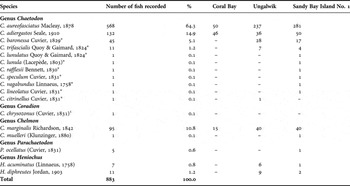
A total of 883 individuals from five genera and 17 species of butterflyfish were recorded within the surveys (Table 1). Nine species were new records for the NT fauna lists. Goldstripe butterfly fish Chaetodon aureofasciatus, was the most abundant species, followed by the Philippine butterfly fish C. adiergastos Seale, margined butterflyfish Chelmon marginalis Richardson, triangle butterflyfish Chaetodon baronessa Cuvier, and chevroned butterflyfish C. trifascialis Quoy & Gaimard (Table 1). These five species together comprised 96.4% of all recorded individuals.
List of butterflyfish recorded in all surveys at Cobourg Marine Park in 1999–2003.

*, indicate new species for the Northen Territory;1. found at Orontes Reef, outside the Cobourg Marine Park.
Seven fauna species of butterflyfish, new for the NT, were represented by only one individual in all surveys (Table 1).
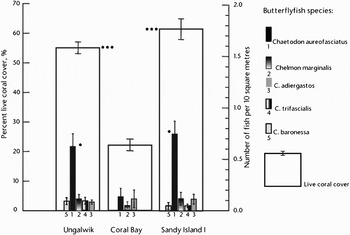
Mean values of LCPC showed significant differences among locations (one-way ANOVA, F2,27 = 14.80, P < 0.001) (Figure 2). No significant differences were found between LCPC at Sandy Island No. 1 and Ungalwik (P = 0.71, Tukey HSD comparison). At both these sites LCPC was higher than in Coral Bay (P < 0.003, Tukey HSD comparison) (Figure 2).
Open bars total live coral per cent cover (recalculated from Line Intercept Transect data) and common butterflyfish population densities (closed bars) at three different coral reef sites at Cobourg. Error bars are standard error. Asterisk between bars, significant differences at P < 0.05; two asterisks, at P < 0.01; and three asterisks, at P < 0.001, Tukey HSD test. Significant differences in population density found only for Chaetodon aureofasciatus, see the text.

Abundances of C. aureofasciatus varied at different study sites on high significance level (one-way ANOVA, F2,27 = 1.322, P = 0.009). Population density of this species was significantly lower in Coral Bay compared with Ungalwik and Sandy Island No. 1, (P = 0.038, P = 0.024, respectively, Tukey HSD comparison). However, population density did not differ significantly between the last two sites (P = 0.07, Tukey HSD test; Figure 2).
Both Chelmon marginalis and Chaetodon adiergastos have similar population densities at all three sites (one-way ANOVA, F2,27 = 0.259, P = 0.77 and F2,27 = 0.281, P = 0.75, respectively).
Two other species, C. baronessa and C. trifascialis were not recorded at Coral Bay, an area with low coral cover and absence of Acropora corals (Figure 2). Differences in population density of both species in Ungalwik and around Sandy Island No. 1 were statistically insignificant (t-test: two-sample assuming unequal variances, respectively: t = 0.75, P (T < =t) two-tail = 0.48, t = 0.74, P (T ≤ t) two-tail = 0.45).
The highest number of butterflyfish species was recorded around Sandy Island No. 1—14 species (Table 1; Figure 1). This area has very high values of overall live coral cover, the highest among all areas surveyed at Cobourg Peninsula (Gomelyuk, Reference Gomelyuk2003, Reference Gomelyuk2007).
Chaetodon aureofasciatus was the most common and abundant species at CMP representing 64.3% of all butterflyfish recorded. This species has the highest population density values, close to 1 fish per 10 m2 of coral reef.
Population densities of the four other common species: Chelmon marginalis, Chaetodon adiergastos, C. baronessa and C. trifascialis representing 32.1% of all fish recorded, were much lower (Table 1; Figure 2). The highest number of butterflyfish species, the highest number of individuals, and the highest population density values were recorded at Sandy Island No. 1 (Table 1; Figure 2). Differences in Fisher's alpha index were highly significant between all sites (one-way ANOVA, F2,27 = 62.70, P < 0.001).
DISCUSSION
Chaetodon aureofasciatus, the most common and abundant butterflyfish at the CMP is an endemic species of northern Australia and southern Papua New Guinea (Allen et al., Reference Allen, Steene and Allen1998). This species is reported to be an obligate hard-coral feeder (Pratchett, Reference Pratchett2005; Pratchett et al., Reference Pratchett, Wilson and Baird2006) that has strong affiliation with corals (Anderson et al., Reference Anderson, Ehrlich, Ehrlich, Roughgarden, Russell and Talbot1981; Williams, Reference Williams1982). The population density of C. aureofasciatus was the highest among all butterflyfish at CMP. On the Great Barrier Reef (GBR), C. aureofasciatus is absent at the outer and inner barrier reef, is rare at the far central reefs, common at the near central reefs, extremely common at the near shore reefs (Williams, Reference Williams1982), common in lagoons and outer reef slope habitats in the Capricorn-Bunker Group, southern GBR (Russell, Reference Russell1983). However, in the central part of the GBR, population densities of C. aureofasciatus range from only 0.02–0.04 fish per 10 m2 (Pratchett et al., Reference Pratchett, Wilson and Baird2006), that is ten times lower than at Cobourg. This species is also reported to be rare in the One Tree Reef, southern GBR (Fowler, Reference Fowler1990). Only at Hayman Island and Hook Island was the population density of this species 4.1 and 1.2 fish per 10 m2 respectively (Findley & Findley, Reference Findley and Findley2001), which is higher than the density at CMP (0.3–0.98 fish per 10 m2).
Chaetodon adiergastos, an omnivorous species, feeding on benthic invertebrates which inhabit coral reefs (Masuda & Allen, Reference Masuda and Allen1993), is common and abundant at CMP (population density 0.1–0.15 fish per 10 m2) and also found in the Dampier Archipelago (Hutchins, Reference Hutchins, Wells, Walker and Jones2003) but is not found on the GBR. This species is absent in many other areas of the Indo-Pacific, and in most surveyed areas in the Philippines, Malaysia (Borneo) and Indonesia (Bali) have a population density lower than 0.05 fish per 10 m2 (Findley & Findley, Reference Findley and Findley2001). Only at two locations: Apo (Philippines) and Borneo (Malaysia) were population densities of C. adiergastos similar to those at Cobourg (Findley & Findley, Reference Findley and Findley2001; Figure 2).
Chaetodon baronessa, a strict coralivorous species, feeding exclusively on the polyps of Acropora corals (Sano et al., Reference Sano, Shimizu and Nose1984; Pratchett, Reference Pratchett2005) is rare on outer barrier reefs and inshore reefs; it is uncommon in inner, far central and near central reefs on the northern and central parts of the GBR (Williams, Reference Williams1982); similarly, it is rare on inner reefs at CMP (population density 0.05–0.09 fish per 10 m2). According to Findley & Findley (Reference Findley and Findley2001) population density of C. baronessa at the GBR was 0.23 fish per 10 m2 (Hayman Island) and 0.55 fish per 10 m2 (Lizard Island). Population density of this species in the central section of the GBR in 2000, before mass die-off of corals, was 0.21 fish per 10 m2; in 2005 density dropped to 0.04 fish per 10 m2 (Pratchett et al., Reference Pratchett, Wilson and Baird2006). Higher population densities of triangle butterflyfish were observed only at Lombok Island, southern Indonesia (0.93 fish per 10 m2) and at Honeymoon Island, Fiji (1.23 fish per 10 m2; Findley & Findley, Reference Findley and Findley2001).
Chaetodon trifascialis feeds primarily on the polyps and mucus of Acropora corals (Sano et al., Reference Sano, Shimizu and Nose1984; Sano, Reference Sano1989; Pratchett, Reference Pratchett2005). Population density of this species was low: 0.01–0.12 fish per 10 m2 in shallow inner reefs at CMP. This species has similar densities on outer and central reefs and is rare on near shore reefs in the central part of the GBR (Williams, Reference Williams1982), at Apo Island and Siquijor Island (Philippines), at Sulavesi Island, Bali Island (Indonesia), at Honeymoon Island and Malolo-lailai Island (Fiji), at Palau Island and Angaur Island (Palau) (Findley & Findley, Reference Findley and Findley2001). This species was abundant with population densities ranging from 1.03 to 3.5 fish per 10 m2 only at Tahiti, Raiatea and Rangiroa Islands, French Polynesia (Findley & Findley, Reference Findley and Findley2001).
No published data are available on population biology of Chelmon marginalis, an endemic Australian species (Allen et al., Reference Allen, Steene and Allen1998) that is common on inshore reefs at CMP. The other species of this genus, Chelmon rostratus, is very similar to C. marginalis, feeding on invertebrates, crustaceans and worms (Anderson et al., Reference Anderson, Ehrlich, Ehrlich, Roughgarden, Russell and Talbot1981). At One Tree Reef on the eastern edge of the Capricorn Group of reefs on the southern GBR, C. rostratus is one of the most common species (Fowler, Reference Fowler1990). Population density of this species varied between 0.18 and 0.48 fish per 10 m2 and was therefore higher than the population density of C. marginalis in different habitats at CMP (0.09–0.18 fish per 10 m2; Figure 2). However, in another study conducted on the GBR (Lizard Island, Hook Island, Hayman Island and Heron Island) population densities of C. rostratus were substantially lower (Findley & Findley, Reference Findley and Findley2001) than those of C. marginalis at CMP.
The number of butterflyfish species in CMP is modest compared with some other areas of tropical Australia. Anderson et al. (Reference Anderson, Ehrlich, Ehrlich, Roughgarden, Russell and Talbot1981) reported 29 species of chaetodontid fish for coral reefs of the northern part of the GBR; Fowler (Reference Fowler1990) reported the same number of species from the southern part of the GBR. Russell (Reference Russell1983) reported 32 species from the Capricorn-Bunker Group (southern GBR) and 36 species occur at Lizard Island (northern GBR). A total of 22 species of chaetodontid fish were recorded at the Dampier Archipelago, Western Australia (Hutchins, Reference Hutchins, Wells, Walker and Jones2003). Butterflyfish biodiversity at CMP (17 species) is lower than at the GBR and at the Dampier Archipelago; however, it is still the highest of any area surveyed so far in NT waters.
During surveys on different rich coral reef sites at Gove Peninsula (north-eastern part of Arnhem Land, (12°17′S 136°49′E) only two species, Chaetodon aureofasciatus and Chelmon marginalis, were found, despite more than 50 hours of diving (V. Gomelyuk, unpublished data). Only four butterflyfish species have been recorded so far in the Gulf of Carpentaria (Blaber et al., Reference Blaber, Brewer and Harris1994) and seven species are found in Darwin Harbour (Larson & Williams, Reference Larson, Williams, Hanley, Caswell, Iviegirian and Larson1997).
Chelmon marginalis, an Australian endemic species found at Dampier Archipelago, Western Australia (Hutchins, Reference Hutchins, Wells, Walker and Jones2003, Reference Hutchins2004) and only in the northern part of the GBR (Allen et al., Reference Allen, Steene and Allen1998) has a relatively high abundance and population density at CMP (Table 1; Figure 2).
The abundance of Chaetodon adiergastos at CMP is similar to those at Apo (Philippines) and in Borneo (Malaysia) where the population density is the highest in the Indo-West Pacific region (Findley & Findley, Reference Findley and Findley2001).
ACKNOWLEDGMENTS
I would like to express my gratitude to Helen Larson for butterflyfish identification. Scott Whiting, Barry Russell, and two anonymous referees generously provided their helpful comments and a valuable improvement to the manuscript. Staff at Black Point Ranger Station, Garig Gunak Barlu National Park and Parks and Wildlife Service of the Northern Territory provided field assistance and invaluable logistical support.