Introduction
Before the discovery of fossil fuels, essentially all human activities were powered by solar energy. This energy was continuously captured by photosynthesis and converted to chemical energy, building materials and useful molecules such as nutrients. The discovery of vast quantities of stored fuel in the form of coal, petroleum and natural gas led to cheaper modes of production that have enabled industrial revolution. However, because fossil fuels ultimately derive from living matter, we cannot expect that other planets will have such stores of energy. To explore other moons and planets, biological modes of production must be harnessed.
Historically, the diversity of products used by humans on earth derived from a diversity of crops – complementary nutritional sources and animal feed from various plants, wood as fuel and building material from yet other plants. These crops in turn require a diversity of environments that exist naturally on earth, but that would need to be independently replicated on another planet.
In the review that follows, our essential argument is as follows. Previous analyses of uses for biology in space have primarily considered naturally occurring organisms (Elverum et al. Reference Elverum, Bagian, Colwell, Dunn, Humphrey, Kanade, Llinas and Stupp1998. Recent advances in genetic engineering make it possible to essentially produce any biological molecule in virtually any organism. This would allow a diversity of products to be generated using a single production system based on a single ‘chassis’ organism engineered to produce a broad spectrum of needed materials. A photosynthetic bacterium would be a logical candidate chassis organism, although electrically driven bacteria or eukaryotic photosynthetic microbes could also be considered.
Why microbes?
The recent advent of global warming due to CO2 production and the asymmetric geographical distribution of petrochemical resources have led to efforts to create fuel using genetically engineered plants and photosynthetic microbes (Huntley & Redalje Reference Huntley and Redalje2007; Dismukes et al. 2008; Posten Reference Posten2009). These efforts have laid a potential groundwork for chemical production in space and on other planets. Such chemicals include carbon-based fuels; amino acids, organic acids, vitamins, proteins, lipids, sugars and other nutritional molecules; plastics and cellulosic building materials; and antibiotics, as well as oxygen. Capture of waste CO2 would be another advantage of photosynthetic metabolism. The requirements for production at scale would be the local availability of the essential elements of life: hydrogen, carbon, nitrogen, oxygen, sulphur and phosphorus, as well as sunlight. Additional trace amounts of metals required for enzymes, certain cofactors and redox proteins (micronutrients) would need to be taken or mined in space.
On earth, two approaches to photosynthetic fuel production are being investigated: green plants and photosynthetic microbes. The advantage of green plants is that they require low maintenance: they develop their own structures to collect sunlight, water, nitrogen and trace minerals; they adapt to changing environmental conditions; and they have a number of mechanisms for resisting predators. In addition, they naturally produce food molecules and other useful chemicals. A central advantage of photosynthetic microbes is that they are significantly more efficient on a cultivated volume basis at capturing solar energy. In addition, they are much more easily genetically engineered than plants as a result of their more rapid growth and simpler biology. The much shorter replication time of microbes versus macroscopic plants offers another important advantage: as new challenges and opportunities arise in space, we cannot expect that concepts developed terrestrially months or years earlier in simulated environments will be good enough, much less optimal, to provide mission-critical nutrients and chemicals. It will be much faster to reiteratively evolve and select for multiple new microbes superior to anything pre-developed on earth and taken into space. Provided a sufficiently diverse stock of microbes with well-understood properties as ‘chassis’ organisms' for manufacture are taken into space, and provided methods for rapid selection or screening are available, microbes can be rapidly developed on-site.
In the context of terrestrial fuel production, it is currently unclear as to which of these production systems will be economically more successful. However, in the context of space travel and planetary settlement, we believe that several of the terrestrial advantages of plants fall away, and that the advantages of microbial production are more crucial. For example, the low-maintenance characteristics of plants on earth are not such an advantage – space is a fundamentally high-maintenance environment, and special effort would be needed to supply water, light and nutrients to either plants or microbes. In addition, the proper development of plants depends on gravity, while microbial growth does not.
Efficiency of light utilization
One central advantage of photosynthetic microbes is their high yield of biomass for a given light input. Dismukes et al. (2008; see Table 1) have reviewed the biomass productivity of green plants and photosynthetic microbes; this summary suggests that the microbes are 4–10-fold better at converting solar energy into biomass (although the values are from diverse sources that may be difficult to compare). The volume required to manufacture the required mass of nutrients or chemicals in space is another important consideration in terms of cost of infrastructural materials and operating costs (in this context cost is not financial, but the cost in all chemical and materiel components required to deliver the required output in space). Bioreactors containing photosynthetic microbes will deliver more output per unit operational volume than greenhouse-type environments for row crops or market vegetables.
The theoretical maximal efficiency of biomass production corresponds to about one glucose molecule synthesized from the energy of 48 photons or 1 kg glucose (5.5 moles) from 48×5.5×6×1023=2.64×1025 photons (Brenner et al. Reference Brenner, Bildsten, Dyson, Fortson, Garwin, Grober, Hemley, Hwa, Joyce and Katz2006). The terrestrial solar flux is about 1017 photons cm−2 second−1=1021 photons×43 200 m−2 12 hours−1=8.64×1025 m−2 day−1, which could give rise to over 1.5 kg glucose day−1 m−2. This light flux is in excess of what plants or microbes can use by a factor of about 10. Earth-based systems for distributing light into photo-bioreactors have been developed (e.g. Valcent Products Inc.), and while these may be expensive in the context of producing biofuels that compete with fossil fuels, such systems would be appropriate for space. As a point of comparison, the amount of CO2 released by human breathing is about 1 kg day−1 (http://www.epa.gov/climatechange/fq/emissions.html#q7). During a space flight, if the astronauts consume the photosynthetic microbes, the cycling of O2 and CO2 would largely form a closed loop. Taken together, these calculations suggest that the enhanced efficiency of cyanobacteria compared to plants in overall CO2 conversion to biomass would be important in minimizing the physical space taken up by a CO2 recycling system.
Diversity of production through metabolic engineering
Metabolic engineering is a biotechnology discipline in which microbes are engineered to produce significant amounts of biological molecules such as amino acids and vitamins (Smolke Reference Smolke2010). The flux of molecules through metabolic pathways is controlled through a combination of mutations and expression of foreign genes to shunt metabolic flux of carbon and energy use into certain biochemical pathways.
Recent articulations of the achievements of synthetic biology have led to enhanced interest in metabolic engineering. (A well-publicized example is the synthesis of the anti-malarial drug artemisinin; Hale et al. Reference Hale, Keasling, Renninger and Diagana2007.) In addition to making natural biological molecules, synthetic biologists are now expressing novel combinations of enzymes in cells, such that non-natural compounds are produced. These approaches have been commercially used with heterotrophic microbes such as Escherichia coli, various Clostridium species and yeast. Typically, the engineered organism uses a carbohydrate such as sucrose or high-fructose corn syrup as a starting point to provide fixed carbon and energy, and the cost of this ‘feedstock’ is often the major expense in manufacturing. Because of this cost issue, ‘metabolic flux analysis’ is used to quantitatively calculate how chemical intermediates are processed to create a given product, and metabolic flux models often include descriptions of all the enzymes identified in the sequence of a microbial genome (Shastri & Morgan Reference Shastri and Morgan2005; Palsson Reference Palsson2006; Kennedy et al. Reference Kennedy, Boyle, Waks and Silver2009).
Metabolic engineering of photosynthetic microbes
For terrestrial purposes, the main reason to consider photosynthetic microbes instead of heterotrophs is that the requirement for carbon feedstock, such as glucose or sucrose, can be eliminated. Usually, the cost of this feedstock is a significant fraction of the overall manufacturing cost. Both commercial and academic groups have explored the production of carbon-based fuels from photosynthetic bacteria, using engineered pathways (Deng & Coleman Reference Deng and Coleman1999; Savage et al. Reference Savage, Way and Silver2008; Atsumi et al. Reference Atsumi, Higashide and Liao2009; Radakovits et al. 2010; Schirmer et al. Reference Schirmer, Rude, Li, Popova and del Cardayre2010). Production of other molecules such as hydrogen, isoprene, sugars, oils, lipids, proteins, etc. have been explored (reviewed by Ducat et al. Reference Ducat, Way and Silver2011).
Cyanobacteria (photosynthetic bacteria) are the main organisms for engineering, since they are bacteria and have many features in common with particularly genetically tractable bacteria such as E. coli. Additional photosynthetic bacteria such as the purple non-sulphur (PNS) bacteria are also of interest as microbial factories because several of them are genetically tractable for optimization, can be grown at scale and are extremely flexible and adaptable metabolically (McEwan Reference McEwan1994; Obeid et al. Reference Obeid, Magnin, Flaus, Adrot, Willison and Zlatev2009; Carlozzi et al. Reference Carlozzi, Pintucci, Piccardi, Buccioni, Minieri and Lambardi2010). Metabolic engineering of cyanobacteria or PNS bacteria is in a more primitive state than traditional manufacturing workhorse organisms that use carbohydrate feedstocks. Most of the effort has occurred in the last 5 years and has focused on demonstrating production of a given molecule, even at a low level. (Various groups are attempting to commercialize chemical production from cyanobacteria and PNS bacteria, but it is unknown as to whether such commercialization will be economically successful for terrestrial applications in the face of competition from natural sources; Ducat Reference Ducat, Way and Silver2011).
Optimization of production from photo-bacteria may be more complicated than from organisms using glucose as a feedstock, because the Calvin cycle by which CO2 is fixed is indeed a cycle. Intermediates in the cycle can only be withdrawn at a measured rate: if they are removed too quickly and the molecule onto which CO2 is added disappears, the cycle will break down. In contrast, typical engineered metabolic pathways begin with glucose, end with a product and are linear. Dramatic enhancements of manufacturing yield from cyclic metabolic pathways may be a new challenge for metabolic engineering.
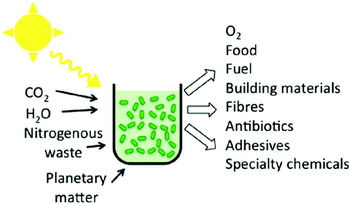
Nonetheless, engineering photo-bacteria has become the focus of intensive research. Many researchers, including ourselves, believe that the ability to produce fuel from carbon-fixing microbes will be essential to decelerate CO2 emissions, that the US has the national will to develop such technology and that it will be developed. Given the length of time needed for planning space missions, NASA should assume that photosynthetic microbes will be engineered to produce a variety of useful molecules, and such microbes will be worth taking into space (Fig. 1).
Photosynthetic bacteria as a platform for non-terrestrial chemical production. As autotrophs, photosynthetic microbes can rely solely on inorganic nutrient sources. In space, these would include primarily exhaled CO2 and recycled human waste, while on other planets the nutrients could derive from planetary matter. A single fermentation system could be used to grow derivatives of a single species, which would be engineered to synthesize various products. A wide variety of chemicals and materials could be generated from one process.

‘Electrofuels’ is a new variation on the idea of photosynthetic production (Thrash & Coates Reference Thrash and Coates2008; Cheng et al. Reference Cheng, Xing, Call and Logan2009; Carbajosa et al. Reference Carbajosa, Malkia, Caillard, Lopez, Palomares, Martín-Gago, Rodríguez, Amils, Fernández and De Lacey2010; Villano et al. Reference Villano, Aulenta, Ciucci, Ferri, Giuliano and Majone2010). The essential idea is that bacteria could be engineered to absorb electrons from an electrode as their sole energy source, for example, from a solar panel. It is already clear that numerous chemolithotrophs take up electrons from inorganic metal ions and other inorganic substrates in nature (including Fe2+, Mn2+, S0 and S2−). The challenge is to enhance this electron flux and couple a high flux to useful levels of chemical productivity in organisms that are comparatively poorly studied. Nevertheless, the exciting possibility that microbes could make useful chemicals from sole inputs of CO2 and electrical energy is a spur to technology development in this area. Electricity-using bacteria would be engineered to use electrons as chemical reducing equivalents to fix CO2, and then synthesize a biofuel. The electrons could be transmitted from an electrode either by direct contact or through a chemical mediator such as hydrogen. There are several reasons to consider this approach as a highly attractive concept worthy of at-risk investment to develop the technology. First, green plants and cyanobacteria can only absorb about 10–20% of maximal sunlight on the earth's surface; at higher flux levels, the excess energy is lost as heat. This loss is independent of the energy loss that is inherent in the reactions of Photosystems I and II, which is also almost 90%. In contrast, solar panels can absorb large amounts of solar radiation without ‘maxing out’. Even low-cost solar panels have an efficiency of 15–18% in their conversion to electrical energy, somewhat higher than Photosystem I+II. When these effects are combined, the overall improvement in efficiency may be as high as ∼15-fold for ‘electrofuels’ relative to biofuels generated by natural photosynthesis.
A second advantage of the electrofuels approach is that the photon absorption step, with its associated heat loss, is separated from the bioreactor housing the bacteria. This makes temperature control more straightforward, and prevents the bacteria from overheating. In the context of a spaceship or facility on another planet, solar panels that generate the electricity could be outside the capsule, liberating precious space where the astronauts function.
A third advantage of electricity-driven microbial metabolism and chemicals production derives from the limitation of all photosynthetic processes on the capture of light energy by the microbe or plant cell. Sunlight cannot penetrate the microbial suspension in a dense bioreactor for more than a few millimetres, any more than it can penetrate the leaves of a plant to efficiently deliver light energy to leaves underneath in shade. The two-dimensional (2D) reactivity of photosynthetic organisms and plants at a surface exposed to sunlight places 2D engineering constraints on any such system, necessitating a large surface area and real limitations on the ability to provide energy to all cells simultaneously. In electricity-powered microbial systems, a very similar limitation on energy flux, microbial density and system yield would pertain if the microbes grow as a biofilm on the electrode. If on the other hand we use redox carriers to transfer electrons from the electrode to the surface of microbes in planktonic suspension in stirred culture, it should be possible to generate much higher yield for a given bioreactor volume or 2D footprint. The transfer of electrons from electrodes to microbes in suspension in manufacturing scale reactors is well documented (Straub et al. Reference Straub, Benz and Schink2001; Thrash & Coates Reference Thrash and Coates2008).
Thus, the electrofuels concept has a number of advantages that may be particularly important for space travel. NASA should monitor the developments in this area, which are currently supported by DOE (http://arpa-e.energy.gov/ProgramsProjects/Electrofuels.aspx). In addition, NASA should consider supporting the development of electrofuel bioreactors that would be specifically designed for use in space. In the discussion that follows, we will for simplicity describe the potential for engineering photosynthetic bacteria, but electrofuel-producing bacteria could be engineered similarly.
We envision that at least three major classes of material could be produced biologically in space: food, fuel and building materials. Other classes of chemicals can also be produced such as lubricants, adhesives, redox and chemical catalysts and solvents. As described in more detail below, it may be possible to use a single species of photosynthetic bacteria to satisfy all these needs through the design of variants that could be grown in bioreactors of a standardized design.
Photosynthetic bacteria as food
Spirulina (Arthrospira platensis) is a cyanobacterial species that is already used as a nutritional supplement and is sold in health food stores. Its current popularity is due to the fact that native populations in Africa and Mexico used Spirulina as a food source (Ciferri Reference Ciferri1983). Based on inspection of bacteria metabolic pathways and human nutritional requirements, cyanobacteria are indeed expected to be a nearly complete nutritional source, except for vitamin C and possibly essential oils.
Photosynthetic bacteria also have the advantage that they are absolutely dependent on light for growth and are completely non-infectious. Cyanobacteria are also more palatable than most bacteria or, subjectively, yeast (J. Way, unpublished results).
For a long space flight or planetary settlement, sensory stimulation should be provided by food. Recently, a variety of smell- and taste-conferring molecules have been expressed in bacteria. For example, the iGEM teams from MIT in 2006 and Art/Science Bangalore in 2009 expressed in E. coli the biosynthetic pathways for banana oil (isoamyl acetate) and oil of wintergreen (methylsalicylate) (http://parts.mit.edu/wiki/index.php/MIT_2006) and geosmin (an earthy-smelling terpenoid compound from actinobacteria; http://2009.igem.org/Team:ArtScienceBangalore/Aproach). Cultures of the expressing bacteria indeed smelled like the compound in question, although the aesthetic experience was dominated by the inherent sulphide smell of E. coli, which cyanobacteria do not produce in such high quantities.
Synthesis of taste molecules could also be engineered into photosynthetic microbes. Brazzein is a small protein (54 amino acids) with an intense sweet flavour; it can be heterologously expressed (Ming & Hellekant Reference Ming and Hellekant1994). Miraculin is a ‘flavour inverter’ that has little flavour by itself, but converts sour flavour to sweet (Faus Reference Faus2000). Valencene (so named from Valencia oranges) is a terpenoid molecule that confers flavour to oranges; this molecule is produced from farnesyl-pyrophosphate by the action of a single enzyme, valencene synthase (Chappell Reference Chappell2004). Valencene is just one of a variety of terpenoid compounds that contribute flavours and/or odours to food. In addition to the potential for synthesizing strong non-nutritive flavour molecules, cyanobacteria have already been engineered to synthesize such nutritive flavour molecules as sugars, lactic acid and ethanol (Deng & Coleman Reference Deng and Coleman1999; Niederholtmeyer et al. Reference Niederholtmeyer, Wolfstädter, Savage, Silver and Way2010).
Colour variation is another aspect of food. Lycopene and beta-carotene are isoprenoid compounds that confer red and red–orange colours to vegetables such as tomatoes and carrots. These compounds may also have important health benefits including oxidative protection. Biochemical pathways for these compounds have been defined and they have been produced by metabolic engineering (Liu et al. Reference Liu, Zhu and Jiang2009). Another important aspect of food attractiveness and variety is its texture and material properties. These properties could also be engineered into microbes, or more simply, provided by various procedures and simple machines for treatment of biomass or nutrients mixed with texture enhancers.
The point about these examples of genetic engineering is that astronauts will be in need of sensory stimulation on long space flights and on other planets. Normally, this variation comes from different foods, but it should be possible to engineer food that can be produced by a single method that nonetheless varies in smell, taste, texture and appearance.
Genetic manipulation of carbohydrate, protein, nucleic acid, lipid and vitamin content
To reengineer photosynthetic bacteria to be a complete food source, several modifications would be needed: addition of synthetic pathways for a few necessary molecules that humans require and bacteria do not produce, and balancing of overall synthesis to fit with human needs. Pathways for synthesis of vitamin C and essential oils, for example, could be introduced by straightforward metabolic engineering.
Achieving a balance between the overall ratios of cellular components will be important. There is a vast, sporadic literature covering several decades on the use of microbes, including algae, as food (Kharatyan Reference Kharatyan1978; Ciferri Reference Ciferri1983; Elverum et al. Reference Elverum, Bagian, Colwell, Dunn, Humphrey, Kanade, Llinas and Stupp1998). One recurrent theme is that microbes do not have an ideal ratio of components for human nutrition, and in particular have high nucleic acid content. (High levels of purines lead to uric acid accumulation and can cause gout.) Bacteria are also relatively poor in carbohydrates. It is important to note that this literature focuses almost entirely on wild-type organisms and does not explore how genetic modifications could tailor the ratios of major cell constituents.
Recent genetic manipulations indicate how the ratios of various substituents might be varied. Cyanobacteria have already been engineered to synthesize and secrete ethanol and sugar (Deng & Coleman Reference Deng and Coleman1999; Niederholtmeyer et al. Reference Niederholtmeyer, Wolfstädter, Savage, Silver and Way2010), and so culture supernatants could be non-destructively harvested and used as a food source. To address the problem of nucleic acid content, the genome size could be reduced, and the bacteria could also be engineered to express inducible enzymes that break down their nucleic acids and the purines that lead to uric acid buildup.
Synthesis of plastic polymers from bacteria
Some species of bacteria synthesize polyhydroxyalkanoate polymers to store energy and carbon (Madison & Huisman Reference Madison and Huisman1999). These are ester polymers with a variable side chain that varies from species to species, and the chemical characteristics of the resulting polymers are also varied. The pathways for producing the polymers typically involve only three genes. A variety of different hydroxyalkanoate polymers have been expressed in E. coli as well as in cyanobacteria (Asada et al. Reference Asada, Miyake, Miyake, Kurane and Tokiwa1999; Sudesh et al. Reference Sudesh, Taguchi and Doi2002), indicating that the identified genes are indeed sufficient for polymer production and that the pathways could be transferred to other bacteria.
Fuel
Synthesis of carbon-based fuel from cyanobacteria is the focus of a number of recent startup companies, such as Sapphire Energy, Solazyme and Joule Unlimited. While the use of carbon-based fuels may be limited in space due to the preciousness of oxygen, synthesis by photosynthetic microbes may be relatively straightforward.
Conclusions
Recent advances in synthetic biology and the engineering of photosynthetic and electrosynthetic bacteria have created an opportunity for NASA to generate a microbial chemosynthetic platform for production in space.
While most effort in academia and industry is focused on fuel production, the utility of carbon-based fuels in space [versus typical propellants used in space] is probably less than that of food and building materials. The economic forces driving research in this area are completely different for product concepts useful on earth versus space. Consequently, NASA should support research to deliver technology breakthroughs distinct from, but synergistic with, efforts of other funding agencies, such as the US DOE and National Science Foundation.
The potential for ‘dual-use’ of research proposals for both space and terrestrial applications should be proactively considered by NASA. Investment in NASA-sponsored research in agriculture, carbon capture, etc. will not only be perceived as a positive contribution of NASA funding to terrestrial and immediate concerns here on earth, but will also lead to technology flow in the reverse direction. Industrial and academic research on microbial chemosynthesis has already created the potential described here for construction of microbes that promise new platforms for lower risk, system-independence and highly adaptable resource use and recycling in space.
Recommendations
1. NASA should support research on engineering photobacteria to efficiently synthesize nutrient molecules such as sugars, amino acids, fatty acids or secreted proteins, using CO2 as the sole carbon source and sunlight as sole energy source. The goal should be towards efficient conversion of light energy, and high-level sustained production, not just production of trace amounts.
2. NASA should design a light-driven bioreactor that can be used to grow photobacteria in space, and use it to grow photobacteria that synthesize a nutrient molecule. Such a bioreactor should be tested on an orbiting space station within ∼5 years. Tests would be performed on the ability of the system to absorb CO2, produce oxygen, synthesize the nutrient molecule, harvest the molecule/organisms using compact and relatively simple processing technology and produce nutrient for consumption by astronauts.
3. NASA should design an electrically driven bioreactor in which electro-bacteria grow and produce a nutrient molecule with electricity as sole energy source and CO2 as sole carbon source. This system, currently in early stages of technical enablement, would, if enabled, offer the possibility for conversion of sunlight into electrical energy followed by use of the electricity to drive microbial growth and nutrient productivity in high-volume stirred reactors. A bioelectric reactor should be tested on an orbiting space station within ∼5 years. The ability of the system to absorb CO2, produce oxygen, synthesize the nutrient molecule and have the molecule/organisms be harvested and consumed by astronauts would be tested.