Introduction
Depression is estimated to affect 350 million people worldwide and is a leading cause of global disability (Ferrari et al. Reference Ferrari, Charlson, Norman, Patten, Freedman, Murray, Vos and Whiteford2013). A confirmed diagnosis of major depressive disorder accounts for 8.2% of the total worldwide years lived with disability (YLDs) (Ferrari et al. Reference Ferrari, Charlson, Norman, Patten, Freedman, Murray, Vos and Whiteford2013). Within the past decade, there has been an increasing emphasis on the physical health challenges of people with depression (Henningsen et al. Reference Henningsen, Zimmermann and Sattel2003).
Pain is also highly prevalent (Breivik et al. Reference Breivik, Collett, Ventafridda, Cohen and Gallacher2006) and a leading cause of global burden and YLD (Murray et al. Reference Murray, Vos, Lozano, Naghavi, Flaxman, Michaud, Ezzati, Shibuya, Salomon, Abdalla, Aboyans, Abraham, Ackerman, Aggarwal, Ahn, Ali, Alvarado, Anderson, Anderson, Andrews, Atkinson, Baddour, Bahalim, Barker-Collo, Barrero, Bartels, Basáñez, Baxter, Bell, Benjamin, Bennett, Bernabé, Bhalla, Bhandari, Bikbov, Bin Abdulhak, Birbeck, Black, Blencowe, Blore, Blyth, Bolliger, Bonaventure, Boufous, Bourne, Boussinesq, Braithwaite, Brayne, Bridgett, Brooker, Brooks, Brugha, Bryan-Hancock, Bucello, Buchbinder, Buckle, Budke, Burch, Burney, Burstein, Calabria, Campbell, Canter, Carabin, Carapetis, Carmona, Cella, Charlson, Chen, Cheng, Chou, Chugh, Coffeng, Colan, Colquhoun, Colson, Condon, Connor, Cooper, Corriere, Cortinovis, de Vaccaro, Couser, Cowie, Criqui, Cross, Dabhadkar, Dahiya, Dahodwala, Damsere-Derry, Danaei, Davis, De Leo, Degenhardt, Dellavalle, Delossantos, Denenberg, Derrett, Des Jarlais, Dharmaratne, Dherani, Diaz-Torne, Dolk, Dorsey, Driscoll, Duber, Ebel, Edmond, Elbaz, Ali, Erskine, Erwin, Espindola, Ewoigbokhan, Farzadfar, Feigin, Felson, Ferrari, Ferri, Fèvre, Finucane, Flaxman, Flood, Foreman, Forouzanfar, Fowkes, Fransen, Freeman, Gabbe, Gabriel, Gakidou, Ganatra, Garcia, Gaspari, Gillum, Gmel, Gonzalez-Medina, Gosselin, Grainger, Grant, Groeger, Guillemin, Gunnell, Gupta, Haagsma, Hagan, Halasa, Hall, Haring, Haro, Harrison, Havmoeller, Hay, Higashi, Hill, Hoen, Hoffman, Hotez, Hoy, Huang, Ibeanusi, Jacobsen, James, Jarvis, Jasrasaria, Jayaraman, Johns, Jonas, Karthikeyan, Kassebaum, Kawakami, Keren, Khoo, King, Knowlton, Kobusingye, Koranteng, Krishnamurthi, Laden, Lalloo, Laslett, Lathlean, Leasher, Lee, Leigh, Levinson, Lim, Limb, Lin, Lipnick, Lipshultz, Liu, Loane, Ohno, Lyons, Mabweijano, MacIntyre, Malekzadeh, Mallinger, Manivannan, Marcenes, March, Margolis, Marks, Marks, Matsumori, Matzopoulos, Mayosi, McAnulty, McDermott, McGill, McGrath, Medina-Mora, Meltzer, Mensah, Merriman, Meyer, Miglioli, Miller, Miller, Mitchell, Mock, Mocumbi, Moffitt, Mokdad, Monasta, Montico, Moradi-Lakeh, Moran, Morawska, Mori, Murdoch, Mwaniki, Naidoo, Nair, Naldi, Narayan, Nelson, Nelson, Nevitt, Newton, Nolte, Norman, Norman, O'Donnell, O'Hanlon, Olives, Omer, Ortblad, Osborne, Ozgediz, Page, Pahari, Pandian, Rivero, Patten, Pearce, Padilla, Perez-Ruiz, Perico, Pesudovs, Phillips, Phillips, Pierce, Pion, Polanczyk, Polinder, Pope, Popova, Porrini, Pourmalek, Prince, Pullan, Ramaiah, Ranganathan, Razavi, Regan, Rehm, Rein, Remuzzi, Richardson, Rivara, Roberts, Robinson, De Leòn, Ronfani, Room, Rosenfeld, Rushton, Sacco, Saha, Sampson, Sanchez-Riera, Sanman, Schwebel, Scott, Segui-Gomez, Shahraz, Shepard, Shin, Shivakoti, Singh, Singh, Singh, Singleton, Sleet, Sliwa, Smith, Smith, Stapelberg, Steer, Steiner, Stolk, Stovner, Sudfeld, Syed, Tamburlini, Tavakkoli, Taylor, Taylor, Taylor, Thomas, Thomson, Thurston, Tleyjeh, Tonelli, Towbin, Truelsen, Tsilimbaris, Ubeda, Undurraga, van der Werf, van Os, Vavilala, Venketasubramanian, Wang, Wang, Watt, Weatherall, Weinstock, Weintraub, Weisskopf, Weissman, White, Whiteford, Wiebe, Wiersma, Wilkinson, Williams, Williams, Witt, Wolfe, Woolf, Wulf, Yeh, Zaidi, Zheng, Zonies, Lopez, AlMazroa and Memish2012). The management of pain is associated with considerable financial burden (Breivik et al. Reference Breivik, Eisenberg and O'Brien2013). A previous systematic review over a decade ago demonstrated that pain and depression are highly comorbid and associated with worse outcomes compared with when each condition exists on its own (Bair et al. Reference Bair, Robinson, Katon and Kroenke2003). Moreover, comorbid pain and depression are related to increased costs and burden on health care services (Rayner et al. Reference Rayner, Hotopf, Petkova, Matcham, Simpson and McCracken2016). Therefore, understanding the pain and depression relationship has important health and economic consequences.
To date, most of the research investigating the pain and depression relationship has focused on the Western world. For instance, in a large representative study conducted in the UK, Nicholl et al. (Reference Nicholl, Mackay, Cullen, Martin, Ul-Haq, Mair, Evans, McIntosh, Gallagher, Roberts, Deary, Pell and Smith2014) found that depression was associated with increased odds of pain. Pain is also common in low- and middle-income countries (LMICs) and is in particular related to trauma, cancer, birth complications, congenital defects, and surgical complications, all potentially leading to chronic pain if not treated or if treated inadequately (Jackson et al. Reference Jackson, Thomas, Stabile, Han, Shotwell and McQueen2015; Jackson et al. Reference Jackson, Thomas, Stabile, Han, Shotwell and McQueen2016). There is however a distinct paucity of representative population cohort studies investigating associations between depression and pain in LMICs. Such data would be valuable as depression is highly pervasive among people in LMICs (Prina et al. Reference Prina, Ferri, Guerra, Brayne and Prince2011; Andreasen et al. Reference Andreasen, Lonnroos and von Euler-Chelpin2014; Guerra et al. Reference Guerra, Prina, Ferri, Acosta, Gallardo, Huang, Jacob, Jimenez-Velazquez, Llibre Rodriguez, Liu, Salas, Sosa, Williams, Uwakwe and Prince2016). Moreover, the majority of the world's population resides in LMICs, and the population in this setting is expected to increase in recent decades, while chronic pain is common among people living in LMICs (Jackson et al. Reference Jackson, Thomas, Stabile, Han, Shotwell and McQueen2015). However, resources to provide integrated care for pain and depression comorbidity are limited. Thus, understanding the additional mental health burden is important for planning service developments in this context.
To date, three large-scale studies have investigated pain and depression comorbidity across multiple countries including a small number of LMICs (Demyttenaere et al. Reference Demyttenaere, Bruffaerts, Lee, Posada-Villa, Kovess, Angermeyer, Levinson, de Girolamo, Nakane, Mneimneh, Lara, de Graaf, Scott, Gureje, Stein, Haro, Bromet, Kessler, Alonso and Von Korff2007; Gureje et al. Reference Gureje, Von Korff, Kola, Demyttenaere, He, Posada-Villa, Lepine, Angermeyer, Levinson, de Girolamo, Iwata, Karam, Guimaraes Borges, de Graaf, Browne, Stein, Haro, Bromet, Kessler and Alonso2008; Tsang et al. Reference Tsang, Von Korff, Lee, Alonso, Karam, Angermeyer, Borges, Bromet, Demytteneare, de Girolamo, de Graaf, Gureje, Lepine, Haro, Levinson, Oakley Browne, Posada-Villa, Seedat and Watanabe2008). These studies found that across 18 countries (eight in LMICs), people with multisite pain (Gureje et al. Reference Gureje, Von Korff, Kola, Demyttenaere, He, Posada-Villa, Lepine, Angermeyer, Levinson, de Girolamo, Iwata, Karam, Guimaraes Borges, de Graaf, Browne, Stein, Haro, Bromet, Kessler and Alonso2008) and chronic pain (Tsang et al. Reference Tsang, Von Korff, Lee, Alonso, Karam, Angermeyer, Borges, Bromet, Demytteneare, de Girolamo, de Graaf, Gureje, Lepine, Haro, Levinson, Oakley Browne, Posada-Villa, Seedat and Watanabe2008) are at increased risk of mood disorders. Moreover, chronic neck and back pain is associated with an increased odds of mood disorder (Demyttenaere et al. Reference Demyttenaere, Bruffaerts, Lee, Posada-Villa, Kovess, Angermeyer, Levinson, de Girolamo, Nakane, Mneimneh, Lara, de Graaf, Scott, Gureje, Stein, Haro, Bromet, Kessler, Alonso and Von Korff2007). While helpful and clearly advancing the field, the lack of focus specifically on LMICs does not make the results generalizable to this region (only eight countries were considered), nor give sufficient coverage and attention to this neglected phenomenon. A number of pertinent questions also remain unanswered. First, many LMICs do not have data on the pain and depression comorbidity. Second, it remains unclear whether the relationship between pain and depression is influenced by depression subtypes (i.e. brief depressive episode, subsyndromal depression, and depression). Finally, whether the association between pain and depression is similar across a wide variety of countries is unknown.
Thus, the aims of the current study were to: (1) explore the relationship between pain and depression subtypes across 47 LMICs; (2) investigate the factors that might influence the pain and depression relationship; and (3) conduct a country-wide meta-analysis to explore if pain and depression comorbidity is significantly increased across all 47 countries. Our a priori hypothesis was that we would observe a consistent association between pain and depression syndromes across all LMICs, with the presence of a depression syndrome (v. no depressive syndrome) being associated with higher levels of pain.
Methods
The survey
Secondary data analysis of the World Health Survey (WHS) was conducted. This was a cross-sectional study undertaken in 2002–2004 in 70 countries worldwide. The data are publically and freely available to all interested researchers subject to approval through the WHO website (http://www.who.int/healthinfo/survey/en/). Data were collected using single-stage random sampling and stratified multistage random cluster sampling across 10 and 60 countries, respectively. Full details of the WHS are available in the above-mentioned WHO website. Briefly, persons aged ⩾18 years with a valid home address were eligible to participate. Each member of the household had equal probability of being selected by utilizing Kish tables. A standardized questionnaire, translated accordingly was used across all countries. Linguists were utilized to ensure that the translation was conducted to a high standard.
The individual response rate (i.e. ratio of completed interviews among selected respondents after excluding ineligible respondents from the denominator) ranged from 63% (Israel) to 99% (Philippines) (Moussavi et al. Reference Moussavi, Chatterji, Verdes, Tandon, Patel and Ustun2007). In order to conduct the study, ethical approval was obtained from the ethical boards at each study site. Sampling weights were generated to adjust for non-response and the population distribution reported by the United Nations Statistical Division. Informed consent was obtained from all participants.
Of the 70 countries, 69 had data which are publicly available. Of these, 10 countries (Austria, Belgium, Denmark, Germany, Greece, Guatemala, Italy, the Netherlands, Slovenia, and UK) were excluded due to lack of data on sampling information. Furthermore, 10 high-income countries (Finland, France, Ireland, Israel, Luxembourg, Norway, Portugal, Spain, Sweden, and United Arab Emirates) were excluded in order to focus on LMICs. Moreover, Turkey and Morocco were also excluded due to missing information on some of the variables of interest. Thus, the final sample consisted of 47 countries, which corresponded to 21 low-income and 26 middle-income countries according to the World Bank classification (http://chartsbin.com/view/2438) at the time of the survey (2003) (the full list of the included countries can be found in Fig. 2). The data were nationally representative in all countries with the exception of China, Comoros, the Republic of Congo, Ivory Coast, India, and Russia.
Variables
Pain (outcome variable)
Pain was assessed in two ways. Participants were asked ‘Overall in the past 30 days, how much bodily aches or pains did you have?’, with answer options none, mild, moderate, severe, and extreme. In line with a previous publication using the same dataset (Koyanagi & Stickley, Reference Koyanagi and Stickley2015), those who answered severe or extreme were considered to have severe pain. Second, another pain measure was constructed with the use of the above-mentioned question and another ‘In the past 30 days, how much bodily discomfort did you have?’, which also had the same response options. A factor analysis with polychoric correlations was used in order to obtain a factor score, which was converted into a scale ranging from 0 to 100 with higher scores corresponding to higher levels of pain/discomfort. This pain score has been used in previous WHS publications (Nuevo et al. Reference Nuevo, Van Os, Arango, Chatterji and Ayuso-Mateos2013; Koyanagi et al. Reference Koyanagi, Oh, Stickley, Haro and DeVylder2016).
Depression (exposure variable)
Depressive symptoms were classified based on individual questions from the WHS version of the World Health Organization World Mental Health Composite International Diagnostic Interview, which captures the duration and persistence of depressive symptoms in the preceding 12 months (Kessler & Ustun, Reference Kessler and Ustun2004). The same algorithm as in a previously published paper from the WHS (Ayuso-Mateos et al. Reference Ayuso-Mateos, Nuevo, Verdes, Naidoo and Chatterji2010) was utilized, which includes four mutually exclusive groups based on the International Classification of Diseases, 10th Revision (ICD-10) Diagnostic Criteria for Research (ICD-10-DCR) (World Health Organization, 1993) where criterion B referred to symptoms of depressed mood, loss of interest, and fatigability. The algorithms used to define the four groups were the following: (a) depressive episode group: at least two criterion B symptoms with a total of at least four depressive symptoms lasting 2 weeks most of the day or all of the day. (b) Brief depressive episode group: same criteria as depressive episode but did not meet the 2-week duration criterion. (c) Subsyndromal depression: at least one criterion B symptom with the total number of symptoms being three or less, lasting 2 weeks most of the day or all of the day. The criteria of duration of at least 2 weeks and presence of symptoms during most of the day had to be met. (d) No depressive disorder group: none of the above. Within the results, any depression refers to depressive episode, brief depressive episode or subsyndromal depression.
Other variables
A range of other socio-demographic information was captured including sex, age, education, and wealth. For the current paper, education was categorized as: no formal education, primary education, secondary or high school completed, or tertiary education completed. Principal component analysis based on 15–20 assets was conducted to establish country-wise wealth quintiles. Anxiety was assessed by the question ‘Overall in the past 30 days, how much of a problem did you have with worry or anxiety?’ Those who answered severe or extreme were considered to have anxiety, in accordance with previous publications (Wong et al. Reference Wong, Hunter Rowe, Douwes and Senthilselvan2013; Koyanagi et al. Reference Koyanagi, Oh, Stickley, Haro and DeVylder2016). We also considered other physical health diagnoses known to be associated with pain and depression, including arthritis, asthma, and diabetes, all of which were based solely on self-reported lifetime diagnosis. For angina, in addition to a self-reported diagnosis, a symptom-based diagnosis based on the Rose questionnaire was also used (Rose, Reference Rose1962).
Statistical analysis
The statistical analysis was performed with Stata 14.1 (Stata Corp LP, College station, Texas, USA). The difference in sample characteristics between those with and without severe pain was tested by χ2 tests. We assessed the association between depression and pain in two ways. First, we conducted multivariable binary logistic regression analysis, which used the dichotomous severe pain variable as the outcome. Second, multivariable linear regression analysis with the continuous pain score as the outcome was also performed. The former analysis was intended to assess specific associations with extreme levels of pain for its clinical relevance, whereas the latter was intended to capture increasing levels of pain associated with depression while using a combined measure of pain and discomfort. We conducted hierarchical analysis based on wider literature to assess how the inclusion of different control variables affected the coefficient of depression. Three models were constructed: Model 1 – adjusted for socio-demographics (sex, age, education, wealth) and country; Model 2 – adjusted for socio-demographics, anxiety, and country; and Model 3 – adjusted for socio-demographics, anxiety, chronic physical conditions (arthritis, diabetes, angina, asthma), and country. Specifically, each of the variables was chosen based on past literature due to their relationship with pain and/or depression (Bair et al. Reference Bair, Robinson, Katon and Kroenke2003; Rayner et al. Reference Rayner, Hotopf, Petkova, Matcham, Simpson and McCracken2016). To adjust for country, dummy variables for each country were included in the models, following the methods used in previous WHS publications (Nuevo et al. Reference Nuevo, Chatterji, Verdes, Naidoo, Arango and Ayuso-Mateos2012; Koyanagi et al. Reference Koyanagi, Oh, Stickley, Haro and DeVylder2016). We also conducted country-wide logistic regression analysis to assess the association between depression and severe pain while adjusting for sex and age. A pooled estimate was obtained by combining the estimates for each country into a random-effect meta-analysis. This was done to evaluate the generalizability of our findings across countries. The sample weighting and the complex study design were taken into account in all analyses. Results from the logistic and linear regression models are presented as odds ratios (ORs) and regression coefficients (β) respectively, with 95% confidence intervals (CIs). All statistical tests were two-tailed and the level of statistical significance was set at p < 0.05.
Results
Prevalence of depression and pain
The final sample size was 237 952 with a mean age of 38.4 years of whom 49.2% were male. The prevalence of subsyndromal depression, brief depressive episode, and depressive episode were 2.5, 2.7, and 6.5%, respectively. The prevalence of severe pain across the entire sample was 10.7%. The mean (s.d.) pain scores were 23.3 (26.0), 43.0 (26.2), 41.7 (26.8), and 49.9 (26.2) for no depression, subsyndromal depression, brief depressive episode, and depressive episode, respectively, while the prevalence of severe pain for these four conditions was 8.0, 28.2, 20.2, and 34.0%, respectively.
Regression analyses
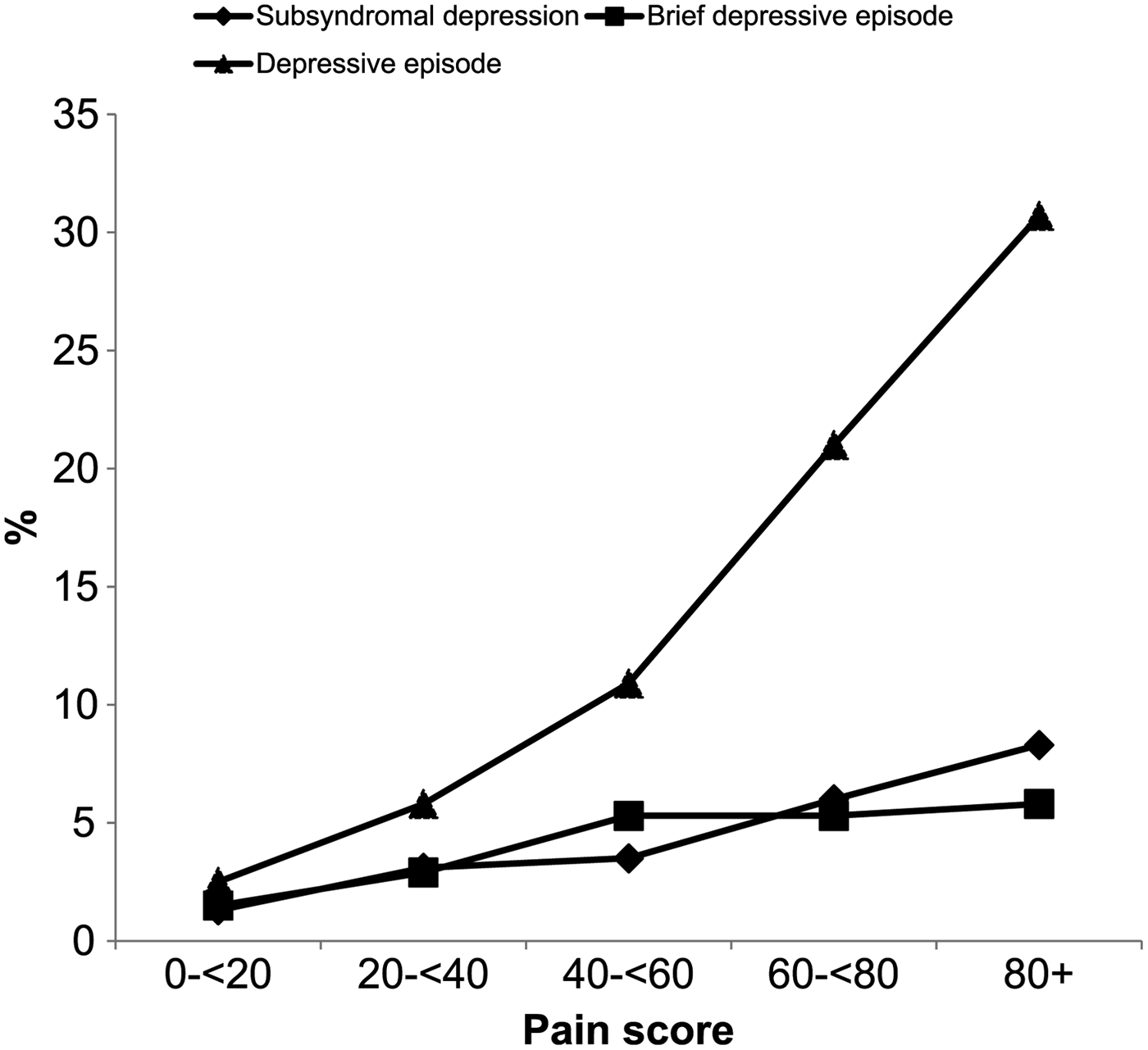
A linear increase in the prevalence of all types of depression was observed with increasing pain scores, with the increment of depressive episode being most pronounced (Fig. 1). The sample characteristics are illustrated in Table 1.
Prevalence of different types of depression by pain score. Estimates are based on weighted sample. The pain score ranges from 0 to 100 with higher scores corresponding to higher levels of pain.

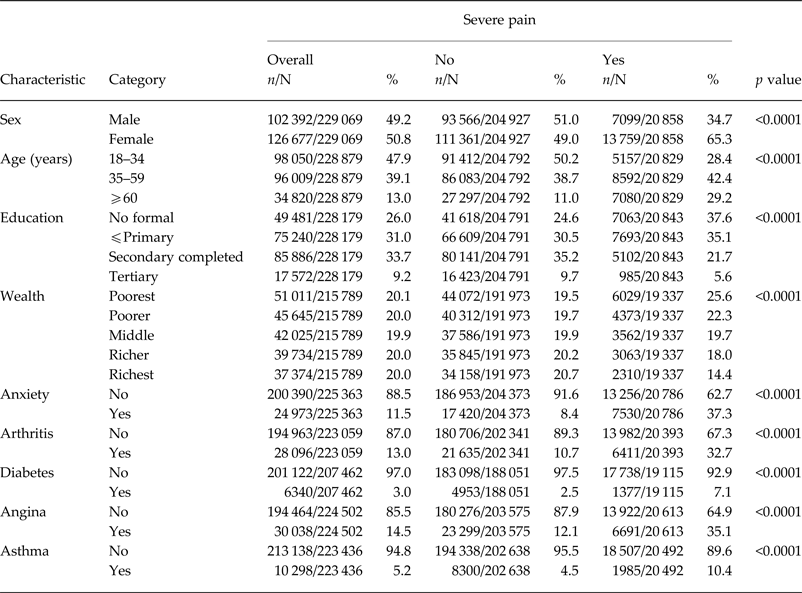
Characteristics of the study sample (overall and by severe pain)

Estimates are unweighted n/N and weighted column percentages
Differences in all sample characteristics between those with and without severe pain were tested by χ2 tests
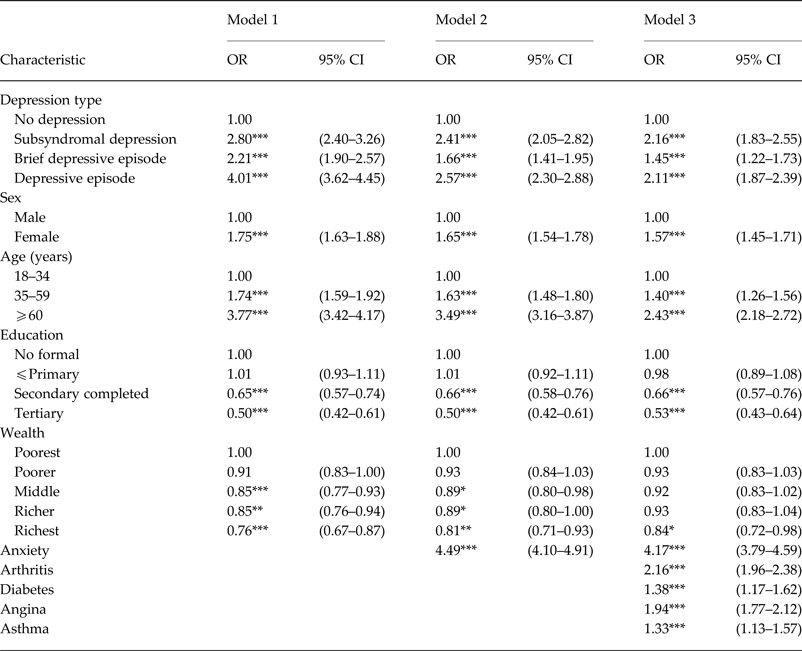
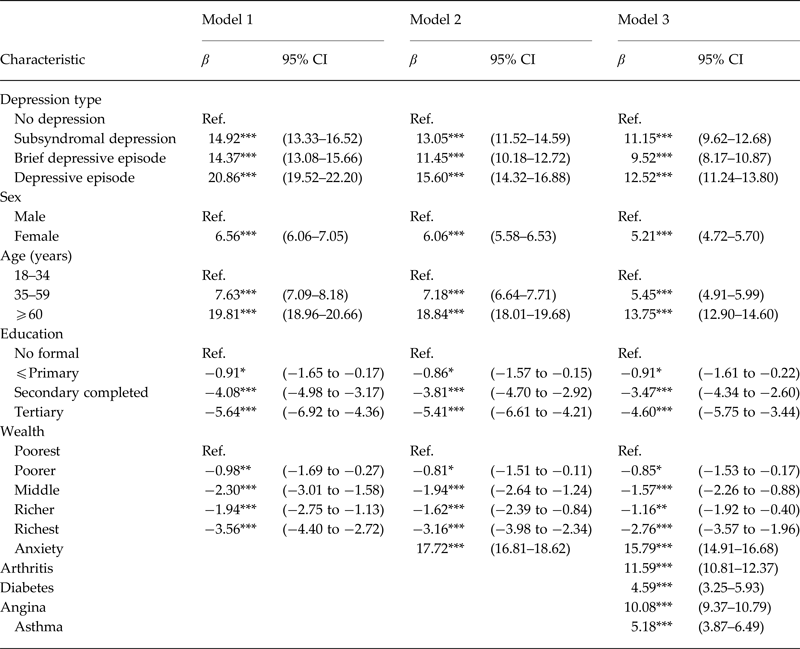
Female sex, older age, lower levels of education and wealth, anxiety, arthritis, diabetes, angina, and asthma were significantly associated with higher prevalence of severe pain. The association between different types of depression and pain are illustrated in Tables 2 and 3. In the logistic regression model, compared with those with no depression, depression was associated with 2.80 (subsyndromal depression) to 4.01 (depressive episode) times higher odds for severe pain after adjustment for socio-demographics (Table 2, Model 1). When anxiety was included in the model, a moderate attenuation in the ORs were observed (Table 2, Model 2), while further adjustment for chronic conditions lead to a further albeit less pronounced attenuation in the ORs with the ORs (95% CIs) for subsyndromal depression, brief depressive episode, and depressive episode being 2.16 (1.83–2.55), 1.45 (1.22–1.73), and 2.11 (1.87–2.39), respectively, in the fully adjusted model (Table 2, Model 3). Similar declines in the coefficients of depression were observed in the linear regression model across Model 1 and 3 (Table 3). Compared with those with no depression, the β-coefficient (95% CI) for subsyndromal depression, brief depressive episode, and depressive episode were 11.15 (9.62–12.68), 9.52 (8.17–10.87), and 12.52 (11.24–13.80), respectively, in the fully adjusted model (Table 3, Model 3). These coefficients can be interpreted as the mean increase in the pain score (range 0–100) for that depression category when compared with those with no depression.
Association between types of depression and severe pain estimated by multivariable logistic regression

OR, odds ratio; CI, confidence interval.
Models are adjusted for all variables in the respective column and country.
*p < 0.05, **p < 0.01, ***p < 0.001.
Association between types of depression and pain score estimated by multivariable linear regression

Ref., reference category; CI, confidence interval.
Models are adjusted for all variables in the respective column and country
The pain score (outcome) ranges from 0 to 100 with higher scores corresponding to higher levels of pain
*p < 0.05, **p < 0.01, ***p < 0.001.
Country-wide meta-analysis of depression and pain association
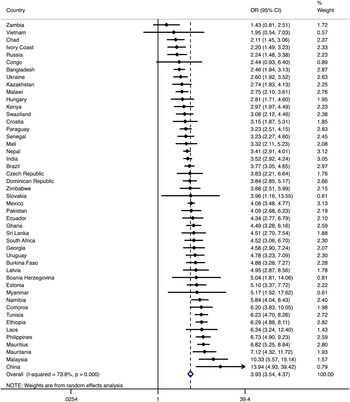
Finally, the results of the country-wise association between any depression and severe pain estimated by logistic regression are illustrated in Fig. 2. The pooled OR across 47 countries adjusted for age and sex demonstrated that depression was associated with a nearly four fourfold increase in odds (OR 3.93; 95% CI 3.54–4.37) of severe pain. Across the 47 countries, 44 demonstrated statistically significant increased odds of depression and pain. Particularly high ORs were observed in China (OR 13.94), Malaysia (OR 10.33), Mauritania (OR 7.12), Mauritius (OR 6.82), Philippines (OR 6.73), and Laos (OR 6.34).
Country-wise association between any depression (independent variable) and severe pain (dependent variable) estimated by logistic regression adjusted for sex and age. Any depression refers to having subsyndromal depression or brief depressive episode or depressive episode.

Discussion
General findings
The current study found that pain and depression are strongly associated across 44/47 LMICs. Our results provide the first evidence on the association between depression subtypes and pain in LMICs. Anxiety and chronic conditions were influential factors in the association between pain and depression but did not fully explain or ameliorate the association. Our country-wide meta-analysis demonstrates that pain is associated with increased odds of depression across most LMICs.
Despite wide variation in socio-economic, demographical and cultural characteristics across the participating countries, and in the magnitude of country-specific associations between depression and pain, several findings were consistent across the large number of countries. Our data suggest that women exhibited a higher overall prevalence of physical pain than men in line with prior research (Mogil, Reference Mogil2012). The precise reasons for this in our data are not clear; however, previous research has that the reason for this is complex and multifactorial and includes psychosocial factors, hormonal factors, and genetic differences (Paller et al. Reference Paller, Campbell, Edwards and Dobs2009; Mogil, Reference Mogil2012). Another cross-national consistent finding that confirms published epidemiological surveys is an increased vulnerability to physical pain with increasing age (Tsang et al. Reference Tsang, Von Korff, Lee, Alonso, Karam, Angermeyer, Borges, Bromet, Demytteneare, de Girolamo, de Graaf, Gureje, Lepine, Haro, Levinson, Oakley Browne, Posada-Villa, Seedat and Watanabe2008). The present study suggests that the same clinical sensitivity to comorbid mental disorders and physical pain, in particular arthritis, diabetes, angina, and asthma may be important in the elderly population. Of interest, higher education status and higher income were associated with less pain. The reason for this relationship might be an increased awareness of health risks that might cause pain and less trauma and accidents in higher educated people, while those with a better socio-economic status have a better health coverage than those who cannot afford it, particularly in LMICs (Asante et al. Reference Asante, Price, Hayen, Jan and Wiseman2016).
There are several hypotheses which might explain why people with depression report higher levels of severe pain. First, and as indicated in the current study, is that the heightened prevalence of somatic comorbidity among people with depression might play a role, which has been reported in previous research (De Hert et al. Reference De Hert, Correll, Bobes, Cetkovich-Bakmas, Cohen, Asai, Detraux, Gautam, Möller and Ndetei2011b ). Pain is a primary symptom of many physical health conditions and the increased pain–depression relationship could be an underlying symptom of poorer physical health. Alternatively, suboptimal treatment for physical health condition due to inequality in access to health care, stigma and discrimination, and less attention by care givers to comorbidities in people with mental illness may be other explanations (De Hert et al. Reference De Hert, Cohen, Bobes, Cetkovich-Bakmas, Leucht, Ndetei, Newcomer, Uwakwe, Asai, Möller, Gautam, Detraux and Correll2011a ). It is established that among people with mental illness, there are health inequalities, and people are less likely to receive physical health care (De Hert et al. Reference De Hert, Cohen, Bobes, Cetkovich-Bakmas, Leucht, Ndetei, Newcomer, Uwakwe, Asai, Möller, Gautam, Detraux and Correll2011a ). Thus, the heightened relationship we observed may be related to underaddressed physical comorbidity. Clearly, this is an issue in LMICs where resources are sparser than in established Western society. Third, inflammatory processes have been implicated in the pathogenesis of pain in depression (Bai et al. Reference Bai, Chiou, Su, Li and Chen2014). Recent evidence has demonstrated that depression is also associated with considerable inflammation (Strawbridge et al. Reference Strawbridge, Arnone, Danese, Papadopoulos, Herane Vives and Cleare2015). Moreover, there is an increasing evidence base to suggest that anti-inflammatory treatments such as statins offer favourable improvements in depressive symptomology in people with depression (Salagre et al. Reference Salagre, Fernandes, Dodd, Brownstein and Berk2016). Such findings seem to support the notion that depression and pain may also be linked through inflammatory pathways. Related to the inflammatory hypothesis, sedentary behaviour is also associated with inflammation (Hamer et al. Reference Hamer, Sabia, Batty, Shipley, Tabák, Singh-Manoux and Kivimaki2012a , Reference Hamer, Venuraju, Urbanova, Lahiri and Steptoe b ), and both pain (Stubbs et al. Reference Stubbs, Patchay, Soundy and Schofield2014) and depression are associated with sedentary behaviour (Vancampfort et al. Reference Vancampfort, Stubbs, Sienaert, Wyckaert, De Hert, Rosenbaum and Probst2015). Given that physical activity can improve inflammatory markers (Hamer et al. Reference Hamer, Stamatakis and Steptoe2014), interventions increasing activity levels may improve pain symptoms (Uthman et al. Reference Uthman, van der Windt, Jordan, Dziedzic, Healey, Peat and Foster2013) and depression (Schuch et al. Reference Schuch, Deslandes, Stubbs, Gosmann, Silva and Fleck2016a , Reference Schuch, Vancampfort, Richards, Rosenbaum, Ward and Stubbs b ) and at a population level may be a particularly viable option in LMICs. Another potential explanation is that areas of the brain linked to mood dysregulation (e.g. amygdala, insular) also project to structures involved in pain modulation (e.g. periaqueductal gray). Therefore, the neurobiological changes among people with depression could increase the risk of pain. However, clearly, future research is required to explore all of the aforementioned hypotheses.
Clinical implications
Our data demonstrate that physical pain is an important problem across the depression spectrum in LMICs. Strategies to better understand this relationship and manage it are needed. For example, pain assessment, prevention, and management should be integrated in the clinical practice guidelines for people across the depression spectrum. Existing health care models may benefit from adapting to actively monitor and intervene with the depression and pain comorbidity. Health care systems in LMICs including policy makers may benefit from embracing and managing the physical health needs of people with depression in health care services. However, a number of considerations exist. An important environmental barrier in the care of people with depression in LMICs is the lack of integrated mental and medical services and the poorly developed community-based psychiatric services (Mugisha et al. Reference Mugisha, Ssebunnya and Kigozi2016). In addition, LMICs have limited access to most expensive novel antidepressants, as the norepinephrine–serotonin reuptake inhibitor drugs, for example, a scenario which further increases the burden associated with depression–pain interface (Pan et al. Reference Pan, Pan, Chan and Kuo2015). This is compelling considering that a considerable number of individuals living in LMICs may ‘manifest’ depression complaining for (medically unexplained) somatic pain (Fornaro et al. Reference Fornaro, Maremmani, Canonico, Carbonatto, Mencacci, Muscettola, Pani, Torta, Vampini, Parazzini, Dumitriu and Perugi2011) rather than verbal communication of their own emotions due to stigma issues (Fornaro et al. Reference Fornaro, Clementi and Fornaro2009). Also, pain is a risk factor for self-medication and abuse of analgesic medication, with particular concerns regarding opioid medication dependence (Webster et al. Reference Webster, Brennan, Kwong, Levandowski and Gudin2016).
We suggest that pain assessment, prevention, and management has an important role in health services, particularly when one considers the heightened risk of suicidal behaviours in those with painful comorbidities (Stubbs, Reference Stubbs2016). However, it should be acknowledged that many mental health providers do not ask about physical pain in their patients because of lack of consideration of this health care aspect, lack of time, or lack of resources directly available to them (De Hert et al. Reference De Hert, Cohen, Bobes, Cetkovich-Bakmas, Leucht, Ndetei, Newcomer, Uwakwe, Asai, Möller, Gautam, Detraux and Correll2011a ). Therefore, first of all, there is a clear need to increase awareness of the importance of physical health needs of patients with depression among mental health providers in LMICs. Continued medical education [which is a common practice in LMICs (Mugisha et al. Reference Mugisha, Ssebunnya and Kigozi2016)] should be used to inform health providers on the importance of assessing physical pain in people with subsyndromal depression, brief depressive episode, and depressive episode. Health providers in LMICs need to be informed that their roles extend beyond taking care of the mental or physical health of their patients and assume responsibility for both the mental and physical health of their patients. There is also the need for mental health training institutions that train medical personnel to include physical pain assessment as part of their curriculum and training programs. However, effective pain screening/monitoring is not sufficient on its own, as appropriate treatment is also mandatory. Patients should be provided self-care management strategies including advise on a healthy and active lifestyle and prioritizing the prevention of chronic pain and avoiding fragmented care (De Hert et al. Reference De Hert, Cohen, Bobes, Cetkovich-Bakmas, Leucht, Ndetei, Newcomer, Uwakwe, Asai, Möller, Gautam, Detraux and Correll2011a ). Concomitant pain and mental health disorders often complicate pharmacological management, but several drug classes, including serotonin–norepinephrine reuptake inhibitors, tricyclic antidepressants, and anticonvulsants, have efficacy for both conditions and should be considered first-line treatment agents (Hooten, Reference Hooten2016).
Limitations
Current findings should be interpreted in the light of some limitations. The first limitation pertains to the assessment of pain. Although the pain assessment was based on one or two dimensions of pain, specific details regarding the duration (e.g. acute or chronic), type, and site of pain were not characterized. Thus, for example, our pain measure is likely to include pain of both acute and chronic nature. Since the WHS was conducted in many different cultural settings and was primarily aimed to assess general health issues, it was not feasible to include a more comprehensive pain assessment. Future studies with data on the site, nature, and severity of pain may provide further understanding of the pain–depression relationship. Previous research also demonstrated that self-report measures may be more amenable to underrepresentation compared with behavioural pain measures among people with mental health diagnoses (Stubbs et al. Reference Stubbs, Thompson, Acaster, Vancampfort, Gaughran and Correll2015; Stubbs et al. Reference Stubbs, Thompson, Solmi, Vancampfort, Sergi, Luchini and Veronese2016). Second, pain was only captured over the past 30 days, while depression was based on past 12-month symptomatology. Therefore, it is possible that our results may not accurately capture the pain–depression comorbidity and it could be an under- or over-representation of this relationship. Clearly, future research should therefore consider pain and depression, which occur during a concurrent period. Third, the diagnosis of subsyndromal depression, brief depressive episode, and depressive episode was not assessed by a clinical interview. Fourth, risk for type I error may exist due to the multiple comparisons conducted. However, the association between depression subtypes and pain were highly significant (p < 0.001), and thus, this is unlikely to have influenced our main findings. Fifth, anxiety was assessed with a single question, and the specificity and sensitivity of this question against the gold standard diagnosis of anxiety disorders is not established. Therefore, future studies should include a more complete anxiety assessment and ideally use a clinical diagnosis. Moreover, information on physical conditions was limited in the WHS. Thus, we were unable to adjust for physical conditions such as cancer, which may confound the pain–depression relationship. Next, there were six countries for which data were not nationally representative. However, there were no appreciable differences in the results even after the omission of these countries from the analysis. Finally, the data are cross-sectional. Therefore, the directionality of the relationships cannot be deduced from our data. Nonetheless, the strengths of the study include the large sample size and the multinational scope, including most regions of the world, but in particular LMICs in Africa, Latin America, Asia, and Eastern Europe.
In conclusion, our data demonstrate that depression (particularly a full depressive episode) is associated with increased pain. The results were consistent across almost all of the 47 LMICs even after adjusting for multiple confounders. Clearly, efforts are needed to tackle pain and depression comorbidity in LMICs. Future research is also needed to attempt to elucidate the underlying mechanisms explaining this association, which might also offer a window of opportunity for viable treatment options in this region with sparse resources.
Acknowledgments
BS receives funding from the National Institute for Health Research Collaboration for Leadership in Applied Health Research and Care Funding scheme. The views expressed in this publication are those of the author(s) and not necessarily those of the NHS, the National Institute for Health Research or the Department of Health. AK's work was supported by the Miguel Servet contract financed by the CP13/00150 and PI15/00862 projects, integrated into the National R + D + I and funded by the ISCIII – General Branch Evaluation and Promotion of Health Research – and the European Regional Development Fund (ERDF-FEDER). This paper received no specific grant of direct funding.
Declaration of Interest
PS, JM, BS, AK, DV, MF, MS, NV, TT, and AFC have no conflict of interest to declare.