INTRODUCTION
Overexploitation of wildlife is one of the principal causes of biodiversity loss (Stuart et al. Reference Stuart, Chanson, Cox, Young, Rodrigues, Fischman and Waller2004; Bradshaw et al. Reference Bradshaw, Sodhi and Brook2009), and targeted exploitation for international trade represents a significant threat (Blundell & Mascia Reference Blundell and Mascia2005). Globally hundreds of millions of plant and animal specimens are traded as traditional medicines, bushmeat, ornamental plants, timber, and luxury items such as caviar and furs. The legal trade is worth billions of dollars per year (CITES [Convention on International Trade in Endangered Species of Wild Fauna and Flora] 2011) but in addition, there is a very substantial illegal trade (Cook et al. Reference Cook, Roberts and Lowther2002). Criminal sentencing has multiple purposes, including the punishment and reform of criminals, protection of the public, and the reduction of crime through incarceration and by generating deterrence (Keane et al. Reference Keane, Jones, Edwards-Jones and Milner-Gulland2008; Roberts et al. Reference Roberts, Hough, Jacobson and Moon2009). There has been concern that sanctions for wildlife trade crimes do not reflect how serious such crimes are in terms of the potential illegal profit (House of Commons 2004; Chaber et al. Reference Chaber, Allebone-Webb, Lignereux, Cunningham and Marcus Rowcliffe2010; Johnson Reference Johnson2010), the threat status of the species involved, or the level of loss to society (Eagle & Betters Reference Eagle and Betters1998). However, whilst setting penalties as high as possible may be theoretically optimum in some circumstances (Becker Reference Becker1968), sanctions can be counterproductive if they are considered unfair (van Vugt Reference van Vugt2009). As such, in addition to reflecting how serious a crime is, sanctions should be socially acceptable, for this reason public and professional opinions of crimes are often consulted (Roberts et al. Reference Roberts, Hough, Jacobson and Moon2009; Sentencing Council 2011). Understanding rule breaking is important for developing interventions to improve compliance (St John et al. Reference St John, Edwards-Jones, Gibbons and Jones2010), however wildlife crime in general is under researched (Wilson-Wilde Reference Wilson-Wilde2010) and little is known about how members of judiciaries involved in sanctioning wildlife trade crimes, conservationists, or the general public, view offences.
CITES is an international agreement between governments which aims to ensure that the international trade in wild plants and animals does not threaten their survival. Once a country has ratified the Convention, legislation is required to implement it; for example, in the UK, CITES is implemented through both European and domestic legislation. Despite the long history of CITES, the fact that it has been signed by 175 countries, and that numerous domestic and regional laws have been developed to enact it, illegal wildlife trade continues. For example a recent study estimated that five tonnes of bushmeat, 39% of which were CITES-listed species, were smuggled in personal luggage per week through Charles de Gaulle airport in Paris, France (Chaber et al. Reference Chaber, Allebone-Webb, Lignereux, Cunningham and Marcus Rowcliffe2010). Further, some of the largest exporters and importers of wildlife products, such as Brazil and the USA, are not fully compliant with CITES requirements (Phelps et al. Reference Phelps, Webb, Bickford, Nijman and Sodhi2010). Eagle and Betters (Reference Eagle and Betters1998) raised concern that fines awarded for infractions of CITES in the USA do not vary appropriately with respect to species’ threat status; similarly, sanctions in Europe and Australia tend not to reflect the conservation impact of, or the profits gained by wildlife trade criminals (House of Commons 2004; Chaber et al. Reference Chaber, Allebone-Webb, Lignereux, Cunningham and Marcus Rowcliffe2010; Johnson Reference Johnson2010). By applying sanctions that inadequately take account of the ecological impacts of wildlife crimes and the potential profits to be made from such crimes, judiciaries are failing to reimburse society for losses and to deter future crimes (Eagle & Betters Reference Eagle and Betters1998).
Within England and Wales, magistrates’ courts deal with 97% of all criminal cases (Raine & Dunstan Reference Raine and Dunstan2009). An important guiding principal of sentencing is that the sanction should fit the crime. Magistrates initially consider how serious the crime was; this can be straightforward if the crime can be assessed in purely economic terms (for example by the amount of illegal profit made). However for crimes where this is not possible, assessing crime seriousness can be difficult, involving a measure of culpability and harm, both of which can be subjective (Raine & Dunstan Reference Raine and Dunstan2009). Magistrates then consider any mitigating or aggravating factors, such as previous crimes by the defendant and the defendant's plea. Further, in order to equalize the impact of sanctions on criminals with different circumstances, magistrates are required to take into account the financial circumstances of the criminal (Sentencing Guidelines Council 2008). In summary, magistrates consider two key factors when deciding upon a sentence: (1) crime seriousness, which may include the amount of illegal profit made and harm done; and (2) any mitigating or aggravating factors, such as the criminal's plea and previous convictions. To reduce disparity in sentencing, guidance is available for different types of crimes (Sentencing Guidelines Council 2008). However, the Magistrates’ Court Sentencing Guidelines do not include guidance on sentencing wildlife trade crimes. The Magistrates’ Association has produced a guide focused on environmental crimes to help magistrates in the sentencing of such offences (Magistrates’ Association 2009). However, with few wildlife trade crimes reaching court, magistrates have limited experience in processing such crimes and are unlikely to be familiar with the example prosecutions presented (Magistrate, personal communication 2011). Further, defining seriousness is particularly challenging, as wildlife trade crimes can be thought of as victimless or costless rather than as thefts of public resources motivated by profit (Wilson-Wilde Reference Wilson-Wilde2010); cases presented to magistrates often fail to provide adequate information about the threat status of species involved (harm caused) or the potential profits to be made (House of Commons 2004).
In this study, we use conjoint analysis, a method used in marketing to investigate the attributes of a product valued by a consumer (Green & Rao Reference Green and Rao1971), to investigate which attributes of wildlife trade offences UK-based conservation professionals, magistrates and the general public consider most important when sentencing wildlife trade criminals. The principal underlying conjoint analysis is that purchasers evaluate the overall desirability of a product using the value of the products’ separate parts or attributes. For example, a purchaser's preference for a house may depend upon the conjoined influences of attributes such as distance from work, number of rooms or size of garden. By systematically varying these attributes and observing the choices made by purchasers, the value of the separate attributes can be statistically deduced (Orme Reference Orme2006). Conjoint analysis has been used in many non-marketing contexts, including: animal disease (Cross et al. Reference Cross, Williams and Edwards-Jones2009); health care (Ryan & Farrar Reference Ryan and Farrar2000); environmental planning (Álvarez-Farizo & Hanley Reference Álvarez-Farizo and Hanley2002); willingness to pay for conservation (Hanley et al. Reference Hanley, MacMillan, Patterson and Wright2003); and criminal sentencing (Brocke et al. Reference Brocke, Göldenitz, Holling and Bilsky2004). We developed hypothetical wildlife trade crime profiles that varied in respect of attributes presumed to influence the severity of wildlife trade crimes in terms of both offence seriousness (taxon, trade protection owing to threat status as given by European Union [EU] Annexes and illegal profit) and mitigating or aggravating circumstances (previous convictions and plea).
METHODS
Survey instrument
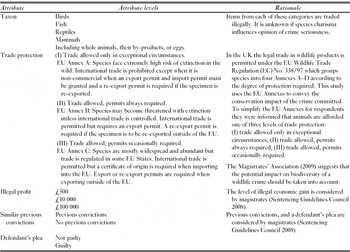
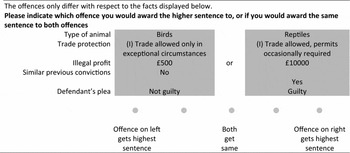
The survey was made up of three parts: a brief information section which included photos of wildlife known to be traded including whole animals, by-products and eggs; 15 conjoint tasks; and a demographic section (the complete survey is available from Freya St John on request). Attributes of wildlife trade crimes investigated were: taxon, trade protection, illegal profit, previous convictions and a defendant's plea (Table 1). Full-profile conjoint analysis tasks, designed using Sawtooth Software SSI Web 7 (Sawtooth Software Inc. 2010), were presented to respondents. For each conjoint task they were required to indicate on a five-point scale which of the two offences they would award the higher sentence to, or if they would award the same sentence to both offences (Fig. 1).
Attributes and levels included in the conjoint analysis tasks.

An example of a conjoint analysis task. Respondents are required to indicate which of the two offences they would award the higher sentence to, or if they would award equal sentences to both.

The five attributes and 14 attribute levels were combined to construct a 4 × 3 × 3 × 2 × 2 factoral design measuring main-effects, based on the attributes and attribute levels (Table 1). Conjoint task design allowed for attributes and levels to be independent of each other to ensure efficient estimation of utilities. However, because the number of conjoint tasks presented to respondents was limited to avoid respondent fatigue, the design was not entirely orthogonal (i.e. the design did not achieve zero correlation between attributes). Whilst the software produces high quality designs, it is unlikely to be orthogonal or completely balanced if design constraints are applied, such as asking fewer than the optimal number of conjoint tasks. This study has ten parameters to be estimated (calculated as: total number of levels – number of attributes + 1). It is recommended that respondents complete three times the number of conjoint tasks as there are parameters in the study; or a minimum of 1.5 × the number of parameters in the study (Sawtooth Software Inc. 2010). According to these guidelines, the optimal range of conjoint tasks in this study was between 15 and 30. Since 30 conjoint tasks are too many for respondents to continue to provide high quality responses, the minimum of 15 was assessed. Reducing the number of conjoint tasks had minimal impact on the design efficiency, decreasing it to 0.97 (where 1.0 indicates an orthogonal design) (Sawtooth Software Inc. 1997). To reduce psychological effects such as question order and context bias (Schwarz & Sudman Reference Schwarz and Sudman1992), three versions of the survey were generated; each version presented a unique set of conjoint tasks. These were distributed randomly to respondents in approximately equal quantities.
Data collection
The survey was piloted on colleagues and improved before a formal pilot with 31 members of the general public. No further changes were required, so the pilot data (n = 31) were included in the final analysis of data from the general public. Identical online surveys were created for completion by conservation professionals and magistrates.
Conservation professionals
A sampling frame was developed from the online list of organizations involved in the UK Biodiversity Action Plan (JNCC [Joint Nature Conservation Committee] 2010). Hobby groups, companies whose primary function was not conservation or natural resource management, and socioeconomic enterprise projects were excluded from the sampling frame, leaving 321 organizations. Between 21 and 26 October 2010, 195 organizations received a survey invite by e-mail (from Freya St John), which included an http link to start the online survey. Survey invites were staggered over a number of days to avoid the survey running slowly in the event that many people attempted to access it at any one time. All invitees were informed that they might forward the survey link to colleagues and friends working for conservation organizations. Where personal contacts of the authors existed within an organization included in the sampling frame, they were contacted individually. The maximum sample size (limited by the academic license for Sawtooth) of 250 was reached prior to all 321 organizations on the sampling frame being contacted. The online survey closed on 17 November 2010.
Magistrates (Justices of the Peace)
Four Clerks to the Justices in Wales agreed to send out the survey invitation. Between October and November 2010, magistrates presiding in Welsh courts received an email survey invitation (composed by Freya St John) from the personal assistant of their Clerk to the Justices. The survey invite included an http link which started the survey. The online survey closed on 17 January 2011, by which time 182 magistrates (9.8% of magistrates presiding in Welsh courts; trained identically to those in England) had completed the survey.
General public
Following the approach taken by Nilsen et al. (Reference Nilsen, Milner-Gulland, Schofield, Mysterud, Stenseth and Coulson2007) for sampling the general public, we approached potential respondents (aged 18 to 65 years) in public places such as cafés and trains in rural and urban locations in England and Wales. We varied survey location, and specifically targeted under-sampled groups to achieve a sample close to the UK population in terms of gender, age and income (based on the 2001 National Census; Office for National Statistics 2008). Between September 2010 and April 2011, 250 people completed the survey. As we did not apply strict probability sampling (Newing Reference Newing2011), the sample is unlikely to perfectly represent the UK general population and so results should be interpreted with a degree of caution in this respect.
Data analysis
The relative preference for attributes and attribute levels presented in the hypothetical wildlife trade crime scenarios were calculated for each of the three groups using hierarchical Bayes estimation in SSI Web 7 (Sawtooth Software Inc. 2010). This analysis estimates a hierarchical random coefficients model using a Monte Carlo Markov Chain algorithm. At the upper level, this hierarchical model considers respondents as members of a population of similar individuals whose part-worth estimations are assumed to have multivariate normal distribution described by a vector of means and a matrix of variances and covariances. At the lower level, each respondent's part-worth estimations are assumed to be related to their overall ratings of the crime profiles presented in the conjoint survey, by a linear regression model. Because each respondent is assumed to come from a population of similar individuals, when estimating parameters, information can be ‘borrowed’ from respondents. Such an approach enhances parameter estimation compared to ordinary regression analysis; full details of the model are available in Sawtooth Software Inc. (2002). Data were further analysed using PAWS Statistics 18 (SPSS Inc., Chicago, USA). The mean preferences for attributes were compared on a common scale by calculating the ranges (highest to lowest) of the hierarchical Bayes estimations for all levels within an attribute, and dividing them by the sum of all the utility ranges (Home et al. Reference Home, Keller, Nagel, Bauer and Hunziker2009). Utility estimates were non-normal, so were analysed using non-parametric tests for differences between groups.
RESULTS
Three surveys completed by members of the public were excluded from analysis because too few conjoint tasks had been completed. Following hierarchical Bayes analysis, 84 respondents across the three groups were excluded from further analysis due to low internal consistency of responses across conjoint tasks (correlation coefficient < 0.5) (Brocke et al. Reference Brocke, Göldenitz, Holling and Bilsky2004). The final sample represents data from 226 conservation professionals, 176 magistrates and 193 members of the public. The gender ratio of those sampled was approximately equal for each group, with 50.9%, 51.3% and 47.2% female for conservation professionals, magistrates and the public, respectively. The median age of conservation professionals was 37 (inter-quartile range 17, n = 225), 61 for magistrates (inter-quartile range 11, n = 173), and 34 for the general public (inter-quartile range 22, n = 167). In terms of educational background, 89.8% (n = 203) of conservation professionals, 74.4% (n = 131) of magistrates and 63.7% (n = 123) of the general public were educated to degree level or higher. Compared to national statistics (Office for National Statistics 2008), our sample of the public are unrepresentative of the underlying population in terms of education level, as too many people educated to degree level or higher were sampled; we also oversampled people aged 20–24 and undersampled those aged 45–59 years (age categories derived from Office for National Statistics 2008). Compared to the magistrate population of England and Wales (Judiciary of England and Wales 2011), the only group where the sample data were unrepresentative of the underlying population was for magistrates aged 40–49 years, where too few were sampled.
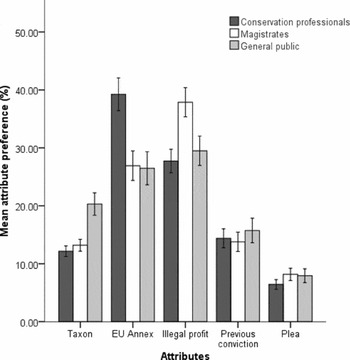
The mean preferences (utility value) for wildlife trade crime attributes of the three groups (conservation professional, magistrates and the general public) were derived using hierarchical Bayes estimation and shown on a common scale (Fig. 2). Magistrates and the general public placed most importance on the amount of illegal profit made by criminals, whereas conservation professionals placed most importance on the EU Annex of the species involved. Therefore it appears that magistrates and the public initially considered how much profit the criminal made before considering other crime attributes, whereas conservation professionals thought first and foremost about the threat status of the species involved. There was a statistical significant difference between the three groups (n = 595) in the importance they placed on the taxon involved (Kruskal-Wallis test H = 69.1, p < 0.001), its EU Annex (p < 0.001), the illegal profit made (p < 0.001) and defendant's plea (p = 0.05). However there was no statistically significant difference between groups with respect to the importance they placed on defendants’ previous convictions (p = 0.75).
The relative importance of attributes (expressed as a percentage) of hypothetical wildlife trade offences as viewed by conservation professionals, magistrates, and the general public. Error bars show 95% confidence intervals. Conservation professionals placed most importance on the EU Annex of specimens found in illegal consignments, whereas magistrates and the general public both placed most importance on the value of the illegal profit made by criminals.

Following illegal profit, magistrates and the general public both considered that the EU Annex of the species involved was the second most important attribute determining the seriousness of a crime. The general public then considered taxon to be the third most important attribute, placing significantly greater importance on whether the species illegally traded was a mammal, bird, reptile or fish, than conservation professionals and magistrates. All groups considered the defendant's plea to be the least important attribute, however, both magistrates and the public, who did not differ significantly with respect to this attribute (Mann-Whitney U test 16 317.0, p = 0.515, n = 369), placed significantly greater importance on this attribute as compared to conservation professionals.
Results indicate that there are more discrepancies between the opinions of conservation professionals and either magistrates (differing significantly on EU Annex [Mann-Whitney U test p < 0.001], illegal profit [p < 0.001] and plea [p = 0.002]), or the public (differing significantly on taxon [p < 0.001], EU Annex [p < 0.001] and plea [p = 0.016]), than there are between magistrates and the public, who held significantly different opinions on just two attributes, namely taxon (p < 0.001) and illegal profit (p < 0.001).
The percentage of respondents aged above and below 45 years differed significantly by group (χ2 = 188.33, p = < 0.001, n = 593). Most magistrates (90.9%, n = 160) were ≥ 45 years old, whilst just 32.0% (n = 72) of conservation professionals and 26.6% (n = 51) of the public were ≥ 45 years old. To understand if differences in reported preferences for attributes between groups (Fig. 2) were the result of differences in age, data gathered from each group were analysed to see if there were significant differences in attribute preference for respondents within groups aged above and below 45 years. There were no significant differences for conservation professionals (Mann-Whitney U tests: taxon p = 0.266; EU Annex p = 0.096; illegal profit p = 0.426; previous convictions p = 0.993; plea p = 0.624); magistrates (taxon p = 0.688; EU Annex p = 0.789; illegal profit p = 0.253; previous convictions p = 0.186; plea p = 0.121); or the public: (taxon p = 0.889; EU Annex p = 0.469; illegal profit p = 0.374; previous convictions p = 0.943; plea p = 0.627).
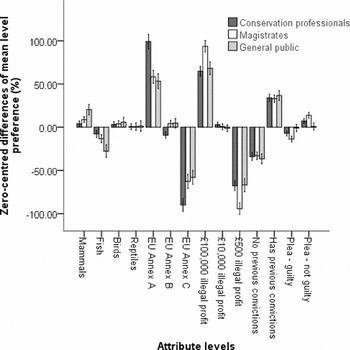
We analysed the degree of preference for each of the levels within each attribute (for example, within the attribute taxon, there are four levels: mammals, birds, fish and reptiles) (Fig. 3). Within their most preferred attribute of illegal profit, magistrates and the general public placed most importance on criminals making an illegal profit of £ 100 000 (£ 1 = c. US$ 1.59 in January 2011); the more illegal profit the criminal stood to gain, the more serious these groups considered the crime to be. Conservation professionals placed the most importance on the attribute EU Annex, and within this attribute they placed most importance on illegal consignments containing Annex A species; the higher the threat status of the species involved, the more serious conservation professional considered the crime to be. There were statistically significant differences between the three groups and the degree of preference they placed on different levels; for example, with respect to taxon, the public indicated a greater preference for mammals, and non-preference for fish, compared to conservation professionals and magistrates (Fig. 3), namely they would punish a criminal illegally trading mammals more harshly than a criminal illegally trading fish, birds or reptiles.
Relative preferences for levels within an attribute. Data are zero-centred such that the mean preference of all attributes within each level sum to zero. Error bars show 95% confidence intervals. Considering the levels within the attribute EU Annex, all groups placed most importance on consignments containing EU Annex A species, and least on those containing EU Annex C species. Considering the levels within the attribute illegal profit, all groups placed most importance on the highest level of illegal profit, and least on the lowest level of illegal profit.

DISCUSSION
This study is unique in presenting data from magistrates, access to whom is heavily restricted, as well as conservation professionals and the general public, thus giving a range of perspectives on the sentencing of wildlife trade crimes. Our results show that magistrates placed most importance upon economic gains resulting from wildlife trade crimes. This is consistent with the manner in which they assess other more commonly processed offences for which sentencing guidelines exist, such as the evasion of alcohol or tobacco duty. In assessing the seriousness of such an offence, magistrates consider the level of duty evaded and the amount of personal profit made by the criminal, in addition to aggravating (for example repeated criminal offences, criminal played organizational role) and mitigating (for example timely guilty plea, criminal assisted police with inquiry) factors before deciding upon a sentence which must be within the range given in the guidelines (Sentencing Guidelines Council 2008). Similarly, given that conservation professionals are familiar with the potential threat that illegal wildlife trade poses to the continued existence of some species in the wild (Shivji et al. Reference Shivji, Chapman, Pikitch and Raymond2005; Shepherd & Nijman Reference Shepherd and Nijman2008), it is perhaps unsurprising that they considered the potential ecological impact of the offence to be the most serious aspect of the crime. It has been suggested that the public do not hold a coherent opinion regarding sentencing and that they are ‘punitive sentencers’ who focus only on the details of the harm done, ignoring characteristics of the criminal which may be mitigating (Durham Reference Durham1993). However, more recent research suggests that, in determining which factors make a crime serious, there is a close fit between judicial practice and public opinion (Roberts et al. Reference Roberts, Hough, Jacobson and Moon2009). Our study reports similar findings, with few discrepancies between opinions of the public and magistrates in considering the relative importance of attributes affecting offence seriousness with respect to wildlife trade crimes. Indeed, our results suggest that the public are less punitive than conservation professionals, who showed greater insensitivity to mitigating characteristics of criminals.
Whilst magistrates place more importance on the illegal economic gain than on the conservation impact of the crime, economic value and rarity are related (Angulo et al. Reference Angulo, Deves, Jalmes and Courchamp2009). As such, by considering economic gain to be the key factor determining crime seriousness, by default magistrates may be punishing offences proportionally in accordance with the threat status of the species involved. However, because magistrates must judge criminals’ ability to pay a fine and consider reducing sanctions in response to offender mitigation (such as a timely guilty plea), fines are frequently lowered. Sanctions may thus become too low to act as an effective deterrent to repeat and future criminals, particularly those who stand to make considerable profit from illegally traded wildlife products such as white rhino horn, which may attract a price upwards of £ 30 000 kg−1 in China (UK Boarder Agency 2010).
Efforts to curb illegal wildlife trade need a clear understanding of how society, experts and those directly involved in punishing illegal wildlife trade view the seriousness of such crimes. This study presents findings from a single high-income country. Although only a single case study, it raises some important points with broader relevance. In common with the few other studies to directly investigate the attitudes of conservationists and the general public towards wildlife policy (Hanley et al. Reference Hanley, MacMillan, Patterson and Wright2003; Koval & Mertig Reference Koval and Mertig2004), this study has identified differences in opinions between conservationists and non-conservationists. Whilst conservationists perceive the degree of ecological damage to be the most punishable attribute of a crime, the public and magistrates do not see the world this way, instead perceiving the size of economic gain to be the most punishable attribute of a crime. Such information can be used to improve the way in which conservationists communicate with others who do not share the same world view.
CONCLUSIONS
We have shown how conjoint analysis, most frequently used to identify which attributes of a product are most desirable to consumers, can be a useful tool for identifying differences between groups of people and their perspectives on policy issues, such as factors affecting the seriousness of a crime. Reducing wildlife trade crime may be critical to the persistence of many species. Our results suggest that magistrates, when presented with appropriate information on the conservation impact of wildlife trade offences, do consider the threat status and corresponding legal protection afforded to wildlife when considering offence seriousness, and that doing so is in line with public opinion. This study highlights the importance of ensuring that judiciaries are presented with information of the potential profit and conservation impact of wildlife trade crimes. We urge sentencing councils to develop appropriate guidelines to support judiciaries in their sentencing of wildlife crimes.
ACKNOWLEDGEMENTS
Professor Gareth Edwards-Jones, our co-author on this work, died before this paper was published. He is greatly missed. We thank the Clerks to the Justices and their personal assistants who contacted magistrates on our behalf, and all the café owners who allowed us access to their customers. Thank you to every respondent who completed this survey. We also thank Stephanie Pendry of TRAFFIC International, Cambridge, and Paul Cross and James Gibbons of the School of Environment, Natural Resources and Geography, Bangor University, for their assistance with this research. This work was funded by the School of Environment, Natural Resources and Geography, Bangor University.