Introduction
There have been many studies of naturally occurring hybrid plant populations. These have concentrated mostly on the mechanisms involved in the hybridization process and the role of hybridization in evolution (Arnold, Reference Arnold1997). Studies have looked at the barriers to gene flow (Grant, Reference Grant1949; Bouck et al., Reference Bouck, Peeler, Arnold and Wessler2005) or the composition of the resultant vegetation as a result of gene flow, e.g. the production of hybrid swarms (Arnold, Reference Arnold1994). Others have described potential rare plant extinction due to demographic swamping and genetic assimilation by a common congener (Levin et al., Reference Levin, Francisco-Ortega and Jansen1996), or predicted species displacement (Wolf et al., Reference Wolf, Takebayashi and Rieseberg2001).
Seed-bank studies in natural or semi-natural vegetation types are usually related to their use in habitat re-creation and restoration (Mitchell et al., Reference Mitchell, Marrs and Auld1998; Pywell et al., Reference Pywell, Pakeman, Allchin, Bourn, Warman and Walker2002; Bossuyt and Hermy, Reference Bossuyt and Hermy2003; Allison and Ausden, Reference Allison and Ausden2006), or for the conservation of rare species (Fischer and Matthies, Reference Fischer and Matthies1998). The relative fitness of seeds and seedling genotypes of known provenance from a hybrid zone has been investigated experimentally by Johnston et al. (Reference Johnston, Arnold and Donovan2003). However, there are no studies that examine the effects of hybridization on the species composition of naturally occurring soil seed banks. This study examines the small-scale variation in the seed-bank structure of a dwarf shrub, heathland vegetation type that is characterized by the abundance of two closely related Erica species and their hybrids.
Erica tetralix and Erica ciliaris, the parent species, have overlapping geographical distributions. E. ciliaris is a rare plant in the British Isles (Wigginton, Reference Wigginton1999), where it is at the northern limit of its European range in south-west England (Rose et al., Reference Rose, Bannister and Chapman1996). The hybrid Erica × watsonii is a naturally occurring cross between Erica ciliaris and Erica tetralix. The breeding system of E. ciliaris and E. tetralix creates an F1 generation of hybrids with low pollen viability and high seed sterility (Gay, Reference Gay1957). The hybrid is found in all areas and habitats where the two parent species coexist in continental Europe (Neyraut, Reference Neyraut1900) and Britain (Perring and Sell, Reference Perring and Sell1968; Stace, Reference Stace1975). In south-west England, both species and the hybrid co-occur on a series of acidic soils that range from dry, free-draining mineral soil to waterlogged, organic peat soil. These soils support heath and mire vegetation, which corresponds to the H3 (Ulex minor–Agrostis curtisii heath), M16 (Ericetum tetralicis wet heath) and M21 (Narthecio–Sphagnetum valley mire) plant communities of Rodwell (Reference Rodwell1991). The plants of both species are most abundant on the wetter heaths (M16), where they are characteristically co-dominant with mixtures of Calluna vulgaris, the grass Molinia caerulea and the bog mosses Sphagnum compactum and S. tennellum. The flowering periods for each species show similar patterns. The first flowers of E. tetralix open in May, and those of E. ciliaris appear in June. The peak flowering is in early July for E. tetralix and early August for E. ciliaris. Flowering continues into September for E. tetralix and late October for E. ciliaris. Hybrid plants can be found flowering throughout the flowering period of the two parent species, and they have an intermediate flowering peak. The majority of flowers of both species and the hybrid are produced between July and September.
The species composition of heathland soil seed banks does not always reflect the species composition of the above-ground vegetation (Pakeman and Marshall, Reference Pakeman and Marshall1997; Valbuena and Trabaud, Reference Valbuena and Trabaud2001). This can be due to a number of biological and environmental factors, such as: seed production, seed longevity, predation, soil conditions and vegetation management. Seed-bank composition can be an important factor in the species composition of recovering vegetation following extreme events, such as fire and drought (Valbuena and Trabaud, Reference Valbuena and Trabaud2001; Odion and Tyler, Reference Odion and Tyler2002) or soil disturbance (Britton et al., Reference Britton, Marrs, Carey and Pakeman2000). Many plants of the Ericaceae, especially the Erica spp., produce seeds that can persist in the soil for many years, building up a considerable and long-lived seed bank (type IV seed bank of Thompson and Grime, Reference Thompson and Grime1979; long-term persistent in Thompson et al., Reference Thompson, Bakker and Bekker1997). It is also important to consider the residual seed bank when making decisions on the suitability of sites for habitat restoration (Walker et al., Reference Walker, Stevens, Stevens, Mountford, Manchester and Pywell2004a, Reference Walker, Pywell, Warman, Fowbert, Bhogal and Chambersb).
Soil moisture and groundwater depths can have an effect on soil seed-bank survival. By raising the groundwater from 30 cm below the surface to 5 cm below the surface for 3 years, significant differences in both species composition and individual species numbers in a wet meadow seed bank have been reported by Bekker et al. (Reference Bekker, Oomes and Bakker1998). The soil conditions in the three vegetation communities in this study varied from aerobic throughout most of the year on the relatively free-draining humid heathland (H3) sites, to seasonally inundated wet heathland (M16) and to permanently anaerobic, waterlogged soils of the M21 mire.
In heterogeneous vegetation types, such as those where there is an intimate mix of both parent plants and their hybrids, the method of seed dispersal can have an effect on the small-scale distribution of seeds within a seed bank. Local variations in seed densities related to dispersal have been demonstrated by Eshel et al. (Reference Eshel, Henig-Sever and Ne'eman2000) for Pinus halepensis. The dispersal of the seeds of E. cinerea has been measured (Bullock and Clarke, Reference Bullock and Clarke2000). Their results showed that, although long-range dispersal and colonization of new sites is possible, most of the seeds produced by a heather plant fall within a radius of 1 m of its own centre. This species of heather has a similar growth form and seed size to E. ciliaris and E. tetralix, (see Bannister, Reference Bannister1965, Reference Bannister1966; Rose et al., Reference Rose, Bannister and Chapman1996). Thus, both E. ciliaris and E. tetralix have no specific seed-dispersal mechanisms, and are likely to exhibit locally variable seed-bank seed densities that are dependent on the above-ground vegetation composition.
On the Dorset heaths, there are patches of heathland vegetation with differing proportions of these two Erica species and the hybrid on a range of different vegetation types, based on the local hydrological conditions. Heathland vegetation consists primarily of dwarf shrubs interspersed with grasses, forming a dense vegetation canopy. In mature vegetation stands, there is also a ground layer of bryophytes or litter, consisting of dead plant material. Under these conditions, seed germination and seedling establishment are rare, and gaps for seedling growth tend to occur only following disturbance events, such as a fire, physical disturbance of the soil by animals or by anthropogenic activities, such as afforestation. Historical information on pre-afforestation and pre-fire vegetation and hybrid composition enabled this study to compare the relative composition of the Erica spp. in the seed bank with that of the existing vegetation types, and to see if this varies with soil conditions and site history. The results of this work will help us to understand the current distribution of the different genotypes and to predict the possible changes that may result from different forms of management.
Materials and methods
The species and study sites
E. ciliaris and E. tetralix, the two parent species, are closely related (to sub-genus). They are similar in growth form, and where they co-occur, they are partially co-flowering, with the E. tetralix flowering season peaking in early July and that of E. ciliaris peaking in August. The corollas are of similar shape: E. ciliaris tubular–urceolate and E. tetralix ovoid–urceolate; length: E. ciliaris 8–10 mm and E. tetralix 6–8 mm; and colour: E. ciliaris dark rose and E. tetralix, pink. They share the same floral visitors (in particular bumblebees) and are likely to share the same mechanisms of cross-pollination (Bannister, Reference Bannister1966; Rose et al., Reference Rose, Bannister and Chapman1996).
This study was carried out on the Purbeck Heaths in Dorset, south-west England. This area contains the majority of the remaining British sites for E. ciliaris. Within this area, much of its former range has been lost to conifer plantations and some to agricultural conversion. However, there remain large populations within National Nature Reserves and Sites of Special Scientific Interest.
Site selection was based on the surveys of the distribution of E. ciliaris in 1973 (Chapman, Reference Chapman1975) and 1987 (Chapman and Rose, Reference Chapman and Rose1994). Information on the extent of the heathland and history of the vegetation structure in each site was extracted from the Dorset Heathland Survey database records for 1978 and 1987 (see Rose et al., Reference Rose, Webb, Clarke and Traynor2000). Sites were chosen on the basis of the presence of a population of each Erica species and the hybrid, a range of heathland vegetation types that correspond to the three plant communities – H3, M16 and M21 – mentioned above, i.e. humid heath, wet heath and peatland (see Chapman et al., Reference Chapman, Clarke and Webb1989 for vegetation definitions), and a constancy of heathland area between survey dates. By using the vegetation growth phase data from the Dorset Heathland Survey database (see Rose et al., Reference Rose, Webb, Clarke and Traynor2000), the selected sites could be divided into two groups, those that had been burnt in the period 1975–1985 and those that had not. Additional sets of former E. ciliaris sites within conifer plantations were also sampled. These sites were afforested between 1965 and 1968, but were recorded by Chapman (Reference Chapman1975) as being ‘former heathland’ with young conifers in 1973.
Vegetation and habitat description
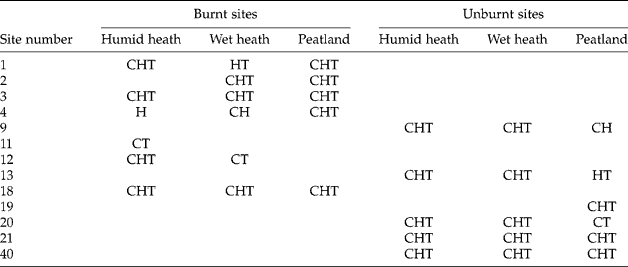
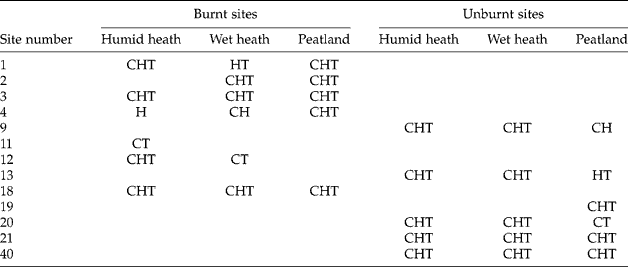
In this study, the seed banks of heathland with three different management histories were assessed: afforested former heathland that had had no seed input for many (>20) years; undisturbed heathland with a continual seed input for more than 35 years; and disturbed heathland where the seed bank had been removed or severely reduced by burning 20 years ago, but was gradually increasing as the vegetation returned to the mature growth phase. Within each site, 2 m × 2 m areas of humid heath, wet heath and peatland vegetation with a high proportion of Erica cover (sites with a minimum 30% estimated cover in each of the three; 1978, 1987 and 1996 Dorset Heathland Surveys) were selected for sampling. These were divided into three types: dominant E. ciliaris, dominant hybrid or dominant E. tetralix, giving nine combinations of vegetation type and Erica cover. Few individual heathland sites had examples of all ninecambinations. Therefore, a total of 13 heathland sites were used (seven disturbed, six undisturbed). In addition, five afforested former heathland sites were sampled. For these sites within the conifer plantations, nine sample quadrat locations were selected at random from within the known former range of E. ciliaris [mapped by Chapman in 1963, but recorded as reduced or absent in 1973; see Chapman (Reference Chapman1975) for details]. Table 1 shows the site numbers of each sample heathland type.
The allocation of individual samples between the sites (burnt and unburnt) and vegetation types. C=E. ciliaris, H= hybrid and T=E. tetralix. The site number refers to the sites used by Chapman (Reference Chapman1975)
Seed-bank and vegetation sampling
The sampling period was restricted to the mid-July and early August period. This coincided with the mid-point between the peak flowering times of the two species, allowing accurate floristic assessments of the relative abundance of the three genotypes to be made.
The total cover of Erica within a randomly selected 2 m × 2 m quadrat was estimated by sub-dividing the area into 16 plots of 0.5 m × 0.5 m and assessing the cover visually to the nearest 5%. The 16 plot estimates were averaged to give a quadrat cover estimate.
The proportions of each of the Erica species and the hybrid plants in each plot were assessed by taking the Erica flowering spike nearest the centre of the plot and tallying its hybrid score (see below for methodology). Where no Erica occurred within a plot, no sample was taken. The results of these hybrid evaluations were then combined to give values for the whole quadrat. From this, quadrats were grouped according to the dominant hybrid evaluation.
The seed bank in each quadrat was sampled by taking 16 soil cores, one from the centre of each plot. The samples were taken using a 24-mm diameter corer. Thus, the total area sampled in each plot was 7239 mm2, giving a minimum detectable seed-bank size of 103 seeds m− 2.The sampling depth was 50 mm. This depth was chosen because 95% of the seed bank occurs in the top 50 mm of the soil profile in undisturbed heathland soils (Gillham, Reference Gillham1980; Pywell et al., Reference Pywell, Putwain and Webb1997; Odion and Tyler, Reference Odion and Tyler2002).
Seed-bank germination
The soil cores from each sub-plot were bulked, air dried and sieved to remove twigs, stones and the larger roots. The sample was then spread to a depth of < 0.5 mm over the surface of a 300-mm diameter flowerpot filled with soil of heathland origin (but with no residual seed bank). In addition, 13 ‘control pots’ containing only the heathland soil were included in the experimental design. The pots were then randomized and placed on a 16 × 8 grid in a gravel-filled plunge bed with a constant water table at 15 cm below the soil surface. This was chosen as an average water-table depth for the range of hydrological situations from which the samples had been taken. Thus, optimum conditions for seedling emergence of both E. tetralix and E. ciliaris were created (ter Heerdt et al., Reference ter Heerdt, Schutter and Bakker1999).
The germination of both species occurs in the spring and autumn (Rose et al., Reference Rose, Bannister and Chapman1996). The number of germinating seedlings was monitored between autumn 1995 and spring 1997 (four germination seasons) by marking seedling germination positions with short lengths of coloured wire. The seedlings of plant species other than the Erica species were removed as soon as it could be established that they were not Erica spp. At the end of the germination period, the numbers of seedlings and marker wires (indicating where seedlings had perished) were counted to give an overall estimate of the Erica seed-bank size.
Seedling identification
During the germination period, a sub-sample of seedlings was taken to assess their hybrid scores. Sixteen individual plants were selected at random from each pot and grown until they produced flowers. Where fewer than 16 seedlings were present, all seedlings were used. Few plants produced flowers in the first year; therefore, this procedure was continued during the summers of 1998, 1999 and 2000 until all plants had flowered and could be scored for both vegetative and floral characters (see below).
Determination of the hybrid index
The method for hybrid characterization was that used by Chapman (Reference Chapman1975), modified from the system developed by Gay (Reference Gay1960). Nine morphological features were scored: 0 for the typical E. ciliaris form of the character; 1 for typical E. tetralix form of the character; and 1/2 for intermediate forms. The hybrid indices were summed for each individual. The plants were classified into pure E. ciliaris, hybrid and E. tetralix using the rules set out by Chapman (Reference Chapman1975). Plants with hybrid indices < 3 were deemed to be E. ciliaris, those with hybrid indices from 3 to 6 (inclusive) were hybrid plants, and those with hybrid indices >6 were E. tetralix.
Statistical analysis
For the analyses, the total seedling numbers were calculated as the number of germinating seedlings m− 2.The number of E. ciliaris, E. tetralix and hybrid seedlings was estimated by multiplying the proportion of each group of seedlings grown in each sample by the total number of seedlings in that sample. The data were normally distributed. Simple linear regression was used to analyse the relationship between the vegetative abundance and the size of the seed bank of each genotype.
Different heathland sites, burning histories, vegetation types and the percentage cover of each Erica in the vegetation, factors that may affect the density of seeds in the seed bank of the three genotypes, were assessed using general linear models (GLM) for unbalanced nested data. Specifically, in the between-site analysis, differences between the site types (burnt against unburnt) were tested; in the residual within-site analysis, effects of vegetation type (humid heath, wet heath or peatland) and remaining effects of percentage cover of each Erica (treated as covariates) on the seed density were tested.
Two sample t-tests were used to compare the seed-bank size of the three vegetation types with those of the afforested soils.
Results
Hybrid composition of the vegetation and seed bank
No Erica seedlings grew in any of the 13 control pots in the seed-bank study. Thus, any possibility of contamination of the samples, either by a residual Ericaceous seed bank in the propagation medium or by aerial inputs of seed, can be discounted.
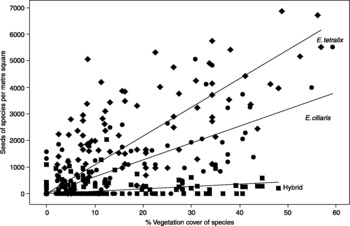
Both E. ciliaris and E. tetralix were common in the vegetation at all the heathland sites used in this study, and the seeds of both species were found in the seed banks at each site. Hybrid plants occurred in both the vegetation samples taken and the seed banks at 12 of the 13 heathland sites used in this study. Figure 1 shows that the size of the seed bank of both E. ciliaris and E. tetralix within the 4 m2 plot is significantly and positively related to the species abundance in the vegetation of heathland sites. In contrast, there was no significant association between the numbers of hybrid seeds in the seed bank and the vegetative hybrid abundance. These relationships are further explored below (Table 2).
Linear regressions of Erica spp. seed-bank size on the proportion of each species in the vegetation (circles = E. ciliaris, r 2 = 46.5%, P = 0.000; squares = hybrid, r 2 = 0.9%, P = 0.180; diamonds = E. tetralix, r 2 = 41.7%, P = 0.000).

The statistical analysis of differences between the numbers of Erica seeds m−2 present in the seed bank of each genotype for each of the parameters measured. Results from the general linear models (GLM) analyses

F-values with significance; ns = not significant; *P = 0.05; **P = 0.01; ***P = 0.001. Degrees of freedom: site, 11; vegetation type and burning × vegetation type (interaction), 2; and percentage cover of E. ciliaris, hybrid and E. tetralix, 1 with remaining error 70; burning, 1, remaining error 11.
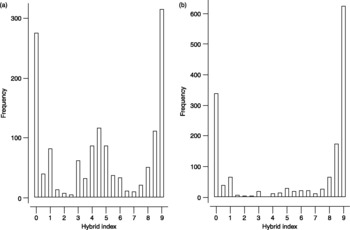
The overall distribution of hybrid index scores in the sample vegetation is given in Fig. 2a. The main characteristics were: large proportions of ‘pure’ plants (high and low scores), some mid-range scores (representing the central range of the hybrids), and very few scores that were intermediate or edge of range between the pure and hybrid plants. This follows a pattern similar to that found in a selection of 30 E. ciliaris sites, where individual plants of E. ciliaris, E. tetralix and hybrids were sampled randomly and scored for their hybrid index number (see Chapman, Reference Chapman1975). By combining the hybrid index scores into three categories (E. ciliaris, E. tetralix and hybrids), the total of 1388 plants scored fell into approximately equal proportions. This was partly due to the sampling procedure, which selected equal numbers of sites dominated by each of the genotypes.
The distribution of hybrid scores of Erica plants (a) in the vegetation and (b) in the Erica seed bank. E. ciliaris = hybrid indices < 3; hybrid plants = hybrid indices from 3 to 6 inclusive; and E. tetralix = hybrid indices >6.

The distribution of hybrid scores in the seed bank (Fig. 2b) did not reflect the distribution of scores in the vegetation. Of the 1491 seedlings produced from the seeds, most were classified as one of the two pure species. There were relatively few seeds that produced plants classified as hybrid [111 (7.4%)], whereas there were 455 E. ciliaris plants (30.6%) and 925 E. tetralix plants (62.0%). These proportions should be compared with the relative proportions of cover of the three genotypes found in the vegetation of the sample quadrats (E. ciliaris, 30.3% cover; E. tetralix, 37.1%; and the hybrid, 32.5%). Furthermore, while the vegetation samples showed an obvious peak in the mid-range of scores (Fig. 2a), there was no peak in the hybrid range of the seed-bank plants (Fig. 2b), and there was an apparent skewing of the plant numbers towards E. tetralix and hybrids that have more characteristics in common with E. tetralix.
The average number of E. ciliaris seeds in the total seed-bank sample was 1165 seeds m− 2. The mean density for hybrids was 275 seeds m− 2 and for E. tetralix 2350 seeds m− 2. The size of the seed bank at the different heathland sites did not differ significantly, and there was no effect of either vegetation type or burning history (Table 2). However, there was an interaction effect on hybrid seed-bank size between the burning history and vegetation type. In the heathland sites with a burning history, peatland was the vegetation type with the smallest seed bank (in 4 out of 5 cases), whereas in the unburnt sites, peatland had the largest seed bank on average (in 2 out of 5 cases). The sizes of both the E. ciliaris and E. tetralix seed banks were strongly related to the percentage cover of each species in the vegetation. The increasing percentage cover of E. tetralix in the vegetation had a positive effect on the number of hybrid seeds in the seed bank. The size of the hybrid seed bank was not related to the percentage cover of the hybrid or E. ciliaris in the vegetation. However, there was a strong affinity between the percentage cover of E. tetralix and the seed bank of hybrid seed.
The Erica seed bank in afforested sites
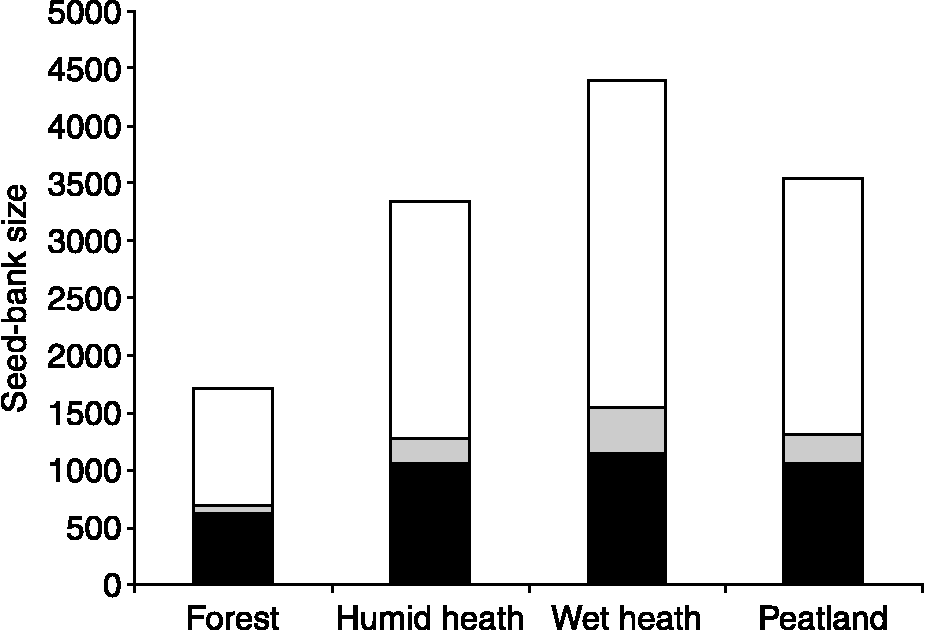
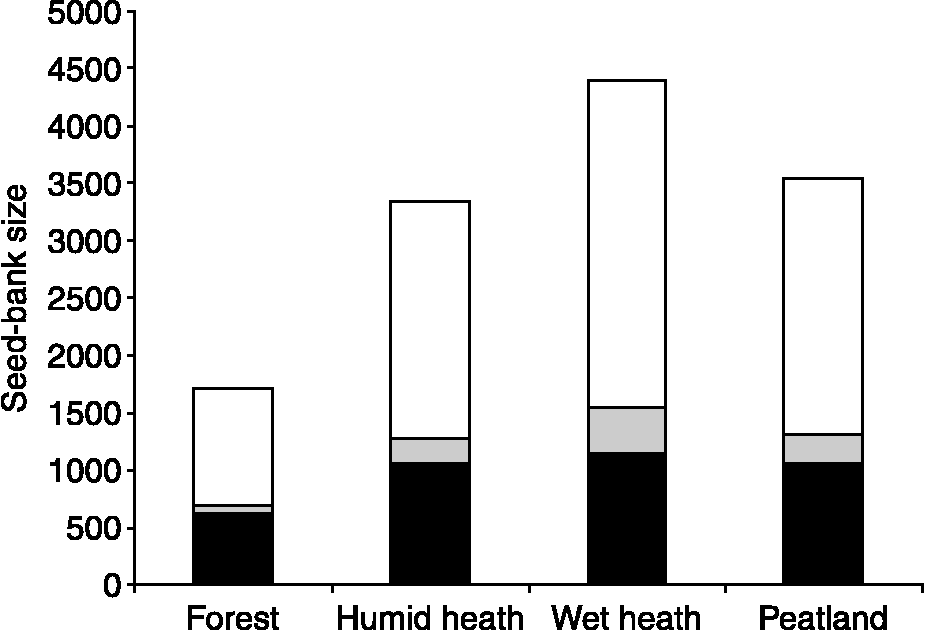
The sizes of the residual seed banks in the afforested sites were compared with the seed banks of the heathland sites. Due to the soil disturbance during tree planting, the afforested sites could not be classified into the three heathland vegetation types. Therefore, tests were done in combination with each vegetation type individually and in total. Results for each set of tests of significance show the same trends (Table 3). The results for E. ciliaris showed that the seed bank in the afforested sites did not differ significantly from the open heathland sites, even though they have had no seed input for 20 years or more. The hybrid and E. tetralix seed banks had both declined significantly from 275 seeds m− 2 and 2350 seeds m− 2, to 74 seeds m− 2 and 995 seeds m− 2, about 73% and 58%, respectively (Fig. 3).
The significance of differences between the number of Erica seeds m−2 present in the seed bank of the forest soils with the seed bank of the heathland vegetation types

t-test values: ns, not significant; *P = 0.05; **P = 0.01; ***P = 0.001.
The Erica seed-bank size and composition in the four vegetation types (black bars, E. ciliaris; grey bars, hybrid; and white bars, E. tetralix).
Discussion and conclusions
Comparison with other studies
This study has shown that both E. ciliaris and E. tetralix have large and persistent seed banks. A seed-bank database (Thompson et al., Reference Thompson, Bakker and Bekker1997) lists a number of studies that include E. tetralix, but none for E. ciliaris. Some of the findings reported in Thompson et al. (Reference Thompson, Bakker and Bekker1997) suggest that E. tetralix may only have a transient seed bank in some circumstances. However, this work, and other lowland heathland studies in Dorset and elsewhere in southern England, have confirmed that the seed bank of E. tetralix can persist for many years, even if the above-ground vegetation is modified by afforestation (Pywell et al., Reference Pywell, Pakeman, Allchin, Bourn, Warman and Walker2002), natural succession (Mitchell et al., Reference Mitchell, Marrs and Auld1998) and agricultural reclamation (Pywell, Reference Pywell1993). The size of the Erica seed banks found under the three vegetation types were generally lower than those found by Pywell et al. (Reference Pywell, Pakeman, Allchin, Bourn, Warman and Walker2002) in Calluna vulgaris dominated dry heathland vegetation with pure E. tetralix. However, seed-bank size in this species might be expected to be different due to the variability of seed longevity under different soil moisture conditions (as recorded by Bekker et al., Reference Bekker, Oomes and Bakker1998).
Vegetation type
While there were no significant differences in the size of the seed bank of E. ciliaris, E. tetralix or the hybrids that could be attributed to the vegetation type (humid heath, wet heath or peatland), the relative sizes of the seed banks of the three genotypes showed that the production of hybrid seed is a relatively rare occurrence (6.9% of the total seed bank). The pure plants also contributed differing proportions of seeds to the seed bank, with E. tetralix contributing 63.4% and E. ciliaris the remaining 29.7% in a set of samples selected for approximately equal proportions of each genotype in the vegetation. This may be due to differences in flowering, seed production or seed-bank survival. Evidence from the afforested sites suggested that the seed-bank survival of E. ciliaris may be greater under those conditions than that of the hybrid or E. tetralix. From the relative sizes of the seed banks in the natural vegetation, and given the similarities in vegetation cover within the experimental areas, the data also imply that the seed production of E. tetralix is greater than that of E. ciliaris.
Burning history
The burning history of the sites had no significant effect on the size of the seed bank of either of the pure species or the hybrids. Therefore, it can be assumed that during a normal management cycle of 25 years between managed burns, the additional seed rain during the most productive ‘building phase’ of heather re-growth (for details, see Gimingham, Reference Gimingham1972) was sufficient to compensate for physical losses during, and immediately after, burning and the reduced seed input in the period of vegetation re-growth in subsequent years. Also, the fact that the unburnt sites do not have continually increasing seed banks suggests that a maximum seed-bank size has been reached, with new annual inputs balancing losses to decay, predation and germination.
The influence of vegetation cover
The percentage cover in the vegetation of the three genotypes influences the composition of the seed bank (Table 2). The size of the pure seed bank of both E. ciliaris and E. tetralix was positively associated with the percentage cover of the respective species in the vegetation, and there was a significant association between percentage vegetation cover of E. tetralix and the number of hybrid seeds in the seed bank. The distribution of hybrid scores in the seed bank was skewed towards the higher (E. tetralix) end of the range of scores. This may be due to E. tetralix being more susceptible to the process of hybridization. Evidence for this comes from the fact that there was a greater affinity between the percentage cover of E. tetralix and the production of hybrid seeds, compared with E. ciliaris. Further evidence for the ability of E. tetralix to hybridize comes from the formation of other natural hybrids (with E. mackaiana and E. vagans) recorded by Stace (Reference Stace1975), but no other hybrids of E. ciliaris are known (Rose et al., Reference Rose, Bannister and Chapman1996).
Hybrid index scores and hybrid formation
There were differences between both the proportions and the distributions of the hybrid index scores for the vegetation and the seed bank (shown in Fig. 2a, b). The high proportion of hybrid plants in the vegetation, when compared to the seed bank, is due partially to the very low fertility of the hybrid plants, but also to the more robust growth form of the hybrids. It is common that F1 hybrids between closely related species tend to exceed their parents in vegetative vigour or robustness (Grant, Reference Grant1975) and, thus, the vegetative spread of these plants has led to hybrid dominance in some areas. The distribution of hybrid scores in the seed bank was skewed towards the higher (E. tetralix) end of the range of scores.
Afforested sites and restoration
Within the local range of E. ciliaris, there are a number of former sites that were planted with conifers and have been afforested for more than 20 years. This study has shown that there is the potential for restoration of the Erica component of heathland at these afforested sites. The residual seed-bank sizes are much higher than the seed addition rates given for heathland restoration (300–500 seeds m− 2; Putwain and Rae, Reference Putwain and Rae1988). The differences between the genotypes in the rates of depletion of germinable seeds in the residual seed bank will also have an effect on the species composition of any restoration site. From this work, it can be expected that a greater proportion of pure E. ciliaris seedlings and fewer E. tetralix seedlings will be produced, and the occurrence of hybrid seedlings will be rarer than in the original seed bank, thus aiding the conservation of the rare species (E. ciliaris).
Implications for the conservation of E. ciliaris
The low pollen viability and high seed sterility of the hybrids creates a strong postzygotic barrier. Investigating the risk of extinction through hybridization, Wolf et al. (Reference Wolf, Takebayashi and Rieseberg2001) simulated mixed populations of Helianthus petiolaris and H. annuus, which exhibit similar postzygotic characteristics to those of E. ciliaris and E. tetralix. Where there were no differences in survivorship between species in a given habitat, one of the parent species always displaced both the other species and the hybrid plants (Wolf et al., Reference Wolf, Takebayashi and Rieseberg2001).
The conservation of the rare species, E. ciliaris, is not only inextricably linked with habitat preservation and management, but also to the hybridization relationship with E. tetralix. In this paper, I was unable to show a clear differentiation of habitat preferences between these two species along a soil moisture gradient. The work of Wolf et al. (Reference Wolf, Takebayashi and Rieseberg2001) would suggest that one or other of the species or the hybrid should become abundant and eventually displace the others. However, previous studies by Chapman (Reference Chapman1975) have identified more subtle differences in habitat preference between E. ciliaris and E. tetralix, such as vegetation height. This differentiation in a habitat preference is continually changing due to both managed and unmanaged perturbations, and this may be sufficient to maintain mixed populations at naturally heterogeneous sites. Alternatively, the progression towards extinction of two of the taxa may be happening at an extremely slow rate, because the simulation model of Wolf et al. (Reference Wolf, Takebayashi and Rieseberg2001) predicts that the process can take many generations. In this heathland system, individual plants may effectively live for many years, both by re-sprouting from established rootstocks after fire and by vegetative propagation in the form of layering, when the above-ground stems become old. The long-lived nature of E. ciliaris seeds demonstrated in this paper suggests that current conservation management trends, i.e. to return some of the afforested, former E. ciliaris sites to heathland, are likely to be the most effective and beneficial method of maintaining this rare species.
Acknowledgements
I would like to thank Charlene Legg for assistance with scoring the hybrid characteristics of the plants grown on from the seed-bank study; Ralph Clarke for statistical advice; and James Bullock, Ken Thompson and an anonymous referee for providing helpful comments on earlier drafts of this paper.