

Introduction
The millipede fauna of Mexico comprises around 500 species (Hoffman, Reference Hoffman1999; Bueno-Villegas et al., Reference Bueno-Villegas, Sierwald, Bond, Llorente-Bousquets, Morrone, Yáñez-Ordóñez and Vargas-Fernández2004). This number, however, is likely an underestimate of the actual diversity, and further taxonomic work is needed to provide a more accurate approximation of Diplopoda diversity in this country. Apart from the still undescribed native diversity, exotic species are also a source of new taxa. For example, two species of exotic Polydesmida have been newly reported in Mexico in the last 10 years (Cupul-Magaña, Reference Cupul-Magaña2011; Recuero and García-París, Reference Recuero and García-París2016). Arrivals and eventual naturalization of further species are to be expected, considering the intensity of recent worldwide commercial and non-commercial activity.
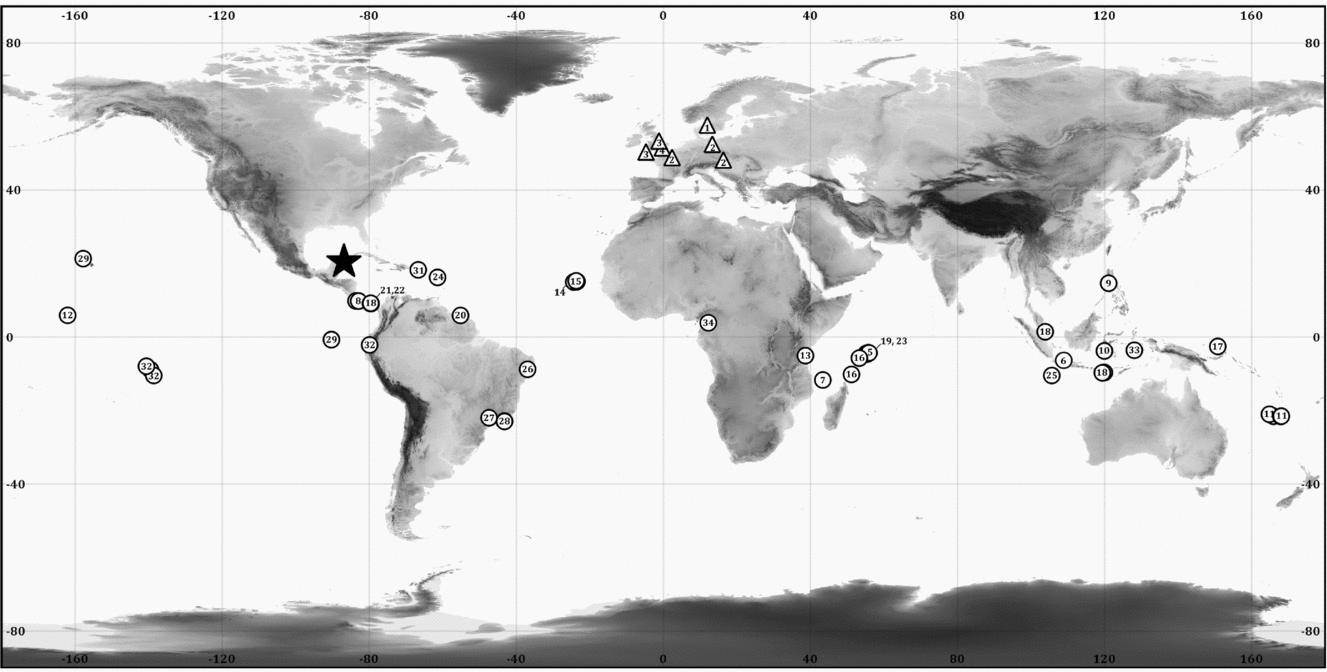
Cylindrodesmus hirsutus Pocock, Reference Pocock1889 is a successful colonizer with a virtually pantropical distribution (Golovatch et al., Reference Golovatch, Hoffman, Knapinski and Adis2001). Its area of origin seems to be centred in Indonesia or Melanesia (Golovatch et al., Reference Golovatch, Hoffman, Knapinski and Adis2001). To date, it has been reported from localities in America, Africa, Asia and Europe and it is also present in many archipelagos throughout the tropics (Fig. 1). It has often been observed in clear synanthropic conditions and in temperate regions, the species is associated with greenhouses (Golovatch et al., Reference Golovatch, Gruber, Adis, Knapinski, Zerm and Hansen2000). Parthenogenesis is frequent, which together with a clear tendency to anthropochory could help the species to establish new populations (Golovatch et al., Reference Golovatch, Gruber, Adis, Knapinski, Zerm and Hansen2000). For a complete description, diagnosis and synonymic list of the species, see Golovatch et al. (Reference Golovatch, Hoffman, Knapinski and Adis2001).
Known distribution of Cylindrodesmus hirsutus, including the new record from Cozumel, Mexico (star) and published records across the World (greenhouse population = triangles, outdoor population = circle; numbers refer to the citing references as follows: 1. Andersson (Reference Anderson2012); 2. Golovatch et al. (Reference Golovatch, Gruber, Adis, Knapinski, Zerm and Hansen2000); 3. Lee (Reference Lee2005); 4. Read (Reference Read2008); 5. Attems (Reference Attems1900); 6. Attems (Reference Attems1903); 7. Attems (Reference Attems1910); 8. Bergholz (Reference Bergholz2005); 9. Brölemann (Reference Brölemann1895); 10. Carl (Reference Carl1912); 11. Carl (Reference Carl1926); 12. Chamberlin (Reference Chamberlin1954); 13. Enghoff (Reference Enghoff1978); 14. Enghoff (Reference Enghoff1982); 15. Enghoff (Reference Enghoff1993); 16. Golovatch and Korsós (Reference Golovatch and Korsós1992); 17. Golovatch and Stoev (Reference Golovatch and Stoev2009); 18. Golovatch et al. (Reference Golovatch, Hoffman, Knapinski and Adis2001); 19. Hill (Reference Hill2002); 20. Loomis (Reference Loomis1934); 21. Loomis (Reference Loomis1964); 22. Loomis (Reference Loomis1969); 23. Mauriés (Reference Mauriès, P.L.G. and Van Mol1980b); 24. Mauriès (Reference Mauriès1980a); 25. Pocock (Reference Pocock1889); 26. Schubart (Reference Schubart1942); 27. Schubart (Reference Schubart1944); 28. Schubart (Reference Schubart1945); 29. Shear and Peck (Reference Shear and Peck1987); 30. Shelley and Golovatch (Reference Shelley and Golovatch2000); 31. Silvestri (Reference Silvestri1908); 32. Silvestri (Reference Silvestri1939); 33. Verhoeff (Reference Verhoeff1894); 34. Golovatch et al. (Reference Golovatch, Nzoko Fiemapong and VandenSpiegel2017).

Cylindrodesmus hirsutus has been known from the Americas since 1908 when Silvestri described it under a different name as Lasiodesmus carabicus (Silvestri, Reference Silvestri1908), from specimens collected in Puerto Rico. Since then it has been found in Brazil, Surinam and Ecuador (mainland and Galapagos Islands) in South America (Loomis, Reference Loomis1934; Silvestri, Reference Silvestri1939; Schubart, Reference Schubart1944, Reference Schubart1945; Shear and Peck, Reference Shear and Peck1987), as well as in Panama, Costa Rica and Guadalupe in Central America and the Caribbean (Loomis, Reference Loomis1969; Mauriès, Reference Mauriès1980a; Golovatch et al., Reference Golovatch, Hoffman, Knapinski and Adis2001; Bergholz, Reference Bergholz2005). Nonetheless, reports are sparse in these areas, and the species has neither been reported from the northern Caribbean nor from any Mexican region.
Materials and methods
Sampling was done on Cozumel Island in March 2016, during the dry season. Millipedes were hand-collected from different microhabitats in semideciduous tropical forest and mangrove forest, and by visual inspection of litter samples.
A worldwide distribution map of known localities of C. hirsutus was made using QGIS v2.6.1 (http://qgis.osgeo.org/en/site/).
Results and Discussion
On 9 March 2016, one adult male and one dead, incomplete, adult female of C. hirsutus were found on Cozumel Island, Quintana Roo, about 3.5 km SW of San Miguel (20°28'23''N 86°54'08''W, 10 masl) (Fig. 1). The animals were found under a piece of decayed plywood in an area of medium semideciduous tropical forest. They were found together with an immature Oxidus gracilis (Koch, Reference Koch, Panzer and Herrich-Schäffer1847) and a single specimen of Rhinotus purpureus (Pocock, Reference Pocock1894), other mostly anthropochorist millipedes previously unreported from the state of Quintana Roo (Bueno-Villegas et al., Reference Bueno-Villegas, Sierwald, Bond, Llorente-Bousquets, Morrone, Yáñez-Ordóñez and Vargas-Fernández2004; Cupul-Magaña and Shelley, Reference Cupul-Magaña and Shelley2011).
The origin of this population is most likely associated with human activity. Cozumel is a leading tourist destination, as well as an area of significant commercial activity. One likely means of dispersal could be through plants imported for gardens in hotels and residential areas. This means of dispersal seems to be common in this species, as shown by the colonization of greenhouses in temperate regions (Golovatch et al., Reference Golovatch, Gruber, Adis, Knapinski, Zerm and Hansen2000). The extent and degree of success of this colonization are still unknown, but it is to be expected that new population will appear throughout the island and along the mainland coast, where human activity is most intense.
The millipede fauna of the Yucatan Peninsula is mostly unknown, with just a few scattered contributions (see Bueno-Villegas, Reference Bueno-Villegas and Vázquez2001), and even less information on the Diplopoda of Cozumel is available. García-Gómez et al. (Reference García-Gómez, Castaño-Meneses, Vázquez-González and Palacios-Vargas2014) published a study on the diversity of arthropod mesofauna found in the litter of mangrove forests and reporting that, among Myriapoda, millipedes were the most abundant, but provided no taxonomic information under the class level. As for so many other regions, particularly in tropical environments, much effort is still needed towards a better understanding of the diversity of Diplopoda in the Yucatan Peninsula, and the potential effects of invasive species on its native fauna and in the equilibrium of soil dynamics.
Acknowledgements
Thanks to the peer reviewers for their helpful comments and particularly to Dr S. I. Golovatch for his help in completing the bibliographical information, M. García-París and I. Martínez-Solano for his suggestions, and to D. Buckley for his comments and corrections of the manuscript.