Introduction
The roles of livestock farmers’ institutions and their respective members in the management of animal genetic resources are becoming more important. In particular, the important roles which these resource-poor farmers can play in successful design and implementation of low-input breeding schemes was recognized by FAO (2007). Nevertheless, some farmers’ associations become dysfunctional just a few years after their establishment due to technical, financial and institutional challenges (Rewe, Reference Rewe2009). Specifically, for some developing countries, such associations set up for the breeding and genetic improvements of indigenous animals have become redundant because their objectives were poorly understood by the members or they were inappropriately supported by the relevant stakeholders (Messer and Townsley, Reference Messer and Townsley2003). An appropriate assessment of livestock farmers’ institutions in terms of formation, modes of operation and interaction is considered important in the context of sustainable animal breeding programme (Sun, Reference Sun2007; Rewe, Reference Rewe2009).
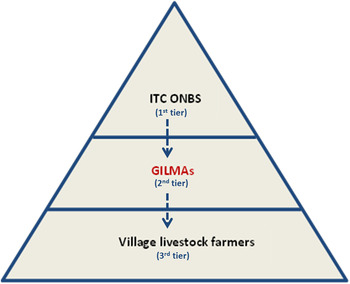
The present study based on the three-tier Open Nucleus Breeding Scheme (ONBS) of the International Trypanotolerance Centre (ITC), examined the performance, participatory and institutional status of the Gambia Indigenous Livestock Multipliers Associations (GILMAs). The ONBS which was founded in 1995 has a primary objective to increase milk and meat production of three unique breeds of indigenous ruminant species (N'Dama cattle, West African Dwarf goat and Djallonke sheep) without losing their tolerance to trypanosomiasis and other endemic diseases. The GILMA (Figure 1) was established in 2002 in response to the need for effective multiplication and dissemination of superior breeding bulls, bucks and rams to other livestock farmers.
The position of GILMAs in relation to flow of superior male animals from the ONBS of ITC to village farmers.

The major objectives of GILMA are to multiply and disseminate the genetically improved animals obtained from the ITC nucleus (first tier) to other farmers in the villages (third tier). ITC owns the nucleus animals and usually sells its selected elite/superior breeding males (bull, buck, ram) to GILMA at a subsidized price, while expecting these associations to in turn to sell the offspring of elite breeding males to the base famers at prices that will generate enough revenues for sustaining their operations. At its creation, both technical and financial supports for GILMA were offered by ITC and the Department of Livestock Services (DLS). In 2003, due to organizational and communication challenges, GILMA was divided along the River Gambia into two branches (GILMA Saloum and GILMA Fulladu). The membership of GILMA Saloum and GILMA Fulladu consisted of livestock farmers living in the north and south of the River Gambia, respectively. Meanwhile, the management of each branch was entrusted to the executive committee members who were elected during the general assemblies.
Like many other farmers’ organizations in sub-Saharan Africa, a preliminary assessment of the GILMAs (Fulladou and Saloum) done by ITC in 2012 showed that the two associations had continuously encountered institutional instability in terms of carrying out their set goals (ITC, 2012). This apparently resulted to functionally weak institutions that overly depended on major partners (ITC and DLS) for continuity and survival. To systematically address those challenges, proper assessment through institutional diagnosis and analysis of GILMAs is very important. Grimble (Reference Grimble1998) emphasized the need for analysis of institutions in order to identify relationships among various actors and as well as clarify their roles and inherent trade-offs.
This exploratory investigation aims to understand the roles of local institutions involved in the breeding and genetic improvement of indigenous ruminant breeds by assessing how they are organized, what their challenges are, how they can be strengthened and made more sustainable concerning their roles and institutional mandates.
Materials and methods
In the planning phase which lasted for 2 days in February 2014, the experts reviewed and used content analysis to assess GILMAs’ constitution, by-laws, registration certificate, bank statements and partners’ report of the two associations. By regarding GILMA Saloum and Fulladu as the centre of diagnosis, an inception meeting for elaboration of action plans was held with the ITC staff. A list of materials, persons and organizations to be used for the Participatory Institutional Diagnosis (PID) was also compiled during this period. Meanwhile, PID as designed by the West Africa Rural Foundation (WARF) is a participatory diagnosis and learning tool for understanding an organization's strength and weaknesses. This tool was also used in this study to support identification of innovative changes in both internal and external environments of the GILMAs.
The two PIDs in the form of a focus group discussion were conducted at Fulladu and Saloum and each lasted for three consecutive days. A semi-structured questionnaire was used and the participants consisted of nine and ten members of GILMA Fulladu and Saloum, respectively. They were purposefully selected based on their positions as executive members or as ordinary members with active participation in the affairs of GILMAs. Seven staff from ITC, DLS and PROGEBE (Regional Project on Sustainable Management of Endemic Ruminant Livestock) participated and provided support for the PID at each site of the GILMAs. The diagnosis of each association's institutional, technical and financial issues was done by allowing the participants to answer the questions written on the flip charts. The issues addressed during the PID included GILMAs’ strategies for partnership, planning, decision making, reporting and communication. GILMAs’ vision and mission statements were reappraised and the associations’ strategies for resources mobilization and financial management were assessed by the experts. The diagnoses ended with feedback and briefing sessions on the outcomes of PID. Site visits were also made to GILMA Saloum and GILMA Fulladu members’ livestock herds in order to gather more information about their livestock herds and flocks.
In addition to focus group discussions, the experts used individual interviews of participants to engage them in the process of participatory learning and analysis. At the end of field diagnosis, a general feedback and validation workshop was held in order to share the results of PID and to give the relevant stakeholders a general overview of the major constraints and challenges affecting GILMAs’ overall functionality as the multipliers of indigenous ruminant breeds in The Gambia. The opportunities and potentials for strengthening the GILMAs were also presented during this workshop while various suggestions of the stakeholders’ groups were incorporated into an agreed action plan for revitalizing the two groups.
Results
The desk reviews of relevant documents and the PID generated the following findings:
Institutional landscape of the GILMAs
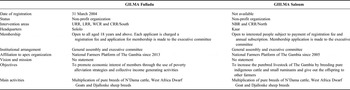
Both GILMA Saloum and Fulladu were registered as non-profit organizations with clearly stated objectives. Each association (Table 1) has a constitution as well as by-laws, and the executive committees are responsible for an overall management.
Profile of the GILMAs.

CRR, Central River Region; URR, Upper River Region; LRR, Lower River Region; NBR, North Bank Region; WCR, West Coast Region
With regard to constitution and by-laws, GILMA Fulladu has an appropriate legal document where its objectives and operations are explicitly stipulated, while the statutory bodies of the association are the general assembly and executive committee. In the by-laws, the association was meant to convene at least one annual general meeting, in addition to other special executive committee meetings. Statutorily, the executive committee which consists of the chairperson, vice chairperson, treasurer, secretary, auditor, organizer and adviser can occupy such positions for a 5-year term, while there is a possibility to be re-elected only once through elections of the general assembly. However, the GILMAs were operating outside their constitutional mandates with irregular annual general and executive meetings as well as non-compliance to terms of office by the executive members. Also, there were just a few youths in both the executive committee and in the overall membership.
Regarding membership, any interested person above 18 years of age can apply regardless of gender, ethnic, religious, political party or other affiliations. Applications for membership are made to the executive committee who has the authority to either grant or refuse admission. However, interviews during the diagnosis showed that roles and responsibilities were not clearly understood by many members and even by the leaders. In addition, there have been no annual general or executive committee meeting since 2005 due to lack of continuous support for such activities from ITC and DLS. Similar to GILMA Fulladu, statutory bodies of GILMA Saloum are the annual general assembly and the executive committee. However, there were some discrepancies between the written contents of the by-laws and the verbal assertion of interviewed members. Also the mistake concerning date on the registration certificate of the association was not realized by any of the members prior to the period of this study. GILMA Saloum convened three executive committee meetings between 2003 and 2004, but there was no annual general meeting. Only one out of its seven executive committee members could read and write in the English language and they were all older than 35 years of age. In addition, there were just a few women in leadership positions and the associations had no office building and facilities.
Assessment of GILMAs’ performance
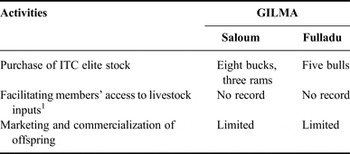
As a strategy for multiplication of the genetically selected male animals, the GILMA executive committee, on behalf of all members was expected to purchase elite bulls, bucks and rams from ITC ONBS flocks/herds at discounted price and utilize them only for breeding purpose. Oral interviews and assessment of current records (Table 2) indicates that only a few number of elite males were bought by the GILMA members. Also, activities such as marketing and facilitation of members’ access to livestock production inputs were not documented.
Assessment of GILMAs’ activities since 2002 to date.

1 Livestock input refers to veterinary services, breeding facilities and relevant knowledge.
The above table also shows that after 10 years of existence, very little progress was realized in terms of the expected GILMAs’ roles and responsibilities. The reason for this poor achievement was attributed to the organizational and managerial weaknesses of the associations coupled with institutional instability of the GILMAs’ supporting partners which are mainly ITC and DLS. Consequently, the inability of GILMAs to cope with various challenges made the two associations very redundant and institutionally fragile within the ONBS of ITC. Furthermore, there was loss of revenues from sale of elite male animals’ offspring because the first breeding stock of bucks, rams and bulls purchased from ITC and retailed to members of GILMA were not recorded and monitored up to the time of this study.
This participatory diagnosis also showed that the current partnership mechanisms between the GILMAs and stakeholders are either absent or not very strong. In addition, the capacities of both GILMAs in terms of strategic financial and technical partnership were very low. As a result, partners’ goods and services including access to genetically improved animals, health care, supplementary feeds and marketing facilities were not harnessed by the associations. Even though ITC as one of the technical partners of GILMA used to provide breeding males and organize capacity building workshops, such activities had dwindled due to institutional and financial instability of this research Centre since 2006. DLS, on the other hand, also provided capacity building, monitoring, data recording, access to livestock shows, animal health and watering facilities. However, DLS also experienced institutional instability due to frequent changes in its organizational structure. As a result, its capacity to support the breeding programme especially at the levels of multipliers and livestock farmers was significantly undermined. Besides that, the GILMAs did not take full advantage of relevant livestock and development projects that were at their reach.
Weaknesses in communication and financial management
Poor information flow between members was one of the major constraints that hindered effectiveness and efficiency of the GILMAs. Additionally, the widespread locations of members’ farms and houses resulted in poor communication and social interactions. Also, meetings were infrequently held and due to low literacy level of the executive committee members, it was difficult for them to record the number of elite animals purchased and retailed to their members.
Both GILMAs had financial challenges which consequently undermined overall discharge of their statutory roles and responsibilities. Although the first action plan and annual budget at the inception of GILMA was made in partnership with ITC and DLS, those documents were not subsequently reviewed for the strategic purpose of running the two associations in effective and progressive ways. Similarly, the procedures, management practices and accounting systems for normal transactions were neither formalized nor transparent due to inadequate knowledge in petty cash book keeping and financial management.
Although retailing of elite bulls’ offspring was supposed to be an important source of income for each association, this was not realized due to lack of appropriate skills in small-scale entrepreneurship. The GILMAs also lacked the basic skills to properly develop proposals, manage the available financial resources and assets or reinforce existing partnerships. The executive committees of the two associations were also not aware of any external funding mechanism and did not demonstrate any initiative that could lead to securing financial opportunity with partners or similar organizations.
Neither GILMA had an annual budget, financial record or loan recovery system. Subsequently, the proceeds that would have accrued from the elite animals sold on credit to members were yet to be recovered, even after 10 years. Also, the few financial resources of the two associations were spent without receipts and records. The procurement of goods and services, as well as commercial transactions were arbitrarily conducted based on loose contracts and moral trust. Although each association has an auditor in the executive committee, there was no audit report and the resources supposedly saved in the bank accounts of the associations were not known by their treasurers. Even though the GILMAs were established to reduce unemployment and poverty rate of members, there was no record of how those goals have being achieved. Furthermore, only few instances of profiting from the animals sold at the individual level were reported, while members of the executive committees were not remunerated.
In this participatory diagnosis, we realized that the processes of decision making in both GILMAs were not transparent. Even though executive committee members asserted that decisions were taken unanimously, this was contradicted by lack of annual general assembly as this was the only entity authorized to take strategic decisions according to the by-laws. Decisions concerning overall management of the associations were not participatory and there was no follow-up on subsequent communication procedures which could have adequately informed the members.
Discussion
The PID used in this study follows the guidelines of Messer and Townsley (Reference Messer and Townsley2003) and Akpo et al. (Reference Akpo, Vissoh, Tossou, Crane, Kossou, Richards, Stomph and Struik2012) in analysing the linkages between various actors and stakeholders of local institutions. Involvement of GILMA members and stakeholders in joint reflection and elaboration of a coherent action plan resulted in mutual interactions, improved communication, as well as identification of convergences and divergences at different institutional levels and scales. The discovery and diagnostic approaches embedded in this particular methodology enhanced better understanding of typical farmers group's challenges and opportunities in the context of developing countries. Being used as a stimulating tool for identifying causes and consequences of dysfunction in an association, the PID in the case of GILMAs critically examined both the formal and informal aspects of the two associations with focus on inclusiveness in decision making, financial management and communication strategies. The general approach and outputs of PID which are based on participatory learning, coaching and mentoring principles will strengthen the institutional capacity of GILMAs towards achieving a better management of endemic animal genetic resources in The Gambia. This type of activity, which focused on collective assessment of farmers groups’ functionalities by the relevant stakeholders, was also considered very important for sustainable animal breeding programmes (FAO, 2007; Rewe, Reference Rewe2009).
The objectives of this assessment in line with Grimble (Reference Grimble1998) and Sun (Reference Sun2007) emphasized the need for analysis of local institutions and community-based associations in order to identify relationships among various actors with respect to clarity of roles and inherent responsibilities. Specifically, an assessment of each GILMA's leadership pattern, resources mobilization, financial management, organizational procedures, partnership strategies and appreciation of external funding environment provided good platforms to explore the associations’ history, vision, mission and incentives. The participatory diagnosis as carried out in this study strengthened the key outcomes and also supported strategic reflection on the revitalization plan for capacity development of the GILMAs.
The gender composition of GILMA membership was identified in this study. A higher number of male members can be linked to sociocultural setting in which livestock ownership pattern is differentiated along the gender line in some developing countries. According to Olaniyan and Hiemstra (Reference Olaniyan and Hiemstra2012), small ruminant production in the Gambia is associated with women compared with men, who are more involved in cattle production. This is an indication that GILMA membership is majorly composed of male cattle owners even though the groups are open to interested individuals regardless of gender, ethnic, religious, political party or other affiliations. Also, the leadership of GILMAs skewed toward the executive committee members who have little formal education and were all older than 35 years. This pattern of leadership which consisted of more old members was believed to have impacted negatively on the growth, operation and continuity of the GILMAs as youths are believed to be more innovative, dynamic and adventurous. However, Jackson, Joshi and Erhardt (Reference Jackson, Joshi and Erhardt2003) states that although relation-oriented diversity expressed in terms of age or gender differences may have tendency to influence relationship among members of a group, it nonetheless does not have direct effect on the group's performance.
The mission and vision of either GILMA Fulladu or Saloum was not explicitly described. This observation undermines adequate understanding of GILMAs’ roles and responsibilities as multipliers of endemic ruminant breeds within the ONBS of ITC. Another implication was the incapability of members to adequately describe the formation, evolution and historical progression of their associations. This culminates in their inabilities to precisely draw lessons from past initiatives and strategic interventions of partners. Meanwhile, a structured livestock breeding programme requires clearly defined goals and breeding objectives, consents and wilful participation of farmers in order to be successful (Sölkner, Nakimbugwe and Valle Zárate, Reference Sölkner, Nakimbugwe and Valle Zárate1998; Dekkers et al., Reference Dekkers, Gibson, Bijma and van Arendonk2004). Furthermore, clearly defined visions and missions of a breeder society can enhance optimization of livestock breeding programmes, dissemination of genetic progress and sustainable management of animal genetic resources.
The unavailability of genetically improved animals from the ONBS of ITC as a result of institutional and financial instability illustrates the situation of a few breeding programmes in the developing countries. As an illustration, the National Beef Research Centre (NBRC) in Kenya, which operates a breeding scheme similar to ONBS of ITC, experienced stagnation due to a decentralized production and marketing of animals (Rewe, Reference Rewe2004), while inconsistencies in data collection and analysis by NBRC led to the withdrawal of some livestock farmers (Kahi, Wasike and Rewe, Reference Kahi, Wasike and Rewe2006). Meanwhile, a structured breeding and selection programme for producing genetically improved animals on a regular basis can be achieved through breeding activities such as animal recording, genetic evaluation, selection and mating (Hazel, Dickerson and Freeman, Reference Hazel, Dickerson and Freeman1994).
The GILMAs’ overdependence on ITC in addition to the inadequate knowledge of the associations’ role and responsibilities can be addressed by considering the Boran Cattle Breeders Society (BRBS) which was responsible for its own administration, maintenance of stud book and marketing of elite animals (Rewe, Reference Rewe2009). Also, the mode of GILMAs’ dependence on partners such as ITC and DLS can be minimized through self-organized livestock genetic improvement scheme in which the roles of professional and educated GILMA members will include data recording, maintenance of stud books and coordination of similar activities that are relevant for maintaining the indigenous breed in pure forms. This will give GILMAs the institutional status and sense of ownership over the endemic ruminant species in the Gambia. In order to analyse and interpret the data for selection and mating purposes, and to disseminate the improved genetic material of such a scheme through reproductive techniques, strategic partnership with ITC and DLS then becomes expedient and this needs to be explored accordingly.
Apart from ITC and DLS, there was no recorded action aimed at fostering GILMA's partnership with other relevant key stakeholders in the recent years. This type of isolation of GILMAs from potential partners is a manifestation of weak leadership. While GILMA Saloum and GILMA Fulladu are working on similar livestock breeding objectives, there was however no formal link between the two associations. As a result, the associations were unable to collaboratively draw any benefit from the developmental opportunities that exist in the livestock sector of the Gambia. This institutional weakness also hindered GILMAs’ ability to benefit from strategic consultation with the relevant government agencies and community-based organizations. Such incongruence with the potential partners and sponsors is significant for the GILMAs and could partly explain the low performance of the two associations.
However, a collaborative breeding programme in which livestock breeders’ association can strategically partner with researchers were described by Bosso (Reference Bosso2006) and Kahi, Rewe and Kosgey (Reference Kahi, Rewe and Kosgey2005). At the sub-regional levels of sub-Saharan Africa, Rewe (Reference Rewe2009) suggested a genetic improvement programme comprising the breeders’ associations, government and national agricultural research institutions while Madalena et al. (Reference Madalena, Agyemang, Cardellino and Jain2002) attributed the success of breeding programmes in Brazil to collaborations between breed societies, private firms, universities and research institutions. For the GILMAs, these associations’ organizational skills and management needs to be improved in order to enhance better performance and strategic partnerships with research institutions and other relevant agencies in the Gambia. Although the idea of merging the two GILMAs into a single apex association that could facilitate clearly defined and better partnership may be a good approach, however such process should not be driven from outside the two associations as it may result in lack of ownership and commitment of members.
Conclusions
It can be concluded from this study that the GILMAs were not efficient at multiplying and disseminating the improved male breeding animals from the nucleus to livestock farmers in the villages. Their constraints and challenges were linked to internal factors and also, the institutional and financial challenges of partners such as ITC and DLS. To revive the GILMAs, various opportunities and potentials for strengthening the two associations were highlighted and agreed upon by the relevant stakeholders. Main issues to address will include capacity development of GILMA's executive committees in terms of institutional and financial management, group facilitation, participatory planning and improved strategies for partnership.
Recommendations
The plans presented here represent the necessary and realizable actions for developing self-reliant GILMAs. They are based on the principle of members’ inclusiveness although with facilitation and capacity building supports from the partners of GILMA. Consequently, all actions aiming at reinforcing GILMAs must take into account the following issues:
-
• Draft of constitution and by-laws with the assistance of a legal adviser to ensure conformity with the members’ aspirations and decisions;
-
• Clearly stated membership and registration fees;
-
• Clearly defined duties and rights of members;
-
• Restructuring and re-election of the executive committee members including new position for a deputy treasurer in the executive committee to enhance ease and transparency in cash management;
-
• Clear definition and documentation of roles and responsibilities of executive committee members in the local languages;
-
• Required minimum literacy level for any aspiring member of the executive committee;
-
• Development of strategic framework (vision, mission and strategic plan) for each GILMA;
-
• Reinforcement of GILMAs’ strategic partnerships in order to benefit from the apparent opportunities that this may present.
-
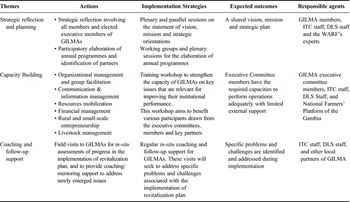
• Implement the key capacity development themes, actions, and implementation strategies presented in Table 3.
Revitalization plan for the GILMAs.

Acknowledgements
The authors appreciate PROGEBE (Regional Project on Sustainable Management of Endemic Ruminant Livestock) for financing the field-related activities of this study. Also, the staff of ITC, DLS and PROGEBE-Gambia who participated in the field related activities are duly acknowledged for their important contributions and meaningful interaction with the members of GILMA. Special thanks to Momodou Jeng, Nerry Corr, Mamut Njie, Saja Kora and Matarr Njie who provided extra information and motivation for the success of this study.