Introduction
Early adverse experiences can increase vulnerabilities to mental health problems across the life course (Shonkoff et al. Reference Shonkoff, Boyce and McEwen2009); in turn, these may have implications for mental health service use. Childhood bullying victimization is one such adverse experience and is increasingly recognized as a public health concern (Gilbert et al. Reference Gilbert, Widom, Browne, Fergusson, Webb and Janson2009). Empirical evidence supports strong and robust associations with mental health symptoms in childhood and adolescence (Arseneault et al. Reference Arseneault, Bowes and Shakoor2010). Studies have also shown that childhood bullying victimization is associated with persisting problems in early adulthood (Copeland et al. Reference Copeland, Wolke, Angold and Costello2013) and even up to midlife (Takizawa et al. Reference Takizawa, Maughan and Arseneault2014). We hypothesized that bullying victimization might have an effect on mental health service use, not only during childhood and adolescence, but also across the life course.
Some evidence indeed points in that direction. A registry-based study of a nationwide Finnish birth cohort indicated that childhood bullying victimization was associated with greater use of psychotropic medication and psychiatric hospitalizations during early adulthood, over and above psychopathology prior to bullying (Sourander et al. Reference Sourander, Ronning, Brunstein Klomek, Gyllenberg, Kumpulainen, Niemelä, Helenius, Sillanmäki, Ristkari, Tamminen, Moilanen, Piha and Almqvist2009, Reference Sourander, Gyllenberg, Brunstein, Sillanmäki, Ilola and Kumpulainen2016). This is important as it also indicates that early childhood bullying victimization can have important implications for healthcare systems. At this stage, however, little is known about broader patterns of mental health-related service use, and whether such an impact is persistent over time. We examine the impact of childhood bullying victimization on mental health service use in childhood and adolescence, early adulthood, and up to midlife in a nationally representative UK birth cohort followed to the age of 50 years. To further contextualize our results, we compare the association between childhood bullying victimization and ever being ‘in care’ on mental health service use, as being in care is a known marker of later mental health problems (Odgers & Jaffee, Reference Odgers and Jaffee2013).
Method
Participants
Data came from the National Child Development Study (NCDS), the 1958 British Birth Cohort Study (Power & Elliott, Reference Power and Elliott2006). Information was collected on 98% of all births in 1 week in 1958 in England, Scotland and Wales (17 638 participants). Subsequent follow-ups took place at ages 7 (1965), 11 (1969) and 16 years (1974) in childhood, and at ages 23 (1981), 33 (1991), 42 (2000), 45 (2003) and 50 years (2008) in adult life. During the childhood surveys the sample was augmented by 920 immigrants to the UK who were born in the study week, for a total of 18 558 cohort members.
Measures
Assessment of bullying
Exposure to bullying was assessed via parental interviews when participants were aged 7 and 11 years. At each age, parents were asked if their child was bullied by other children never, sometimes or frequently. We combined responses from both interviews (n = 11 872) to create a three-level indicator of exposure to childhood bullying: 0 = never bullied (never at both 7 and 11 years); 1 = occasionally bullied (sometimes at either 7 or 11 years); 2 = frequently bullied (frequently at either 7 or 11 years, or sometimes at both ages). Where only one parental interview was available (n = 2511 at age 7 years, n = 1563 at age 11 years), responses from that interview were used, providing bullying assessments for 86% of cohort members.
Mental health service use
The NCDS collects data on use of health services in relation to a range of medical conditions. For this study, we focused on health service use reported specifically in relation to mental health problems. The exact questions about mental health service use, the providers involved and the time-frames covered are presented in online Supplementary Appendix S1. Reports of service use in childhood and adolescence (from ages 11 to 16 years) were recorded in the course of an examination by a local authority medical officer, who consulted available records and interviewed the young people and their parents. Cohort members' own reports of adult service use related to the intervals between adult survey sweeps, which varied between 1 and 10 years. This allowed for assessment of the impact of bullying in relation to a range of services and settings at different life stages. Because absolute rates of reported service use inevitably vary for different providers (e.g. general practitioners v. specialist mental health professionals) and for different observation periods, we focused predominantly on the ratios between groups according to bullying victimization rather than absolute rates of service use.
Childhood sociodemographic and clinical characteristics
Childhood intelligence quotient (IQ) was assessed at age 11 years using a standardized 80-item general ability test (Douglas, Reference Douglas1964). Scales of childhood emotional and behavioural problems were derived from teacher ratings on the Bristol Social Adjustment Guides (Stott, Reference Stott1969) (precursors to more recent behaviour ratings) at ages 7 and 11 years. These scales show adequate reliability, and predict psychiatric morbidity in adult life (Clark et al. Reference Clark, Rodgers, Caldwell and Stansfeld2007). We used the mean of scores across the ages of 7 and 11 years where both measures were available (n = 12 781), and single-age measures for the remainder of the sample (n = 3522). Family social class in childhood was classified on the basis of the father's occupation at age 7 years, and categorized as ‘I and II’ (professional/managerial/technical), ‘IIINM’ (other non-manual), ‘IIIM’ (skilled manual) and ‘IV and V’ (unskilled manual) (Office of Population Censuses and Surveys, 1980). Childhood adversity was assessed from both prospective and retrospective reports. Prospectively, parents/caretakers reported at the age-11 years contact whether the child had ever been in the care of a local authority or voluntary agency. In addition, information collected from parents and teachers was used to create an eight-item scale of low parental involvement, including indicators of the child's physical appearance and the parents' activities with the child at the ages of 7 and 11 years (Power et al. Reference Power, Thomas, Li and Hertzman2012). Parents and caretakers reported at the age-11 years contact whether the child had ever been in the care of the local authority or a voluntary agency. Retrospectively at age 45 years, participants completed a 16-item questionnaire about their exposure to a range of childhood adversities including poverty, parental mental health and drug/alcohol problems, family conflict, and physical and sexual abuse (Rosenman & Rodgers, Reference Rosenman and Rodgers2004). We grouped responses into those reporting no (47%), one (25%) and two or more adversities (28%).
Statistical analysis
First, we calculated the frequency of mental health service use by childhood bullying victimization, overall and by gender for each assessment. Next, five separate multivariable logistic regression models examined the impact of childhood bullying victimization on mental health service use at each interview time point. Each multivariable model adjusted for all confounders described previously. As it was not possible to directly compare the absolute prevalence estimates of service use over time given the differences in how questions were asked at each survey year, we compared the odds ratio (OR) associated with service use for those who were frequently bullied v. never and occasionally bullied v. never bullied. To provide an estimate of the magnitude of the association between bullying and mental health service use, in a separate model, we investigated the link between ever being ‘in care’ and mental health service use.
Second, we examined patterns of mental health service use over time and whether the same group of individuals accounted for the majority of service use across age, or whether different individuals were using services at each time point. For this analysis, we assessed (i) incidence of mental health service use at each time point (i.e. new ‘cases’ who had not reported any previous mental health service use), and (ii) the persistence of mental health service use across time (by adding together the number of reported service use contacts from childhood through to age 50 years).
All statistical models built on the analyses from our past research which investigated midlife mental health outcomes of childhood bullying victimization (Takizawa et al. Reference Takizawa, Maughan and Arseneault2014), and included the same covariates. The analyses incorporated inverse probability weights to address sample attrition; these were derived from logistic regression analyses predicting availability of complete data on childhood bullying and service use at age 50 years. As a conservative approach, we report on individuals who had complete data on bullying in childhood and service use at age 50 years (n = 9242). Sensitivity analysis did not identify differences in mental health service use between those with and without complete data. As participants were based across the UK, we examined whether region of residence was related to use of mental health services. As no significant association was identified, we did not include this variable in our subsequent analyses. Analyses were carried out using SAS version 9.3 (USA) and Stata version 11.2 (USA).
Ethical standards
All procedures contributing to this work comply with the ethical standards of the relevant national and institutional committees on human experimentation and with the Helsinki Declaration of 1975, as revised in 2008.
Results
Frequency of mental health service use over the lifespan by bullying victimization
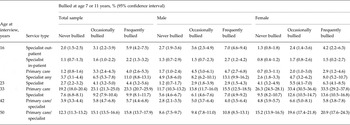
The prevalence of mental health service use for individuals who were frequently or occasionally bullied in childhood was greater than for those who were not bullied (Table 1). This trend was evident when looking at general, specialty and child and adolescent mental health service use. However, even those who were occasionally bullied in childhood had greater use of mental health services compared with those who were not bullied (except for specialist out-patient and in-patient services at age 16 years and mental health specialty service use at age 33 years). The associations between bullying victimization and service use were characterized by an age-related gradient: we observed greater disparity in service use associated with bullying victimization at younger ages compared with later, when individuals were farther away from the exposure of interest. Except for age 16 years, there was no difference in service use between those who were occasionally v. frequently bullied. Rates of service use varied by gender, with females having higher rates of mental health service use in adulthood and males having higher rates of service use in childhood and adolescence. Prevalence of service use according to bullying victimization is presented separately for males and females and the associations between bullying and service use were consistent within each gender (Table 1).
Prevalence of health service use for mental health problems, by gender (unadjusted)

Longitudinal trends of mental health service use according to bullying victimization
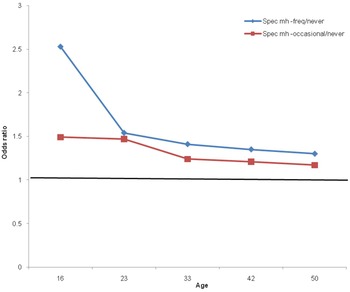
Bullying victimization was associated with mental health service use from age 16 up to age 50 years (Table 2): participants who were bullied, either occasionally or frequently, had a higher risk of using mental health services up to midlife compared with those who were not bullied. Fig. 1 also illustrates that the disparity between those participants who had been bullied or not in childhood was greatest at age 16 years, suggesting that the impact of bullying victimization on mental health service use was most pronounced at the time point closest to the exposure, and particularly for those who were frequently bullied. The higher risk of use of mental health services for individuals who were occasionally or frequently bullied in childhood decreased with age, but remained significant up to the age of 50 years. This association was also robust to controls for the potentially confounding effects of childhood IQ, socio-economic status of parents, low parental involvement, childhood emotional and behavioural problems, and childhood adversity (see online Supplementary Appendix S2 for details of the full model and adjusted OR for each covariate). Reassuringly, associations between covariates and service use identified here were similar to those found in the broader mental health literature in that females and those who experienced childhood adversity were more likely to use mental health services.
Odds ratio of the prevalence of specialty mental health (spec mh) service use for individuals who were frequently v. never bullied (freq/never) and occasionally v. never bullied (occasional/never).

Likelihood of health service use a for mental health problems over time, adjusted results based on logistic regression model b

OR, Odds ratio; CI, confidence interval.
a Where we have more than one measure of service use (ages 16 and 33 years), we included the measure indicating specialty mental health service use.
b Each logistic regression model controls for the following covariates which are also described in the Method and reported in online Supplementary Appendix S2: childhood intelligence quotient, socio-economic status of parents, low parental involvement, childhood emotional and behavioural problems in childhood and childhood adversity.
To provide an estimate of the magnitude of the association between bullying and mental health service use, in a separate model, we investigated the link between ever being ‘in care’ and mental health service use. The odds of mental health service use at age 50 years for individuals who were in care in childhood [OR 1.40, 95% confidence interval (CI) 1.02–1.94] were significantly greater than for individuals who had not been in care, but not significantly different in magnitude than for those who were bullied either occasionally or frequently (for example, frequently bullied v. not bullied: OR 1.30, 95% CI 1.10–1.55).
Incidence and persistence of mental health service use over the lifespan
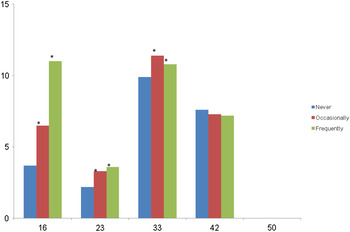
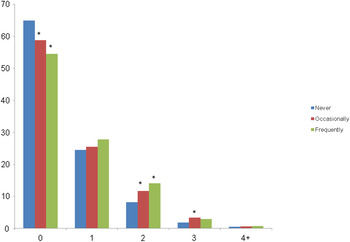
The persisting association between bullying victimization and mental health service use was not simply due to the same individuals using mental health services over time (Fig. 2); we observed new cases of mental health service use after childhood. There was a disparity in mental health service use at age 16 years according to bullying victimization, when the risk is greatest, but also at the ages of 23 and 33 years. By age 42 years, there were no differences in incidence of service use by bullying victimization and no new mental health service use was reported at age 50 years. Individuals who were occasionally or frequently bullied also showed more persistent service use over time than those who were not bullied, as indicated by the total number of reported mental health service use encounters across assessment periods (Fig. 3).
Incidence of service use (%) over time by bullying victimization; where we have more than one measure of service use (ages 16 and 33 years), we included the measure indicating specialty mental health service use.* Statistical significance (p < 0.05), relative to never bullied.

Persistence (%) of mental health service use encounters (0, 1, 2, 3 or 4+) over the lifespan by bullying victimization. * Statistical significance (p < 0.05), relative to never bullied.

Discussion
Being bullied in childhood has previously been shown to be associated with poor mental health up to midlife. In this study, using a large prospective British birth cohort, we show that childhood bullying victimization is also associated with a long-term impact on mental health service use through to midlife. This has important implications for an already stretched healthcare system, given the durability of the impact we identified over time. The impact on mental health services is most notable at an early age, as would perhaps be expected, but the association remains significant at age 50 years, despite controlling for established correlates of bullying victimization and mental health problems. Increased service use among those who experienced childhood bullying victimization resulted from individuals with early-onset mental health problems who continued to use services over their lifetime, in addition to some new cases who started using mental health services in their 20s and 30s. As a result, our study suggests that, in addition to reducing suffering, actions to prevent bullying in childhood and adolescence could reduce some of the pressures on healthcare resources.
The persistence of the association between childhood bullying victimization and mental health service use across nearly four decades, although diminishing over time, is surprising and deserves further attention. This long-term effect might reflect at least two different processes. First, half of the adult population with a psychiatric disorder already show signs of poor mental health by the age of 15 years (Kim-Cohen et al. Reference Kim-Cohen, Caspi, Moffitt, Harrington, Milne and Poulton2003). If unnoticed or untreated, early onset of mental health problems could be the starting point of persistent disorders, especially those childhood and adolescent mental health problems known to be associated with bullying victimization, including depression and anxiety (Arseneault et al. Reference Arseneault, Milne, Taylor, Adams, Delgado, Caspi and Moffitt2008; Bowes et al. Reference Bowes, Wolke, Joinson, Lereya and Lewis2014), self-harm (Fisher et al. Reference Fisher, Moffitt, Houts, Belsky, Arseneault and Caspi2012; Lereya et al. Reference Lereya, Winsper, Heron, Lewis, Gunnell, Fisher and Wolke2013), suicidality (Geoffroy et al. Reference Geoffroy, Boivin, Arseneault, Turecki, Vitaro, Brendgen, Renaud, Séguin, Tremblay and Côté2016), and psychotic disorders (Arseneault et al. Reference Arseneault, Cannon, Fisher, Polanczyk, Moffitt and Caspi2011; van Dam et al. Reference van Dam, van der Ven, Velfhorst, Selten, Morgan and de Haan2012). Second, bullying victimization may set the conditions for a cycle in which people become at risk of exposure to further abuse in later life (Dodge et al. Reference Dodge, Bates and Pettit1990). The cumulative effect of being repeatedly exposed to victimization – and its detrimental effect on wellbeing – may push some individuals to seek help for mental health problems only when they transition to early adulthood. This pathway may also be exacerbated by the poor social outcomes associated with childhood bullying victimization, such as marital failure and poor employment outcomes (Goodman et al. Reference Goodman, Joyce and Smith2011; Knapp et al. Reference Knapp, King, Healey and Thomas2011).
Overall, we did not find that bullying victimization increased mental health service use more specifically for boys or girls. However, we observed that boys showed higher levels of mental health service use at age 16 years compared with girls. This difference probably reflects the key role that adults play in recognizing, referring and engaging with mental health services and the higher rates of externalizing symptoms among young boys (Costello et al. Reference Costello, Pescosolido, Angold and Burns1998; Stiffman et al. Reference Stiffman, Pescosolido and Cabassa2004), whereas, later on, men seek care on their own behalf. In agreement with previous research, our study also indicates higher rates of mental health service use among females compared with males in adulthood. This may be due to stigma associated with mental health problems among men or their inability to recognize feelings of distress and seek help (Wang et al. Reference Wang, Aguilar-Gaxiola, Alonso, Angermeyer, Borges, Bromet, Bruffaerts, de Girolamo, de Graaf, Gureje, Haro, Karam, Kessler, Kovess, Lane, Lee, Levinson, Ono, Petukhova, Posada-Villa, Seedat and Wells2007; Mojtabai, Reference Mojtabai2010; Evans-Lacko et al. Reference Evans-Lacko, Corker, Williams, Henderson and Thornicroft2014).
Limitations
This study was based on a large nationally representative cohort with data from face-to-face interviews with participants and their families across five decades. The impact of childhood bullying victimization on mental health service use at midlife was robust to controls for a number of factors we know to be associated with mental health problems, and is consistent with our previous studies showing an association with mental and physical health problems despite considering the confounding effects of several key variables. Nevertheless, the study has a number of limitations. First, attrition is notable over the 50-year assessment period. It is unlikely that this affected our findings; however; we showed previously that dropout was unrelated to bullying victimization (Takizawa et al. Reference Takizawa, Maughan and Arseneault2014) and other observable attributes (Hawkes & Plewis, Reference Hawkes and Plewis2006). Furthermore, we controlled for other effects of selective attrition by including inverse probability weights throughout the analyses. Second, the service use measures may be vulnerable to recall bias. Although it was not possible to verify interview reports of service use with medical records, past research has shown good agreement between self-reports and hospital and emergency service use over the lifetime (Horwitz et al. Reference Horwitz, Hoagwood, Stiffman, Summerfeld, Weisz, Costello, Rost, Bean, Cottler, Leaf, Roper and Norquist2001). Reliability of reports of out-patient visits is lower; however, moderate to high agreement has been shown for reports of out-patient visits over a 1-year period (Horwitz et al. Reference Horwitz, Hoagwood, Stiffman, Summerfeld, Weisz, Costello, Rost, Bean, Cottler, Leaf, Roper and Norquist2001), and self-report is considered an acceptable method for collecting service use data (Patel et al. Reference Patel, Rendu, Moran, Leese, Mann and Knapp2005). Third, interview questions about service use varied across assessments (i.e. at different ages), rendering direct comparisons of utilization over time difficult. Nevertheless, the assessment of a variety of types of mental health service use at different ages allowed us to validate the impact of bullying victimization across mental health service settings and life stages. Service use for drug and alcohol problems, however, was only covered up to age 42 and not at age 50 years. Fourth, and by the same token, our assessment of service use was not comprehensive and most probably did not capture all types of mental health service use – although we report on the most common ones. Moreover, we did not have data on the intensity of mental health service use. Finally, although participants were representative of UK births in 1958, the cohort lacks the ethnic diversity currently found in the UK (Power & Elliott, Reference Power and Elliott2006) and may not accurately represent patterns of service use today.
Bullying is widespread among primary and secondary school students (Gilbert et al. Reference Gilbert, Widom, Browne, Fergusson, Webb and Janson2009; Finkelhor et al. Reference Finkelhor, Turner, Shattuck and Hamby2015). Attention to this issue has been growing in policy and related discussions; for example, bullying was referred to 72 times in the Chief Medical Officer's report for 2013, highlighting it as an issue of particular importance and in need of expert attention (Davies & Mehta, Reference Davies and Mehta2014). Our study showed that childhood bullying victimization adds to the pressure on a healthcare system which is already stretched, as bullying victimization was associated with long-term effects on service use through to age 50 years. Anti-bullying initiatives are relatively inexpensive and offer good value for money (Beecham et al. Reference Beecham, Byford, Kwok, Parsonage, Knapp, McDaid and Parsonage2011). One model developed for the National Institute for Clinical Excellence estimated that a school-based anti-bullying initiative costs around £15.50 per pupil, per year (Hummel et al. Reference Hummel, Naylor, Chilcott, Guillaume, Wilkinson, Blank, Baxter and Goyder2009). Given the tremendous current strain on the healthcare system, specific policy and practice efforts to prevent bullying could not only reduce individual suffering over many years, but also help to contain or even reduce costs.
Supplementary material
The supplementary material for this article can be found at http://dx.doi.org/10.1017/S0033291716001719
Acknowledgements
There was no funder which specifically supported this paper, although N.B.'s time was funded from a National Institute for Health Research Senior Investigator award to M.K.; R.T. is a Newton International Fellow Alumnus funded by the Royal Society, the British Academy and through a Grant-in-Aid for Scientific Research (B) (JSPS KAKENHI Grant Number JP16H05653) from the Japanese Society for the Promotion of Science (JSPS); S.E.-L. currently holds a Starting Grant from the European Research Council (337673). The authors had final responsibility for the decision to submit for publication. The funders played no part in the design or conduct of the study, the analysis or interpretation of data, or the writing of the article and the decision to submit it for publication.
Declaration of Interest
None.