The worldwide birth prevalence of congenital heart disease stabilized over the last two decades to 9.2 per 1000 births.Reference van der Linde, Konings and Slager1 Survival into adulthood improved remarkably, as a result of medical progress and a more advanced organization of care. In addition, survival in adults with congenital heart disease has benefited from general healthcare improvements. The largest mortality reductions were observed in patients with severe lesions.Reference Khairy, Ionescu-Ittu and Mackie2 Consequently, the adult patient population is rapidly expanding. Marelli et al reported an 85% increase in prevalence between 1985 and 2000, Reference Marelli, Mackie, Ionescu-Ittu, Rahme and Pilote3 and a further 57% increase in the first decade of the 21st century.Reference Marelli, Ionescu-Ittu and Mackie4 Adult patients now outnumber pediatric patients by two to one.Reference Marelli, Ionescu-Ittu and Mackie4
The majority of adults with congenital heart disease cannot be considered to be cured. The disease is characterized by a chronic course and morbidity and mortality risks are still high compared to the general population.Reference Verheugt, Uiterwaal and van der Velde5, Reference Greutmann, Tobler and Kovacs6 Therefore, adult congenital heart disease programs have been developed to periodically follow up on patients, in order to detect potential health problems at an early stage and to deal appropriately with recurrent care needs.Reference Moons, Meijboom and Baumgartner7 The increased prevalence together with the need for follow-up is expected to lead to an increase in healthcare utilization.
A good understanding of healthcare utilization of adult patients is necessary to develop appropriate healthcare structures. One recent scoping reviewReference Seckeler, Thomas, Andrews, Joiner and Klewer8 already provided a brief description of some aspects of healthcare utilization but a comprehensive systematic literature overview is lacking. Therefore, the current systematic review aims to present the trends over the past decades of real-world medical resource utilization as well as its current status, with a particular focus on hospitalizations, emergency department visits, outpatient cardiology visits, and visits to other healthcare professionals.
Materials and methods
Search strategy
Three bibliographical databases, MEDLINE (via Pubmed), Embase (via embase.com) and Web of Science Core Collection (via Web of Science), were searched for scientific publications as of 19 December, 2017. The applied search strategy consisted of patient population-related keywords (adult, grown-up, congenital, heart, cardiac, disease, defect, achd, and guch) in combination with keywords to identify relevant articles on resource utilization (health, healthcare, utilization, resources, hospitalization, admission, readmission, and visits). The search strategy was modified to the particular databases’ properties and can be found in Supplementary Table S1.
Eligibility criteria
Studies were eligible for this review if they complied with the following inclusion criteria:
The publication describes a population of patients in a real world context. Adulthood is defined as 18 years and older, or patients who have already transitioned from the pediatric clinic to the specialized adult congenital heart center. Age at transition differs across countries, and it is always individual dependent.
The publication includes a description of medical resource utilization. Resource utilization is defined as hospitalization, emergency department visits, outpatient cardiology visits, or other healthcare use (such as general practitioner visits).
Medical resource utilization is reported as a rate (e.g., a number of hospitalizations per patient year), a percentage (e.g., % of patients who are hospitalized during a given time period) or absolute numbers at more than one point in time (e.g., number of hospitalizations in 2010 and 2011).
A retrospective database research was conducted.
The manuscript was written in English, Dutch, or French.
Studies with a mixed sample of pediatric and adult patients were excluded if the reported results were not age stratified. Studies were also excluded if the patient population was defined based on a specific complication (e.g., patients with arrhythmia or patients with heart failure). However, studies describing medical resource utilization stratified for the lesion’s complexity grade (e.g., single ventricle patients) were included. No restriction was applied on the date of publication. The corresponding author was contacted if the full text article was not accessible online.
Data extraction
Two reviewers (R.W. and A.W.) independently reviewed all titles and abstracts of candidate publications. Discrepancies were discussed until consensus was reached. Eligible full texts were screened by the former (R.W.). The following predetermined information was retrieved from the included studies:
General information: study year, country, funding, conflict of interest, study design, database, study’s time period.
Population characteristics: lesion type, sample size, age, gender, disease distribution, complexity distribution (mild, moderate, severe, undefined), complexity definition (e.g., 32nd Bethesda conference), morbidity, and mortality.
Clinical characteristics: e.g., teaching status, tertiary center, acute center, rural/urban center.
Medical resource utilization: hospitalization, emergency department visits, outpatient physician visits, and other healthcare seeking behaviour.
In order to improve the comparability between studies, we recalculated the increase in medical resource utilization over time to a “percentage increase per year”. We stratified results for mild, moderate, and severe lesions as defined by Task Force 1 of the 32nd Bethesda Conference.Reference Warnes, Liberthson and Danielson9
Quality appraisal
As the selected studies were based on retrospective database research, the ISPOR checklist for retrospective database studiesReference Motheral, Brooks and Clark10 was used for quality appraisal. This checklist was initially developed for, but it is not limited to, medical claims or encounter-based databases. Studies based on disease registries or national survey databases can potentially be assessed as well.Reference Motheral, Brooks and Clark10 A score of “1”, “0” or “not applicable” was assigned to each question. The average score is an indication of the quality of the study. Two authors (R.W. and A.W.) independently assessed one article. Discrepancies were discussed until consensus was reached by defining the assessment criteria (Supplementary Table S2). The former (R.W.) subsequently assessed all remaining articles.
Results
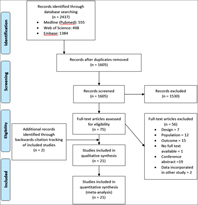
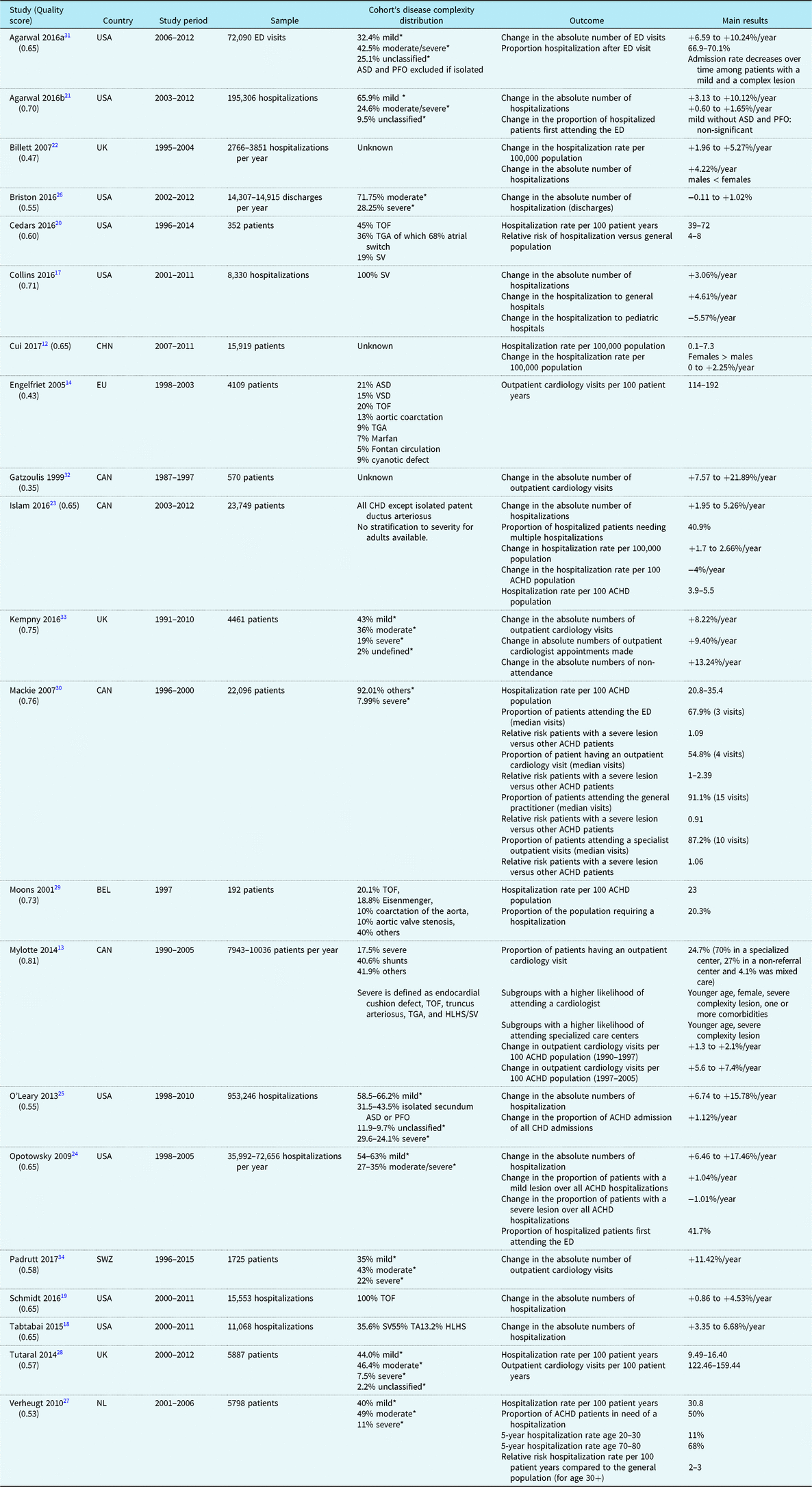
Figure 1 displays the selection process’ flow chart. After removal of duplicate records, 1605 articles were screened by title and abstract. Seventy-five articles were found eligible for full text screening. One article was not screened, as the full text could not be retrieved.Reference Harrison, Silversides, Oechslin and Kovacs11 Two additional articles were found by the snowball search method.Reference Cui, Zhao and Sun12, Reference Mylotte, Pilote and Ionescu-Ittu13 Three articles reported on the same study population.Reference Engelfriet, Boersma and Oechslin14–Reference Hoffmann, Engelfriet and Mulder16 Only one of these three articles, covering all relevant information, was selected for inclusion.Reference Engelfriet, Boersma and Oechslin14 Twenty-one articles in total fitted the inclusion criteria (Table 1).
Prisma flow diagram.

Study characteristics
The included studies were published between 1999 and 2017. Respectively nine, four, and seven studies originated in the United States of America, Canada, and Western Europe. Only one Chinese study was included. The majority of the studies (71%) reported on hospitalizations; one third of the included studies reported on outpatient cardiology visits; five studies examined emergency department visits; one study described visits to other healthcare providers. Most studies included samples with a broad range of CHD types. Two studies focused on patients with a single ventricle,Reference Collins, Doshi, Onukwube, Fram and Robbins17, Reference Tabtabai, DeFaria Yeh and Stefanescu18 one study focused on patients with tetralogy of Fallot,Reference Stefanescu Schmidt, DeFaria Yeh and Tabtabai19 and one study focused on patients with a single ventricle, tetralogy of Fallot, or corrected transposition of the great arteries (mainly atrial switch).Reference Cedars, Benjamin and Vyhmeister20
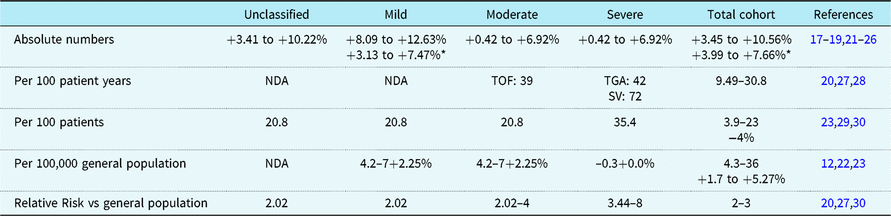
We identified four methods in the reporting of medical resource utilization. The first two categories reflect the prevalence of the growing population and its impact on the broad community. The last two categories focus on the care provided to the adult congenital heart disease population and reflect the evolution of medical management (Table 2):
(i) in absolute numbers: the total number of instance hospitalizations in a defined time period (usually a year).
(ii) per 100,000 general population: this measurement reflects for instance the impact of adult congenital heart disease-related hospitalizations on the total population in a defined time period. The absolute number of hospitalizations (numerator) is divided by the total population (denominator) and multiplied by 100,000.
(iii) per 100 patients: this measurement divides for instance the absolute number of hospitalizations (numerator) by the number of adult congenital heart disease patients (denominator) in a defined time period and is then multiplied by 100.
(iv) per 100 patient years: this measurement is similar to the “per 100 patient” –measurement but also takes mortality into account.
Overview of the included studies

* =defined by the 32nd Bethesda Conference. ASD: atrium septal defect; BEL: Belgium; CAN: Canada; CHD: congenital heart disease; CHN: China; EU: Europe; HLHS: hypoplastic left heart syndrome; NL: the Netherlands; SV: single ventricle; SWZ: Switzerland; TA: tricuspid atresia; TGA: transposition of the great arteries; TOF: Tetralogy of Fallot; UK: United Kingdom; VSD: ventricle septal defect; USA: United States of America
Percentage increase in hospitalizations per year and hospitalization rates, stratified for lesion’s complexity grade

Mild/moderate/severe classification is based, in most papers, on the 32nd Bethesda Conference classification.
Percentages are stated as yearly increases.
* Exclusion of patients with an atrial septal defect or a patent foramen ovale.
TGA: transposition of the great arteries; TOF: tetralogy of Fallot; SV: single ventricle;
NDA: no data available
Hospitalization
Absolute numbers
Most studies described a rapidly growing hospitalization burden in adults with congenital heart disease. In the last two decades, hospitalization increased 3.45–10.56% per year. The exclusion of patients with an atrial septal defect or a patent foramen ovale shows more modest, though still high, estimates up to 7.66% per year.Reference Agarwal, Sud and Menon21–Reference O’Leary, Siddiqi, de Ferranti, Lanzberg and Opotowsky25 Some evidence indicated a declining growth rate of hospital admissions in more recent times.Reference Tabtabai, DeFaria Yeh and Stefanescu18, Reference Stefanescu Schmidt, DeFaria Yeh and Tabtabai19
Hospitalization numbers of patients with mild lesions increased 8.09–12.63% per year.Reference Agarwal, Sud and Menon21, Reference Opotowsky, Siddiqi and Webb24, Reference O’Leary, Siddiqi, de Ferranti, Lanzberg and Opotowsky25 As previously mentioned, these numbers are largely driven by hospitalizations of patients with an atrial septal defect or a patent foramen ovale (for defect closure). Excluding these patients, reported yearly increases were 3.13–7.47%.Reference Agarwal, Sud and Menon21, Reference Opotowsky, Siddiqi and Webb24 One study from the United Kingdom of moderate and severe lesion-related hospitalizations found small yearly increases of only 0.42%.Reference Briston, Bradley, Sabanayagam and Zaidi26 All other studies reported a yearly 2.86–6.92% rise in the hospitalization of patients with moderate and severe lesions.Reference Collins, Doshi, Onukwube, Fram and Robbins17–Reference Stefanescu Schmidt, DeFaria Yeh and Tabtabai19, Reference Agarwal, Sud and Menon21, Reference Opotowsky, Siddiqi and Webb24–Reference Briston, Bradley, Sabanayagam and Zaidi26 Hospitalization numbers of patients with an unclassified lesion increased 3.41–10.22% per year.Reference Agarwal, Sud and Menon21, Reference Opotowsky, Siddiqi and Webb24–Reference Briston, Bradley, Sabanayagam and Zaidi26 A growing proportion of all adult congenital heart disease-related hospitalizations can be attributed to the hospitalization of patients with mild lesions, with the proportion increasing by 1.04% per year in absolute terms. However, when excluding patients with an atrial septal defect and a patent foramen ovale, the proportion remained invariable over time with mild lesions accounting for 39% of all hospitalizations.Reference Opotowsky, Siddiqi and Webb24
Hospitalizations of geriatric (+65) patients increased at a higher yearly pace (5.26% versus 1.95 and 2.66% in age categories 18–39 and 40–64 years, respectively).Reference Islam, Yasui, Kaul, Marelli and Mackie23 Additionally, the number of single ventricle patients admitted to pediatric hospitals is decreasing (–5.57% per year) while admissions to general hospitals are increasing (+4.61% per year).Reference Collins, Doshi, Onukwube, Fram and Robbins17
Per 100,000 general population
Males across different age categories (25–44, 45–64 and 65+ years) were significantly less frequently hospitalized than females in 2004 (12.4 versus 14.5, 11.9 versus 12.0, and 6.4 versus 7.2, respectively).Reference Billett, Majeed, Gatzoulis and Cowie22 A Chinese study reported lower hospitalization rates per 100,000 population, but hospitalization was also remarkably more frequent in females (7.3 versus 4.3).Reference Cui, Zhao and Sun12
The hospitalization rate increased 3.3–5.3% per year over an 8-year period, depending on age category and gender. The hospitalization rate in geriatric males increased only by 2% per year.Reference Billett, Majeed, Gatzoulis and Cowie22 A slower trend was observed by Islam et alReference Islam, Yasui, Kaul, Marelli and Mackie23, reporting a 1.7, 1.0, and 2.5% yearly increase in age categories 18–39, 40–64 and 65+ years, respectively, and by Cui et alReference Cui, Zhao and Sun12, who reported a 2.1% yearly increase in the total cohort.
Per 100 patients
A little more than one in five Belgian adults with congenital heart disease was hospitalized over a one-year timeframe; 27.9% of these patients had multiple hospitalizations.Reference Moons, Siebens and De Geest29 Other research reported hospitalizations in half of all Dutch patients, of which 60% needed multiple hospitalizations over a 5-year timeframe.Reference Verheugt, Uiterwaal and Van Der Velde27 Per 100 patients, 21.4 and 23 hospitalizations were reported amongst Canadian and Belgian patients, respectively.Reference Moons, Siebens and De Geest29, Reference Mackie, Pilote, Ionescu-Ittu, Rahme and Marelli30 On the contrary, another Canadian study reported a hospitalization rate of only five hospitalizations per 100 patients. Substantially, fewer patients needed multiple hospitalizations over a longer timeframe (41% over 10 years). In addition, they found a yearly 4% decrease in hospitalization rate.Reference Islam, Yasui, Kaul, Marelli and Mackie23 Adults with congenital heart disease required 108% more hospitalizations than the general population. The hospitalization rate in severe complexity patients was 244% higher.Reference Mackie, Pilote, Ionescu-Ittu, Rahme and Marelli30
Per 100 patient years
The hospitalization rate per 100 patient years is generally higher than the hospitalization rate per 100 patients, as it accounts for mortality. A Dutch study reported 30.8 hospitalizations per 100 patient years,Reference Verheugt, Uiterwaal and Van Der Velde27 but a British study reported hospitalization rates two to three times lower.Reference Tutarel, Kempny and Alonso-Gonzalez28 The hospitalization rate increased with increasing ageReference Verheugt, Uiterwaal and Van Der Velde27, Reference Tutarel, Kempny and Alonso-Gonzalez28 and higher complexity of the lesion, with single ventricle patients recording 72 hospitalizations per 100 patient years, eight times higher than the general population.Reference Cedars, Benjamin and Vyhmeister20 Moreover, a two-to-threefold higher hospitalization risk for the overall cohort is reported.Reference Verheugt, Uiterwaal and Van Der Velde27
Emergency department
In a study by Mackie et al,Reference Mackie, Pilote, Ionescu-Ittu, Rahme and Marelli30 67.9% of the patients visited the emergency department over a 5-year timeframe, with a median of three visits. The likelihood to attend an emergency department was 9% higher in patients with severe or moderate lesions compared to mild and unspecified lesions.Reference Mackie, Pilote, Ionescu-Ittu, Rahme and Marelli30 However, the gap might be gradually closing as the absolute number of emergency department visits in patients with mild (7.05% per year) and unspecified (10.24% per year) lesions was growing more rapidly between 2006 and 2012 compared to patients with severe or moderate lesions (6.59% per year).Reference Agarwal, Sud and Khera31 70 and 66.9% of patients with mild lesions and severe lesions, respectively, attending the emergency department between 2006 and 2012 were subsequently hospitalized. Hospitalization rates after emergency department visit relatively declined by approximately 1.30% per year in both patients with severe and a mild lesions. Patients with severe lesions were however more often transferred to another hospital.Reference Agarwal, Sud and Khera31
Conversely, over 40% of patients hospitalized between 1998 and 2005 visited the emergency department a priori,Reference Agarwal, Sud and Menon21, Reference Opotowsky, Siddiqi and Webb24 and this proportion is increasing over time for both patients having either a mild or a severe lesion. The significant proportional increase in patients with mild lesions can be entirely attributed to the vast increase in hospitalized patients with an atrial septal defect or a patent foramen ovale, admitted through the emergency department.Reference Agarwal, Sud and Menon21
Outpatient cardiology visits
Absolute numbers
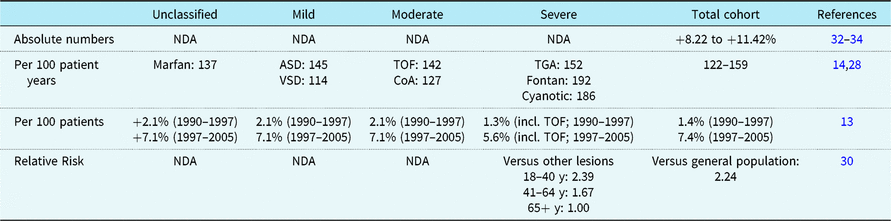
A major increase in the number of outpatient visits over the last three decades is generally noted by single-center studies (Table 3). A Canadian study reported an 11.20% yearly increase of outpatient visits to their clinic between 1987 and 1997.Reference Gatzoulis, Hechter, Siu and Webb32 A British study reported a yearly 8.22% increase between 1991 and 2010. However, little growth in outpatient visits was observed between 2006 and 2010.Reference Kempny, Diller and Dimopoulos33 A Swiss study reported similar results: the number of outpatient visits substantially increased until 2005. Thereafter, little growth was observed until 2010, after which further sharp growth was observed.Reference Padrutt, Bracher and Bonassin34 Moreover, an even higher increase was noticed in the number of appointments made in the United Kingdom but clinicians there also encountered a rise in no-shows.Reference Kempny, Diller and Dimopoulos33
Percentage increase in outpatient cardiology visits per year and number of outpatient cardiology visits, stratified for lesion’s complexity grade

Mild/moderate/severe classification is based, in most papers, on the 32nd Bethesda Conference classification.
Percentages are stated as yearly increases.
ASD: Atrial Septal Defect; CoA: Coarctation Aorta; TGA: Transposition of the Great Arteries; TOF: Tetralogy of Fallot; VSD: Ventricular Septal Defect;
ACHD: adults with congenital heart disease; NDA: no data available.
Per 100 patients
Outpatient visits to specialized centers per 100 patients increased steadily (1.4% per year) before the inflexion point in 1997. Afterwards, a yearly 7.4% increase per 100 patients was noted.Reference Mylotte, Pilote and Ionescu-Ittu13 A quarter of all Canadian patients made an outpatient cardiology visit in 2005, of which 70% were to a specialized center.Reference Mylotte, Pilote and Ionescu-Ittu13 Younger patients and patients with severe lesions are more prone to make an outpatient visit to a specialized center. On the other hand, younger patients make less outpatient cardiology visits in general (not only to specialized centers), as do patients with less severe lesions.Reference Mylotte, Pilote and Ionescu-Ittu13 However, an interaction between age and severity was noticed.Reference Mackie, Pilote, Ionescu-Ittu, Rahme and Marelli30 Patients with severe lesions were 139% more likely to visit outpatient cardiology services in young adulthood (18–40 years) compared to other patients. A decrease was noticed in middle-aged patients (41–64 years) but the likelihood remained 67% higher. No significant difference was observed in late adulthood.Reference Mackie, Pilote, Ionescu-Ittu, Rahme and Marelli30
Per 100 patient years
Engelfriet et alReference Engelfriet, Boersma and Oechslin14 reported an average of 144 visits per 100 patient years between 1998 and 2003 in the Netherlands. These results were confirmed by a study in the United Kingdom spanning the 2000 to 2012 time period. Young adults (20–40 years), middle-aged adults (41–60 years), and older patients (60+ years) undertook 122, 145, and 159 visits per 100 patient years, respectively.Reference Tutarel, Kempny and Alonso-Gonzalez28 Outpatient cardiology visits are associated with diseased complexity: single ventricle patients visited their cardiologist nearly 200 times per 100 patient years, while patients having a ventricular septal defect made 114 visits per 100 patient years.Reference Engelfriet, Boersma and Oechslin14
Other healthcare visits
The frequency of visits to a general practitioner was mentioned in only one Canadian study. Ninety-one percent of the included patients visited their general practitioner over a 5-year timeframe. Half of the patients made at least 15 visits (IQR 7–27). Patients with severe lesions were 9% (CI 4–13%) less likely to visit a general practitioner compared to other patients.Reference Mackie, Pilote, Ionescu-Ittu, Rahme and Marelli30 The same study reported on outpatient specialist visits, other than cardiology visits. 87% of the patients visited a specialist medical doctor with a median of 10 visits over 5 years (IQR 4–22). Severe complexity patients were 6% (CI 0–12%) more likely to visit other medical specialists compared to other patients.Reference Mackie, Pilote, Ionescu-Ittu, Rahme and Marelli30 Age was unrelated to both healthcare provider consultations (general practitioner and medical specialists).Reference Mackie, Pilote, Ionescu-Ittu, Rahme and Marelli30 Unfortunately, no trends of other types of healthcare consultations have yet been reported in retrospective database research.
Discussion
This systematic review summarizes the high and changing healthcare demands of adult congenital heart disease patients. We noticed high annual increases in the absolute number of hospitalizations and the hospitalization rate per 100,000 general population. These two measurements reflect the expanding patient population. Simultaneously, the hospitalization rate per 100 patient/patient-years appears to be decreasing over time. These measurements can be seen as proxies for improved medical management. Indeed, a strong increase in outpatient cardiology visits can be observed over the past 30 years.
Our findings are relevant from a health policy point of view. Even though undeniably remarkable improvements are being made, current long-term medical management can only address part of the healthcare needs of the described patient population. Currently observed trends in emergency department visits support this thesis: emergency department visits and unplanned hospitalizations are increasing substantially in adults with congenital heart disease. Tang et alReference Tang, Stein, Hsia, Maselli and Gonzales35 reported a 2.10% yearly increase in emergency department visits in the general population, while the increase in emergency department visits of adults with congenital heart disease is observed to be three to four times higher. Meanwhile, the proportion of hospitalized patients who first visited the emergency department is increasing. The number of hospitalizations after an emergency department visit is thus growing faster than hospitalization after an outpatient cardiology visit. In other words, the number of unscheduled hospitalizations is growing faster than the number of scheduled hospitalizations. An even closer, systematical follow-up at outpatient services may mitigate the high (unplanned) hospitalization burden. This is of paramount importance to maintain a sustainable healthcare system in a patient population expected to continue to grow,Reference Wren and O’sullivan36 although some evidence suggests a decreased pace of increasing hospitalization numbers in more recent times.
The growth in absolute numbers of hospitalizations is highest in patients with mild lesions. Hospitalization trends in patients with mild and moderate lesions are of at least comparable magnitude to those in patients with severe lesions, even after exclusion of patients with an atrial septal defect or a patent foramen ovale. Similar patterns can be observed in emergency department visits and related hospitalization. One explanation of the significantly higher hospitalization rate after an emergency department visit in patients with mild lesions might be a less established follow-up structure. Patients with more complex lesions have more outpatient contact points, consistent with published guidelines dictating a higher follow-up frequency with growing complexity.Reference Landzberg, Murphy and Davidson37–Reference Baumgartner, Bonhoeffer and De Groot39 It will be necessary to explore optimal contact frequency and referral strategies to improve long-term care of patients with less complex lesions, particularly since the positive effect of referral to specialized centers on mortality is mainly found in patients with severe lesions.Reference Mylotte, Pilote and Ionescu-Ittu13 Nonetheless, the risk of an adverse outcome (such as a permanent loss of cardiac function) is also higher in patients with mild or moderate lesions managed at a non-specialized center. General cardiologists tend to deviate from the guidelines more often than pediatric and adult congenital heart disease-trained cardiologists.Reference Cordina, Nasir Ahmad and Kotchetkova40 Therefore, all patients should be seen by a specialized cardiologist at least once and thereafter, a shared care model with a general cardiologist should be established.Reference Baumgartner, Bonhoeffer and De Groot39
The trends described above can also be explained by technology advances, which may explain for example the high hospitalization increase (after emergency department visit) in patients with an atrial septal defect or a patent foramen ovale. A substantial number of patients admitted with ischemic cerebrovascular events are expected to be categorized in the patent foramen ovale cohort. Although accessibility to percutaneous interventions improved since the turn of the century,Reference Opotowsky, Siddiqi and Webb24 it is still debatable whether patent foramen ovale closure (in combination with antiplatelet therapy), anticoagulation therapy, or antiplatelet therapy alone is the preferred therapy after stroke. Patent foramen ovale closure may reduce the occurrence of subsequent ischemic stroke, but it may also cause atrial fibrillation and device complications.Reference Sondergaard, Kasner and Rhodes41–Reference Saver, Carroll and Thaler43 However, from an economic perspective, patent foramen ovale closure appears to be the most cost-effective option.Reference Pickett, Villines, Resar and Hulten44, Reference Hildick-Smith, Turner and Shaw45 Hence, we can expect a further increase of hospitalizations in patients with mild lesions.
Geriatric patients are a newly emerging patient population, with the highest hospitalization rates and the highest outpatient cardiology visits per 100 patient years. However, the literature indicates that they have fewer outpatient cardiology visits at specialized centers compared to younger adult patients. This might be caused by the fact that, although the first specific adult congenital care programmes were established in the sixties, the exponential growth in programmes was only observed between 1990 and 2000.Reference Moons, Meijboom and Baumgartner7 Geriatric patients might thus currently be followed up at a less specialized, less appropriate care level. A second valid explanation is the higher mortality risk in severe lesions, leading to higher proportions of mild lesions in the elder population.Reference Zomer, Vaartjes and Uiterwaal46 Conversely, age-related comorbiditiesReference Tutarel47 might urge specialized follow-up in geriatric patients, irrespective of the lesion’s complexity grade.
The reliance on medical resource use seems to be higher in females, although results on gender disparities are inconclusive. One explanation might be the impact of pregnancy on the cardiovascular and respiratory systems. Close pregnancy management is of utmost importance to limit health risks.Reference Shum, Gupta, Canobbio, Durst and Shah48 The higher hospitalization rate in females reflects the observed hospitalization patterns in the general population, even after exclusion of maternal stays.Reference Weiss and Elixhauser49 Hence, pregnancy alone may not account for the differences in medical resource use. Second, biological sex differences (such as a lower body weight and narrower arteries in females) may impact morbidity and mortality in adulthood. Pulmonary hypertension for instance is known to be more frequent in females,Reference Verheugt, Uiterwaal and van der Velde50, Reference Oliver, Gallego and Gonzalez51 possibly affecting hospitalization patterns. Lower compliance to treatment in females is a less likely explanation, as data published by White et alReference White, Pardue and Ludbrook52 indicated lower compliance rates in males.
Literature on patients’ visits to a general practitioner and non-cardiology specialists is scarce. We found only one retrospective database study examining general practitioner visits and other healthcare provider visits. About 91 and 87% of all patients did consult a general practitioner and other medical specialists over a 5-year period, respectively. Patients with severe lesions made less general practitioner visits and more specialist visits compared to other patients. In addition to retrospective database research, a Dutch cross-sectional survey study reported general practitioner visits in 40% of all patients in the past year. A wide range of additional medical healthcare providers were consulted by patients but only outpatient contact with a nurse, physical therapist, and thrombosis specialist occurred in more than 10% of all adults with congenital heart diseases.Reference Schoormans, Sprangers and Pieper53, Reference Schoormans, Sprangers and van Melle54
It is possible that research subjects and regions show linkages in these observations. Half of the studies on hospitalization were conducted in the United States of America, two in Canada, four in Europe, and one in Asia. Three of the studies on emergency department visits were conducted in the United States of America, and one in Canada. Three of the studies on outpatient cardiology visits were conducted in Canada, three in Europe, and none in the United States of America. Replication of research in different countries can provide us with new insights on how healthcare systems may impact patients’ medical resource seeking. In fact, differences in hospitalization patterns even occur within one country, as we have noted in Canada.Reference Islam, Yasui, Kaul, Marelli and Mackie23, Reference Mackie, Pilote, Ionescu-Ittu, Rahme and Marelli30 At last, we found low hospitalization numbers in China compared to European and American hospitalization numbers,Reference Cui, Zhao and Sun12 possibly reflecting cultural, genetic, or healthcare system differences.
Limitations
Six limitations were identified. First, we did not analyze additional characteristics of hospitalization or outpatient visits. A hospitalization for instance can be characterized by the length of stay, the intensive care unit stay, and the number of interventions performed. There is a need to assess how the length of stay evolved over time or to assess in how many hospitalizations surgery occurred. A second limitation is that we did not link the change in, and frequency of, medical resource use to costs. The financial impact of this quickly evolving patient population on healthcare systems is of paramount importance and should be closely monitored. Third, several database studies included made use of ICD-9 classification to determine the study sample. It was therefore not feasible to distinguish between atrial septal defect and patent foramen ovale as they share a common code. Fourth, the interpretation of emergency department-related hospitalization rates must be made with caution. In some countries, it may reflect how the healthcare system is working, rather than reflecting the disease’s severity. Fifth, future research should investigate in which department the hospitalizations took place (cardiology versus other). Sixth, we only included retrospective administrative database studies. Database studies have several disadvantages (e.g., data are not primarily gathered to answer the study’s research questions, administrative data are prone to miscoding, and coding principles might change over time).55 However, one of our inclusion criteria was on study design since databases contain real world data and is thus representative of the population of interest.55
Conclusion
Lifetime medical resource use in congenital heart disease patients can be plotted as a U-curve with very high resource use in early childhoodReference Billett, Majeed, Gatzoulis and Cowie22, Reference Islam, Yasui, Kaul, Marelli and Mackie23, Reference Simeone, Oster and Hobbs56 and higher resource use in late compared to middle and young adulthood. The fact that improved efficiency levels cannot compensate for a growing population calls for improved long-term care models and for determinants of the optimal care level. In this review, we focused on retrospective database research. Scientific knowledge generated by retrospective analyses of databases may enhance specialized cardiologists’ abilities to determine the appropriate referral level for patients with varying complexity lesions. Furthermore, the scope of future research should expand beyond hospitals and explore the burden adults with congenital heart disease exerts on the broad healthcare sector.
Author ORCID
Ruben Willems 0000-0001-8732-9455
Supplementary Material
To view supplementary material for this article, please visit https://doi.org/10.1017/S1047951119000441.
Acknowledgements
None.
Financial Support
This work was supported by a research grant from the Fonds voor Wetenschappelijk Onderzoek Vlaanderen [Research Foundation Flanders] (grant number: G.0975.16N).
Conflicts of Interest
None.