Natural or human-made disasters can cause significant human morbidity and mortality.Reference Noji 1 Austere environmental conditions potentiate hazards that can jeopardize the health and safety of affected individuals, including occupants of disaster shelters. Because protecting public health is an important priority, rapidly gathering information about the status and needs of sheltered populations becomes urgent during response.
Public health disaster assessments are epidemiological, statistical, or anthropological methods that allow rapid collection, analysis, and dissemination of event information for decision-making and resource prioritization. Since the response to Hurricane Andrew in Florida in 1992, assessment tools have been developed and implemented to collect information on health or medical status, hygiene and sanitation, and service-oriented needs.Reference Malilay, Heumann and Perrotta 2 , Reference Bayleyegn, Schnall and Ballou 3
To protect the population, disaster shelter facilities house persons considered to be at risk before, during, or after disaster events. 4 In congregate group settings, people may be housed together, often under crowded or unsanitary conditions. 5 Shelter occupants may have specific medical (including mental health), functional, or access needs, as well as physical, sensory, or cognitive disabilities requiring special accommodations, such as access to service animals. 6
Most shelter operations are co-led by the Federal Emergency Management Agency (FEMA) and the American Red Cross (ARC), with assistance from nongovernmental organizations such as National Volunteer Organizations Active in Disasters. 7 Public health teams support lead agencies by providing services to ensure the health and safety of all shelter occupants. Despite these roles, however, managing large numbers of shelters across localities or multi-states during large events may pose operational challenges. For example, at the peak of the sheltering effort for Hurricanes Katrina and Rita in 2005, more than 1300 shelters operated in 27 states. 8 During Super Storm Sandy, which struck the Northeast in 2012, over 27,000 people sought refuge in 716 shelters in 16 states. 9
Standard tools and assessment methods can facilitate monitoring and evaluation of shelter facilities.Reference Malilay, Heumann and Perrotta 2 In 2008, the US Centers for Disease Control and Prevention (CDC) released a tool, “Environmental Health Assessment Form for Shelters,” used by at least 2000 environmental health personnel from state, local, and territorial and tribal (SLTT) health agencies trained as part of CDC’s Environmental Health Training in Emergency Response.Reference Kalis and Zaidel 10 However, the use of environmental health shelter assessments during actual disasters in SLTT jurisdictions has not been widely assessed.
In 2013, we conducted a State and Territorial Use of Shelter Assessments Survey (STUSA) to ascertain environmental health departments’ knowledge and awareness of and familiarity with shelter assessment tools. The survey targeted 50 states, the District of Columbia, American Samoa, Guam, Commonwealth of the Northern Mariana Islands, Puerto Rico, and the US Virgin Islands with these objectives: (1) ascertain the prevalence of environmental health shelter assessments, (2) determine knowledge levels about assessment tools, and (3) gather information about jurisdictions’ roles, preparedness, training, and engagement with partners in planning and exercises. Because this work was part of a doctoral dissertation (MC), the Florida International University Institutional Review Board approved the research.
Methods
We used a cross-sectional survey to measure knowledge and preparedness related to utilization of environmental health shelter assessments among environmental health program directors or their designees (N=56) who were identified on websites of state and territorial public health agencies. We developed and e-mailed a secure online survey tool (Qualtrics, a survey platform from FIU [Qualtrics, Provo, UT]) to study participants from May to August 2013. Participation was voluntary.
The self-administered questionnaire consisted of 15 questions in 5 domains: knowledge of and familiarity with shelter assessments, procedures and training, utilization of assessment tools, participation in planning and exercises, and feedback from survey respondents. Using IBM SPSS Statistics for Windows (version 21.0) for analysis (IBM Corp, Armonk, NY), we stratified by jurisdiction type and population size in millions (small, <1; medium, 1-4.9; large, 5-10; and mega, >10) and reported data in aggregate. We used descriptive statistics and Fisher’s exact test, with significance level at P<0.05.
Results
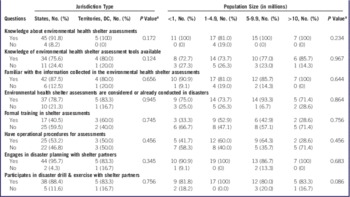
Of 56 eligible jurisdictions (49 states, 6 territories, and District of Columbia), 55 (98%) responded. Although no statistically significant results were found, jurisdictions overall reported high levels of knowledge of and familiarity with environmental health shelter assessments (92% of states and 100% of territories; Table 1). Small, medium, large, and mega-size jurisdictions reported knowledge of methods at 100%, 81%, 100%, and 100%, respectively.
Knowledge of and Familiarity With Shelter Assessment Responses and Preparedness Measures for Shelter Assessments by Jurisdiction Type and Population Size as Reported in the 2013 State and Territorial Use of Shelter Assessments Survey

a P value corresponds to Fisher’s exact test.
Measures of familiarity with the information collected by assessment tools indicated that 87% of states and 80% of territories knew of the content of the tools. Small and mega-size jurisdictions were more familiar with information collected by the tools (91% and 100%, respectively). Knowledge of available environmental health shelter assessment tools was similar in both states and territories (77% vs 80%, respectively). Mega-size jurisdictions were found to be most knowledgeable about the tools (86%).
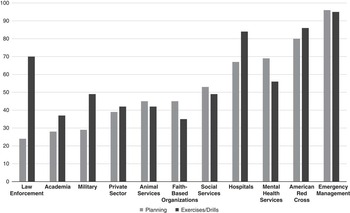
In the domain of preparedness for assessments, 79% of states and 83% of territories already used environmental health shelter assessments or were considering using them during future disasters. However, only 41% of states and 60% of territories reported receiving formal training in these methods. Although medium and large jurisdictions reported the highest levels of training (53% and 43%, respectively), only 53% of states and 50% of territories reported having formal operational procedures. Mega-size jurisdictions were less likely (29%) to have operational procedures than were large jurisdictions (64%). States and territories participated in disaster planning with partners (96% and 83%, respectively) and in disaster drills (88% and 83%, respectively). Most jurisdictions reported collaborating frequently with emergency management (96%) and the ARC (88%), and similarly for participating in exercises and drills with shelter partners (Figure 1).
Selected Planning and Disaster Drill Partners, by Percentage, Reported in the 2013 State and Territorial Use of Shelter Assessments Survey.

Discussion
Although states and territorial jurisdictions exhibited high levels of knowledge of and familiarity with environmental health shelter assessment methods, they still lacked ways to plan and operationalize shelter assessments during actual events. As an example, training and availability of shelter assessment procedures were observed to be low despite knowing that formal training and guidance for standard operating procedures are essential when deploying personnel under hazardous conditions. Also, standard shelter assessment procedures may be useful when working with external teams deploying through mutual or interstate agreements for disaster assistance and who may not be familiar with state or local procedures. Planning and operationalizing continue to be problematic despite efforts to improve systems for monitoring safety, services, and accommodations for persons with disabilities and those with functional and access needs by shelter services agencies. 6
Because the survey was conducted at state and territorial levels, results may not reflect knowledge and preparedness at jurisdictional levels for cities, counties, or tribes, an important limitation because preparedness ideally occurs at all levels. Also, no clear national standards currently exist for environmental health assessment methods for shelter facilities, particularly in domestic settings. As a result, survey respondents might have misinterpreted terminology in the absence of common language or standards. Additionally, because responses were completely anonymous, assessing the respondents’ levels of experience or knowledge in environmental health shelter operations was not possible. However, our interactions with representatives from targeted jurisdictions allowed for appropriate feedback between the survey team and individual respondents. These extra actions ensured that the appropriate programs from the jurisdictions answered survey questions.
Our survey showed that preparedness trended positively. For example, most public health agencies appeared to be engaged in disaster planning and in participating in disaster drills and exercises with key partners. Acknowledgement of collaborations with established preparedness partners reflected the extent to which jurisdictions were committed to working with appropriate groups on shelter issues.
Because the public health sector leads disease and injury prevention efforts, having the operational capability and knowledge about these tools and methods to carry out these assessments is paramount for ensuring health and safety. Information from the results of disaster shelter assessments eventually could be used by mass care agencies as lessons learned, for training, and for developing specific guidance for different facilities to be used as shelters. Also, such information may provide the basis to evaluate the usefulness of these assessments in reducing morbidity and mortality in disaster shelter settings.
Conclusions
Environmental health shelter assessments are necessary to ensure the well-being of shelter occupants. Although environmental health shelter assessments are being used or considered, limited operational procedures hamper the ability of jurisdictions to effectively monitor shelter occupants. The public health sector, through its environmental health disaster response component, may ensure that assessment methods are incorporated as part of disaster response plans and procedures.
Disclaimer
The findings and conclusions in this report are those of the authors and do not necessarily represent the views of Florida International University or the Centers for Disease Control and Prevention.