Introduction
Evidence of preferences for physical attractiveness, and distinct biases in attributing behavioural and psychological attributes to individuals based on perceived attractiveness, has been widely published in the social psychology literature (see below). The majority of these studies utilized two-dimensional photographs of unknown individuals from WEIRD (Western, Educated, Industrialized, Rich and Democratic) populations as stimuli (Heinrich et al., Reference Henrich, Heine and Norenzayan2010). Evolutionary psychology attempts to identify and theoretically explain both the biological correlates of attractiveness and its evolutionary significance and consequences (Langlois et al., Reference Langlois, Kalakanis, Rubenstein, Larson, Hallam and Smoot2000; Fink & Penton-Voak, Reference Fink and Penton-Voak2002; Grammer et al., Reference Grammer, Fink, Møller and Thornhill2003; Roberts et al., Reference Roberts, Little, Gosling, Perrett and Carter2005; Little et al., Reference Little, Jones and DeBruine2011; van Osch et al., Reference Van Osch, Blanken, Meijs and van Wolferen2015; Maestripieri et al., Reference Maestripieri, Henry and Nickels2017). This work points to the importance of physical traits such as waist–hip ratio and symmetry. The roles that bodily symmetry (measured as fluctuating asymmetry (FA), see below) and attractiveness play in self-perception and peer associations in Jamaican children were assessed in this study.
Studies on the social benefits of attractiveness first appeared in the scientific literature in 1921 and demonstrated that attractiveness was an important determinant of popularity (Perrin, Reference Perrin1921), the results of which were later replicated by Dion et al. (Reference Dion, Berscheid and Walster1972) in preschool children. The attractiveness stereotype predicts that more attractive individuals will be favoured and assumed to possess better personality characteristics (reviewed in Maestripieri et al., Reference Maestripieri, Henry and Nickels2017). For example, attractive school children are expected to achieve higher academic scores by their teachers, and actually do receive higher scores (Clifford & Walster, Reference Clifford and Walster1973). Even infants prefer attractive faces (Langlois et al., Reference Langlois, Roggman, Casey, Ritter, Rieser-Danner and Jenkins1987), and physical attractiveness of children as young as 4 years old is related to the child’s popularity and perception of social behaviours (Berscheid & Walster, Reference Berscheid and Walster1974). Unattractive children are more likely to be labelled as ‘bad’, and highly attractive boys and girls have been reported to be more independent. A study of Italian children found that being less attractive was related to higher peer rejection (DiGiunta et al., Reference DiGiunta, Pastorelli, Thartori, Bombi, Baumgartner, Fabes and Enders2018).
Krebs and Adinolfi (Reference Krebs and Adinolfi1975) found that the most unattractive individuals were not rejected per se, but rather neglected or ignored by the opposite sex. The ‘beauty is good’ hypothesis predicts positive characteristics are attributed to attractive people; but it may be more accurately interpreted as a strategy to avoid unattractive individuals (Griffin & Langlois, Reference Griffin and Langlois2006).
Physical attractiveness can influence an individual’s personality traits, because of feedback from social interactions (Krebs & Adinolfi, Reference Krebs and Adinolfi1975). For example, attractive people are more frequently the recipients of altruistic acts or co-operation initiated by others (Zaatari et al., Reference Zaatari, Palestis and Trivers2009; Bhogal et al., Reference Bhogal, Bartlett and Farrelly2018; but see Bhogal et al., Reference Bhogal, Galbraith and Manktelow2016) and an individual’s attractiveness can influence prosocial behaviours towards them (Adolphs & Tusche, Reference Adolphs and Tusche2017). The image an individual has of themselves is primarily based on the way significant others treat them, which in turn is instrumental in forming a personal evaluation of worthiness, otherwise known as self-esteem. There have been many studies investigating the effects of physical appearance and self-perceived attractiveness on an individual’s self-esteem (Cash, Reference Cash and Adams1985; Cooper, Reference Cooper1993; Canning et al., Reference Canning, Andrew, Murphy, Walker and Snowden2017).
Individuals tend to overestimate their own attractiveness (Epley & Whitchurch, Reference Epley and Whitchurch2008). However, there appears to be a clear sex difference in self-perception of attractiveness, with men having higher ratings of self-esteem and tending to rate their own facial and bodily attractiveness more favourably than do women (Franzoi & Herzog, Reference Franzoi and Herzog1987; Kwon, Reference Kwon1997; Klein et al., Reference Klein, Frohlich and Emrich2017). Among males, those with higher self-rated attractiveness pay less attention to unattractive female faces (Morgan & Kisley, Reference Morgan and Kisley2014). Little et al. (Reference Little, Burt, Penton-Voak and Perrett2001) found that women who rated themselves as more attractive also exhibited increased preference for masculinity and symmetry in the faces of men, as if females of perceived high value seek out males of high genetic quality.
For men, being highly attractive is positively correlated with the quantity of social interactions with women and negatively correlated with the quantity of social interactions with other males (Reis et al., Reference Reis, Nezlek and Wheeler1980). Canning et al. (Reference Canning, Andrew, Murphy, Walker and Snowden2017) found in a sample of young individuals leaving care that for males, high levels of attractiveness predicted aggression, while in females, low levels of attractiveness were associated with aggression. Reis et al. (Reference Reis, Wheeler, Spiegel, Kernis, Nezlek and Perri1982) also reported that attractive men were more assertive and less afraid of rejection by females than less attractive men. For males, facial attractiveness correlates positively with the number of short-term sexual partners and in females facial attractiveness is positively associated with the number of long-term partners and age of first sex (Rhodes et al., Reference Rhodes, Simmons and Peters2005). Attractiveness has also been shown to exhibit positive effects on income (Judge et al., Reference Judge, Hurst and Simon2009) and social status (Anderson et al., Reference Anderson, John, Keltner and Kring2001).
An interesting aspect of same-sex interaction and attractiveness is that there appears to be a matching effect, where attractive individuals tend to be friends with other attractive individuals and the same is true for less-attractive same-sex friendships (Feingold, Reference Feingold1988). Recent research found evidence for positive genetic similarity among friends (Domingue et al., Reference Domingue, Belsky, Fletcher, Conley, Boardman and Harris2018). There may also be a ‘halo’ effect, where people want to be associated with attractive individuals because it makes them feel better about themselves and they may be viewed more favourably by others (Sigall & Landy, Reference Sigall and Landy1973). Interestingly, self-enhancement of attractiveness also extends to attractiveness of friends (Epley & Whitchurch, Reference Epley and Whitchurch2008).
Symmetry is often related to attractiveness, and like more-attractive individuals, more-symmetrical individuals appear to be at a significant advantage (Møller & Swaddle, Reference Møller and Swaddle1997). Symmetry is typically measured as fluctuating asymmetry (FA), defined as small, random deviations from perfect bilateral symmetry in traits where the population distribution is evenly distributed around zero (Van Valen, Reference Van Valen1962). These are assumed to be under stabilizing selection to become more symmetrical but are held back by disturbances during development inadequately buffered by the genetic system (Leamy, Reference Leamy1997). Thus FA is a measure of stress during early development and genetic inability to compensate for the stress, and therefore can be an indicator of developmental instability.
Relationships with FA often have low effect sizes (van Dongen & Gangestad, Reference Van Dongen and Gangestad2011; Graham & Özener, Reference Graham and Özener2016; Grebe et al., Reference Grebe, Falcon and Gangestad2017), but positive associations between symmetry in humans and variables such as mating success appear to be robust (van Dongen & Gangestad, Reference Van Dongen and Gangestad2011; Grebe et al., Reference Grebe, Falcon and Gangestad2017). Many studies have found a negative relationship between facial attractiveness and FA (Gangstad et al., Reference Gangestad, Thornhill and Yeo1994; Grammer & Thornhill, Reference Grammer and Thornhill1994; Shackelford & Larsen, Reference Shackelford and Larsen1997; Hume & Montgomerie, Reference Hume and Montgomerie2001; Jones et al., Reference Jones, Little, Penton-Voak, Tiddeman, Burt and Perrett2001). Effects of symmetry extend beyond physical attractiveness to personality traits, as would be expected given the connections between attractiveness and behavioural development reviewed above. For example, more symmetrical men report being more self-assured and present themselves in a more confident and positive way (Simpson et al., Reference Simpson, Gangestad and Leck1999), but may also be more aggressive (Furlow et al., Reference Furlow, Gangestad and Armijo-Prewitt1998; Manning & Wood, Reference Manning and Wood1998). More-symmetrical female faces are rated higher not just in attractiveness per se, but also in ratings of health and positive personality traits (Fink et al., Reference Fink, Neave, Manning and Grammer2006).
Previous research on the Jamaican children studied here has also showed effects of symmetry on both physical and behavioural traits. Symmetry measured in children predicted sprinting speed as adults and willingness to participate in a race (Trivers et al., Reference Trivers, Palestis and Manning2013). When these subjects were adolescents and young adults, a behavioural economics game showed that more symmetrical males were less co-operative with others (Zaatari & Trivers, Reference Zaatari and Trivers2007). Fluctuating asymmetry among these children may therefore affect social interactions and self-perception through relationships with attractiveness and other aspects of quality.
Studies of attractiveness in evolutionary psychology usually involve presentation of photographs of strangers to college undergraduates in modern WEIRD populations. This study investigated the importance of attractiveness among children who knew each other well in multiple dimensions, and for whom measurements of bodily symmetry and body mass index were known. Although the children could only see each other’s faces in the photos, they were familiar with other aspects of the individuals, including physical and personality traits. Results of studies can differ when subjects know more than just an individual’s facial appearance (Bhogal et al., Reference Bhogal, Galbraith and Manktelow2016). This study also contributes to cross-cultural comparisons, as it took place in rural Jamaica, rather than in an industrialized society. When they have been studied, effects of attractiveness appear to hold across cultures for children and among familiar individuals (Langlois et al., Reference Langlois, Kalakanis, Rubenstein, Larson, Hallam and Smoot2000). However, societies may vary in attractiveness preferences for specific traits (Marcinkowska et al., Reference Marcinkowska, Kozlov, Cai, Contreras-Garduño, Dixson and Oana2014; DeBruine et al., Reference DeBruine, Jones, Crawford, Welling and Little2010). Adult Jamaican women, for example, prefer more masculinized men’s faces than do British women (Penton-Voak et al., Reference Penton-Voak, Jacobson and Trivers2004).
Based on the literature reviewed above, it is hypothesized that attractiveness ratings of subjects by peers will be positively correlated with measures of self-perception and self-esteem. It is also predicted that males’ self-rated attractiveness and self-esteem will be higher than females’. It is expected that attractive individuals will be chosen more often as friends and that there will be an effect of sex, where attractive individuals will be chosen less often as friends by same-sex raters than by opposite-sex raters. Additionally, FA may be negatively associated with measures of self-perception and self-esteem. It may also affect preferences for peer associations, but in which direction is unclear. More symmetrical individuals may be preferred as friends due to their higher phenotypic quality, or avoided due to increased aggression and decreased co-operation, at least among boys. Individuals may also choose to associate with individuals of similar levels of FA, if similar individuals tend to group together.
Methods
Subjects
The study subjects were part of the Jamaican Symmetry Project – a long-term study of fluctuating asymmetry in 288 Afro-Caribbean children from Southfield, St Elizabeth parish, Jamaica (Trivers et al., Reference Trivers, Manning, Thornhill, Singh and McGuire1999). Children ranged in age from 5 to 12 years (mean age ± SD=8.18±1.73) in 1996, when morphometric measurements were taken (see below). The experiments analysed here were conducted in 1998.
Research protocols were approved by the Institutional Review Board for the Protection of Human Subjects in Research of Rutgers, the State University of New Jersey. Participation of subjects included written parental consent.
Physical measurements and fluctuating asymmetry
Morphometric measurements were collected for each child (wrists, ankles, elbows, 3rd digit, 4th digit, 5th digit, ears, feet, knees) with vernier calipers to 0.01 mm accuracy (see Trivers et al., Reference Trivers, Manning, Thornhill, Singh and McGuire1999, for methodology). To establish repeatability, reduce measurement error and distinguish small differences between sides from measurement error, each trait was measured twice on each side (Palmer & Strobeck, Reference Palmer, Strobeck and Polak2003). Repeatability of measurements was at r>0.96 for all traits, which were found to be reliable indicators of between-subject differences and reflect true FA rather than biologically significant directional asymmetry or antisymmetry (Trivers et al., Reference Trivers, Manning, Thornhill, Singh and McGuire1999; Palestis & Trivers, Reference Palestis and Trivers2016).
Composite indices that combine FA across traits typically provide a better indication of underlying developmental stability than does FA in any one trait (Gangestad & Thornhill, Reference Gangestad and Thornhill1999; Leung et al., Reference Leung, Forbes and Houle2000; van Dongen & Gangestad, Reference Van Dongen and Gangestad2011). Composite relative fluctuating asymmetry was calculated by subtracting the average length of the right side of the trait from the left (L–R) and dividing by trait size and then summing across all traits. Complete measurements of all traits were available for 260 children. Although the use of relative FA has been criticized (Leung et al., Reference Leung, Forbes and Houle2000; Palmer & Strobeck, Reference Palmer, Strobeck and Polak2003; Graham & Özener, Reference Graham and Özener2016), the preferred composite index cannot be used, which standardizes FA across traits by mean FA rather than trait size (Leung et al., Reference Leung, Forbes and Houle2000; Palestis & Trivers, Reference Palestis and Trivers2016). This limitation arises because mean FA of individuals claimed as friends was calculated nearly 20 years ago and can no longer be deconstructed into individual FA values by trait and recalculated. Fortunately, composite relative FA and composite standardized FA of individual subjects are very closely correlated (r=0.95), and preliminary analyses suggest that these results would barely change with an alternative FA index.
Height and weight were used to calculate body mass index (BMI, n=255) to be included as a covariate in the models, as body size is correlated with FA (Manning, Reference Manning1995; Trivers et al., Reference Trivers, Manning, Thornhill, Singh and McGuire1999) and may also bias attractiveness judgments (Tovée et al., Reference Tovée, Reinhardt, Emery and Cornelissen1998).
Photographic stimuli
In January 1998, 111 children had their faces videotaped under standardized conditions. The children were all students at Top Hill Primary School. In the approximately 5-second video clip, each subject was asked to look straight ahead with their mouth closed and display a neutral expression. They were then asked to rotate their head 180 degrees beginning from a right profile through to a left profile shot. A single frame was subsequently captured for each individual using software that depicted the subject facing straight ahead. These images were then printed in black and white, laminated and labelled on the back with the individual’s identification number assigned by the Jamaican Symmetry Project.
Measurements of self-perception
Rating of stimuli
The photo stimuli were presented to 99 of the photographed subjects, who were asked to assess various attributes of the individuals depicted in the photographs using a 1–5 Likert scale. These attributes included: attractiveness (1=very ugly, 5=very pretty/handsome), friendliness (1=very unfriendly, 5=very friendly) and friend-to-child (1=worst enemy, 5=best friend).
Each attribute was assessed separately, with the subset of opposite-sex peer stimuli presented first, followed by the subset of same-sex stimuli. The rater was seated at a table with a series of five index cards placed in front of him/her labelled 1–5 with the appropriate key words for each attribute being assessed (e.g. for ‘friend-to-child’; 1=worst enemy, 2=enemy, 3=not enemy, not friend, 4=friend, 5=best friend). The rater was then handed a randomized subset of photographs and allowed to hold and look at each picture for as long as necessary before placing it on the appropriate index card representing where they felt that individual fell along the continuum for each attribute. The rating given to each stimulus was then recorded. An attractiveness rating was calculated for each subject by averaging the attractiveness assessments of their photograph given by their peers. Ratings for friendliness and friend-to-child were calculated in the same manner.
Creation of adjusted self-perception indices
An adjusted self-perception score was calculated for ‘attractiveness’, ‘friendliness’ and ‘friend-to-child’ by taking the raw score that the individual gave their own photograph (as it appeared randomly in the sample during their rating process) and subtracting the average score that individual assigned to all same-sex peers. For example, if a female rated her own attractiveness as a 4 and the average rating she gave to all other female peers was 3.2, her adjusted self-perception score for attractiveness was 0.8. This was done in order to put the raw self-rating score in perspective in terms of that individual’s overall assessment range for each attribute, to provide a measure of overconfidence in one’s own attributes (Murphy et al., Reference Murphy, von Hippel, Dubbs, Angilletta, Wilson, Trivers and Barlow2015). For instance, if individual A rated himself as a 4 for attractiveness and individual B gave himself a 5, the raw scores would indicate that individual B has a higher opinion of his own attractiveness. However, if individual A gave an average attractiveness rating to male peers of 2.2, while individual B gave an average rating of 4.6, in reality individual A had a much more positively skewed opinion of his own attractiveness (e.g. adjusted self-perception index for individual A=1.8, individual B=0.4).
Rosenberg Self-Esteem Questionnaire
A Rosenberg Self-Esteem Inventory (RSEI) (Rosenberg, Reference Rosenberg1965) was administered as a written questionnaire where 164 subjects were asked to read ten standardized questions and circle a response on a continuum from ‘strongly agree’ to ‘strongly disagree’, indicating their response (e.g. ‘I am able to do things as well as most other people’). Responses were assigned a numeric value based on a scoring key and a composite self-esteem score was generated.
Results
Correlations among variables
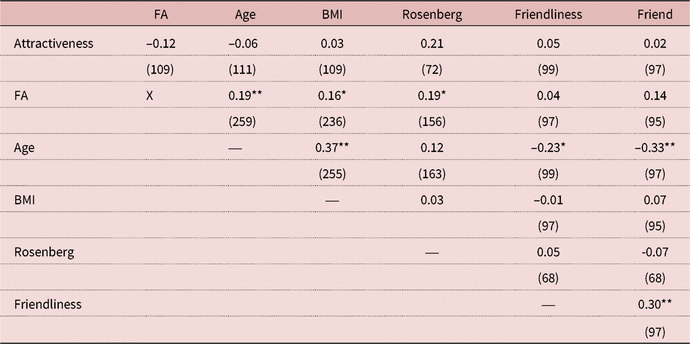
Attractiveness ratings received from peers were not significantly related to bodily FA, age or BMI, whether using all subjects (Table 1) or when split by sex (data not shown). Attractiveness ratings by peers were also not related to adjusted self-rated ‘friendliness’, adjusted self-rated ‘friend-to-child’ or Rosenberg self-esteem scores. As previously reported (Trivers et al., Reference Trivers, Manning, Thornhill, Singh and McGuire1999; Palestis & Trivers, Reference Palestis and Trivers2016), FA increased with age and BMI (Table 1). There was a significant positive correlation between composite relative FA and the Rosenberg self-esteem scores; that is, more asymmetrical individuals appear to think more highly of themselves – opposite to the predicted direction.
Pearson correlation coefficients for relationships among variables (sample sizes in parentheses)

Asterisks indicate statistical significance, without correction for multiple comparisons: *p<0.05, **p<0.01.
Variables are: attractiveness ratings received by peers; composite relative fluctuating asymmetry (FA), age, BMI, Rosenberg self-esteem scores, adjusted self-rated friendliness and adjusted self-rated ‘friend-to-child’.
The correlations reported in Table 1 have not been corrected for multiple comparisons, but are presented to illustrate possible relationships among variables. Hypotheses are tested using multiple regression, both to control for the presence of covariates and to reduce the number of comparisons. The weak correlations among predictor variables suggest that multicollinearity is unlikely to present a problem in the regression analyses (Dormann et al., Reference Dormann, Elith, Bacher, Buchmann, Carl, Carré and Lautenbach2013).
Attractiveness and self-rated attractiveness
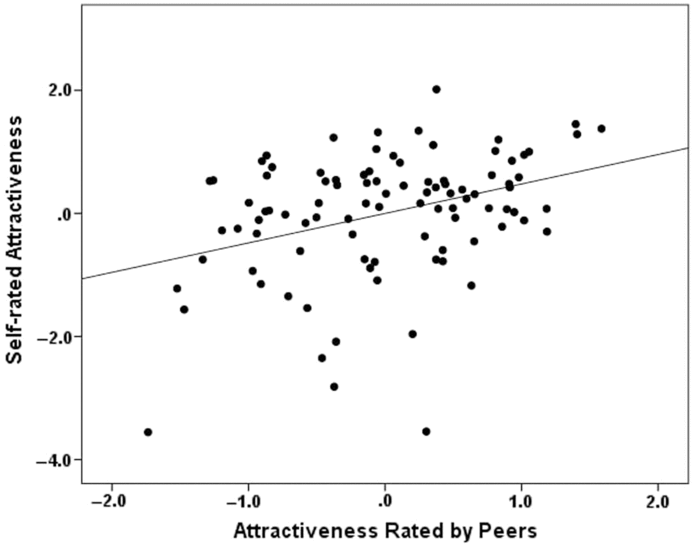
Because age and body size may influence self-perception and FA, they were controlled for in a multiple regression analysis testing for the relationship between attractiveness as rated by peers and self-rated attractiveness. Adjusted self-rated attractiveness was the dependent variable and the following independent variables were included: attractiveness ratings received, age, BMI and composite relative FA. The adjusted R 2 value was 0.11, which was statistically significant (F 4, 90=3.91, p=0.006). There was a significant positive relationship between attractiveness ratings received and self-rated attractiveness (b=0.48, SE=0.13; t=3.61, p=0.001; partial r 2=0.12; Fig. 1). None of the covariates was significantly related to self-rated attractiveness (all p>0.27). If split by sex, the overall regression model was no longer significant but the relationship between attractiveness and self-rated attractiveness appeared to be similar in both sexes (boys: b=0.47, SE=0.20; girls: b=0.42, SE=0.19).
Partial regression plot of adjusted self-rated attractiveness and attractiveness ratings given by peers.

Unlike in WEIRD samples, males actually rated themselves significantly less attractive than did females (t-test; t 96=–2.04, p=0.04; male mean=1.11, SD 1.06; female mean=1.52 SD 0.92). Similarly, females had significantly higher Rosenberg scores (t 162=–4.57, p<0.001; male mean=22.42, SD 3.06; female mean=24.57, SD 2.95). Surprisingly, Rosenberg self-esteem scores were not correlated with self-rated attractiveness (r=0.07, n=68, p=0.55) and a similar multiple regression analysis as above using Rosenberg scores as the dependent variable and the same independent variables was not significant (adjusted R 2=0.07, F 4, 64=2.29, p=0.07).
Peer associations
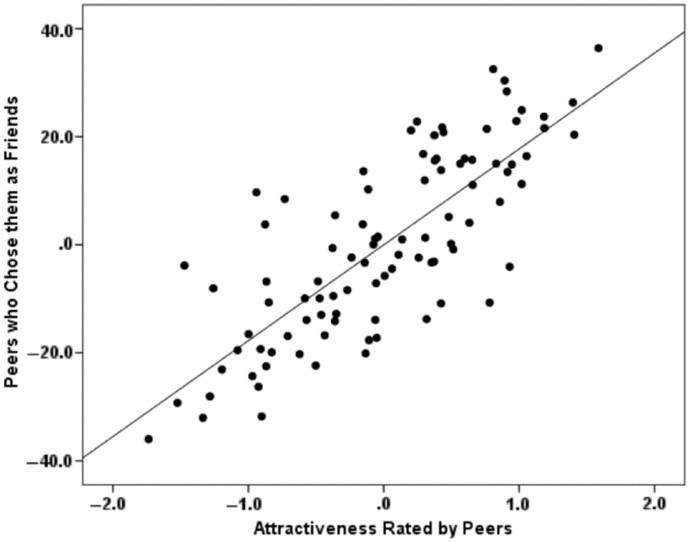
Degree of attractiveness to others predicts popularity as a friend. A multiple regression was run that predicted popularity as a friend from peer-rated attractiveness, age, BMI and composite relative FA (F 4, 90=40.17, p<0.001, R 2=0.63). The relationship between attractiveness and the percentage of peers who chose an individual as a friend was significant (b=17.76, SE=1.45, t=12.25, p<0.001, partial r 2=0.60). Attractiveness therefore accounted for 60% of the sample variance in the outcome variable (i.e. popularity as a friend; see Fig. 2). Popularity as a friend also increased with age (b=4.04, SE=1.18, t=3.41, p=0.001, partial r 2=0.05), but was unrelated to FA (p=0.26) or BMI (p=0.45). Attractive individuals were considered to be attractive regardless of the sex of the rater, and were claimed as friends more often than unattractive individuals regardless of sex of the subject. For both girls and boys, correlations between attractiveness ratings received from same- or opposite-sex peers and the number of same- or opposite-sex peers claiming them as friends were all significant (all r>0.46, all p<0.001).
Partial regression plot of popularity as a friend (percentage of peer raters who chose an individual as a friend) and attractiveness ratings given by peers.

FA and peer association
A multiple regression analysis was performed to test the relationship between raters’ FA and the mean FA of individuals chosen as friends, with age, BMI and attractiveness ratings as covariates. This regression model explained a large proportion of the variance in FA of friends (adjusted R 2=0.60, F 4, 89=35.35, p<0.001), mostly due to a relationship between age and average FA of friends (b=0.014, SE=0.001, t=11.02, p<0.001, partial r 2=0.53). A positive relationship between age and FA of friends is expected, because FA also increases with age (see above). Despite this confounding effect of age, an individual’s own FA made a significant, independent contribution to variance in FA of friends (b=0.074, SE=0.024, t=3.13, p=0.002, partial r 2=0.042). In other words, FA was more similar among friends than would be predicted by age alone. BMI and an individual’s attractiveness were unrelated to friends’ FA (p=0.78 and 0.49, respectively).
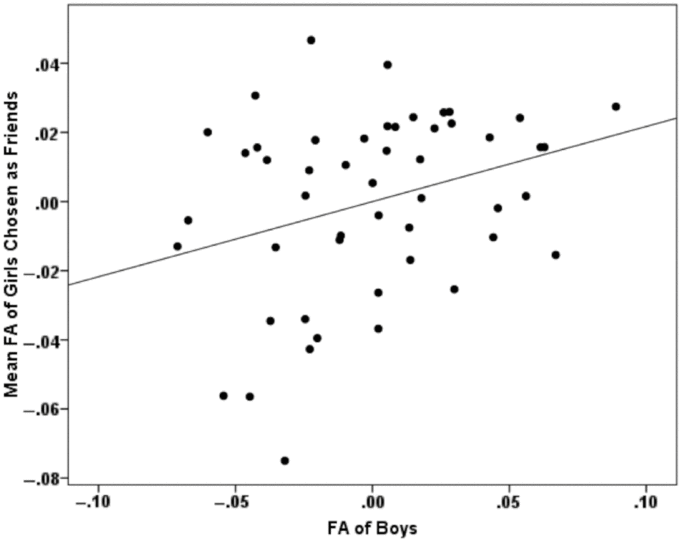
Further investigation revealed that this effect of FA was mostly due to the relationship between male FA and the FA of females they chose as friends. Performing the same regression analysis as above, but restricted to male subjects selecting female friends, the overall model remained significant (adjusted R 2=0.29, F 4, 45=6.09, p=0.001) and the relationship between the FA of subjects and the FA of friends was strengthened (b=0.22, SE=0.10, t=2.18, p=0.034, partial r 2=0.069; Fig. 3). If restricted to female subjects, there was clearly no relationship between female FA and the FA of male friends (p=0.96, partial r 2~0). There were also no significant within-sex relationships between raters’ FA and the FA of friends (male: p=0.25, partial r 2=0.025; female: p=0.78, partial r 2=0.001).
Partial regression plot of male composite relative fluctuating asymmetry (FA) and the mean composite relative FA of females claimed as friends.

Discussion
The study found that individuals’ adjusted self-ratings of attractiveness positively correlated with attractiveness assessments of them by others. This result supports the hypothesis that attractiveness has an effect on an individual’s sense of self-value in terms of attractiveness. More-attractive children did not score significantly higher on the Rosenberg self-esteem scale, but the trend was in the prediction direction. It could be that individuals receive cues from others that enable them to adjust their perceived reality based on their condition.
Although more-attractive children had more friends (see below), the adjusted self-ratings of ‘friendliness’ and ‘friend-to-child’ did not correlate with attractiveness in this sample. Given the positive personality biases associated with the physical attractiveness stereotype, unattractive and/or asymmetrical individuals may attempt to compensate in the social arena by engaging more often in co-operative behaviour or presenting themselves as friendlier (Simpson et al., Reference Simpson, Gangestad and Leck1999; Takahashi et al., Reference Takahashi, Yamagishi, Tanida, Kiyonari and Kanazawa2006; Zaatari & Trivers, Reference Zaatari and Trivers2007). An individual’s opinion as to whether they are friendly and how well they like themselves may be influenced by a multitude of factors besides their attractiveness (e.g. socioeconomic, early rearing environment). The development of these self-concepts are more psychologically complex and cannot be explained simply by an individual’s attractiveness.
Because the subjects were well known to each other, judgments of attractiveness may also have entailed more than just facial attractiveness. Subjects would have been aware of various aspects of each other’s physical attractiveness not captured in the photos, such as body proportions (Versylus et al., Reference Versluys, Foley and Skylark2018), as well as their personalities, abilities and the results of previous social interactions. The measure of FA used here included multiple body traits, rather than facial symmetry, and was therefore a measure of overall phenotypic quality, rather than a direct correlate of facial attractiveness. It is noteworthy that a sample of university students in the US also evaluated the photos of Jamaican children for attractiveness (unpublished data) but these evaluations correlated with none of the key variables in this study, including the children’s peer attractiveness ratings, underscoring the value of the sample of individuals known to each other. The only variable significantly related to facial attractiveness ratings by university students was BMI (r=–0.20, p=0.012, n=162). However, there are many, potentially interacting traits that could have influenced how the children in this study perceived their peers’ attractiveness.
Additionally, effects of attractiveness are expected to act in a condition-dependent manner, in which those with higher and lower self-rated attractiveness should place higher and lower emphasis, respectively, on attractiveness or other markers of good genes in others (Little et al., Reference Little, Burt, Penton-Voak and Perrett2001). For instance, Wang et al. (Reference Wang, Cao, Sauciuvenaite, Bissland, Hacker, Hambly and Speakman2018) found that female ratings of males’ attractiveness were 4 times more sensitive to different salaries attached to the photographs, opposed to the male ratings of female attractiveness, where salary had little to no effect on attractiveness. Sometimes conditions may exist that would select for female reproductive strategies that sacrifice good genes for other qualities in males, such as access to resources, if those resources will increase the reproductive success of the female under those specific conditions (Fink & Penton-Voak, Reference Fink and Penton-Voak2002; Penton-Voak et al., Reference Penton-Voak, Jacobson and Trivers2004).
In WEIRD populations, males tend to have higher self-esteem and better body image than females (Knox et al., Reference Knox, Funk, Elliott and Bush2000). The exact opposite result was found in this sample: where girls had both higher self-rated attractiveness and higher Rosenberg self-esteem scores than boys. Akbar et al. (Reference Akbar, Chambers and Thompson2001) also found that female Jamaican children had significantly higher self-esteem than males as measured by the Piers-Harris Self-Esteem Scale. Investigations into body image issues and ratings of self-attractiveness have found that African-American women generally have a better body image and higher ratings of self-attractiveness than white females (Altabe, Reference Altabe1998; Jones et al., Reference Jones, Moulton, Moulton and Roach1999).
Another possible explanation for the discrepancy in self-esteem scores between Jamaican males and females is that significant differences exist in life experiences among young rural Jamaicans that may affect the development of an individual’s self-perception. Females may develop higher self-esteem because of social and economic conditions that value the role of women in Jamaican society (Smith, Reference Smith1988). Living in households with strong female role models, surrounded by maternal kin, may help young girls to develop a strong sense of identity and self-worth. It could also be that increased expectations placed on girls involving domestic duties such as responsibilities including household chores and childcare facilitate the development of stronger concepts of self-worth.
In contrast, economic instability and lack of male parental investment (reviewed in Penton-Voak et al., Reference Penton-Voak, Jacobson and Trivers2004) may lead to more insecurity in the establishment of self-identity in Jamaican boys. For instance, of the 160 Jamaican children who participated in the study by Akbar et al. (Reference Akbar, Chambers and Thompson2001), only 14% of the subjects lived with their fathers, whereas 76% of the children reported living with their mothers or grandmothers. Subsequent attempts to recapture the Jamaican sample used here revealed that males were more likely to drop out of school and less likely to attain significant levels of literacy. This may have affected the outcome of the Rosenberg scores, because school officials had to verbally administer the questionnaire to some male students who could not read.
The sex difference in self-ratings of attractiveness between Jamaican and WEIRD samples could also result from differences in patterns of physical development. Studies of WEIRD populations demonstrate that rapid growth in children is related to high fluctuating asymmetry but that FA decreases as children progress from childhood to adolescence. Fluctuating asymmetry is at its lowest at age 18 when mate choice is prominent (Wilson & Manning, Reference Wilson and Manning1996; Hope et al., Reference Hope, Bates, Dykiert, Der and Deary2013).
Jamaican children in this sample experienced a period of rapid growth, resulting in increased levels of FA, presumably due to developmental trade-offs in the demands of tissue growth and the maintenance of bodily symmetry. The proficiency of symmetry enhancing mechanisms is related to the rate of development. Rapid growth can lead to early maturation and early reproduction as well as an increase in FA. This suggests that attaining adult size is more important than allocating energy to maintain symmetry in this population. This has implications for peer perceptions of attractiveness that might impact future reproductive success.
Differences in rates of development in affluent Caucasian and rural Afro-Caribbean children may result in differences in perceptions of attractiveness with regard to attributes such as height, muscle mass, fat mass and fluctuating asymmetry. This paper provides a baseline for future studies in non-WEIRD African diaspora populations.
There were no significant associations between an individual’s body FA and self-ratings. Interestingly, there was a significant relationship between FA and Rosenberg Self-Esteem Inventory scores but opposite of the predicted relationship – asymmetrical individuals actually scored higher than symmetrical individuals. While there is little quantitative evidence of actual psychological benefits of FA, facial symmetry is positively associated with assessments of dominance, health, sexiness and extraversion (Grammer & Thornhill, Reference Grammer and Thornhill1994; Jones et al., Reference Jones, Little, Penton-Voak, Tiddeman, Burt and Perrett2001; Fink et al., Reference Fink, Neave, Manning and Grammer2005, Reference Fink, Neave, Manning and Grammer2006) and negatively associated with psychological, emotional and physiological distress and neuroticism (Shackelford & Larsen, Reference Shackelford and Larsen1997; Fink et al., Reference Fink, Neave, Manning and Grammer2005). However, studies of human FA have also indicated an association with traits that would have a negative effect on friendliness, such as positive relationships between bodily symmetry and aggression in boys (Manning & Wood, Reference Manning and Wood1998) and young men (Furlow et al., Reference Furlow, Gangestad and Armijo-Prewitt1998) and reduced levels of co-operative behaviour in the boys studied here when they were adolescents and young adults (Zaatari & Trivers, Reference Zaatari and Trivers2007). These results have previously been interpreted as indicating a positive association between symmetry and dominance (more likely to win fights, less need to co-operate), but the current study suggests that this relationship is more complex.
Since FA has been hypothesized to be a measure of developmental stability and an important factor in mate choice, it may also be that in young children who are not yet focused on reproduction, other factors are more important in their evaluations of self-esteem and identity. It could also be possible that the Rosenberg Self-Esteem Inventory was not optimally suited to testing this population. The majority of psychological tools available for measuring self-esteem have been developed for use in WEIRD samples. There were specific wording and conceptual issues with the questions used in the RSEI that were problematic (e.g. ‘Do you consider yourself to be on an ‘equal plane’ as others?’ This abstract concept of a hypothetical plane was not well understood by subjects).
Attractive individuals were chosen more often as friends than unattractive individuals. The hypothesis based on trends from social psychology regarding same- versus opposite-sex effects (Feingold, Reference Feingold1988) was not supported, however. In this sample, attractive individuals of both sexes were preferred as friends by both same- and opposite-sex peers. One explanation may be that results in the literature are based on adolescent and adult samples, where same-sex peer associations may be more influenced by mating competition. In this sample of younger children it is possible that preferences for peer associations are based on social dynamics that are less motivated by mate choice, but more focused on establishing relationship networks which allow individuals to successfully manoeuvre within their social reality.
Since the benefits of attractiveness in terms of positive attributes perceived by others is well established (see Introduction), preferentially associating with attractive individuals may be a good strategy for all children. Seeking out and establishing relationships with attractive peers may also have long-term benefits if those relationships last into adulthood and could possibly lead to potential mating opportunities later on. Associating with attractive same-sex peers may also have delayed pay-offs if members of the opposite sex preferentially seek out attractive mates; being in close proximity to these target individuals may result in increased mating opportunities.
There was a significant correlation between an individual’s FA and the average FA of those individuals that they chose as their friends. Further analysis revealed that this was primarily a result of preferences by males for females possessing similar levels of FA. This is interesting because female mate choice for good genes should be well developed in rural Jamaica (Penton-Voak et al., Reference Penton-Voak, Jacobson and Trivers2004) due to increased parasite load in the tropics (Gangestad & Buss, Reference Gangestad and Buss1993) and reduced male parental investment (Trivers, Reference Trivers and Campbell1972), because of paternity uncertainty and limited socioeconomic opportunities for men (Smith, Reference Smith1988). Preferring to associate with females who have similar levels of FA during childhood may allow boys to establish friendships with girls of equal relative mate quality, increasing the chances they may be able to continue these relationships into adulthood. Being of similar mate quality may increase the chance that a male will be considered as a mate by females who have been selected to try to maximize their reproductive success by being choosy.
It is important that future research on attractiveness, self-esteem and FA takes into consideration cultural background, developmental age and environmental conditions of specific populations and how these variables may contribute to interpretation of the results.
Funding
The Biosocial Research Foundation, Enhanced Learning Foundation, Center for Human Evolutionary Studies and the Rutgers Graduate School provided funding for this research.
Conflicts of Interest
The authors have no conflicts of interests to declare.
Ethical Approval
The authors assert that all procedures contributing to this work comply with the ethical standards of the relevant national and institutional committees on human experimentation and with the Helinski declaration of 1975, as revised in 2008.