They have forced upon the country, the distinct issue: “Immediate dissolution, or blood.”
—Abraham LincolnFootnote 1Common wisdom and current scholarship hold that governments need to stand firm in the face of secessionist demands, since permitting the secession of one region can set a precedent for others. Speaking about secessionism in Chechnya, Russian President Boris Yeltsin asserted, “we cannot stand idly by while a piece of Russia breaks off, because that would be the beginning of the collapse of the country.”Footnote 2 In a recent book on this topic, Walter argued that states fight secessionists “not because territory is so valuable, as many people have assumed, but because fighting helps them to deter other groups from seeking secession in the future.”Footnote 3 Thus, the argument runs that because there are no clear barriers to the contagion of secession, states will choose blood rather than risk dissolution.
I argue that administrative organization provides states with a third option. Central governments (that is, metropoles) use administrative lines and categories when determining which groups can secede without fear of setting a precedent, and who they must deny (and potentially fight) to maintain a credible reputation. Internal lines and status categories reduce bargaining problems between center and periphery; they create conceptual distinctions that can become salient in the eyes of the relevant parties; and international law emphasizes administrative territories as a guide for recognizing new states via the principle of uti possidetis (as you possess). These factors shape the manner in which metropoles respond to secessionist demands. As a result, secessionist movements that do not cohere with any administrative region are the least likely to be granted independence. In contrast, those regions that represent a unique administrative type are more likely to be recognized by their metropole. Finally, large compound states sometimes downsize by category, and this helps explain why governments will release one set of units without contest whereas it will prevent another set from doing the same.Footnote 4 In sum, the administrative architecture of states provides them with a means to disassemble in a controlled manner and, in fact, the administrative status of breakaway regions (or lack thereof) is a strong predictor of secessionist outcomes.
Whereas most of the work on secession examines the rise of nationalist movements or how the international community reacts to them, I focus on the strategic response of the state to secessionist demands. My theory synthesizes key elements from the existing literature. Specifically, I emphasize administrative units, much like Roeder and Bunce.Footnote 5 But I shift the focus from the region to the metropole to argue that administrative lines and categories are used by states when selecting which regions can secede. I combine this argument with Walter's claim that states need to deny secessionist ambitions to deter other potential breakaway nations.Footnote 6 But whereas Walter's model assumes that all secessionist movements are like types, I maintain that administrative organization effectively creates unlike types, and governments use these differences when responding to demands. Finally, I join these arguments with Lustick's claim regarding the importance of ideological thresholds in state contraction, and I assert that such thresholds generally fall along administrative lines.Footnote 7 I test this theory in a large-N study using original data on secessionist movements and administrative units between 1816 and 2011.
My dependent variable is the metropolitan response to a secessionist movement's declaration of independence: denial or acceptance. This is an important but underexamined outcome. It determines whether a new state will join the international community and it affects the likelihood that blood will be spilled. Scholars estimate that at least half of the civil wars since 1945 have involved secessionism,Footnote 8 and Walter argues that secessionism is the chief source of violence in the world today. Footnote 9 I contend that metropolitan denial is a necessary condition for secessionist conflict. Thus, it would be useful to identify the factors that lead metropoles to accept or deny independence demands, since these decisions have an impact on the likelihood of conflict.
Secessionist Movements and Proto-States
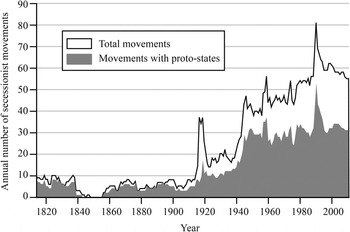
The unit of analysis in this research note is the secessionist movement, which I define as a nation that actively seeks to obtain independence from their sovereign. I identify 403 secessionist movements between 1816 and 2011 using Coggins's criteria: the movement must last at least one week, include at least 100 people, lay claim to a territory no smaller than 100 square kilometers, possess a flag, and declare independence (see Figure 1).Footnote 10 The logic behind these criteria is that the secessionist movement must be above a certain size and that the group in question actively seeks their independence by choosing a flag and by making their intentions known to the international community. Importantly, this data set includes the successes (Latvia) and the failures (Biafra).
Annual number of secessionist movements, 1816–2011

My broad definition is consistent with recent research,Footnote 11 but it does differ from other views that restrict the term secession to violent, illegal, or noncolonial cases.Footnote 12 I defend my definition primarily on methodological grounds: it provides a base category of aspiring nations before they are awarded independence or denied it. For example, despite the fact that Buganda had been an independent kingdom in the nineteenth century, it was denied independence by the British in 1960, two years before the larger territory of Uganda became sovereign.Footnote 13 Rather than treat Buganda and Uganda as completely different phenomena that belong in different data sets, I begin with a set of secessionist movements that all meet the same criteria. Overall, my approach provides a more rigorous analysis by not selecting on the outcome.
Figure 1 is a stacked line graph illustrating the number of secessionist movements since 1816. Aside from a burst of secessionism in the early nineteenth century—mostly in Latin America—and a sharp spike in secessionist demands following World War I, secessionism had been much more common in the post–1945 era. On average, there have been fifty-two secessionist movements per year since 1945, and there were fifty-five active movements as of 2011. The demand for independence remains a common feature of international life.
Testing my theory of metropolitan response required that I create a second data set that captures the administrative architecture of states. To that end I identified proto-states, which I define as political jurisdictions with the following traits:
-
1. They have a minimum population of 1,000 people and a minimum size of 100 square kilometers, and
-
2. They either possess complete internal independence (indirect rule),
-
a. or they are granted specific rights in accordance with a unit-wide ethnic group or nation,
-
b. or they are the result of a territorial transfer in the past ten years,
-
c. or they are separated from the metropole by at least 100 miles.
-
The first set of criteria is meant to filter out extremely small jurisdictions and it matches the size minimums for secessionist movements. The second set of criteria is meant to detect difference (political, ethnic, historical, or geographical) between the proto-state and its metropole.
An additional feature of this data set is the mapping of each state's administrative architecture. I identified proto-states given the above criteria, and, depending on each state's administrative design, I sorted each unit into one of the following levels: core level (often federal units); intermediate level (usually politically internal with national distinction or local autonomy); outer level (politically external).Footnote 14 For example, the states of Hawaii and Alaska are core-level proto-states because they are separated from the metropole by more than 100 miles.Footnote 15 Most Native American reservations are intermediate-level proto-states because they are nationally based.Footnote 16 The Commonwealth of Puerto Rico is an outer-level proto-state because it is geographically distant, nationally based, and regarded as an external possession (that is, an unincorporated territory).
Finally, I determined whether any proto-state was a sole member of its administrative type for any given year. For example, Papua New Guinea possessed a unique status in the Australian administrative framework when it became independent in 1975. Similarly, since 2001 Bougainville has possessed a special autonomous status that is unique among all the territories in Papua New Guinea. In all, I identified 638 proto-states between 1816 and 2011 and the result is an administrative map that can be overlaid on the set of secessionist movements to examine how these distinctions shape secessionist outcomes.Footnote 17
What is the relationship between secessionist movements (the unit of analysis) and proto-states? Empirically, 62 percent of secessionist movements possessed a proto-state, meaning that the group in question declared the independence of the entire administrative region. The remaining 38 percent of the movements claimed territories that did not conform to these administrative lines and categories. Conversely, most proto-states (93 percent) did not have secessionist movements.
The Importance of Administrative Lines and Categories
My theory fills a gap in the literature on secession. Most of the work on this topic examines the factors that drive groups to seek independence. Explanations for this group of study focus on economic concerns and ethnonational differences,Footnote 18 how elites manipulate these issues,Footnote 19 how potential secessionists evaluate the costs and benefits of seeking independence,Footnote 20 the bargaining environment between center and periphery,Footnote 21 the role of diaspora communities,Footnote 22 the degree to which secessionist groups learn from one another,Footnote 23 and how the construction of internal administrative units can create the building blocks for future states.Footnote 24 Although this research centers on different elements of secessionism, the common theme is a focus on the aspiring nation. A second body of work investigates the response of the international community.Footnote 25 This research has been heavily influenced by international law,Footnote 26 but recent work has examined how states' strategic calculations—especially great powers—influence recognition,Footnote 27 and how international norms regarding recognition have changed over the past 200 years.Footnote 28
The gap in this literature is how the state responds to secessionist demands. One of the reasons the state remains underexamined in the extant literature is a long-running belief that it is always averse to secession. Hechter supports this view when he says “if there is one constant in history apart from the universality of death and taxes, it is the reluctance of states to part with territory.”Footnote 29 This perception that state preferences are static has been challenged recently by a number of scholars who point out that system-level conditions can change the costs and benefits of possessing large territories,Footnote 30 and that it is not simply the innate value of territory that drives metropolitan response.Footnote 31
Theory of Metropolitan Response
Administrative lines and categories shape secessionist outcomes in three mutually reinforcing ways. First, laying claim to a specific territory with an identified boundary helps the relevant parties—typically the sovereign and the breakaway region—to overcome the basic problem of where to place borders. Administrative boundaries provide clear bargaining solutions and reduce the possibility of conflict.Footnote 32 They fit Schelling's definition of focal points in that they coordinate the participants' expectations of where borders should be drawn.Footnote 33 This is important given that nations are typically fuzzy, overlapping groups rather than discrete, easily delineated units.
Second, administrative organization creates categories. Just as the Soviets had the so-called nationalities ladder of ordered types, the United States has its incorporated territories (core fifty states), Native American reservations, and unincorporated territories (for example, Puerto Rico). Consider the cases of Hawaii and Puerto Rico, both island units that were acquired by the United States in 1898. Although both became administrative regions and eventually generated a secessionist movement, their difference in type has profound consequences for their chances of secession. Puerto Rico was admitted as an unincorporated territory, a category that constitutes the outer belt of the various American units. As with other units in that category, Puerto Rico has been given the right to secede. Hawaii, on the other hand, was inducted as an incorporated territory. As a type of unit that is subject to the full weight of the US Constitution, Hawaii's chances for eventual secession were dramatically reduced more than 100 years ago when the relevant actors decided to incorporate it. Whereas its secession would set a precedent for the other forty-nine states, the secession of Puerto Rico would not.
Finally, both of these points are further reinforced by international law that, since at least the dissolution of the Spanish Empire in the Americas, has emphasized internal administrative territories as a guide for recognizing new states. Based on the principle of uti possidetis, international law holds that emerging states should inherit their administrative boundaries at the time of independence.Footnote 34 Shaw writes that “the primary justification of uti possidetis … has been to seek to minimize threats to peace and security, whether they be internal, regional, or international. This is achieved by entrenching territorial stability at the critical moment of transition.”Footnote 35 Although the application of the principle has received criticism, legal theorists typically defend it as a least-bad solution. As Ratner argues, uti possidetis is an example of an idiot rule—a simple, clear norm that offers an acceptable outcome in most situations, “especially in the absence of any other solution.”Footnote 36
My theory synthesizes several directions in the existing literature. First, I emphasize administrative units, much like Bunce and Roeder.Footnote 37 But their work focuses on the generative capacity of administrative units that, they argue, are states in the making. In contrast, I shift the focus from the region to the metropole to argue that states use administrative lines and categories when selecting which regions can secede. Whereas the first account helps explain where many secessionist movements come from, my theory explains why secessionist movements, even ones with a well-developed sense of nation, almost never secede unless they have the appropriate administrative status. A good example is Moscow's response to secessionism in the early 1990s, when it chose to release its first-order units (union republics) and keep its second-, third-, and fourth-order units (autonomous republics, autonomous oblasts, and autonomous okrugs), even though these latter categories were organized on an ethnonational basis and many of them had secessionist movements. Although a unit's rank often changed over the decades as Moscow periodically upgraded and downgraded units—sometimes as a punishment and sometimes for efficiency—what mattered most was the rank when the state did finally downsize. Unlike the lower-ranked units, the first-order republics had been guaranteed the right to secession under the Soviet constitution, and this was the legal and historical distinction upon which Moscow and the emerging central governments of the former republics could erect a barrier to further secession.Footnote 38 Moscow could not release any lower-order units because doing so would set a precedent, and thus it denied independence to Chechnya even as it permitted the secession of the union republics.
This theory brings the state into the center of the analysis. The states-in-the-making literature rightly notes the nation-generating effects of administrative design.Footnote 39 But central governments are not passive players in this process, merely permitting the fittest nations to secede. Rather, they often deny independence to well-developed secessionist movements that lacked the right administrative status, and they have often permitted the independence of administrative units that possessed weak national identities. States are strategic when dealing with secessionists and they incorporate administrative lines and categories into their strategies.
To model the strategic behavior of states I utilize Walter's logic of entry deterrence, but I develop it further by highlighting the importance of administrative organization. Walter argues that metropoles will fight secessionists as a way to deter others from attempting to secede in the future, just as a chain store will engage in a costly price war with an entrant to establish a tough reputation.Footnote 40 This is a useful analogy and several key dynamics can be identified. First, the number of potential secessionist movements matters. If there is only one, then there is no risk of setting a precedent by letting the region secede and therefore no reason to demonstrate resolve. Second, secessionist commitment is variable, and one of the reasons the metropole needs to demonstrate its resolve is to deter potential secessionists who adjust their estimates of success with signals coming from the metropole. Third, some territories are less valuable than others and the cost of administering a unit can outweigh the benefits.Footnote 41 However, metropoles cannot always pick and choose which units they want to keep. Releasing a low-value territory that is actually not worth keeping can start a cascade effect that would eventually reach a high-value territory.
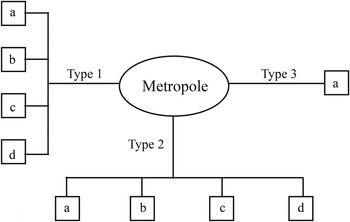
But the analogy falls short in one critical way: the assumption that the regions are like types and that the metropole cannot discriminate between them. Indeed, the relevant economics literature recognizes that entry deterrence works only if entrants perceive that each market is sufficiently similar; the more variegated the market types, the less deterrence will have an effect.Footnote 42 In the context of the chain store analogy, metropoles are usually playing on multiple boards (see Figure 2).
Schemata of proto-state types

The varied typology of proto-states effectively compartmentalizes secessionism in such a way that cascades often do not travel across type. There are two general reasons. First, the conceptual distinction between types can become quite salient. For example, the United States could permit the secession of Puerto Rico without fear of inspiring a movement in one of its fifty states. That it could not so easily permit Hawaii to secede without setting a precedent for Alaska or Texas demonstrates the cognitive salience on the issue. This explanation maps onto Lustick's theory regarding the importance of ideological thresholds in state contraction.Footnote 43 Despite its distance from the mainland, Hawaii's attachment to the core is such that no serious contender for political power would currently suggest otherwise. Meanwhile, Puerto Rican secession is openly discussed and considered nonthreatening to the core. Lustick is right that these thresholds of attachment to territory govern how states downsize, but I go further to argue that there is a tight correspondence between these thresholds and administrative organization. Therefore, my theory lays out predictions about where these thresholds will be located.
Second, it is upon these distinctions that metropoles typically draw a line between those they will permit to secede and those they will deny, as the UK did when it discriminated between colonial units such as Burma and Uganda, and other colonized nations such as the Karens and the Baganda. Such distinctions are focal in nature, and they clearly sort out the respective groups. Moreover, these distinctions are backed by the principle of uti possidetis, which shapes the legal and strategic environment for aspiring nations. It is when these distinctions are particularly salient that the metropole will have an easier time and potential secessionists will be dissuaded; conversely, the weaker the salience, the more likely the metropole will actually have to demonstrate its resolve.
My theory yields three core hypotheses. The first holds that secessionist movements lacking a proto-state stand a poorer chance of being recognized by their metropole.
H1 (Proto-state)
Secessionist movements that lack a proto-state are less likely to be recognized by their metropole.
In my data set, some 38 percent of the secessionist movements lack a proto-state and these are the least blessed. Most of these movements claim territories that are incongruent with any existing administrative region.Footnote 44 Their secession typically presents a problem for the metropoles about where boundaries should be drawn and how the nation should be delineated, and their lack of status makes the precedent-setting problem more acute because their secession would send a signal to all potential takers.
The remaining hypotheses address comparisons between different types of proto-states. Drawing on the chain store analogy, metropoles are often playing on multiple boards. They may choose to permit the secession of one type of unit—see, for example, the Type 3 unit in Figure 2—but fight to ward off any other type of challenger. This is particularly so when the unit in question is the sole member of its type, as Norway was for Sweden, Syria was during its brief federation with Egypt, and as Bougainville currently is for Papua New Guinea.
H2 (Single)
Metropolitan recognition is more likely when the proto-state is the sole member of its type.
Importantly, these cases are not exclusive to so-called binary states. What matters is that there is an administrative unit that is considered unique in type. There are plenty of administrative regions in Papua New Guinea, but Bougainville's special status after 2001 made it unique.
The third hypothesis focuses on levels of administrative organization. States organize their space in a variety of ways. For example, India used to have three types of units: its core states, its union territories, and its protectorates (until 1975). It was much easier for India to permit the independence of its protectorates, as it did with Bhutan, because these were regarded as outer-belt territories, different in status from neighboring states such as Assam. In contrast, Assamese independence was denied because it was a core state, because its secession would set a dangerous precedent, and because opening the door to this sort of fragmentation risked the dissolution of the country. My data set identifies these political architectures for all countries between 1816 and 2011 and sorts the constituent proto-states for each country by type.
H3 (Level)
Metropolitan recognition is more likely for higher-level units.
The unifying logic behind these hypotheses is that the administrative architecture of states actually structures how they respond to secessionist demands. These architectures may have been created for other reasons. They may be arbitrary, poorly drawn, or the product of geopolitical calculations, but they nevertheless present a blueprint for how states can downsize. They provide states with clear lines and status categories, and the strategic use of these distinctions is backed by the international legal emphasis on uti possidetis. This administrative focus is a common mechanism in political life. The mechanism was evident during decolonization, when the colonial powers relied on an administrative snapshot to recognize about fifty administrative units in Africa and simultaneously deny or dissuade perhaps 500 nations.Footnote 45 It was used by a beleaguered Yeltsin to erect a bulwark to state dissolution.Footnote 46 Administrative distinctions continue to feature in both the legal arguments of aspiring nations and in the responses of states and international organizations who decide their fate.
Critics may contend that the theory suffers from endogeneity because administrative distinctions are given to only robust nations, and such distinctions only foment further nationalism. Thus, proto-states are permitted to secede not for strategic reasons on the part of the metropole, but because they are well organized and deserving. I concede that these dynamics do operate, and I model them as an alternative hypothesis in the analysis,Footnote 47 but I contend that the picture is incomplete unless one includes the strategic realities of the metropole. Catalonia is a hard case for my theory because it was once a sovereign state, and because its current autonomous status is both the consequence and cause of nationalist ambition. Yet even here one can see the importance of political organization. Madrid cannot recognize Catalan independence without setting a precedent for other autonomias such as the Basque Country. The Spanish administrative architecture shapes Catalonia's possibilities.
But the Catalan case is hardly the standard where administrative design is concerned. Many higher-level administrative units were the product of top-down decisions that had little regard for the contours of local nations. This is a common critique of decolonization and the application of uti possidetis.Footnote 48 As a result, many territories with weak national identities find independence foisted on them, just as many historic nations bereft of status find that independence is denied them. In all, this administrative focus is a least-bad solution that often yields odd, unfair, and near-miss outcomes. For example, Eastern Karelia was a Union Republic until 1956, when it was downgraded to the level of autonomous republic. Had it kept its status for the remainder of the Soviet era, there is every reason to expect that it would have seceded peacefully along with the other union republics and would now be a sovereign state.
Variables
The dependent variable in this study is the metropolitan response to a secessionist movement's declaration of independence. I coded two outcomes: (0) if the metropole denied the group independence; (1) if the metropole publicly accepted the declaration. Focusing on the response to a declaration is appropriate for several reasons. First, a declaration is a signifier of intent, and it is the most important criterion in my data set that separates secessionist movements from other forms of mobilization aiming for more modest forms of local autonomy. Second, declarations of independence are a distinguishable genre of political writing that typically includes a statement of independence, a declaration of rights, and a manifesto detailing grievances of that nation against the sovereign.Footnote 49 Third, declarations are a trigger event that not only articulates the nation's aspirations but also elicits a response. If the metropole chooses to deny, it almost always issues a rejection for the reason Ker-Lindsay stated: “any silence about an act of secession may possibly be read as de facto acceptance.”Footnote 50 If the metropole chooses to accept, it is keen to show that acceptance and demonstrate its role in the birth of the new state.
The core hypotheses were coded using my data on secessionist movements and proto-states. The variable proto-state indicates whether the secessionist movement laid claim to a proto-state. I modeled this as a binary variable where “no” = 0 and “yes” = 1. single indicates whether the secessionist movement is the sole member of its administrative type (for example, Bougainville since 2001) and is also modeled as a binary variable where “no” = 0 and “yes” = 1. level represents the administrative level for each proto-state based on the respective metropole's administrative architecture. I coded three levels:
-
1. Core. First-order units (states, departments, prefectures, etc.) that count as proto-states because of physical distance (for example, Algeria from 1848 to 1962).
-
2. Intermediate. Politically internal units that possess local autonomy or national distinction (for example, Poland from 1816 to 64; Aruba since 1986).
-
3. Outer. Politically external units (for example, Puerto Rico).
This system captures the varied ways in which states are organized. It is sensitive to how units are nested (first-order, second-order, etc.), and whether they are regarded as politically external, national distinct, and/or autonomous.
I included a number of control variables:
-
• econval quantifies the economic value of the secessionist region.Footnote 51
-
• stratval sums the number of strategic factors (sea outlet, shipping lane, military base, international border, attack route, mountain range) in the region.
-
• prior tests for endogeneity by coding whether the proto-state was previously a sovereign state or a secessionist movement (“no” = 0; “yes” = 1).
-
• geodistance indicates whether the secessionist region is separated from the rest of the state by at least 100 miles of water or foreign territory (“no” = 0; “yes” = 1).Footnote 52
-
• concurrent tests the standard deterrence argument by summing up the number of parallel secessionist movements inside the same state.
-
• numethnic also tests the deterrence argument by summing the number of ethnic groups inside the country.Footnote 53
-
• ethnodistinct signifies the degree of religious and/or linguistic difference for the secessionist group. The variable is coded: (0) no difference; (1) either religiously or ethnically different; (2) both religiously and ethnically different.
-
• polity assesses the regime type of the larger state on a twenty-one-point scale.Footnote 54
Results
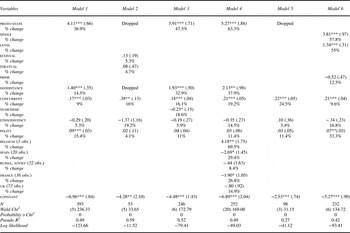
Model 1 includes all secessionist movements whether or not they corresponded with a proto-state (see Table 1). As such, the single, level, and prior variables are excluded at this stage. Similarly, the econval, stratval, and numethnic variables are initially excluded because of limited data. Overall, the effects of having a proto-state are quite strong, increasing the predicted probability of metropolitan acceptance by 37 percent. In addition, the geodistance, concurrent, and polity variables are also highly significant. Notably, the sign on the concurrent variable is positive, indicating that metropolitan acceptance is positively correlated with the number of secessionist movements inside the state. Finally, the effects of the ethnodistinct variable are statistically insignificant, implying that religiously and/or linguistically different nations are not more likely to get a favorable outcome.
Logit results for metropolitan response

Notes: Marginal change calculated by moving the variable from low to high while holding the other variables at their mean. The concurrent, numethnic, and econval variables are calculated by increasing the value from one standard deviation below the mean to one standard deviation above. Standard errors are in parentheses. *p < .10; **p < .05; ***p < .01.
Model 2 includes the variables that quantify the economic and strategic value of the secessionist region. It appears, as Walter argues, that these factors matter less than what is commonly perceived.Footnote 55 Both variables are statistically insignificant and their signs indicate a positive relationship between territorial value and metropolitan acceptance. However, there are limited data for these variables and the model suffers from fewer cases (109 observations). In this reduced set, the proto-state variable now perfectly predicts metropolitan acceptance.Footnote 56
Model 3 shows the regression results once the numethnic variable is included, which limits the time period to the years after 1945 on account of data limitations. Here, the results are stronger: having a proto-state increases a movement's chances by nearly 48 percent, all else equal. Meanwhile, the effects of the numethnic variable are moderately significant, suggesting that the chance of metropolitan denial increases in relation to the number of ethnic groups in the country.
I conducted a number of tests to gauge the robustness of my results.Footnote 57 Model 4 shows fixed country effects, picking up the potential variation caused by factors unique to individual countries.Footnote 58 The marginal effects of proto-states are the strongest here at 63 percent. Model 5 includes only the secessionist movements that claim territory contiguous with the metropole (or within 100 miles). Here, proto-state perfectly predicts metropolitan acceptance. There were twenty-six instances where a metropole permitted the independence of a contiguous group, and in each case the group claimed a proto-state (for example, Norway, Venezuela, Finland). These results suggest that proto-state status matters greatly for contiguous units.
A closer look at the data helps illuminate the relationship between proto-states and metropolitan acceptance. Although there were numerous cases of proto-states that were denied independence (for example, the Basque Country), there have been only three instances since 1816 where secessionist movements not claiming a proto-state were accepted. Although Pakistan consisted of a number of proto-states, it was not one itself. Its rupture with India was extremely violent, but with respect to the UK I have coded it as a case of metropolitan acceptance. Rwanda and Burundi constituted a joint administrative unit under Belgium, but they were not individual proto-states when they seceded peacefully in 1962. They were, however, separate kingdoms in the nineteenth century. This small number of cases demonstrates that metropolitan consent for groups that lack a proto-state is a rare occurrence.
Model 6 includes only those secessionist movements that claim proto-states. Consequently, the single, level, and prior variables can be tested.Footnote 59 In accordance with the core theory of this research note, the single and level variables have a significant impact. The results for the single variable indicate that proto-states that are unique in type are significantly more likely to be permitted independence. For these units the probability of acceptance increases by nearly 58 percent. In some of these cases the breakaway region was splitting from a classic binary state: for example, Norway from Sweden, Syria from the United Arab Republic. In others the secessionist territory was an imperial legacy in a class of its own: for example, Papua New Guinea from Australia, and Luxembourg from the Netherlands. In only two of these cases have secessionist demands been denied by the central government: Flanders and Republika Srpska.
The results for the level variable indicate that the predicted probability of acceptance for outer units is 55 percent more likely than it is for core units. Out of forty-seven cases, only five core units were permitted to secede. These five exceptions included Venezuela and Ecuador from Gran Colombia, Singapore from Malaysia, and two core territories that were splitting from binary states: Syria and Slovakia. In contrast, out of 128 outer-level cases, eighty-eight were permitted independence. This is further evidence that administrative status shapes how states respond.
The remaining results listed in Table 1 are interesting. The prior variable tests for endogeneity, but the effects are weak and in the wrong direction, implying that prior statehood or secessionism does not increase a proto-state's chance of acceptance.Footnote 60 Meanwhile, the geodistance variable shows strong effects. Movements that are geographically distant from the rest of the country have a greater chance of getting their government's acceptance. Perhaps the principles of decolonization shape outcomes even after one controls for the implications of uti possidetis. Or maybe distance itself is the cause, and a sundered territory provides metropoles with a natural (and defensible) way to disassemble. Interestingly, the concurrent variable shows strong effects, but in the opposite direction. That is, the likelihood of metropolitan permission increases as the number of parallel movements increases. This indicates that states are more inclined to release units in waves, casting some doubt on the standard deterrence hypothesis.Footnote 61 Finally, the results for polity indicate that democracies are somewhat more tolerant of secessionist demands.
Conclusion
Administrative architecture shapes the response of metropoles to secessionist demands. Secessionist movements that lack a proto-state are unlikely to be permitted independence. Proto-states that are unique in type or members of a higher-level administrative category are far more likely to be recognized. This administrative focus is an important mechanism in political life.
These findings raise a number of questions. First, how much more secession will likely occur in the near future? One way to answer this question is to examine the long-term trend in proto-state creation and destruction. Not unexpectedly, the number of proto-states has declined from a historical high of 301 in 1947 to a little more than 200 today. Consonant with this decline in number is a pattern whereby states are becoming less articulated, with fewer administrative categories with special status. Those fortunate nations that are unique in type—Bougainville, Flanders—or members of outer-belt categories—Puerto Rico—are likely to be given their independence should they want it. But a number of groups from Casamance to the Thai Malays lack administrative status and are therefore more likely to be denied independence, and more likely to have a conflict. However, many secessionist movements claim core federal units within secessionist-prone countries such as Myanmar, India, Ethiopia, and Spain, and in these cases denial should remain the norm unless the state can find a way to permit secession without risking dissolution. If the rate of secessionism continues, it may become increasingly contested.
Second, what is the relationship between metropolitan response and conflict? I conjectured that a necessary condition for secessionist conflict is that a nation demands independence and their metropole denies it. There are no cases in the data set that falsify this claim—that is, all conflict cases were denied independence.Footnote 62 But denial is not a sufficient condition for conflict, and many denied nations have chosen not to fight. Further research should examine how factors such as administrative status and democracy continue to shape the likelihood of conflict after a nation has been denied.
Finally, if administrative distinctions matter so much, should aspiring nations not work to obtain a special status so that they could one day secede peacefully? This prospect suggests a strategic environment in which nations bargain for small administrative gains, and where governments have to deny calls for special status since one group's permission could set a precedent. Therefore, the difficult process of even getting a proto-state, much less a unique administrative distinction, is a dynamic that deserves attention. It may be that the cognitive demands required for this type of strategic interaction are unrealistic. But anecdotally, Bougainville wrestled a special distinction from Papua New Guinea after more than a decade of civil war, and one former leader stated that the national government insisted that Bougainville's autonomous status and promise of a future referendum on independence is a one-off event, and not something that other provinces can hope to obtain.Footnote 63