The central dialectic of Archaeological Survey in the Lower Mississippi Valley, 1940–1947 (Phillips et al. Reference Phillips, Ford and Griffin1951) concerns the nature of time and cultural change as represented and distorted by artifactual chronology. James A. Ford, who conducted a careful seriation of pottery recovered by the project, argues for a lengthy, slow, and gradual change in the ceramics in an “uninterrupted cultural flow.” Philip Phillips and James B. Griffin, in contrast, argue for a significant break between the ceramics of the Baytown and Mississippi periods. The debate—which reaches no synthesis—hinges not only on different perspectives regarding the evolution of material culture (phyletic gradualism versus punctuated equilibrium), but also on what constitutes a “pure” or temporally unmixed context and how archaeologists should construct and use chronologies. The central methodological challenge is whether more accurate models of cultural change can be constructed through seriation or through typological classification. Type-Variety approaches to chronology tend to create long periods of apparent stasis interrupted by very short periods of rapid change. In contrast, seriation tends to identify slight morphological and technological shifts in the “otherwise placid stream of pottery continuity” (Phillips et al. Reference Phillips, Ford and Griffin1951:427). Phillips and Griffin, in fact, question whether seriation, which assumes continuity, can identify any real “breaks” in the archaeological record.
Chronologies created by Maya ceramic analysts often rely more on typological classification than on seriation. A strength of this method is that it facilitates comparison between sites and regions. Intersite comparison not only fosters the study of exchange, but also allows distinct sequences to be correlated with each other. In this way, ceramic crossties between sites may be used to refine the accuracy of absolute chronologies. Critiques of typology-based chronology emphasize that there is nothing inherently temporal to classificatory schemes. Moreover, typological chronologies may identify chronological breaks that are arbitrary rather than historically meaningful. Finally, seriation, which focuses on the gradual change in the attributes of artifacts, is a more fine-grained tool than typology, which tends to lump variation into artificially defined and sometimes falsely homogeneous categories. Ceramic analysts commonly confuse modal or attribute analysis with seriation. Attribute analysis identifies differences in ceramic vessels but does not explain them. Such differences might indicate change over time, but could also be contemporary and caused by a host of functional, contextual, social, economic, or aesthetic factors. Chronological seriation, therefore, should be used only after these non-temporal factors have been eliminated as potential reasons for attribute variance.
Spurred on by great advances in hieroglyphic decipherment and by a new knowledge of historical events that may be linked to individual rulers, Maya archaeologists are increasingly looking for ways to create artifactual chronologies consisting of shorter phases, chronologies that, in turn, may be correlated to those historical events. At Copan, one attempt based on obsidian hydration dating failed (Braswell Reference Braswell1992, Reference Braswell and Fagan1996b), but a second founded on ceramic analysis was remarkably successful (Bill Reference Bill1997). Rather than consisting of a single 300-year block for the Late Classic, the ceramic chronology of Copan is now sufficiently fine-grained to answer questions regarding cultural change during the lifetimes of particular rulers. It is reasonable to expect that such chronological precision may be achieved in other regions of the Maya world, such as the northern Maya lowlands.
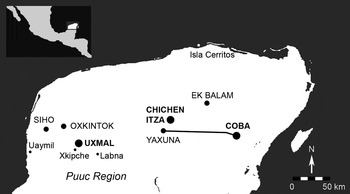
Two ceramic analysts from the Carnegie Institution of Washington—George W. Brainerd (Reference Brainerd1958) and Robert E. Smith (Reference Smith1971)—are responsible for constructing the basic framework for ceramic chronologies of the northern Maya lowlands (Figure 1). Their approach is both typological in method and regional in scope. Like Phillips and Griffin, they emphasize what they see as major chronological discontinuities and associate those breaks with putative historical events such as the arrival of the Toltecs in Yucatan. Moreover, the regional scale of their analyses leads to the confusion of spatial and chronological variation. The most notable example is the Cehpech/Sotuta problem. Smith (Reference Smith1971) interprets the distinction between these two rather similar ceramic complexes in terms of chronology; Cehpech pottery was produced and used during the Terminal Classic period and was replaced by Sotuta pottery in the Early Postclassic. Archaeologists of the northern lowlands now concur that the pattern of variation is both temporal and regional. Although what we call “Cehpech” began in the Puuc region before the earliest pottery called “Sotuta” was produced at Chichen Itza, both sorts of ceramics were made and used during the ninth, tenth, and (probably) early eleventh centuries a.d. During this period—referred to here as the Terminal Classic—the distinction between Cehpech and Sotuta is best understood as spatial rather than chronological. Nevertheless, despite unanimity concerning the existence of a centuries-long overlap of Cehpech and Sotuta, the absolute dates assigned by ceramic analysts to their phases are sometimes derived from the older non-overlap model (e.g., Suhler et al. Reference Suhler, Ardren and Johnstone1998). Such schemes tacitly assume all variation is diachronic and overlook synchronic variation.
The northern Maya lowlands, showing the location of the Puuc region and Xkipche.

RESEARCH AT XKIPCHE
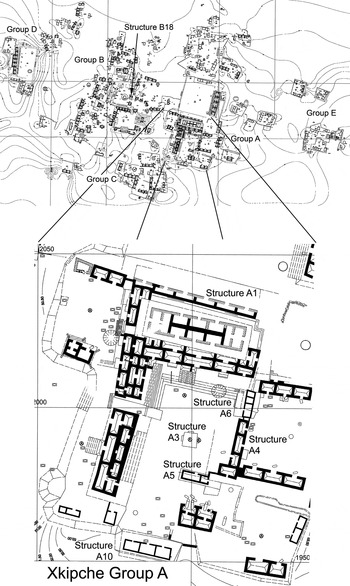
In recent decades, several projects have sought to refine chronologies of sites in the northern Maya lowlands. One of the most ambitious attempts was undertaken at Xkipche, a relatively small site located 9 km southwest of Uxmal in the Puuc region (Figure 1). From 1991 to 1997, the Projekt Xkipche, directed by Hanns Prem, Alfredo Barrera Rubio, and (in 1992) Peter Schmidt, carried out a program of rigorous settlement survey (Figure 2) (Prem Reference Prem and Prem2003a, Reference Prem2003b), meticulously documented excavation (Reindel Reference Reindel1997, Reference Reindel and Prem2003), and careful artifact analysis. From the perspective of chronology, the work of ceramic analyst Michael Vallo (Reference Vallo2000, Reference Vallo and Prem2003) is particularly noteworthy. Rather than limiting himself to a strictly typological approach, from the start Vallo applied two distinct analytical methods: modal analysis (from both quantitative and qualitative perspectives) and Type-Variety classification. As a result, he has defined seven ceramic phases (named Xkipche I to VII) that span the Terminal Preclassic to Late Postclassic periods. Moreover, seriation of ceramic attributes has allowed him to subdivide the previously “monolithic Cehpech ceramic complex” (Vallo Reference Vallo and Prem2003:312) into four well-defined and two transitional complexes that contain both Cehpech pottery and other ceramics. This gradual developmental sequence reached a “climax” during the period a.d. 900/950–1100 (Vallo Reference Vallo and Prem2003:327–328). Finally, one of the largest suites of chronometric data assembled for a site in the Puuc region has allowed Vallo to assign absolute dates to his phases. As was the case for the Lower Mississippi Survey, Vallo's modal analysis and seriation emphasizes continuity and gradual change. It does not, however, consider the possibility that much variation in pottery could be contemporary, or that the vast majority of the contexts are temporally mixed.
The ruins of Xkipche, Yucatan (after Prem Reference Prem2003b:Mapa 1 and foldout).

Parallel to the ceramic analyses, but on a much smaller scale, Braswell and Glascock conducted typological, metric, and geological source analyses of 182 obsidian artifacts recovered during the 1991 to 1995 seasons of the Projekt Xkipche. Although the sample size is numerically quite modest, these studies tell us something about technology and both interregional and long-distance procurement patterns at Xkipche. Moreover, like ceramics and architecture, lithic artifacts also provide the archaeologist with chronological information.
Throughout the Maya area, the Terminal Classic period is marked by dramatic shifts in both obsidian procurement patterns and production technology. Obsidian artifacts dating to a period after this marked “break,” which occurred at Chichen Itza at about a.d. 800 and in the Puuc region a century or so later, are present but quite uncommon at Xkipche. This is contrary to Vallo's proposed ceramic (and, presumably, occupational) climax dating to the tenth and eleventh centuries. Like Phillips and Griffin, we wonder if the apparent continuity in the ceramic sequence is more an artifact of the method of seriation than of historical processes.
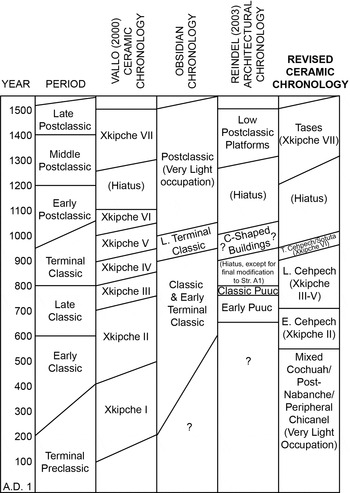
This article summarizes and discusses both Vallo's carefully documented ceramic data and our own analyses of the obsidian from Xkipche. The first section accentuates how the comparative Type-Variety method and seriation lead to different chronological interpretations. In the second and third section, we discuss obsidian procurement and production patterns from a comparative and regional perspective. Finally, we propose a compromise chronology for Xkipche that is derived not only from the ceramic seriation and absolute dates, but also from comparative Type-Variety, obsidian, and even architectural data. This combined approach, we believe, allows us to reach a synthesis of the sort that is missing from Archaeological Survey in the Lower Mississippi Valley, 1940–1947 (Phillips et al. Reference Phillips, Ford and Griffin1951).
ABSOLUTE AND RELATIVE CHRONOLOGIES OF XKIPCHE
Radiocarbon and Thermoluminescence Dates
A problem that has hindered archaeologists working in the Puuc region, and indeed, throughout much of the northern Maya lowlands, is a lack of radiocarbon dates. Xkipche is one of the best-dated archaeological sites in the Puuc. Fully 30 radiocarbon dates and an additional 13 thermoluminescence (TL) assays have been reported for the site (Vallo Reference Vallo and Prem2003:Figure 16, Table 3; Wagner and Wagner Reference Wagner and Wagner1997:Tabelle 4).
The earliest of the radiocarbon dates from Xkipche has a calibrated mid-point of a.d. 159 (Erl-1309; 1880 ± 89 B.P.) and the latest date has a calibrated mid-point of a.d. 1532 (Erl-1333; 408 ± 30 b.p.). The calibrated mid-points of the TL dates range from 705 b.c. (HdTL31 B1-7; 2699 b.p., 905 [705] 465 b.c., 1-sigma range) to a.d. 969 (HdTL33 B23-1; 1028 b.p., a.d. 861 [969] 1077, 1-sigma range). Thus, the radiocarbon dates are consistent with an occupation spanning the Terminal Preclassic through Postclassic periods, while the TL dates suggest a Middle Preclassic through Terminal Classic occupation.
Unlike the radiocarbon dates, the TL dates all have large error ranges. Moreover, most of the 50 samples analyzed either for TL or electron spin resonance did not yield any dates at all (Vallo Reference Vallo and Prem2003:334; Wagner and Wagner Reference Wagner and Wagner1997:Tabelle 2), suggesting that there also may be problems with the samples that did yield dates. Finally, many of the TL dates have mid-points that are unexpectedly early. This is particularly true of the dates thought to pertain to ceramic phases Xkipche IV and VI (Vallo Reference Vallo and Prem2003:Figure 16). We may be confident in the 30 radiocarbon assays but the 13 TL dates should be viewed with more skepticism.
Architectural Chronology
Puuc sites often are dated according to an architectural chronology developed by Pollock (Reference Pollock1980) and later refined by George Andrews (Reference Andrews1986, Reference Andrews1995). Reindel (Reference Reindel and Prem2003:94) notes that many of the structures at Xkipche are Early Puuc (a.d. 650–770) in style, but that earlier structures containing Proto-Puuc elements may once have existed at the site. Other later building phases reflect the transition from the Early Puuc to Classic Puuc styles, or what Andrews (Reference Andrews1995) calls “Intermediate Styles.” Hanns Prem (personal communication 2007) points out that this is not at all a homogeneous category, and doubts the value of “Intermediate Styles” as a chronological phase.
Classic Puuc structures (traditionally dated to a.d. 770–1000/1100, but we prefer the more limited range of a.d. 750/800–950) are less common at Xkipche. Nonetheless, most groups have one or more such buildings. Structures A17, A20, B56, C1, D1, and D10 contain Columnette architecture. Standing façades built in the Mosaic style are now completely lacking at Xkipche, but at least one building, Structure D1, appears to have been built in that style. There are signs that this mosaic façade was demolished in ancient times (Paap Reference Paap2007). Other Mosaic-style structures may have once existed at Xkipche but were deliberately dismantled. The final significant modification to the Xkipche Palace (Structure A1), an incomplete upper level, conforms to what Prem (personal communication 2007) calls “Late Uxmal,” a style common at Uxmal but generally lacking in much of the Puuc region.
Reindel (Reference Reindel and Prem2003:95) argues that the major period of construction at Xkipche ended about a.d. 800. Nonetheless, a few more structures and, especially, the final modification to Structure A1, likely date to the ninth or even early tenth century.
Prem (Reference Prem and Prem2003a:291–298; 2003b:50–51, 121–122, 140, 144–146) describes at least four and possibly seven C-shaped structures similar to platforms at Uxmal (Huchím Herrera and García Reference Huchím Herrera and Ayala2000), Ek Balam (Bey et al. Reference Bey, Hanson and Ringle1997), and many other sites. In much of the northern lowlands, such structures generally postdate the construction of Classic Puuc-style buildings and seem to be roughly contemporaneous with episodes of late Terminal Classic depopulation. At Uxmal and Ek Balam, Sotuta ceramics, which are best known from Chichen Itza, have been found associated with C-shaped structures. It is therefore tempting to assign a late tenth-century date to such structures at Xkipche.
At Xkipche, however, these buildings could be earlier. Structure B20, a round structure, remains enigmatic even after excavation by the Projekt Xkipche. A few late sherds were found on the surface, but the majority of the ceramic material associated with Structure B20 is assigned to the Cehpech complex. Moreover, Structure B20 is but part of a larger, semicircular group of buildings that are related. One of these is Structure B19, also excavated by the project. In contrast to Structure B20, which is of uncertain date, excavations in the related Structure B19 yielded eight cached vessels assigned to either the Motul or early Cehpech complexes. The project also excavated several C-shaped buildings at Xkipche. Although their stratigraphy implies that they were built later than most other structures at the site, the pottery associated with the C-shaped structures is all assigned to the Cehpech and not to the Sotuta complex.
The architectural sequence of the Puuc, therefore, still contains a few surprises. It may be that round structures—so often thought to be a hallmark of Itza influence in the Puuc—have significant local roots stretching back to the sixth or seventh century. Moreover, although the C-shaped structures at Xkipche are late, they seem to have been built and used during Cehpech “times.” The lack of associated Sotuta pottery might be interpreted in two ways: (1) the C-shaped structures date to a time before Itza influence at the site; or (2) Itza influence, as measured by the presence of Sotuta pottery, may have waned at Xkipche (but not at Uxmal or Ek Balam) before these structures were built. In the second case, the lack of association of C-shaped structures with Sotuta ceramics should be considered as having spatial, rather than temporal, significance.
In summary, although later modification of buildings has made it difficult to assess the quantity of Early Classic architecture at the site, most of what is still standing dates to the Late Classic (a.d. 600–800), and especially to the narrower range of a.d. 650–770. It is clear that Xkipche experienced limited architectural growth during the early Terminal Classic (a.d. 800–900) and even less during the late Terminal Classic (a.d. 900–950/1050). It is reasonable to ask if the decline of architectural elaboration at Xkipche was linked to the remarkable expansion of Uxmal during the ninth and early tenth centuries. Finally, a small number of rather simple C-shaped structures may date to the waning years of the Terminal Classic period but the lack of associated Sotuta ceramics is both surprising and renders dating of these structures problematic.
Ceramic Chronology: Seriation and Type-Variety Classification
Vallo (Reference Vallo2000, 2003) stresses that a simple Type-Variety analysis of the Xkipche ceramics is insufficient for forming a detailed chronology. The Type-Variety method identifies within the Xkipche collection just four ceramic complexes: “a scarcely represented Motul, an abundant Cehpech, and also scarcely represented Sotuta and Tases/Hocaba complexes” (Vallo Reference Vallo and Prem2003:320). A particularly important goal of his analysis was to seek a way to subdivide the apparently monolithic Cehpech complex. Many ceramic analysts see Cehpech types as first appearing in the Puuc at the end of the Early Classic and continuing (with the addition of later Sotuta and Hocaba types) until the beginning of the Tases ceramic complex. Thus, the Cehpech ceramic complex is often viewed as beginning about a.d. 550 and lasting until about a.d. 1100/1200. In the Puuc region within this rather long time period, a “pure Cehpech” component lacking significant amounts of Sotuta and Hocaba types can be dated to about a.d. 550–850/950. It should be stressed that this “pure Cehpech” complex and its dates do not necessarily apply to other areas, specifically to the region around Chichen Itza where Sotuta ceramics developed and became dominant by about a.d. 800.
Vallo's (2000, 2003) approach is not to use ceramic types as index fossils diagnostic of particular phases. Instead, he employs modal seriation as a means to define a more fine-grained chronology. This allows him to divide the traditional Cehpech complex into four distinct subcomplexes that characterize four phases (Xkipche II-V). Before these is a Terminal Preclassic to Early Classic phase (Xkipche I), and after are two additional phases corresponding to the late Terminal Classic (Xkipche VI) and Postclassic (Xkipche VII) periods. It is important to note that types classified as belonging to the Cehpech complex appear not only during the Xkipche II to V phases, but also in both the Xkipche I and VI phases. Thus, Vallo's seriation identifies Cehpech as a tradition nearly 1,000 years in duration, but containing measurable changes that allow the creation of a fine-grained chronology.
Absolute dates for Vallo's seven phases rely on both the radiocarbon and TL dates. Although he uses modal seriation as the basis of his chronology, Vallo (Reference Vallo2000:69–153) also conducted a careful Type-Variety analysis. This allows his seriation and chronology to be appraised by comparison with other sites where similar pottery has been found.
Ceramic Seriation and Chronometric Data
One of the most important discoveries in the northern lowlands in recent years is that the Puuc was inhabited during the Middle and Late Preclassic periods. Two TL dates from Xkipche fall into this range. The first (HdTL31 B1-7; 2699 b.p., 905 [705] 465 b.c., 1-sigma range) is Middle Preclassic in date, but comes from a context containing Cehpech ceramics assigned to the Xkipche IV phase. A second date (HdTL31 B4-1; 2128 b.p., 400 [135 b.c.] a.d. 130, 1-sigma range) is Late Preclassic, but again seems too old for the context from which it is derived. These early TL dates allow Reindel (Reference Reindel1997:236, 244) to posit that construction began at Xkipche some time during the Preclassic period. It is quite possible that these two TL dates are in error, and that substantial occupation and construction began at Xkipche during the Early Classic period. Alternatively, these two dates could come from temporally mixed contexts. Obsidian procurement patterns, discussed below, neither support a significant Preclassic occupation nor rule out a minor one.
Xkipche I (a.d. 100/200–400/500)
Two radiocarbon dates have been determined for Vallo's Xkipche I phase. One date (Erl-1309; 1880 b.p. ± 89, with a 2-sigma calibrated range of 60 b.c. [a.d. 159] 377) seems a bit early, but is used by Vallo to determine the lower absolute date for this phase. A second radiocarbon date (Erl-1344; 1538 b.p. ± 97, with a 2-sigma calibrated range of a.d. 265 [467] 669) is fully consistent with an Early Classic ceramic assemblage. Five TL dates, all with very large error ranges, were also determined for Xkipche I contexts. Three of these have midpoints later than a.d. 300, lending weak support to the suggestion that these contexts are essentially Early Classic in date.
Thirteen ceramic wares and 23 types have modal forms assigned to the Xkipche I phase (Vallo Reference Vallo2000:Tabelle 17). Among these types are Sierra Red, Black Ucu, Maxcanu Buff, and Timucuy Orange. Also represented in the Xkipche I assemblage are: (1) Fine Gray ceramics including Chablekal Gray and Chicxulub Incised; (2) Puuc Slate types such as Muna Slate, Akil Impressed, Chumayel Red-on-Slate, and Xaya Gouged-Incised; (3) Puuc Unslipped types such as Oxkutzcab Appliqué, Chum Unslipped, and Yokat Striated; and, (4) the Puuc Red Ware type Teabo Red. In fact, the only two ceramic wares/groups that represent more than 3% of the Xkipche I collection are Puuc Unslipped/Chum (n = 1,935; 75.9%) and Puuc Slate/Muna (n = 408; 16.1%) (Vallo Reference Vallo2000:Tabellen 12–13).
Thus, although seriation has created a neatly-defined cluster of morphological traits (large dishes with flaring sides; jars with thickened, short flaring necks and rounded rims; Slate ware dishes with thumb-impressed decorations), a Type-Variety analysis for the Terminal Preclassic to Early Classic Xkipche I phase reveals the presence of types that at other sites are known to date to the Late and Terminal Preclassic, Early Classic, Late Classic, and Terminal Classic periods. Particularly surprising to Puuc ceramic specialists is the suggestion that Muna Slate—the second most common ware represented in the Xkipche I sample—was produced as early as the second century a.d. A more likely period for the appearance of this ware is the transition between the Early Classic and Late Classic periods (Varela Torrecilla Reference Varela Torrecilla1998), perhaps no earlier than a.d. 550 (Robles Castellanos Reference Robles Castellanos2000; Fernando Robles Castellanos, personal communication 2006). Moreover, very few Maya ceramic analysts—regardless of where they work in the lowlands—embrace the suggestion that Sierra Red, Fine Gray, and some types of Puuc Slate are all contemporaneous.
From a Type-Variety perspective, the Xkipche I ceramics is a mixed bag of types, a few of which date to the Terminal Preclassic and Early Classic periods, but most of which probably date to the Late Classic or even later times.
Xkipche II (a.d. 400/500–700/750)
The next phase is more firmly dated by six radiocarbon assays. Taking into account the full two-sigma ranges of all but one of these assays, Vallo proposes that Phase II dates to a.d. 400/500–700/750.
Forms identified by the seriation as co-occurring during the Xkipche II phase include: (1) jars with striations, medium high necks, direct rims, beveled and grooved lips, and a rather coarse paste; (2) dishes with flaring sides, red or black trickle paint, and low slab feet; (3) dishes with large and solid nubbin feet, everted rims, and a basal Z-angle; and, (4) dishes with flaring sides, direct rims, and stepped slab feet (Vallo Reference Vallo and Prem2003:322).
From a Type-Variety perspective, Xcantun Unslipped ware and Yucatan Opaque ware disappear (both were originally defined by Smith [1971] as belonging to the Preclassic Tihosuco complex). Sierra Red (Late Preclassic to Early Classic, Post-Nabanche and Peripheral Chicanel complexesFootnote 1), Campeche Gloss, and Yucatan Gloss wares (both belonging to the Early Classic Cochuah complex), and Fine Gray (a ware belonging to the problematic Motul complex) become even rarer than they are in the Xkipche I phase. The decline in the quantity of Fine Gray wares is somewhat surprising given that they are often viewed as diagnostic of the Late Classic to early Terminal Classic periods (e.g., Adams Reference Adams1971; Demarest Reference Demarest2006; Foias Reference Foias1996; Sabloff Reference Sabloff1975).
The most important difference between Xkipche I and II is in the quantity and variety of Cehpech ceramics. Puuc Slate/Muna group ceramics account for 20.1% (n = 8,446) of the Xkipche II phase collection, and both Cauich Coarse Cream/Holactun group (n = 3,398; 8.0%) and Thin Slate/Ticul group (n = 1,074; 2.5%) ceramics appear for the first time. Other new appearances include three sherds of Fine Orange/Balancan, two sherds of Fine Orange/Altar, and one of Fine Orange/Silho (Vallo Reference Vallo2000:Tabelle 12). The last is assigned to the Sotuta complex, best known from Chichen Itza.
In sum, the Type-Variety analysis suggests that Xkipche I and II are rather similar. A few (but certainly not all) of the Preclassic and Early Classic types disappear during Xkipche II, and more types dating to both the Late Classic and the Terminal Classic periods appear. Although the Xkipche I phase is defined by Vallo as having some Cehpech types, the Xkipche II phase includes many more. Although Type-Variety analysis suggests that most of the pottery identified by seriation as belonging to Xkipche I may date to later times, most—but certainly not all—of the material assigned to the Xkipche II phase are Cehpech types consistent with all but the first 50–150 years of the temporal range suggested for this phase.
Although some ceramic analysts may consider a.d. 500 a bit early for the initiation of the Cehpech complex, a date within the sixth century now seems warranted. From a Type-Variety perspective, a likely initiation date for Xkipche II is a.d. 550, or about a century later than that proposed by Vallo (Reference Vallo2000, Reference Vallo and Prem2003). Such a reinterpretation is well within the error ranges of the radiocarbon dates, and is also consistent with the architectural evidence. Nonetheless, the presence of Thin Slate (let alone Silho Fine Orange) in the Puuc before about a.d. 700 is quite suspicious. This implies that from a Type-Variety perspective, the Xkipche II complex (like that of the previous phase) was defined from temporally mixed contexts.
Xkipche III (a.d. 700/750–800/850)
The third phase in the Xkipche sequence is dated by 16 radiocarbon assays. One of these (Erl-1141; 1667 b.p. ± 48, with a 2-sigma calibrated range of a.d. 255 [395] 534) is too early and one (Erl-1331; 1036 b.p. ± 47, with a 2-sigma calibrated range of a.d. 891 [1025] 1158) seems late. Vallo suggests limiting the upper range of this phase to a.d. 800/850, apparently in order to leave a temporal gap sufficient to include the next two proposed phases. Nevertheless, six (38%) of the dates have calibrated midpoints later than a.d. 850 and 10 (63%) have midpoints later than a.d. 800. For this reason, a later endpoint seems warranted. The radiocarbon assays suggest that the Xkipche III phase dates to the second half of the Late Classic and the first century of the Terminal Classic period.
According to Vallo (Reference Vallo and Prem2003:323–324), the Xkipche III ceramic inventory demonstrates a strong trend toward simplification. Nonetheless, the variety of Puuc Slate ware forms increased dramatically and, during this phase, came to include huge bowls and jars as well as plates with more elaborate decorations than in earlier phases. Vallo (Reference Vallo and Prem2003:325) also identifies a gradual trend toward the use of incised and gouged-incised ornamentation and the near absence of polychrome decoration.
Type-Variety analysis reveals that more than 99.8% of the ceramics described as belonging to the Xkipche III inventory are Cehpech types consistent with a Late to Terminal Classic date. Nonetheless, trace quantities of Peripheral Chicanel (Sierra Red), Cochuah (Yucatan Gloss and Yucatan Chalky), and transitional Motul (Fine Gray/Chablekal) wares are represented in the collection. Also present but very rare are Sotuta wares (Chichen Red, Chichen Slate, and Chichen Unslipped), and Hocaba/Tases wares (Peto Cream, Mayapan Unslipped, Mayapan Red, and Xkipche Unslipped). Together, these later wares account for less than .02% of the Xkipche III collection. From a Type-Variety perspective, then, the Xkipche III inventory appears to be an almost “pure Cehpech” assemblage with just a very small quantity of earlier and later sherds.
Xkipche IV (a.d. 800/850–900/950)
The next phase defined by Vallo's seriation is assigned an absolute chronology on the basis of five TL dates. No radiocarbon assays were conducted for this phase. The earliest of the TL dates has a midpoint of 705 b.c. (HdTL31 B1-7; 2699 b.p.), in the Middle Preclassic period. Four other dates are reported as having midpoints of a.d. 592 (HdTL33 B14-1), a.d. 718 (HdTL31 B2-1), a.d. 777 (HdTL33 A7-1), and a.d. 835 (HdTL A1-2) (Vallo Reference Vallo and Prem2003:Table 3). Three of these midpoints are within the temporal range proposed for the Xkipche II and III phases, and just one falls within the period proposed for the transition between Xkipche III and IV. The TL dates may be in error (and at least one is far too early for its context), the absolute chronology proposed for the phase may be incorrect, or both may be wrong.
A total of 203,496 sherds were assigned to the Xkipche IV phase (Vallo Reference Vallo2000:Tabelle 12), or about 7.5% more than the preceding phase. Although this may be a result of sampling, it seems to suggest that Xkipche IV times were characterized by a heavy occupation, one that is not usually associated with the cessation of building activity. Yet Reindel (Reference Reindel and Prem2003:95) asserts that “the greatest construction activity at Xkipche took place before a.d. 800.” In contrast, Vallo writes: “The phase Xkipche IV stands out due to a further qualitative and quantitative increase in the construction activities in all examined parts of the site, especially regarding the building A1” (Vallo Reference Vallo and Prem2003:327). These two statements concur if and only if the Xkipche IV phase dates to a time earlier than suggested.
According to the seriation, the Xkipche IV ceramic assemblage is typified by a remarkable increase in the forms and types of major Cehpech wares:
“Diagnostic elements of this phase are huge Puuc Slate ware basins with triangular rims and pre and post fire incised decorations…. We saw further an increase in incised, impressed, and gouged-incised plates with the typical late Cehpech cylindrical and decorated foots [sic]. Other new diagnostic elements are vases with vertical sides of Puuc Red and Thin Slate ware, replacing the older vases with incurving sides and direct rims.” (Vallo Reference Vallo and Prem2003:326)
Moreover, vases and thick-walled Puuc Slate bowls were completely replaced by Thin Slate and Puuc Red ware forms. Continuing a pattern observed for the Xkipche III phase, virtually all imported polychromes were replaced by local products. Indeed, the only imports of the Xkipche IV phase are a small number of Balancan and Altar Fine Orange vessels, and perhaps a few dozen vessels of Moxa Gray (Vallo Reference Vallo and Prem2003:325).
As for earlier phases, the vast majority of types assigned to the Xkipche IV phase belong to the Cehpech complex. From a Type-Variety perspective, the Xkipche IV collection contains even fewer sherds belonging to earlier complexes such as Post-Nabanche/Peripheral Chicanel and the transitional Motul complex, but has more Sotuta and Hocaba/Tases material than does the Xkipche III collection. Fully 1,885 sherds, or just over 0.9% of the Xkipche IV total collection, are from wares assigned to these “post-Cehpech” complexes. From the Type-Variety perspective, the Xkipche IV collection may be viewed as consisting of Cehpech materials mixed with a small but significant quantity of later materials.
Xkipche V (a.d. 900/950–1000/1050)
Xkipche V is well-defined according to Vallo's seriation, but chronometric data are limited to a single radiocarbon assay. The date (Erl-1312; 1224 b.p. ± 50, with a 2-sigma calibrated range of a.d. 680 [816] 951) is more consistent with the proposed temporal range of Xkipche III or Xkipche IV than it is for the Xkipche V phase. In fact, 10 of the 16 dates for the Xkipche III phase are later than this date for Xkipche V.
Vallo describes the Xkipche V ceramic assemblage as “the full Cehpech complex described by Smith (Reference Smith1971) for Uxmal and Kabah.” His date for the phase, however, is the last 50 to 100 years—and perhaps as much as 50 years beyond—of the period proposed by Smith for the Cehpech complex. Moreover, unlike either Uxmal or Kabah, Xkipche contains very little Classic Puuc architecture, especially that of the Puuc Mosaic style. We should expect to find Classic Puuc architecture in conjunction with a ceramic phase presenting the full florescence of the Puuc. In any event, it now seems probable that the Puuc phenomenon was essentially over by a.d. 950, a date towards the beginning of the range proposed for this phase. At Uxmal, there is little evidence of substantial construction—except perhaps for the enigmatic C-shaped buildings and other related structures—after the middle of the tenth century (Dunning and Kowalski Reference Dunning and Kowalski1994; Kowalski Reference Kowalski and Prem2003).
As in the Xkipche IV phase, the only imports are Altar and Balancan Fine Orange bowls and small quantities of Moxa Gray ware vessels. The complex is characterized by a trend toward luxury tableware, rather than cooking vessels, made in Puuc Red and Ticul Thin Orange. To us, this indicates more of a functional or contextual distinction than a chronological difference from the Xkipche III and IV complexes. Forms diagnostic of this phase include: (1) huge jars with high flaring necks and horizontal interior striations; (2) censers with appliqués and light exterior striations; (3) Cauich Coarse Cream ware vessels with a cinnamon to light orange slip and thick black bands; (4) small Ticul Thin Slate ware bowls with the same decorations as basins and drums; (5) huge basins of Ticul Thin Slate ware with flaring sides, rounded rim bolsters, and vertical strap handles; and, (6) the first appearance of highly decorated dishes of the types Hohcacab Composite, Yaxnic Modeled, Xaya Gouged-Incised (all Puuc Slate ware), and Tepakan Composite (Puuc Unslipped ware) (Vallo Reference Vallo and Prem2003:327).
From a Type-Variety perspective, the Xkipche V phase ceramic inventory consists of a highly rich and diverse variety of Cehpech types. New additions of this phase include three varieties of Holactun Black-on-Cream (a type within Cauich Course ware), three varieties of Puuc Red types, five varieties of Puuc Slate, and three varieties of Puuc Unslipped (Vallo Reference Vallo2000:Tabelle 17). Also appearing in the Xkipche V ceramic assemblage is Tenosique Red-on-Orange, a Balancan Fine Orange type. Xkipche IV types and varieties that do not appear in the Xkipche V collection include Palizada Black-on-Orange/Incised (a variety of Balancan Fine Orange), Sayan Red-on-Cream (a Campeche Gloss ware type), and Chiburna Brown (a Yucatan Glossy ware type). The Xkipche V assemblage contains not only a wider variety of Cehpech types than earlier periods, but also contains fewer types and varieties assigned to other complexes.
Xkipche VI (a.d. 1000/1050–1100)
Like the previous two phases, Xkipche VI is poorly dated by chronometric means. Two calibrated TL dates of a.d. 645 (870) 1095 (HdTL33 B19-1; 1127 b.p., 1-sigma range) and a.d. 861 (969) 1077 (HdTL33 B23-1; 1028 b.p., 1-sigma range) both overlap with the proposed absolute dates for the Xkipche VI phase only in their upper ranges, and are consistent with the ranges proposed for the Xkipche IV and Xkipche V phases.
According to Vallo (Reference Vallo and Prem2003:329), building activity ceased by the end of the Xkipche VI phase. At that time, he argues, construction of the second story of the east wing of Structure A1 ended. Reindel (Reference Reindel and Prem2003) dates this to about a.d. 800. Thus, the architectural and ceramic interpretations of the cessation of building activities at Xkipche differ by 300 years; Reindel dates this cessation to the early Terminal Classic, Vallo to the Early Postclassic period.
Ceramic forms diagnostic of the Xkipche VI phase include:
highly decorated dishes with incised comorans [sic] and geometric motives, stamped designs in combination with incising[,] and hollow cylindrical foots [sic]…. Other diagnostic forms are very huge decorated jars showing slight similarities with later Chichén Slate forms and undecorated huge to medium size and mostly undecorated basins. (Vallo Reference Vallo and Prem2003:329)
Cinnamon-colored slipped Cauich Coarse Cream drums and basins with painted lines, as well large jars with covers fixed on with cords are also common, as are Puuc Unslipped storage jars with high, outcurving necks (Vallo Reference Vallo and Prem2003:329).
The Xkipche VI ceramic collection contains a mixture of Cehpech and Sotuta complex types, the latter associated most strongly with Chichen Itza. Nonetheless, the vast majority of sherds are assigned to Cehpech types and varieties. A few of these are present in the Xkipche V collection but not in the Xkipche VI sample. These include Yaxumha Composite, Teabo Red/Impressed and Teabo Red/Red Paint (Puuc Red types and varieties), Tekit Incised/Red Paint and Sacalum (Puuc Red ware), and Halacho Impressed/Halacho (a variety of Puuc Unslipped ware). Holactun Black-on-Cream/Appliqué (Cauich Course ware) and Teabo Red/Appliqué (Puuc Red ware) are two new Cehpech varieties that are not known from earlier contexts at Xkipche (Vallo Reference Vallo2000:Tabelle 17).
Although the absolute number of Sotuta sherds is small compared to the quantity of Cehpech material, nine different Sotuta types are represented in the small Xkipche sample. These include Silho Orange, Yalton Black-on-Orange (both Silho Fine Orange types), Dzibiac Red (a Chichen Red ware type), Balantun Black-on-Slate, Chacmay Incised, Dzitas Slate (three Chichen Slate ware types), Piste Striated and Sisal Unslipped (both Chichen Unslipped ware types), and Tumbador Incised (a Tohil Plumbate type made in the Pacific lowlands of the southern Maya area, but considered to belong to the Sotuta complex). Two other new arrivals during the Xkipche VI phase are Pantano Impressed (Petén Gloss ware) and Xcanchakan Black-on-Cream (Peto Cream ware). The first is likely a Late Classic or early Terminal Classic import from the Usumacinta region. The second is a type characteristic of the Hocaba complex, often thought to postdate or to overlap with the Sotuta complex at Chichen Itza, and found at that site only in surface and post-construction contexts. Finally, two new types of Altar Fine Orange ware, Pabellon Modeled-Carved and Tumba Black-on-Orange, also appear in the Xkipche VI phase sample. In much of the Maya lowlands, these appear during the early Terminal Classic and not later during the eleventh century.
Smith (Reference Smith1971) and (albeit employing different terminology) Brainerd (Reference Brainerd1958) argue that the Sotuta complex of Chichen Itza was strictly later than the Cehpech complex. Sotuta ceramics, therefore, served as a means of identifying the Early Postclassic appearance of a “Mexican” component in the northern Maya lowlands. In contrast, contemporary ceramic analysts are now unanimous in acknowledging at least some temporal overlap between the two complexes. A mix of Cehpech and Sotuta types, such as the Xkipche VI phase assemblage, need not represent a mix of temporally distinct materials. Mixed Cehpech/Sotuta assemblages have been discovered at other Puuc sites, including Uxmal (Kowalski Reference Kowalski and Prem2003:256–257). These mixed assemblages date to, and especially after, the construction of the most elaborate Mosaic-style structures. At Uxmal, mixed Cehpech/Sotuta ceramics were found associated with the low C-shaped buildings located between the Palace of the Governor and the Bird Quadrangle (Huchím Herrera and García Reference Huchím Herrera and Ayala2000), with the Caracol-like round structure west of the Palace of the Governor (Kowalski et al. Reference Kowalski, Rubio, Más, Herrera, Macri and McHargue1996), within the Nunnery Quadrangle (Konieczna and Mayer Reference Konieczna and Guala1976; Ruz Lhuillier Reference Ruz Lhuillier1955), on the Great Pyramid (Sáenz Reference Sáenz1975), and along the north side of the platform supporting the House of the Governor (Tomás Gallareta Negrón, personal communication 1995).
In recent years, several scholars have argued that the Puuc region collapsed in the late tenth century (e.g., Dunning and Kowalski Reference Dunning and Kowalski1994). Still others have argued that the period of intense interaction between Chichen Itza and the Puuc region was limited to the tenth and perhaps early eleventh centuries (Braswell and Glascock Reference Braswell, Glascock and Glascock2003; Cobos Reference Cobos, Laporte and Escobedo1998; Ringle Reference Ringle2004; Ringle et al. Reference Ringle, Negrón and Bey1998). Thus, at Uxmal mixed Cehpech/Sotuta contexts date to some time after a.d. 900 and before the abandonment of the site (Kowalski Reference Kowalski and Prem2003). We now consider it likely that the end of the Puuc florescence occurred as early as a.d. 920, and that Uxmal was virtually abandoned within the next 30 years. Although many scholars will prefer a date of 50 to 100 years later for this event, it seems clear that both architectural and ceramic cross-dating with Uxmal suggest that Vallo's (2000, 2003) absolute chronology of the Xkipche VI phase is at least 100 years too late.
Xkipche VII (a.d. 1250/1300–1500)
The Xkipche VII phase represents a limited Hocaba/Tases reoccupation of the site. Three radiocarbon assays provide absolute dates for this period. The calibrated 2-sigma ranges for these dates are a.d. 1300 (1370) 1440 (Erl-1097; 575 b.p. ± 40), a.d. 1432 (1529) 1626 (Erl-1095, 435 b.p. ± 38), and a.d. 1437 (1532) 1626 (Erl-1333; 408 b.p. ± 30). All three are consistent with a very Late Postclassic to Early Colonial period occupation. During this time, a few buildings appear to have been reoccupied.
In the article that summarizes his ceramic research, Vallo (Reference Vallo and Prem2003:330–331) does not discuss modal variations typical of the Xkipche VII phase. Instead, he relied on Type-Variety analysis to distinguish Xkipche VII ceramics from the material of earlier phases. Given the drastic differences between Cehpech and Tases complex pottery, this is quite reasonable. In fact, no Cehpech types are represented in the Xkipche VII sample. A total of 23 types (each represented by just one variety) from 12 wares make up the Xkipche VII assemblage. These wares are Xkipche Unslipped, Puuc Waxy Red, Campeche Gloss (Dolorido Cream-Polychrome type), Mayapan Red, Mayapan Unslipped, Silho Fine Orange, Chichen Red, Chichen Slate, Chichen Unslipped, Peto Cream, and Petén Gloss (Portia Gouged-Incised type). Most of the Xkipche VII pottery can be assigned to the Middle to Late Postclassic Tases complex, best known from Mayapan, but transitional Early to Middle Postclassic Hocaba and Terminal Classic Sotuta types are also present. Thus, like the Xkipche I phase (and to a lesser extent, other phases in the sequence), Type-Variety analysis suggests that the Xkipche VII phase is a mix of several complexes that at other sites are thought to date to a variety of periods. Given that much of the Xkipche VII pottery was recovered from post-construction and near-surface lots, it is reasonable to suspect that the phase is defined from mixed contexts.
The Problem: Alternative Chronologies for Xkipche
The radiocarbon data for Xkipche are rich by Puuc standards and imply that the site was inhabited during the Classic and Postclassic periods. If early TL dates are also considered, dates not yet corroborated either by independent radiocarbon assay or by ceramic analysis, the occupation of the site may extend back into the Middle Preclassic period.
Two alternative approaches to ceramic analysis lead to significantly different ceramic chronologies. Vallo's (2000, 2003) careful seriation of the Xkipche ceramics suggests a gradual in situ development of the Cehpech ceramic complex. Xkipche may have been occupied in the Late or Terminal Preclassic period, but with the commencement of the Early Classic, Cehpech types began to appear alongside Post-Nabanche/Peripheral Chicanel, Cochuah, and other early pottery. Over the ensuing centuries, the Cehpech complex became richer in variety and changed in form and decoration, allowing it to be divided into a total of six phases (including transitional Motul/Cehpech and Cehpech/Sotuta phases at the beginning and end of the sequence). Thus, the production of Cehpech ceramics spanned the late second through eleventh centuries (Vallo Reference Vallo2000, Reference Vallo and Prem2003). Following a possible break in occupation, Xkipche was again occupied by people using not only Hocaba and Tases types known from Mayapan, but also some Sotuta ceramics best known from Terminal Classic Chichen Itza.
In contrast, a comparative typological approach using long-established ceramic wares, groups, types, and varieties suggests that materials corresponding to a limited Late Preclassic to Early Classic period occupation (represented by Post-Nabanche/Peripheral Chicanel and Cochuah types) are mixed with subsequent and abundant Late to Terminal Classic types. That is, what are identified as contemporary ceramics dating to the Xkipche I phase are derived from mixed contexts. To a lesser extent, the Xkipche II complex also appears to be defined from mixed ceramics, but the Xkipche III through Xkipche V complexes are essentially “pure Cehpech.” We wonder if much of the modal variation seen in the Xkipche III, Xkipche IV, and Xkipche V complexes is best thought of as contemporary and functional in nature, and hence, unsuited to seriation. Ceramics assigned to the Xkipche VII complex also are mixed, but are derived from Sotuta, Hocaba, and—especially—Tases material. In sum, the typological approach suggests a very limited (and, unfortunately, contextually mixed with later Cehpech material) Late Preclassic to Early Classic occupation, a very strong Cehpech presence dating to about a.d. 550–900/950, a weak mixed Cehpech/Sotuta occupation dating to the second half of the Terminal Classic (a.d. 900/950–950/1050), and, after a hiatus, a Middle to Late Postclassic Tases occupation. Rather than seven complexes, only four can be clearly identified using the comparative typological approach, and these can be used to define three phases—Cehpech (a.d. 550–900/950), Cehpech/Sotuta (a.d. 900/950–950/1000), and Hocaba/Tases (a.d. 1200–1540). An earlier presence (Late Preclassic to Early Classic) is also identified by Type-Variety analysis, but only in secondary contexts that are thoroughly mixed with later Cehpech pottery. The fact that the Xkipche III to Xkipche V phases cannot yet be separated using chronometric data suggests that contextual, rather than temporal, differences may exist within the Cehpech complex.
Seriation provides a more fine-grained chronology (seven rather than three or possibly four phases) than the comparative typological approach. But are the morphological changes identified through seriation temporally meaningful? Alternatively, does the seriation reflect a statistical blend of forms dating to both earlier and later times? Are the phases defined from temporally mixed archaeological contexts? These methodological questions are precisely those raised by Phillips and Griffin (Phillips et al. Reference Phillips, Ford and Griffin1951). Finally, are the absolute dates suggested by Vallo for each of the seven phases of Xkipche accurate or should they be questioned?
One approach to answering these questions is to consider independent and alternative chronologies based on classes of material culture other than ceramics. Architectural studies reveal that most of the important structures at Xkipche were built during the Late Classic period, specifically the seventh and eighth centuries a.d. This appears to limit significant occupation of the site to the first florescence of the Puuc region before the great expansion of the Uxmal state. But earlier structures at Xkipche may have been destroyed by Late Classic construction (Reindel Reference Reindel and Prem2003). Moreover, the cessation of major building activities at about a.d. 800 does not imply abandonment of the site. Finally, a few C-shaped buildings and a round platform may date to a somewhat later time, perhaps to the mid-tenth century or even later.
Another potential source of chronological data, one that has seldom been tapped in the Puuc region, is lithic artifacts. The rest of this article examines the obsidian collection of Xkipche with the goals of testing alternative chronologies of the site. Although obsidian and lithic artifacts in general are not as sensitive to change as Maya ceramics, distinct technological practices, procurement patterns, and even particular morphological types are characteristic of different periods. Here we concentrate on technology and procurement, two aspects of obsidian studies that are broadly comparable to modal or attribute analysis in ceramics. Different technologies of production lead to formal variation of obsidian artifacts. Moreover, the geological source of an obsidian artifact may be considered an attribute. Changes in technology and procurement, therefore, can be used as temporal markers.
In discussing the collection from Xkipche, we first consider the procurement of obsidian from different geological sources. We then describe attribute and typological analyses of the collection. Xkipche did not develop in a vacuum; an important aspect of both analyses, therefore, is comparison with other sites in the northern Maya lowlands. Finally, we return to the absolute and relative chronology of Xkipche and the potential problem of mixed contexts.
GEOCHEMICAL AND VISUAL SOURCE ATTRIBUTION OF OBSIDIAN ARTIFACTS FROM XKIPCHE
In order to understand obsidian procurement patterns at Xkipche, lithic analysis began with experiments designed to identify the geological sources of 182 artifacts recovered from the site. A combined method of visual and instrumental neutron activation analysis (INAA) sourcing has been described elsewhere (Braswell et al. Reference Braswell, Andrews and Glascock1994, Reference Braswell, Clark, Aoyama, McKillop and Glascock2000). Results of this strategy have been presented for collections from Chichen Itza, Uxmal, Yaxuna, Coba, Ek Balam (Braswell and Glascock Reference Braswell, Glascock and Glascock2003), Calakmul (Braswell et al. Reference Braswell, Gunn, Carrasco, Folan, Fletcher, López, Glascock, Demarest, Rice and Rice2004), Topoxte (Braswell Reference Braswell and Würster2000), Quelepa (Braswell et al. Reference Braswell, Andrews and Glascock1994), and dozens of Postclassic period sites throughout Mesoamerica and lower Central America (Braswell Reference Braswell, Smith and Berdan2003).
Methodology and Results of Sourcing Experiments
Classic period obsidian collections from the central and southern Maya lowlands are typically dominated by material from just one or two sources located in the Guatemalan Highlands. At Topoxte, for example, 65% of the Early to Terminal Classic obsidian comes from El Chayal and 24% from Ixtepeque (Braswell Reference Braswell and Würster2000:Figura 172). At Late Classic Copan, fully 99.6% of the obsidian comes from the Ixtepeque source (Aoyama Reference Aoyama1999:131). The decision-making process employed when visually sorting such Early and Late Classic collections is virtually binary: Is it Source A or Source B? An effective sourcing strategy for such collections is to form one or two visual categories representing these groups, and to set aside all visual “outliers” for trace-element assay. The efficacy of the visual sort can be judged by assaying a random sample from the dominant visual group or groups. If accuracy is high for the random sample, it may be assumed that it is also high for the visual group as a whole.
Terminal Classic collections from the northern lowlands contain obsidian from as many as ten sources, and hence, can be more difficult to source according to visual criteria. More visual categories need to be formed by the analyst, and a significant sample from each must be subjected to trace-element sampling. Braswell finds two central Mexican sources—Ucareo, Michoacan, and Zaragoza, Puebla—to be particularly difficult to distinguish from each other (but typically not from other sources) using visual criteria. In an experimental sort of 107 artifacts from Chichen Itza thought to be from these two sources, he was able to identify only 80% of them correctly, but INAA did reveal that all 107 artifacts were from these two sources and no other. It seems best, then, to conduct trace-element analysis on all artifacts thought to be from either Ucareo or Zaragoza.
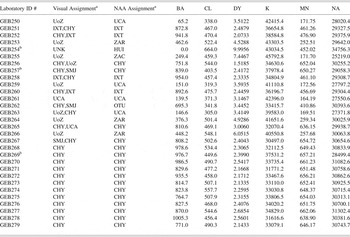
The collection of 182 obsidian artifacts from Xkipche was only the second such northern lowland sample analyzed by Braswell and Glascock. In this case, five visual groups were formed. The first, and by far the largest, consisted of artifacts thought to come from the El Chayal, Guatemala, source (n = 156). A random sample consisting of 12 artifacts was selected from this group and assayed by Glascock using INAA (Table 1: GEB268–279). Each and every artifact did, indeed, come from the El Chayal source, allowing us to assign a high degree of confidence to the source assignment made for the remaining 144 artifacts in that group.
Source data for 30 obsidian artifacts from Xkipche.

Note: Elemental composition in parts per million. For cases where multiple visual assignments are listed (i.e., pieces that could not be given a source assignment with certainty), the visual assignment considered at the time of analysis to be most likely is listed first.
aCHY = El Chayal, Guatemala; HUI = Huitzila, Zacatecas; IXT = Ixtepeque, Guatemala; OTU = Otumba, Estado de México; SMJ = San Martín Jilotepeque, Guatemala; UNK = unknown; UCA = Ucareo, Michoacan; UoZ = either Ucareo or Zaragoza; ZAC = Zacualtipan, Hidalgo; ZAR = Zaragoza, Puebla.
bSource assignment by six-element, short-irradiation INAA (data reported here) was not possible for these three samples. Subsequently, long-irradiation, 22-element INAA was used on these three pieces. INAA assignments are based on this second procedure.
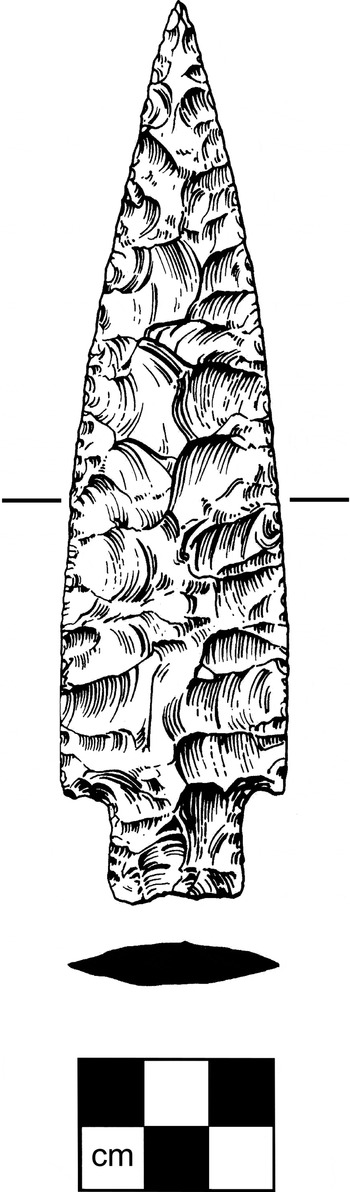
A second and much smaller visual group contained four artifacts considered to be unequivocal examples of Ixtepeque obsidian. A third group consisted of three green artifacts assumed to come from the Pachuca, Hidalgo source. No samples from these two groups were assayed by INAA. A complete stemmed biface from Structure A3, Offering 3 (Figure 3) also was excluded from destructive INAA. It has been given a visual source assignment of Ucareo, but this must be considered tentative.
Obsidian biface recovered from Offering 3, Structure A3 (after Reindel Reference Reindel1997:Abbildung 32).

All of the remaining 18 obsidian artifacts were assigned to sources using both visual criteria and INAA. A fourth visual group consisted of eight blue-black artifacts made of fine obsidian thought to come most likely from either the Ucareo or Zaragoza sources. INAA revealed that seven of these pieces did, indeed, come from these sources (Table 1: GEB250, -253, -259, -261, -263, -264, -266), but the eighth piece came from Zacualtipan, Hidalgo, a third central Mexican source of dark black obsidian.
A single and unique looking piece was assigned to a category called “source unknown” (Table 1: GEB254). Twenty-two element, long irradiation INAA revealed that this singular artifact is from the distant geological source of Huitzila, Zacatecas. It is the only artifact from this source that has been identified in the Maya region,Footnote 2 and it is important to stress that it was singled out for INAA by visual sourcing. This piece, a percussion flake, was found on the surface of fall and accumulated debris in Room 2 of Structure A6, and was associated with Postclassic Xkipche VII phase pottery. The secondary nature of the context, however, does not preclude the possibility that the flake was once incorporated into structural fill. Darling (1998:329, Table C.1) notes that most obsidian from the Huitzila, Zacatecas, source that circulated in northwest Mexico was used for casual flake production rather than the prismatic blade industry. Flakes and chunks of obsidian from this source, for example, are known from La Quemada (Trombold et al. Reference Trombold, Luhr, Hasenaka and Glascock1993), perhaps an important link in the chain that brought Patio-Gallery architecture and other northern ideas to Chichen Itza and Yucatan. Although it would be absurd to argue that a single piece of obsidian from the Epiclassic or Postclassic northwestern frontier of Mesoamerica demonstrates extensive trade links, it does provide clear evidence that such trade—no matter how evanescent or indirect—did occur.
The fifth and final visual group was a remainder category called “source unsure.” This group contained nine pieces judged to be difficult to assign to a single source (Table 1: GEB251, -252, -256, -257, -258, -260, -262, -265, -267). Most were very small and thin pieces lacking distinguishing colors or inclusions. Nearly all were given two possible visual source assignments; the first listed in Table 1 was judged as probable and the second as possible. In eight of the nine cases, one of the two assignments turned out to be correct. Sample GEB262, which subsequent INAA demonstrated was from Otumba, Hidalgo, was completely misidentified by visual sourcing.
In sum, a random sample drawn from a homogeneous visual group of 156 artifacts suggests that they do, in fact, come from the El Chayal source. Four other pieces of El Chayal obsidian were identified by INAA in the “source unsure” group, so this Guatemalan source accounts for 88% of the obsidian artifacts in the collection. Eight more artifacts (4%) come from Ixtepeque, a second highland Guatemalan source. No fewer than six distinct Mexican sources account for the remaining 8% of the collection. In descending order these are Ucareo (n = 4; 3%), Pachuca (n = 3; 2%), Zaragoza (n = 3; 2%), Zacualtipan (n = 1; 1%), Otumba (n = 1; 1%), and Huitzila (n = 1; 1%).
Comparison with Procurement Patterns at other Northern Lowland Sites
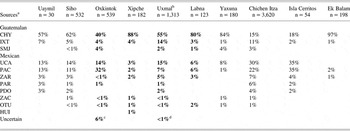
Table 2 presents obsidian procurement data for various sites in the northern Maya lowlands, including four in the Puuc region. Two basic procurement patterns are immediately evident in these data. First, most sites, including all those in the Puuc region except Oxkintok, received most of their obsidian from El Chayal, Guatemala. Chichen Itza, its port at Isla Cerritos, and Oxkintok have more central and west Mexican obsidian, particularly from Ucareo and Pachuca.
Obsidian procurement data for selected sites in the Northern Maya Lowlands

Note: Sites are presented from west to east; data for Puuc sites are displayed in bold type. No attempt is made to separate collections on the basis of chronology. Data from all sites but Uaymil and Siho have been partially or fully presented before by Andrews et al. (Reference Andrews, Michel, Stross, Rivero and Asaro1989), Braswell and Glascock (Reference Braswell, Glascock and Glascock2003:Tables 3.1-3.3), and Braswell (Reference Braswell, Smith and Berdan2003:Table 20.3).
aCHY = El Chayal; IXT = Ixtepeque; SMJ = San Martín Jilotepeque; UCA = Ucareo; PAC = Pachuca; ZAR = Zaragoza; PAR = Paredon; PDO = Pico de Orizaba; ZAC = Zacualtipan; OTU = Otumba; HUI = Huitzila.
bA complete contextual and temporal analysis of this material is planned by Huchím and Braswell.
cIncludes pieces visually sourced to either Ucareo or Zaragoza. Overall, 20% of the analyzed collection from Oxkintok comes from these two sources.
dIncludes one piece that is either Ucareo, Zaragoza, or Zacualtipan, and one piece from an unknown source.
Temporal variation in procurement patterns
Two factors account for most of the differences in these procurement patterns: chronology and economic relations with Chichen Itza. During the Middle Preclassic period, most obsidian in the Maya region (excluding the highlands from Kaminaljuyu to the east, as well as portions of the Pacific lowlands) came from the San Martin Jilotepeque source. During the Late Preclassic, the proportion of El Chayal material consumed at most Maya sites increased, and the proportion of San Martin Jilotepeque obsidian slowly decreased.
During the Early and Late Classic, most obsidian that reached sites in the Maya lowlands—with the exception of areas in the southeastern periphery—came from El Chayal. Trace quantities of Mexican obsidian, especially from Pachuca, often are found in royal and elite contexts dating to the late fourth and fifth centuries a.d. Pachuca material dating to this period indicates a chain of interaction linking the Maya region to Teotihuacan (Spence Reference Spence1996). But it is important to note that there is very little evidence for the local production of artifacts made of this Teotihuacan-related material at Maya sites. Instead, Pachuca obsidian seems to have been imported in finished form, most probably as part of composite tools and items of adornment.
Shortly after a.d. 800, significant quantities of Mexican obsidian, especially from the Pachuca and Ucareo sources, began to enter the Maya lowlands. The importation of Mexican obsidian likely reached its peak between about a.d. 900 and 1050. Unlike during earlier periods, the distribution of exotic obsidian during the Terminal Classic was not limited to elites. Central Mexican obsidian seems to have become a commercialized commodity (Braswell Reference Braswell, Smith and Berdan2003; Braswell and Glascock Reference Braswell, Glascock and Glascock2003). There is ample evidence for local production in the Maya region of prismatic blades and other instruments from imported cores and preforms in the Terminal Classic period.
During the Early Postclassic period (a.d. 1050/1100–1200), long-distance exchange with central Mexico became much less important. In the northern lowlands, Middle and Late Postclassic sites turned once again to highland Guatemalan sources for obsidian. At many northern communities, including Mayapan and sites on the coast of Quintana Roo, about 95% of Middle and Late Postclassic obsidian comes from Ixtepeque (Braswell Reference Braswell, Smith and Berdan2003; Escamilla Ojeda Reference Escamilla Ojeda2004).
Chichen Itza and the development of a market economy
The presence of Mexican-source obsidian at Terminal Classic Maya sites probably indicates direct or indirect exchange with Chichen Itza. It is certain that Chichen Itza was the primary consumer of Mexican obsidian in the northern lowlands, and it seems to have been among the very first sites to have significant access to exotic material from highland Mexico. Moreover, as Table 2 reveals, the relative proportions of Mexican obsidian present at most sites are very similar. In particular, Ucareo is the most common Mexican obsidian source, followed by Pachuca. Material from Zaragoza typically is a distant third in frequency. Finally, small quantities of Paredon and Pico de Orizaba obsidian are present, and the remaining Mexican sources appear only in trace amounts. That this same mix of Mexican sources appears at most sites suggests participation in a single “homogenizing market” (Hirth Reference Hirth1998). Since this highly diverse mix is not known at any single site in central Mexico and because the greatest quantity of Mexican obsidian was consumed at Chichen Itza, it seems likely that this city was a focal or collection point for market exchange.
The sole exception to this pattern is Oxkintok, where much more Pachuca obsidian has been found. It is important to note that none of the Pachuca obsidian found at Oxkintok comes from Oxkintok Regional-phase contexts, that is, from contexts dating to the “Middle Classic” (Varela Torrecilla and Braswell Reference Varela Torrecilla, Braswell and Braswell2003:264–265). Instead, all of the Pachuca obsidian found at Oxkintok seems to have reached the site during the Terminal Classic period. Excluding obsidian artifacts dating to the Oxkintok Regional phase, the proportion of Pachuca obsidian is even higher than indicated in Table 2—fully 44% of the collection (Braswell Reference Braswell, Smith and Berdan2003:Table 20.1). This is twice the proportion of Pachuca obsidian found at Chichen Itza. Thus, it is possible that Oxkintok participated in a procurement system different from that of the other sites. Alternatively, and much more difficult to assess, it may be that excavation strategies at Oxkintok somehow created a bias towards contexts that include more Pachuca obsidian.
Artifacts from the Initial Series group of Chichen Itza demonstrate that some central Mexican obsidian was already being used at that city at the time Structure 5C4-I was constructed in the Late Classic (José Osorio, personal communication 2003). Nevertheless, 31% of the obsidian recovered by Peter Schmidt and the Proyecto Chichen Itza from this part of the site comes from El Chayal, roughly three times the relative frequency of that material recovered from excavations elsewhere in the city (Braswell Reference Braswell, Smith and Berdan2003:Table 20.1). Mexican obsidian was much less common in the Puuc region until after a.d. 900. It is found most frequently in post-construction overburden or is associated with late Mosaic-style, C-shaped, or round structures. Braswell and Glascock (Reference Braswell, Glascock and Glascock2003) have argued that a new market economy fostering exchange between the Puuc and Chichen Itza developed during the last century of the Terminal Classic period.
Obsidian procurement and chronology at Xkipche
Obsidian procurement data from Xkipche can be interpreted in terms of this temporal information. Compared to Oxkintok, Uxmal, or even Labna, occupation of Xkipche during the period after about a.d. 900 was quite limited. Both the ceramics and the architecture of Xkipche are consistent with this conclusion. Very few sherds of Sotuta material were found at Xkipche and the latest imposing architecture at the site is built in the Columnette style. Moreover, all but three of the 14 artifacts made of obsidian from Mexican sources were recovered from surface or near-surface contexts. This suggests that most of these pieces date to a period after the end of major construction.
The collection most similar to that of Xkipche is from Yaxuna. Yaxuna had a long Preclassic and Classic occupation, but construction ceased and the site was abandoned when its territories were absorbed into the Chichen Itza state. Excavators of Yaxuna argue that the site was conquered ca. a.d. 1050–1150 (Suhler et al. Reference Suhler, Ardren and Johnstone1998:179). Evidence for the violent destruction of Yaxuna is equivocal, but re-evaluation of the chronology of Chichen Itza suggests that a.d. 900 may be a more likely date for this event (see Cobos Reference Cobos, Laporte and Escobedo1998), if, indeed, it happened. As at Xkipche, the few artifacts made of central Mexican obsidian found at Yaxuna come from post-construction contexts, and, in fact, virtually all seem to be associated with post-abandonment activity (Suhler et al. Reference Suhler, Ardren and Johnstone1998:178–179). There are few reasons to suspect that Xkipche was conquered by distant Chichen Itza, but it may be that the decline of the Puuc site corresponds to an expansion of Uxmal in the ninth century a.d. An important distinction between the obsidian collections from Yaxuna and Xkipche is the presence of San Martin Jilotepeque obsidian at the first of these sites. At Yaxuna, obsidian from this Guatemalan source was recovered from Preclassic contexts. The lack of San Martin Jilotepeque obsidian at Xkipche supports the contention that it is essentially a Classic period site. In sum, the obsidian collection from Xkipche is consistent with a robust occupation during the Classic and a limited presence after a.d. 900.
TYPOLOGICAL AND ATTRIBUTE ANALYSES
Chronology and the Analysis of Obsidian Artifacts from Xkipche
Typological and source analyses of the 182 obsidian artifacts from Xkipche are presented here in two ways. First, all the obsidian artifacts are considered together. The principal reason is that the total sample is small. Next, only materials from primary and well-dated contexts are considered. Although no obsidian was recovered from primary contexts (e.g., burials, caches, and middens) containing Xkipche IV, V, or VI ceramics, materials from secondary, single-component contexts are discussed with the goal of determining if they are chronologically distinguishable from the Late to Terminal Classic Xkipche III sample.
Lithic Industries and Behavioral Typologies
Braswell conducted typological and attribute analyses of the Xkipche collection in 1995. The analysis began with the assumption that all obsidian artifacts could be classified into one or more of four lithic industries: the prismatic blade industry, the retouch industry, the casual percussion industry, and the bipolar percussion industry. Each of these represents a distinct series of technological steps and set of behaviors, and is characterized by particular initial preforms, debitage, and final products. Each lithic industry contains within it a certain amount of variation; there is, of course, more than one way to make a prismatic blade or a biface. Nevertheless, the technological chain of behaviors and choices that are made in each industry are relatively distinct. There is much less variation in the technological details of a single industry than there is across all industries. The concept of such behavioral typologies is well established (e.g., Sheets Reference Sheets1975), and we have described specific behavioral typologies for these industries elsewhere (Braswell Reference Braswell and Würster2000).
Prismatic blade and retouch industries
The prismatic blade industry is the most complex of the four industries. The key diagnostic feature of its final stage is that a pressure tool is used to remove long, parallel-sided ribbons of obsidian from (in most cases) a bullet-shaped polyhedral core. The retouch industry entails removing small flakes by hard hammer percussion, soft hammer percussion, or pressure (and often more than one of these techniques) from a preform or blank in order to thin, shape, or strengthen a particular tool. The most easily recognizable retouched tools from the Maya area are bifacially worked knives and projectile points. These were most often made using percussion blades or even pressure blades as blanks. Unifacially retouched scrapers, often made on percussion flakes, are at least as common as bifaces.
Casual and bipolar percussion industries
Both the casual percussion and bipolar percussion industries are much less complex and were practiced to create simple, ad hoc tools. In the Maya lowlands, obsidian tools and byproducts resulting from another industry were often recycled using either of these expedient methods. The difference between the two industries lies in how flakes are produced. In the casual percussion industry, a hard hammer is used to strike flakes from a hand-held core. In the bipolar industry, a small core is placed on an anvil and smashed.
Type assignments
Each of the four lithic industries has diagnostic types, but some types crosscut all industries. These are often nondiagnostic artifacts, unless scars representing particular activities are noted. One example of this is the common debitage taxon “chunk” or “shatter.” Fortunately, all four of the chunks from Xkipche have morphological characteristics that make it possible to assign them to a particular industry.
In ceramic analysis, pottery sherds are assigned to a single type because they represent one and only one final product. Chipped-stone artifacts, however, often were recycled and morphologically altered, and the products and byproducts of one particular lithic industry frequently became the preforms for another. A percussion blade (perhaps a byproduct of core shaping for prismatic blade manufacture) can serve as a blank for making a projectile point in the retouch industry. Later, the projectile point may break and be reused as a core for producing bipolar flakes. Because of lithic recycling, it often is necessary to ascribe an artifact to two or more types or even to two or more lithic industries.
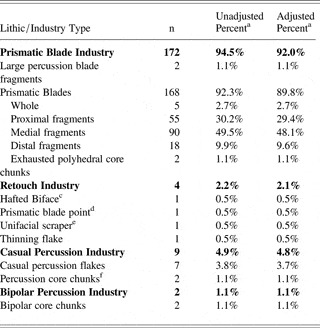
The 182 analyzed artifacts from Xkipche are assigned to four fundamental morphological types, several of which have subtypes. The basic types noted in the collection include flakes (with two distinct subtypes pertaining to the casual percussion and retouch industries), large percussion blades (including one that was subsequently modified by the retouch industry), prismatic blades (including one that was modified by bifacial retouch), and chunks (including two used as bipolar cores and two fragments of exhausted polyhedral cores that were reused as casual percussion cores). Typological data are summarized in Table 3. Five artifacts are assigned to two industries, so the total the number of typological assignments is 187. The adjusted percentages in the final column reflect these double assignments.
Typological classification of the Xkipche obsidian (n = 182).

Note: Totals for each lithic industry are presented in bold.
aBased on dividing by 182, the total number of artifacts. The sum is greater than 100% because five artifacts are each given two typological assignments.
bBased on dividing by 187, the total number of artifact assignments
cAlso classified as a large percussion blade fragment
dAlso classified as a medial prismatic blade
eAlso classified as a casual percussion flake
fAlso classified as exhausted polyhedral core chunks
Table 3 reveals that the most common lithic industry represented at Xkipche is the prismatic blade industry. Nearly 95% of all artifacts are either prismatic blades or byproducts of prismatic blade production. This is typical for most Maya sites after the Middle Preclassic period. The second most common is the casual percussion industry (5%). Finally, artifacts pertaining to the retouch and bipolar percussion industries are much less frequent and together account for only 3% of the collection. Bifacial tools, particularly projectile points, are most common at sites with significant Terminal Classic and Postclassic occupations. The paucity of such tools at Xkipche suggests that occupation after about a.d. 800 was relatively light.
Attribute analysis
In addition to typological analysis, certain metric attributes (length, width, thickness, mass, and for blades and blade-derived types, total cutting edge) and non-metric attributes (the presence of cortex, unifacial and bifacial retouch, grinding, and platform preparation technique) were noted, as were descriptive comments. All pieces were assigned to geological source areas by visual analysis, and 30 artifacts (16% of the collection) were subject to abbreviated INAA, described above.
Lithic Production at Xkipche
The collection from Xkipche is not large, nevertheless conclusions can be drawn regarding the form in which obsidian was brought to the site and the tool-types that were manufactured there.
Prismatic blade industry
Although no complete exhausted polyhedral cores were collected, two chunks from cores were recovered. The presence of these core fragments (debitage resulting from the production of prismatic blades) suggests that the prismatic blade industry was practiced at Xkipche. No primary or secondary series blades were collected, suggesting that polyhedral cores arrived at Xkipche in a partially reduced form. Two distal fragments of tertiary series blades contained traces of cortex near their terminations. This is weak evidence suggesting that the cores from which these blades were made probably did not arrive at Xkipche in a significantly shortened and nearly exhausted state.
Both core fragments are made of El Chayal obsidian and were recovered from fall and collapse contexts in Structure A5 and Structure B18 (Figure 2). The ceramics collected from these same contexts date chiefly to the Terminal Classic and Postclassic periods, but it is possible that the two core fragments were once incorporated into construction fill. Both fragments were reused as casual percussion cores, so may have been scavenged sometime after the Late Classic occupation of the site.
The ratio of prismatic blade fragments to blade-core fragments and the ratio of the minimum number of individual prismatic blades per core fragment can be considered as crude measures of the relative importance of production and consumption. Excavated contexts that yield great numbers of core fragments and few prismatic blades imply that blade production was a significant activity but indicate a relatively low degree of blade consumption. In contrast, contexts with very few core fragments and many blades suggest activities in which blade consumption, rather than production, were of greater relative importance. At Xkipche, the ratio of prismatic blade fragments to polyhedral core fragments (PBF:PCF) is 168:2, or 84. The ratio of minimum number of individual prismatic blades to polyhedral core fragments (MNIPB:PCF) is 60:2 or 30. Braswell has calculated similar ratios for Uxmal (PBF:PCF = 324; MNIPB:PCF = 72), Oxkintok (PBF:PCF = 529; MNIPB:PCF = 145), and Labna (PBF:PCF = 58; MNIPB:PCF = 17). The consumption-to-production data for the four Puuc sites suggest that blade consumption was an important activity in the excavated areas of the two largest sites, Uxmal and Oxkintok, but that, in comparison, the disposal of production waste was not. In contrast, data from excavated contexts at the two smaller sites, Xkipche and Labna, reveal a more mixed pattern of consumption and production. These data do not indicate that prismatic blade production was less important at the two larger cities when considered as a whole, because the samples were drawn from excavated contexts limited to the epicenters of each site. Instead, the data imply that lithic production and the disposal of debitage were more integral aspects of life in the palaces and central precincts of Labna and Xkipche than in similar areas of Oxkintok and Uxmal. At the small centers, sites of production and consumption were not as spatially separated as they appear to have been in the larger cities. Specialization of space was more developed in urban contexts than at rural sites or towns such as Xkipche and Labna.
The platforms of prismatic blades exhibit distinct preparation techniques. In the Maya area, most prismatic blades dating to the Preclassic or Classic periods have either unmodified (simple facet) or scratched platforms. Recovered polyhedral cores indicate that platforms typically were not scratched in their entirety in one episode. Instead, they were scratched around their edges shortly before one or more concentric rings of blades were removed. After removing these blades, the new edge of the platform would be scratched again. From about a.d. 800 onward, pecked-and-ground platforms became common. Unlike sequential concentric scratching, this technique was applied at once to the entire platform of a core.
There are several reasons why the platform of a polyhedral core might be modified before detaching blades. First, a roughened surface allows the bit of a pressure tool to be placed with less chance of slipping. Second, roughening the platform reduces surface tension, allowing blades to be removed with less initiating force. Because the force needed to propagate a fracture is less than that needed to initiate it, reducing the difference between the initiating and propagation forces lowers the risk of overpass and other unwanted terminations. Third, pecked-and-ground platforms are often found on relatively small cores. It seems likely that pecking and grinding constituted steps in the rejuvenation of broken or partially reduced cores (Hirth Reference Hirth, Hirth and Andrews2002).
The analyzed collection from Xkipche contains five complete prismatic blades and 55 proximal fragments. Three of the unbroken blades, all from Offering 3 in Structure A3 (Figure 2), have unmodified, simple facet platforms. A fourth complete blade from this same context has a scratched platform. All four are made of obsidian from the El Chayal source. A fifth complete blade, recovered from fall on top of a terminal floor, has a pecked-and-ground platform. It is made of green obsidian from Pachuca, Hidalgo.
Seven proximal fragments, all made of El Chayal obsidian, have simple facet platforms. Thirty-five more proximal fragments have scratched platforms; these too, are all made of El Chayal obsidian. Ten fragments have pecked-and-ground platforms; five are from the El Chayal source, three from Ucareo, one from Ixtepeque, and one from Zaragoza. All but one of these were recovered from near-surface and mixed secondary contexts, consistent with a Terminal Classic or Postclassic date. Finally, three proximal fragments have broken, incomplete, or crushed platforms. Two of these come from El Chayal, the third from Ixtepeque.
Casual percussion industry
After artifact types representing the prismatic blade industry, the next most common are products and byproducts of the casual percussion industry. Seven percussion flakes (from four sources: El Chayal, Pachuca, Huitzila, and Otumba) and two casual percussion cores were collected. The flakes come from contexts dating to phases throughout the ceramic sequence, suggesting that casual flakes were made and used on an ad hoc basis throughout the history of Xkipche. The two casual percussion cores are the recycled exhausted polyhedral core fragments discussed above.
Retouch industry
Only four artifacts are products of the retouch industry. A single thinning flake made of El Chayal obsidian was recovered from a near-surface context in Structure A6. This flake, belonging to a debitage taxon, demonstrates the practice of the retouch industry to either manufacture or repair tools at Xkipche. The other three artifacts pertaining to this industry are tools: a simple unifacial side-scraper made on a casual percussion flake, a stemmed prismatic blade point, and a large hafted biface (Figure 3). The prismatic blade point was recovered from a near-surface context and was associated with Xkipche VII-phase ceramics; INAA reveals that it is made of obsidian from the Ucareo, Michoacan, source. These small dart or arrow points are more common in the northern Maya lowlands during the early Terminal Classic period than at any other time. The large hafted biface was recovered from Offering 3 of Structure A3, and was accompanied by Xkipche III-phase ceramics. Visual sourcing suggests that it too was made of obsidian from Ucareo. In the Maya region, the presence of Ucareo obsidian is most consistent with a date of a.d. 800–1050. Thus, no obsidian bifaces recovered at Xkipche appear to date to the Early or Late Classic periods. Moreover, there is no evidence that bifaces made of Mexican obsidian were manufactured in the excavated portions of Xkipche; no thinning flakes of Ucareo obsidian were found at the site. Although the data are negative, it may be that these exotic bifaces were made by specialists at another location.
Many sites demonstrate a marked increase in the number of projectile points and other retouched weapons after about a.d. 800 or 900. This is particularly true for Copan (Braswell and Manahan Reference Braswell and Manahan2001), Terminal Classic Coba, Chichen Itza, and Postclassic sites in the Maya highlands (Braswell Reference Braswell1996a). The low number of bifacially retouched tools at Xkipche may be nothing more than the result of sample size. Alternatively, it may be viewed as further evidence that occupation of the site after a.d. 800 was limited.
Bipolar Industry
Two small chunks of obsidian were used as bipolar cores. One is made of El Chayal obsidian and the other of material from Ixtepeque, Guatemala. Both were recovered from fall and slump contexts in Structure A6 (Figure 2) and were found associated with Xkipche VII pottery. They may be scavenged artifacts that were reused as bipolar cores at a time late in the history of the site.
Diachronic and Contextual Analysis
Primary contexts (burials, caches, and middens)
Just 24 obsidian artifacts were recovered from primary archaeological contexts at Xkipche. One of these, a percussion flake made of El Chayal obsidian, was recovered from Burial 858 in Room 2 of Structure A4 (Figure 2). This burial is dated to the Xkipche I phase.
Nineteen additional obsidian artifacts were recovered from three offerings in Structure A3, a low altar located in the middle of the patio to the south of the Structure A1 palace (Figure 2). All three offerings were found in the construction fill of the altar and are contemporary. Pottery in the offerings consists of types dating to the Xkipche III phase. Offering 1 of Structure A3 contained two prismatic blade fragments made of El Chayal obsidian. Offering 4 contained a single El Chayal prismatic blade fragment. The remaining 16 pieces were recovered from Offering 3, located 2 m northwest of the center of the altar. These consist of four complete prismatic blades (probably bloodletters) and 11 prismatic blade fragments all made of El Chayal obsidian. The large hafted obsidian biface also was recovered from this context (Figure 3). As discussed above, visual analysis suggests it may be made of Ucareo obsidian. Ten of the fragmentary and complete prismatic blades from these offerings have platforms. Four have simple facet platforms, the other six are scratched.
The last primary context that contained obsidian artifacts is a Postclassic (Xkipche VII phase) midden in the palace. Five prismatic blade fragments were recovered from this context. Four are from the El Chayal source and one is from Zaragoza. Two of these fragments have scratched platforms. Both the geological sources and technology used to make these blades suggest that they could have been scavenged from contexts dating to earlier periods.
Terminal Classic obsidian
Fully 84 obsidian artifacts were recovered from contexts containing Xkipche IV, V, or VI ceramics. Unfortunately, some of these pieces were collected from the surface and the rest come from fill, fall, or other secondary contexts. Thus, it is possible that many of the obsidian artifacts found associated with ceramics thought to date to the ninth to eleventh centuries a.d. may have been made and used in other periods.
Sixty artifacts come from secondary contexts containing Xkipche IV or V ceramics. All but four of these artifacts were recovered from overburden on or around Structure A10 (Figure 2). The lack of stratigraphic distinction and the clear contextual association imply that the lithic artifacts from the overburden to Structure A10 should not be separated into two chronologically distinct units. The sources represented in the 60 artifacts are El Chayal (n = 57), Zaragoza (n = 2), and Ucareo (n = 1). Seventeen of the fragmentary prismatic blades contain platforms: two have simple facets, ten are scratched, and five are pecked-and-ground. Both the sources represented and the technology of platform preparation are consistent with a mixed or transitional assemblage dominated by pieces produced before about a.d. 900 but containing a few pieces that date to a later time.
Twenty-four obsidian artifacts were recovered from surface and near surface contexts containing late Terminal Classic ceramics assigned to the Xkipche VI phase. Most of these lithic artifacts, however, appear to date to an earlier time. Twenty-two are made of El Chayal obsidian and the remaining two come from Ixtepeque. Six prismatic blade fragments have platforms, five are scratched, and the sixth has a simple facet. Although the sample is woefully small, it is consistent with both technology and procurement patterns dating to before a.d. 900. Nineteen of these artifacts were recovered from overburden contexts on or around Structure A5, the remaining five come from Structure A4 (Figure 2). It may be that by the time Terminal Cehpech/Sotuta ceramics were used at Xkipche, most obsidian consumed at the site was scavenged from earlier contexts.
Postclassic obsidian
Forty-five obsidian artifacts were found associated with Xkipche VII-phase ceramics. With the exception of the midden, all come from secondary surface or near-surface contexts similar to those described for the Terminal Classic obsidian. More than half (n = 26) of the obsidian artifacts found associated with Postclassic ceramics comes from overburden associated with Structure A6, but additional pieces were found at the palace (n = 13) and at Structure B18.
Postclassic collections from Mayapan (Braswell Reference Braswell, Smith and Berdan2003; Escamilla Ojeda Reference Escamilla Ojeda2004), Xelha, San Gervasio, and Champoton all are dominated by obsidian from Ixtepeque. Most of the Postclassic sample from Xkipche, however, consists of pieces from El Chayal (n = 37), but Ucareo (n = 2), Ixtepeque (n = 2), and a single example from each of the Huitzila, Otumba, Pachuca, and Zaragoza sources are also represented. The variety (but not the quantity) of Mexican-source obsidian found in secondary association with Postclassic ceramics at Xkipche is consistent with a tenth or early eleventh century assemblage. Fifteen of the complete and fragmentary blades have platforms; 11 are scratched, three are pecked-and-ground, and one has a simple facet. All of these come from El Chayal, except for the three pecked-and-ground examples that come from Pachuca, Ucareo (sample GEB261), and Ixtepeque (sample GEB260). Thus, many of the El Chayal blades from these secondary contexts may actually date to the Early or Late Classic periods, and the exotic obsidian probably dates to the late Terminal Classic period.
The obsidian artifacts recovered from contexts at Xkipche that are dated by associated Xkipche IV to VII ceramics to the Terminal Classic and Postclassic periods come almost entirely from surface, overburden, fall, or other secondary contexts. For this reason both the association and the dating of these artifacts must be questioned. Moreover, there is relatively little stratigraphic reason to distinguish between Xkipche IV and Xkipche V obsidian. Nevertheless, for each ceramic phase, the obsidian samples appear mixed with materials from earlier periods. Thus, the Xkipche IV through VI obsidian is consistent more with a Classic than with a post-a.d. 900 date, and the Xkipche VII obsidian sample contains artifacts that date to the Classic and Terminal Classic, but very few pieces imported to the region during the Middle and Late Postclassic periods.
DISCUSSION: THE OBSIDIAN CHRONOLOGY OF XKIPCHE
It is possible to construct an alternative chronology for Xkipche based entirely on obsidian data. The obsidian chronology is not as fine-grained as a ceramic chronology based on Type-Variety classification, and is much less precise than Vallo's (2003) seriation. Moreover, the abundance of obsidian artifacts recovered from contexts dating to a particular period does not necessarily correlate with the amount of ceramic materials collected for that same period. In particular, a phase of occupation characterized by abundant pottery may be one during which very little obsidian was brought to a site. Finally, a discarded lithic artifact may be scavenged at a much later time and either be reused as-is or reshaped into another tool. Thus, obsidian that reached a site in one period may be found in contexts containing ceramics dating to later periods. Despite these caveats, an obsidian chronology is a particularly useful diacritic for several periods of time.
Middle Preclassic (1050/950–700/400 b.c.) obsidian collections from the northern Maya lowlands are characterized by casual and bipolar flake technologies, and virtually all the obsidian used during this period is from the San Martin Jilotepeque source (Nelson Reference Nelson1985; Rovner and Lewenstein Reference Rovner and Lewenstein1997; see also Awe and Healy Reference Awe and Healy1994). Prismatic blade technology was introduced into the Maya area at the beginning of the Middle Preclassic and gradually grew in statistical importance throughout the ensuing millennium (Jackson and Love Reference Jackson and Love1991). No obsidian in the Xkipche collection comes from San Martin Jilotepeque, and materials pertaining to percussion industries are both rare and often appear in later contexts suggesting recycling and scavenging of lithic resources. In short, the obsidian collection from Xkipche is not consistent with a substantial Middle Preclassic occupation.
Throughout the Maya lowlands of Mexico, Belize, and Guatemala (but not the southeast periphery), the Late and Terminal Preclassic periods (700/400 b.c.–a.d. 200/430) are typified by a very gradual shift away from the consumption of obsidian from San Martin Jilotepeque and towards the use of material from El Chayal. By the end of the Terminal Preclassic, more than 90% of obsidian consumed at sites in the northern lowlands came from this source (Nelson Reference Nelson1985), and the vast majority appears in the form of prismatic blades. A very few obsidian artifacts from Xkipche might date to the Late Preclassic, but the lack of San Martin Jilotepeque material, present at Preclassic Yaxuna, is not consistent with a robust occupation. For this reason, Figure 4 leaves the question of a Late to Terminal Preclassic occupation unresolved.
Alternative chronologies of Xkipche.

During the Early and Late Classic periods (a.d. 200/430–800), about 95% of obsidian artifacts at Maya sites in the northern Maya lowlands were products, byproducts, or preforms pertaining to the prismatic blade industry. Blades were produced on site using imported polyhedral cores from the El Chayal source. Typically, 90–95% of obsidian dating to this period comes from that Guatemalan source, although trace quantities of obsidian from other sources—especially Ixtepeque, San Martin Jilotepeque, and Pachuca—also may appear. Pachuca artifacts, dating to the late fourth through sixth centuries, were not locally manufactured but were imported as finished objects from central Mexico. These are found exclusively in elite contexts such as palaces. Throughout the Late Classic, very small numbers of sacrificial knives, most commonly found in special caches, were imported from the Gulf Coast and central Mexico. These are often made of black material from the Zaragoza or Otumba sources. There is no evidence they were made in the Maya region (and, in fact, they often have distinctively non-Maya patterned flaking), although smaller bifaces of Ixtepeque and El Chayal obsidian were locally produced. These observations hold true as well in the Puuc region during the first century or so of the Terminal Classic period, but not at Chichen Itza.
Early Terminal Classic (a.d. 800–900) obsidian collections from the Puuc differ little from those of the Early and Late Classic. At Uxmal, small quantities of Mexican obsidian have been found, perhaps suggesting limited exchange with the royal court of Chichen Itza (Braswell Reference Braswell, Smith and Berdan2003; Braswell and Glascock Reference Braswell, Glascock and Glascock2003). In comparison with the epicenter Uxmal, most smaller Puuc sites dating to the ninth century had virtually no access to Mexican obsidian. During the late Terminal Classic (a.d. 900–950/1000), however, the relative frequency of Mexican obsidian increased three-fold at Uxmal. At that time, Mexican obsidian began to appear at other Puuc sites, where it is found in association with late Mosaic-style architecture, C-shaped structures, and round platforms. Pecked-and-ground platforms first appeared on blades in the Puuc during the early Terminal Classic, but became much more common after a.d. 900.
The vast majority of artifacts recovered from Xkipche are prismatic blades from the El Chayal source. Moreover, nearly all blades have either scratched or plain facet platforms. Together, this demonstrates a particularly strong occupation during the Classic period. Unfortunately, there are few differences between Early and Late Classic obsidian collections. For this reason, the presence of a substantial occupation during Vallo's Xkipche I phase can neither be substantiated nor refuted from the perspective of an obsidian chronology. What is clear, however, is that obsidian provides evidence for a very weak occupation during the second half of the Terminal Classic (a.d. 900–950/1050), precisely that period proposed as the “climax of the development of the local ceramic inventory of Xkipche and the western Puuc area” (Vallo Reference Vallo and Prem2003:328).
The Early Postclassic (a.d. 950/1050–1200) of the northern Maya lowlands is poorly understood. We view this period as a hiatus between the decline of the Puuc and Chichen Itza (the date of a.d. 950 reflects the first and the date of a.d. 1050 the second of these declines) and the rise of Mayapan as a great power. Peter Schmidt (personal communication 2006) cautions that it is better to view this interval as a gap in our archaeological knowledge. What is clear is that during this period exchange with central and western Mexico dissipated. By about a.d. 1200, most of the obsidian in the northern lowlands came from Ixtepeque. Although obsidian is relatively scarce at most Middle to Late Postclassic sites, including the habitation zones of Mayapan, it is abundant in the monumental core of that city. In fact, more obsidian has been found at epicentral Mayapan than in all the rest of Yucatan combined (see Escamilla Ojeda Reference Escamilla Ojeda2004). This implies elite control of access to the imported material. Ixtepeque obsidian is scarce at Xkipche, suggesting a light occupation during the Middle to Late Postclassic period. Nevertheless, it should be cautioned that Postclassic inhabitants of Xkipche almost certainly scavenged the site for obsidian first brought to the Puuc during the Classic period.
In sum, an obsidian chronology provides no unambiguous evidence of Preclassic settlement at Xkipche. There is ample evidence for a very strong Classic to early Terminal Classic occupation. Obsidian data suggest that after about a.d. 900, occupation of Xkipche was quite light and perhaps intermittent during the late Terminal Classic and Postclassic periods. Thus, we can create a three-phase obsidian chronology from the Classic through Postclassic periods (Figure 4).
Complementary architectural data suggest a refinement to the obsidian chronology of Xkipche. The apparent lack of Early Classic architecture—although negative evidence—may imply that occupation was very light during that period. Moreover, the absence of numerous and substantial Classic Puuc-style structures implies that major construction episodes ceased about a.d. 800. Combined, these two sources of chronological data suggest that Xkipche is fundamentally a Late Classic site, with a light occupation in the Terminal Classic and Postclassic periods.
CONCLUSIONS
The many field seasons of carefully documented scientific investigations at Xkipche have allowed us to examine the relative chronology of the Puuc region from the perspectives of ceramics, obsidian, and architecture. A substantial number of radiocarbon dates fixes much of this chronology in absolute time, and thermoluminescence dates provide additional chronometric data. We now know that Cehpech ceramics began to be produced during the transition between the Early and Late Classic periods, perhaps as early as a.d. 550 (Robles Castellanos Reference Robles Castellanos2000; Varela Torrecilla Reference Varela Torrecilla1998; also Fernando Robles Castellanos, personal communication 2006). There is tantalizing evidence, in the form of Late Preclassic and Early Classic ceramics, of an earlier occupation of Xkipche. Seriation of modal variation has led to the creation of the Xkipche I phase (a.d. 100/200–400/500), but typological analysis implies that modal analysis has misidentified seeming regularities within temporally mixed lots containing Late Preclassic, Early Classic, Late Classic, and perhaps Terminal Classic ceramics.
Xkipche ceased to expand at about the same time that Uxmal became a regional capital at the dawn of the Terminal Classic period. The construction of a few modest C-shaped structures as well as the presence of trace quantities of Mexican-source obsidian and Sotuta ceramics attest to a limited occupation during the late Terminal Classic period. A very limited Postclassic occupation has also been identified, probably dating to a time after several hundred years of abandonment.
As a chronological tool, ceramic seriation at Xkipche was only partially successful. In the case of the Early Classic, its use defined an early phase from temporally mixed materials. Seriation necessarily implies continuation and gradual change, so this result is not at all surprising. As Phillips and Griffin (in Phillips et al. Reference Phillips, Ford and Griffin1951) argue, seriation is often a poor tool for identifying sharp chronological boundaries and events. At Xkipche, that event is the beginning of significant settlement after a period of unknown length characterized by very limited occupation. Moreover, the seriation gives the false impression that ceramics from before (Late to Terminal Preclassic and Early Classic types) and after (Late Classic types) that event should be considered to be contemporaneous. Seriation creates not only the appearance of a “placid stream of ceramic continuity,” but also freezes that stream by including types dating to many centuries and several distinct complexes. Most seriously, seriation can create a single phase of occupation out of temporally distinct materials recovered from mixed contexts, and it can also chronologically separate contemporary ceramics recovered from different sorts of functional contexts. Seriation should not be applied to pottery from mixed contexts or from those where factors other than time might account for modal variation. In the case of the Xkipche I “phase,” the typological approach—despite its faults as a chronological tool—is a valuable check of the results of modal analysis seriation.
Nevertheless, both radiocarbon dates from Xkipche and the modal analysis have provided useful divisions within the apparently monolithic Cehpech complex. Specifically, the Xkipche II phase (what might be called Early Cehpech, dating to a.d. 550–700) is distinctly different from Xkipche III to Xkipche V (what might be called Late Cehpech, dated in this article to the period a.d. 700–900/950). This distinction can also be made using the typological approach (e.g., Thin Slate wares date to the Late but not to the Early Cehpech phase), but modal analysis provides a potentially powerful chronological tool for dating vessels that are not recovered alongside diagnostic or index types. Modal analysis also identified distinctions among phases Xkipche III, IV, and V. It is possible that these will prove to be chronologically meaningful, but we currently have very few chronometric dates for the Xkipche IV and V phases. Given that these three phases apparently date to a period of just two centuries, it will probably prove difficult to verify this portion of the seriation. Alternatively, as we suspect, the distinctions between the Xkipche III, IV, and V complexes may be more related to the specialized nature of elite contexts than to chronology. That is, the Xkipche IV and V collections may represent functionally distinct behaviors within a broader Xkipche III phase. Specifically, Xkipche V is characterized by “luxury tableware” (Vallo Reference Vallo and Prem2003:327). This illustrates a further methodological problem with seriation—all variation may be interpreted as having chronological, rather than contextual, meaning.
The Xkipche VI phase (what might be called Terminal Cehpech/Sotuta, here dated to a.d. 900/950–950/1000) also can be identified from a Type-Variety perspective because it includes Sotuta types. Again, modal analysis provides a potentially powerful tool for interpreting ceramics and contexts that date to the Xkipche VI phase but lack the uncommon yet temporally diagnostic Sotuta types.
Ceramic analysts of the northern lowlands need no longer despair that there is a monolithic Cehpech complex. Significant strides have been made in dividing Cehpech into three or more phases. For example, Arnauld's (Reference Arnauld, Michelet, Becquelin and Arnauld2000) exemplary relative ceramic chronology for the Xculoc region closely mirrors that proposed here for Xkipche, as does Varela Torrecilla's (1998) Late-to-Terminal Classic chronology for Oxkintok. In fact, the temporal resolution of the Cehpech complex is now comparable with that of Tepeu ceramics of the southern and central lowlands. Both Type-Variety approaches and modal analysis have identified at least three distinct phases within the Cehpech complex. Michael Vallo's (2000, 2003) research at Xkipche has played an important role in this refinement.
Throughout this article, we have stressed that formal variation may be both diachronic and synchronic. As Maya archaeologists continue to refine site typologies and chronologies, we must be sure to consider contextual and geographical components of variation. Seriation is a powerful tool, but is limited in that all variation is assumed to be temporal. Comparative Type-Variety analysis often is needed to understand the spatial component of variation. We argue that the best approach to chronology building considers both techniques.
RESUMEN
Los arqueólogos que trabajan en las tierras bajas del norte del área maya luchan contra problemas persistentes relacionadas a la precisión y la exactitud de la cronología. Ha probado difícil de crear cronologías precísas para los períodos clásico tardío y clásico terminal. Los investigadores de Xkipche, un sitio pequeño al sudoeste de Uxmal, han empleado la técnica de seriación y el método tipo-variedad para crear su crononología cerámica. Los resultados de la seriación cerámica sugieren una gran persistencia desde 100/200 d.C. hasta 1100 d.C., una continuidad que no es soportable por el método tipo-variedad. Este reporte comienza con un resumen de ambas interpretaciones de los datos cerámicos, y después da la vuelta a otro material arqueológico: la obsidiana. Los patrones de abastamiento y la tecnología de la producción se discuten para los 182 artefactos de obsidiana recogidos durante las primeras cinco temporadas del Projekt Xkipche. Comparamos la colección de Xkipche con colecciones similares de otros sitios de las tierras bajas del norte. Los resultados de este análisis de la obsidiana están en conflicto con la cronología absoluta propuesta para la secuencia de cerámica de Xkipche. Finalmente, se propone una cronología nueva de cerámica, una que esta de acuerdo con la obsidiana y los datos arquitectónicos. Esta cronología propuesta divide el complejo “monolítico” de cerámica Cehpech en tres fases: Cehpech temprano (550–700 d.C), Cehpech tardío (700–900/950 d.C) y Cehpech terminal/Sotuta (900/950–950/1000 d.C.).
ACKNOWLEDGMENTS
The authors would like to thank the many members of the Projekt Xkipche whose meticulous field work, laboratory research, and scholarship are truly exemplary. Braswell is particularly grateful to Hanns Prem for permission to analyze the artifacts and to Markus Reindel for facilitating that study. We all thank Michael Vallo for his years of carefully documented work, as well as for providing contextual information for the obsidian artifacts. Neutron activation analysis was supported by grants from the National Science Foundation (SBR-9802366) and the Foundation for the Advancement of Mesoamerican Studies, Inc. (Grant 95004), and was conducted at the Missouri University Research Reactor. We are thankful for the many years of friendship and collaboration we have enjoyed with Mexican, Spanish, German, and North American scholars working in the northern lowlands. Obsidian data from some of the projects with which Braswell has collaborated are presented in Table 2. Special thanks are due to the directors of those projects: Rafael Cobos (Uaymil and Siho), Miguel Rivera Dorado (Oxkintok), José Huchím Herrera and Alfredo Barrera Rubio (Uxmal), Tomás Gallareta Negrón (Labna), David Freidel (Yaxuna), Peter Schmidt (Chichen Itza), and Leticia Vargas and Victor Castillo (Ek Balam). We also thank Hanns Prem, Kam Manahan, and Joseph Ball for their extensive and helpful comments on earlier drafts of this work.