


Health care facilities are often very noisy places, with various sounds such as monitors beeping or messages being announced over loudspeakers (Park, Kohlrausch, de Bruijn, de Jager, & Simons, Reference Park, Kohlrausch, de Bruijn, de Jager and Simons2014). Standards for acceptable levels of background noise in some communication environments (e.g., classrooms) have been established (Acoustical Society of America, 2010); for example, unoccupied classroom levels must not exceed 35 dBA, and the signal-to-noise ratio (SNR) of the teacher’s voice to background noise should be at least +15 dB at a child’s ears. Similarly, the American Society of Heating and Air Conditioning has recommended maximum noise levels in an open office plan environment, with suggested limits between 49–58 dBA (Hemp, Glowatz, & Lichtenwalner, Reference Hemp, Glowatz and Lichtenwalner1995). Recommended acoustical standards also exist for health care facilities and clinics; however, these recommendations differ across organizations. The Environmental Protection Agency recommends sound level limits of 45 dBA during the day and 35 dBA at night. The World Health Organization recommends sound level limits of 35 dBA during the day and 30 dBA at night. The International Noise Council recommends that noise levels in acute care facilities not exceed 45 dBA in the day and 20 dBA at night (Konkani & Oakley, Reference Konkani and Oakley2012).
Unfortunately, noise levels often exceed these recommended limits. For example, one study of an urban hospital in Spain found noise levels exceeding 55 dBA, with negative effects on both staff and patients (Bayo, García, & García, Reference Bayo, García and García1995). Similarly, Soutar and Wilson (Reference Soutar and Wilson1986) found night noise levels in acute care admission and general medical wards of 67 dBA. Increased noise correlates with patients’ lengths of stay, the number of staff on duty, and the frequency of headaches and burnout in staff (Grumet, Reference Grumet1993). Other negative effects of noise in health care settings on patients and/or staff include increased physiological stress (Falk & Woods, Reference Falk and Woods1973), increased hypertension, and cardiovascular disease (Basner et al., Reference Basner, Babisch, Davis, Brink, Clark, Janssen and Stansfeld2014), and sleep disturbances (Muzet, Reference Muzet2007). Given that cognitive screening tests may be administered in noisy health care environments, it is important to determine the effects of background noise on test performance. In particular, noise could have a deleterious effect on the performance of older adults who may have difficulty hearing even in relatively quiet environments.
There are well-known negative effects of background noise on the cognitive performance of children (for a review, see Evans & Hygge, Reference Evans, Hygge, Luxon and Prasher2007) and healthy older adults (for a review, see Schneider, Pichora-Fuller, & Daneman, Reference Schneider, Pichora-Fuller, Daneman, Gordon-Salant, Frisina, Popper and Fay2010). Strikingly, Baldwin and Ash (Reference Baldwin and Ash2011) found that simply decreasing the intensity level of test stimuli in a quiet environment resulted in lowered working memory span scores in younger adults and even greater reductions in working memory span scores in older individuals who had normal hearing thresholds. Pope, Gallun, and Kampel (Reference Pope, Gallun and Kampel2013) tested word recognition and recall in medical/surgical in-patients when recordings of noise taken from hospital units were played in the background at different intensities; they found that for all participants, scores decreased as the amount of noise increased, with background noise containing voices having more deleterious effects than white noise.
As the number of older adults aged 65 years and older doubles by 2050 (Centers for Disease Control and Prevention, 2013), it seems inevitable that more health care providers will find themselves administering cognitive screening tests to more older adults in a wider variety of health care settings, many of which are noisy. Physicians and psychologists often conduct tests to screen for cognitive loss in older adults in health care settings where background noise could be detrimental to cognitive performance. Recent standards from the National Institute on Aging-Alzheimer’s Association workgroups on the core clinical criteria for diagnosing all-cause dementia include an objective cognitive assessment, either a “bedside” mental status examination or neuropsychological testing (McKhann et al., Reference McKhann, Knopman, Chertkow, Hyman, Jack, Kawas and Phelps2011). Mental status examinations often include the Mini-Mental State Examination (MMSE; Folstein, Folstein, & McHugh, Reference Folstein, Folstein and McHugh1975). The Montreal Cognitive Assessment (MoCA; Nasreddine et al., Reference Nasreddine, Phillips, Bédirian, Charbonneau, Whitehead, Collin and Chertkow2005) is another cognitive screening test that is gaining in popularity (Harvey et al., Reference Harvey, Ferris, Cummings, Wesnes, Hsu, Lane and Tekin2010).
Recent surveys of physicians reveal that the majority do rely on cognitive screening tests to support the diagnosis of cognitive loss, with over 90 per cent of neurologists in a U.K. sample reporting their use (Davey & Jamieson, Reference Davey and Jamieson2004). Cognitive screening tests often require the patient to hear and respond to, repeat, or recall auditory items. If these tests are not administered in a quiet environment, items may be misheard and subsequent responses may be incorrect, resulting in the over-estimation of cognitive loss, with potentially devastating effects on patients and their families. Indeed, Jorgensen and colleagues (Reference Jorgensen, Palmer, Pratt, Erickson and Moncrieff2016) recently demonstrated that administering the MMSE to younger adults under reduced levels of audibility resulted in artificially lower MMSE scores. Stress levels in the patient may also be increased if cognitive testing is conducted near a busy waiting room or in a hospital clinic where noise levels exceed the “threshold of annoyance” (e.g., Busch-Vishniac et al., Reference Busch-Vishniac, West, Barnhill, Hunter, Orellana and Chivukula2005; German-González & Santillán, Reference German-González and Santillán2007; Mazer, Reference Mazer2012). Thus, it is important to determine how the accuracy of these tests may be affected by environmental test conditions.
The consideration of acoustical conditions may be especially relevant when testing older individuals with hearing loss. Hearing loss is the third most common chronic health condition in older adults (Yueh, Shapiro, MacLean, & Shekelle, Reference Yueh, Shapiro, MacLean and Shekelle2003), with prevalence rates of approximately 50 per cent for individuals aged 65 years or older and 90 per cent for those over 80 years of age (Cruikshanks, Zhan, & Zhong, Reference Cruikshanks, Zhan, Zhong, Gordon-Salant, Frisina, Popper and Fay2010). Furthermore, there are important connections between hearing loss and cognitive decline, with significant associations between audiometric thresholds and the manifestation of incident dementia (Gurgel et al., Reference Gurgel, Ward, Schwartz, Norton, Foster and Tschanz2014; Lin et al., Reference Lin, Ferrucci, Metter, An, Zonderman and Resnick2011a; Lin et al., Reference Lin, Metter, O’Brien, Resnick, Zonderman and Ferrucci2011b). Thus, there is a pressing need to ensure that cognitive testing is as accurate as possible for those with hearing loss who may be at increased risk for cognitive decline and who are also more vulnerable to the effects of noise in testing environments.
In the current study, we hypothesized that noise would have a negative effect on MoCA scores, with the effect being greater in older than in younger adults, especially for those older adults with hearing loss.
Method
Participants
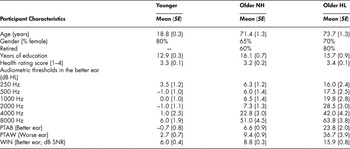
There were 60 participants: 20 younger adults (M age = 18.8 years, SD = 1.3), 20 older adults with normal hearing (NH; M age = 71.4 years, SD = 5.8), and 20 older adults with hearing loss (HL; M age = 73.7 years, SD = 5.8). All of the older adults had participated in another study in our lab approximately one year (M = 11.4 months, SD = 2.7) prior to the current study (Dupuis et al., Reference Dupuis, Pichora-Fuller, Chasteen, Marchuk, Singh and Smith2015), but none of the younger adults had participated in our prior study. Participant characteristics are summarized in Table 1. They all self-reported their health to be at least “good”, with scores > 2 on a 4-point scale ranging from 1 (poor) to 4 (excellent). All participants learned English before the age of five years in a country where English is the dominant language. Most of the older adults (70%) had undertaken post-secondary education, and all had completed at least grade 10. The younger participants were university students and received course credit. The older participants were recruited from an existing volunteer pool and received an honorarium. The potential differences between the three groups of participants on these characteristics were examined using one-way ANOVAs (using version 15.0 of the IBM Statistical Package for the Social Sciences [SPSS]) and tests of multiple comparisons when indicated. There was no significant difference between groups in self-reported health status (p = .64). The age of the younger group was significantly less than the age of the two older groups (p < .001), but the two older groups did not differ significantly from each other in age (p = .22). The younger group had fewer years of education (p = .002) than the two older groups, but the two older groups did not differ from each other (p = .73).
Summary of participant characteristics (means and SEs) a

a Pure-tone thresholds at 500, 1000, and 2000 Hz were averaged for the better
(PTAB) and worse ears (PTAW).
HL = hearing loss; NH = normal hearing; PTAB = pure-tone average threshold in the better ear; PTAW = pure-tone average threshold in the worse ear; SE = standard error
Participants were assigned to groups according to age and hearing status. Hearing status was determined based on pure-tone air-conduction audiometric thresholds and results on the Words-in-Noise test (WIN; Wilson, Abrams, & Pillion, Reference Wilson, Abrams and Pillion2003; Wilson & Burks, Reference Wilson and Burks2005). Audiometric thresholds were measured at standard octave frequencies from 250 to 8000 Hz (American National Standards Institute [ANSI], 2004a, 2004b). The pure-tone average threshold was calculated for each ear using the thresholds measured at 500, 1000, and 2000 Hz. In the WIN test, five words are presented in each of seven SNR conditions; the level of the speech is reduced so that the SNR conditions become progressively more difficult (24 to 0 dB SNR in 4-dB decrements). The WIN threshold is the dB SNR at which 50 per cent of the words are correctly repeated. Audiometry and WIN testing were conducted using Telephonics TDH-50P headphones and a Grason-Stadler 61 clinical audiometer (note that hearing aids are not worn for these standard clinical tests which are administered under the headphones).
Criteria for inclusion in the “normal” hearing experimental group were an average pure-tone threshold in the better ear (PTAB) < 20 dB HL (Smith, Bennett, & Wilson, Reference Smith, Bennett and Wilson2008), a 2000-Hz threshold < 35 dB HL in both ears (Davis, Smith, Ferguson, Stephens, & Gianopoulos, Reference Davis, Smith, Ferguson, Stephens and Gianopoulos2007), and a WIN threshold < 10.8 dB SNR (15th percentile or about 2 SDs higher than the mean WIN threshold of older adults with normal hearing who were tested in our earlier study; Dupuis et al., Reference Dupuis, Pichora-Fuller, Chasteen, Marchuk, Singh and Smith2015). All younger participants met these criteria. Older participants who failed to meet any criterion were assigned to the HL group. As shown in Table 1, some of the participants in the NH group had mild high-frequency hearing loss that would be considered to be “normal for age” according to median population thresholds specified in ISO Standard 7029 (International Organization for Standardization, 2000). Six of the participants in the HL group were regular hearing aid users with more than a year of hearing aid experience. In our earlier study, two of these participants reported using the hearing aid for less than one hour a day, two reported four to eight hours of daily use, and two reported using the hearing aid for more than eight hours a day.
Only older individuals who had obtained a normal MoCA score (> 26/30; M = 27.5, SD = 1.3) on version 1 of the MoCA (version 7.1 at mocatest.org) at the time of our prior study (Dupuis et al., Reference Dupuis, Pichora-Fuller, Chasteen, Marchuk, Singh and Smith2015) were invited to participate in the current study. In the current study, version 1 of the MoCA was administered in a quiet sound booth to all participants using the typical face-to-face testing procedures to characterize their baseline performance. Of note, there was no significant difference in the baseline MoCA scores of the two older groups either in the prior study or in the current study (ps > .05). In addition, the magnitude of change between the scores at the two time points did not differ between the two groups of older participants (p > .05). The change between the two time points was 1.5 points on average (SD = 1.9 points). Although 100 per cent of the older participants had passed the MoCA previously (M = 27.5, SD = 1.3, Range = 26–30), in the current study, only 60 per cent (24/40) of them passed the MoCA (M = 26.0, SD = 2.0, Range = 21–29); however, there was no significant difference in the number of participants in the two older groups who passed the MoCA in the current study, x 2 = .42, df = 1, p = .52. It is also noteworthy that, for those whose scores decreased (29/40 participants), there was no correlation between the magnitude of the decrease in their score and their auditory acuity as measured by audiometric thresholds. Thus, the participants in the two older groups tested in the current study differed in terms of their hearing abilities, but were matched in terms of their age, education, general health, and their baseline performance on the MoCA when version 1 was administered using typical test procedures in a quiet sound booth both in our prior study and in the current study. Furthermore, there was no significant difference between groups when the baseline MoCA scores of the younger participants were compared to the scores of the two groups of older participants using a one-way ANOVA (F (2, 59) = 1.16, p = .32).
Measures and Instrumentation
The MoCA has 13 items designed to measure attention, memory, language, and visuospatial functions. MoCA scores of > 26/30 are considered to be normal, scores < 25/30 indicate possible mild cognitive impairment, and scores < 21/30 suggest more significant impairment (Nasreddine et al., Reference Nasreddine, Phillips, Bédirian, Charbonneau, Whitehead, Collin and Chertkow2005). There are three English versions of the MoCA (versions 7.1, 7.2, and 7.3 at mocatest.org) and equivalent performance on the three versions has been found in normal controls and cognitively impaired participants (Costa et al., Reference Costa, Fimm, Friesen, Soundjock, Rosschy, Gross and Reetz2012).
For the experimental conditions, the spoken instructions for MoCA versions 2 and 3 (alternative versions 7.2 and 7.3 at mocatest.org) were audio-recorded by a female, 28-year old, native-English speaker. The 12-talker babble stimuli from the Speech Perception in Noise (SPIN; Bilger, Nuetzel, Rabinowitz, & Rzeczkowski, Reference Bilger, Nuetzel, Rabinowitz and Rzeczkowski1984) test were used as background noise. The instructions and multi-talker background babble were presented through the audiometer under TDH-50P headphones. Visual stimuli for the visuospatial/executive and naming tasks of the MoCA were presented using Microsoft PowerPoint displayed on a Dell 17ʺ SL-400 monitor.
Design
The MoCA was administered in the two experimental conditions with background noise. All participants completed the two alternate versions of the MoCA test (versions 2 and 3), one in each of the two background noise conditions. The order of the two background noise conditions was counterbalanced across participants; half completed the low-level noise condition first and half completed the high-level noise condition first. MoCA versions 2 and 3 were also counterbalanced across noise conditions; each version was used for half of the testing in each noise condition, and each participant was tested with a different version in each noise condition.
Procedures
The study was conducted in accordance with human ethics standards and received approval from the research ethics board of the University of Toronto. All testing took place in the Human Communication Lab at the University of Toronto. One experimenter tested all participants. Prior to the experimental tests, participants provided informed consent, demographic information, and completed the baseline MoCA test, as well as audiometric and WIN testing. The hearing tests and all MoCA testing were conducted with the participant seated in a double-walled sound-attenuating booth. For the baseline MoCA test, version 1 was administered in quiet conditions using the typical face-to-face testing procedures with both the participant and the tester seated at a table inside the sound booth. In this condition, participants could view the experimenter’s face and thus had access to visual-speech perception cues (i.e., speechreading) to complement the experimenter’s auditory signal. For the experimental MoCA tests using versions 2 and 3, the experimenter controlled the presentation of the pre-recorded test materials for the experiment from outside the booth, but the experimenter and participant could see each other through a window, and they could communicate with each other using microphones routed through the audiometer if necessary. In the two experimental conditions, participants did not have the opportunity to use speechreading to complement the recorded audio-only speech signal.
MoCA versions 2 and 3 were administered using the visual display and recorded auditory instructions with two levels of background babble. For all participants, the low-level noise condition was intended to be relatively easy. Speech was presented at 50 dB HL (typical conversational level) and babble at 30 dB HL, yielding an SNR of +20 dB (as in a quiet testing room that would meet recommended acoustical standards for daytime background noise in health care settings). In contrast, the high-level noise condition was intended to be more difficult than the low-level noise condition for all participants. In the high-level noise condition, for participants who had normal hearing, the instructions and test stimuli were presented at –12 dB SNR, with speech presented at 50 dB HL and the background babble noise at 62 dB HL (as in a noisy situation such as near a crowded hallway or waiting room that would not meet recommended acoustical standards). Pilot testing of the recordings in listeners with normal hearing guided the choice of –12 dB SNR for the more difficult high-level condition.
For the HL group, because hearing abilities varied within the group, we attempted to offset some of the effects of variation in their hearing abilities by increasing the level of the speech and decreasing the level of the noise according to their hearing test results. Specifically, for 12 of the 20 participants in the HL group whose PTAB was greater than 20 dB HL, the presentation level of the speech in the high-level noise condition was adjusted by increasing it from 2 to 22 dB (median of 9 dB) using a formula based on each individual’s PTAB; for 19 of the 20 participants in the HL group whose WIN threshold was greater than 11 dB SNR, the presentation level of the noise was adjusted by increasing it 2 to 12 dB (median of 7 dB) using a formula based on each individual’s WIN threshold. Footnote 1 In effect, the difficulty of the high-level noise condition was made more uniform across the participants in the HL group by using corrections based on each individual’s hearing thresholds in quiet and in noise when their thresholds were not within the range considered to be clinically normal. Customizing the levels of presentation in this fashion enables differences due to hearing abilities to be at least partially controlled to isolate the effects of hearing loss that cannot readily be accommodated by simply adjusting the levels of speech and noise being presented to the listener (for descriptions of this approach in compensating for hearing abilities when testing older adults, see Humes & Dubno, Reference Humes, Dubno, Gordon-Salant, Frisina, Popper and Fay2010; Humes, Reference Humes2007; Murphy, Daneman, & Schneider, Reference Murphy, Daneman and Schneider2006; Schneider et al., Reference Schneider, Pichora-Fuller, Daneman, Gordon-Salant, Frisina, Popper and Fay2010).
Results
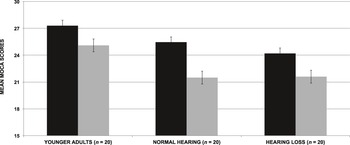
As seen in Figure 1, MoCA scores were lower in the high-level noise condition than in the low-level noise condition (respectively, the scores for the high- and low-level noise conditions collapsed across groups were M = 22.7, SD = 3.4 and M = 25.7, SD = 2.8). The scores of the younger group were higher than those of both older groups whereas the scores of the two older groups were not significantly different (respectively, the scores for the younger, NH older, and HL older groups collapsed across noise conditions were M = 26.2, SD = 2.0; M = 23.4, SD = 2.5; and M = 22.9, SD = 2.8). This pattern of results was confirmed by an ANOVA conducted with listening condition (low-level noise, high-level noise) as a within-subjects factor and group (NH younger, NH older, HL older) as a between-subjects factor. Post-hoc analyses confirming the descriptions were conducted using t-tests with Bonferroni adjustments for multiple comparisons and alpha levels set at p = .05. Specifically, there were significant main effects of listening condition, F(1, 57) = 63.12, p < .001, np 2 = .53, and group, F(2, 57) = 10.62, p < .001, np 2 = .27, but, as shown in Figure 1, there was no significant interaction of listening condition with group, p = .13. The reported ANOVA does not include MoCA version or presentation order of the noise levels as factors because a preliminary analysis confirmed that they had no significant effect on MoCA scores.
Mean Montreal Cognitive Assessment (MoCA) scores for all three participant groups. Black bars represent the mean scores in the low-level noise condition and grey bars represent the mean scores in the high-level noise condition. Error bars show standard errors (SEs).

Note that the six older adults in the HL group who were hearing aid users had poorer hearing, with higher PTABs (M = 32.2 dB HL, SD = 5.2) and WIN thresholds (M = 18.5, SD = 4.0) compared to the other 14 participants in the HL group (M PTABs = 20.2 dB HL, SD = 7.7, p < .05; M WIN = 14.8, SD = 3.1, p < .05). However, regardless of the differences in PTAB or WIN thresholds between the sub-groups, the MoCA scores of the sub-groups did not differ significantly in any condition (p > .05), likely because the presentation levels were titrated sufficiently to compensate for each individual’s hearing abilities when stimuli were presented under headphones.
Discussion
Overall, the results of the current study suggest that health care professionals conducting cognitive screening tests need to be aware of the potential effects of noise in the test environment, the patient’s hearing status, and the manner in which test materials are presented (Pichora-Fuller, Dupuis, Reed, & Lemke, Reference Pichora-Fuller, Dupuis, Reed and Lemke2013).
Environmental noise negatively affects performance on the MoCA for both younger and older adults. In general, participants showed a significant reduction in scores when the test was conducted in noisier test conditions, with all participants obtaining lower MoCA scores in the high-level noise condition compared to the low-level noise condition. There was no significant interaction between noise level and group, indicating that all participants were similarly penalized when the noise level was increased. These finding suggest that the level of background noise that may be present in clinics and hospitals could adversely affect MoCA scores for individuals of all ages and hearing abilities.
Not surprisingly, in both noise conditions, MoCA scores were better for the younger group than for the older groups. Recall, however, that all three groups had obtained similar scores on the baseline MoCA test conducted using the typical face-to-face procedure in quiet conditions in the sound booth. Thus, differences between the younger group and the two older groups emerged in the experimental noise conditions that had not been observed in the baseline MoCA test conducted in the highly controlled quiet condition. Notably, the older adults in both the NH and HL groups were penalized to a greater degree than were their younger counterparts by the addition of background noise, including the small amount of noise used in the low-level condition that might be found even in health care settings that meet recommended acoustical standards.
It is important to note that when cognitive screening tests are administered in typical test conditions, performance is commonly poorer for older adults who have hearing loss compared to those with normal hearing (e.g., Dupuis et al., Reference Dupuis, Pichora-Fuller, Chasteen, Marchuk, Singh and Smith2015). Interestingly, there was no significant difference between the MoCA scores for the NH and HL older groups in the current study. There are two likely explanations for this finding. First, differences between our two older groups may not have been observed because we invited only those who had passed the MoCA screening test in a prior study, and the scores of the two groups did not differ significantly when the baseline MoCA was administered under typical quiet test conditions in the sound booth by an experimenter with knowledge of the participants’ hearing status. Because the two older groups were matched on their baseline MoCA scores in quiet, any differences between the groups observed in the experimental conditions could be attributed with greater confidence to the specific effects of noise.
The second likely explanation is that, for the HL group participants, the presentation levels for the speech and noise in the high-level noise condition were adjusted based on each individual’s hearing thresholds in quiet and noise in an attempt to equalize the effective difficulty in the high-level noise condition so that it was as uniform as possible across participants. Indeed, the intended effect of adjusting the levels of speech and noise used during testing was to accommodate the hearing needs of the older participants in the HL group using techniques that could be implemented clinically to optimize the accuracy with which their cognitive performance could be evaluated. It is likely that differences between the NH and HL older groups would have been observed had the presentation conditions in the more difficult high-level noise condition not been adjusted according to the hearing test results of those in the HL group. However, with the adjustment of presentation levels, MoCA scores did not differ significantly between older participants in the NH and HL groups, and there was also no significant difference in the scores obtained by those in the HL group who did or did not use hearing aids.
The findings from the current study suggest that (a) the specific presentation levels and SNRs used for each individual participant in the HL group were appropriately adjusted to offset or compensate for any differences in their auditory abilities, and (b) a similar approach could potentially improve the accuracy of clinical assessments of cognition. Importantly, after adjusting for individuals’ hearing abilities, increased noise during testing had a similarly deleterious effect on the performance of all groups.
Clinicians, especially those working with an older population, should ensure that all clients are tested in a very quiet environment. Doors and windows should be shut, and any fans or other sources of background noise (e.g., radios) should be turned off during testing. Given that younger adults performed better than older adults when tested in background noise, younger health care professionals should not rely on their self-perceptions of the difficulty of listening in background noise when evaluating the adequacy of test environments. Rather, they should expect that the presence of even small amounts of noise could compromise the ability of their clients to achieve their best performance. The recent publication of acoustical standards for health care facilities has increased awareness of the importance of designing or modifying the acoustical environments in which care is provided to meet recommended targets. Ideally, testing rooms could be acoustically evaluated to determine if they meet acoustical guidelines, and room modifications could be undertaken to improve acoustics as needed.
It is not yet known how knowledge of a patient’s hearing status might affect how clinicians administer cognitive screening tests, or the tests that they choose to use. However, there is clear potential for this knowledge to be used to advantage in a number of ways. Unfortunately, recent findings suggest that the majority of older individuals who are assessed for dementia are not even asked questions about hearing loss (Jorgensen, Palmer, & Fischer, Reference Jorgensen, Palmer and Fischer2014). Recall that the experimenter in the current study was aware of the hearing status (NH vs. HL) of the participants; therefore, it is possible that she may have modified the administration procedures during the baseline MoCA test, perhaps by speaking more loudly during testing to participants in the HL group. Future research would be needed to determine whether or not blinding the experimenter to the hearing status of participants influences how they produce speech and communicate when administering cognitive tests. Apart from how knowledge of hearing loss could influence the clinician’s speech production (e.g., speaking louder or slower or more clearly), this knowledge could be used in other ways to optimize how test materials are presented to individuals with sensory impairments.
The use of controlled auditory and visual presentations during MoCA testing could potentially help to minimize some of the detrimental effects of environmental noise and/or age-related hearing loss on test performance for individuals who have sensory deficits. For example, in the present study, we recorded auditory stimuli and presented them with amplification through an audiometer, and we presented visual stimuli on a computer monitor (see also Toner et al., Reference Toner, Reese, Neargarder, Riedel, Gilmore and Cronin-Golomb2012, regarding the potential importance of using displays that correct for vision loss). However, this type of administration using recorded materials does not allow for as much spontaneous interaction between the examiner and the client as could occur in the typical face-to-face administration of the MoCA test. Furthermore, in the typical face-to-face test administration there are both auditory and visual speech cues, whereas audio-only recordings of speech eliminate the possibly useful visual speech cues that would typically be available in face-to-face testing conditions or that could be made available if audiovisual recordings were used.
Nevertheless, recent work indicates that audio-only telephone-administered cognitive screening measures can be used successfully with older adults (see Smith, Tremont, & Ott, Reference Smith, Tremont and Ott2009, for a review), and a recently developed telephone-administered version of the MoCA (in which the visuospatial-executive and naming items are eliminated) has been shown to be a reliable measure of cognitive function (Pendlebury et al., Reference Pendlebury, Welch, Cuthbertson, Mariz, Mehta and Rothwell2013). Thus, a face-to-face administration of the test may not be necessary in some cases, and the advantages of interaction may be outweighed by using recorded stimuli that can be presented at levels adjusted to optimize the perception of stimuli by those with sensory impairments (see MoCA-Blind test developed by Wittich, Phillips, Nasreddine, & Chertkow, Reference Wittich, Phillips, Nasreddine and Chertkow2010).
Clients who own hearing aids should be encouraged to use them during cognitive testing, and clinicians should ask them to confirm that the hearing aid is working properly and has a fresh battery. For clients who do not own a hearing aid or whose hearing aid has been forgotten or is not working, generic assistive listening devices by which amplified sound is presented through headphones (e.g., an FM system or a Williams Sound Pocketalker) could be used to minimize hearing difficulties during testing. Note that when a device such as an FM system or a Pocketalker is used, not only is the voice of the clinician amplified, but also the surrounding room noise is reduced, such that the SNR is improved for the listener, much as we discovered when we adjusted the presentation level and SNR for the participants in our HL group. When using a Pocketalker, the listener wears either a headband or earbud-style earphones attached to a unit (about the size of a deck of cards) that contains a volume control and a microphone positioned to pick up the voice of the talker. FM systems can be used with or without a hearing aid, and, like the Pocketalker, they both amplify and improve the SNR because the microphone is located close to the talker’s mouth and the headset worn by the listener attenuates some of the background room noise.
In addition, when cognitive screening tests are administered in the typical face-to-face testing conditions, the presentation of test materials could be optimized by ensuring that (a) visual cues for speechreading are provided when instructions are given or stimuli are presented, (b) glasses or visual assistive technologies are used, and (c) lighting enables pictures or print to be seen easily (see Toner et al., Reference Toner, Reese, Neargarder, Riedel, Gilmore and Cronin-Golomb2012). Another approach to consider might be to compensate for hearing difficulties by accompanying the typical face-to-face spoken presentation of the stimuli with written materials (e.g., words for the memory portion of the test could be shown in text as they are being spoken) or even the use of sign language for individuals who are deaf and users of sign language. Note that, when normative data for the MoCA test were originally gathered, the authors did not provide information about the presentation levels (and potential presence of background noise) during testing. Additional work could provide normative data for the MoCA in older adults with normal hearing and hearing loss under different listening conditions and in conditions in which visual supports such as speechreading, text, or sign language are provided to older adults, including those who may have dual impairments in hearing and vision. Such research would help to guide future refinement of test administration procedures.
Finally, sensory status, the quality of the test environment, and whether or not amplification or other technologies were offered or used during testing should be noted and considered when test results are interpreted.