Physical activity is associated with increased likelihood of healthy aging (Dahany et al., Reference Dahany, Dramé, Mahmoudi, Novella, Ciocan and Kanagaratnam2014). Physical activity improves functional abilities and increases the likelihood of functional independence in later life (Pate et al., Reference Pate, Pratt, Blair, Haskell, Macera and Bouchard1995). People who are more physically active also have reduced risk, later onset, and reduced severity of chronic diseases such as heart disease, stroke, and osteoporosis (Cress et al., Reference Cress, Buchner, Questad, Esselman, DeLateur and Schwartz1999; Landi et al., Reference Landi, Abbatecola, Provinciali, Corsonello, Bustacchini and Manigrasso2010; Pate et al., Reference Pate, Pratt, Blair, Haskell, Macera and Bouchard1995).
Despite the benefits of physical activity, many older adults do not achieve recommended physical activity levels (Centers for Disease Control and Prevention [CDC], 2014). The World Health Organization, the U.S. CDC, and the Public Health Agency of Canada recommend that adults age 65 and older perform at least 150 minutes of moderate-intensity physical activity or 75 minutes of vigorous-intensity aerobic physical activity per week, in addition to strengthening exercises twice per week (CDC, 2014; World Health Organization [WHO], 2014; Public Health Agency of Canada, 2012). Despite these recommendations, more than half (52%) of Canadians age 65 and older were physically inactive in 2014 (that is, they did no physical activity during leisure time) (Statistics Canada, 2015).
Nearly 90% of older adults reported that there is at least one significant barrier that prevents them from being physically active, including barriers due to health, geography, and perceived safety (O’Neill & Reid, Reference O’Neill and Reid1991). Older adults report that poor health, mobility impairment, and pain are the primary barriers to being physically active (Booth, Owen, Bauman, Clavisi, & Leslie, Reference Booth, Owen, Bauman, Clavisi and Leslie2000; Cohen-Mansfield, Marx, & Guralnik, Reference Cohen-Mansfield, Marx and Guralnik2003; Pereira et al., Reference Pereira, Kriska, Day, Cauley, LaPorte and Kuller1998; Schutzer & Graves, Reference Schutzer and Graves2004). Difficulties accessing exercise classes and facilities also decrease the likelihood of physical activity, especially among older adults who do not drive or who live in remote locations (Chao, Foy, & Farmer, Reference Chao, Foy and Farmer2000). Unsafe environments (because of traffic, people, or animals) further limit physical activity, especially walking, among older adults (Eyler et al., Reference Eyler, Baker, Cromer, King, Brownson and Donatelle1998). In order to increase physical activity levels, it is important to reduce these barriers experienced by older adults.
It is possible that an older adult’s type of residence may influence their physical activity levels and, thereby, impact physical function. For example, many retirement living facilities offer physical activity classes and age-appropriate exercise equipment onsite as well as having staff to support residents’ physical activity. However, few studies have examined differences in physical activity or functional abilities between older adults living in the community versus retirement living, and all studies to date have been cross-sectional. One study found that older adults in retirement living had lower levels of physical activity than those living in the community (Henry, Webster-Grandy, & Varakamin, Reference Henry, Webster-Gandy and Varakamin2001). In line with this finding, older adults in retirement living also performed significantly poorer on multiple functional indicators of balance and agility compared to those still living in the community (Kang, White, Hayes, & Snow, Reference Kang, White, Hayes and Snow2004). The researchers speculated that retirement living may inadvertently have led to a decline in physical function because residents no longer needed to do most housework, and only a minority of older adults engage in any leisure time physical activity (U.S. Department of Health and Human Services, 2000). Both studies, however, were cross-sectional and included substantial age differences between the community and retirement living samples and likely some uncontrolled-for health and functional differences, which may have confounded results (Henry et al., Reference Henry, Webster-Gandy and Varakamin2001; Kang et al., Reference Kang, White, Hayes and Snow2004).
Conversely, a study examining only retirement living seniors observed sufficiently high levels of physical activity among this population to suggest that this group may be more physically active than their community-dwelling counterparts (Zalewski, Smith, Malzahn, VanHart, & O’Connell, Reference Zalewski, Smith, Malzahn, VanHart and O’Connell2009). Longitudinal studies are needed to better understand changes in physical activity (both intentional exercise and activities of daily living [ADL]) and physical function among older adults who transition from the community to retirement living to determine whether there are benefits or harms to these health indicators. The objective of our study was to conduct a pilot study to examine the change in both physical activity and physical function among older adults who moved from the community to retirement living.
Methods
This study was a prospective, pre-test post-test pilot study to examine the change in physical activity and function among older adults who transitioned from living in the community to retirement living. Participants for this study were recruited from the wait lists from two retirement living facilities in Ontario, Canada. To be eligible for the study, participants had to (1) be living independently in the community without assistance in basic ADL; and (2) be on the wait list for one of the retirement living facilities, with a proposed move-in date to occur within 1 to 3 months. Exclusion criteria included having (1) an acute disruption to mental or physical health, including delirium or unstable cardiovascular, recent stroke, or hospitalization; and (2) self-reported diagnosis of mild cognitive impairment or dementia.
Retirement living included apartment style suites. Participants could have meals, laundry, or housekeeping services provided, but did not receive significant assistance with ADL or medical support. These units were available for singles or couples and had one or two bedrooms. The retirement living facilities included in this study also had fitness centres with an onsite kinesiologist, a main street with a library, shops, and a community centre, as well as landscaped grounds with paved walkways. Many recreational activities and events were also offered to residents. This study received ethics clearance from the University of Waterloo Office of Research Ethics (ORE reference # 17982).
Protocol
Physical activity and physical function were assessed at two time points: (1) baseline: one to three months prior to the move to retirement living (when people were still living in the community); and (2) follow-up: approximately two months after they had moved into retirement living. At each time point, physical function was measured and habitual physical activity was reported, after which physical activity was objectively assessed over seven consecutive days. All participants were assessed by the same lead assessor at both time points.
Measures
Physical Activity.
Physical activity was objectively assessed over seven days using a tri-axial activity monitor (ActiGraph GT3X+; http://actigraphcorp.com/). The activity monitor was worn on the right hip at all times of the day, except when bathing or sleeping at night, as per manufacturer instructions. The activity monitor collected activity data at 30 Hz, which was analysed in 10-second epochs. Weartime validation was determined using parameters set by Choi, Liu, Matthews, and Buchowski (Reference Choi, Liu, Matthews and Buchowski2011). Activity was classified based on counts per minute (cpm) in the vertical axis as sedentary (< 150 cpm), light (150 to 809 cpm), moderate (810 to 3,396 cpm), or vigorous physical activity as (> 3,396 cpm), with ranges determined from prior studies with older adults (Hall, Howe, Rana, Martin, & Morey, Reference Hall, Howe, Rana, Martin and Morey2013; Kozey-Keadle, Libertine, Lyden, Staudenmayer, & Freedson, Reference Kozey-Keadle, Libertine, Lyden, Staudenmayer and Freedson2011). To control for differences in weartime each day, time in each physical activity level was normalized by daily weartime to obtain percentage of time spent in sedentary, light physical activity, and moderate/vigorous physical activity.
Habitual physical activity was reported using a modified Community Healthy Activities Model Program for Seniors (CHAMPS) activity questionnaire (Stewart et al., Reference Stewart, Mills, King, Haskell, Gillis and Ritter2001). The CHAMPS activity questionnaire has moderate test-retest reliability among older adults (0.56–0.70) and is more strongly associated with total daily activity energy expenditure than other physical activity scales for older adults (Colbert, Matthews, Havighurst, Kim, & Schoeller, Reference Colbert, Matthews, Havighurst, Kim and Schoeller2011). To characterize change broadly by type of physical activity, we categorized the questions regarding physical activity on the CHAMPS questionnaire into intentional exercise (e.g., dancing, walking for exercise, attending exercise classes) and ADL (e.g., gardening, sweeping, vacuuming). To account for seasonal variability in physical activity, participants were also asked how many months per year they participated in each seasonal activity (e.g., golf or tennis). Weekly participation was then weighted by months per year of participation (weekly frequency and duration were multiplied by months of participation and divided by 12 months). The CHAMPS questionnaire was otherwise scored according to the instructions given by the developers (Stewart et al., Reference Stewart, Mills, King, Haskell, Gillis and Ritter2001). This included scores developed to assess both frequency and duration of physical activity.
Physical Function
Physical function was assessed with the Senior Fitness Test (Rikli & Jones, Reference Rikli and Jones1999). In the Senior Fitness Test, endurance is measured with the 6-minute walk and 2-minute steps in place. Upper and lower body strength are measured in this test by number of arm curls (5 lbs. for women and 8 lbs. for men) and chair stands, respectively, completed in 30 seconds. Agility is measured with the timed 8-foot up and go test. Lastly, upper and lower body flexibility are measured using the back scratch and chair sit-and-reach tests, respectively. Each measure was administered and scored based on instructions given by the developers (Rikli & Jones, Reference Rikli and Jones1999).
Additional Measures
Questionnaires were used to report demographics (age, gender, marital status, years of education) and health information, including falls (number in the last 6 months), mobility aids, arthritis, and lower limb injury or surgery (current or previous). Depressive symptoms were examined using the Center for Epidemiologic Studies Depression Scale (CESD), which has good specificity (90%) and sensitivity (86%) among older adults (Radloff & Teri, Reference Radloff and Teri1986). Balance confidence was assessed using the 16-item Activities-specific Balance Confidence (ABC) Scale, which is a reliable and valid measure of balance confidence among older adults living in the community (Jorstad, Hauer, Becker, & Lamb, Reference Jorstad, Hauer, Becker and Lamb2005; Myers et al., Reference Myers, Powell, Maki, Holliday, Brawley and Sherk1996; Myers, Fletcher, Myers, & Sherk, Reference Myers, Fletcher, Myers and Sherk1998; Powell & Myers, Reference Powell and Myers1995).
Statistical Analysis
Participant characteristics were presented as mean (standard deviation) or per cent (n), as appropriate. Outcome measures were then assessed for normality. Since neither physical activity nor physical function scores were normally distributed, changes in physical activity and physical function from baseline to follow-up were evaluated using the Wilcoxon signed-rank test.
Results
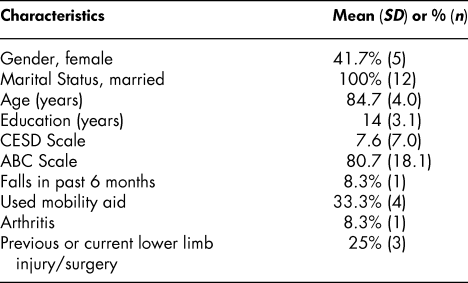
We recruited 14 participants to the pilot study from May to August 2013. Of the 14 people who were eligible and completed pre-transition assessments, two did not complete the follow-up examinations, resulting in a sample of 12 participants (7 male and 5 female) with pre- and post-measures of physical activity and physical function. Participants were aged 73–87 years, all of whom were married. Additional demographic information is reported in Table 1.
Baseline characteristics of study participants (n = 12)

ABC = Activities-specific Balance Confidence
CESD = Center for Epidemiologic Studies Depression
Physical Activity
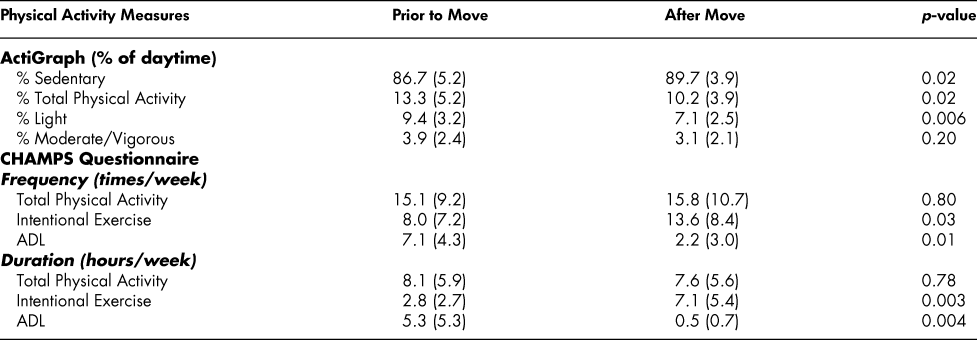
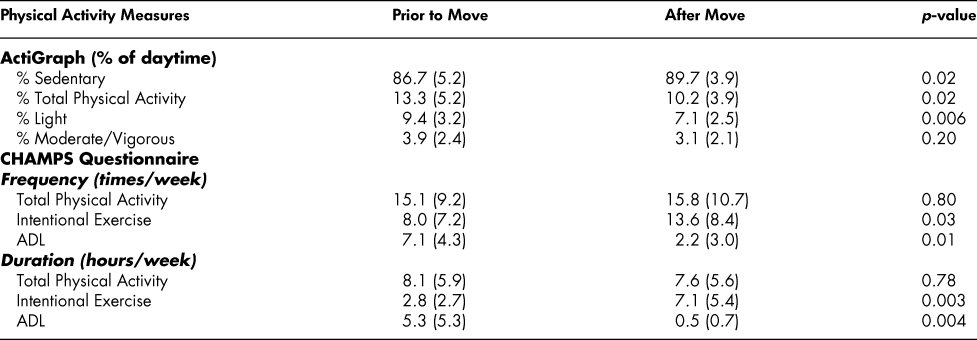
Objectively measured total physical activity (all intensities) was significantly lower following the move to retirement living from 13.3 per cent (5.2) to 10.2 per cent (3.9) (p = 0.02). However, when classified by intensity of activity (light or moderate/vigorous), only light physical activity showed a significant decline from 9.4 per cent (3.2) to 7.1 per cent (2.5) (p = 0.006). Details regarding change in objectively measured physical activity by intensity are provided in Table 2.
Change in physical activity with the transition to retirement living (n = 12). Numbers are expressed as mean (SD)
ADL = activities of daily living
CHAMPS = Community Healthy Activities Model Program for Seniors
Self-reports of total physical activity, in contrast, were similar at baseline and follow-up. However, when broken down by type of physical activity, residents reported an increase in the frequency from 8.0 times/week (7.2) to 13.6 times/week (8.4) (p = 0.03) and duration from 2.8 hrs/week (2.7) to 7.1 hrs/week (5.4) (p = 0.003) of intentional exercise and a decrease in the frequency from 7.1 times/week (4.3) to 2.2 times/week (3.0) (p = 0.01) and duration from 5.3 hrs/week (5.3) to 0.5 hrs/week (0.7) (p = 0.004) of ADL. Details regarding change in reported physical activity frequency and duration are shown in Table 2.
Physical Function
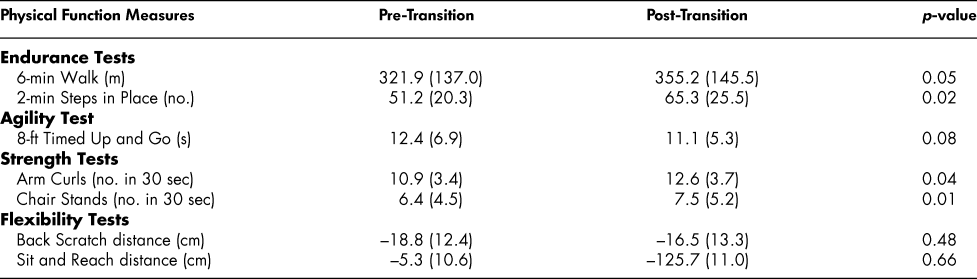
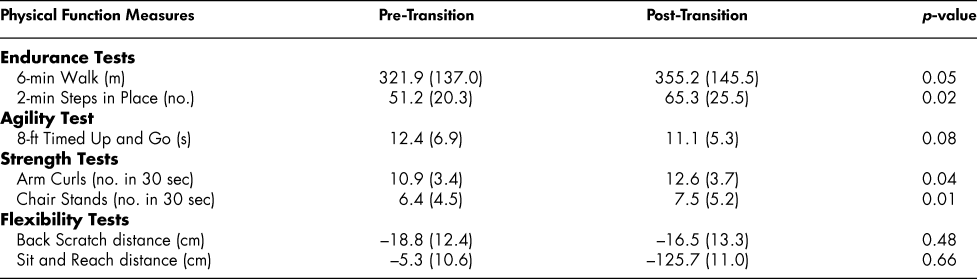
Data for two participants were excluded from the 6-minute walk test as one person used a walker at baseline but not at follow-up, and another did not do the test at follow-up because of recent surgery. Most measures of physical function improved after the transition to retirement living. This included both measures of endurance (6-min walk pre: 321.9 m [137.0], post: 355.2 m [145.5], p = 0.05; steps in 2-min pre: 51.2 steps [20.3], post: 65.3 steps [25.5], p = 0.02) and both measures of strength (arm curls pre: 10.9 [3.4], post: 12.6 [3.7], p = 0.04; chair stands pre: 6.4 [4.5], post: 7.5 [5.2], p = 0.01). Measures of agility and flexibility were similar pre- and post-transition (p > 0.08). Details regarding change in physical function before and after the transition to retirement living are presented in Table 3. Additionally, there was no significant change in balance confidence as measured with the ABC pre- to post-transition (pre: 80.7% [18.1], post: 74.8% [22.3], p = 0.10).
Change in physical function with the transition to retirement living (n = 12). Numbers are expressed as mean (SD)
Discussion
This pilot study is the first to longitudinally examine changes in physical activity and physical function with the transition from community to retirement living and found that total physical activity and, specifically, ADL decreased after the transition. Despite this overall decrease in physical activity, improvements in physical function (endurance and strength) occurred following the transition. The increase in intentional exercise reported among our participants may have contributed to the increase in physical function. Our preliminary results need to be confirmed in a larger, representative population.
Participants’ objectively measured physical activity (but not self-reports) decreased after the transition from the community to retirement living. These findings are consistent with those from a prior cross-sectional study that found that older adults living in retirement living were less physically active than their community-dwelling peers (Henry et al., Reference Henry, Webster-Gandy and Varakamin2001). In contrast, a study of retirement living residents by Zalewski et al. (Reference Zalewski, Smith, Malzahn, VanHart and O’Connell2009) found sufficiently high step counts to suggest that these residents were likely to be at least as active as their community-dwelling peers. Zalewski et al. (Reference Zalewski, Smith, Malzahn, VanHart and O’Connell2009) suggested that the environment of retirement living may encourage walking and minimize limitations to walking such as weather and safe pathways. However, our pilot study suggests that any reduction in environmental barriers that may be experienced in retirement living was insufficient to increase or even maintain total physical activity. Differences in the environment or amenities may be responsible for the contrasting results.
The drop in total physical activity with the transition to retirement living is possibly due to a significant decrease in ADL, as reported by our participants. In retirement living, many ADL (e.g., washing windows, cleaning, cooking) are performed by staff rather than by the residents. In contrast to ADL, reports of intentional exercise increased after the transition to retirement living among our participants. It is possible that barriers to physical activity – and, more specifically, barriers to intentional exercise such as proximity to exercise facilities and safety of the environment – are alleviated in retirement living. In our sample, it is possible that the reported increase in intentional exercise was facilitated by the exercise equipment and classes available onsite, although usage of these specific onsite facilities and programs (as opposed to facilities and programs in general) was not quantified.
Change in objective physical activity by intensity somewhat validates these reports. Light physical activity decreased with the transition to retirement living whereas moderate/vigorous physical activity was similar in the community as well as in retirement living. One might expect changes in moderate/vigorous physical activity to align with the reported increase in intentional exercise. It is possible that the discrepancy we observed in our study resulted from a decrease in moderate/vigorous intensity ADL (e.g., sweeping/vacuuming, raking leaves) that negated any increase in moderate/vigorous intentional exercise (Knaggs, Larkin, & Manini, Reference Knaggs, Larkin and Manini2011). Alternatively, it is possible that reports of intentional exercise in retirement living were biased upward and did not reflect actual exercise participation. However, as we discuss in the following paragraphs, physical function also improved among our study sample with the transition to retirement living, supporting the likelihood of a true improvement in intentional exercise.
Most measures of physical function improved among participants following the transition to retirement living. Participants had better endurance and strength when measured in retirement living than in the community. This result is in contrast to a prior cross-sectional study where 172 older adults in retirement living had poorer agility than 169 community-dwelling older adults (Kang et al., Reference Kang, White, Hayes and Snow2004). However, this prior study was confounded by age wherein community-dwelling older adults were significantly younger than the retirement living older adults (average 77 years versus 84 years p < 0.05), which likely contributed to the differences in physical function. Alternatively, it is possible the improved performance we observed following the transition in the current study was a result of measurement bias caused by repeated testing, given that the same tests of physical function were used prior to and following the transition to retirement living.
These preliminary results offer preliminary suggestions for both retirement living facilities and older adults contemplating a move. Retirement living may enable intentional exercise, given appropriate facilities. Older adults with considerable barriers to physical activity, such as those with limited physical function or who live far from exercise facilities, may consider retirement living as an avenue to increase involvement in intentional exercise and possibly improve their physical function. The drop in overall physical activity levels, however, suggests that greater effort is needed to maintain overall physical activity levels among retirement living residents. Our preliminary results suggest that staff and residents should encourage regular physical activity over the course of the day and minimize sedentary time. Effective strategies are not yet clear; however, potential strategies could include scheduling daily events in different locations so that residents will walk more between events. Additionally, staff could ask residents to help with events and activities (for example, to set up or clean up), although not all residents may be amenable.
Strengths and Limitations
This study has both strengths and weaknesses. Most importantly, this is the first study to assess physical activity and physical function with transition to retirement living in a prospective manner. Previous studies all used cross-sectional designs (Henry et al., Reference Henry, Webster-Gandy and Varakamin2001; Kang et al., Reference Kang, White, Hayes and Snow2004), which were confounded by age and functional differences between groups. In addition, physical activity was measured both objectively as well as by self-reports, the latter of which are prone to errors but can help to classify physical activity by activity type (Resnicow et al., Reference Resnicow, McCarty, Blissett, Wang, Heitzler and Lee2003; Stewart et al., Reference Stewart, Mills, King, Haskell, Gillis and Ritter2001). However, the results of this pilot study should be interpreted cautiously, particularly because of the small sample size (n = 12) that was recruited from just two retirement living facilities. Our results may not be generalizable to other residents or facilities. The sample was not representative, featuring more males than females and with study participants having, on average, about 14 years of education. Additionally, there was no control group so changes in physical activity and function may reflect change due to repeat testing or normal change over time (less likely). Finally, it is possible that the physical activity levels at baseline or at follow-up were not reflective of participants’ normal physical activity.
Conclusions
These preliminary results indicate that total physical activity decreases with the transition from community to retirement living. However, it appears that the decrease was primarily due to a drop in ADL. Both intentional exercise and physical function improved with the transition, suggesting that there may be some functional benefits to retirement living. However, strategies to encourage physical activity (and not just intentional exercise) are needed to maintain daily physical activity levels as people transition from the community to retirement living. A larger, more representative study is needed to fully understand the changes in physical activity and physical function, and to additionally investigate accompanying changes in cognitive function and mood over the transition to retirement living. In addition, qualitative research to discern the motivators and barriers to physical activity and facility usage in retirement living would help elucidate the relationship between physical activity and function over the transition.