“Learning is not a spectator sport.”
—Kiki Caruson (2005, 309)
Simulations are an important complement to a traditional political science education in that they can promote active learning and enhance student understanding of course material. Simulations can also provide students with the opportunity to learn and develop important research, writing, public speaking, and analysis skills. This essay describes a multi-class campaign simulation of my own design that was run in two upper-level government courses during the spring of 2006 at Hamilton College. This simulation is designed to promote student engagement in political ideas and concepts from the varied perspectives of candidates, campaign staff, parties, the media, and voters. At the same time, the simulation also helps students develop the knowledge and skills needed to succeed in a political campaign, legislative office, or other professional political environments.
The results of an exit survey of students indicate that this simulation successfully prompted student engagement in course material and enhanced student interest in politics and political campaigns. In addition, there is evidence that students who participated in the simulation viewed political campaigns more favorably and were more likely to consider running for office or pursuing a career as a political professional. A second running of the simulation in the fall of 2006 allowed for re-consideration of the simulation design, introduction of improved methods of grading student work, and further assessment of the impact of the simulation on student efficacy and engagement.
Using Simulations to Promote Experiential Learning
Experiential learning is an important tool for teaching politics; it encourages students to apply lessons they have learned in the classroom to a dynamic and interactive political environment. Experiential learning activities enable students to engage course materials and reflect on political theories and concepts within a broader, real-world context (Pappas and Peaden 2004, 859; Caruson 2005, 305). Experiential learning exercises can also be used to promote learning and engagement in students with non-traditional learning styles and help students learn and practice writing, communication, and analytical skills that are useful in the workplace (Cantor 1997).
Experiential learning can take many forms, including study abroad trips, web-based exercises, internships, and service-learning opportunities (Shellman and Turan 2006, 19–20). Classroom simulations can also be used to promote active learning, encourage critical thinking about politics, and develop the skills and situational awareness needed to succeed in professional work environments (Swansbrough 2003; Kathlene and Choate 1999; Ciliotta-Rubery and Levy 2000; Pappas and Peaden 2004; Caruson 2005). Several recent studies have found evidence that simulations can enhance “both substantive knowledge and critical and analytical thinking skills” (Shellman and Turan 2006, 30; Frederking 2005). For example, Olsen and Statham's (2005) study concluded that simulation activities in their Introductory Comparative Politics course helped students “realize the importance of developing skills for their academic careers and beyond,” and promoted “an understanding of critical thinking broadly in accord with our understanding of critical thinking in Political Science” (340).
Simulation Overview
The simulation was run in two upper-level government courses in the spring of 2006: Government 308: Politics, Persuasion, and Public Opinion (PPPO) and Government 208: Political Parties and Elections. In the case of a campaign simulation, a multi-course approach has several advantages. First, multiple courses make it possible to increase the pool of students who can participate in the simulation—an important factor at Hamilton because the college places a high priority on maintaining small class sizes. Second, multi-course simulations allow for inter-class observations that can help students recognize and appreciate the interplay of ideas and concepts from multiple perspectives (see Endersby and Webber 1995; Ciliotta-Rubery and Levy 2000). Third, a multi-course approach makes it possible to separate the campaign teams from the electorate, creating an environment that more closely reflects the experiences of voters and campaign staffers in actual elections.
The simulation started with a basic premise: state assembly districts had been dramatically reduced in size, leading to the creation of a new district in which Hamilton College students make up 40% of the electorate. Because the remainder of the district was divided evenly between nearby rural areas that lean Republican and a nearby village that leans Democrat, there was a reasonable chance that a candidate from a third, student-based party could win in a three-way race. With this context in mind, students were given the task of running competing candidates in a primary to represent the “Hamilton Party” in the upcoming state legislative election.
Prior to the start of the campaign, the 27 PPPO students were divided into three groups, including two 12-person campaign teams and one three-person media team. Students in this course were prepared to run a campaign through numerous course readings and exercises that focused on campaign organization; management and strategy; political polling and analysis; the selection and framing of issues; and practical exercises on how to craft speeches, press releases, and campaign advertisements. The 42 students in Political Parties and Elections served as members of the electorate; they were prepared for the simulation through a series of readings on campaigns, campaign advertising, and the role of parties and party leaders in the political system. Students in both classes also received handouts that explained the simulation's basic premises and a tentative timeline of simulation activities.
Immediately prior to the start of the simulation, each of the campaign teams was asked to select a candidate from among their ranks to run in a primary election to select the Hamilton Party's candidate for state legislature. The campaign teams were allowed to conduct a single benchmark survey of the electorate and use the results to help them in the candidate selection process. The candidates ran as themselves and members of their campaign teams served as campaign management and staff. In addition to selecting a candidate, each campaign team also selected a campaign manager; remaining team members were assigned to research, media relations, or web site development.
Three students from PPPO were assigned roles as members of the media; they covered the race through in-class reports, a once-a-week newsletter, and a campaign news web site. The media component to the simulation was actually a late addition to the simulation that was added in response to a number of students who expressed an interest in the media's role in politics. Other simulations have successfully used media teams to provide an added sense of realism to student campaigns and an opportunity for students to reflect on the important role of the media in modern political campaigns (Kathlene and Choate 1999).
The simulation ran for a total of six weeks. Key activities included a campaign kickoff event in week two, press conferences in week three, a “Meet the Press” interview in week four, a candidate debate in week five, and candidate speeches and the election in week six (see Campaign Timeline, Table A1). Both classes met twice a week. In PPPO, one class period each week was devoted to the simulation. In Political Parties and Elections, the first 10 minutes of each class were set aside for media reports, polling, and the distribution and presentation of the newsletter and campaign advertisements.
Campaign Roles and Assignments
Each of the two campaign teams was responsible for selecting a candidate and campaign manager. The selection process varied, with Team 1 making its decision through secret ballot and Team 2 deciding based on the general consensus of the group. By group consensus, remaining members of the group were then given responsibility for various campaign activities, including research, media relations, and web design.
Each campaign was required to complete a number of group activities, including:
- developing a written campaign strategy
- conducting both benchmark and tracking surveys
- holding a press conference
- creating a campaign web site
- preparing for and participating in a candidate debate
- developing a series of radio, television, and print advertisements
The students on the campaign teams were not required to participate in every aspect of the campaign; instead, they were encouraged to divide the responsibilities under the supervision of the campaign manager. This division of labor was designed to reflect, at least partly, the organization of a typical campaign office. Frequent team meetings, both inside and outside of class, ensured that the students kept one another updated on the progress of their assignments and allowed them to share feedback on projects before they were finalized.
In addition to participating in group activities, campaign team members were also responsible for a number of individual assignments. Each student on the campaign team was required to:
- draft a press release, which was posted on the web site and shared with the media
- draft a five-minute campaign speech and present it to the campaign team prior to Election Day
- write a 1,500-word op-ed that assessed both teams' campaign strategies and considered the winning candidate's chances for victory in the general election
These assignments provided students with the opportunity to develop and apply important writing skills to “real-life” political situations. The press release assignment required students to write in the unique persuasive style of media relations professionals and to apply research to enhance their credibility and the effectiveness of their message. The speechwriting assignment required them to apply these same skills a bit differently, focusing their persuasive efforts on the electorate rather than on the media, and enabled students to gain experience and confidence through the speechmaking process. The speeches also provided students with the opportunity to critically analyze each other's speeches. Each team used this process to select the “best” speech for their candidate to use in an Election Day address to the electorate. The 1,500-word op-ed piece was used in place of a final exam for PPPO. This final assignment provided students with the opportunity to reflect on what they learned and consider how the simulation connects to the ideas and concepts discussed in class readings and discussions.
Individual assignments were slightly modified for members of the media group. In place of press releases, students were evaluated on their written stories and “in person” coverage of the campaign. In place of campaign speeches, members of the media team gave speeches to the class that considered the role of the media in modern campaigns and used the simulation as an example. Media team members were also required to write the 1,500-word op-ed piece assessing the campaign teams' campaign strategies from the media's perspective.
Members of the electorate (the students in Political Parties and Elections) were encouraged—but not required—to attend campaign events and to read the media and campaign team web sites. Class time was set aside to show campaign advertisements, conduct polling, and distribute campaign literature and media newsletters. In addition, members of the media team played an active role in the Political Parties and Elections class by delivering formal, in-person media reports on major campaign developments. These activities helped promote class discussion and encouraged students to engage the material; through these activities, students were able to connect the theories and concepts discussed in class with real-world choices faced by candidates and campaign staffers in political campaigns.
Evaluating and Grading Student Work
PPPO students received both individual grades and group grades for the simulation. Members of the campaign teams received an individual grade for their press releases, political speeches, and post-election analyses. These students also received an individual participation grade for the simulation, which was determined by their teammates using a “World Series shares” system.1
Students in each team were given a limited number of points to distribute (confidentially) between their teammates. Because the number of points was limited, distributing high scores to some students required students to give correspondingly lower scores to others. The high and low scores were dropped and the remaining scores averaged to compute students' final participation grade. For other approaches to World Series shares, see Maranto and Gresham (1998).
Members of the electorate (students in the Political Parties and Elections course) did not receive a separate grade for the simulation; however, students who attended outside activities (e.g., press conference or campaign kickoff) and actively participated in class discussions on the simulation did receive participation credit. In addition, the final exam for the course included an essay question that asked students to apply the political concepts and ideas discussed in class to the campaign activities undertaken by the candidates and their campaign teams.
Assessment and Feedback
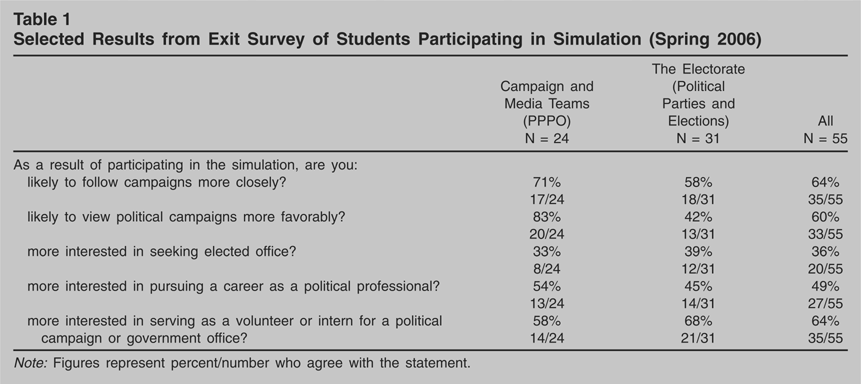
Students from both courses were asked to take part in an exit survey at the end of the simulation that provided useful feedback about what the electorate liked and disliked about their candidates and campaigns. The survey also asked a number of questions that gauged student reactions to the simulation itself and assessed the simulation's effect on students' attitudes toward politics and political campaigns. Selected results from the exit survey are presented in Table 1.
Selected Results from Exit Survey of Students Participating in Simulation (Spring 2006)

The exit survey results indicate that students were active and engaged in simulation activities: 50% of students in PPPO reported that they spent more than six hours per week outside of class on the campaign simulation alone. Though there was a range of estimates as to time spent outside of class on the simulation, all but one student reported spending more than two hours per week and 50% reported spending six or more hours. Exit poll results also provide evidence that students in Political Parties and Elections were engaged by the simulation: over 90% (28 of 31) agreed that they had enough information on the candidates to make an informed decision, and 87% (27 of 31) reported that they followed the campaign “somewhat closely” or “very closely.”
There is also evidence indicating that this simulation can increase student interest in politics and encourage active engagement of the political process. Among the results:
- 71% of students in PPPO and 58% of students in Political Parties and Elections reported that they would follow campaigns more closely as a result of participating in the simulation
- 83% of students in PPPO and 58% of students in Political Parties and Elections reported that they viewed political campaigns more favorably as a result of participating in the simulation
These responses suggest that, in addition to providing students with opportunities to learn about politics, this simulation may lead some students to be more attentive to political campaigns and more appreciative of the challenges faced by candidates for public office and the political professionals who work for them.
In response to questions on what they liked and disliked about the simulation, PPPO students responded that “it was like a real campaign.” One student added that she “enjoyed the chance to practice real campaign activities and get a glimpse of the campaign manager's job.” A number of students also remarked on the high level of enthusiasm and interaction among students, noting that there was “a lot of interaction between the three groups,” and “enthusiasm from most students.” Students in Political Parties and Elections responded similarly to the question, noting that the simulation “seemed real,” “was fun and interesting,” and “everyone seemed engaged.” Only a small number of students expressed any “dislikes” related to the simulation; those who did raised concerns about “too much work,” and the “difference in work responsibilities among members [of the campaign teams].” Though Political Parties and Elections students were more passive participants in the simulation, only one student raised a concern about being “disconnected from the candidates.”
Though exit-survey results are not conclusive on their own, these results do suggest the potential for a simulation to promote political engagement and an enhanced sense of political efficacy. Further research is warranted to take into account factors such as self-selection and the impact of outside events, and to consider whether changes in political attitudes that occur as a result of simulation activity are temporary or long-term in nature.
Lessons Learned
Quality simulations encourage students to learn about politics, not merely practice it. Accordingly, it is important to provide students with readings, lectures, and discussions that enable them to understand and address important political questions related to campaigns, parties, elections, and public opinion. The readings and course materials that were most effective were those that spoke to both theoretical and practical concerns, such as Lakoff's Don't Think of an Elephant (2004), Powell and Cowart's Political Campaign Communication (2003), and Jeffrey Stonecash's Political Polling (2003).
The premise of the simulation—that a college student could win the election due to redistricting of the state legislative boundaries—made it possible for students to run as themselves. The general consensus among students was that this realism made it easier for them to engage the simulation as if it were the real thing. Of course, when students play themselves in a simulation it is important for the instructor to be aware of the potential for one or both campaigns to go too far in their campaign literature or statements. To preclude this, I made it a condition that all advertising and media reports were shared with me in advance. This gave me the opportunity to dissuade students from targeting negative messages at an individual and encouraged communication between the campaign managers, who sought to avoid the mudslinging sometimes seen in real-life campaigns. One concern that did arise, however, is that student candidates playing themselves and appealing to an electorate of fellow students may focus too excessively on student-oriented issues at the expense of issues more likely to emerge in the course of a state legislative campaign. In the campaign debriefing, most students supported the idea of running as themselves but recommended making the campaign a congressional rather than state legislative race because students would be more familiar with national issues.
The last-minute addition of a media team added to the realism to the campaign. By having a media team, students in the electorate were able to receive the majority of information on the campaign the same way that a real electorate does: through a combination of media reports and advertisements. In addition, the campaign teams were compelled to deal with the fact that the media served a gate-keeping role in the campaign and to incorporate that fact into their campaign strategy and their day-to-day campaign activities. The student members of the media team also benefited from the opportunity to develop writing, analysis, research, and public speaking skills.
The multi-course approach provided flexibility that enabled campaign teams to work independently of the electorate; this gave the simulation a more realistic feel and made campaign teams responsible for finding ways to get and hold the attention of the electorate. The downside of this approach is that the simulation was much more intense for PPPO students because they were the ones who ran the campaigns and covered the race as members of the media. The Political Parties and Elections students who made up the electorate had a much more passive role. Although this may reflect a principal, and unfortunate, characteristic of the electorate, there is the potential for students in this environment to feel disengaged from the simulation. Clearly, watching a simulation is not nearly as valuable as participating in one. In-person reports by members of the media to the electorate and required attendance at a candidate debate (in which members of the electorate asked questions directly to the candidates) helped ensure a measure of activity and engagement on the part of the electorate. In future simulations, participation on the part of the electorate could be increased by asking them to form their own interest groups and political parties, and having them engage the electoral process through public education initiatives, lobbying, and campaign rallies.
Throughout the simulation, I used my own experiences as a political professional and campaign manager to engage students in the course materials and provide them with real-world examples of the often difficult choices faced by political campaigns. Clearly, a simulation like this benefits from the addition of outside speakers who can provide real-world context about how political campaigns operate (e.g., party leaders, candidates, campaign staffers, pollsters, and political consultants). Likewise, simulations like this are likely to be more effective when instructors take full advantage of on-campus resources by connecting students to college and university personnel who understand the “nuts and bolts” of library and Internet research and the use of video and computer technologies (see, for example, Rivera and Simons 2006).
Lessons Learned from a Second Running of the Simulation
In response to high levels of student interest in the simulation, PPPO was offered a second time during the fall 2006 semester and students from a Congress and the Presidency course served as the electorate. During the second running of the course, the simulation was adapted to more closely parallel the highly anticipated 2006 congressional elections. Rather than playing themselves, this time around the student candidates played the role of one of two major candidates in a highly competitive local congressional race. In addition, the simulation was moved forward in the class schedule so that Election Day corresponded to that of the November congressional elections.
Having actual student candidates role-play the part of congressional candidates proved a big improvement. The role-playing aspect reduced the risk that campaign activities would reflect on the candidates personally. Furthermore, this change encouraged the campaign teams to focus on broad national issues rather than on the localized, campus-centered issues that dominated the candidate agendas in the first simulation. The role-playing aspect also strengthened the campaign research component of the course by making it possible for students to conduct thorough research on both candidates' public statements, professional experiences, and voting records.
Moving the simulation forward to parallel the congressional election had both positive and negative effects. On the positive side, the revised campaign schedule allowed the instructor and students to react to the same local and national events that were impacting actual congressional campaigns during the run-up to the fall 2006 elections. For the campaign teams and the electorate, this provided opportunities to engage in discussions and debates that were not only relevant to the class activities, but to the broader political world. Over the course of the semester, however, it became clear that the student campaign teams were overly reliant on the themes and arguments put forward by the actual candidates and the creativity of the student campaigns suffered. In addition, the course seemed to work much better when there was a clear separation between the readings and preparatory activities and the simulation itself. The simulation is very labor intensive and works best if students have time to prepare themselves sufficiently through readings, coursework, and in-class activities. Moving the simulation forward in the second running required the instructor to alternate between the coursework and readings and the simulation activities; as a result, the coursework felt much more rushed and students had a much harder time keeping up with the work.
The second running of the simulation also allowed the instructor to make several significant improvements that allowed for increased feedback and a more comprehensive approach to grading student work. Rather than responding to student work on an individual basis, the instructor created a course blog that allowed students to post their own work (including campaign press releases and print advertisements, candidate statements, and media reports).2
The course blog can be viewed at http://mackmariani.blogspot.com.
The creation of a campaign portfolio requirement for members of the campaign and media teams was another significant improvement. Students were required to submit campaign portfolios that included all individual work completed during the course of the simulation, including campaign plans, press releases, speeches, direct mail advertising, and media reports. Rather than receiving a separate grade for each assignment, students in the second running received a single grade for the entire portfolio. The portfolio requirement has several advantages over the assignment of individual grades throughout the course of the simulation: first, receiving and returning the assigned work all at once simplifies the instructor's work; second, it allows for a more complete assessment of each student's overall performance in the simulation; and, third, it enables students to revise their work in response to peer and instructor comments.
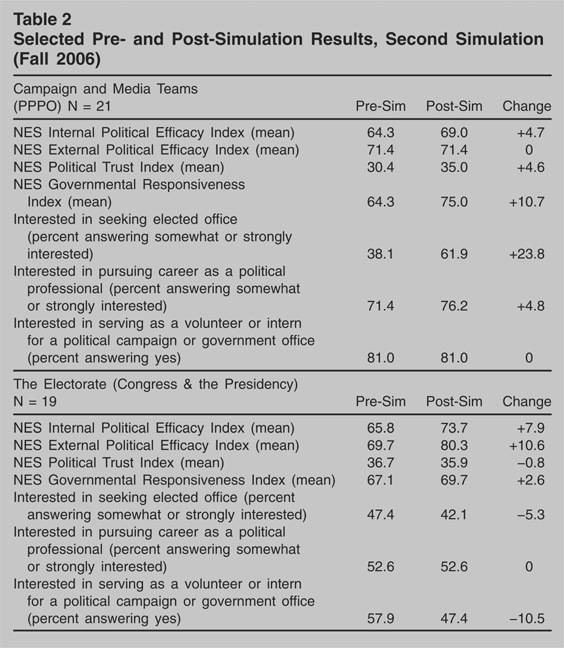
The second running of the simulation also provided an opportunity to conduct a more thorough assessment of the course's impact on student attitudes toward politics and political careers. Pre- and post-simulation surveys of students participating in the course indicate that by the end of the course, students on the campaign and media teams viewed government as more responsive to the average citizen and expressed higher levels of internal political efficacy and trust (see Table 2). Campaign and media team members were also considerably more likely to express an interest in seeking elected office and slightly more likely to express an interest in a career as a political professional.
Selected Pre- and Post-Simulation Results, Second Simulation (Fall 2006)

Like their counterparts in PPPO, students in the electorate also expressed higher levels of internal efficacy and were more likely to view the government as responsive. Students in the electorate differed from the campaign and media teams, however, in that they expressed higher levels of external efficacy (the PPPO group reported no change) but slightly lower levels of political trust. The electorate also differed in that they were less likely, following the course, to express an interest in seeking elected office or working as a volunteer or intern for a political campaign.
Conclusion
According to John D. Occhipinti (2003, 69), the most effective type of group exercise is one that embraces cooperative learning strategies, the “highly structured type of group learning that entails positive interdependence and student accountability.” Occhipinti contrasts cooperative learning with “mere group work,” the loosely-structured and more informal group exercises that are used to provide a change of pace from in-class lectures and generate additional discussion (69). This simulation reflects the design objectives of “cooperative learning” outlined by Occhipinti (70): it is well-planned and long-term; has stable and heterogeneous group membership; helps students learn course material and develop social skills; and is structured to provide individual accountability as well as positive interdependence among team members. By setting aside time during class for group meetings, it provides the opportunity for regular intervention and close monitoring by the instructor, and makes it more likely that intra-group conflicts will be brought to the instructor's attention.
The simulation described in this essay proved an effective exercise that connects students to politics on a number of levels. First, the simulation reinforces the ideas and concepts laid out in course readings and lectures and promotes active learning about political campaigns, political communication, and public opinion. Second, it encourages students to actively engage politics by showing them how campaigns work and giving them the tools they need to understand the campaign strategies and tactics employed by political campaigns. Finally, the simulation provides students with the opportunity to learn and practice real-world skills that will help them succeed in a political internship or employment with a political campaign or government office.
Author Bio
Mack D. Mariani is assistant professor of political science at Xavier University. He previously served as visiting assistant professor at Hamilton College. He is co-author of Diverging Parties (2003, with Jeffrey Stonecash and Mark Brewer) and co-editor of The Insider's Guide to Political Internships (2002, with Grant Reeher). His articles have appeared in Political Science Quarterly, Legislative Studies Quarterly, and other journals.
Campaign Simulation Timeline