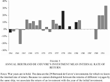
The largest trading power in Europe at the end of the 1780s was France. The total value of its long-distance trade—trade with Africa, Asia, America and re-exports to the rest of Europe—was equal to 25 million pounds sterling. The total value of British long-distance trade was only 20 million pounds sterling. The growth of French long-distance trade from the 1710s had been faster than the growth of English trade.1
The main support to long-distance trade, the plantation system, was larger and more efficient in the French colonies than in the British ones.
As such, French trade is an important case to study for anyone interested in the relations between Europe and the other continents during the eighteenth century.
However, most of the debate about the role of long-distance trade in European economies has centred on England. It has, for example, long been claimed that the relations between England and Africa, Asia, and America played a great role in the “primitive accumulation” of capital before the Industrial Revolution.3
This vision has been soundly criticized on macro-economic grounds.
On microeconomic grounds, the debate has focused on the profits of the most striking aspect of long-distance trade: the slave trade. No fewer than three different methods have been used to estimates slave trade profits: theoretical results from competition theory, theoretical reconstruction of profit rates, and examination of traders' accounts.
The different estimates of annual profit rates based on the second method range between 7.1 percent and 30 percent.
Estimates of annual profit rates based on the third method range between 8 percent and 10 percent.
A companion paper discusses the difficulties of measuring profits for the slave trade and other long-distance trades.8
Four recommendations are worth repeating here. The first one is to remember that profits are private returns to capital. They do not include the benefits and costs associated with the whole society or the state; they should exclude the remuneration of work, knowledge, and networks that is associated with outfitter's revenues.
The second one is that the examination of actual accounts seems to be the safest way to reach a conclusion on profits. The third one is related to the treatment of time. The undiscounted benefit cost-ratio, the present value, and the internal rate of return should not be confused. Finally, it is important to compare the profitability of the slave trade and other long-distance trades with alternative investments.
In addition to following these recommendations, this article extends the microeconomic debate on investment in long-distance trade in three directions. First, it introduces French data to the debate. Second, it examines data on all the branches of long-distance trade, not only the slave trade. Third, it studies all the characteristics of investment in long-distance trade, rather than focusing exclusively on profit and risk.
INTERNAL RATE OF RETURN ON SLAVE TRADE AND OTHER LONG-DISTANCE TRADES
All the sources listed in Table 1 give enough information to compute the undiscounted benefit-cost ratio of each investment, computed as the ratio between the initial investment and net returns minus one. This ratio has often been called the “rate of profit” or “profit rate” in past studies on the profitability of the slave trade. We will use the latter expression as a convenient shorthand. It does not take into account the timing of returns. Obviously, an investment of 100 livres that yields 125 livres in one year is a much more successful venture that if the same return is achieved only after five years, despite having the same “profit rate” of 25 percent. As we have noticed in the preceding section, the returns of trading ventures were spread out over time. For example, less than half of the Bertrand de Cœuvre's investments yielded their full returns in fewer than ten years.22
Meyer, Armement nantais, p. 219.
The “profit rate” that many studies report is inappropriate for comparing returns from capital invested in trade with returns elsewhere in the economy. To take the chronology of returns into account, we must compute the internal rate of return of these ventures; that is, the discount rate which equalizes to zero the present value of all outlays and returns during the life of an investment. The internal rate of return of the first hypothetical venture presented at the beginning of this paragraph is 25 percent; the internal rate of return of the second venture is only 4.6 percent.
The difficulty is that most of the data do not provide us with an exact chronology of return. As a consequence, it is not possible to compute internal rates of return. Fortunately, some of the data relating to Bertrand de Cœuvre are an exception. We will start from the firm ground of this source and then try to generalize the results to the other sources.
Bertrand de Cœuvre, both father and son, were part of one of the most important trading and outfitting family in Nantes during the eighteenth century.23
Ibid., pp. 265 and 368–69.
Although they had stopped being outfitters themselves well before 1770, they kept investing in long-distance trade expeditions.
24 The estate accounts of Bertrand de Cœuvre fils have been fully transcribed and published by Jean Meyer in a book recently re-printed.
25 Ibid. The data are to be found on pages 384–439. The discussion of the data by Meyer is on pages 215–24. An electronic copy of the data is available upon request. The tools Meyer used to analyse these data can be improved on by using modern investment evaluation instruments.
These accounts were established between 1794 and 1798. They summarize older, lost, accounts covering both outlays and returns from 1733 to 1796. The first main document is a summary report of all the investments made by Bertrand de Cœuvre and his father. It provides information on the full outlays and returns of 69 investments. The second main document is a detailed report of investments made by Bertrand de Cœuvre himself. This document provides the chronology of outlays and returns for 29 investments.
26 We do not have complete inflows schedules for an extra 19 investments. We have excluded them from the analysis, except for Figure 3, which is only concerned with outlays.
It was probably built from accounts between the different outfitters and Bertrand de Cœuvre. We will focus on the latter document.
This source gives us information on investments in 29 individual ships or groups of ships. These 29 investments correspond to 65 voyages: 39 slavetrade voyages, 23 direct West Indies trade voyages, and three miscellaneous voyages—one to China, one to India, and one to “Amérique” (probably the United States). These 29 investments are the core of our analysis of the profitability of investments in the slave trade and other long-distance trades. This source is not perfect for two reasons. First, although we know exactly on what day various outfitters paid money to Bertrand de Cœuvre, information on Bertrand de Cœuvre's outlays is sketchier. Only the year of the voyage is indicated alongside the costs associated with the preparation of each voyage.27
An additional cost is given as well, associated to a particular voyage, but without any date. These expenditures are listed as “Quote-part des dépenses depuis la mise-hors.” I will assume that this cost was incurred between the outfitting and the departure of the ship. Some outlays lack a date. Here are the choices we have made to give them one. Last investment on the St.-Charles (dossier number 5): 1777 (as this is given elsewhere as the last date of outfitting). Second investment on the St.-Hilaire (dossier number 14): 1766 (as there is one investment in 1765 and one in 1767); Last investment on the Le Quartier Morin (dossier number 37): 1778 (as this is given elsewhere as the last date of outfitting).
Because the daily details are available only for returns, I have taken into account both costs and returns at the yearly level. Second, each payment is associated with a ship or a group of ships, and not with an individual voyage. Because the returns of individual voyages were spread out over many years, it is not possible to separate individual voyages by the same ship or group of ships. With these caveats, it is possible to compute that the internal rate of return of Bertrand de Cœuvre's portfolio was 6 percent.
28 The internal rate of return of Bertrand de Cœuvre's portfolio of 19 slave-trade investments was 7.2 percent and the internal rate of return of his portfolio of seven West Indies direct trade investments was 5.3 percent. The rate of return of his three miscellaneous investments was −2.9 percent. However, the number of observations is too small to make much of these differences.
We can now try to extrapolate the typical internal rate of return in the rest of the data. If the chronological profiles of two investments are similar, the equality of their “profit rates” entails the equality of their internal rates of return. Hence, although it is not possible to compute the internal rates of return of the other investments, it is possible to use the comparison of their “profit rate” to Bertrand de Cœuvre's “profit rate” as a proxy for the comparison of their internal rate of return to Bertrand de Cœuvre's internal rate of return if the chronology of returns is comparable in Bertrand de Cœuvre's portfolio and in the rest of the available data. Actually, it is probable that Bertrand de Cœuvre experienced longer repayment periods for the same “profit rate” than was common in the rest of the data. That is because slave trade and late century investments are over-represented in Bertrand de Cœuvre's voyages. Ninety percent of Bertrand de Cœuvre's voyages started after the Seven Years war—but that was the case of the voyages associated with only 50 percent of the profit observations in the data—and 60 percent of Bertrand de Cœuvre's voyages were slave trade voyages—but that was the case of the voyages associated with less than 40 percent of the profit observations in the data. As buying slaves was the main reason why plantation owners in the West Indies had to go into debt, the slave trade was more prone than other trades to long repayment periods. As the financial position of plantation owners declined continuously during the eighteenth century, their debts were more and more difficult to recover for French traders.29
Their financial position declined to the extent that traders had to take over a greater part in the West Indies economy, not always with happy consequences: Thésée, Liaisons d'habitations.
As a consequence, returns from investments took longer to be repatriated later in the century than earlier. Because of this double over-representation, if we find that the typical “profit rate” in the rest of the data is equal to Bertrand de Cœuvre's “profit rate,” we can safely conclude that the internal rate of return in the rest of the data is at least equal to, and probably higher than, Bertrand de Cœuvre's internal rate of return.
The “profit rate” of Bertrand de Cœuvre's portfolio of 29 investments is 23 percent. The mean, unweighted, “profit rate” of the other 209 observations in the data is 31 percent (standard deviation: 0.98). However, some very high profit observations might play too large a role in determining the mean “profit rate.” If every rate higher than 200 percent is replaced by 200 percent (9 observations), the mean “profit rate” falls to 23 percent (standard deviation: 0.53). Bertrand de Cœuvre “profit rate” was indeed typical of the whole sector. This suggests that the typical internal rate of return in the slave trade and other long-distance trade was at least 6 percent.
Before accepting this conclusion, we must examine four difficulties with the computation of the mean “profit rate” in the other 209 observations.
The first difficulty is the wide range of “profit rates” that entails large statistical confidence intervals. The large standard deviation frustrates the research for a statistically significant conclusion. It is not even possible to show that the mean “profit rate” in long-distance trade was different from zero. The same problem exists in our times for estimates of mean internal rates of return when individual investments yield widely different payoffs (it has been called the “mean blur” problem).30
Luenberger, Investment Science, pp. 214–15. It applies to the computation of returns of equities on a specific market.
There are not many remedies to it, except obtaining even larger amounts of data. Our estimation already takes into account data an order of magnitude more abundant than has been the case in the literature on French trade until now. Moving one order of magnitude beyond that would be very difficult. Statistical doubt remains. It is, however, comforting to notice that our result is robust to using a different method of aggregation.
31 Daudin, “Rôle du commerce,” chap. 5, section 3, especially table 70, attains a comparable results by aggregating by sources instead of observations.
A second difficulty is the potential selection bias in our data. Success might have attracted more curiosity than failure, and secondary sources might give an undue place to successful ventures. We have only used private account sources, and hence the curiosity of the eighteenth-century public should not affect us. Considering the paucity of the data, it is doubtful that researchers were particularly picky; they probably did not select the sources they studied. Their curiosity should not affect us either. The selection bias, then, can only come from what data have actually survived in the archives. In that case, the bias could be reversed: when a bankruptcy occurred, account books were taken away from traders' whims to be put into official archives. They had more chances of surviving there than in private archives. In the same way, when something went wrong, investors became less trusting toward the outfitter and demanded to be given more details on what was happening. As a consequence, the evidence on investments that went wrong was repeated in many letters and dispatched to different places. It had more chances of surviving. The selection bias should lead to underestimating the usual “profit rate” rather than overestimating.
A third difficulty is that the usual “profit rates” might have varied between locations and types of activities. The data we use comes from numerous French ports and numerous different activities. Table 2 tries to assess if there was a systematic difference in “profit rates.”
If one excludes Rouen, Marseille, and La Rochelle, “profit rates” were comparable across different geographical regions. The difficulty with Rouen, Marseilles, and La Rochelle comes from the fact that we observe voyages from entrepreneurs' books, not investors' ones. Hence, specific port and activity “profit rate” reveal something about the success and failure of a particular entrepreneur rather than about the general investment opportunities that existed in that port and that activity. The bad results of Rouen are based on a single source, the Dugard company. This company was so unsuccessful it had to be liquidated amidst bickering between its outfitter and its investors. The same company explains the bad results of investments linked with Canada. In Marseilles, Solier and Cie are the only firm we have information on. They were newcomers in the trade, Protestants attracted there by the high profits that were to be made in the 1780s. They were not successful. Finally, the good results of La Rochelle come from operations made in 1722, before the stabilization of the livre tournois; it is possible that part of the these profits were simply due to monetary movements.
This relative uniformity in “profit rates” is explained by the fact that all the harbors were faced with comparable international and institutional situations. Furthermore, we have already pointed out that, as the same investors put their money in a large range of trade activities willingly, profits must have been constant in that range.
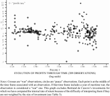
A fourth difficulty is the possible evolution of the mean “profit rate” throughout the period. Figure 1 shows no discernible trend in the evolution of “profit rates.” This is reinforced by the computation of time trends. If the data are not truncated, there is a positive time trend. If they are truncated at 250 percent, 200 percent, or 150 percent, there is a negative time trend. Neither one nor the other is statistically significant.
To the best of our current knowledge, our computation of the mean “profit rate” is sound. If the mean “profit rate” was at least equal to Bertrand de Cœuvre's “profit rate” and if the chronology of returns was typically more advantageous than what Bertrand de Cœuvre experienced, we can conclude that the typical internal rate of return of long-distance trade was either equal to or higher than the internal rate of return of Bertrand de Cœuvre's portfolio, i.e., 6 percent.32
This is a nominal internal rate of return. However, it is also mainly a silver internal rate of return, as the silver value of the livre tournois was stable from 1726 to the 1790s. I have assumed that the post-1792 accounts we have were in metallic livre tournois, and I have not taken into account the devaluation of the assignats. We do not know enough about the evolution of the whole range of prices in France during the eighteenth century to compute a meaningful real rate of return.
INVESTMENT IN SLAVE TRADE AND OTHER LONG-DISTANCE TRADE IN CONTEXT
In this section, we compare investment in the slave trade and other longdistance trades with alternative investments in terms of internal rate of return, liquidity, maturity, and risk.
We will focus on the comparison with French private and public longterm debt, and we will make only passing comparison with British and Dutch public debt, short-term commercial paper, and land investment. This focus does not imply that we believe that the returns of all investments were not linked to one another; we are simply trying to compare like with like. The creation of short-term commercial paper was a by-product of commercial activity. Only entrepreneurs would have had the regular opportunity to invest capital in commercial paper. Land was both a conspicuous consumption good and an investment good. As such, it offered sources of utility that long-distance trade investment did not offer. The study of British and Dutch public debt would be more justified; but—unlike the Dutch—French investors did not contribute to the financing of foreign countries' debt. This suggests that it was less attractive than French public debt.
We first look at the internal rate of return on investment in long-distance trade. In absolute terms, 6 percent does not seem like a large number: it is lower than the numbers presented in the debate on British slave-trade profits—but none of them are really comparable internal rates of return. Yet, as we have seen, it is a conservative estimate. It can only be interpreted in comparison with alternative investments:
In France, the maximum legal rate of interest, had been fixed at 5 percent in 1665 and did not change until the Revolution.33
Postel-Vinay, La terre et l'argent, p. 86.
Because of legal problems linked to the notion of usury, there were only two investment instruments in the traditional notarized credit: obligations and rentes.34
On notarized credit, see Hoffman, Postel-Vinay, and Rosenthal, Priceless Markets.
were zero-coupon bonds. Only the repayment date and the capital to be repaid were ever specified in the contract; it is not possible to compute their internal rates of return. For that reason, we cannot use them in this study.
Rentes were perpetual bonds paying a constant interest. Their internal rate of return was equal to their interest rate. The capital and the interest were specified in the contract. In Paris, “around 1750, the legal rate [5 percent] had imposed itself to a great extent.”
35 Ibid., pp. 91–98, especially p. 92, “Vers 1750, le denier légal s'est largement imposé.”
In rural markets, the interest rate charged also converged toward 5 percent.
36 Rosenthal, “Credit Markets,” pp. 133–34.
Short-term commercial interest rates varied much more. Yet, the mean price of short-term loans between Paris and London was 4.99 percent per year between 1740 and 1790.37
Luckett, “Credit and Commercial Society,” quoted by Postel-Vinay, La terre et l'argent, p. 90.
As French government debt was not consolidated, it is difficult to determine its internal rate of return for investors.38
Velde and Weir, “Financial Market.”
Different assets had different interest rates depending on the extend of their risk of default. The most secure French public bonds were the
Rentes sur l'Hôtel de Ville de Paris and, after 1770, the October Loans. Their internal rate of return, computed by comparing their market value and their promised stream of future payments, varied between 4.8 percent and 6.5 percent from 1746 to 1792—except during the budgetary crisis period between 1769 and 1774.
39 Starting in 1737, the state offered life annuities at a rate of 10 percent per year.
40 Riley, Seven Years War, p. 176.
That rate went up to 12 percent during the Seven Years War (1757–1763), and after Terray's partial bankruptcy in 1770, varied between 6 and 8 percent. When these annuities were on children's lives, investors would typically exceed the yields of the October Loan by two to three percentage points.
41 Velde and Weir, “Financial market,” p. 34.
This reflected a higher probability of bankruptcy on these bonds.
Comparison of land prices and rents suggests that land investment had an internal rate of return varying between 3.5 percent and 4.5 percent in England and France, including a presumed 0.5 percent capital gain per year.42
Ibid., p. 19. They quote debates during the nationalization of church goods and different regional studies: Frêche, Toulouse, pp. 568–73; Poitrineau, La vie rurale, pp. 513–14; Saint-Jacob, Paysans de la Bourgogne, p. 293.
Foreign internal rates of return give perspective on these numbers. In England, the interest rate on mortgages was around 4.5 percent.43
Velde and Weir, “Financial Market,” p. 19. Compare Clark, “Debt,” pp. 415–17.
In 1788 debt service was 7.5 percent of the French state debt, but only 3.8 percent of the British state debt.
44 Crouzet, La grande inflation, pp. 58–76.
British debt paid between 3 and 3.5 percent, the debt of Dutch public corporations paid between 2.5 percent and 3 percent.
45 Net of tax. Thanks to Jan Luiten van Zanden for bringing this fact to my attention. See Riley, International Government Finance, p. 72.
To sum up, the internal rate of return of long-distance trade was comparable to that of the most secured French state bonds. It was between 33 percent and 70 percent higher than the internal rate of return of a land portfolio, and 20 percent higher than the internal rate of return of private rentes. It was also higher than the most secure foreign public bonds.
Its internal rate of return is only one aspect of the attractiveness of an investment. Liquidity, maturity, and risk also have to be taken into account. Modern tools of investment assessment, even if they were not used by eighteenth-century investors, allow us to debate objectively notions that investors understood and took into account: liquidity, maturity, and risk.46
Although it would be wrong to undervalue the sophistication of eighteenth-century investors: see Velde and Weir, “Financial Market,” p. 11.
We will focus on comparing investment in long-distance trade with investment in French state bonds or French private
rentes.
Liquidity measures how easy it is for investors to change the utilization of their capital. In finance, it is a quantitative measure that seeks to approximate the slope of the demand and supply curve of an asset. This is not possible to estimate in our case, as we do not have enough information on the quantities bought and sold on the market. We can, however, examine a necessary condition for liquidity: was it legally and practically possible to trade different investments?
Ship shares could be sold and bought without legal difficulties, sometimes even at auctions. Only ship shares could be sold, not the future stream of income from past investment on the ship. Jean Meyer and Charles Carrière suggest all the same that this flexibility both delayed (by a process of “crowding out”) and prepared the development of modern-style negotiable share firms.47
Meyer, Armement nantais, pp. 103–04, 113–14; and Carrière, Négociants marseillais, pp. 537–39.
The liquidity of ship shares is also confirmed by the study of the number of voyages per Bertrand de Cœuvre's investment in
Table 3.
This table suggests that Bertrand de Cœuvre was able to sell ship shares between voyages. The average life of a ship was higher than one voyage; if Bertrand did not sell ship shares, it would be difficult to understand why nearly one half of his investments only covered a single voyage. Furthermore Bertrand de Cœuvre's sale of ship shares was not random or indiscriminate. There was an inverse correlation between the “profit rate” of an investment and the number of voyages it included. Bertrand de Cœuvre apparently assumed that the profit of one voyage gave information on both the quality of the ship and the skills of the outfitter and the captain, thus predicting the profits of subsequent voyages. He kept investments that he thought were going to be profitable in his portfolio, weeding out the others.48
The buyers were probably the outfitters themselves, who could either use their own capital to finance their future venture, find other investors, or sell the ship itself.
Furthermore, even when he kept investing in a ship, the extent of his share changed between voyages in five cases. That suggests the existence of some liquidity for long-distance trade investment.
The liquidity of private debt was lower. Even if—in some regions—it was formally possible to sell notarized long-term instruments of credits, formal costs and transaction costs were very high on these markets. The buyer of a rente had to be convinced that the debtor was trustworthy and required explanation of the particular clauses of each contract. Private information was difficult to transfer. As a result, there was no active secondary market in long-term private credit.
State bonds were more liquid. In Paris, a bourse had been created after Law's bankruptcy. After the late 1740s it had developed as a resale market for some state-issued bonds and for stocks from a limited number of firms, such as Compagnie des Indes or Caisse d'Escompte.49
See Velde and Weir, “Financial market,” pp. 13–14; and Hoffman, Postel-Vinay, and Rosenthal, Priceless Markets, p. 111.
However, exchanging through this market had a cost, especially for provincial or foreign investors who had to deal through Parisians agents.
50 Antonetti, Une maison de banque, pp. 162–74; and Potter and Rosenthal, “Clienteles and Intermediaries”; and Potter, “Good Offices.”
Furthermore, Philip Hoffman, Gilles Posel-Vinay, and Jean-Laurent Rosenthal have estimated that 80 percent of the state debt did not have an active resale market.
51 Hoffman, Postel-Vinay, and Rosenthal, Priceless Markets, p. 100.
This fact alone does not mean that an active resale market could not have emerged if it was needed. But, for example, the
Rentes sur l'Hôtel de Ville de Paris were treated as real estate and hence were rather illiquid. Life annuities formed the bulk of the state's debt and were not tradable once the “lives” they were attached to were specified.
The incomplete information we have suggest that there were no more obstacles to the exchange of trade investment than to the exchange of state debt. Trade investment was certainly more liquid than private debt.
Maturity is another important aspect of an asset. To some extent, choosing short-term investments can mitigate liquidity problems. It is less critical to be able to sell an asset if its maturity is only three years than if it is 15 years. Similarly, a quick rotation of capital makes it possible to act quickly on new information.
The average maturity of obligations was 4.2 years in 1780s Paris.52
Ibid., p. 213. However, as we do not know their internal rates of return, we cannot fully compare obligations with the other investments.
, at least in Paris, had no
ex-ante maturity, as it was never possible for the lender to ask for repayment. The borrowers decided alone when (and if) the capital should be reimbursed. Their mean
ex-post maturity in Paris was 12.7 years in 1718 and 15 years in 1789.
53 In rural markets, 20 percent of
rentes lasted more than 50 years and the median maturity was higher than 17 years.
54 Rosenthal, “Credit Markets,” p. 153.
Laurence Fontaine has studied the evolution of a country gentleman's portfolio from 1728 to 1748. Only four of the 35
rentes that were reimbursed by peasants were paid in fewer than ten years, whereas 16 were repaid between 52 to 78 years after the lending. Other categories of borrower were not more rapid at repaying the money.
55 Where that gentleman lived, in Dauphiné, it was possible to specify both a repayment date and an interest rate on bonds. But the repayment dates were not enforced. See Fontaine, “Antonio and Shylock,” pp. 43–45.
The record of investment in long-distance trade seems to be mixed. The long “tails” (queues)—payments received years after the initial investment —were a striking feature of the returns to investments in long-distance trade. They were caused by the difficulties of remitting credit in the West Indies. The mean maturity of Bertrand de Cœuvre's ship investments was between 17 and 18 years.56
Meyer, Armement nantais, p. 219.
However, most of the income was actually collected in two or three years. Obviously a measure of maturity as simple as the length of the income stream is not enough to assess investments in long-distance trade.
The Macaulay duration of an investment is a generalized measure of maturity.57
See Luenberger, Investment Science, pp. 57–62. Duration is defined as
The “present value” of cash flows is simply their value discounted by an interest rate r. Hence, the computation of a duration implies using a reference interest rate. This is difficult to find in eighteenthcentury France. However, one can use the internal rate of return of an investment to measure its duration; in this case the duration is called a Macaulay duration.
It depends both on the chronology of returns and the internal rate of return of the investment. The median Macaulay duration of Bertrand de Cœuvre's investments in long-distance trade was 5.2 years. That is equal to the Macaulay duration of a hypothetical six-year 6-percent
rente or a 5.2 year obligation. A 15 year
rente would have to pay 23 percent of its principal each year to have a duration of 5.2 years. Hence, investment in longdistance trade had a much shorter duration than the domestic alternatives.
The high internal rate of return of long-distance trade investment cannot be explained as a compensation for lower liquidity or longer maturity. The remaining candidate is extra risk. In examining this hypothesis, it is important to remember that there are two types of risks. “Private” risk is associated with each individual investment, and is uncorrelated with the outcome of other investments, whereas “market” risk is associated with the whole sector. If private risk is high and market risk is low—high variance but low covariance— it is possible to protect against risk by diversifying. As a result, the standard investment theory predicts that the risk premium associated with an investment is linked to its covariance with other similar investments.58
The CAPM (Capital Asset Pricing Model) is an illustration of that. Ibid., pp. 205–06.
In a sector where diversification is possible, the idea that the variance of outcome of different individual investments is a good measure of risk is wrong.
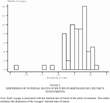
Because of navigational and commercial hazards, long-distance trade has often been viewed as a lottery-like business. Even if navigational hazards could be insured against, commercial uncertainty in Africa, the West Indies, and Europe could not. As a result, the profitability of individual voyages varied widely. The very high standard deviation of the “profit rates” in our data in the preceding section and in Figure 1, and the distribution of the internal rates of return in the Bertrand de Cœuvre's portfolio, as illustrated in Figure 2, confirm this.
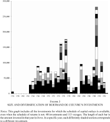
The practice of dividing investment into shares testifies of the diversification efforts of investors. Bertrand de Cœuvre's strategy of diversification, as shown in Figure 3, confirms this effort.
Diversification was only possible for a wealthy investor, as investment in long-distance trade was lumpy. The “minimal” investment in any long-distance trade venture was rather large, as small investments did not justify the fixed transaction costs, such as the administrative costs of providing evidence about the accounts.59
Meyer, Armement nantais, pp. 113–14. A debt arrangement would have entailed lower transaction costs than the usual equity-like arrangement, but the outfitters were mainly looking for investors ready to share part of the risk.
Bertrand de Cœuvre's smallest initial investment in a venture was worth 1,400
livres—more than five years of a soldier's pay—and his mean initial investment in a venture was worth nearly 21,000
livres.
60 A soldier's pay was 250 livres per year. Lavoisier uses this number to evaluate the annual consumption of an adult male: Lavoisier and Perrot, Richesse territoriale, p. 122. Bertrand de Cœuvre's median initial investment was worth 17,000 livres.
Yet, Bertrand de Cœuvre could invest in a mean of 4.2 voyages per nonwar year. By doing so, he reduced his risk of losing part of the capital he invested each year to less than 20 percent. Diversification also took place over time. To reduce the risk of losing part of its capital to less than 10 percent, Bertrand de Cœuvre needed to diversify into eight different investments; that represented two subsequent years of investments. To reduce this risk to less than 5 percent, he needed to diversify into 12 different investments; that represented three years of investments.
61 These results come from an application of a Monte-Carlo method to the 209 observations of “profit rates” in long-distance trade (excluding Bertrand de Cœuvre's own investment because we do not observe individual voyages' profits). For example, to compute the repartition of annual returns if annual investment is diversified into eight different voyages, we have studied the statistics linked to a built-to-purpose database of 1,000 means of eight different randomly picked observations from the total 209 observations available. This gives an approximation of the result that would be given by an explicit computation based on the estimation of the stochastic law of voyages' profits. It assumes the absence of correlation between returns.
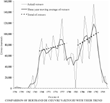
The result of this is shown in
Figure 4. His annual positive cash flows (or
retours), compared with their yearly trend from 1763 to 1778 and from 1784 to 1793, were much more regular that would be expected from the examination of the dispersion of the internal rates of return of individual investments.
Bertrand de Cœuvre was diversifying a large part of his private risk away. This diversification was possible for every investor as long as they were rich enough.
In contrast to private risk, market risk could not be diversified away. In the case of the long-distance trade sector, the events affecting the profitability of the whole sector were mainly linked to wars. It is common wisdom that the economic costs of wars were higher than their economic benefits, especially for consumers and producers of colonial goods. Yet it is easy to overestimate their negative effects on trade investors. James Riley, examining the effects of the Seven Years war, concludes: “Even in trade, the loss leader in war, old regime conflicts had comparatively mild short-term effects.”62
Riley, Seven Years War, p. 131.
Carrière, in his book on Marseilles traders, devotes a full chapter to explaining why war had an ambiguous effect on the prosperity of traders.
63 Carrière, Négociants marseillais, pp. 465–66.
To explore this issue, it is useful to distinguish between the effects of wars on past investments and their effects on potential new investments.
What was the effect of wars on existing capital? Some ships were captured, but that was largely covered by insurance.64
Even the 1755 peacetime Boscawen raid of French trade—probably the worst thing to ever happen to it before the Revolution—did not destroy the whole fleet: Villiers, Marine royale, p. 447.
Ships were left in ports. But ships represented a small share of capital. Commercial credit extended to the West Indies to help the sale of slaves or European products was much more important. The real effect of wars was that it was more difficult for planters to repay their debts as trade was interrupted. That could be mitigated when wars were forecasted, as it was possible to try to recover as much capital as possible during the prewar boom in activity and to use shortmaturity investments to avoid getting too much capital immobilized in the first place. Even when that was not possible, neutral trade, and even trade with the British (especially when the French Leeward Islands were occupied during the Seven Years War) gave planters some credit that could be sent back to France using to the international finance network.
65 On neutral trade during the War of American Independence, see Tarrade, Commerce colonial, p. 467. On trade with the British during the Seven Years War, see Pluchon, Histoire de la colonisation française, p. 238; and Villiers, Marine royale, p. 481. On the international finance network, see Villiers, ibid., p. 477.
Finally, wars were such a burden on
Ancien Régime state finances that no one expected them to last too long.
66 That was to change after the French Revolution.
When peace returned, the planters' debts could be repaid, probably even if France had ever lost its plantations colonies. War made traders' assets in the West Indies more difficult to recover; it did not destroy them.
Wars reduced the opportunities for new “peace-type” investments. The British Navy dominated the seas and made French trade hazardous. Trade activity in general, and slave trade in particular, declined dramatically.67
Villiers, “Les bases internationales,” pp. 178–79.
Insurance was more difficult as premiums increased and rationing set in.
68 Carrière, Négociants marseillais, pp. 537–39.
However, postwar periods were the occasion for speculative booms as traders tried to benefit from shortages in newly re-opened markets.
69 Pétré-Grenouilleau, Les négoces maritimes français, p. 117.
Prewar booms also occurred when planters and traders accumulated stocks as a precaution measure. The decline in trade during the Seven Years War was fully compensated by the increase in trade before and after the war.
70 Riley, Seven Years War, pp. 116–21.
This was a general pattern.
Furthermore, wars created new profit opportunities: privateering, the use of neutral ships, and convoy trade. Wars were times of heightened speculations and increased opportunities.71
Pétré-Grenouilleau, Les négoces maritimes français, p. 117. An example of a profitable war expedition: Villiers, Marine royale, p. 676.
The wars of Louis XIV were used by French traders to establish their first long-distance trade positions.
72 Villiers, Marine royale, p. 196; see also Lespagnol, Messieurs de Saint-Malo, p. 230 on the positive effects of Louis XIV's wars on Saint-Malo.
During the War of Austrian Succession and the War of American Independence, the French Navy was not completely outclassed by the British Navy. Privateering was profitable and French convoys systems were efficient. In addition, pseudo-neutral trade, i.e., with French money, was possible.
73 Villiers, Marine royale, p. 436; Villiers, Le commerce colonial et la guerre d'indépendance ; Villiers, Marine royale, pp. 667–86.
Even during the Seven Years War, certainly the one that had the worst effect on French trade, some activities were still carried on. Trade on neutral ships was made difficult by the modification of neutrality rules by the British, but did not disappear, especially as Spain kept its neutrality until 1761. Privateering might have absorbed as much as 15 percent or 20 percent of French peace trading investment in the Channel and the Atlantic—providing positive profits to Dunkerque and Bayonne, if not to the other harbors. Trade in salted beef between France and Ireland was still being conducted through the Dutch island of Saint-Eustache in 1758. Voyages mixing trading and privateering brought some profits to outfitters.
74 Villiers, “Les bases internationales” and Marine royale, pp. 375, 431, 473. 463, 466–68, and 476.
The available data on long-distance trade corroborate these theoretical arguments on the modest effect of war. More specifically, two pieces of evidence show that there was no systematic negative relationship between war and profitability. The first one is the fact that there is no systematic relationship between the mean internal rate of return of Bertrand's investments and wars, as Figure 5 shows. The second piece of evidence is the fact that the study of the other 209 observations of “profit” (Figure 1) leads to the surprising conclusion that mean “war” profits (as defined in the notes to Figure 1) were higher than mean “peace” profits, even if the data available are truncated at 150 percent.75
The difference is statistically significant if the data are not truncated, but not if they are truncated at 150 percent.
The effect of war on the business cycle was of the same order of magnitude as the effect of domestic crisis. In Bordeaux, the mean annual number of failures from 1715 to 1792 was 14.7. It was 21 during the Seven Years War and 29 during the War of American Independence. This is still slightly less than between 1715 and 1718, when there were 30 failures per year.
76 Butel, Négociants bordelais, pp. 110–15.
War changed the way trade investments were conducted, but it did not shut down all opportunities for profitable operations. Furthermore, thanks to the short duration and high liquidity of long-distance trade investments, it was possible to transfer one's capital to domestic ventures during wars. As such, war did not massively undermine the profits of long-distance trade investments. It represented only a limited market risk.
The crisis that followed 1789 in France and the West Indies was much more thorough than the eighteenth-century wars. The plantation system was deeply shaken by constitutional disagreements between France and its colonies, the revolt of free colored people before 1791, the slave revolt after 1791, the theoretical abolition of slavery in 1794, and the state of civil war in the West Indies.77
Pluchon, Histoire, pp. 771–1002.
In France, after 1792, the institutional framework was not favorable to trade. International traders were suspected of collaborating with foreign powers and conservative forces. The
assignats crisis disorganized regular economic activities. Finally, as British dominance of the sea was much more thorough than during the Seven Years War, war with Great Britain meant that long-distance trade was virtually completely interrupted for a whole generation. The French West Indies planters became virtually bankrupt and that precluded most recovery of funds from long-distance trade investment. The blockade of French trade created a 20-year period in which it was difficult for traders to replace traditional long-distance markets with new ones. Because many of the disruptive events were West Indies based, it was more difficult for French traders to react to them than it had been to react to the mainly European events of the
Ancien Régime wars. The limited wars that occurred before the French Revolution did not really undermine the profitability of French long-distance trade activities and investments. The demise of the French plantation and long-distance trade system that actually occurred after 1792 did really undermine the profitability of French long-distance trade activities and investment.
The private risk associated with long-distance trade ventures was not unusual; rentes had a similar risk. Private notarized credit was local, secured by collateral, and grounded on notaires' knowledge. However, notaires were not providing any formal guarantee and could be wrong; collateral was often illusory. It was impossible, for example, to know if it had already been mortgaged. Even if it had not, the actual recovery of collateral could only be accomplished through a costly legal action.78
Hoffman, Postel-Vinay, and Rosenthal, Priceless Markets, p.18
Moreover, this legal action was often unsuccessful. In particular, collateral provided by peasant borrowers was often illusory.
79 Fontaine, “Antonio and Shylock,” p. 44. She notices that this is confirmed by Boheler, Paysannerie de la plaine d'Alsace, pp. 1180–81.
Traditional private credit hence had high private risks.
80 For more on the issue of imperfect information and collateral problems: Postel-Vinay, La terre et l'argent pp. 103–27; and Hoffman, Postel-Vinay, and Rosenthal, “Information,” pp. 79–80, Priceless Markets, pp. 62–68.
But, as in the case of long-distance trade investment, diversification was possible to some extent. But as most lending was done through local networks, one could not get rid of local risk. The market risk was mainly limited to the risk of a generalized bankruptcy. That happened through monetary crises twice in the eighteenth century, once in the late 1710s and once in the 1790s.
81 On the 1710s, see Faure, La banqueroute de Law. On the 1790s, see Crouzet, La grande inflation.
During both periods, debtors would repay creditors in highly depreciated currency. There was a drop of 40 percent in the stock of notarized debt in Paris from 1718 to 1720. Nearly all pre-Revolution debts had been repaid by 1797—a large part of
rentes being repaid in spring and summer 1795, when the value of the currency was less than 20 percent of what it had been before the Revolution.
82 See Hoffman, Postel-Vinay, and Rosenthal, Priceless Markets, pp. 308–12 and 188–92.
Market risks on
rentes and on longdistance trade investment were comparable.
In contrast, there was no private risk associated with French state debt. Some assets were more risky than others, but their risks were strictly correlated.83
Velde and Weir, “Financial Market,” p. 19.
If the less risky state debt were struck by a bankruptcy, the more risky had been struck as well. However, the market risk was quite large. The state went bankrupt both during the late 1710s—during the Law affair—and during the Revolution. It also went through two partial bankruptcies in 1759 and 1770. Comparison of French, British, and Dutch public debt makes it clear that the rate of interest on French state debt included a risk premium. Even if the risk of crisis—under the guise of partial bankruptcies and wars—was equal for French state debt and long-distance trade investment, the effect of state bankruptcy on French state debt investment was much more severe than the effect of war on long-distance trade investment. Loss of capital was a real possibility when lending to the French state. Before the demise of the French colonial system, it was very much less likely when investing in long-distance trade. The market risk associated with the French state debt was larger than the market risk associated with long-distance trade investments.
As a result, a diversified long-distance trade portfolio was less risky than a government bond portfolio. The risk associated with a diversified longdistance trade portfolio was similar to the risk associated with a private lending portfolio.
Table 4 sums up our comparison of different investments available to passive investors in eighteenth-century France.
For every characteristic, long-distance trade investment was equivalent or better than domestic alternatives. Hence, without providing investors with “fabulous” returns, long-distance trade investment was more attractive than domestic alternatives. It was more liquid, shorter, and more profitable than private notarized credit without being more risky. It was less risky and had a shorter duration than government bonds, without being less liquid or less profitable.