

Introduction
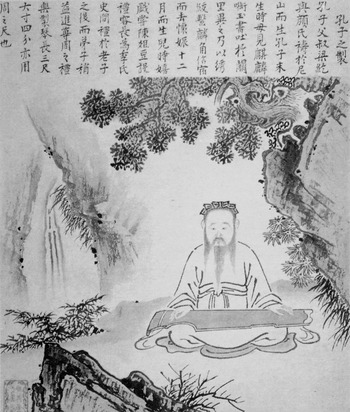
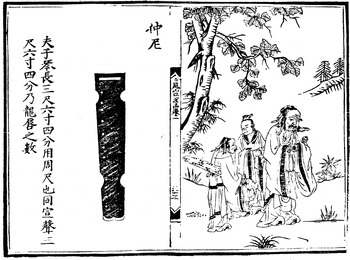
Redolent of the scholar, the aristocrat, and the literatus, the qin 琴 has a deep and distinguished lineage within the pantheon of Chinese musical instruments. Throughout its long history, a complex ideology has evolved around it, and it has become a cultural symbol of the Chinese literati;Footnote 1 for example, Confucius (551–479 b.c.e.) himself was said to have been an eminent qin player, and Figure 1 is a Chinese painting ascribed to the Song dynasty (960–1279 c.e.) that depicts him playing the instrument.Footnote 2 A more exact representation of the shape of this instrument is shown here in Figure 2, which is a woodcut from a Ming dynasty (1368–1644 c.e.) theoretical treatise on a qin playing Fengxuan xuanpin 風宣玄品 (Profound Airs Spread by the Wind); a portion of the text accompanying the picture reads: “Confucius' qin was, in length: three feet, six inches, and four ‘milli-inches’, using the system of measures employed by the Zhou dynasty (c. 1046–256 b.c.e.) …”, which gives the modern scholar an indication of the exactness of manufacture that qin craftsmanship had attained.Footnote 3
Confucius playing the qin. Taken from: Manual of Qin Styles in the Past Dynasties, album leaf paintings ascribed to the Song dynasty; Length: 37.6 cm, width: 27.2 cm; formerly in the collection of the Manchu court, now in the National Palace Museum, Taipei. After: Guoli Gugong bowuyuan bianji weiyuanhui, ed., Gugong shuhua tulu, vol. 22, 108.

The shape of Confucius' qin. Taken from: Profound Airs Spread by the Wind, Library of Chinese Academy of Arts, Beijing. After: Wenhuabu wenxue yishu yanjiuyuan yinyue yanjiusuo and Beijing guqin yanjiuhui, eds., Qinqu jicheng, vol. 2, 24.

Nevertheless, very little was known about the morphology of the qin in the age of Confucius until the excavation, in 1978, of the tomb of Marquis Yi 乙 in Suizhou 隨州, Hubei province.Footnote 4 This site, dated 433 b.c.e., preserves an ancient ten-stringed qin that has a significantly different silhouette to that of the classical qin depicted in Figures 1 and 2. Since then, studies of three other ancient recently excavated qin dated from the mid- to the late Warring States period (475–221 b.c.e.) have also been published.Footnote 5 Amongst these, the most recently discovered is the highly decorated qin found in 2002 in a fourth-century b.c.e. tomb in Jiuliandun 九連墩, Zaoyang 棗陽 city, Hubei province. Surprisingly, no archaeological report of this remarkable artifact has yet been published, and the only authoritative information available so far is a five-page “Brief Report” which appeared in the Chinese journal Kaogu 考古 in 2003.Footnote 6 This article, however, provides us only with a list of the excavated musical instruments, including the qin and a se 瑟,Footnote 7 and does not give any further details about the qin. With generous support of the Hubei Provincial Museum, where all the finds from the Jiuliandun site are deposited, I examined the qin excavated from the Jiuliandun tombs at the Museum in the summer of 2012, and prepared line drawings of it based on my photographs taken at the time. This article, starting with a brief introduction to the archaeological background of the Jiuliandun site, will then concentrate on exploring the relief carvings and lacquered drawings found on the instrument itself and their symbolic significance as a representation of the worldview and philosophical state of mind of the Warring States period, a discussion only made possible by employing the line drawings I prepared.
Jiuliandun Tomb No. 1
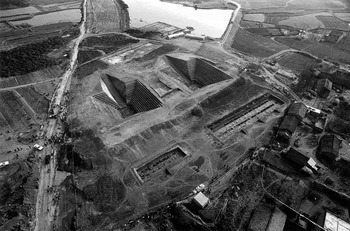
Jiuliandun tomb nos. 1 and 2 are located in the west of the villages of Dongzhaohu 東趙湖 and Wujin 烏金 of Zaoyang city, Hubei province, where the planned Xiaogan 孝感–Xiangfan 襄樊 national expressway was going to pass through. From September 2002 to January 2003, in order to facilitate the construction of this road, a comprehensive excavation of them was carried out by the Hubei Provincial Archaeological Research Institute (Figure 3).Footnote 8 Both are large in size and rectangular in design, with a ramp leading to the burial chamber, the ramps themselves flanked on both sides by stairs of fourteen steps;Footnote 9 both contain two outer coffins which enclose two further inner coffins. An accompanying horse-and-chariot burial pit is situated on the western side of each tomb. Examination of the occupants' skeletons and studies of Chu 楚 funeral customs indicate that the two tombs belonged respectively to a high official of the Chu kingdom and his wife.Footnote 10 The occupant of tomb 1 is male and died approximately 310 b.c.e.; his consort, the occupant of tomb 2, was buried about one decade later.Footnote 11
Bird's eye views of tombs 1 and 2, Jiuliandun, Hubei province. The highly decorated qin discussed here was excavated from tomb 1, i.e., the one on the right of this picture, and furnished with the longer horse-and-chariot burial pit situated in front of it. After: Shenzhen bowuguan ed., Jianwu Chu tian: Hubei chutu Chu wenwu zhan, 14.

Tomb 1 is the slightly larger, with the pit measuring 38.1 m by 34.8 m at its top and 8.0 m by 6.8 m at its bottom. The space within the first outer coffin was divided into five compartments: two sides (i.e., the north and the south chambers), one head (east chamber), one foot (west chamber) for burial objects, and one central chamber for the second outer coffin, and inside it the double inner coffins. The highly decorated ten-stringed qin was excavated from this tomb and found in the west chamber of the first outer coffin.Footnote 12
The Qin and Its Symbolism
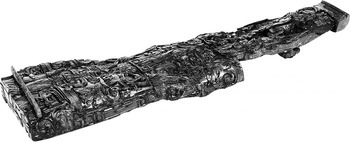
The qin's total length is 72.0 cm (Figure 4) and, in shape, it separates visibly into two parts: a broad hollow sound-box (43.7 cm) on the player's right, and a solid “tail” on the left (28.3 cm). Sadly, no bottom plate and tuning pin have been preserved, neither have the strings, but the number of string holes located next to the bridge on the player's right indicates that there were originally ten strings.Footnote 13
The highly decorated ten-stringed qin excavated from tomb 1, Jiuliandun, Hubei province. Length: 72 cm; width (on the player's right): 18 cm; tail width (on the player's left): 8.2 cm. Hubei Provincial Museum, Wuhan. After: Hubei sheng bowuguan, ed., Jiuliandun: Changjiang zhongyou de Chu guo guizu damu, 89.

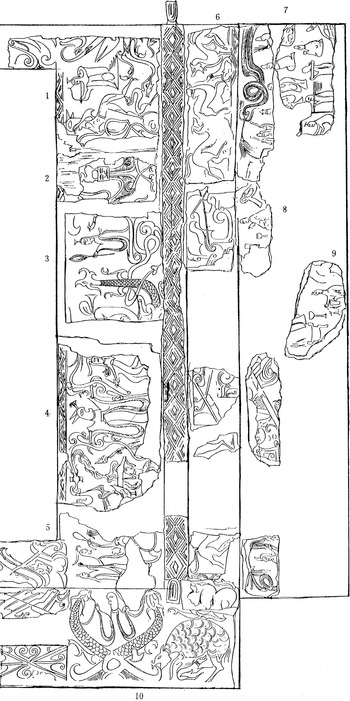
The qin is furnished with extensive carved relief and lacquered decorations. Its surface is adorned entirely with juxtaposed and intricately intertwined motifs of taotie 饕餮, dragons, phoenixes, snakes, and lizards. These motifs, in high relief, are arranged in an extremely systematic way, and, as a result, the Jiuliandun qin is thus divided by its decorations into five registers, and its overall design concept exhibits a strong architectonic tendency. After examining it at the Hubei Provincial Museum, I prepared line drawings of all these decorations, and the different combinations of motifs in the five registers are very revealing. The first three registers comprise the hollow sound-box, the fourth is the join between the sound-box and the “tail,” and the fifth is the “tail” itself. Roughly an hourglass in shape, the narrowest width (“waist”) of the first three registers is approximately 14.8 cm at the boundary between registers two and three, whereas, by contrast, the width of the far right side of the instrument measures 18.0 cm, and that at the end of the third register 19.0 cm.
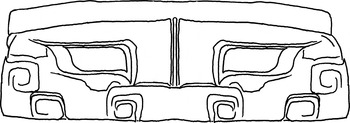
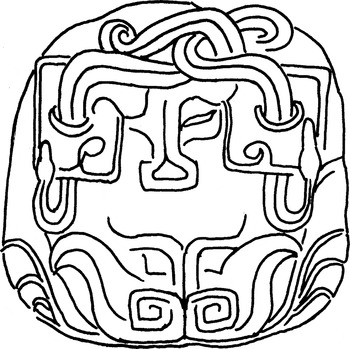
The first register on the player's far right-hand side consists of one taotie motif (Figure 5) and two lizards carved in high relief (Figure 6). The bilaterally symmetrical zoomorphic face known as taotie faces the viewer directly, is equipped with a pair of huge raised eyes and, like many other ornaments decorated with the same motif, lacks the lower jaw area. The taotie design is typically found on Chinese ritual bronze vessels of the Bronze Age,Footnote 14 and Jessica Rawson plausibly suggests: “taotie and ritual vessels were closely associated in the minds of the users,”Footnote 15 but this design is rarely found on surviving lacquered wooden musical instruments of the period: the only other examples are on se zithers excavated from the tomb of marquis Yi. On these, two taotie motifs (Figure 7), a large one opening its mouth and a small one located between the ears and eyes of the larger one, can be found on the right end of each se.
The taotie motif in the forehead of the first register of the Jiuliandun qin. Drawing by the author.

The first and second registers of the Jiuliandun qin. Drawing by the author.

Two carved lacquered wooden taotie on the se excavated from the tomb of Marquis Yi of Zeng, Suizhou, Hubei province. After: Jenny F. So, ed., Music in the Age of Confucius, 69.

The second register of the Jiuliandun qin is dominated by two ox-head-shaped motifs, presumably representing two imaginary dragons (Figure 6). In addition, located at the mouths and gripped by the talons of the two dragons, we find four snakes, which seem to be trying to wriggle away from the dragons that are about to swallow them. The overall iconographic themes of the first two registers are connected by two kinds of animal motifs: (1) the lizard motifs, which pass through the belt-shaped boundary in between the registers; and (2) the body of one of the snake motifs which is being bitten in half by the lower of the two ox-head-shaped dragon motifs.
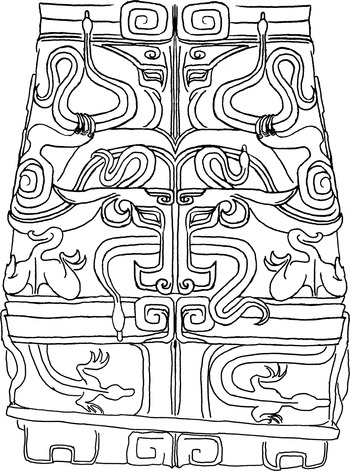
The decoration of the third register is made up of motifs of phoenixes, snakes, and the highly abstract representation of a phoenix tail (Figure 8). Just as dragon themes dominate the second register, here, the phoenix is most prominent, which recalls late medieval Chinese nomenclature of the two sound-holes on the verso of the classical qin, namely, the longchi 龍池 (dragon pool), and fengzhao 鳳沼 (phoenix pond),Footnote 16 plausibly a terminology which is itself a fleeting memory of the late Bronze Age, though visual representation of dragons or phoenixes are last found on instruments made in the high Tang dynasty (618–907).Footnote 17 On this ancient qin, a clear iconographic division between the two sections of the sound-box is to be observed: the first and second registers are dominated by the dragon motifs, the third register by phoenix designs. These two sections (i.e., from the second to the third registers) are connected by the two tensely twisted snakes caught in the dragon's claws of the second register (Figures 8 and 6).
The third register of the Jiuliandun qin. Drawing by the author.

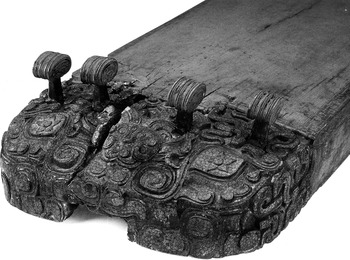
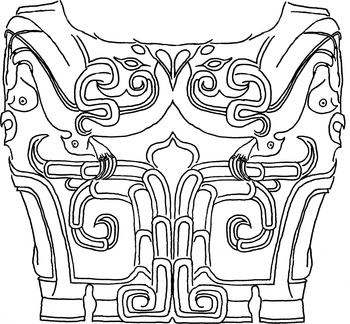
Register four serves as the join between registers three and five (Figure 9), and is round in shape. Owing to deformation caused during dehydration processes applied during restoration subsequent to excavation, the design of the high relief in this register is not completely recognizable, but undoubtedly combines the basic motifs which occur in registers two, three, and five, i.e., ox-head-shaped, phoenix, and snake motifs.
The fourth register of the Jiuliandun qin. Drawing by the author.

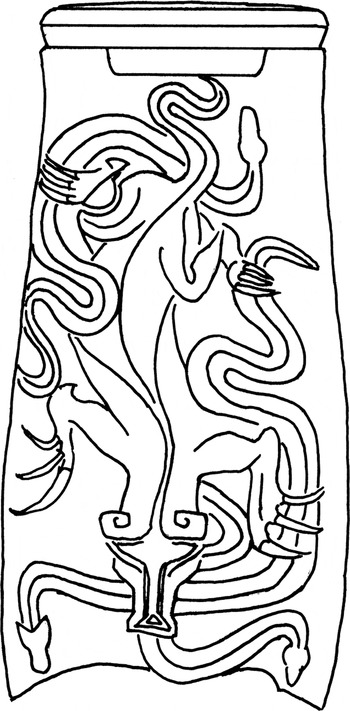
The fifth register covers the surface of the protruding solid tail on the player's left (Figure 10). Narrower than the sound-box, the width at the end of the tail measures only 8.2 cm. Its decoration consists of one complete flying dragon motif and some snake motifs. The dragon has four three-clawed feet and an ox-shaped head, which is similar to those that appear in the second register, thus underpinning the identification of these head motifs as representations of dragons, and, moreover, three snakes are transfixed in the claws of this flying beast.
The fifth register of the Jiuliandun qin. Drawing by the author.

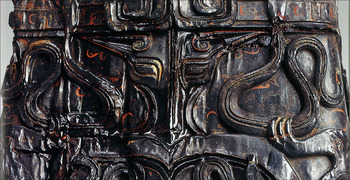
The entire instrument is covered with lacquer, principally black and red, with some other colors in addition. On the top surface of the instrument, over the black grounding, red lacquer has been applied to pick out and delineate subtle geometric patterns, lines, and dots. For particular highlights of the carved relief, such as the dragons' eyes and feet, gold is employed. During and after the dehydration process had been applied, the colour of this gold deteriorated and is now only faintly visible, but photographs taken directly after excavation record the dazzling splendor of this fabulous musical instrument of the fourth century b.c.e. (Figure 11).
Detail of the relief carvings and lacquered drawings on the surface board of the Jiuliandun qin. After: Shenzhen bowuguan ed., Jianwu Chu tian: Hubei chutu Chu wenwu zhan, 95.

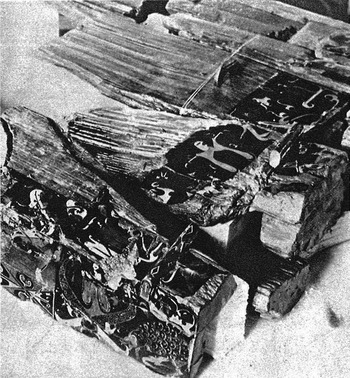
Even more strikingly, the two edges on either side of the instrument, which are not carved with relief designs, are painted instead with figurative motifs (Figures 12a and 12b), but these images are now dark brown, though, on excavation, they were much brighter. Figures 13a and 13b are line drawings of all these depictions, based on the barely discernible lacquered drawings shown in my photograph. Drawings on lacquered wooden musical instruments are only found elsewhere on a se zither excavated from a fourth-century b.c.e. tomb in Changtaiguan 長台關, Xinyang 信陽, He'nan Province,Footnote 18 but these portray humanoid shaman images in ritualistic postures (Figures 14–16),Footnote 19 whereas the figurative motifs on the Jiuliandun qin are bona fide representations of the daily life of the Chu people:Footnote 20 they illustrate rural scenes, such as farming, riding, picking mulberry leaves, and galloping horses pulling carriages.
Detail of the lacquered drawings on the inner (player's) side of the Jiuliandun qin. Photography by the author.

Detail of the lacquered drawings on the outer side of the Jiuliandun qin. Photography by the author.

Line drawings of the figurative motifs on the inner (player's) side of the Jiuliandun qin. Drawing by the author.

Line drawings of the figurative motifs on the outer side of the Jiuliandun qin. Drawing by the author.

The lacquered drawings on the forehead of the painted se excavated from tomb 1, Xinyang, He'nan province. After: He'nan wenwu yanjiusuo, Xinyang Chu mu, plate XV.

Line drawings of the ten figurative motifs on the forehead of the Xinyang se. Adapted after: Xinyang Chu mu, 30.

Details of the motifs 1, 3, and 4 on the Xinyang se. After: Xinyang Chu mu, plates XVI and XVII.

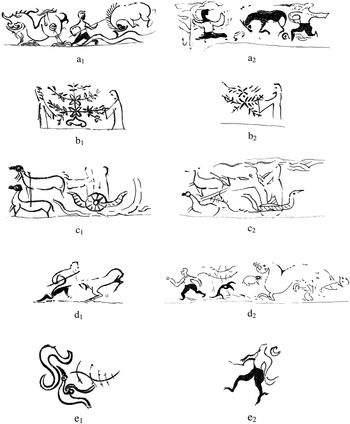
Five different figurative motifs can be tentatively identified from the lacquered drawings on each edge of the fifth register, and detailed comparison of these reveals a carefully crafted isomorphic relation between the sequences of motifs on both sides (Figure 17).
Line drawings corresponding motifs taken from the inner and outer sides of the Jiuliandun qin. Drawing by the author.

The first motif on either side depicts farming: on the player's side of the two edges (Figure 17: a1), the scene comprises two beasts and one farmer. The animal in front of the farmer, probably a bull, is turning over the earth with a plough, whilst the animal behind him, maybe a horse, is pushing the plough with its head. The farmer, looking backwards, is beating the horse with a stick. The contorted bodies of the farmer and the two animals, the curled tail of the bull, the erect horsehair, and the long stick in the hands of the farmer all suggest the Chu people's arduous efforts made at the outset of the agricultural year. By contrast, the first scene on the far side of the player consists of two farmers and one animal (Figure 17: a2), perhaps a donkey, which seems to be completely exhausted, however, the extended arms and the dancing feet of the two farmers indicate that this scene might depict the more cheerful scene of a plentiful and successful harvest.
On the inside edge, the second motif consists of two individuals dressed in plain robes on either side of a tree, which they seem to be holding (Figure 17: b1). The artist places emphasis on the roots of the tree, which indicates that this scene might represent the planting of a sapling. The corresponding section on the outside edge (Figure 17: b2), however, consists only of one person dressed in a plain robe holding the branches, now more luxuriant, and is, perhaps, a scene depicting mulberry leaf picking. The third section on both sides depicts two people in plain robes riding a two-horse chariot, but the difference between the treatment of this theme on either side rests with its geographical context: on the inside edge (Figure 17: c1), a river has been painted underneath the carriage, whilst on the outside edge (Figure 17: c2), a mountain-shaped landscape has been sketched on the top of the edge.
A thrilling scene of camel wrestling can be found in the fourth section of the drawings on the inside edge (Figure 17: d1): a wild animal is butting a man, its hind legs rearing off the ground. With a long stick in his hand, the man courageously confronts the animal and appears to be fighting back. Whether to interpret this scene as one of domestication or hunting will, after all, depend on our understanding of the corresponding section on the other side (Figure 17: d2). Here, a person appears to be running away with a group of animals located behind him. Analyzed as someone trying to flee from dangerous wild animals, then, by extending the “cause and effect” symbolism we have discovered so far, the drawing on the opposite side could be regarded as representing a hunting scene. Further scrutiny of this barely discernible lacquered drawing reveals, nonetheless, that this is not the portrayal of a fortuitous escape, as, right in front of the large animal, there is a much smaller one facing the larger animal, thus suggesting a more intimate relationship between them: a more powerful explanation might be that this scene represents the breeding of an animal as a result of a successful domestication. The person running is, then, not a hunter, but instead a joyful master of animal husbandry who is scampering away, delighted to share with others the good news.
In the fifth section of the drawings, on the inside edge (Figure 17: e1), the motif represents a mythical, heavenly creature, presumably a phoenix, whilst that of the outside edge (Figure 17: e2) depicts a human being, reminiscent in gait, gesture, and possibly clothing of the farmers portrayed in the first section and discussed above.
Lastly, it is noteworthy that not only the exterior, but also the interior of the Jiuliandun qin, which was scooped out of the inside of the surface board, has also been completely lacquered. Looking through the sound-hole, the pattern of the lacquered decorations on the inside is comparable to the abstract geometric patterns, lines, and dots that appear on the surface.
Conclusion
As a highly decorated specimen, the Jiuliandun qin stands in stark contrast to the well-known undecorated, black-lacquered qin excavated twenty-five years earlier from the tomb of marquis Yi (Figure 18). Unlike the qin found at Jiuliandun, the plain surface of marquis Yi's instrument is only adorned with simple incised lines. In 2000, when musical archaeologists prepared the exhibition catalogue Music in the Age of Confucius for the Freer Gallery of Art, the meaning of these incised lines was still unclear. Therefore, after ruling out one possible explanation by stating “they are unlikely to mark positions where strings were touched,” the authors of the catalogue had to admit that these incised lines are “not encountered consistently on the other ancient examples,” and, as a consequence, left the issue unresolved.Footnote 21 Now, in the new light of the highly decorated Jiuliandun qin, the function of these incised lines becomes immediately comprehensible: they are simply indicators of the boundaries of the five registers of the ancient qin. Marquis Yi's qin can be reliably dated to 433 b.c.e., whilst the Jiuliandun qin was made in around 310 b.c.e.; although at least one hundred and twenty years divide the manufacture of these two ancient instruments, in respect of their most crucial architectonic feature, that is, the division of the length of the qin into five registers, they are in a high degree of agreement with each other. Even more importantly, this practice of qin craftsmanship differs tremendously from that of medieval China. Returning to the first image of the fifth-century b.c.e. Chinese philosopher Confucius playing a classical qin (Figure 1), newly informed by the qin found at Jiuliandun, we learn that a qin contemporaneous to Confucius and played by him looks distinctly different from the version produced by the fertile imagination of the medieval Chinese.Footnote 22 Instead, we now know that it consisted of a sound-box and a solid tail, and that it was divided into five registers: it is this segmented subdivision which defines the ancient qin and differentiates it fundamentally from its classical counterpart. We also know that the symbolic depictions in which it was clad represent not only the mystical beasts and fertile imagination of the aristocracy, but also include portrayal of the more menial tasks of the ordinary Chu farmer and herdsman as he proceeds through the cycle of the agricultural year.
Line drawings of the ten-stringed qin from the tomb of Marquis Yi of Zeng, Cuizhou, Hubei province (above), and the highly decorated ten-stringed qin excavated from tomb 1, Jiuliandun, Hubei province (below). Drawing by the author.