Major political protests have taken place in nearly every corner of the globe in the last decade, including in Tunisia, Egypt, Libya, Venezuela, the United States, the United Kingdom, Greece, Spain, Turkey, South Africa, Argentina, Ukraine, Thailand and most recently in South Sudan, Hong Kong, France, Peru, Honduras and Brazil. Taking a longer view, the incidence of political protest appears to be very much on the rise: ‘the systematic cross-national survey evidence that is available confirms that a significant long-term rise in protest politics has indeed occurred . . . .[T]he proportion of citizens engaged in protest politics has risen, and risen dramatically’ (Norris Reference Norris2002, 197). The emergence of anti-protest laws after anti-austerity protests in Canada, the United States and Spain (among others) supports the existence of such a trend.Footnote 1 There is substantial evidence that these political protests have real consequences for governments and citizens alike: ‘protests can build political movements that ultimately affect policymaking, and. . .they do so by influencing political views’ (Madestam et al. Reference Madestam2013, 1,633; see also Collins and Margo Reference Collins and Margo2007; Finkel and Muller Reference Finkel and Muller1998; Lohmann Reference Lohmann1993).
It is tempting to suggest that the rising incidence of political protest is rooted in growing levels of citizen grievance. After all, at the individual and group levels, protest and upheaval have long been linked to resentment and frustration (Gurr Reference Gurr1970). Recent studies show that dissatisfaction with the performance of democracy is quite common (Pew Research Center 2019). Yet, much of the country-level literature on protest finds that grievances in and of themselves seldom explain the emergence of protest activity (Kerbo Reference Kerbo1982; Kitschelt Reference Kitschelt1986; McCarthy and Zald Reference McCarthy and Zald1977; Snyder and Tilly Reference Snyder and Tilly1972, 520; Webb et al. Reference Webb1983; see also Skocpol Reference Skocpol1979). We argue below that this seeming paradox is the result of an oversimplification in generalizing traditional models of group grievance to a societal level.
For example, France has been wracked by a series of ‘yellow vest’ anti-government protests. These disturbances reflect ‘profound forms of inequality: between urban and rural communities; full-time employees and temporary workers; graduates of prestigious universities and the plebeian masses. And not least, they reflect inequalities between retirees, who maintain the divine right of pensions, and younger people excluded from social welfare programs’.Footnote 2 Yet France was only one of three countries in which satisfaction with democracy increased from 2017 to 2018, by 15 percentage points.Footnote 3 In other words, despite a general increase in satisfaction with democracy, disparate gains across French society have led to a variety of demographic cleavages – and, eventually, protests. Is this experience indicative of a more widespread phenomenon whereby disparities in citizens' judgments about the performance of government programs to enhance their well-being engender protest, rather than the general sentiment in the populace?
This study examines the relationships between grievance, polarization and nonviolent political protest in democratic and semi-democratic systems. We define grievance as the mean level of dissatisfaction, at the country level, with how well a government is providing opportunities for its citizens to advance their well-being. We use the term ‘polarization’ to indicate the polarization of citizens' grievance judgments, or the extent to which a country's citizens disagree with each other that their government is providing opportunities to advance their well-being. In a country where some citizens are aggrieved and others are not, the population will be polarized. Finally, ours is a study of nonviolent political protest in democracies.Footnote 4 Stephan and Chenoweth (Reference Stephan and Chenoweth2008, 9) define nonviolent protest as ‘a civilian-based method used to wage conflict through social, psychological, economic, and political means without the threat or use of violence’. We anticipate that the dynamic linking grievance, polarization and protest in authoritarian states could operate very differently, and thus do not include these countries in our analysis (Haggard and Kaufman Reference Haggard and Kaufman2012; Kaufman Reference Kaufman2009; Roberts Reference Roberts2002). We discuss this point more below.
Theoretically, we elaborate and extend Gurr's model of relative deprivation from the group to the societal level. Doing so reveals that we should expect political protest to be rooted in the polarization of citizens' grievance judgments within countries, rather than tied to the mean level of societal grievance. Then, using data from twelve separate cross-national survey projects, we develop new measures of grievance and polarization that are comparable across countries. We then examine the effect of grievance, polarization and their joint effect on political protest in eighty-four countries from 1977 to 2010. Our analyses yield two novel conclusions. First, countries with polarized citizens are more likely to experience nonviolent protest. Secondly, protests are most likely in countries where the average level of citizen grievance is rather low, but citizens are polarized.
These findings have important implications. For example, they add to a growing literature that takes a more nuanced look, theoretically and empirically, at the role of grievances across different groups and under varying contexts (Kurer et al. Reference Kurer2019). Where prior studies have yielded mixed results on the link between grievance and protest, our findings suggest that another factor – polarization – may be key.
Background
According to grievance theory (for example, Gurr Reference Gurr1970), mass protest results from an individual's sense of ‘relative deprivation’, or a disjuncture between their perceived opportunity to advance their well-being relative to their expectations. Gurr (Reference Gurr1970, 24) defines relative deprivation as ‘actors' perceptions of discrepancy between their value expectations and their value capabilities’.Footnote 5 It is an affective perception of injustice and/or dissatisfaction that has been linked to collective action (Van Zomeren, Spears and Leach Reference Van Zomeren, Spears and Leach2008).
One of the primary sources of the gap between expectations and capabilities, according to Gurr, is observing advancement by others in society (so-called reference groups), which leads to heightened expectations among observers that are not always met with similarly rising opportunities. The importance of a reference group has been explored extensively in the political psychology and social psychology literatures on collective action. These studies suggest that the existence of a reference group to which disaffected individuals can compare themselves is important for collective action to develop (Crosby Reference Crosby1976; Davis Reference Davis1959; Gurin, Miller and Gurin Reference Gurin, Miller and Gurin1980). For instance, Crosby (Reference Crosby1982) studies gender discrimination in the workplace and found that when women became aware of salary disparities along gender lines, they used ‘male workers’ as a reference group, resulting in an increased sense of relative deprivation among women. Similarly, Cross and Vandiver (Reference Cross, Vandiver, Ponterotto, Casas, Suzuki and Alexander2001) highlight the role of a reference group in their examination of the Black Consciousness Movement.Footnote 6
In an effort to test Gurr's theory that protest is rooted in grievance, a number of scholars have examined, at the country level, the relationship between protest and various subjective measures of grievance, expressed in the language of life satisfaction, satisfaction with the performance of the political system or current government, and sociotropic and egotropic evaluations of the economy (Anderson and Mendes Reference Anderson and Mendes2006; Booth and Seligson Reference Booth and Seligson2009; Dalton, Van Sickle and Weldon Reference Dalton, Van Sickle and Weldon2009). The results of these investigations are decidedly mixed. One set of studies finds that a greater sense of grievance decreases citizens' interest in politics and their willingness to participate in conventional forms of political activism (for example, voting), but at the same time increases the likelihood of more protest activity (Booth and Seligson Reference Booth and Seligson2009; Dalton Reference Dalton2004, ch. 8; Norris Reference Norris2011, ch. 11). However, much of the country-level literature on protest finds that grievances in and of themselves seldom explain the emergence of protest activity (Kerbo Reference Kerbo1982; Kitschelt Reference Kitschelt1986; McCarthy and Zald Reference McCarthy and Zald1977; Snyder and Tilly Reference Snyder and Tilly1972, 520; Webb et al. Reference Webb1983; see also Skocpol Reference Skocpol1979).
Importantly, virtually all these empirical studies focus on the mean or median societal constituent (but see Reenock, Bernhard and Sobek Reference Reenock, Bernhard and Sobek2007), which may explain their disparate outcomes.Footnote 7 That is, these studies extend, or scale up, Gurr's claim that grievance explains individual or group protest behavior to a claim that societal-level grievance explains the incidence of political protest. In so doing, we contend they posit an empirical implication that is not entirely consistent with Gurr's model.
Because individuals' capabilities and expectations often co-vary with their demographic characteristics (such as income, race/ethnicity or religious affiliation), Gurr's theory is often expressed as a theory of group behavior (see also Van Zomeren, Spears and Leach Reference Van Zomeren, Spears and Leach2008). Importantly, however, his is not a theory of societal behavior, or how entire countries will behave. Because societies consist of groups, though, Gurr's theory can be elaborated to the country level. Doing so adds complexity to the theory due to the dynamic interaction of societal subgroups.
For instance, extant studies focusing on the mean level of societal grievance would expect that where a society consists of two equally sized groups expressing the same ex ante level of relative deprivation (RD), an increase in RD for one group coupled by a decrease in RD for the other should result in no change in the likelihood of protest (because the mean RD is unchanged). Gurr's theory stresses that perceptions of group RD are often rooted in the perceived upward mobility of other groups in society. So, it is not the shared experience of RD across groups that produces protest, but rather the disparate experiences of groups that is key. Group divergence in RD should therefore lead to protest even where the societal mean is unchanged.
Some scholars have begun to shift their focus from comparing the experience of the average citizen across democratic systems to comparing the varying experiences of citizens within a single political system (for example, Adams and Ezrow Reference Adams and Ezrow2009). These studies seek to disaggregate the public, asking whether within countries some citizens better evaluate the political system than others, or whether judgments are polarized. To date, though, these studies of citizen polarization have not been truly comparative across countries. Most comparative studies are single-country case studies or include a small number of countries (Adams and Ezrow Reference Adams and Ezrow2009; Ezrow Reference Ezrow2010).Footnote 8 This is not surprising, because it is very difficult to compare polarization in multiple countries in an encompassing manner. This is our aim.
Theory
Our theoretical contribution is an elaboration and extension of Gurr's work on the determinants of citizen protest. Our reading of Gurr is that as grievances in one segment of a society rise, they are often falling in another segment. This is the case because rising grievances are often associated with the perceived value gains of a reference group – gains that are not shared by the aggrieved group. Perceived reference group gains increase the expectations of those who observe these gains, and increase observers’ grievances when these expectations are not met.
Importantly, within the reference group itself the value gains perceived by others may generally lead to a reduced sense of grievance as the gap between the reference group's expectations and its value capabilities narrows. This is true as long as the value gains perceived by the aggrieved group also are perceived by the reference group itself. This is true even if the reference group's value gains are accompanied by upping its expectations, a common occurrence, so long as expectations rise slower than the group's perception of its value gains. In sum, under Gurr's conceptualization, it is reasonable to infer that grievances may generally be falling among the members of reference groups. Thus, considering the dynamics of relative deprivation across groups, Gurr's theory contains a tradeoff that has been underappreciated. Perceptions of grievance in a society are linked phenomena: a rising sense of grievance in one group is often a consequence of a falling sense of grievance in another.
Thus according to Gurr's (elaborated) theory we should observe increasing protest as the variance in grievance judgments in a society grows. The key predictor of protest is the polarization of grievance – when some groups in society are particularly aggrieved while others are quite satisfied with how democratic processes have impacted their lives.Footnote 9 Our first expectation is therefore that protest increases with polarization, which we define as variance in grievance judgments. Generally, we expect that polarized systems will experience more protest.Footnote 10
However, mean grievance does play a role. Next, we elaborate a series of expectations regarding the moderating effect of grievance on polarization's relationship to political protest, together with illustrative cases. Figure 1 portrays four ideal type distributions relating mean levels of grievance to polarization – what we call Inclusive, Predominant, Oligarchic and Exclusionary systems. In the figure, two pairs of distributions share a very similar mean, but have very different distributions.
Distribution of grievance: empirical examples of ideal types

Norway in 1997 perhaps best approaches the inclusive ideal type distribution, since in that year Norwegians were overwhelmingly satisfied with democratic performance: fewer than 10 per cent of respondents expressed dissatisfaction (that is, grievance). In countries with inclusive distributions of grievance, there is a low average level of grievance and only small differences in such evaluations across groups in society; hence, low levels of polarization. Applying Gurr's logic of relative deprivation, most individuals in inclusive systems are similarly satisfied. They are likely to lack a stark, better-off ‘reference group’ to which individuals can compare their current situation. For example, Karl (Reference Karl2000) suggests that Uruguay and Costa RicaFootnote 11 are relatively stable because they have fairly equal economic and political opportunities. In inclusive contexts we do not expect protest to emerge often.
While the average level of grievance was essentially equal for both Norway in 1997 and Ghana in 2008, there is significantly greater disagreement in the latter; over half of all respondents reported they were ‘very satisfied’ in Ghana, while over 15 per cent expressed dissatisfaction with the working of democracy (see Figure 1). As a consequence, Ghana in 2008 perhaps best represents a predominant distribution. In countries with predominant distributions, there may be similarly low levels of grievance on average, but much more pronounced differences in evaluations across groups in society, or high levels of polarization. In these countries, most citizens feel well served by the political system, but a minority does not. Compared to an inclusive system, the modal constituent in a predominant system actually has a lower level of grievance. However, a significant share of the society is aggrieved. For this aggrieved group there is no shortage of potential reference groups because most of the society is better off. And these reference groups' grievance judgments are likely to be starkly different than those of the aggrieved group. Thus we expect a higher level of political protest in predominant than in inclusive systems.Footnote 12
While average grievance levels are equally high in the cases of Georgia in 1994 and Moldova in 1996, there is much greater polarization in opinions in the former than in the latter (again refer to Figure 1). A sizeable minority of Georgians (20 per cent) were satisfied or very satisfied with democratic performance, while 55 per cent were very unsatisfied, indicating an oligarchic distribution. In oligarchic distributions, there is a high average level of grievance and significant differences in grievances across societal groups, or high polarization. In these countries, the vast majority of citizens are dissatisfied with the functioning of the political system, but a small minority feels well served by it. Compared to exclusive systems, (see below), the modal constituent in an oligarchic system has a higher level of grievance and there is a greater sense of relative deprivation due to the disparity of grievance judgments across the society. Because most of the citizenry feels disaffected and there is a better-off reference group to which they can compare their situation, we expect there to be a higher level of protest than in an exclusionary system.
There was significantly more accord among Moldovans in 1996, as over two-thirds said they were unsatisfied, and less than 7 per cent expressed satisfaction. In countries with such exclusionary distributions, average grievance is high and only small differences in such evaluations occur across groups in society; thus polarization is low. As in inclusive systems, in exclusionary systems potential reference groups are similarly situated to potentially aggrieved groups, blunting the emergence of strong grievances. As Gurr (Reference Gurr1970, 24) explains (quoting Runciman) ‘if people have no reason to expect or hope for more than they can achieve, they will be less discontented with what they have, or even grateful simply to be able to hold on to it’ (see also Houle Reference Houle2009). In societies where average levels of grievance are high, and polarization is low, we do not expect protest to emerge often.
As between predominant and oligarchic systems, we expect higher levels of protest in predominant systems. In predominant systems there is no shortage of potential reference groups because most of the society has become better off while a small group has been left behind; in oligarchic systems, only a small segment of society is not aggrieved. Having a plentiful number of potential reference groups is important for producing protest because grievances are more likely to emerge when the members of a reference group are of a different race, ethnicity, religion, language or other politically relevant characteristic (Besançon Reference Besançon2005; Major Reference Major1994). That is, it produces more resentment if someone ‘like you’ becomes better off than if someone ‘not like you’ does so. The greater the number (and diversity) of those who have realized value gains, the greater the opportunity for aggrieved groups to identify a reference group with a shared characteristic. For example, as noted above, the ‘yellow vest’ protests in France merged a variety of demographic cleavages in the society, including age, education and urbanicity. In sum, the first reason we expect to observe more protests in predominant systems is that there are many and varied potential reference groups.
In addition, we expect that the larger size of the disaffected group in an oligarchic system will tend to tamp down protest. There is ample psychological research showing that, as the saying goes, ‘misery loves company’ (Gray, Keiko and Ambady Reference Gray, Keiko and Ambady2011). That is, not only are people attracted to others like themselves, or what has been termed homophily, but people who are sad or depressed find comfort in being with others who feel similarly. Thus, where the group of aggrieved people is large, as in an oligarchic system, the aggrieved are less likely to identify a reference group, and more likely to identify and find community with other aggrieved persons.
In summary, most tests of grievance theory have assumed that high average levels of grievance are the key driver of protest, while ignoring differences in the distribution of grievance. However, this focus on mean grievance is misplaced: increasing polarization could cause mean grievance to rise or fall. By contrast, we maintain that protest should be highest in distributions with significant polarization (that is, in countries with predominant and oligarchic distributions of grievance), and lowest in countries with high levels of accord, whether that be low levels of shared grievance (inclusive) or high levels (exclusive).
Before we turn to the data, we make two points about scope conditions. First, we contend that the effects of relative deprivation on protest play out uniquely in a democratic context. Gurr theorized that societal conditions that raise the level of value expectations without increasing capabilities will result in increased discontent. Democratic systems offer two outlets for such discontent – the ballot box or the soap box. As Muller and Seligson (Reference Muller and Seligson1987, 429) suggest, ‘in the context of a nonrepressive or “democratic” regime, dissident groups will not face significant restrictions on their ability to organize for collective action, and their belief in the likelihood of achieving at least some success from collective action will probably be relatively high’.Footnote 13 In contrast, authoritarian systems place an artificial ceiling on value expectations because voting and protest are not viable avenues by which to translate discontent into greater opportunity. Stated another way, relative deprivation will not result in policy-oriented protest in authoritarian systems because policy change requires regime change (Brancati Reference Brancati2016).Footnote 14 Because non-democratic countries experience fewer protests,Footnote 15 and indeed are coded by Polity as non-democratic if they repress protest, this has the effect of decreasing the variance in our dependent variable and making it less likely that we will observe systematic relationships.
Secondly, although Gurr studied collective violence, our analysis is chiefly confined to non-violent protest (but see the Appendix). This decision is related to our choice to focus on democratic regimes. Violent protest is more often associated with repressive regimes that use force to remain in power and where the goal of protest is regime change. In addition, most contemporary protests, even those that eventually become violent, begin with nonviolent activity, and nonviolent protest appears to be a more effective tool for policy change, which may help to explain why it has become more common (Chenoweth and Stefan 2008). Finally, in a recent set of reflections on Why Men Rebel, Gurr recognized that his theory aims to explain the emergence of not only political violence, but protest more generally, in all its forms (Gurr Reference Gurr2011).
Measurement
Measuring Grievance and Polarization Cross-Nationally
In order to test our contentions that polarization predicts nonviolent protest and interacts with grievance to affect the likelihood of protest, we constructed new, cross-nationally comparable measures of these concepts based on a common survey question that has been included on cross-national surveys across the globe over the last several decades. More specifically, we utilize the mean and variance, respectively, in citizens' (dis)satisfaction with the way that democracy works in their country as our key measures of grievance and polarization, respectively.Footnote 16
Our focus on satisfaction with the performance of the political system to deliver opportunities for citizens to improve their well-being allows us to capture grievances beyond those that are simply economic or political. Prior work on relative deprivation suggests that deprivation is composed of a variety of sources of grievance (for example, Crosby Reference Crosby1976). It also links relative deprivation to dissatisfaction and collective action (Van Zomeren, Spears and Leach Reference Van Zomeren, Spears and Leach2008). Therefore, we believe that utilizing a measure of satisfaction with the overall political system offers an opportunity to gauge individuals' grievances, and their dispersion, in various areas.
While the ubiquity of the item is one of its principal advantages, we argue that it also serves as a good summary measure of grievance with the political system (see also Fuchs Reference Fuchs and Norris1999; Fuchs, Guidorossi and Svensson Reference Fuchs, Guidorossi, Svensson, Klingemann and Fuchs1995; Harmel and Robertson Reference Harmel and Robertson1986; Klingemann and Wessels Reference Klingemann and Wessels1999; Lockerbie Reference Lockerbie1993; McDonough, Barnes and Pina Reference McDonough, Barnes and Pina1986; Morlini and Tarchi Reference Morlini and Tarchi1996; Weil Reference Weil1989; Widmaier Reference Widmaier1990). As noted by Anderson and Guillory (Reference Anderson and Guillory1997, 70), the ‘satisfaction with the way democracy is working item is indicative of ‘system support at a low level of generalization’, meaning that the item captures political evaluations that lie between diffuse support for the political regime and specific support for the current government (Norris Reference Norris2011). This medium-term evaluation reflects a person's perceptions of the political system's ability to offer opportunity. It exhibits the degree to which strong governmental performance is realized (or not) over a period of time, including when their favored party controls government as well as when it does not.
We operationalize grievance using this measure of satisfaction with democracy. This is a country average from each yearly survey. While the exact question wording varies slightly across surveys, the standard satisfaction with democracy item asks respondents to evaluate the functioning of democracy in their country using a four-point scale. We compiled surveys from twelve cross-national survey projects that include this four-point item, resulting in data for eighty-four countries between 1977 and 2010, or a total of 874 country-years of data.Footnote 17 For each country-year, our measure of grievance is simply the average of the inverted satisfaction with democracy response scale, rescaled to a range of 0 to 100.Footnote 18 Since we argued above that our expectations are confined to democratic systems, we restricted our analysis to countries that were at least semi-democratic (that is, greater than or equal to 0 on the Polity combined autocracy-democracy index).
Following researchers examining attitudinal disagreement in other domains (for example, Kalmijn and Veenhoven Reference Kalmijn and Veenhoven2005), our measure of polarization is based on the aggregate-level standard deviation in citizen responses concerning satisfaction with democracy in a country-year. Notably, since the response scale for the satisfaction with democracy item is relatively short, the observed variance may be truncated, especially in cases in which the means approach the scale minima and maxima. For example, if on a four-point scale a country average is 3.5 (a high average satisfaction evaluation), it is likely that some respondents would have chosen a higher value (say, a response corresponding to 5 or 6) if it were available to them.Footnote 19 In other words, there is a structural dependency between the mean and standard deviation. To account for this problem, we follow the adjustment proposed by Delhey and Kohler (Reference Delhey and Kohler2011), which divides the observed standard deviation by the maximum possible standard deviation at the corresponding mean value.Footnote 20 Therefore our measure of polarization is in effect the percent of the maximum standard deviation at the respective mean value.Footnote 21
Some readers might ask why these measures of grievance and polarization are constructed at the country level. After all, Gurr's theory of grievance, which we rely heavily upon and extend, emphasizes the important role of perceived value gains achieved by reference groups seemingly local to the aggrieved group. We defend our measures on three grounds. First, as a practical matter our measures of protest, grievance and polarization cannot be aggregated at a more localized level. The advantage of our data is its country breadth: we are able to test our theory across a large number and variety of nations. Its chief shortcoming is that we cannot know if the data are ‘nested’, that is, whether differences in grievance judgments are localized and/or whether reference group and aggrieved group pairs arrive at disparate judgments. Future research could instead focus on a single country with more targeted geographic indicators to elucidate these mechanisms.
Secondly, our measures may indeed reflect aggregated, localized grievances across each country. In other words, a country might contain multiple aggrieved groups each with its own local reference group, and so long as the data are representative, which we have every reason to believe is the case, we will observe the (aggregated) dispersion of localized grievance judgments.
Finally, another advantage of our data is that perceptions of reference group value gains may not be exclusively local (Cramer Reference Cramer2016). In her study of the state of Wisconsin, for example, Cramer described the development of a ‘rural consciousness’ or ‘strong sense of identity as a rural person combined with a strong sense that rural areas are the victims of injustice: the sense that rural areas do not get their fair share of. . . resources compared to city dwellers’ (Cramer Reference Cramer2016, 89). Traditional media and social media coverage of economic opportunities and lifestyle, particularly in urban areas, can create resentment in far-distant rural areas. Gurr's theory also recognizes that the ‘demonstration effect’ can be caused by reference groups that are not necessarily nearby (Gurr Reference Gurr1970, 105). Stated another way, even in countries that are highly segregated – where religious, regional or ethnic groups do not often come into contact with one another – information is not segregated, and this can foster grievances. For this reason, even if we could aggregate our data at a more localized level, it is not clear that this would be a more rigorous test of the mechanism we posit.
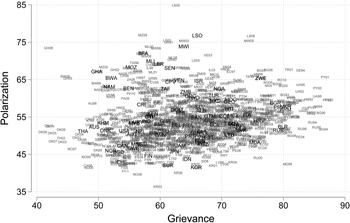
Figure 2 plots country-level polarization vs. grievance on the y and x axes, respectively. Country-year values are indicated with small grey labels, while country averages across all survey years are plotted with larger black labels. The level of grievance in the sample ranges from a low of 41.0 in Denmark in 2006 to a high of 87.4 in Paraguay in 2002, with a median value of 63.9 in Mexico in 2012, and country averages ranging from a low of 46.5 in Ghana to a high of 80.4 in Ukraine. Polarization ranges from a low of 36.4 in South Korea in 2001 and a high of 84.9 for Lesotho in 2000, with country averages ranging from 41.1 in South Korea to 76.8 in Lesotho. There is evidence of a slight positive correlation between grievance and polarization (r = 0.18), although the figure makes clear that there are countries that approach the four ideal type distributions represented in Figure 1.
Scatterplot of grievance and polarization, by country-year and country averages

Additional Data and Methods
Our measure of protest is based on the number of anti-government protests and strikes recorded in a given year by the Cross National Time Series (CNTS) Data Archive (Banks Reference Banks2011), data employed in many reputable analyses (Bellinger and Arce Reference Bellinger and Arce2011; Casper and Tyson Reference Casper and Tyson2014; Murdie and Bhasin Reference Murdie and Bhasin2011).Footnote 22 The event counts are based on coding of mentions in news sources, primarily the New York Times. Details of the operationalization and measurement of these measures are available from CNTS.
The literature on protest provides a plethora of potential control variables, including those associated with grievance and political opportunity structure theories.Footnote 23 Grievance theory models include the natural log of GDP per capita, income inequality, growth in GDP per capita and the natural log of inflation (inflation <0 set to 0).Footnote 24 Our measure of inequality is the Gini coefficient for income net taxes and transfers included in the Standardized World Income Inequality Database (Solt Reference Solt2009), which compiles distributional data from a variety of sources. Since both linear and curvilinear relationships have been hypothesized (Solt Reference Solt2015), all the models include both the mean and quadratic Gini coefficient. Political opportunity structure models include dummy variables indicating if an executive or legislative election took place, the level of democracy (Polity 2), regime durability, a measure of repression/political terror and the level of urbanicity. Time-invariant variables, including a dummy variable for presidential systems and a measure of ethnic fractionalization, are also included as controls. The descriptive statistics of all of the variables are summarized in Appendix A.Footnote 25
Table 1 models the incidence of nonviolent political protest as a function of grievance, polarization and their interaction. The set of models includes both ordinary least squares models as well as linear random effects models to account for unmodeled, between-country variation.Footnote 26 Since the protest variable is a count variable, we report negative binomial regressions for the protest models, with and without random country effects specified.
Predicting political protest

Note: cell entries reflect the results of negative binomial regressions, with and without country random effects specified. Standard errors in parentheses. Significance tests are two-tailed. All independent variables are mean centered and lagged by one year, with the exception of time invariant variables. The alpha is the estimate of the < dispersion parameter in count models. +p < 0.10; *p < 0.05; **p < 0.01
Results
Table 1 reports negative binomial count models predicting protest (without and with country random effects specified). Model Specification 1 incorporates all the control variables but not grievance and polarization. We also added a lagged variable of protest to account for the ‘history matters’ component of this kind of data. In other words, we expect past experience with protest to have an effect on future demonstrations. Not surprisingly, the effect of past protest is positive and significant across models. The addition of the grievance and polarization variables in Model Specification 2 suggests that what is most important about the grievance/protest relationship is not the mean level of grievance but rather the dispersion of grievance judgments, or what we have termed polarization. The coefficients reveal that grievance is unrelated to protest, but that polarization is positively related to protest. Indeed, this finding remains strongly robust across different model specifications.Footnote 27 As polarization increases, the likelihood of protest also increases.
The model suggests that a change from one standard deviation below to one standard deviation above the mean in polarization (for example, the approximately 12-point difference between Chile (2009) and the Dominican Republic (2008)) is associated with an approximately 10-percentage-point increase in the probability of at least one protest happening. As a point of comparison, this difference in probabilities is double the effect of moving from zero to one protest event in the prior year.Footnote 28
We also expect grievance to amplify the effect of polarization on nonviolent protest. Specifically, according to the elaboration of Gurr above, we would expect the highest level of protest when grievances are generally low (low average grievance) and there are large grievance differences across groups (high polarization). That is, adopting our language above we would expect to observe the greatest incidence of protests in predominant contexts. Model 3 in Table 1 tests this hypothesis by interacting grievance with polarization. According to this estimation, the impact of polarization indeed increases as average levels of grievance decrease.
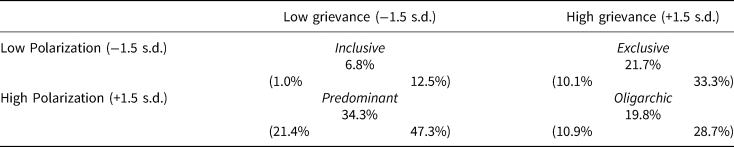
To more closely investigate the interaction between grievance and polarization, and hence, the four ideal types theorized earlier, Figure 3 and Table 2 report predicted probabilities of at least one protest event occurring at different levels of grievance and polarization, holding other variables at their mean values. As Figure 3 shows, while polarization is essentially unrelated to protest at high average levels of grievance, it strongly shapes the probability of protest for countries with below-average levels of grievance.
Predicted probability of at least one protest, by level of polarization and grievance

Probabilities of at least one protest, varying polarization and grievance

Note: cell entries are predicted probabilities of at least one protest at the indicated levels of grievance and polarization, holding other variables at their mean values. 95 per cent confidence intervals in parentheses.
In terms of the substantive impact of polarization moderated by grievance, Table 1 and Figure 3 show, for example, that a one-standard-deviation increase in polarization above the mean produces approximately a 10-percentage-point increase in the likelihood of at least one protest in countries where mean grievances are low, but no change (or perhaps even a modest decrease) in the likelihood of a protest in countries where grievances are high.
To further underscore this point, Table 2 reports predicted probabilities that roughly correspond to our four ideal type grievance distributions illustrated in Figure 1, varying levels of grievance and polarization from 1.5 standard deviations above and below the mean, respectively. The predicted probability of protest is highest in predominant distributions (34 per cent), lowest in inclusive distributions (6 per cent), and in between in oligarchic (20 per cent) and exclusive (22 per cent) distributions. That is, protest is most likely where the average level of grievance is fairly low, but there is significant polarization in such opinions. This is consistent with the idea that deprivation ‘in the midst of plenty’ motivates people to overthrow the existing regime (for example, Reenock, Bernhard and Sobek Reference Reenock, Bernhard and Sobek2007).
However, we did not expect to observe a similar level of protest in exclusive and oligarchic systems, which Table 2 also shows. This is a subject for future research, but we speculate that exclusive systems experience a higher level of protest than we anticipated because, consistent with the political opportunity structure literature, closed or exclusionary political systems tend to push actors outside conventional channels, increasing levels of protest activity (e.g. Kitschelt Reference Kitschelt1986).
Conclusion
To recapitulate our findings, we have observed that the mean level of grievance in a country is not systematically related to the likelihood of nonviolent protest. Instead, we find that countries with more polarized citizens – that is, those who have very different levels of grievance – are more likely to experience nonviolent protest. Polarization is most likely to generate protest where the country's average grievance level is relatively low, and less mobilizing in countries with a relatively high level of grievance. These findings are new, and they warrant additional investigation.
Our argument that the mean level of grievance in a country should be unrelated to the likelihood of protest, and our empirical evidence to this effect, helps to explain why prior studies have reached very different conclusions about the relationship between grievance and protest (Booth and Seligson Reference Booth and Seligson2009; Dalton Reference Dalton2004; Kerbo Reference Kerbo1982; Kitschelt Reference Kitschelt1986; McCarthy and Zald Reference McCarthy and Zald1977; Norris Reference Norris2011; Snyder and Tilly Reference Snyder and Tilly1972; Webb et al. Reference Webb1983). Our elaboration of Gurr's theory shows that the level of grievance in a society is likely to be a poor indicator of the likelihood of citizen protest, because, for example, a country might have a high average level of discontent but few (if any) reference groups to raise citizens' value expectations.
Our finding that a polarized citizenry – where individuals reach very different conclusions about whether their opportunities measure up to their expectations – is more prone to protest has significant implications for scholars of protest mobilization. Consistent with Gurr's original conceptualization, protests co-vary with growing opportunities in some segments of society while others are left behind.
Our finding that protest is most common in what we term ‘predominant’ societies, where grievances are generally low but polarization is quite high, helps to explain why rather well-off societies often experience protests. Prior scholarship has emphasized the importance of well-developed political opportunity structures to explain this phenomenon. While we do not disagree that these structures are an important part of explaining protest in developed countries, we would add that it is in these societies that polarization has the greatest effect. When most members of a society are content – that is, their opportunities approach their expectations – protest is especially likely among those few left behind.
One line of investigation for future research may be to probe the sources of polarization in societies. For instance, one likely cause of polarization is socioeconomic inequality. And if polarization is tied to income and social inequality, it may be rising along with the trends in these measures (Piketty Reference Piketty2015). Polarization may also be exacerbated by other group differences including religious, racial, ethnic and cultural heterogeneity coupled with disparities in opportunities across (and within) these groups. Stated another way, it may be easier for an aggrieved group to identify a reference group in a heterogeneous society.
Future research might also examine other important consequences of polarization. For example, polarization may lead to regime change, electoral volatility and/or an increase in crime. For now, we have learned one important consequence of polarization in a society – that those it leaves behind are likely to take to the streets.
Supplementary material
Data replication sets are available in Harvard Dataverse at: https://doi.org/10.7910/DVN/SVXE7L and online appendices at: https://doi.org/10.1017/S0007123419000681.
Acknowledgements
We are grateful to Andy Baker, Carew Boulding and Andrew Philips for helpful comments. A previous version of this article was presented at the ECPR Annual Meeting.