Introduction
The age structure of the world population in 2005 (United Nations, 2008) indicates that elderly people accounted for an estimated 7.3% of the world's population; in Japan, however, this figure was 20.1%. This percentage is the highest in the world and is expected to rise further, reaching 48.0% in 2025. The unprecedented aging of the Japanese population markedly increases the number of persons at risk for Alzheimer's disease (AD). Early detection of AD has therefore emerged as an important public health priority in Japan because it allows prevention of further deterioration of the disease. Early detection will become more important if new early treatments with long-term effectiveness are developed. However, early detection is not always easy because of the lack of efficient and effective methods to identify the early stage of AD (Grober et al., Reference Grober2008), and many people with AD often remain undiagnosed until symptoms are moderate or severe and, in turn, miss the opportunity to receive early effective treatment. Therefore, the precise characterization of this phase is important to reduce the number of such persons.
Mild cognitive impairment (MCI) is the most actively investigated concept to describe an early or prodromal stage of dementia, particularly AD (Petersen and Morris, Reference Petersen and Morris2005; Gauthier et al., Reference Gauthier2006; Reisberg et al., Reference Reisberg, Ferris, Kluger, Franssen, Wegiel and de Leon2008). MCI is considered a clinical entity that involves cognitive changes not severe enough to warrant the diagnosis of dementia (Dubois and Albert, Reference Dubois and Albert2004). A greater understanding of the phenomenology of cognitive deficits during the MCI stage of AD is essential for the early detection of AD. It is also essential for the establishment of the efficient and effective neuropsychological test battery to identify cognitive symptoms during MCI. There is no doubt that episodic memory impairment is the most common symptom of MCI, and this symptom has therefore been emphasized as a unique cognitive symptom in early clinical criteria for MCI (Petersen et al., Reference Petersen1999). The importance of episodic memory impairment in the diagnosis of MCI is supported by neurobiological evidence that neurobiological changes associated with medial temporal lesions, such as lesions of the hippocampus and entorhinal cortex, which are often related to episodic memory performance, are prominent in persons in the MCI stage of AD (Bäckman et al., Reference Bäckman, Jones, Berger, Laukka and Small2004). Episodic memory impairment is now considered the most common symptom in persons with MCI; however, this impairment is not the only one in such persons (Winblad et al., Reference Winblad2004).
There are some neurobiological evidences that neurobiological changes in the parietal and frontal cortices are also observed during the MCI stage of AD (Killiany et al., Reference Killiany2000; Kogure et al., Reference Kogure2000; Arnaiz et al., Reference Arnaiz2001; Fox et al., Reference Fox, Crum, Scahill, Stevens, Janssen and Rossor2001; Yamaguchi et al., Reference Yamaguchi, Sugihara, Ogawa, Oshima and Ihara2001; van der Flier et al., Reference van der Flier2002). This suggests that, besides episodic memory, multiple cognitive domains related to the frontal and parietal lobes are also affected in the MCI stage of AD. In fact, recent neuropsychological studies (Chapman et al., Reference Chapman, Zientz, Weiner, Rosenberg, Frawley and Burns2002; Estévez-González et al., Reference Estévez-González2004; Hashimoto et al., Reference Hashimoto2004; Hodges et al., Reference Hodges, Erzinçlioğlu and Patterson2006; Kramer, Reference Kramer2006; Ribeiro et al., Reference Ribeiro, de Mendonca and Guerriro2006; Taler and Phillips, Reference Taler and Phillips2008) suggest that multiple cognitive domains other than episodic memory, such as executive function, perceptual speed, language, and semantic memory, temporal orientation, and visuospatial skill, are affected in the MCI stage of AD. However, because there are only a few studies that compare the impairment of different cognitive domains, it remains controversial as to how and which domains of cognitive function other than episodic memory are affected during the MCI stage of AD. Studies to address this point should be useful in understanding more precisely the phenomenology of cognitive deficits during the MCI stage of AD.
In this study, we attempted to clarify how and which domains of cognitive functions other than memory were affected during the MCI stage of AD, using J-COGNISTAT, the Japanese version of the neurobehavioral cognitive status examination (Matsuda and Nakatani, Reference Matsuda and Nakatani2004). J-COGNISTAT is a brief but comprehensive cognitive test, which takes cognitively intact individuals about five minutes to complete, whereas most patients with impairments require 10–20 minutes (Kiernan et al., Reference Kiernan, Mueller, Langston and van Dyke1987). J-COGNISTAT comprises 10 subtests that assess multiple cognitive domains such as orientation, attention, language, constructive ability, episodic memory, calculation, and reasoning. This is the only brief test that can assess the presence and degree of multiple cognitive deficits simultaneously in Japanese subjects; J-COGNISTAT is designed to convert a low score for each subtest into a standardized score, and the cutoff point for each standardized score is established (Matsuda and Nakatani, Reference Matsuda and Nakatani2004).
Methods
Subjects
The subjects in this study were 57 Japanese people, comprising 28 patients in the MCI stage of AD (7 males and 21 females; MCI group) and 29 normal controls (14 males and 15 females; NC group). These groups were marginally but not significantly different in sex ratio [χ2(1) = 3.32, p = 0.07]. The mean ages of the MCI and NC groups were 71.46 [standard deviation (SD) 3.90] and 69.58 (SD 7.74), respectively, and there was no significant difference between the two groups [F(1,55) = 1.32, p = 0.26]. The mean number of years of education of the MCI and NC groups was 13.00 (SD 2.45) and 13.62 (SD 2.45), respectively; there was no significant difference observed between the two groups [F(1,55) = 0.34, p = 0.56].
Subjects in the MCI group were selected from patients treated in an outpatient psychogeriatric clinic in metropolitan Tokyo, which was a medical institution authorized by the Japanese Psychiatric Association. To participate, they had to meet the general diagnostic criteria for MCI, proposed by the international working group on MCI (Winblad et al., Reference Winblad2004). Their clinical dementia rating (CDR) at the time when they underwent J-COGNISTAT was CDR 0.5 (a stage between normal and mild dementia). Their Mini-mental State Examination (MMSE) results at that time ranged from 24 to 29 (mean 26.75, SD 1.43). None of the subjects in the MCI group had a history of stroke, brain injury, or transient ischemic attack, or a diagnosis of vascular, psychiatric, or medical conditions that cause cognitive deterioration. Subsequently, all of the subjects in the MCI group converted to a state that satisfied the clinical diagnostic criteria for probable AD (McKhann et al., Reference McKhann, Drachmann, Folstein, Katzman, Price and Stadian1984).
Subjects in the NC group were recruited from community volunteer groups in metropolitan Tokyo. They consented to participate as controls in the study after the procedure had been fully explained. All were classified as CDR 0 (healthy) and had MMSE scores above 26, ranging from 27 to 30 (mean 29.55, SD 0.87). None of them fulfilled the diagnostic criteria for possible AD (McKhann et al., Reference McKhann, Drachmann, Folstein, Katzman, Price and Stadian1984) or for dementia (DSM-IV; American Psychiatric Association, 1994). Like the MCI group, the NC group had no history of stroke, brain injury, or transient ischemic attack, and no diagnosis of vascular, psychiatric, or medical conditions that cause cognitive deterioration.
Cognitive assessment
Cognitive functions were assessed with J-COGNISTAT (Matsuda and Nakatani, Reference Matsuda and Nakatani2004). J-COGNISTAT comprises 10 subtests that assess cognition, including orientation (ORI), attention (ATT), comprehension (COM), repetition (REP), naming (NAM), constructive ability (CON), memory (MEM), calculation (CAL), similarities (SIM), and judgment (JUD). ORI assesses orientation for self (name and age), time (date, day of the week, and time), and place (address and location). ATT assesses selective attention using a digit span forward test, although this test confounds other aspects of attention. COM assesses ability in verbal comprehension of oral commands and complex motor praxis, REP assesses the ability to repeat phrases and sentences after oral presentation, and NAM assesses confrontational naming using pictures. CON assesses constructive ability and includes two tasks: the subjects are asked to draw two figures in the first task and construct three designs using eight tokens in the second task. MEM is a delayed recall task used to assess episodic memory; the patient is presented with four unrelated words after ATT and is asked to recall them after CON. CAL assesses arithmetic computation performed mentally after oral presentation, SIM assesses logical abstract thinking, and JUD assesses social judgment and problem solving.
A higher score on a subtest indicates a higher level of function in that domain. Like the original version (Mueller et al., Reference Mueller, Kiernan and Langston2007), J-COGNISTAT (the Japanese version) can illustrate the cognitive status profile, which is useful for identifying how a certain domain decreased compared to other domains. However, unlike the original version, J-COGNISTAT is designed to convert a low score for each subtest into a standardized score that is distributed with mean 10 and SD 1, and the cutoff point for each standardized score is set between 8 and 9. If a subject's score is not more than 8, the score is considered to be at an impaired level. This scoring system may make it possible to examine accurately how and which cognitive domains other than memory are affected in the MCI stage of AD. The details of J-COGNISTAT are thoroughly described elsewhere (Matsuda and Nakatani, Reference Matsuda and Nakatani2004).
Statistical analysis
Statistical analysis was performed using SPSS version 12.0 software. Data processing was conducted from two perspectives of analyses, between-subject comparison and within-subject comparison. In the between-subject comparison, data were compared between the groups, and in the within-subject comparison, data were compared between each pair of 10 subtests. The standardized scores were analyzed by repeated measures analysis of variance (ANOVA) with group as a between-subject factor and subtest as a within-subject factor. If a significant interaction effect was found, simple main effects of group (between-subject factor) and subtest (within-subject factor) were analyzed. The frequency of subjects whose results indicated an impaired level (i.e. ≤8) was analyzed using the χ2 test or Fisher's exact test (between-subject comparison) and Cochran's Q test (within-subject comparison).
Results
Between-subject comparison
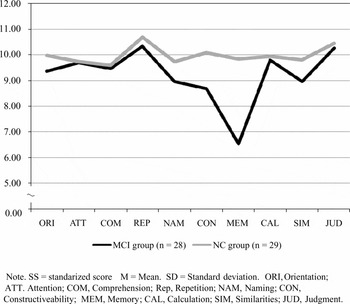
As illustrated in Figure 1, the cognitive profile of the MCI group was apparently different from that of the NC group. ANOVA showed a significant main effect of group [F(1,55) = 21289.05, p < 0.001, η = 1.00] and a significant interaction effect [F(9,495) = 18.94, p < 0.001, η = 0.17]. Significant simple main effects of group were found for five subtests: ORI [F(1,55) = 5.24, p < 0.05, ES = 0.60], NAM [F(1,55) = 4.98, p < 0.05, ES = 0.58], CON [F(1,55) = 14.85, p < 0.001, ES = 1.00], MEM [F(1,55) = 134.55, p < 0.001, ES = 3.02], and SIM [F(1,55) = 10.41, p < 0.005, ES = 0.84]; scores for the MCI group were significantly lower than those for the NC group. On the basis of these results, a discriminant analysis with the scores of these five subtests as an independent variable and with group as a dependent variable was conducted. Approximately 94.7% of subjects (26 in the MCI group and 28 in the NC group) were correctly classified with a significant discriminant function [Wilk's λ = 0.25, χ2(5) = 72.61, p < 0.001].
Group cognitive profiles.

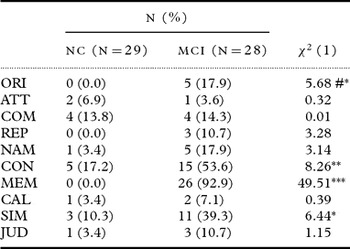
As shown in Table 1, in the MCI group, there were significantly more subjects with results indicating an impaired level on ORI (Fisher's exact test, p < 0.05), CON [χ2(1) = 8.26, p < 0.005], MEM [χ2(1) = 49.51, p < 0.001], and SIM [χ2(1) = 6.44, p < 0.05] compared to the NC group. More than 90% (n = 26) subjects in the MCI group showed an impaired level on MEM. Three-quarters (n = 21) of the MCI group showed similar results on MEM and at least one subtest other than MEM, and about 81% of them (n = 17) showed similar results on CON and/or SIM.
The frequency of subjects who showed the results of an impaired level on each subtest.

Note: *p < 0.05. **p < 0.01. ***p < 0.005. # Fisher's exact test.
ORI,Orientation; ATT, Attention; COM, Comprehension; Rep, Repetition; NAM, Naming; CON, Constructive ability; MEM, Memory; CAL, Calculation; SIM, Similarities; JUD, Judgment.
Within-subject comparison
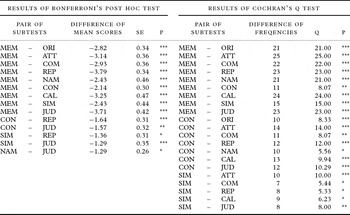
Simple main effects of subtest were examined, since ANOVA showed the significant interaction effect of group and subtest, as previously described. As a result, significant simple main effects of subtest were found [F(9,243) = 17.82, p < 0.001, η = 0.40]. As shown in Table 2, Bonferroni's post hoc test showed that the MCI group performed significantly worse on MEM than on any other subtest. The MCI group also performed significantly worse on CON and SIM than on REP and JUD. In addition, the MCI group performed significantly worse on NAN than on JUD.
Pairs of subtests whose mean scores differed significantly (Bonferroni's post hoc test) and those whose frequencies of subjects with the results of impaired level differed significantly (Cochran's Q test) in the MCI group (n = 28)

Note: * p < 0.05. ** p < 0.01. *** p < 0.005. SE = Standard erorr. Q = value of Cochran's Q. ORI,Orientation; ATT, Attention; COM, Comprehension; Rep, Repetition; NAM, Naming; CON, Constructive ability; MEM, Memory; CAL, Calculation; SIM, Similarities; JUD, Judgment.
Table 2 also shows that the number of subjects in the MCI group who showed an impaired level on MEM was significantly higher than for any other subtest. There were significantly more subjects with such results on CON than on ORI, ATT, COM, REP, NAM, CAL, and JUD. In addition, there were significantly more subjects with impaired results on SIM than on ATT, COM, REP, CAL, and JUD.
Discussion
The results of the present study should be interpreted with caution because of several limitations. The sample size of this study was relatively small. Although this was primarily the result of the need to include only persons in the MCI stage of AD, replication of the results in a larger sample is clearly warranted. Because the subjects of this study were selected from patients treated at the memory clinic, the sample of this study may be biased to a patient having memory problems or everyday dysfunction resulting from episodic memory impairment and other cognitive deficits. This may influence the results of this study, for example the frequency of subjects in the amnestic MCI multiple domain. This study did not include persons with MCI who did not convert to AD or those who had different etiologies of MCI, such as vascular dementia, frontotemporal dementia, dementia with Levy bodies, and depression (Petersen and Morris, Reference Petersen and Morris2005; Gauthier et al., Reference Gauthier2006); studies including such persons may be needed to characterize the cognitive deficits in the MCI stage of AD more precisely. Furthermore, this study did not examine the relationship between cognitive deficits and functional disturbances (Matsuda and Saito, Reference Matsuda and Saito2005; Ozioma et al., Reference Ozioma2006). It would be valuable to examine how cognitive changes in persons with MCI affect their ability to perform complex or instrumental activities of daily living (IADL), because the disturbance in IADL usually has a large impact on their quality of life. Despite these limitations, the results of this study may be important in increasing the understanding of the phenomenology of cognitive deficits in the MCI stage of AD.
The focus of this study was to clarify how and which domains of cognition other than memory were affected during the MCI stage of AD. Most subjects in the MCI group showed an impaired level on MEM, which assessed episodic memory. This clinical feature corresponded to the clinical presentation of amnestic MCI. About 80% of these had an impaired level on MEM and other subtests, particularly on NAM, CON and SIM, which assessed confrontational naming, constructive ability and abstract thinking, respectively. This suggests that the majority of the present subjects in the MCI group corresponded to clinical presentation of the amnestic MCI multiple domain. These results suggest that cognitive symptoms during the MCI stage of AD include not only episodic memory impairment, but also other cognitive domains such as naming, constructive ability, and abstract thinking. This is consistent with the results of previous studies that demonstrated that cognitive deficits other than episodic memory were observed early in the course of AD (Chapman et al., Reference Chapman, Zientz, Weiner, Rosenberg, Frawley and Burns2002; Estévez-González et al., Reference Estévez-González2004; Hashimoto et al., Reference Hashimoto2004; Hodges et al., Reference Hodges, Erzinçlioğlu and Patterson2006; Kramer et al., Reference Kramer2006; Ribeiro et al., Reference Ribeiro, de Mendonca and Guerriro2006; Taler and Phillips, Reference Taler and Phillips2008). However, unlike these studies, the within-subject comparisons in the present study showed that the MCI group performed significantly worse on MEM than on any other subtest compared to the NC group. This suggests that multiple cognitive domains other than episodic memory are already impaired in the MCI stage of AD; however, the degree of these non-mnemonic deficits is not as great as episodic memory impairment.
The results on the naming tasks are coherent with previous studies that showed that MCI patients can have language impairment (e.g. Chapman et al., Reference Chapman, Zientz, Weiner, Rosenberg, Frawley and Burns2002; Taler and Phillips, Reference Taler and Phillips2008) and semantic memory impairment (e.g. Estévez-González et al., Reference Estévez-González2004; Hodges et al., Reference Hodges, Erzinçlioğlu and Patterson2006). The subject's performance on CON seems to reflect his or her speed of processing because in this task the person is given a bonus point for correct constructions within 30 seconds, and no point is given for correct performances that require longer than 60 seconds. In addition to the speed of processing, abstract thinking assessed by SIM is also an important element of executive function. It may be possible to speculate that the impairment of the present MCI sample on the CON, NAM and SIM subtests of the J-COGNISTAT could potentially be accounted for by language and/or semantic and/or executive deficits.
It may be valuable to discuss the underlying neurobiological mechanism responsible for the cognitive deficits during the MCI stage of AD, because the cognitive deficits in AD are related to underlying neurobiological changes in the brain. The greatest impairment during the MCI stage of AD was episodic memory impairment, followed by deficits on constructive ability and abstract thinking, though the degree of these deficits was slight. Episodic memory is typically associated with neurobiological changes in the temporal lobes (Bäckman et al., Reference Bäckman, Jones, Berger, Laukka and Small2004). Constructive disability is often related to changes in the parietal lobes (Kaufman, Reference Kaufman1990). Changes in abstraction tend to be associated with left hemisphere lesions, particularly in the temporal and frontal lobes (Kaufman, Reference Kaufman1990). Considering the pattern of cognitive deficits presented in this study and their neurobiological underpinnings, the results of this study seem compatible with those of previous studies that have demonstrated neurobiological changes in parietal and frontal areas as well as in the medial temporal area (Killiany et al., Reference Killiany2000; Kogure et al., Reference Kogure2000; Arnaiz et al., Reference Arnaiz2001; Fox et al., Reference Fox, Crum, Scahill, Stevens, Janssen and Rossor2001; Yamaguchi et al., Reference Yamaguchi, Sugihara, Ogawa, Oshima and Ihara2001; van der Flier et al., Reference van der Flier2002). However, because the present study did not address the neurobiological factors underlying the cognitive defects, future studies are needed to clarify the relationship between neurobiological and neuropsychological changes.
This study suggests that, besides episodic memory, multiple non-mnemonic cognitive domains, such as constructive ability and abstract thinking, are also impaired during the MCI stage of AD, but these non-mnemonic deficits are not as great as episodic memory impairment. Considering the brevity of J-COGNISTAT, it can be one of the important diagnostic tools for identifying MCI on Japanese clinical ground. Future studies that overcome the limitations of this study are clearly needed to clarify the cognitive symptoms of MCI more precisely.
Conflict of interest
None.
Description of authors' roles
The first author was responsible for all components of this research, including the design of the study, data collection, statistical analysis, and writing the manuscript. The second author was responsible for the diagnosis of the subjects.