Introduction
The last year of life is characterized by high utilization of health care services and high costs (Davis et al., Reference Davis, Nallamothu and Banerjee2016). Transitions (defined as a change in care setting) occur frequently at the end of life (Hanratty et al., Reference Hanratty, Lowson and Grande2014) and contribute to discontinuity and fragmentation of care (Kelfve et al., Reference Kelfve, Wastesson and Fors2018; Makaroun et al., Reference Makaroun, Teno and Freedman2018). While they are sometimes necessary (Reyniers et al., Reference Reyniers, Houttekier and Cohen2014), they can be burdensome (Naylor et al., Reference Naylor, Kurtzman and Pauly2009; Gozalo et al., Reference Gozalo, Teno and Mitchell2011; Miller et al., Reference Miller, Lima and Intrator2016; Makaroun et al., Reference Makaroun, Teno and Freedman2018) and are often avoidable (Ouslander and Maslow, Reference Ouslander and Maslow2012; Walsh et al., Reference Walsh, Wiener and Haber2012; Gott et al., Reference Gott, Ingleton and Gardiner2013; Delgado-Guay et al., Reference Delgado-Guay, Kim and Shin2015; Kasdorf et al., Reference Kasdorf, Dust and Vennedey2021).
Palliative Care regulations in Germany include generalist palliative care, as well as allowances for in-patient or day care in hospices, palliative home care by hospice services, and special palliative home care services (Van Beek et al., Reference Van Beek, Woitha and Ahmed2013). Although Germany achieved rank seven in the overall global ranking in the 2015 Quality of Death Index, indicating its good level of palliative care services on a national level (The Economist Intelligence Unit, 2015), access to palliative care varies based on location and demographics (Bertelsmann Stiftung, 2015).
The number of transitions people experience in their last year of life varies in different studies, ranging from 1.5 Klicken Sie hier, um Text einzugeben.to 4.2 in different settings in the USA and Canada (Burge et al., Reference Burge, Lawson and Critchley2005; Wilson et al., Reference Wilson, Thomas and Kovacs Burns2012; Teno et al., Reference Teno, Gozalo and Bynum2013). Hospitalizations occur with a high frequency near death, and only some of these transitions can potentially be avoided (Walsh et al., Reference Walsh, Wiener and Haber2012; Xing et al., Reference Xing, Mukamel and Temkin-Greener2013).
Various factors influence the occurrence of transitions. In quantitative approaches, factors like age, gender, income (Burge et al., Reference Burge, Lawson and Critchley2005; Lawson et al., Reference Lawson, Burge and Critchley2006; Aaltonen et al., Reference Aaltonen, Forma and Rissanen2010; Aaltonen et al., Reference Aaltonen, Raitanen and Forma2014; Abraham and Menec, Reference Abraham and Menec2016; Bahler et al., Reference Bahler, Signorell and Reich2016), level of education (Kelfve et al., Reference Kelfve, Wastesson and Fors2018), physician, and hospital bed supply (Menec et al., Reference Menec, Nowicki and Kalischuk2010; Abraham and Menec, Reference Abraham and Menec2016) have been reported in connection with transitions. Those studies used claims data or national registers with large sample sizes. Retrospective survey-based approaches measured via physicians (Van den Block et al., Reference Van den Block, Deschepper and Drieskens2007; Abarshi et al., Reference Abarshi, Echteld and Van den Block2010) or bereaved relatives (Bone et al., Reference Bone, Gao and Gomes2016) indicate that if end-of-life preferences were discussed and if there had been a health care professional as a single point of contact, end-of-life transitions to the hospital were less likely. So far, to the best of our knowledge, there are no studies that investigate transitions from the views of bereaved relatives independent of the type of transition.
The above approaches do not take into account if transitions are experienced as burdensome. The literature on burdensome transitions primarily uses quantitative measures (Aaltonen et al., Reference Aaltonen, Forma and Rissanen2010; Abarshi et al., Reference Abarshi, Echteld and Van den Block2010; Gozalo et al., Reference Gozalo, Teno and Mitchell2011; Teno et al., Reference Teno, Gozalo and Bynum2013; Bahler et al., Reference Bahler, Signorell and Reich2016; Makaroun et al., Reference Makaroun, Teno and Freedman2018; Teno et al., Reference Teno, Gozalo and Trivedi2018; Chen et al., Reference Chen, Ho and Liao2020), based on a definition by Gozalo et al., who define transitions in the population of long-term care residents as burdensome if they occurred in the last three days of life, if there was discontinuity of nursing home care after hospitalization, and if there had been multiple hospitalizations in the last 90 days of life (Gozalo et al., Reference Gozalo, Teno and Mitchell2011). A recent systematic review synthesized a similar definition based on the existing literature (Hanna et al., Reference Hanna, Quach and Scott2020).
Qualitative approaches with patients and bereaved relatives show that coordination of care (Harrison and Verhoef, Reference Harrison and Verhoef2002), managing risk (Coombs et al., Reference Coombs, Parker and de Vries2017), support across settings, being heard, and dignity (Hanratty et al., Reference Hanratty, Holmes and Lowson2012) contribute to how transitions are experienced by patients and relatives. Those and other existing studies are focused either on one specific type of transition, have limited sample sizes, and/or are conducted in one setting (e.g., nursing homes). They also do not specifically investigate factors classifying transitions as burdensome and cannot be linked to the time of the transition before death.
We see the following research gaps in the existing literature:
1) There is a lack of studies about the types and frequencies of transitions at the end of life in German urban areas.
2) Burdensome transitions are typically investigated based on frequencies and time of occurrence, which is not sufficiently justified with qualitative data.
3) Few studies about the subjective experiences of burdensome transitions exist and bereaved relatives are seldom included as a source of knowledge after death.
This study aims to close these gaps by investigating the following research questions:
1) What types of transitions in the last year of life occur in German urban areas and at what frequency?
2) What are the indicators of burdensome transitions as experienced from the views of bereaved relatives?
Methods
Study design
Patterns of end-of-life transitions were assessed with an explanatory sequential design. A retrospective cross-sectional survey with bereaved relatives (N = 351) was followed by in-depth interviews with a subset of this sample (N = 41). The two study phases were carried out in Cologne, which is exemplary of an urban setting in Germany with well-developed palliative and hospice care structures.
Participants
We included relatives, friends, or voluntary workers (henceforth: “informants”) if they were 18 years or older and have recently cared for a person who lived their last year of life in the Cologne area. Deaths of people under the age of 18 years, as well as accidental and suspicious deaths, were excluded. Interviewees were selected from the survey sample, stratifying with pre-defined variables to ensure maximum heterogeneity regarding these characteristics. Stratifying variables were time of communication of foreseeable death, because this significantly influences the course of the last year of life, and overall rating of the quality of care as the main outcome for patients and relatives.
Multiple channels for recruitment were combined to reduce selection bias. Participants were recruited via more than 100 cooperation partners (care homes, hospice networks, bereavement cafés, doctors, hospitals, undertakers, nursing services, local public health department) and through newspaper articles, flyers, and posters.
Data collection and measures
Quantitative
Data were collected in a post-bereavement survey as part of the Last Year of Life Study Cologne (LYOL-C) (Strupp et al., Reference Strupp, Hanke and Schippel2018) from November 2017 to August 2018. In the quantitative strand, the VOICES-LYOL-Cologne was used, which is described elsewhere in more detail (Voltz et al., Reference Voltz, Dust and Schippel2020). The questionnaire examines experiences with care by multiple providers in the last year of life from the views of bereaved informants. Participants were further asked to provide information about all care settings during the last year of life, including dates. We defined five settings: home (including assisted living), hospital, care home, hospice, and rehabilitation clinic. A transition was defined as a change in location of where the patient was cared for.
Qualitative
An interview guideline was developed, revised by the research team, and discussed within a research workshop. The interview guideline was structured around three main areas: (1) breaking bad news about incurable disease, (2) transitions between care settings, and (3) the dying phase. All participants were asked the same basic set of questions. Questions were added depending on the individual questionnaire to elaborate on the quantitative results. Interviews were carried out by NS and CvR in the participants’ homes or in the research institute. Interviews were audiotaped and transcribed verbatim. All interviewees provided written informed consent.
Data analysis
Quantitative analysis
Types and frequencies of transitions in the last year of life and associations with age, illness, and communication patterns were analyzed exploratively, computing descriptive statistics, t-tests, and Spearman correlations with SPSS Statistics 25 (IBM Corp., Armonk, NY, USA) and R version 3.5.1 (The R Foundation). Exact p-values are reported in cases where significance tests were carried out (American Psychological Association (APA), 2020). We performed nonparametric tests for ordinal data and parametric t-tests using the Welch-Correction for metric outcomes. Care trajectories were reconstructed in cases where participants gave information about all places of care including durations for the last year of life. In that way, the time between the transition and death could be computed. Variables for the quantitative analysis were selected from the questionnaire depending on their thematic relevance for the interview. We included all cases, where data were provided for the respective calculations.
Qualitative analysis
Interviews were analyzed using content analysis with provisional and descriptive coding/subcoding (Miles et al., Reference Miles, Huberman and Saldaña2014). Deductive codes were drawn from the ecological systems theory (Bronfenbrenner, Reference Bronfenbrenner1994), which was used previously for building a framework for assessing palliative care on different levels (Pask et al., Reference Pask, Pinto and Bristowe2018). We conducted across-case summaries for transition-related categories and within-case summaries for cases that experienced a burdensome transition according to the definition of Gozalo et al. (Reference Gozalo, Teno and Mitchell2011): (1) any transition in the last three days of life, and (2) multiple hospitalizations in the last three months of life.
Integration is carried out on three levels: design, methods, and interpretation (Fetters et al., Reference Fetters, Curry and Creswell2013). On the design level, the sequence of the study phases (Quantitative–Qualitative) was picked to examine frequencies and patterns of transitions and secondly explore how the burden is experienced. On the methods level, we used linking and building by sampling interview participants purposefully from the questionnaire. On the interpretation level, we used weaving and analyzed both data sources on a theme-by-theme basis (Fetters et al., Reference Fetters, Curry and Creswell2013).
Results
Our quantitative sample was representative for Cologne decedents regarding gender (47.9% male) and age ( $\bar{x} = 76.5$, SD = 13.0 years) compared with full data from the City of Cologne (gender: 50% male) (Stadt Köln - Amt für Stadtentwicklung und Statistik, 2019), age: 77.7 years (Stadt Köln - Amt für Stadtentwicklung und Statistik, 2018); see also Voltz et al. (Reference Voltz, Dust and Schippel2020). It showed small to moderate deviations regarding education (39.7% lower secondary education, 16.1% high school, 42.5% baccalaureate, 1.8% no degree) compared to the people over 50 in the state North-Rhine-Westphalia (46.7%, 21.4%, 26.2%, 5.8%) (Landesbetrieb Information und Technik Nordrhein-Westfalen (IT.NRW), 2020).
In our survey, we asked all informants (N = 351), if they wanted to participate in an interview, to which 266 (75.8%) agreed to. Patient characteristics of the interview sample were similar to the survey population regarding the variables displayed in Table 1, although we oversampled in the underrepresented cells of the stratifying variables to get more insights into trajectories where prospects about approaching death were discussed shortly before death or where overall care was rated badly (Table 1). The average duration of an interview was 54.7 min.
Patient characteristics and stratifying variables, see also Voltz et al. (Reference Voltz, Dust and Schippel2020)

Transitions in the last year of life
We found that 13.7% of the patients experienced no transition in their last year of life. The mean number of total transitions per person in the last year of life was 3.72 (SD = 3.1), while they ranged between 0 and 16 transitions. There was a significant difference in the number of transitions between people aged 85 and older ( $\bar{x} = 2.53$) and people under 85 (
 $\bar{x} = 4.27$, p < 0.001). Education, gender, and multimorbidity did not show significant associations with transitions or hospitalizations.
Full reconstruction of the trajectories in the last year of life was possible for 255 deceased persons. The following analyses of specific time periods relate to this subset.
Generally, the number of transitions increased as death approached, especially the most frequent transition from home to hospital (Figure 1). In the last month of life, a person experienced on average 0.86 transitions, while in the 12th month before death, he or she experienced only 0.11 transitions.
Number of transitions over the course of the last 12 months before death (n = 255).

Burdensome transitions
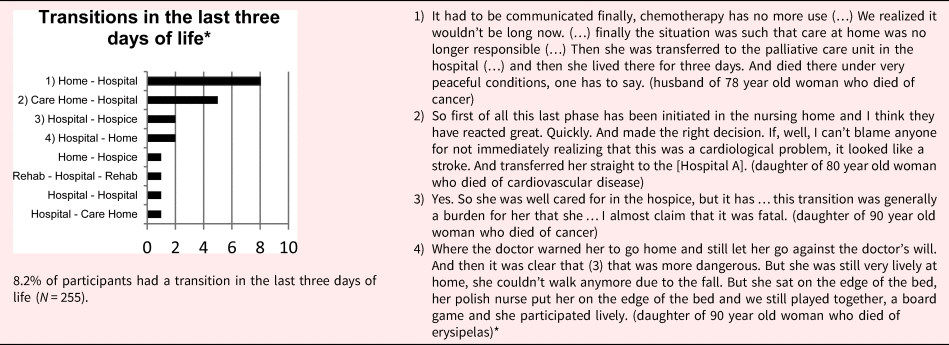
The two types of burdensome transitions defined in the literature were investigated in a mixed-methods approach, where survey and interview data are mutually integrated. Transitions in the last three days of life were experienced by 21 (8.2%) of the patients. The four most frequent types of these transitions were represented in our interview sample. Table 2 provides exemplary citations for these cases.
Joint display for transitions in the last three days of life

* On the right side, for each of the four most frequent transitions in the last three days, there is a quote from a person whose relative experienced the corresponding transition.
The accounts of the informants reveal a mixed picture. While in example 3 (Table 2), the consequence of the transition is reported as negative, the other three accounts do not refer to any burden experienced during the transition. The positive accounts mention transparent communication about the incurable disease and considering the patient's will, even if it went against the doctor's advice.
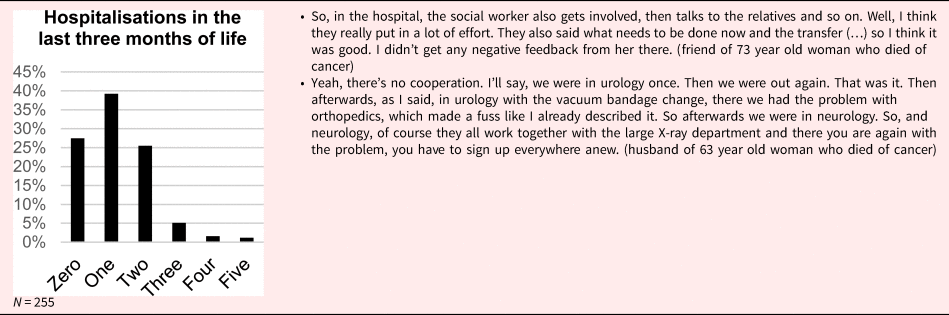
Two or more hospitalizations in the last three months were reported for 85 cases (33.3%), and a minimum of three hospitalizations was reported for 20 (7.8%). Examples of statements regarding three or more hospitalizations are presented in Table 3.
Joint display for multiple hospitalizations in the last three months of life

The first example reports no burden resulting from the transitions. In this case, the social service as a coordinating unit was involved, which seems to have facilitated the positive transitions. In the second case, the burden was experienced as a result of a lack of cooperation between the different providers.
An analysis of the cases who experienced two or more hospitalizations in the last three months (N = 13) shows numerous reports of resulting burden, while occasionally referring positively to these transitions. Reports about the transitions range from “necessary” to “incredibly bad”. Informants distinguished between the process of transfer (“She said that it was a terrible ride. This car was bumping and rumbling around. And then he didn't find the right building” [friend of 73-year-old woman who died of cancer]) and the organizational fit of the subsequent setting:
No, it was not necessary. I know, for example, in [Hospital X], the first care unit, there was not happening anything else than in [Hospital Y]. That was not what I would imagine as short-time rehabilitation. (daughter of 80 year old woman who died of cardiovascular disease)
The transitions that were not considered necessary and did not result in a positive change in the health status of the patient were described as more stressful for both patients and relatives. Burden was also reported as being higher when transitions were executed against the patients’ will.
The number of hospitalizations in the last three months of life also showed associations with the overall rating of care by all providers in the survey data (r (s) = 0.165, p = 0.01). This suggests a general dissatisfaction with multiple hospitalizations, which is supported by interview data:
Now that you ask, the ongoing hospital visits and then the transitions, especially in the last four months, were very stressful for me. (daughter of 85 year old woman who died of cardiovascular disease)
For both types of burdensome transitions according to the literature (Gozalo et al., Reference Gozalo, Teno and Mitchell2011), the reports of experienced burden varied greatly and seem to depend on support, communication, and shared decision making.
Risk factors for burdensome transitions
The analysis of the potentially burdensome transitions revealed no clear indication of the time or frequency of transitions being a precondition of experienced burden. We extended the analysis to the whole sample of informants (N = 41) to investigate risk factors of burdensome transitions. We extracted three main topics, which were frequently related to transitions where subjective burden was reported.
1. Transparent communication in the face of an incurable disease
In various cases, interview data indicated how burdensome transitions can be prevented through communication. Participants talked about how doctors could reassure informal caregivers that some transitions are not necessary and how they can provide appropriate care at home.
There is an emergency practice, in [Place X], and my husband sometimes experienced strong pain at night and then I called him. And then it was such a nice … it was such a nice doctor who … helped me so much. That was such a positive thing … who took away my fear a little bit and said, he doesn't need to go to the hospital, you can do this or do that. (wife of 88 year old man who died of organ failure)
This goes along with various reports about how empathetic communication with patients and relatives facilitated a calmer care trajectory. Survey results indicate that the earlier people were told that they were likely to die, the fewer hospitalizations were experienced in the last three months of life (r (s) = −0.28, p = 0.001) and in the last month of life (r (s) = −0.197, p = 0.021). One of the participants illustrated the relationship between early communication and transitions in the following way:
That was actually one of the first times I thought, “Finally a clear word’. We could have had that earlier (…) actually it would have been most beautiful if they had said that right at the beginning, something like that (…) and she could have somehow spent the last two months sitting under trees instead of this horrible tour back and forth between the houses. (daughter of 80 year old woman who died of cardiovascular disease)
This and various other reports show the importance of early and transparent communication about the prospect of dying.
Survey data also indicated that when patients were told they were likely to die in a sensitive and caring way, they experienced fewer transitions in the last month of life (r = 0.185, p = 0.046). One of the informants elaborated on how a non-sensitive way of breaking bad news could lead to further transitions:
It is possible to indicate ways to go. Peaceful ways of saying goodbye. Yes. Clarity, empathy, and courage are needed. The courage to convey something like that. Yes. And to run away and say: “In two days you can go home”. And afterwards she is transferred to geriatrics. Well, that is not okay. You can't do that. (daughter of 84 year old woman who died of cancer/stroke)
The informant elaborated on how this could have been prevented through clear and transparent communication:
Well, I mean, it was very obvious that mommy was dying. I also believe that this was clear to some of the doctors. But they did not communicate this clearly. (…) This man knew that our mother was dying. And he did not talk about it. I understand that this is not easy. To communicate such sad news. I have great understanding for that. And I think it is important to learn that. How do I convey bad news? (daughter of 84 year old woman who died of cancer/stroke)
2. Coordination of care
Another central topic that emerged with regard to transitions was the structured coordination of care across providers. There were various reports of a lack of guidance given to patients and relatives regarding their subsequent care or different possibilities.
The transport from the hospital, the bottleneck … so the cogwheel hospital relatives, you have to say, the handover, so we were completely lost. What now? (laughs quietly) Hospice? Private home or care home? So there was nothing at all; they said, “That's up to you. And we don't have anything to do with it anymore”. (son of 89 year old woman who died of physical weakness)
This and other statements show how lost patients and relatives may feel when there is a life-limiting diagnosis and no guidance. Oftentimes informants demand a coordinator throughout the care trajectory:
Why don't these people exist? Why isn't there such a pool that can be called up in such emergencies? These are things that I think. Well, you would actually need such a … yes, like a moderator who steers people a bit or something like that. (daughter of 81 year old woman who died of cancer)
There were indications of clear mistakes when it came to transitions. One informant told us how poor coordination between professionals in a hospital led to an unwanted transition and death in the ambulance:
The doctor also told me: “We can't possibly move your mother; she is really severely…” (…) and then they said, “No, your mother has now been taken back to the nursing home.” This can't be happening. What do they want with a dying woman in a nursing home? And, yes, then she died on the way in the ambulance. And that is for me, that is the confirmation that they really messed up. (daughter of 80 year old woman who died of cardiovascular disease)
Some of the reports also mentioned a lack of further care planning in hospitals. In the following statement, a lack of involvement of the social service in hospitals led to strong insecurity for patients and relatives regarding the care trajectory.
So, in [Hospital X] it was definitely a very big problem, the transition. And … because there was no agreement at all with us, with the family, how can it go on? What makes sense? Does it make sense that our mother … For example, it was not discussed with us, does it make sense at this point that our mother goes to a hospice? Does it make sense at this point for our mother to be placed in a nursing home? If she wants to go home as she wanted, how can she be helped? So that's … The social service wasn't even involved yet. And that … I felt very alone. (daughter of 81 year old woman who died of cancer/stroke)
A potential resource for facilitating coordination of care seems to be the relatives themselves, which often is not sufficiently exploited from the views of the bereaved relatives:
So, I say, the A and O are the relatives. It happens on the part of the clinic or on the part of the care home rather still, but more on the part of the clinic the conversation with the relatives is unfortunately not sought and I was also not informed, although they said they would inform me. (daughter of 85 year old woman who died of cardiovascular disease)
Many informants experience themselves as a substantial coordinating unit. Since we collected data only from patients having relatives or friends as informal coordinators, the population of patients without this resource is in even higher danger of suffering from bad coordination.
The worst thing is when a sick person, a terminally ill person, is alone, no longer has any relatives. That he is completely dependent on them [the care personnel]. I was still there, after all, where I put myself out there. When you no longer have anyone, when you are completely dependent on them, that's all I'm saying. That's the worst thing. (wife of 78 old man who died of cancer)
3. Considering patient's preferences
There were frequent reports about experienced burden in transitions or a bad organizational fit of the subsequent setting through a lack of consideration of the patient's preferences. Various informants talked about how previously expressed wishes about treatment or place of care were not considered. This is typically related to the desire to be treated less at the end of life and to spend time at home.
So, the oral arrangements were not kept. And the plans, the daily plans of the rehab were still filled with several therapies every day. (…) So our mother's palliative care physician had his hands clenched over his head because of the report. It even says that our mother should continue to receive ergotherapy, that she should be trained with a lower arm rollator, twice a week and this and that. A dying one. Our mother was dead not even three weeks after that. (daughter of 81 year old woman who died of cancer/stroke)
Not acting in the patient's interest is also partly associated with the ethical self-image of physicians as healers:
With a lot of doctors, it's like … I'm not allowed to do it for ethical reasons. If I do write, I don't want to be cared for anymore. Then it is my will, right? I do not want to throw myself in front of a train. I can no longer do that in old age. (authorized representative of 87 year old man, unknown cause of death)
The fact that knowing patients’ preferred place of death can reduce potentially burdensome transitions is supported by our quantitative findings: If patients spoke about their preferred place of death and professionals knew about this, patients experienced significantly fewer hospitalizations in the last three months of life (1.28 vs. 0.97, p = 0.021).
Discussion
To our knowledge, this is the first study investigating burdensome transitions with a mixed-methods approach and the first German study to examine frequencies of transitions by type over the course of the last year of life.
The sharp rise of transitions towards the end of life, especially hospitalizations, was congruent with international data (Aaltonen et al., Reference Aaltonen, Forma and Rissanen2010; Greenle et al., Reference Greenle, Hirschman and Coburn2019). The amount of transitions reported indicates potential problems concerning continuity and quality of care. The proportion of patients having transitions in the last three days of life (8.2%) was similar to proportions reported in other Western countries, which ranged from 8% in the Netherlands to 13% in Spain (Van den Block et al., Reference Van den Block, Pivodic and Pardon2015), and 9.3% in Switzerland (Bahler et al., Reference Bahler, Signorell and Reich2016), while a similar number of 10.8% was reported in a US study for 2015 (Teno et al., Reference Teno, Gozalo and Trivedi2018). The rate of multiple hospitalizations (two or more) was 33%, whereas 21% was reported in Canada (Abraham and Menec, Reference Abraham and Menec2016). The age differences in numbers of transitions (<85 and >84) were congruent with international data (Lawson et al., Reference Lawson, Burge and Critchley2006; Van den Block et al., Reference Van den Block, Deschepper and Drieskens2007; Abarshi et al., Reference Abarshi, Echteld and Van den Block2010; Abraham and Menec, Reference Abraham and Menec2016; Bahler et al., Reference Bahler, Signorell and Reich2016). This validates our data and potentially allows for extrapolating our findings to other contexts. Deviating from existing literature, we did not find evidence that gender or having multiple conditions was associated with transitions in the last year of life. This may be due to the fact that effect sizes were not very high for those correlations reported and they may only be visible in large data sets.
We could not confirm that having a transition in the last three days of life was a precondition for burdensome transitions. Having multiple hospitalizations in the last three months of life shows some indications of associations with burden. However, it does not appear to be a sufficient proxy for actual burden. Those or similar definitions are still frequently used in assessing burdensome transitions at the end of life in large quantitative databases (Gidwani, Reference Gidwani2018; Chen et al., Reference Chen, Ho and Liao2020; Hanna et al., Reference Hanna, Quach and Scott2020; Lage et al., Reference Lage, DuMontier and Lee2020). Our quantitative and qualitative data suggest that burdensome transitions are predicted by early and transparent communication about life-limiting diseases, coordination of care across settings, and considering patients’ and relatives’ preferences. Those factors are known to be linked to care quality at the end of life. This study underlines the necessity to consider those factors in approaches to reduce burdensome transitions, which is typically not done in quantitative studies. We, therefore, advice to use time- and frequency-based definitions of burdensome transitions carefully in the future and justify them with qualitative data.
The particular strength of the present study lies in the triangulation of methods, which, despite the high access barriers of the population, enables an expanded understanding of care in the last year of life. The design integrating a sequence of quantitative and qualitative data allows for adding in-depth information to certain patterns of transitions. We could successfully integrate quantitative and qualitative results, both data sources mutually benefiting from each other. A recall bias is to be expected due to the retrospective survey form, as are distortions in the proxy assessments of the quality of care, which typically show moderate deviations from the patient's view (Farber et al., Reference Farber, Egnew and Herman-Bertsch2003; Jones et al., Reference Jones, McPherson and Zimmermann2011).
A review of the literature on patient-family concordance concluded that although there are differences between patients and relatives regarding symptom severity, those imperfect proxies are an important source of information for end-of-life research. Moreover, their views have their own validity, as their memory lives on and further impacts their bereavement and health (Addington-Hall and McPherson, Reference Addington-Hall and McPherson2001). The VOICES-questionnaire is widely used for assessing experiences including symptoms in the last year of life from the view of bereaved relatives (Burt et al., Reference Burt, Shipman and Richardson2010; Hunt et al., Reference Hunt, Shlomo and Addington-Hall2014; Office for National Statistics (ONS), 2016; Donnelly et al., Reference Donnelly, Prizeman and Coimín2018). As directly affected persons also after death, relatives offer an appropriate alternative to directly questioning patients at the end of life. Nevertheless, they cannot replace patients’ perspectives, which is why future studies on this topic should include their views. In a direct follow-up study to this LYOL-C-study (LYOL-C II), we prospectively follow up patients who are believed to be in their last year of life. By this, we want to expand our understanding of patient trajectories and experiences in the last year of life.
Conclusion
Avoiding a transition in the last year of life is not necessarily a success. When measuring the positive effect of any medical or organizational intervention, a reduction of (certain) transitions in various timeframes at the end of life should not necessarily be the primary outcome. It should at least be accompanied with additional data informing about burden. For assessing possibilities to reduce burdensome transitions, we need approaches where survey or interview data add to the analyses of large routine data sets. Being transferred without sufficient preparation, coordination, and information seems to be the central risk factor for subjective burden. Conclusively, policy and practice should not only focus on preventing transitions but keeping patients and relatives informed, considering their preferences, and exploiting all coordinative resources (including relatives), especially when patients are transferred. In addition, this is supported by the fact that only about a quarter of transitions is regarded by relatives, as well as professionals as potentially avoidable (Hanratty et al., Reference Hanratty, Lowson and Grande2014; Delgado-Guay et al., Reference Delgado-Guay, Kim and Shin2015), and only 6.7% as practically avoidable (Gott et al., Reference Gott, Ingleton and Gardiner2013).
Ethical approval
All procedures for this study were approved by the Ethics Commission of the Faculty of Medicine of the University of Cologne, Germany (#17-188). Participants gave written informed consent before taking part.
Data availability statement
Data are available from the corresponding author upon reasonable request.
Acknowledgments
RV, CR, and JS designed the study. NS, GD, and CvR were responsible for the acquisition of the data. NS performed the analysis and was responsible for the integrity of the data. NS drafted the manuscript. JS provided supervision. All authors revised the manuscript critically for important intellectual content. All authors read and approved the final version to be submitted for publication.
Collaborators
The CoRe-Net co-applicants: Professor Dr Christian Albus, Department of Psychosomatics and Psychotherapy, Faculty of Medicine (FM), University Hospital Cologne (UHC); Professor Dr Lena Ansmann, Department of Health Services Research, School of Medicine and Health Sciences, Carl von Ossietzky University Oldenburg; Professor Dr Frank Jessen, Department of Psychiatry and Psychotherapy, FM, UHC; Professor Dr Ute Karbach, Sociology in Rehabilitation, Faculty of Rehabilitation, Technical University Dortmund; Professor Dr Ludwig Kuntz, Department of Business Administration and Health Care Management, Faculty of Management, Economics and Social Sciences (FMESS), University of Cologne (UoC); Dr Ingrid Schubert, PMV Health Care Research Group, FM, UoC; Professor Dr Frank Schulz-Nieswandt, Institute for Sociology and Social Psychology, FMESS, UoC; Professor Dr Stephanie Stock, Institute for Health Economics and Clinical Epidemiology, FM, UHC.
Funding
This work was supported by the German Federal Ministry of Education and Research (BMBF), grant no. #01GY1606.
Competing interests
The authors declare none.