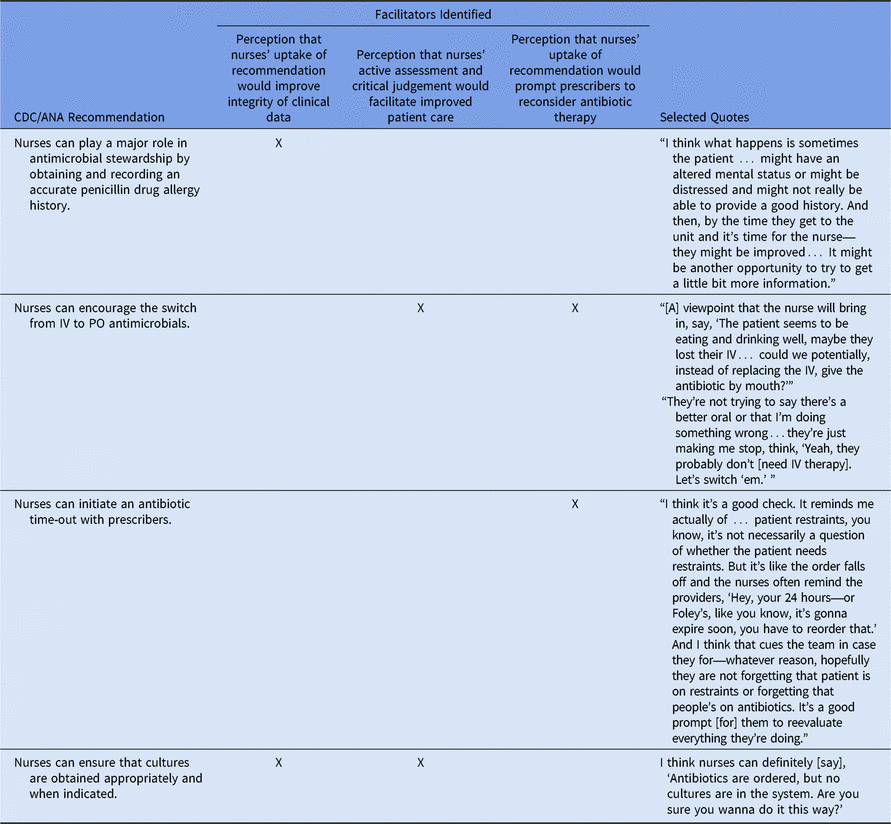
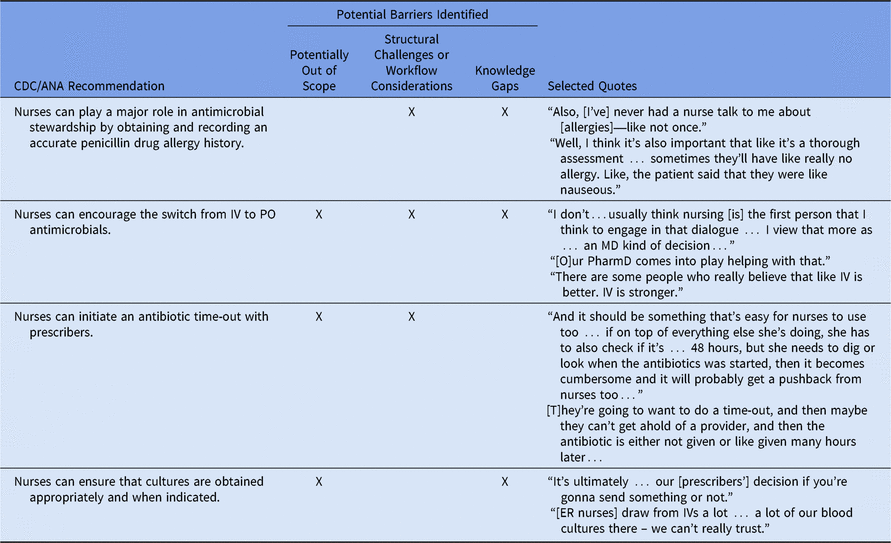
Inappropriate antimicrobial usage is associated with increasing resistance to frontline antimicrobial therapy.Reference Tacconelli, De Angelis and Cataldo 1 – Reference Couderc, Jolivet and Thiébaut 3 Interest has increased in recruiting novel stakeholders across a variety of disciplines to assist with antimicrobial stewardship (AS) in the inpatient setting.Reference Olans, Olans and DeMaria 4 – Reference Monsees, Tamma, Cosgrove, Miller and Fabre 6 The Centers for Disease Control and Prevention and the American Nurses Association (CDC/ANA) have outlined specific responsibilities for clinical nurses in antimicrobial stewardship efforts (Tables 1 and 2). 7 We previously conducted a qualitative study of nurses’ attitudes regarding CDC/ANA recommendations and found that some responsibilities were perceived to expand traditional nursing roles and thus require prescribers’ (eg, physicians and midlevel practitioners) engagement to be implemented effectively.Reference Carter, Greendyke and Furuya 8 In our follow-up, we conducted a qualitative study with prescribers to explore their attitudes towards CDC/ANA recommendations regarding nurses’ involvement in antibiotic stewardship.
Facilitators Identified With Specific CDC/ANA Recommendations Regarding Increased Nursing Involvement in Antimicrobial Stewardship

Barriers Identified to Specific CDC/ANA Recommendations Regarding Increased Nursing Involvement in Antimicrobial Stewardship

Methods
Between July 2017 and March 2018, we conducted focus groups with prescribers at 2 tertiary-care academic medical centers in New York City (hospitals A and B). A variety of prescriber specialties and levels of training were sought to allow for multiple perspectives. Hospital A is a 745-bed adult-care hospital; hospital B is a 268-bed pediatric specialty hospital. Both have long-standing AS programs comprised of ID physicians and ID pharmacists. To facilitate participation, focus groups were conducted in conjunction with existing departmental meetings, and prescribers were given the option of individual interviews to accommodate conflicting schedules. Each focus group was comprised solely of members within a particular specialty or level of training. All participants routinely prescribed antibiotics in the inpatient setting and interacted routinely with clinical nurses. A nurse researcher (E.C.) moderated group discussion, and an advanced practice nurse (A.S.) was also present. An interview guide was used to guide focus-group discussion, and questions were adapted over the course of data collection to reflect emerging themes. Data collection ceased when newly conducted focus groups yielded no new information.
Discussions were recorded and transcribed using a professional transcription service. All transcriptions were reviewed for accuracy. Data were coded by 2 members of the research team (W.G. and E.C.) in NVivo software (http://www.qsrinternational.com/nvivo/nvivo-products) and were analyzed thematically. To ensure consistent coding procedures, 50% of transcripts were independently coded by both researchers. The application of codes was compared, and discrepancies were discussed and resolved by consensus. This study was deemed exempt from approval by the Columbia University Irving Medical Center Institutional Review Board.
Results
Overall, 6 focus groups were conducted among 10 adult hospitalists, 10 internal medicine residents, 9 pediatricians, and 8 critical care nurse practitioners. All participants were familiar with AS concepts and had routine contact with clinical nurses.
When asked to reflect on current nursing roles regarding antimicrobial use, prescribers perceived that nurses’ increased presence at the bedside positioned them well to contribute to stewardship activities. For example, one hospitalist recounted that nurses can help identify patients who may have bacterial infections, “I actually try to elicit the nurse’s opinion …[b]ecause…they are…seeing the patient all the time, and they might see things that I’m not seeing…” Other participants noted an experienced nurse’s value in recognizing common side effects that may occur when a patient is receiving antimicrobials. A pediatrician stated, “If there’s a [patient with] Red Man [Syndrome]…the nurse may tell parents, ‘Don’t worry; we see this often, I’ll stop the infusion, or decrease and I’ll call the doctor,’ … a knowledgeable nurse can be very helpful to a panicky parent or to a difficult situation.”
When asked about specific CDC/ANA recommendations, prescribers were optimistic about recommendations that were perceived to easily facilitate appropriate antibiotic prescribing. For instance, regarding a recommendation that nurses help clarify penicillin allergies, it was felt that nurses’ thorough documentation of assessments would be useful for patients with altered mental status or in pediatric patients when parents may be infrequently present. In a similar manner, the recommendation that nurses incorporate best practices when obtaining blood cultures (eg, obtaining cultures prior to initiating antibiotic therapy) to facilitate accurate diagnostic testing was quite well received.
Prescribers noted several potential barriers to effective implementation of some CDC/ANA recommendations. The first overarching barrier noted was that implementation of recommendations that were perceived to significantly change nurses’ scope of practice were thought to be particularly challenging. For instance, a recommendation that nurses initiate conversations regarding a switch from intravenous to oral therapy when patients are on a 100% bioavailable agent was thought to fall more within prescribers’ responsibilities rather than nurses. Additionally, prescribers pointed to gaps within their own fund of knowledge that could create tension within an expanded nursing role. One hospitalist noted, “[I]f the providers have the knowledge gap to start with, a nurse telling you, ‘You can do this,’ is probably not gonna help.”
The second recurring barrier to implementation encompassed structural challenges related to the workflow of prescribers and nurses, and the lack of frequent face-to-face interactions. For example, among prescribers who do not practice in a geographically localized unit, it was perceived that nurses do not regularly have the opportunity for an intervention such as an antibiotic time-out. One participant recounted, “[A] time-out is when the team is already together and working together … but when are we all together discussing that? – That’s the problem.” Conversely, due to the structure of their respective units, participants from critical care and pediatric settings were more enthusiastic about the ease of nurses’ initiation of an antibiotic time-out.
Discussion
In this descriptive qualitative study of prescribers at 2 separate hospitals, prescribers were receptive to the idea of clinical nurses having some AS responsibilities. Prescribers expressed the most enthusiasm about interventions that fit within current models of practice (eg, nurses taking a thorough drug allergy assessment, rather than initiating an antibiotic time-out or facilitating the switch from IV-to-PO antibiotics). However, our study suggests that implementation of effective partnership between nurses and prescribers will likely require ongoing interdisciplinary conversations to overcome many practical challenges, particularly unaddressed knowledge needs, workflow constraints, and ambiguity about nursing scope of practice. Notably, however, the local culture on a particular unit often influenced the level of enthusiasm for a particular recommendation. For instance, the recommendation regarding the IV to PO switch was well-received on a pediatric ward, where nursing perspective regarding a patient’s ability to tolerate oral intake was perceived to be particularly useful and relevant. It follows that stewardship interventions should be tailored to the needs and resources of a particular unit or specialty. When planning further nurse-driven AS interventions, we plan to take these findings into account.
To our knowledge, this is the first qualitative study of prescribers that assesses attitudes regarding nurse-driven AS activities. Strengths of the study were the inclusion of prescribers at various levels of training across different inpatient care settings, as well as use of a dedicated coding procedure from verbatim transcripts. One limitation was that prescribers were recruited from 2 hospitals within the same medical center and may not be generalizable.
In summary, providers were receptive to the idea of increased nursing involvement in AS activities. Some perceived barriers to the ANA/CDC recommendations can likely be overcome through increased nursing and provider education, but others may require more substantial changes.
Financial support
This research was funded by the APIC Heroes Implementation Research Scholar Award Program 2017–2018, which was supported by an educational grant from Becton Dickinson (primary investigator, Carter).
Conflicts of interest
All authors report no conflicts of interest relevant to this article.