Introduction
Postpartum depression is experienced by 10–15% of mothers (O'Hara & Swain, Reference O'Hara and Swain1996). It is often associated with an inability to bond with, or find reward from, one's baby (Brockington, Reference Brockington2004; Brockington et al. Reference Brockington, Fraser and Wilson2006). Observational studies further suggest that postpartum depression is associated with impaired sensitivity towards infant emotion and disrupted mother–infant interactions (Cohn et al. Reference Cohn, Matias, Tronick, Connell and Lyons-Ruth1986; Murray et al. Reference Murray, Fiori-Cowley, Hooper and Cooper1996). Worryingly, these disruptions are associated with negative future child outcomes including attachment, behavioural, emotional and cognitive disturbances (Murray et al. Reference Murray, Cooper, Wilson and Romaniuk2003; Kim-Cohen et al. Reference Kim-Cohen, Moffitt, Taylor, Pawlby and Caspi2005; van Doesum et al. Reference van Doesum, Hosman, Riksen-Walraven and Hoefnagels2007). By investigating the impact of depression on the basic cognitive processing of infant stimuli, the current study aims to provide further understanding as to why depressed mothers' interactions with their infants are disrupted.
A mother's engagement with her infant begins in pregnancy and antenatal infant attachments and mental representations have been associated with measures of postnatal maternal sensitivity and quality of infant interactions (Siddiqui & Hagglof, Reference Siddiqui and Hagglof2000; Shin et al. Reference Shin, Park and Kim2006; Thun-Hohenstein et al. Reference Thun-Hohenstein, Wienerroither, Schreuer, Seim and Wienerroither2008). Symptoms of antenatal depression appear to be at least as common as in the postpartum period (Evans et al. Reference Evans, Heron, Francomb, Oke and Golding2001). If antenatal depression has an impact on engagement with infant stimuli it may hinder development of maternal sensitivity during pregnancy and therefore disrupt mother–infant interactions independently of postpartum depression. Indeed, there is evidence to suggest that antenatal mood is independently related to adverse infant outcomes (O'Connor et al. Reference O'Connor, Heron and Glover2002; Bergman et al. Reference Bergman, Sarkar, O'Connor, Modi and Glover2007; Rahman et al. Reference Rahman, Bunn, Lovel and Creed2007). The current study therefore investigated the impact of depression on women's processing of infant stimuli in pregnancy.
Both the inability to find pleasure in what is normally rewarding and persistent sad mood are necessary for Diagnostic and Statistical Manual of Mental Disorders, 4th edition (DSM-IV) and International Classification of Diseases (ICD)-10 diagnosis of a major depressive episode. These anhedonic symptoms have been specifically associated with disrupted reward processing networks, and reward processing and depression share common neural correlates (Naranjo et al. Reference Naranjo, Tremblay and Busto2001; Nestler & Carlezon, Reference Nestler and Carlezon2006). In mothers, the same reward networks that are activated by cocaine are activated in response to infant stimuli, including crying (Lorberbaum et al. Reference Lorberbaum, Newman, Horwitz, Dubno, Lydiard, Hamner, Bohning and George2002; Seifritz et al. Reference Seifritz, Esposito, Neuhoff, Luthi, Mustovic, Dammann, von Bardeleben, Radue, Cirillo, Tedeschi and Di Salle2003; Bartels & Zeki, Reference Bartels and Zeki2004; Nitschke et al. Reference Nitschke, Nelson, Rusch, Fox, Oakes and Davidson2004; Swain et al. Reference Swain, Lorberbaum, Kose and Strathearn2007; Noriuchi et al. Reference Noriuchi, Kikuchi and Senoo2008). It is unusual for a stimulus of negative valence to be motivationally appetitive and rewarding. In their first weeks infants will cry for many hours daily and without some reward activation, motivation to withdraw from this unpleasant stimulus may prevail. The reward system therefore plays an important role in maintaining a mother's engagement with a crying infant (Swain et al. Reference Swain, Lorberbaum, Kose and Strathearn2007). Disruption of the reward system in depression could interfere with the development and expression of such engagement and explain depressed mothers' reduced engagement with their infants.
The degree to which a mother is sensitive to her infant's emotion will rely upon her attentional engagementFootnote 1Footnote † with such displays. Whilst extensive research has suggested that our attention is preferentially engaged by threat signals (Ohman & Mineka, Reference Ohman and Mineka2001), such as a fearful face (Morris et al. Reference Morris, Ohman and Dolan1999; Georgiou et al. Reference Georgiou, Bleakley, Hayward, Russo, Dutton, Eltiti and Fox2005), recent evidence suggests that appetitive stimuli such as infant faces also preferentially engage attention. For example, adults are quicker to detect a cue that follows a neutral infant versus a neutral adult face on a dot probe task (Brosch et al. Reference Brosch, Sander and Scherer2007) and brain activity in reward centres is seen within 150 ms of presentation of infant but not adult faces (Kringelbach et al. Reference Kringelbach, Lehtonen, Squire, Harvey, Craske, Holliday, Green, Aziz, Hansen, Cornelissen and Stein2008). Attention may therefore be preferentially allocated to stimuli with survival relevance rather than on the basis of valence per se (Sander et al. Reference Sander, Grandjean and Scherer2005; Bernat et al. Reference Bernat, Patrick, Benning and Tellegen2006).
As their sole source to communicate need, non-verbal signals of infant distress become of unrivalled relevance to new mothers and it is proposed that attentional priorities will reflect this. There is evidence that mothers show differential processing of infant distress compared with non-mothers (Seifritz et al. Reference Seifritz, Esposito, Neuhoff, Luthi, Mustovic, Dammann, von Bardeleben, Radue, Cirillo, Tedeschi and Di Salle2003; Swain et al. Reference Swain, Lorberbaum, Kose and Strathearn2007). For example, in an event-related potential study, a greater neural response to intensely distressed as compared with mildly uncomfortable infant faces was found within 170 ms in mothers but not in non-mothers (Proverbio et al. Reference Proverbio, Brignone, Matarazzo, Del and Zani2006). This suggests that it is a particular processing ability of mothers to rapidly distinguish infant emotion and prioritize distress.
One explanation for the unique emotion/reward processing of distressed infant stimuli by mothers is that sex hormone changes during pregnancy result in neuroplasticity preparing women for motherhood by initiating maternal thinking and behaviour (Sheehan & Numan, Reference Sheehan and Numan2002; Kinsley et al. Reference Kinsley, Trainer, Stafisso-Sandoz, Quadros, Marcus, Hearon, Meyer, Hester, Morgan, Kozub and Lambert2006; Numan, Reference Numan2007). Indeed, sex hormone changes during the menstrual cycle have been found to influence emotion (Pearson & Lewis, Reference Pearson and Lewis2005) and reward processing (Dreher et al. Reference Dreher, Schmidt, Kohn, Furman, Rubinow and Berman2007). It is not known how early maternal development begins. As well as the psychological impact of motherhood expectancy, the hormonal profile of women in their first trimester is very different from their normal cycling profiles and it is therefore important to begin investigation at this stage of pregnancy.
The aim of the current study was to investigate whether women early in pregnancy show an attentional bias towards distressed compared with non-distressed infant faces. A further aim was to investigate whether this bias was diminished in women experiencing symptoms of depression. We predicted that pregnant women will take longer to disengage attention from distressed than non-distressed infant faces and that this effect will be reduced in women experiencing depressive symptoms. To the authors’ knowledge, no previous study has measured the allocation of attention to distressed and non-distressed infant faces. Yet infant distress in particular may be differentially processed by the maternal brain (Proverbio et al. Reference Proverbio, Brignone, Matarazzo, Del and Zani2006) and maternal response to infant distress is important to infant well-being (McElwain & Booth-Laforce, Reference McElwain and Booth-Laforce2006) and may be specifically disrupted by depression.
Method
Sample
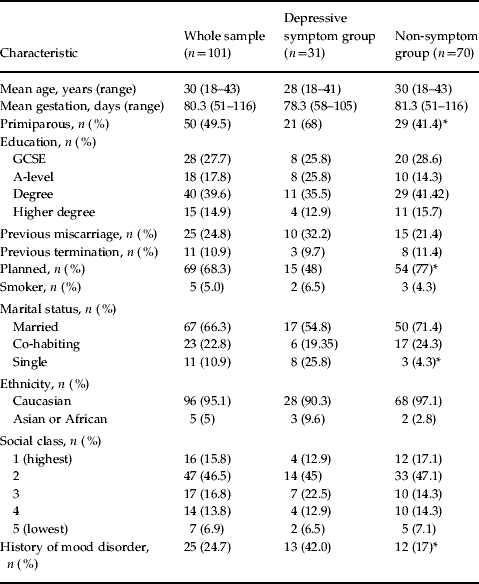
A total of 101 pregnant women were recruited through community midwives based in North Bristol Trust at 8–10 week booking appointments. Women were invited to participate if they were under 12 weeks pregnant and could speak English. Midwives invited as many women as possible until the target of 100 women was reached. The study was approved by The South East Research National Health Service Research Ethics Committee and North Bristol Trust. All participants gave informed signed consent. Women were on average at 11 weeks (s.d.=13 days) gestation at the time of testing. Their mean age was 29 (s.d.=6) years, 51 were multiparous and 31 were experiencing depressive symptoms (see Table 1). One individual was excluded from the analysis because she was breastfeeding regularly and her responses may have been influenced by associated high levels of oxytocin.
Sample demographics

GCSE, General Certificate of Secondary Education; A level, Advanced level.
* Significant difference between depressive symptom subgroups (p<0.05).
Procedure
Women who agreed to participate in the study were visited at home. Participants completed the attention task, a questionnaire regarding demographic and pregnancy information, the Clinical Interview Schedule (CIS-R) and further emotion processing tasks which are not reported here. The attention task was always completed first so that subsequent tasks will not have had an influence on results. Participants were paid £7.50 for this test session.
Measures
CIS-R
The CIS-R is a self-administered computerized interview that creates severity scores (scale 0–4) for 14 neurotic symptoms that constitute anxiety and depression (Lewis et al. Reference Lewis, Pelosi, Araya and Dunn1992). These symptoms provide a diagnosis of these disorders using algorithms according to ICD-10 criteria. The reliability and validity of the CIS-R are comparable with the composite international diagnostic interview (Lewis et al. Reference Lewis, Pelosi, Araya and Dunn1992; Brugha et al. Reference Brugha, Weich, Singleton, Lewis, Bebbington, Jenkins and Meltzer2005b). The interview is standardized and is as reliable whether conducted by a lay or trained interviewer (Lewis et al. Reference Lewis, Pelosi, Araya and Dunn1992). The computerized version shows very close agreement with the interviewer-administered version (Patton et al. Reference Patton, Coffey, Posterino, Carlin, Wolfe and Bowes1999; Bell et al. Reference Bell, Watson, Sharp, Lyons and Lewis2005). The CIS-R is widely used in community samples and traditionally uses a total symptom score threshold of 12 to categorize individuals as having a diagnosable common mental health disorder (Lewis et al. Reference Lewis, Pelosi, Araya and Dunn1992, Reference Lewis, Bebbington, Brugha, Farrell, Gill, Jenkins and Meltzer2003; Brugha et al. Reference Brugha, Morgan, Bebbington, Jenkins, Lewis, Farrell and Meltzer2003, Reference Brugha, Meltzer, Jenkins, Bebbington and Taub2005a; Targosz et al. Reference Targosz, Bebbington, Lewis, Brugha, Jenkins, Farrell and Meltzer2003).
Entry criteria for a depressive episode in ICD-10 as well as DSM-IV are a low mood and/or loss of pleasure, and at least two of seven possible associated symptoms are also required (disturbed appetite, sleep, motor responses and concentration, fatigue, poor self-esteem and suicidality). It was expected that the study would not have sufficient power to categorize women by diagnosis of depression. Furthermore, some associated symptoms may be confounded by physiological changes during pregnancy. In particular, appetite problems are suggested to be invalid to discriminate depression during pregnancy (Kammerer et al. Reference Kammerer, Marks, Pinard, Taylor, von Castelberg, Kunzli and Glover2009) and symptoms of fatigue were found in 85% of the current sample. CIS-R total scores and diagnoses are potentially problematic indicators of depression during pregnancy. Therefore, we categorized women into those with and without at least one of the ‘entry criteria’ depressive symptoms (described below) only. This was our primary approach; however, as this is not the standard use of the CIS-R analyses were also repeated using more standard methods (thresholds and diagnosis) to categorize individuals.
(1) ‘Have you had a spell of feeling sad, miserable or depressed in the past month?’ If the answer is yes and this spell has occurred for 4 days or more, or for more than 3 h on any day in the past week, participants would be given a score of 1 for depressive symptoms.
(2) ‘During the past month, have you been able to enjoy or take an interest in things as much as you usually do?’ If the answer is no, participants would score 1 for depressive symptoms.
The Edinburgh Post Natal Depression Scale (EPDS) (Cox et al. Reference Cox, Holden and Sagovsky1987) was also administered where time allowed. The EPDS is a self-report questionnaire specifically designed to screen for perinatal depression by avoiding using physical symptoms.
Attention task
Background
An attention task which has been specifically designed to look at the ability of stimuli to retain attention was derived from an established paradigm (Bindemann et al. Reference Bindemann, Burton, Hooge, Jenkins and de Haan2005) and modified to suit the current investigation.
Procedure
The task was generated using e-prime software (Psychology Software Distribution, UK). The task involves subjects focusing on a central go/no-go signal (green or red cross) on the computer screen. Two lines, one horizontal and one vertical, were also located at the screen's periphery. A red central cross signalled a no-go trial to which participants pressed the space bar. A green cross signalled a go trial. Here participants were required to make a localization judgement by making appropriate keyboard response (A=left, L=right)Footnote 2 to signal which side of the screen the vertical line had appeared. Go trials therefore require disengaging attention from the central go signal to a peripheral line target. The colour of the go/no-go signal is thought to put minimal demands on attention (Bindemann et al. Reference Bindemann, Burton, Hooge, Jenkins and de Haan2005), meaning the stimuli upon which the signal appears is processed in a mandatory fashion. If certain stimuli have an advantage in retaining attention, it will take longer to disengage attention from them and locate a peripheral target. Thus, reaction times may be slowed by the presence of specific stimuli behind the go/no-go signal. In the present task fearful, happy or neutral adult and distressed, happy or neutral infant faces appeared behind the cross.
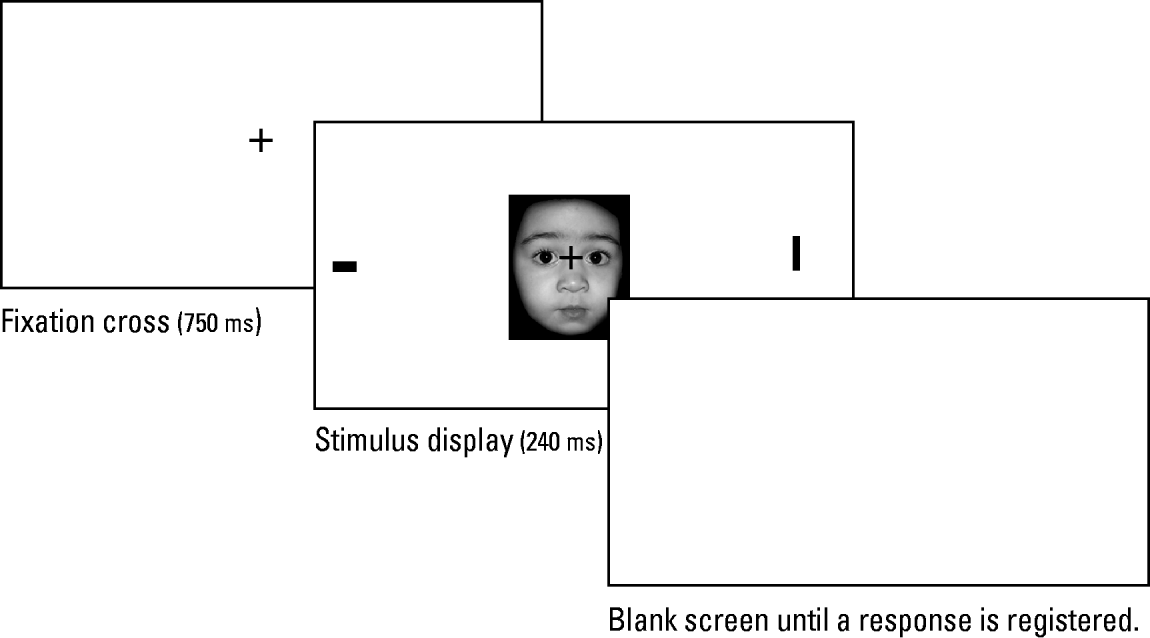
Each trial began with a black fixation cross (750 ms), followed by the stimulus display (240 ms, including the central go/no-go signal, the face stimuli and two peripheral lines), and finally a blank screen until a response was registered (see Fig. 1). Reaction time to press space for a no-go or indicate the locations of the line on a go trial was recorded. Participants were instructed to ignore pictures appearing in the task. A practice block of 36 trials with no images and a further 21 trials with adult and infant faces were included. There were then six blocks of 30 trials (20 go and 10 no-go) one for each face type condition and each followed by a rest. Trial order was randomized within blocks and block order and target line location were randomized. Face type was blocked as in Bindemann et al. (Reference Bindemann, Burton, Hooge, Jenkins and de Haan2005) to reduce possible ‘pop out’ effects (see Palermo & Rhodes, Reference Palermo and Rhodes2003). For all analyses results are for go trials. No-go trials were included to ensure participants were motivated to fixate on the go/no-go signal and thus the face.
Presentation sequence for each trial. A neutral infant trial is represented (not to scale).

Materials
Adult faces of fearful, neutral and happy expressions were taken from the Ekman set (Ekman & Friesen, Reference Ekman and Friesen1976). A total of 60 images of infant faces were taken from the Internet and shown to a convenience sample of 22 students and Bristol University staff who reported the emotion in the image. This was part of the piloting of the task before the main study reported here. The faces in each category that were most consistently rated as displaying expressions of happy [rated as a positive emotion by a mean of 99.5 (s.d.=1) % of participants], distressed (rated as a negative emotion by all participants) and neutral [rated as neutral by a mean of 76 (s.d.=13) % of participants] were used in the study. Distressed faces displayed an infant actively crying, happy faces displayed a smiling expression and neutral faces displayed no expression and closed mouths. Infant faces were cropped, converted to greyscale and matched to adult faces on brightness, contrast and positioning in Photoshop. A further sample of seven non-pregnant women recruited via university email advertisement assigned distressed, positive or neutral to each of these faces in their final appearance, using a forced choice task. Mean accuracy was 100% for distressed, 99% (range 90–100%) for happy and 95% (range 90–100%) for neutral faces. The images measured approximately 9×6 cm, the fixation cross was 0.5 cm and 1.5 cm lines appeared 14 cm left or right of the centre. The task was presented on a Toshiba laptop (screen size 33 cm×20 cm). Viewing distance was approximately 30 cm from the screen.
Analysis
The dependent measure for analysis was reaction time (ms) on accurate go trials. To investigate the influence of block type on reaction times and how this may be modulated by depressive symptoms, a mixed analysis of variance (ANOVA) with two within-subject factors defining block type (face age and face emotion) and the between-subject factor of depressive symptoms was conducted. If depressive symptoms specifically influence response to distressed infants and not negative adult faces or infant faces in general, a face age×face emotion×depression interaction will be seen.
We predicted that depressive symptoms would be associated with a diminished attentional bias towards distressed infant faces. An attentional bias towards infant faces is considered here as longer reaction times on trials when distressed infant faces appear compared with trials where non-distressed infant faces appear. As an index of women's attentional bias towards distressed infant faces, the difference between mean reaction times (ms) on distressed and non-distressed infant trials was computed for each individual. By generating an attentional bias index we reduce comparisons and can investigate the influence of depressive symptoms on this index specifically. Attentional bias indices towards distressed infants were checked for normal distribution and entered as the dependent variable in a linear regression analysis with depressive symptoms as the independent variable. These analyses were repeated first with adjustments for parity and then with adjustments for further variables. These variables were: age (years), gestation (days), emotion recognition (accuracy scores out of 60 to recognize basic emotions from the Ekman set), general reaction times (taken as raw reaction times on neutral adult face trials), desire to have children (10-point Likert scale ratings), social class (1–5), planned pregnancy (yes or no), marital status (married, co-habiting or single), previous loss (yes or no), history of mood disorder (yes or no) and fatigue scores on the CIS-R (0–4). Dummy variables were generated for categorical variables.
Results
Demographic variables
Depressive symptoms were associated with a younger age (t=−1.9, df=99, p=0.06), primiparity (χ2=6.0, df=1, p=0.015), single marital status (χ2=10.3, df=2, p=0.006), history of mood disorder (χ2=5.5, df=1, p=0.019) and an unplanned pregnancy (χ2=8.2, df=1, p=0.004). There were no significant associations between depressive symptoms and general reaction times, social class, gestation, fatigue scores, desire to have children, ability to recognize emotions or previous loss. However, as these variables are theoretically related to both depression and the attentional bias index, all were adjusted for in the final regression analysis.
Attention task accuracy
Overall accuracy for go and no-go trials was 90% in the depressive symptom group and 92% in the non-depressed group, confirming that participants were able to complete the task as instructed. Individuals whose accuracy was below 3 standard deviations of the group mean were excluded from the analysis (n=3). One individual's results were excluded as she was distracted by her phone ringing during the task.
Reaction times
Reaction time data for accurate go trials were first checked for outlying reaction times. Due to the relatively large range of reaction times across individuals and blocks, outliers were considered to be reaction times over 3 standard deviations from the block mean reaction time. Outlying reaction times in individuals' data were removed [mean 2 (s.d.=1) % of trials].
Depressive symptoms
A total of 31 women scored one or more for depressive symptoms on the CIS-R. Out of the 28 remaining in the final analysis, 10 met ICD-10 criteria on the CIS-R for a mild, three for a moderate and one for a severe depressive episode, one for a mixed depressive and anxious episode and three for non-specific neurotic disorders. Individuals who scored ⩾1 for depressive symptoms had significantly higher EPDS scores [n=17, mean=9.9 (s.d.=2.6)], compared with the non-depressed group [n=53, mean=3.4 (s.d.=2.6), mean difference=6.6, 95% confidence interval (CI) 5.1–8.0, t=9.1, df=68, p<0.0001] and depressive symptoms and EPDS scores were positively correlated (R=0.74, p⩽0.001).
ANOVA
A 3×2×2 mixed ANOVA was conducted on the data with two within-subjects factors [emotion of face (positive, negative, or neutral) and face type (adult or baby)] and a between-subjects factor of depression (symptoms or no symptoms). This revealed a main effect of face type; responses following infant faces were slower than following adult faces [F(1, 94)=5.1, p=0.027, 708 (s.d.=119) ms v. 697 (s.d.=108) ms, respectively] in line with Brosch et al. (Reference Brosch, Sander and Scherer2007). This effect did not interact with depression. There was a significant interaction between face type and emotion [F(2, 188)=3.9, p=0.021] and some evidence for an interaction between emotion and depression [F(2, 188)=3.0, p=0.055]. These interactions were qualified by a three-way interaction between face type, emotion and depression [F(2, 188)=5.1, p=0.007]. In order to interpret this interaction, we conducted further ANOVAs, for each face type. For the infant face trials this revealed a significant interaction between emotion and depression [F(2, 188)=6.8, p=0.001], whereas no interaction between emotion and depression was seen with the adult face trials [F(2, 188)=0.5, p>0.5].
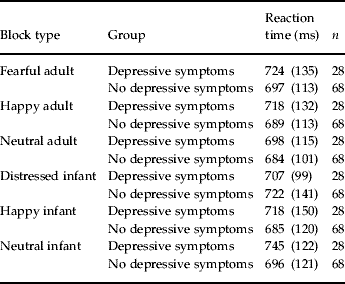
As the interaction between depression and emotion was only found for infant trials, further analysis was conducted for infant trials only. For the non-depressed group infant emotion significantly influenced response times [F(2, 130)=9.8, p<0.001]. Pairwise comparisons (with Bonferroni corrections) revealed that for non-depressed individuals, reaction times following distressed infant trials were slower than trials featuring happy infant (t=3.8, df=67, p<0.01, mean difference 25 ms, 95% CI 6–44) or neutral infant faces (t=2.8, df=67, p<0.01, mean difference 36 ms, 95% CI 17–55). For the depressed individuals there was a trend to suggest that infant emotion influenced responses [F(2, 54)=2.5, p=0.09]. However this trend was in the reverse direction to that in the non-depressed women. As can be seen in Table 2, reaction times were faster following distressed compared with happy or neutral infant faces in individuals with depressive symptoms.
Descriptive statistics for go trials by depressive symptom group

Values are given as mean (standard deviation).
Regression
As described above the effect of infant emotion is found to be associated with depressive symptoms, specifically the attentional bias towards distressed infant faces. Attentional bias indices towards distressed infant faces were computed [mean reaction times (ms) on distressed infant trial – non-distressed infant trial] and these scores are positive or negative. We hypothesized that distressed infants are prioritized over both happy and neutral infants; therefore to reduce comparisons happy and neutral were combined as ‘non-distressed’ infant facesFootnote 3.
The overall mean attentional bias index towards distressed infants for all women was 14 (s.d.=72) ms. We compared those with and without depressive symptoms on this attentional bias index using linear regression, with attentional bias index (ms) as the dependent variable and depressive symptoms as the independent variable. These analyses were performed with and without adjustment for possible confounding variables using stata version 9 (StataCorp LP, USA).
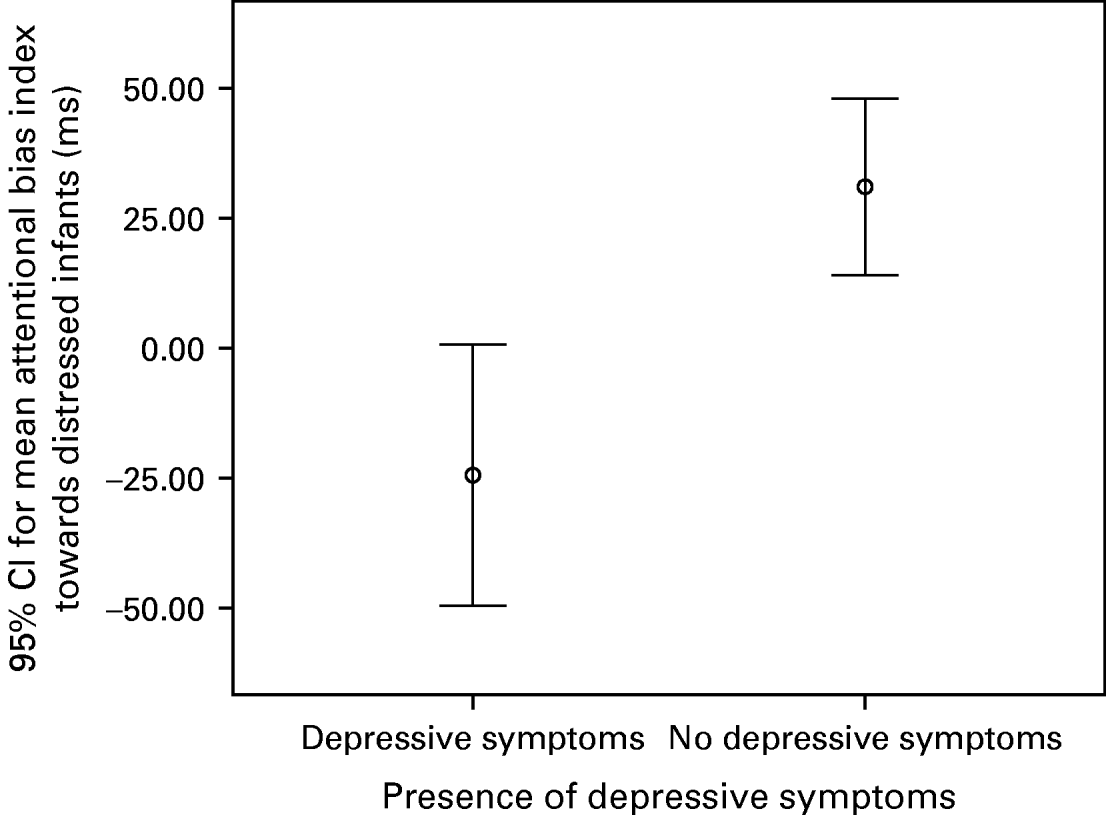
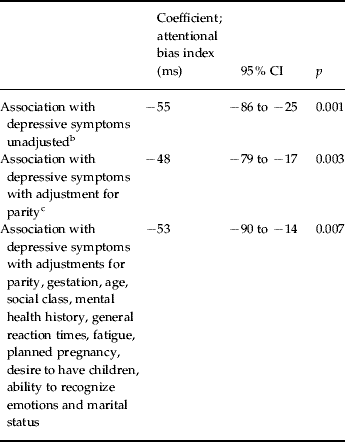
A difference of −55 (s.d.=0.8) ms (95% CI −86 to −25, p=0.001) was found between the attentional bias index of those with and without depressive symptomsFootnote 4 (Fig. 2). The attentional bias index towards distressed infants was 40 (s.d. 0.6) ms (95% CI 11–68, p=0.007) greater in multiparous compared with primiparous women. As depressive symptoms were associated with primiparity this may have been a confounding variable and analysis was repeated initially with adjustments for parity only. After a repeat of the analysis controlling for parity and further variables (see Table 3), a difference of −53 ms (95% CI −90 to −14, p=0.007) was found between the attentional bias index towards distressed infant faces in those with and without depressive symptoms.
Attentional bias index towards distressed infant faces for women experiencing depressive symptoms and women who were not. Attentional bias index=mean reaction time (ms) on distressed infant trial – non-distressed infant trial. Values are means, with 95% confidence intervals represented by vertical bars.

Univariate and multivariate associations between the presence of depressive symptoms and women's attentional bias indexFootnote a, with attentional bias index as the dependent variable

CI, Confidence interval.
a Attentional bias index=mean reaction time (ms) on distressed infant trial – non-distressed infant trial.
b Dummy variable: 0=no symptoms (n=68); 1=depressive symptoms (n=28).
c Dummy variable: 0=primiparous (n=47); 1=multiparous (n=49).
Discussion
The current study investigated women's attentional processing of emotional infant faces in early pregnancy. We found that non-depressed women were slower to disengage attention from distressed than non-distressed infant faces, which suggests an attentional bias towards distressed infants. In those with symptoms of depression this was not the case. In fact, there was a trend towards a reverse effect, where women were quicker to disengage their attention from distressed compared with non-distressed infant faces. After adjustments, attentional bias indices towards distressed infant faces in those with depressive symptoms were 53 (s.d.=0.7) ms lower than those with no symptoms. Depressive symptoms did not, however, influence the general attentional bias towards infant compared with adult faces or responses to negative compared with neutral or positive adult faces. These results suggest that depressive symptoms are already associated with a strong and specific difference in the processing of infant stimuli at the beginning of childbearing.
The attentional mechanisms behind this difference cannot be known from these findings alone; however, some speculation is possible. We predicted that depressive symptoms would be associated with the lack of an attentional bias towards distressed infant faces. This would be reflected by no differences in reaction times to disengage from distressed compared with non-distressed infant faces in those with depressive symptoms. This finding could be consistent with general attention impairments in depression, where negative ruminations impede ability to engage with other aspects of life. However, the trend towards faster reaction times to disengage from distressed compared with non-distressed infant faces in the depressive symptom group may imply facilitated disengagement of attention possibly through active avoidance of these stimuli.
Another explanation for the relatively faster disengagement from distressed infant faces in the depressive symptom group is relatively slower disengagement from non-distressed infant faces. Women with depressive symptoms were particularly slow on trials where infant faces expressed neutral expressions (see Table 2). Depression is known to be associated with abnormal processing of neutral stimuli (Leppanen et al. Reference Leppanen, Milders, Bell, Terriere and Hietanen2004) and the ambiguity of these infant stimuli may have hindered depressed individuals' disengagement from them. However, this does not explain why depressed women's reaction times were faster to disengage from distressed compared with happy infant faces. Moreover, raw reaction times to disengage from distressed infant faces were faster in the depressive symptom group than the non-depressed group whilst for all other block types the reverse was seen (see Table 2). As depression is generally associated with slower motor responses (Sobin & Sackeim, Reference Sobin and Sackeim1997) our data suggest that distressed infant faces speeded up disengagement in the depressive symptom group.
Depressive symptoms were not associated with differential responding to negative adult faces. Adult faces displayed fear, a specific negative emotion signalling threat, whereas infant faces displayed non-specific distress. Nonetheless, this suggests that women with depressive symptoms did not show differential processing of negative stimuli in general. As previous research has demonstrated that depression is associated with a heightened bias towards negative adult faces (Leppanen et al. Reference Leppanen, Milders, Bell, Terriere and Hietanen2004), the absence of this association could suggest that women in this study were not experiencing clinical levels of depression. This result could also be explained by the short presentation time of faces in the current task (240 ms). Increased biases towards fearful faces have been found in depressed individuals during prolonged processing on tasks with presentation times over 500 ms only (Williams et al. Reference Williams, Kemp, Felmingham, Liddell, Palmer and Bryant2007). Depressed women's faster responses to remove attention from distressed infant faces may also appear inconsistent with cognitive biases towards negative stimuli (Leppanen et al. Reference Leppanen, Milders, Bell, Terriere and Hietanen2004) in depression. However, whilst processing of most negatively valenced stimuli involves the defensive system (Bradley et al. Reference Bradley, Codispoti, Cuthbert and Lang2001), to ensure that they evoke an appetitive response the processing of distressed infants will also involve the reward system. The disrupted reward system of depressed women may produce an abnormal response to infant distress.
Moreover, there is an example of a mental disorder where sufferers may show attentional avoidance of negative stimuli. Phobia has been associated with preferential detection of feared stimuli (Mogg & Bradley, Reference Mogg and Bradley2006). However, eye-tracking technologies have found that compared with controls, phobic individuals show more averted eye gaze from feared stimuli once they have been detected (Horley et al. Reference Horley, Williams, Gonsalvez and Gordon2004; Pflugshaupt et al. Reference Pflugshaupt, Mosimann, von Wartburg, Schmitt, Nyffeler and Muri2005). This suggests greater attentional avoidance of feared stimuli in phobics. Relatively faster disengagement from distressed infant faces in depressed pregnant women could then resemble a phobic response.
Whatever the underlying mechanism, if depressive symptoms continue to be associated with disrupted infant emotion processing, these findings may provide insight into observational evidence that suggests that depressed mothers are less engaged by their infants and withdraw from infant signals of distress (Cohn et al. Reference Cohn, Matias, Tronick, Connell and Lyons-Ruth1986; Murray et al. Reference Murray, Fiori-Cowley, Hooper and Cooper1996). Programmes to work on maternal sensitivity and in particular understanding infant crying, such as the Keys to Care Giving (Spietz et al. Reference Spietz, Johnson-Crowley, Sumner and Bernard1990), have preliminarily been shown to improve mother–child interactions (Jung et al. Reference Jung, Short, Letourneau and Andrews2007). The finding that processing of infant emotion is already disrupted by depression in early pregnancy suggests that it could be relevant to apply such programmes earlier in the childbearing transition.
To the authors' knowledge, the finding in non-depressed pregnant women of an attentional bias towards distressed compared with non-distressed infant faces is novel. It is not yet known whether this attentional bias is also seen in non-pregnant women or whether changes in processing of infant emotion have already occurred even earlier in pregnancy. The finding that this attentional bias is more apparent in multiparous women suggests that it may develop during childbearing or childrearing.
Limitations
Some limitations of the study are noted. The study was cross-sectional and looked at women in early pregnancy only. Having no comparison group of non-pregnant women limits what can be concluded about attentional processing of infant emotion in women generally or in pregnancy specifically. In addition, without longitudinal investigation as to whether the findings predict women's processing of infant emotion after birth, the relevance to mother–infant interactions and ultimately infant outcomes can only be speculative. During early pregnancy response to infant stimuli may be a reflection of the initial psychological adjustment to pregnancy and forthcoming demands of motherhood. The effect of depressive symptoms on infant processing during early pregnancy may not, therefore, be the same as during later stages of childbearing and thus our findings may only provide insight into the expression of depressive symptoms at this stage.
This study looked at the relationship between attentional processing and depressive symptoms within a non-clinical sample and the current study did not have sufficient power to look conclusively at women receiving a diagnosis for depression. Disrupted neurocognitive systems may be associated with specific emotional states rather than disorders assigned by diagnostic criteria (Naranjo et al. Reference Naranjo, Tremblay and Busto2001). However, the implications for pregnant women receiving a diagnosis of depression by a psychiatrist according to DSM-IV criteria are unclear.
In the current task participants were instructed to look for peripheral lines and ignore pictures. They were thus directed to disengage their attention from infant stimuli. The finding that depressive symptoms alter processing of distressed infants when the participants' task was to disengage from them does not necessarily mean that depressive symptoms disrupt the ability to purposefully engage with distressed infants. What the results would imply, however, is that in the absence of depressive symptoms an attentional bias towards distressed infants occurs when purposeful attention is being directed elsewhere. It is this possibly uncontrolled preferential processing of distressed infants that appears to be diminished in those with depressive symptoms. The implication of this on real-life response to infant distress requires further investigation.
Conclusion
The current findings provide evidence that in early pregnancy depressive symptoms are associated with differential attentional processing of infant emotion. One interpretation of these findings is that a dysfunctional reward processing system in those with depressive symptoms disrupts the development of a maternal response to infant distress during pregnancy. Additional work, however, is essential to understand the neurocognitive mechanisms underlying the attentional differences seen here and will require neuro-imaging and eye-tracking technologies. A follow-up of this study will investigate these attentional biases in late pregnancy, after birth and in non-pregnant women. An important future direction is to assess whether women's attentional processing of infant stimuli (as measured by cognitive tasks) is associated with observable behaviour during infant face-to-face interactions and with infant outcomes. If this is the case, attention tasks may in the future provide objective measures to help understand and identify vulnerable mother–infant dyads before the infant is born.
Acknowledgements
This study was supported by a Medical Research Council studentship held at the University of Bristol by R.P. The participants' payment of £7.50 was given for the additional tasks they completed at the test session, which was supported by a British Academy small grant held by I.P.-V. We thank the Community Midwifery team based at Southmead Hospital who greatly assisted with recruitment and the women who took part in the study.
Declaration of Interest
None.