In an introductory abstract algebra class, the following definition plays a key role in the development of the hierarchy of integral domains (see for instance [Reference Fraleigh21, Reference Gallian22, Reference Hungerford29]).
Definition 1 (The classic UFD definition).
Let D be an integral domain. Then, D is a unique factorisation domain (UFD) if each nonzero nonunit of D can be written as a product of irreducible elements and whenever

where each
$x_i$
 and
$y_j$
 is irreducible, then:
-
(1) $n=m$
 and
-
(2) there is a permutation $\sigma $
so that
$x_i = u_i y_{\sigma (i)}$
for
$1\leq i\leq n$
, where
$u_i$
is a unit in D.


A deeper dive into the topic generates many other conditions equivalent to the UFD property (also known as the factorial property). Most of these equivalencies can be found in classical sources (such as the papers [Reference Cohn17, Reference Samuel30]) and deal with the ideal theory of D. Another good general reference for UFDs is the monograph [Reference Weintraub32]. In this note, we show, using the relatively new property known as length-factorial, that the classic definition above can be surprisingly altered so that only irreducible factorisations of equal length have to be checked.
Over the past 50 years, the study of factorisation properties of integral domains, and more generally commutative cancellative monoids, has grown into its own discipline (for instance, see the monographs [Reference Geroldinger, Grynkiewicz and Zhong25] or [Reference Geroldinger and Halter-Koch26]). As factorisation problems in rings and integral domains are actually factorisation problems in the structure’s associated multiplicative monoid, the literature in this area has tended to focus on the more general setting of commutative cancellative monoids. Hence, we can define a commutative cancellative monoid to be a unique factorisation monoid (UFM) (or factorial monoid) by making the necessary minor modification in the above-mentioned classic UFD definition. While we will show that the classical axioms for a UFD can be simplified, this simplification will not hold in the more general monoidal setting. While the importance of ring (or domain) properties may not be reflected in the recent literature focusing on monoid factorisation, these modified axioms demonstrate that ring properties do play a key role in element factorisations and highlight that classical factorisation in integral domains can be a surprisingly different arena.
Our work here is another in a long string of attempts to classify algebraic objects based on their factorisation properties. This began with the fundamental paper of Carlitz [Reference Carlitz6], which characterises algebraic number rings that are half-factorial. The interested reader can find more related work in [Reference Baeth, Chapman and Gotti4, Question 7.8 and its associated conjecture], where the the length-factorial and half-factorial properties are considered in semirings. While the length-factorial property is fairly new, it has been the focus of numerous works (see [Reference Baeth, Chapman and Gotti4, Reference Bu, Vulakh and Zhao5, Reference Chapman, Coykendall, Gotti and Smith9, Reference Coykendall and Smith19, Reference García Barroso, García-Marco and Márquez-Corbella23]). We note that Krull monoids that are length-factorial have been recently characterised by Geroldinger and Zhong in [Reference Geroldinger and Zhong27].
For a commutative cancellative monoid M, let
$\mathcal {A}(M)$
 represent its set of irreducible elements. If every nonunit of M can be written as a product of irreducible elements, then M is called atomic. Hence, in the above-mentioned classic UFD definition, a UFD (respectively, UFM) is an atomic integral domain (respectively, monoid) that satisfies properties (1) and (2). If for a commutative cancellative monoid M we set
$M^\times $
 to be the set of units of M, then the quotient monoid,
$M_{\text {red}}= M/M^\times $
 has a unique unit. We call
$M_{\text {red}}$
 the reduction of M and note that by various arguments in [Reference Geroldinger and Halter-Koch26],
$M_{\text {red}}$
 exhibits the same irreducible factorisation properties as does M. Hence, without loss throughout the remainder of our work, we assume that our monoids are reduced. Under this reduced assumption, we call an irreducible factorisation
$\alpha _1\cdots \alpha _n=\beta _1\cdots \beta _m$
 in M nondegenerate if
$\alpha _i \neq \beta _j$
 for
$1 \le i \le n$
 and
$1 \le j \le m$
 . Thus, in a given nondegenerate irreducible factorisation, cancellation of irreducible elements is not possible.
We proceed by focusing on two variations of the factorial property in the more general setting. The first of our two variations was introduced 50 years ago by Zaks [Reference Zaks33]. These domains and monoids have been a popular topic in the literature and a survey of related papers can be found in [Reference Chapman, Coykendall, Chapman and Glaz8].
Definition 2. Let M be an atomic commutative cancellative monoid. Then, M is a half-factorial monoid if whenever

where each
$x_i$
 and
$y_j$
 is an atom, then
$n=m$
 .
While the last definition essentially eliminates condition (2) from the UFM definition, our next new class of factorial-like monoids focuses on eliminating (in some sense) condition (1).
Definition 3. Let M be an atomic commutative cancellative monoid. Then, M is length-factorial if whenever

where each
$x_i$
 and
$y_j$
 is an atom, then there is a permutation
$\sigma $
 so that
$x_i = y_{\sigma (i)}$
 for
$1\leq i\leq n$
 .
As one might expect, we will call an integral domain D half-factorial (respectively, length-factorial) if its multiplicative monoid
$D \setminus \{0\}$
 is half-factorial (respectively, length-factorial). We next offer some basic examples.
Examples 4. By a well-known theorem of Carlitz [Reference Carlitz6], any ring of algebraic integers of class number 2 is a half-factorial domain that is not a factorial domain. If A is a proper subfield of the field K, then
$A+XK[X] = \{f(X)\,\mid \, f(0)\in A\}$
 is a half-factorial domain that is not factorial. (If
$\alpha \in K$
 and
$\alpha \not \in A$
 , then
$X^2=X\cdot X = (\alpha X)\cdot (\alpha ^{-1}X)$
 ; see [Reference Chapman, Coykendall, Chapman and Glaz8, Example 3].) Large classes of Krull monoids are known to be half-factorial; for instance (see [Reference Chapman, Krause and Oeljeklaus15]),

where
$\mathbb {N}_0$
 represents the set of nonnegative integers. Additional constructions in the language of Dedekind domains can be found in [Reference Chapman, Coykendall, Chapman and Glaz8, Propositions 13, 15 and 16].
With regards to the length-factorial property, any commutative cancellative monoid generated by two elements is length-factorial [Reference Chapman, Coykendall, Gotti and Smith9, Corollary 3.3]. This condition characterises length-factorial monoids for the class of Puiseux monoids (additive submonoids of
$\mathbb {Q}_{\ge 0}$
 [Reference Chapman, Gotti and Gotti13, Proposition 4.25]), which includes the class of numerical monoids (additive submonoids of
$\mathbb {N}_0$
 ). Length-factorial Krull monoids have been recently characterised with respect to their class groups in [Reference Geroldinger and Zhong27, Proposition 1.1]. One simple example is the block monoid on the cyclic group
$\mathbb {Z}_3$
 (
$\mathcal {B}(\mathbb {Z}_3)$
 ), which can be expressed as the Diophantine monoid

We close here by noting that without much additional work, the arguments in [Reference Carlitz6] can be used to show that any ring of algebraic integers of class number greater than 2 is an atomic domain that is neither half-factorial nor length-factorial.
The next result follows directly from the three given definitions. In Figure 1, we offer a Venn diagram relationship of our three properties in the general monoidal setting.
The relationship concerning factorial properties in general atomic monoids.

Theorem 5. Let M be a commutative cancellative monoid. Then, M is factorial if and only if M is half-factorial and M is length-factorial.
It follows easily using the examples cited above that relationships involving Definitions 2 and 3 (as illustrated in Figure 1) contain no further refinements. Our goal is to show that in the case of an integral domain, there is a significant refinement. We will need some definitions to describe our approach. If we let
$\mathcal {F}(\mathcal {A}(M))$
 represent the free commutative monoid over
$\mathcal {A}(M)$
 , then we view the factorisations of a nonunit
$x\in M$
 as elements in the free monoid. In other words,

can be viewed in
$\mathcal {F}(\mathcal {A}(M))$
 as

If
$M^\bullet $
 represents the set of nonunits of M, then for
$x\in M^\bullet $
 , set

to be the set of irreducible (atomic) factorisations of x in M and

to be the complete set of factorisations in M. Notice that there is a unique homomorphism

where
$\pi (Z(x))=x$
 for all irreducibles
$x\in \mathcal {A}(M)$
 called the factorisation homomorphism of M. We further set

to be the set of lengths of x in M. For simplicity, if
$z\in Z(x)$
 , we set
$|z| = \sum _{\mathcal {A}(M)}k_i$
 to be the length of the factorisation z of x.
The Betti graph
$\nabla _b$
 of b is the graph whose set of vertices is
$Z(b)$
 having an edge between factorisations
$z,z' \in Z(b)$
 precisely when z and
$z'$
 share an atom.
Definition 6. An element b of M is a Betti element if and only if its Betti graph is disconnected.
We let
$\text {Betti}(M)$
 denote the set of Betti elements of M. Betti elements have proven to be vital in the computation of combinatorial constants related to nonunique factorisations, especially in affine monoids (additive submonoids of
$\mathbb {N}_0^k$
 ; see [Reference Chapman, Garcá-Sánchez, O’Neill and Ponomarenko10–Reference Chapman, García-Sánchez, Llena, Ponomarenko and Rosales12, Reference García-Sánchez, Ojeda and Rosales24]) and Puiseux monoids (additive submonoids of
$\mathbb {Q}_0$
 ; see [Reference Chapman, Jang, Mao and Mao14, Reference Correa-Morris and Gotti18, Reference Gotti and Gotti28]). A more general treatment of Betti elements can be found in [Reference Chapman, Garcá-Sánchez, O’Neill and Ponomarenko10]. We offer some examples to illustrate the idea behind Betti elements.
Examples 7. We return to the monoid U introduced in the previous examples. Using the existing program structure in the GAP programming language (see [Reference Delgado, García-Sánchez and Morais20, 31]),
$\mathcal {A}(U) = \{ (1,0,0,1), (1, 0, 1, 0), (0,1,0,1), (0,1, 1, 0)\}$
 and
$\text {Betti}(U) = \{(1,1,1,1)\}$
 . Note that the two atomic factorisations of
$(1,1,1,1)$
 are
$(1,0,0,1)+(0,1,1,0) = (1,0,1,0) + (0,1,0,1)$
 .
We now use an example that is not half-factorial. Let S be the numerical monoid generated by 11, 12, 13, 16, 17, 18 and 21 (that is,
$S=\langle 11, 12, 13, 16, 17, 18, 21\rangle $
 ). Again, using the GAP program, we identify the Betti elements of S as
$\text {Betti}(S)= \{24, 28, 29, 30, 32, 33, 34, 35, 36, 37, 38, 39, 42, 43, 44 \}$
 . We represent the factorisation
$x_1\cdot 11 + x_2\cdot 12 + x_3\cdot 13 + x_4 \cdot 16 + x_5 \cdot 17 + x_6 \cdot 18 + x_7\cdot 21$
 by the notation
$(x_1, x_2, x_3, x_4, x_5, x_6, x_7)$
 . The factorisations of 43 and 45 in S are as follows:

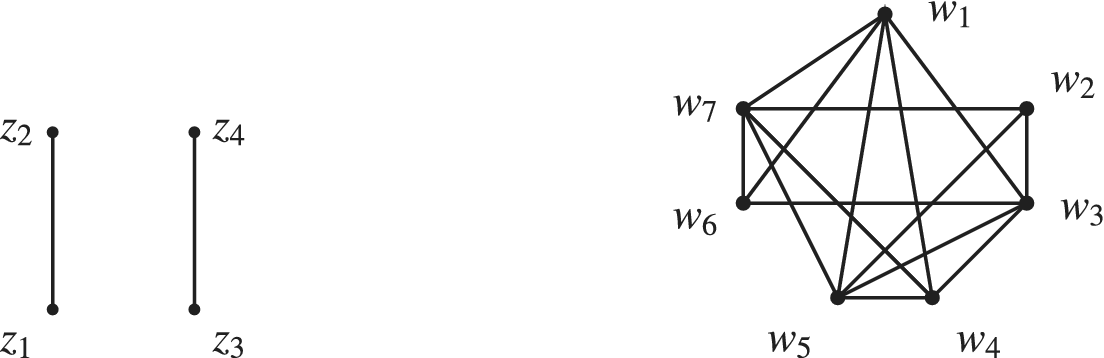
In Figure 2, we exhibit the factorisation graphs of the Betti element 43 (on the left) and the non-Betti element 45 (on the right).
$\nabla _{43}$
 (left) and
$\nabla _{45}$
 (right) in
$S=\langle 11, 12, 13, 16, 17, 18, 21\rangle $
 .

The length-factorial condition is an extremely strong property and forces a strict restriction on the possible form of a nondegenerate irreducible factorisation. We compile a list of conditions equivalent to length-factoriality which have appeared recently in the literature. In the following, let
$\mathcal {Q}(M)$
 represent the quotient group (or Grothendieck group, see [Reference Chapman, Coykendall, Gotti and Smith9, Section 2.2]) of M. If
$\sigma $
 is any equivalence relation on M, then
$\sigma $
 is called a congruence if it respects the operation of M (see again [Reference Chapman, Coykendall, Gotti and Smith9, Section 2.2]).
Theorem 8. Let M be a commutative cancellative atomic monoid. The following conditions are equivalent.
-
(1) The monoid M is length-factorial and not factorial.
-
(2) We have $\text {Betti}(M)=\{x\}$
and x has exactly two factorisations of differing lengths into irreducible elements of M. -
(3) There exists in M a nondegenerate irreducible factorisation
(1) $$ \begin{align} x=\pi_1^{k_1}\cdots \pi_s^{k_s} = \tau_1^{t_1}\cdots \tau_r^{t_r}, \end{align} $$where $\sum _{1\leq i\leq s} k_i> \sum _{1\leq j\leq r} t_j $
and every nondegenerate irreducible factorisation of M is of the form
$x^n$
for
$n\geq 1$
.
-
(4) There exists an $a\in \mathcal {A}(M)$
such that
$\mathcal {A}(M)\backslash \{a\}$
and
$a- \mathcal {A}(M)\backslash \{a\}$
are integrally independent sets in
$\mathcal {Q}(M)$
. -
(5) The congruence $\ker \pi =\{ (z_1,z_2)\in Z(M)^2 \mid \pi (z_1)=\pi (z_2) \}$
on
$Z(M)$
is cyclic and nontrivial.


The factorisation (1) is referred to in [Reference Coykendall and Smith19] as the master factorisation of M. We also note the importance in condition (2) of the theorem that the Betti element has exactly two irreducible factorisations of differing length. The monoid U introduced in our first set of examples has a unique Betti element, but is not length-factorial.
Proof. The equivalence of conditions (1) and (3) is due to [Reference Coykendall and Smith19, Proposition 2.9], the equivalence of conditions (1) and (2) is due to [Reference Chapman, Garcá-Sánchez, O’Neill and Ponomarenko10, Theorem 4.7], and the equivalence of conditions (1), (4) and (5) is established in [Reference Chapman, Coykendall, Gotti and Smith9, Theorem 3.1]. The reader is directed to those sources for precise proofs.
Based on the master factorisation property, we can make an important deduction concerning length-factorial monoids that are not factorial. Some past definitions from the literature will be of interest here. An integral domain D which is atomic and has finitely many atoms is called a Cohen–Kaplansky domain (first studied in [Reference Cohen and Kaplansky16] and then more extensively in [Reference Anderson and Mott3] in which the terminology was defined). In a broader sense, an atomic domain D that has finitely many nonassociated nonprime irreducible elements is known as a generalised Cohen–Kaplansky domain (or generalised CK-domain) and is explored in detail in [Reference Anderson, Anderson and Zafrullah1]. We extend these definitions to atomic monoids in the obvious manner.
Corollary 9. Let M be an atomic monoid that is length-factorial and not factorial with master factorisation (1). Every nonprime irreducible of M appears in (1), and hence M must have finitely many nonprime irreducible elements. Consequently, M is a generalised CK-monoid.
Proof. By definition, every nonprime irreducible of M appears in a nondegenerate irreducible factorisation, so it must appear somewhere in the master factorisation. Hence, there can be at most finitely many nonassociated nonprime irreducibles.
The last corollary allows us to improve Theorem 5 for integral domains (as illustrated in Figure 3).
The relationship concerning factorial properties in atomic integral domains.

Theorem 10. An integral domain D is factorial if and only if it is length-factorial.
The original proof of this result from [Reference Coykendall and Smith19] considers cases predicated on the form of the master factorisation on a case-by-case basis. We offer a different proof using first principles from commutative algebra which reduces D to the much simpler local case and exploits some basic properties of CK-domains.
Proof. If D is factorial, then clearly D is length-factorial. Hence, we assume that D is length-factorial and assume for the sake of contradiction that it is not factorial.
Since D is length-factorial, Corollary 9 shows that there are only finitely many nonprime irreducibles (and at least one, as D is not factorial), and so if S is the multiplicative set of all elements that can be factored into primes (or units) of D, then

is still length-factorial and is also a CK-domain. To further this reduction, we note that [Reference Cohen and Kaplansky16, Theorems 2 and 7] show that:
-
• R has finitely many maximal ideals;
-
• any irreducible of R lies in only one prime (maximal) ideal of R;
-
• there is a one-to-one correspondence between irreducibles of R contained in the maximal ideal M and the irreducibles of the localisation $R_M$
(up to associates in each ring).

These reductions allow us to assume that we have a nonfactorial, length-factorial domain R that is local (that is, has a unique maximal ideal). In addition, [Reference Anderson and Mott3, Theorem 4.3] shows that if R is a local CK-domain, then
$\overline {R}$
 , the integral closure of R, is a local PID and there is an
$n\in \mathbb {N}$
 such that
$x^n\in R$
 for all
$x\in \overline {R}$
 .
Using the above-mentioned notation, we let R be our local length-factorial CK-domain,
$\overline {R}$
 its integral closure, a PID with maximal ideal generated by
$\pi $
 , and
$n\in \mathbb {N}$
 such that
$x^n\in R$
 for all
$x\in \overline {R}$
 . If
$\alpha $
 and
$\beta $
 are nonzero nonunits in
$\overline {R}$
 , we can write

where
$u,v$
 are units in
$\overline {R}$
 and
$a,b\in \mathbb {N}$
 . So, we select
$\alpha $
 and
$\beta $
 nonassociate irreducibles such that a and b are minimised. We first observe that if
$a=b$
 , then
$\alpha ^n$
 is associated (in R) with
$\beta ^n$
 , which contradicts length-factoriality. If, however (and without loss of generality) we have
$a<b$
 , then we call on the additive structure of R (which bifurcates from the smoother ‘monoid only’ case). Note that
$\alpha +\beta $
 can be written (as an element of
$\overline {R}$
 ) as
$\pi ^a(u+v\pi ^{b-a})$
 . Since
$\overline {R}$
 is also local,
$u+v\pi ^{b-a}$
 is a unit in
$\overline {R}$
 and by the minimality of a, it follows that
$\alpha +\beta $
 is also irreducible. Thus,
$\alpha $
 and
$\alpha + \beta $
 are irreducibles of R, and since
$a<b$
 are minimal, this means
$\alpha $
 and
$\alpha +\beta $
 must be associated in R and hence
$\alpha $
 divides
$\beta $
 , which is our desired contradiction.
Here is an alternate proof of Theorem 10 that again uses the properties of a generalised CK-domain as well as some past results from the theory of nonunique factorisations. An atomic monoid M is said to be square-factorial if for atoms
$u, v$
 and w of M,
$u^2=vw$
 implies that u and v are associates (see [Reference Anderson, Chapman, Halter-Koch and Zafrullah2, page 207]). Note that if M is not square-factorial, then it is not length-factorial. If D is an atomic length-factorial domain, then Corollary 9 establishes that it is a generalised CK-domain. A generalised CK-domain that is not factorial is not square-factorial by [Reference Anderson, Chapman, Halter-Koch and Zafrullah2, Theorem 4.6]. This completes the argument.
As a corollary to Theorem 10, a nonfactorial integral domain always contains a nondegenerate irreducible factorisation of equal length.
Corollary 11 (Bonus).
Let D be an atomic integral domain that is not factorial. There exists a positive integer
$n\geq 2$
 and irreducible elements
$\alpha _1, \ldots , \alpha _n, \beta _1, \ldots , \beta _n$
 such that

is a nondegenerate irreducible factorisation in D.
In fact, we have now shown that the following is an equivalent definition of the UFD property.
Definition 12 (Alternative UFD definition).
Let D be an integral domain in which every nonzero nonunit of D can be factored as a product of irreducibles. Then, D is a UFD if whenever

where each
$x_i$
 and
$y_j$
 is irreducible, then there is a permutation
$\sigma $
 so that
$x_i = u_iy_{\sigma (i)}$
 for
$1\leq i\leq n$
 , where
$u_i$
 is a unit in D.
We note that the initial condition in both the classic and alternate definitions, that the domain be atomic, is essential. While not emphasised in an introductory course, there are relatively simple examples of integral domains that fail this property. One such example,

can be found (with a detailed explanation) in [Reference Chapman7, Example, page 166].
Can the alternate UFD definition be further improved? In [Reference Anderson, Chapman, Halter-Koch and Zafrullah2], the authors explore several types of monoids and integral domains that generalise the factorial property. Here is one that is particularly relevant to our current discussion.
Definition 13. Let M be an atomic commutative cancellative monoid and suppose that
$n\geq 2$
 is a positive integer. Call M quasi-n-factorial if whenever

for atoms
$\alpha _1,\ldots , \alpha _n,\beta _1, \ldots , \beta _n$
 , then there is a permutation
$\sigma $
 so that
$\alpha _i$
 and
$\beta _{\sigma (i)}$
 are associates.
Notice by the definition (and its obvious extension) that an atomic monoid M is length-factorial if and only if it is quasi-n-factorial for all positive integers
$n>1$
 . There are several examples constructed in [Reference Anderson, Chapman, Halter-Koch and Zafrullah2, Examples 2.3, 2.4 and 2.5] of atomic monoids that are quasi-n-factorial and neither factorial nor length-factorial. The paper goes on to explore conditions on Krull (and more specifically Dedekind) domains which would force such a domain to be quasi-n-factorial and not factorial. No specific construction is offered and the existence of such a domain remains open. Hence, we close with the following problem.
Problem 14. Does there exist an atomic integral domain that is quasi-n-factorial for some
$n\geq 2$
 but not factorial?
Note that if the answer is ‘no’, then the n in the alternate UFD definition could be changed to any specific integer you like (including 2).
Acknowledgement
It is a pleasure for the authors to thank the referee for the careful review of the manuscript, which included several suggestions that greatly improved our paper.