Introduction
Longer lifespans, a low birth rate, and widespread industrialization have contributed to an increasing number of older adults’ residing in nursing homes in Taiwan. Nursing home placement is well recognized as a stressful life event, and depression is common in this setting (Morley, Reference Morley2010). Studies in Western countries have reported that depression is prevalent in 21%–44.3% of nursing home residents (Jongenelis et al., Reference Jongenelis2007; Pramesona and Taneepanichskul, Reference Pramesona and Taneepanichskul2018) and ranges from 52% to 54% for residents in Taiwan (Lin et al., Reference Lin, Wang, Chen, Wu and Portwood2005; Tsai et al., Reference Tsai, Chung, Wong and Huang2005; Tsai et al., Reference Tsai, Wong, Tsai and Ku2008). Age and physical status have been demonstrated to be predictors of depression for nursing home residents (Juratovac, Reference Juratovac2009; Majerovitz, Reference Majerovitz2007; McDougall et al., Reference McDougall, Matthews, Kvaal, Dewey and Brayne2007), which can be buffered by social support (Patra et al., Reference Patra2017). The finding of Patra et al. (Reference Patra2017) suggests that increasing social support could alleviate depressive symptoms and might reduce the percentage of nursing home residents with depression in Taiwan.
Social support is a mechanism that alleviates life stress and concurrently promotes wellness and health. In the context of older adults, social support from family is closely related to health (Shin et al., Reference Shin2008; Wang et al., Reference Wang, Wu and Liu2003). This is especially important in nursing homes, where families are integral to helping residents experience a sense of belonging, thus reducing the consequences of social isolation (Miller, Reference Miller2019). Therefore, it is unsurprising that depression in nursing home residents has been shown to be statistically correlated with family members’ involvement (Patra et al., Reference Patra2017).
Family involvement is a “multiple roles” behavior, which, in the Western context, includes hands-on assistance, overseeing, and/or managing care, providing socioemotional support, and contributing to the community by enhancing the quality of life (QOL) of residents (Puurveen et al., Reference Puurveen, Baumbusch and Gandhi2018). In a Taiwanese study, the meaning ascribed by family members to making nursing home visits was captured by five major themes: hoping for recovery, ensuring care quality, honoring filial/karmic responsibility, maintaining family relationships, and trying to mitigate their guilt (Tsai and Tsai, Reference Tsai and Tsai2012). Family members’ decision to continue in-person visits with nursing home residents or their visiting involvement are the on basis of those meanings/roles.
Furthermore, family involvement has been shown to be a strong predictor of family members’ perceptions of nursing home residents’ QOL (Roberts and Ishler, Reference Roberts and Ishler2018). In Western studies, three specific types of family involvement—visiting the nursing home, providing personal care, and communicating with nursing home staff—have been found to be related to families’ perceptions of residents’ QOL. Previous research has demonstrated that in-person visits (Backhaus et al., Reference Backhaus, Hoek, de Vries, van Haastregt, Hamers and Verbeek2020) or smartphone-based videoconferencing visits (Tsai et al., Reference Tsai, Cheng, Shieh and Chang2020) have a positive effect on residents’ health. Family involvement is a central element for the provision of individualized care.
Family members whose perceived motivation for visiting a nursing home resident is for emotional maintenance and a sense of responsibility for monitoring care quality are more likely to experience stress or depression (Tsai and Tsai, Reference Tsai and Tsai2013). A recent study reported family caregivers (FCGs) of patients receiving dialysis had high levels of depression when their family member had high levels of depression, suggesting a significant association for levels of depression among patients and caregivers (Gerogianni et al., Reference Gerogianni2019). However, whether family members’ depression is associated with depressive symptoms in nursing home residents is unknown.
Although research on the relationship between nursing home residents’ and family’s depression and family visiting has proliferated in recent decades, it has typically focused on the frequency and duration of family visits and the relationship with residents’ depression. Since family involvement comprises a variety of roles and is related to family’s depression, further research is required to determine how family’s involvement and depression collectively related to residents’ depressive status. Especially in Asian countries, filial piety and karmic responsibility are of paramount importance and thereby influence family involvement (Tsai and Tsai, Reference Tsai and Tsai2012; Zhang et al., Reference Zhang, Clarke and Rhynas2019). Understanding the family’s depression and their meanings endorsed to different types of caregiving roles and their relationships with nursing home residents’ depressive status can help in tailoring interventions to reduce depressive symptoms of residents and make family visiting more enriching. Increased enrichment is particularly significant in the context of the COVID-19 pandemic, because of which family in-person visits are subject to restrictions for an indefinite period.
Although the studies described above-identified family involvement as being associated with families’ perceptions of nursing home residents’ QOL, there is a limited amount of empirical data regarding whether the emotional status of family members and their involvement is associated with depression in nursing home residents. The purpose of this study was to examine variables that might be predictors of depression in nursing home residents. We hypothesized that depression in nursing home residents would be associated with (1) characteristics of residents’ demographics, (2) depression in family members, and (3) involvement of family members in the resident’s nursing home life.
Methods
Design
This is a cross-sectional research study. Resident–family pairs were recruited by random sampling from eight nursing homes in northern Taiwan. Purposive sampling was then used to recruit participants who met the following criteria: (a) residents were aged ≥ 60 years, (b) both residents and FCGs could communicate in Mandarin or Taiwanese, (c) residents’ who met sampling criteria and their FCGs agreed to visit the nursing homes during times the researchers were there for data collection, and (d) both residents and FCGs agreed to participate. All resident–caregiver pairs that met the inclusion criteria were invited to join the study. The sample size was determined by using G * Power 3.1 with the level of significance (α) = 0.05, effect size = 0.15, and power = 0.8 (Cohen, Reference Cohen1992).
Measures
Data were collected through face-to-face interviews using demographic questionnaires for residents and FCGs, depressive status, and the meaning of FCGs’ visits to nursing home residents were collected with face-to-face interviews using survey and self-report instruments described below.
Demographic data
Nursing home residents’ demographic data included age, gender, self-perceived health, physical and cognitive status, and duration of residency. Residents’ physical and cognitive status were measured at baseline by the Barthel Index for activities of daily living (ADL) (Mahoney and Barthel, Reference Mahoney and Barthel1965) and the Mini-Mental State Examination (MMSE) (Folstein et al., Reference Folstein, Folstein and McHugh1975), respectively. FCGs’ demographic indicators included age, gender, marital status, educational level, employment status (employed/unemployed), relationship to the resident, perceived health of the resident after admission, and visiting frequency. Visiting frequency included daily (5–7 times/week), weekly (1–4 times/week), and ≤ monthly.
Depressive symptoms of nursing home residents
The 30-item Geriatric Depression scale (GDS), developed by Yesavage et al. (Reference Yesavage1983), is a well-established assessment tool for depressive symptoms in older adults. In this study, we utilized the Chinese version of the 15-item GDS-short form (GDS-SF) developed by Sheikh and Yesavage (Reference Sheikh and Yesavage1986), which was translated and validated for use in long-term care facilities in Taiwan (Chin et al., Reference Chin, Liu, Lee and Chu2014). The total score ranges from 0 to 15 with scores of 0–4 considered normal, 5–8 indicates mild depression, 9–11 is moderate, and >12 indicates severe. In this study, we used a cutoff score ≥ 5 as an indicator of depression based on previous research in Western countries (Burke et al, Reference Burke, Roccaforte and Wengel1991) and Taiwan (Liu et al, Reference Liu1993). In this study, the Cronbach’s alpha for the GDS-SF was 0.84.
Depressive symptoms for FCGs
Depressive symptoms of FCGs were measured with the 10-item Center for Epidemiologic Studies Depression Scale-Short Form (CESD-SF) (Radloff, Reference Radloff1977), which has been widely used to assess current depressive symptomatology and has been validated as having the same predictive ability as the 20-item CES-D (Andresen et al., Reference Andresen, Malmgren, Carter and Patrick1994; Radloff, Reference Radloff1977; Boey, Reference Boey1999). A score on the CESD-SF > 10 was used as the cutoff for depressive status (Andresen et al., Reference Andresen, Malmgren, Carter and Patrick1994; Lee and Chokkanathan, Reference Lee and Chokkanathan2008). Previous research revealed that the reliability of the 10-item CESD-SF ranged 0.71–0.88 in Asian populations (Lee and Chokkanathan, Reference Lee and Chokkanathan2008; Tsai and Tsai, Reference Tsai and Tsai2013). The reliability of the scale in this study was 0.86.
Family involvement with nursing home visits
Family involvement with visits to the nursing home was measured with the Family Meaning of Nursing-Home Visits scale (Tsai and Tsai, Reference Tsai and Tsai2012). This 32-item tool, answered on a five-point Likert scale, was developed from in-depth interviews with family members about their reasons or roles when visiting nursing home residents (Tsai and Tsai, Reference Tsai and Tsai2012). The six subscales include emotional maintenance (eight items), family education model establishment (four items), responsibility for care quality (nine items), assuaging guilt (three items), maintaining family relationships (five items), and supporting health promotion activities (three items). In this study, the reliability of the overall scale was 0.87. Cronbach’s alpha for each subscale from highest to lowest was family education model (0.97), emotional maintenance (0.94), compensation for guilt (0.92), maintain family relationship (0.84), responsibility for care quality (0.82), and supporting health promotion activities (0.51).
Procedure
After obtaining the necessary approvals, an announcement detailing the research procedure was posted at the entrance of each participating nursing home. A research assistant (RA) collected data on weekends for 2–3 weeks in each nursing home as suggested by nursing home managers. The RA interviewed each FCG and resident in person and provided them with assistance in filling out the answers if needed.
Ethics statement
The study was approved by the institutional review board of the concerned hospital (IRB201702120B0). The authors also got the permission to conduct this study from individual nursing home directors prior to data collection. The RA explained the study purposes and procedures to family members and residents before data collection. Both residents and their family members were informed that they could withdraw from the study at any time and/or refuse to answer any questions. They were assured of the confidentiality of their data as well.
Data analysis
All analyses were performed using SPSS version 22.0 (IBM Corp., Armonk, NY, USA). Characteristics and scale scores for nursing home residents and FCGs were analyzed by descriptive statistics (mean, standard deviation (SD), and percentage). Differences between residents with and without depression were analyzed by t-test and chi-square test using both residents and FCGs’ characteristics. Because we used the dichotomy of depression (absent/present) to define nursing home residents, we used chi-square analysis to understand if there were any associations with categorical variables between the two groups. However, if one or more of the variables had a frequency < 5, Fisher’s exact test was used for analysis. Factors related to residents’ depression were analyzed by multiple logistic regression. Variables that showed a significant difference between residents with and without depression were included in the multiple logistic regression model. We calculated the Variance Inflation Factor (VIF) prior to logistic regression to measure if there was multicollinearity among our multiple regression variables; a VIF value > 10 can cause unstable estimates that affect the results. The significance level was set at p < 0.05.
Results
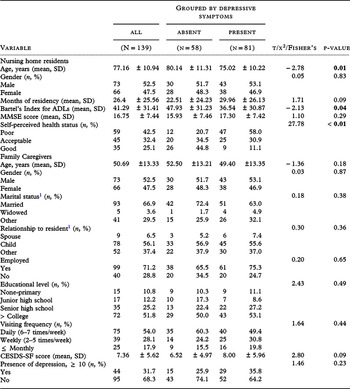
The mean age of the 139 residents who participated in the study was 77.16 years (SD = 10.94, range = 65–97). The mean duration of living in a nursing home was 26.4 months (SD = 25.56, range = 0–93), and 57.6% perceived their own health as acceptable or good. The mean GDS-SF score for all residents was 7.86 (SD = 5.26, range = 0–15). The mean age of the 139 FCGs was 50.69 years (SD = 13.33, range = 30–93); 52.5% were males, 66.9% were married, and 56.1% were the resident’s child. The largest proportion had a college education (51.8%). Most FCGs visited the resident at least once a week (82.1%). Family care givers had a mean CESD-SF score of 7.36 (SD = 5.32, range = 0–29). Using a cutoff score of ≥10, most FCGs had no depressive symptoms (n = 95, 68.3%). Details about residents’ and FCGs’ characteristics are shown in Table 1.
Characteristics of family caregivers, nursing home residents and family depression by residents’ depressive status (N = 139)

ADLs = activities of daily living; MMSE = Mini-Mental State Examination; CESDS-SF = Center for Epidemiologic Studies Depression Scale-Short Form.
1 Statistical analysis with Fisher’s (Fisher’s exact test).
To examine if the characteristics of nursing home residents differed in the absence or presence of symptoms of depression, residents were grouped based on their scores on the GDS-SF using the cutoff score of ≥ 5 for the presence of depressive symptoms (n = 81, 58.3%) and < 5 as the absence of symptoms (n = 58, 41.7%). When the two groups were compared, there was a significant difference in residents’ age (t = 2.78, p < 0.01), ADL scores (t = 2.13, p < 0.05), and self-perceived health (Chi-square = 25.45, p < 0.01). Residents in the group with depressive symptoms tended to be younger, ADL scores were lower, and 58.3% reported their health status as poor, compared with 42.45% for those absent of symptoms. There were no differences between characteristics for FCGs of residents with and without depressive symptoms for any variable. Neither depressive status (Chi-square = 1.46, p = 0.23) nor visiting frequency (Chi-square = 1.64, p = 0.44) of family members differed between residents with or without depressive symptoms (Table 1).
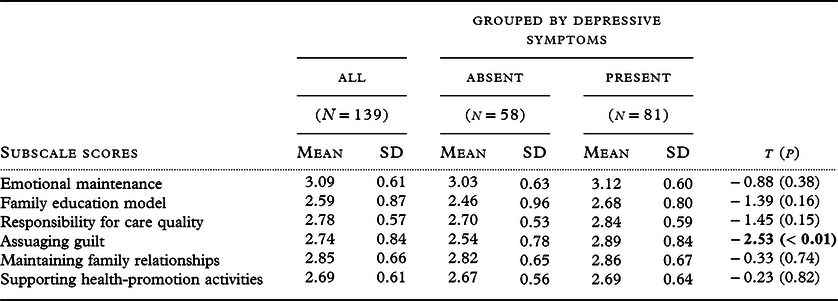
Mean scores for FCGs on the Family Meaning of Nursing-Home Visits were greatest for the subscale of emotional maintenance (3.09 ± 0.61), maintaining family relationships (2.85 ± 0.66), and responsibility for care quality (2.78 ± 0.57) (Table 2). The groups of FCGs of residents with and without depressive symptoms only differed significantly in the meaning ascribed to the caregiving role associated with assuaging guilt (t = 2.53, p < .01) (Table 2).
Mean subscale scores for family caregivers on the Family Meaning of Nursing Home Visits for all nursing home residents (N = 139) and differences between residents grouped by depressive symptoms

SD = standard deviation.
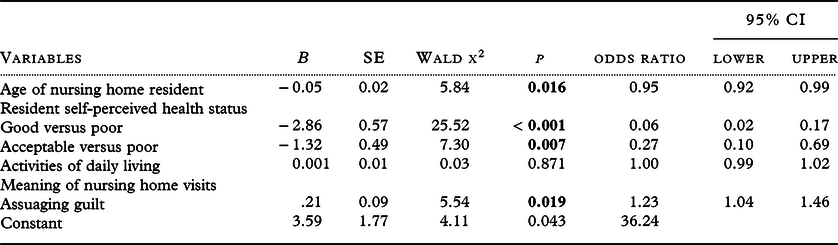
To explore if residents’ age, ADL score, self-perceived health status, or FCGs’ score for assuaging guilt were associated with depressive symptoms, we conducted multiple logistic regression analysis. The VIF ranged from 1.01 to 2.24, indicating no multicollinearity among the four regression variables. Factors associated with an odds ratio (OR) indicating an increased risk of having depressive symptoms among nursing home residents were age (OR = 0.95, 95% confidence interval (CI): 0.92 ∼ 0.99), self-perceived health status: good versus poor (OR = 0.06, 95% CI: 0.02 ∼ 0.17) and acceptable versus poor (OR = 0.27, 95% CI: 0.10 ∼ 0.69), and having a family member who visited the nursing home resident to attempt to assuage their guilt (OR = 1.23, 95% CI: 1.04 ∼ 1.46) (Table 3).
Multiple logistic regression model for variables of residents and caregivers associated with nursing home residents with depressive symptoms

B = standardized regression coefficient; CI = confidence interval.
Discussion
This study is the first to seek to understand the frequency of depressive symptoms among nursing home residents and determine if depressive symptoms are associated with characteristics of nursing home residents, family members’ depressive status, and their involvement in nursing home visits in Taiwan. Our findings support two of our three hypotheses regarding relationships between the presence of depression in nursing home residents and age, self-perceived health status, as well as family members involvement with visits to residents.
Our findings demonstrated 58.3% of the nursing home residents in our study qualified as having depressive symptoms using a cutoff score on the CSD-SF of ≥ 5. The percentage of nursing home residents with depressive symptoms in our study is similar to percentages reported in prior research from Taiwan (52–54%) (Lin et al., Reference Lin, Wang, Chen, Wu and Portwood2005; Tsai et al., Reference Tsai, Chung, Wong and Huang2005, Reference Tsai, Wong, Tsai and Ku2008) but higher than reported for Western countries (21–44.3%) (Jongenelis et al., Reference Jongenelis2007; Pramesona and Taneepanichskul, Reference Pramesona and Taneepanichskul2018).This higher percentage of nursing home residents with depressive symptoms in Taiwan may be related to the cultural concepts of filial piety and karmic responsibility, which are concerned with parents’ expectations regarding their children’s duty to provide them with in-person care (Tsai and Tsai, Reference Tsai and Tsai2012; Zhang et al., Reference Zhang, Clarke and Rhynas2019).
Residents with depressive symptoms (GDS-SF score ≥ 5) and those without depressive symptoms (GDS-SF score < 5) differed significantly in age, ADL scores, and self-perceived health, but not in their duration of residency or MMSE scores. The average age of residents in our sample was 77.16 years, a little younger than reported in previous Taiwanese (80.9 years) and Western research (79.4) (Jongenelis et al., Reference Jongenelis2007; Tsai and Tsai, Reference Tsai and Tsai2013). These findings on factors associated with residents’ depressive symptoms echo previous reports that age and physical status are risk factors for depression in residents (Juratovac, Reference Juratovac2009; Majerovitz, Reference Majerovitz2007; McDougall et al., Reference McDougall, Matthews, Kvaal, Dewey and Brayne2007). Relatively younger residents with severe functional disabilities are at the highest risk of depression in nursing homes. In particular, this study revealed that residents tended to experience more depressive symptoms if they perceived their health as poor. Therefore, to provide timely care, adequate assessment of older residents who are on the younger end of the age distribution with functional disabilities and poor self-perceived health status is necessary. It is interesting to note that none of the FCGs’ characteristics, including visiting frequency were associated with a significant difference in older residents with and without depression. This result differs from the finding of a previous Greek study, wherein the frequency of visits by FCGs was significant (Patra et al., Reference Patra2017). These differences may be due to most Taiwanese FCGs visited nursing home residents on a weekly, if not daily, basis. Further research comparing the effects of family involvement which includes visiting frequency between Western and Asian countries is suggested.
We found that Taiwanese FCGs’ first priority with regard to their family members in nursing homes was emotional maintenance. While this is in accordance with earlier research conducted by Tsai and Tsai (Reference Tsai and Tsai2013), such a result is seldom reported in Western studies. Based on this result, the development of emotional maintenance interventions to help FCGs enhance their motivation is suggested. These interventions could focus on teaching FCGs to effectively communicate with residents through the maintenance of emotions and provide an environment for friendly interactions such as via videoconferencing platforms to increase opportunities for residents’ emotional maintenance when there are restrictions on FCGs’ in-person visits during the COVID-19 pandemic (Tsai and Tsai, Reference Tsai and Tsai2010; Tsai et al., Reference Tsai, Tsai, Wang, Chang and Chu2010).
Studies have found that FCGs who experience difficulties in managing residents’ emotional state tend to experience more depressive symptoms themselves (Tsai and Tsai, Reference Tsai and Tsai2013; Whitlatch et al., Reference Whitlatch, Schur, Noelker, Ejaz and Looman2001). However, our findings failed to demonstrate a significant difference in the depressive status of FCGs of residents with and without depression. The cause of depression is multifactorial and residents with depression were grouped by a cutoff of ≥ 5. Grouping residents by scores for mild, moderate, and severe depression might better elucidate relationships between their depression and the depressive status of their FCGs. Future studies with a larger sample size could allow for such a comparison.
Regarding the prioritization of meanings ascribed to the caregiving role, emotional maintenance and maintaining family relationships and care quality were the most important, while family education model was the least significant. This order of meanings ascribed to the caregiving role is somewhat different from Tsai and Tsai’s study (Reference Tsai and Tsai2013), which found emotional maintenance, care quality, and responsibility to maintain the family relationship to be the most important. In this study, care quality was a lower priority compared to the study by Tsai and Tsai (Reference Tsai and Tsai2013); however, whether there is a cohort effect on the prioritization of caregiving roles for nursing home residents needs further research.
A novel finding of this study is that residents with and without depression differed significantly based on whether FCGs’ motivation for visiting them in the nursing home was to assuage their guilt. This may be because residents’ adjustment is related to caregiver adjustment (Whitlatch et al., Reference Whitlatch, Schur, Noelker, Ejaz and Looman2001). Especially in cultures that emphasize filial piety, it is expected that children will care for their aging parents. Observing their parents experiencing depression may exacerbate children’s guilt about institutionalizing them. The relatives of the depressed residents may have taken this role for cultural reasons; as Chinese family members, they wanted to demonstrate their filial piety by visiting relatives in nursing homes (Tsai and Tsai, Reference Tsai and Tsai2012; Yeh, Reference Yeh1998). However, the causality in the relationship between residents’ depressive symptoms and FCGs’ attempts to assuage their guilt is unknown. Previous research has demonstrated that greater pre-loss grief is associated with greater post-loss grief (Givens et al., Reference Givens, Prigerson, Kiely, Shaffer and Mitchell2011), and depression may follow the same trend. Thus, longitudinal studies are necessary to understand the cause and effect between these two variables. Furthermore, cultural differences between Eastern and Western countries are worthy of further study.
Although this study fills gaps in knowledge about depressive symptoms in nursing home residents and their relation to FCGs’ visiting involvement and depression in an Asian context, it has limitations. The cross-sectional design limits the possibility of making causal inferences regarding the relationship between depression in residents and family involvement and depression. Multiple tests were conducted with a threshold of significance set at 0.05, which increases the chance of a Type I error. Therefore, the significance of our findings should be considered with caution.
This study revealed that factors related to older residents’ depressive symptoms included residents’ age, residents’ self-perceived health, and FCGs’ visiting motivation being to assuage their guilt. These results can serve as a reference for policymakers and institutional managers to formulate strategies for holistic care that reduces residents’ depressive symptoms as well as provides FCGs with the necessary support.
Conflict of interest
None.
Description of authors’ roles
C.C. Wu, H.H. Tsai, H.L. Huang, and Y.W. Wang conceived and designed the study, C.C. Wu collected data; C.C. Wu and H.H. Tsai analyzed the data, C.C. Wu, H.H. Tsai, and H.L. Huang drafted the manuscript; C.H. Huang and C.Y. Liu critically revised the manuscript for important intellectual content.
Supplementary material
For supplementary material accompanying this paper visit https://doi.org/10.1017/S1041610221002842
Acknowledgements
This research was supported by the Ministry of Science and Technology (MOST 107-2314-B-182-009) and the Chang Gung Memorial Hospital (BMRP849). We would like to thank all participants and the selected nursing homes for supporting this study.