INTRODUCTION
Palliative medicine services are becoming more common in acute care hospitals. Although originally designed to help patients at the end of life, palliative medicine services have broadened their role and are often consulted for specific symptom management as well, for example, pain complaints. Overall, the goal is to provide symptom management and information, offer help with decision making, and act as a conduit between other physicians and the patient and family, while saving money for the hospital system (Passik et al., Reference Passik, Ruggles and Brown2004). Definitions of palliative care are remarkably consistent. Comparing five such definitions (the World Health Organization, The National Council for Palliative Care, The Center to Advance Palliative Care, the American Academy of Hospice and Palliative Medicine, and the Palliative Care Foundation), three major points are commonly included (American Academy of Hospice and Palliative Medicine, 2011; The Center to Advance Palliative Care, 2011; National Council for Palliative Care, 2012; Palliative Care Foundation, 2012; World Health Organization, 2012). These commonalities include:
1. Pain and symptom management;
2. Improved quality of life; and
3. Implementation of palliative care early in the disease course.
In addition, the National Consensus Project for Quality Palliative Care has identified eight domains from which a palliative care program can be evaluated: (1) Structure and Process of Care; (2) Physical Aspects of Care; (3) Psychological and Psychiatric Aspects of Care; (4) Social Aspects of Care; (5) Spiritual, Religious and Existential Aspects of Care; (6) Cultural Aspects of Care; (7) The Imminently Dying Patient; and (8) Ethical and Legal Aspects of Care (Grant et al., Reference Grant, Elk and Ferrell2009). Even though the definitions are consistent, and there are evaluative measures available, palliative care services tend to be varied in format, structure, and services offered (Schuurman et al., Reference Schuurman, Crooks and Amram2010). Utilization is extremely varied as well. Rodriguez showed that palliative care services in acute care hospitals are under-utilized and not fully understood (Rodriguez et al., Reference Rodriguez, Barnato and Arnold2007). Research has also suggested that overall utilization of palliative medicine services is varied and that personal, interpersonal and inter-professional factors play a powerful role (Walshe et al., Reference Walshe, Chew-Graham and Todd2008). Despite this lack of standardization and consistency in function and commonality of definition, palliative care services have been shown to be beneficial both clinically and financially (Passik et al., Reference Passik, Ruggles and Brown2004; Penrod et al., Reference Penrod, Deb and Luhrs2006; Ciemens et al., Reference Ciemens, Blum and Nunley2007; Temel et al., Reference Temel, Greer and Muzikansky2010). In addition, provider satisfaction and caregiver satisfaction have also been shown (O'Mahony et al., Reference O'Mahony, Blank and Zallman2005). Further, palliative care services, for example, pain control, have been shown to be “durable” and consistent in 70% of patients as their lives progress to the end (Morrogh et al., Reference Morrogh, Miner and Park2010).
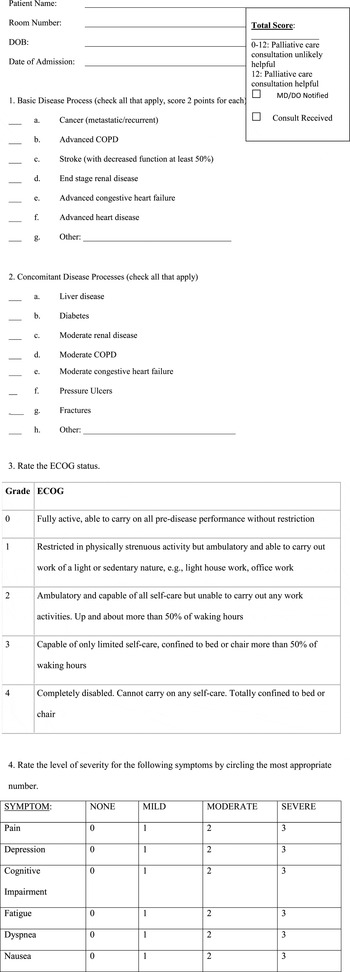
Many studies have been performed on patient outcomes and symptom assessment, but there is a lack of research on consultation triggers and understanding the constituents of an appropriate palliative medicine referral. The current study was undertaken in a Continuing Care Hospital (CCH) at an urban tertiary care hospital in Lexington, Kentucky. This unit is a long-term acute care rehabilitation facility that routinely admits patients with multiple comorbidities, infectious etiologies, and symptoms. The unit consists of 30 individual beds with a nurse-to-patient ratio of either three ventilator patients to one nurse, two endotracheal tube patients to one nurse, or five non-ventilator patients to one nurse. The Palliative Medicine Service has been providing care to this Unit for the last 11 years. To evaluate a screening tool for potential palliative care consultations, and as part of a quality improvement project of the CCH, a novel Palliative Care Consultation Tool was developed (Figure 1).
Initial version of palliative care consultation tool.

METHOD
A one-page instrument was developed using expert opinion. A small group of experts involved in the palliative care service were asked to give input on what would constitute an appropriate signal that might indicate the need for a palliative care consultation. From this list of potential signals, the following was included in our tool: basic and co-morbid diseases; Eastern Cooperative Oncology Group (ECOG) status; and level of symptoms (severity of pain, depression, fatigue, nausea, cognitive impairment, and dyspnea). Point values were identified for each of the variables to create a threshold level to initiate a need for a palliative care consultation. This threshold was artificially set as ≥12. Each basic disease constituted a two-point increase, whereas co-morbid diseases were assigned one point. ECOG status was reported from 0 to 4 as functional status decreased. For each symptom, patients were asked if they had the symptom and then were asked a rating using a Likert scale from 0 to 10; 0 being none and 10 being the worst possible imagined. However, for the tool calculations, symptom severity was valued from 0 to 3 (patient rating responses of none were valued as 0, 1–3 as 1, 4–6 as 2, and 7–10 as 3).
Upon admission, patient data were collected using the tool. This data collection was performed by charge nurses and a trained research assistant (AT). Pain data were also collected upon discharge. Disease information was gathered using history and physical examinations, whereas ECOG and symptom severity were reported using patient interviews. If the threshold of 12 was triggered, then a note reading, “Have you considered a palliative care consultation?” was placed in the chart directed to the admitting physician on a standard physician communication form. It was then up to the patient's admitting physician to ask for a palliative care consultation. This project was part of the quality improvement efforts of the CCH and was reviewed by the leadership of the hospital and ethics committee. It was administered to all admissions over a 10-week period. Every patient admitted, regardless of ability to answer questions or status, received the tool.
RESULTS
The sample comprised 33 men (44.6%) and 41 women (55.4%) with an average age of 63.4 years (SD = 13.8) and an average length of stay of 22.7 days (SD = 10.1). A total of 56 patients (75.7%) were able to be interviewed using the tool, whereas 17 (23%) were not alert at the time of interview, and 1 (1.4%) refused. The most significant symptom was pain, indicated as moderate-to-severe in 23 patients (31%). This was followed by fatigue (n = 10, 13.5%) and nausea (n = 6, 8.1%). The average ECOG score was 3.1 (SD = 1). Sixty patients had both admission and discharge pain ratings. At unit entry, 20 patients (33%) had moderate or severe pain. Upon discharge, this number had been reduced to 12/60 (20%). Chi-Square analysis showed a significant decrease in pain rankings overall (χ2 = 36.3, p < 0.0001). The average total tool score was 7.5 (SD = 3.1). Using an initial threshold of 12 to trigger a palliative referral, 64 patients (86.5%) would not have received a referral and 10 (13.5%) would have. Of these 10 patients, 2 (20%) did not receive a palliative care consultation while they were hospitalized. The number of referrals for palliative care versus the total number of admissions was measured for the 10 weeks in which the instrument was implemented. This was compared to the 4 months prior to using the tool. The pre-implementation months had 46 palliative care referrals out of 129 total admissions (35.7%). In comparison, 28 of 74 patients (37.8%) were referred during the months in which the tool was used. Physicians' attitudes concerning palliative care services were seen empirically in some of the responses (or lack of responses) when the threshold was met. One physician wrote back, “The patient is alert and oriented and does not need palliative care.” Other physicians simply ignored the request.
DISCUSSION
Referrals to a palliative care service may decrease costs, improve quality of life, improve symptom management, and reduce patient suffering. However, exactly when and how a referral should be made has not been adequately evaluated in the literature. Because utilization of palliative care is varied and at times confused, a simple tool that provides physicians, or nurses, with the ability to suggest a consultation could be very helpful. The tool we developed increased consultations over the time period in which it was used compared with the same time period 1 year prior. Although the threshold developed for triggering referrals seemed artificially high, the implementation of the screening tool did increase referrals. The increase in referrals might be explained by the “consciousness-raising” of suggesting a palliative care consultation. One of the secondary outcomes, pain level, was shown to be dramatically reduced once a palliative care consultation was obtained. This further indicates the potential efficacy of a palliative care consultation.
CONCLUSIONS
What was found empirically in our study has also been seen in other reports; physicians lack a firm understanding of what palliative medicine is and what services it can offer (Ho et al., Reference Ho, Engelberg and Curtis2011). Future studies will focus on identifying the best referral cut-point and tool streamlining to identify the most salient issues, as well as general staff acceptance.