Introduction
A combination of continued botanical exploration in Peninsular Malaysia and increasing knowledge of the flora, in this case the recent publication of the revision of Paraboea (Xu et al., Reference Xu, Burtt, Skog and Middleton2008), is revealing taxa new to science. This paper describes two new Paraboea species from Peninsular Malaysia and Thailand.
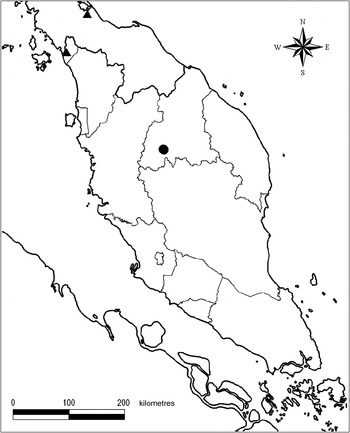
Endemism is very high among Paraboea species in Peninsular Malaysia, the majority of which are confined to limestone hills. Twelve of the 19 species in Peninsular Malaysia are endemic and a further three species are endemic in northern Peninsular Malaysia and Peninsular Thailand. Many species have narrow distributions, being confined to a group of hills. Both of the new species described here were discovered in Peninsular Malaysia when the limestone hills on which they grow were explored for the first time. Paraboea lambokensis is confined to a group of hills in western Kelantan and P. gracillima was discovered in the extreme northwest in Perlis and has also been collected north of the border in Thailand.
Species Descriptions
A Paraboea laxa Ridl. foliis petiolatis differt. – Type: Peninsular Malaysia, Perlis, Mata Ayer Forest Reserve, Bukit Rongkit, 1 vii 1993, Kiew RK 3713 (holo KEP; iso E, SING).
Distribution of Paraboea gracillima Kiew (▴) and P. lambokensis Kiew (•) in Peninsular Malaysia and Thailand.

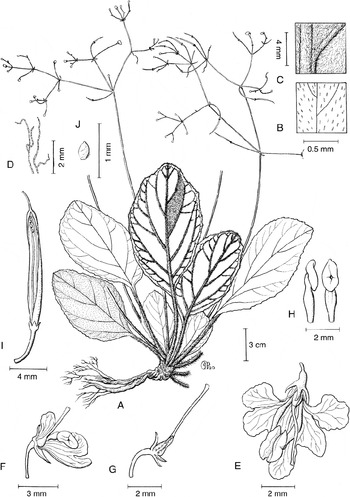
Paraboea gracillima Kiew. A, plant with inflorescence and infructescence; B, upper lamina surface; C, lower lamina surface; D, lower lamina surface hairs; E, flower (cut open between the upper lobes); F, longitudinal section of flower; G, longitudinal section of ovary; H, stamens, side and front view; I, dehisced fruit; J, seed. (All from Kiew RK 3713.)

Perennial rosette herb with up to 9 leaves. Stems woody, to 20 cm long and to 6 mm thick, with fissured corky bark. Leaves with petioles 2–11 cm long, c.4 mm thick; laminas drying mid-green above, broadly elliptic, 5–10.5 × 2.7–6.5 cm, c.1.5 times longer than wide, on the upper surface roughly hairy, trichomes scattered, short, multicellular and uniseriate, c.0.25–0.3 mm long; on the lower surface and on petioles with dense, long, ferrugineous, cobwebby hairs 3–4 mm long, apex rounded to slightly acute, margin shallowly crenate and undulate, base unequal, broadly cuneate, chartaceous when dry; midrib and lateral veins in life impressed above, when dry flat above and slightly prominent beneath, veins 4–5 pairs, ascending, tertiary venation arching towards margin, paler in dry leaves. Inflorescences axillary, very slender, cymose panicles, 20–43 cm long, erect, very lax, many-flowered, almost glabrous but with a few uniseriate, multicellular hairs c.2 mm long, peduncle 14–34.5 cm long, with up to third order branching, branches 3–8 cm. Bracts narrowly obovate, to 4 × 0.5 mm, outer surface ferrugineous with glandular hairs c.0.75 mm long, bracteole pair linear, c.1 mm long, pedicels 6–16 mm long, glabrous. Flower buds pendent, c.3.5 mm long, white with rosy tinge, apex rounded. Calyx sometimes purple, glabrous, c.1–1.5 mm long, divided slightly more than halfway, lobes 5, acute, c.1 mm long, sometimes recurved at apex. Corolla white, slightly pinkish outside, glabrous, 4–5 mm long, 4–5 mm across, tube c.1.25 mm long, limb 2-lipped, upper lip 2-lobed, lobes broadly rounded, c.2 × 2 mm, lower lip c.2.5 × 5 mm, 3-lobed, lateral lobes oblong, apex rounded, c.2.5 × 2 mm, middle lobe narrowly oblong, c.2.5 × 1 mm. Stamens inserted at the base of corolla; filaments 2.5 mm long, broadest halfway up and 0.3 mm thick; anthers ellipsoid, c.2.5 × 1 mm, touching face-to-face but not coherent. Ovary c.1.5 mm long, style 4–5 mm long and projecting above the anthers, stigma minute, slightly rounded. Capsules glabrous, narrowly fusiform, 17–25 mm long, c.1–1.5 mm wide, straight (not twisted), splitting longitudinally on both sides, style persistent, pedicels elongating to 17–21 mm in fruit, calyx persistent.
Distribution. Peninsular Malaysia: Perlis, Mata Ayer Forest Reserve, Bukit Rongkit, and Peninsular Thailand: Songkhla Province, Rattabhume District, Ban Khamphaengphen.
Habitat and ecology. This species grows with its leaves appressed to the rock surface. In Peninsular Malaysia it is extremely local but common in earth-filled crevices in sheer limestone cliffs in shade below the canopy and right up to the summit in light shade. The summit of Bukit Rongkit is 378 m above sea level.
Conservation status. In Peninsular Malaysia, its status is Least Concern because it grows within the Perlis State Park, a totally protected area.
Additional specimens examined. Peninsular Malaysia. Perlis: Mata Ayer Forest Reserve, Bukit Rongkit, 2 xii 2000, Kiew RK 5153 (SING).
Peninsular Thailand.Songkhla: Kamphaeng Phet [Ban Khamphaengphen], 22 vi 1930, Kiah 24376 (BM n.v., K n.v., SING).
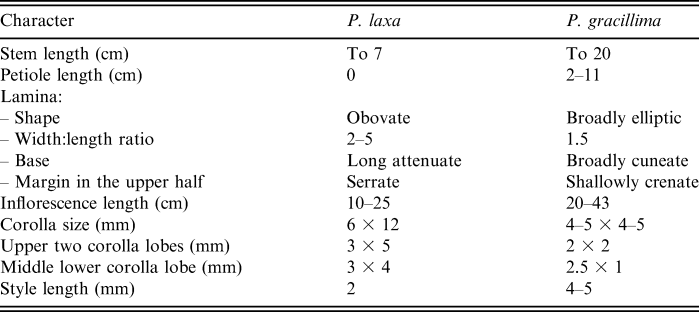
In Peninsular Malaysia this species was first discovered during a survey of the conservation status of limestone hills in Perlis (Kiew, Reference Kiew1993). In its long, slender, lax inflorescences and small flowers it is strikingly similar to Paraboea laxa Ridl. However, it is different in its petiolate leaves as well as in a number of other characters (Table 1).
A comparison of Paraboea laxa and P. gracillima
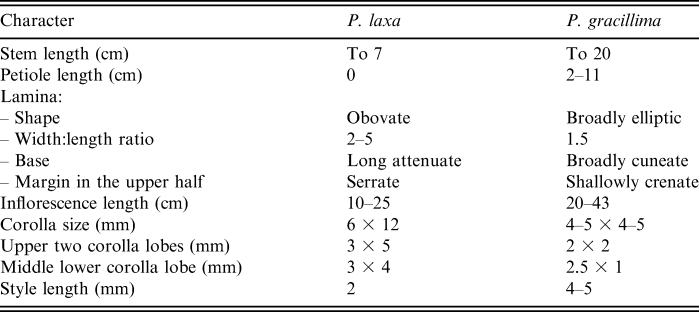
Paraboea laxa is known from the Langkawi Islands, Malaysia, where it grows on exposed limestone sea cliffs, and from one locality on the mainland (Bukit Bintang, Perlis). Paraboea gracillima grows on the mainland in light shade under the forest canopy on limestone cliffs. Xu et al. (Reference Xu, Burtt, Skog and Middleton2008) drew attention to a specimen, Kiah 24376 from Kamphaeng Phet (= Ban Khamphaengphen) in Songkhla Province, Peninsular Thailand, as ‘somewhat different’ and suggested it might be ‘an abnormal specimen of either Paraboea brunnescens or P. laxa, or it may be an undescribed species’. Examination of the Thai specimens show them to belong to this new species, although the three plants on the herbarium sheet are smaller than Malaysian ones (the laminas are 5–6 × 2.7–3.5 cm, petioles 2–4 cm long, panicles 20–24 cm long and peduncles 14–16 cm long, as compared with Malaysian specimens with laminas 9–10 × 6–6.5 cm, petioles 7.5–11 cm long, panicles 23–43 cm long and peduncles 20–34.5 cm long). Perlis, in contrast to most of Peninsular Malaysia, has a monsoon climate and its flora shares much in common with that of Peninsular Thailand, particularly for limestone plants.
Immature capsules appear slightly twisted but as they elongate they become straight. However, after the capsule has split, the two halves sometimes appear twisted.
It is named for its characteristic very slender, much branched panicle.
Differt a Paraboea verticillata (Ridl.) B.L.Burtt petiolis brevioribus (1 cm nec 2.5 cm longis), caulibus florescentibus brevioribus (6–11 cm nec 20–45 cm longis) et fructibus pubescentibus. – Type: Peninsular Malaysia, Kelantan, Kuala Betis, Gua Renayang, 16 ii 2003, Kiew RK 5261 (holo KEP; iso SING).
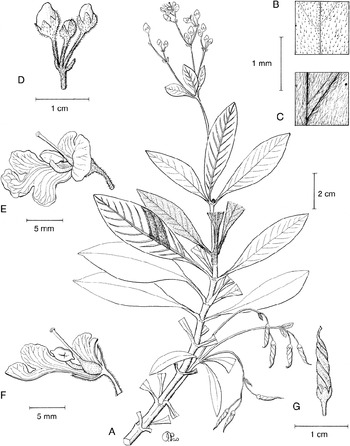
Paraboea lambokensis Kiew. A, flowering shoot; B, upper lamina surface; C, lower lamina surface; D, cymule with buds; E, flower; F, longitudinal section of flower; G, fruit. (All from Rafidah et al. FRI 64318.)

Shrubby herb. Stem woody, erect, to 50 cm tall, basal internodes 0.5–2.5 cm, upper ones to 11 cm long; slightly 4-angled, c.4 mm thick, indumentum white and woolly forming a layer c.1 mm thick, hairs c.2 mm long, slender, densely matted and aligned longitudinally. Leaves in whorls of 3; petioles c.1 cm long, slender, grooved above, indumentum same as stem; laminas narrowly elliptic, 6.5–9.5 × 1.3–2 cm, 4–5 times longer than wide, apex acute to slightly acuminate, margin entire, base long attenuate, slightly leathery in dry state, dark green and velvety above, hairs erect, uniseriate, multicellular, c.1 mm long, apical cell acutely pointed, underneath these hairs with very short unicellular hairs; on the lower surface silvery white, matted hairs, c.2 mm long, thin and tangled; midrib plane above and grooved beneath in dried state, lateral veins 9–10 pairs, ascending, in life impressed above, flat when dry, beneath flat, tertiary veins straight, ascending. Flowering shoots axillary and terminal, erect, lax, few-flowered cymose panicles, peduncles white, slender, indumentum same as the stem but with additional uniseriate glandular hairs; internodes 2–5.5 cm long; terminal panicle to 11 cm long, narrow, c.4 cm wide, peduncle to 6.5 cm long; axillary paniclets to 6.5 cm long. Floral leaves like the vegetative ones but sessile and smaller, c.3 × 0.8 cm, indumentum as leaves; bracts oval, c.2 × 1 mm; pedicels slender, 3–12 mm long. Flower buds rounded, purple. Calyx green, 2–4 mm long, connate for 1–2 mm, lobes narrowed to apex, 1.5–2 × 1–2 mm, minutely pubescent outside, hairs uniseriate, multicellular and glandular. Corolla purple, glabrous, 15–20 × 7–10 mm, tube 4–5 mm, upper 2 lobes recurved, connate, 5–8 × 6–9 mm, with an apical notch c.2 mm deep; lower 3 lobes spreading, lateral lobes rounded c.7 × 3.5–4.5 mm, middle lobe c.10 × 3.5 mm. Stamens attached at base of corolla tube; filaments white, 4–5 mm long; anther yellow, c.4 × 2.5 mm, broadly oblong, coherent on the inner face. Ovary c.4–5 mm long, minutely pubescent, style white, c.5 mm long, stigma slightly peltate, less than 1 mm wide. Capsules spirally twisted with c.4 twists, minutely pubescent, 10–15 × 1.5–2 mm, style persistent, pedicel elongating to 10 mm in fruit, calyx persistent.
Distribution. Endemic in Peninsular Malaysia – Kelantan, Kuala Betis, on the Lambok limestone hills, Gua Renayang and Gua Senarip, near Sungai Teja.
Habitat and ecology. Restricted to limestone, it grows in exposed conditions on the shoulders of cliffs and on large boulders around cave mouths.
Conservation status. Critically Endangered CR B1b(iii). The Lambok limestone hills are a group of three, Gua Teja to the north of Sungai Teja, and Gua Renayang and Gua Senarip to the south of the river and close to Kampung [Fort] Lambok. The hills have recently become accessible on unsurfaced roads that have been constructed on both sides of Sungai Teja. Gua Teja is now surrounded by oil palm plantations and Temiar farms. In 1935, Henderson visited Gua Teja and what he called Gua Lambok, which is either Gua Renayang or Gua Senarip, but did not collect any specimens of Paraboea (Henderson, Reference Henderson1939). We did not find Paraboea lambokensis on Gua Teja but it grows on both Gua Renayang (the type locality) and Gua Senarip (Rafidah et al., in press). Both these hills are close to Kampung Lambok and are surrounded by Temiar farms, with only a very narrow strip of secondary forest on ground that is too rocky to farm. The vegetation of both these hills is therefore vulnerable to burning associated with agricultural practices. In fact, one side of Gua Renayang has been burned in the past. The cauline paraboeas can invade rock faces exposed by burning or quarrying provided there is a seed source close by. None of these hills has any form of legal protection.
Additional specimens examined. Peninsular Malaysia.Kelantan: Gua [Gunung] Renayang, 8 v 1990, Kiew & Anthonysamy RK 2875 (SING); Gua Senarip, 22 iv 2009, Rafidah et al. FRI 64318 (BKF, E, KEP, L, SING).
Paraboea lambokensis belongs to the well-defined group of cauline paraboeas in Peninsular Malaysia that are erect plants with leaves in whorls and with terminal as well as axillary panicles, with large foliar bracts and strongly twisted fruits. In Xu et al.’s (Reference Xu, Burtt, Skog and Middleton2008) account it keys to Paraboea caerulescens (Ridl.) B.L.Burtt because of its minutely pubescent calyx, ovary and fruit. It is also similar to Paraboea caerulescens in the upper lamina surface being pubescent to glabrescent. However, apart from the indumentum, it is quite different from Paraboea caerulescens, which is a large, caulescent subshrub with stems c.1 cm thick, large leaves that measure 12–20 × 3–6 cm and have 12 pairs of lateral veins, flowering stems 30–70 cm long, and longer fruits 1.5–3 cm long.
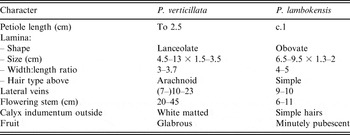
In size Paraboea lambokensis more resembles Paraboea verticillata (Ridl.) B.L.Burtt as both have a similar thickly matted indumentum on the stem. They differ in the arachnoid indumentum of the upper lamina surface and the glabrous ovary and fruit of Paraboea verticillata. In addition, Paraboea verticillata has much longer petioles, laminas c.3 times longer than wide, usually more lateral veins and the flowering shoot is much longer (Table 2).
Salient differences between Paraboea verticillata and P. lambokensis

Paraboea lambokensis is also distinct from other Paraboea species in Peninsular Malaysia by its exceptionally thick (about 1 mm thick), matted woolly sheath on the stems and petioles, by its hairs on the leaves that in life are distinctly sticky, and by its small, obovate leaves that have few veins. Among the cauline species in Peninsular Malaysia, it is the smallest.
It is named for the locality of the limestone hills on which it grows.
Acknowledgements
This project was funded in part by the Flora of Peninsular Malaysia Project (Project no. 01-04-01-0000 Khas) and in part by WWF Malaysia. The Forest Departments of Kelantan and Perlis are thanked for permission to collect. Field work was greatly assisted by S. & J. Anthonysamy, Dennis G. C. Yong, J. H. Tan, Abdullah Piee, K. S. Yap, A. R. Rafidah, A. T. Nor-Ezzawanis, Pauzi Husin and M. R. Adam Rohemy. Joseph Pao is thanked for his elegant botanical plates and A. R. Rafidah for preparing the map.