INTRODUCTION
The Family Investment Model explains how higher socioeconomic status predicts higher levels of parental investment in child development, which in turn predicts more favorable child outcomes (Conger & Donellan, Reference Conger and Donnellan2007), such as early language acquisition (e.g. Bus, van IJzendoorn & Pellegrini, Reference Bus, van IJzendoorn and Pellegrini1995; Rodriguez & Tamis-LeMonda, Reference Rodriguez and Tamis-LeMonda2011; Song, Spier & Tamis-Lemonda, Reference Song, Spier and Tamis-Lemonda2013). However, almost all research (96%) in the field of human behavior and development is based on samples from the so-called Western, educated, industrialized, rich, and democratic countries, which comprise a disturbingly small (12%) and unrepresentative portion of the world's population. (Henrich, Heine & Norenzayan, Reference Henrich, Heine and Norenzayan2010). This is highly problematic, as socioeconomic and cultural context can affect both the manifestations and the inter-relations of key developmental processes (Bornstein, Reference Bornstein1995; Bornstein, Putnick, Lansford, Deater-Deckard & Bradley, Reference Bornstein, Putnick, Lansford, Deater-Deckard and Bradley2015). The Family Investment Model is of special relevance for less affluent parts of the world, where socioeconomic disadvantage is often the norm. However, it is unclear whether the same family processes hold up in populations characterized by generally lower socioeconomic conditions and different ethnic backgrounds with their own sets of social customs and cultural parenting practices. Hence it is important to study commonly found relations between family processes and child development outside the Western world to establish whether these patterns of associations are shared cross-culturally, as the universal effects assumption states, or whether cultural differences occur (Norenzayan & Heine, Reference Bradley and Corwyn2005; Segall, Lonner & Berry, Reference Segall, Lonner and Berry1998). In the current study, we test the Family Investment Model in the Latin-American cultural context of Chile, examining parental investment in terms of the quality of the home environment as a mediator in the relation between socioeconomic status and preschool children's vocabulary acquisition.
The Family Investment Model applied to children's vocabulary acquisition
Differential cognitive child outcomes depending on family socioeconomic status (SES) can be partly explained by genetic factors, reflecting the intergenerational transmission of cognitive abilities (Bartels, Rietveld, Van Baal & Boomsma, Reference Bartels, Rietveld, Van Baal and Boomsma2002; Dickens, Reference Dickens2005). However, there is also evidence that socialization factors play an important role (Anger & Heineck, Reference Anger and Heineck2010). The Family Investment Model is a mediating model explaining possible pathways between family SES and child developmental outcomes (Conger & Donellan, Reference Conger and Donnellan2007). The quality of the home environment has been shown to be an important mediator between the two. According to the Family Investment Model, families with greater wealth and financial prosperity invest more, and more positively, in the physical, emotional, and cognitive development of their children than disadvantaged families. There are only a few Western studies that have examined the full mediation model from SES to family investment to children's language acquisition (Yeung, Linver & Brooks–Gunn, Reference Yeung, Linver and Brooks–Gunn2002) and almost none in Latin America. The only study so far conducted in Chile found that higher maternal education predicted more maternal cognitive and linguistic stimulation at home, which in turn predicted higher levels of children's receptive vocabulary (Coddington, Mistry & Bailey, Reference Coddington, Mistry and Bailey2014). Each of the steps of this mediation model are addressed below.
Socioeconomic status and vocabulary acquisition
Socioeconomic status is commonly conceptualized as the social class to which an individual belongs, and is mostly estimated by income, education, and occupation. An individual's life course is determined by social class in manifold ways from the moment of conception to the last breath (Brooks-Gunn, Duncan & Maritato, Reference Brooks-Gunn, Duncan, Maritato, Duncan and Brooks-Gunn1997). There is convincing evidence, mostly from Western countries, that children's vocabulary acquisition is strongly influenced by family income (Huston et al., Reference Huston, Duncan, McLoyd, Crosby, Ripke, Weisner and Eldred2005) and parental education (Hoff, Reference Hoff2006). In Latin America, higher parental education has been linked to higher vocabulary scores in Chilean and Mexican children (Richman, Miller & LeVine, Reference Richman, Miller and LeVine1992; World Bank, 2012).
Socioeconomic status and quality of the home environment
The physical, emotional, and learning environment in which children are raised at home is related to their developmental outcomes. Research in Western samples clearly shows that lower-SES families provide less stimulating home environments (Bradley & Corwyn, Reference Bradley and Corwyn2002; Bradley, Corwyn, McAdoo & Garcia Coll, Reference Bradley, Corwyn, McAdoo and Garcia Coll2001; Prevoo et al., Reference Prevoo, Malda, Mesman, Emmen, Yeniad, Van IJzendoorn and Linting2014). Low-SES mothers invest less time in mutual play, conversation, and reading activities with their children than middle-SES mothers, partly because they have less material and non-material resources at their disposal and suffer from additional stress due to economic hardship (Bradley & Corwyn, Reference Bradley and Corwyn2002; Coley, Reference Coley2002; Hoff-Ginsberg, Reference Hoff-Ginsberg1991). A review reports that in Latin America parents place less emphasis on stimulation and teaching of academic skills than in Western countries (Bradley & Corwyn, Reference Bradley and Corwyn2005). These cultural practices, coupled with generally poorer living conditions in Latin America, which inter alia manifest in fewer available toys and learning materials in the children's homes, are both likely to negatively affect children's vocabulary acquisition.
Quality of the home environment and vocabulary acquisition
Research in North America and Europe has revealed that children show improved vocabulary acquisition if they grow up in more linguistically and academically stimulating homes, with responsive parents and availability of a variety of age-appropriate learning materials (e.g. Bus et al., Reference Bus, van IJzendoorn and Pellegrini1995; Rodriguez & Tamis-LeMonda, Reference Rodriguez and Tamis-LeMonda2011; Song et al., Reference Song, Spier and Tamis-Lemonda2013). In linguistically and cognitively stimulating homes children are encouraged to explore and to expand their knowledge (Caldwell & Bradley, Reference Caldwell and Bradley2003). They are exposed to more frequent and more diverse language and are invited to express themselves verbally. Responsive parents converse with their children, attend to their children's speech, praise their children, and may also express their appreciation non-verbally by for instance cuddling, holding, and caressing their children. Stimulating homes are also characterized by the availability of learning materials such as books or toys, which may enhance children's cognitive and socio-emotional growth (Isenberg & Quisenberry, Reference Isenberg and Quisenberry2002).
The Chilean context
The following four characteristics of the Chilean context are particularly relevant to the study of preschoolers’ language acquisition: SES, ethnicity, single parenthood, and daycare attendance.
Socioeconomic status
UNICEF (Hudson & Kühner, Reference Hudson and Kühner2016) concluded that Chile has the second highest child poverty rate of the developed world after analyzing forty-one OECD (Organization for Economic Cooperation and Development) and European Union countries. Three out of ten children live below the poverty line, which means that 1,200,000 Chilean children are affected. Moreover, the proportion of fifteen-year-olds falling below proficiency level 2 on the PISA tests (Program for International Student Assessment) in reading, math, and science is as high as 24·6% in Chile. This means that a quarter of the adolescent Chilean secondary school students do not understand what they read, cannot solve basic mathematical operations like multiplication or division, and cannot reason about everyday natural occurrences, because they are lacking basic skills and competencies. Acquisition of these skills and competencies starts early in life and language is known to be a fundamental precondition for all academic learning in kindergarten, primary, and secondary school (Forget-Dubois, Dionne, Lemelin, Pérusse, Tremblay & Boivin, Reference Forget-Dubois, Dionne, Lemelin, Pérusse, Tremblay and Boivin2009; Harlaar, Hayiou-Thomas, Dale & Plomin. Reference Harlaar, Hayiou-Thomas, Dale and Plomin2008; NICHD ECCRN, 2005). The apparent deficit of language learning impacts the lives of millions of Chileans not only across the school years, but all across adult life. Seventy-one percent of the Chilean adult population has no post-secondary schooling (CASEN, 2013), which considerably decreases job opportunities and income, thereby maintaining the cycle of poverty. Early language learning in Chile deserves special research attention, because of the far-reaching societal consequences and the short- and long-term dimension of related problems. The current study aims to examine whether variations in SES within a non-Western low-SES context are related to the quality of the home environment and preschool children's language acquisition.
Ethnicity
Chile is a multi-ethnic society, home to native Americans and descendants of European immigrants. According to single nucleotide polymorphism analysis, a method to map genetic variability, the average Chilean is genetically composed of 42% native American, 55% European, and 3% African ancestry (Eyheramendy, Martinez, Manevy, Vial & Repetto, Reference Eyheramendy, Martinez, Manevy, Vial and Repetto2015). The indigenous Mapuche people constitute the largest minority group and comprise 9% of the national population (one and a half million people). In the Araucanía region, the stronghold of Mapuche culture, the largest regional Mapuche population (31·3%) and highest regional poverty rates (28%) of Chile coincide (CASEN, 2013; INE, 2012. In this particular region, poverty rates are also higher among the Mapuche minority group members compared to Chilean majority group members, which is partially due to lower educational levels, more minimum wage labor, and more unemployment (Cerda, Reference Cerda2009). Nowadays, rural life on ancestral lands or assigned reductions belong to the past for the vast majority of the national Mapuche population (80%), who exchanged it for life in urban contexts and have hence adopted the dominant Chilean culture, language, religion, and lifestyle (work, housing, health, and education), which makes them largely indistinguishable from majority group members of the same social class (Caniguan, Reference Caniguan2012). The ethnic language of the Mapuche is called Mapudungun, and was traditionally a spoken language without written form. Mapudungun was spoken by the Mapuche people before the Law of Obligatory Primary Schooling was adopted in Chile in 1920 (Soto, Reference Soto2009). This law made attendance at a Western Spanish-speaking school system mandatory for indigenous children, and Mapuche children were punished for speaking their native tongue. Consequently, Spanish has gradually become the dominant language of the Mapuche people over the past century, and Mapudungun is nowadays only spoken with high proficiency by 4% of Mapuche adolescents between the ages of ten and nineteen years in the south of Chile (Gundermann, Canihuan, Clavería & Faúndez, Reference Gundermann, Canihuan, Clavería and Faúndez2009). Yet, the broader minority language environment of Mapuche children can still be less conducive to Spanish language acquisition. In the current study, we will take ethnicity into account when examining the predictors of children's vocabulary acquisition.
Single parenthood
Another relevant factor for the study of children's language acquisition in Chile is single parenthood. Twenty percent of all Chilean homes are one-parent households, meaning there is no spouse or partner present (CASEN, 2011). One-parent households concentrate in the lowest income groups, more than two-thirds fall into the two lowest income categories, which implies that these families are socially vulnerable and are struggling with poverty. In this context, it is important to note that children of single mothers in low-SES environments are at special risk of being linguistically under-stimulated, as their mothers are likely to spend even less time with their children due to higher levels of stress and less social support (Cairney, Boyle, Offord & Racine, Reference Cairney, Boyle, Offord and Racine2003). Heath (Reference Heath1990) has reported that children of single mothers who have little education and who live in public housing grow up in virtual silence due to lack of maternal speech. Thus, in the current study we will include single parenthood as a covariate in the main analyses.
Daycare attendance
Quantity of daycare can also impact preschool children's vocabulary acquisition. For children of lower-SES backgrounds, spending more time playing with peers and more involvement with professional caregivers in daycare centers may provide more fertile ground for language development than the immediate family can offer at home, which is in line with the compensatory hypothesis (Desai, Chase-Lansdale & Michael, Reference Desai, Chase-Lansdale and Michael1989). In Chile, children spend increasingly more time in daycare, as a consequence of a fast-growing number of working mothers (INE, 2012) and a considerable expansion of the national public daycare provision. Over the past two decades, nursery school provision quadrupled and kindergarten provision doubled (JUNJI, 2009). Some studies in Chile report beneficial short- and medium-term effects of daycare attendance on language outcomes (Cortázar, Reference Cortázar2012; Noboa-Hidalgo & Urzúa, Reference Noboa-Hidalgo and Urzúa2012), but others report no improvements on vocabulary acquisition (Bucarey, Ugarte & Urzúa, Reference Bucarey, Ugarte and Urzúa2014; Contreras & González, Reference Contreras and González2015). Such inconclusive results have also been found in Western countries, where sometimes no relationship between daycare attendance and child outcomes are reported (NICHD ECCRN, 2000), whereas others find that a higher quantity of daycare relates to positive cognitive outcomes (e.g. Loeb, Bridges, Bassok, Fuller & Rumberger, Reference Loeb, Bridges, Bassok, Fuller and Rumberger2007; Luijk et al., Reference Luijk, Linting, Henrichs, Herba, Verhage, Schenk and van IJzendoorn2015). In the current study, daycare attendance will be included as a covariate in the main analyses.
The current study
The aim of the current study is to test the Family Investment Model applied to language acquisition in the Latin-American cultural context of Chile, examining parental investment in terms of the quality of the home environment as a mediator in the relation between socioeconomic status and preschool children's vocabulary acquisition. We address the following research questions in a novel bi-ethnic population (Mapuche versus Chilean):
1. What is the association between SES, the quality of the home environment, and preschool children's receptive and expressive vocabulary acquisition in Chile?
2. Is the association between SES and receptive and expressive vocabulary outcome mediated by the quality of the home environment?
We test the following hypotheses:
1. Higher SES is associated with higher quality of the home environment. Higher SES and higher quality of the home environment in turn predict more favorable receptive and expressive vocabulary outcomes among preschool children in Chile.
2. The association between SES and preschool children's receptive and expressive vocabulary outcome is mediated by the quality of the home environment.
The main analyses include previously described covariates known to relate to early child development, namely ethnicity, parental caregiver status, and quantity of daycare attendance.
METHOD
Participants
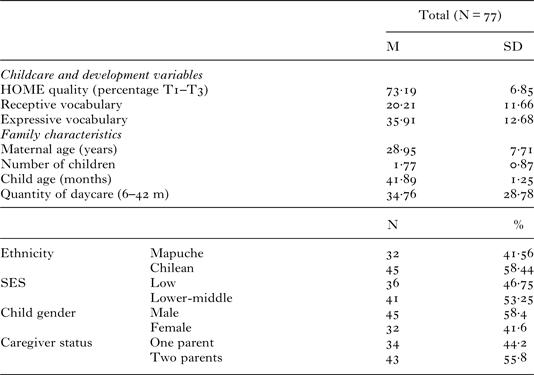
The current study draws on an existing sample which was recruited at the baseline of the longitudinal Magellan–Leiden Childcare Study (Cárcamo, Vermeer, van der Veer & van IJzendoorn, Reference Cárcamo, Vermeer, van der Veer and van IJzendoorn2015), which started in February 2012 (Time 1) with 110 mothers of 6-month-old infants born in 2011. The initial sample was drawn from three public health centers and records of nineteen public daycare centers in the Araucanía region and on Chiloé Island (Lake region) in Chile. Nine months later at Time 2, when the children were 15 months old, the initial number of participants had decreased to 95 due to sample attrition. At Time 3 (January 2015), when the children were 42 months old, sixteen additional mother–child dyads declined participation for various reasons (mostly due to lack of time). Two of the remaining seventy-nine dyads, who gave their written consent for the Time 3 measurement, were excluded due to missing outcome variables. This resulted in a current sample of seventy-seven mother–child-dyads (81% of the Time 2 sample and 70% of initial sample). Participating dyads are from low- to lower-middle-class ethnic majority Chilean (n = 45) and ethnic minority indigenous Mapuche (n = 32) background. Mean household income per capita was 1·74 (SD = 1·14) on a 5-point scale according to national quintile distribution (for details about SES assessment see ‘Measures’ subsection). Mothers’ educational level (M = 2·17, SD = 0·83, on a 4-point scale) was distributed as follows: 18·2% either only completed primary school or did not complete secondary school; 55·8% completed secondary school; 16·9% completed vocational school; and 9·1% completed university studies. Mean age of mothers was 28·95 years and almost all primary caregivers were mothers, with the exception of one father. Forty-four percent of the children were raised by a single parent and 58% are boys. See Table 1 for descriptive statistics of childcare, vocabulary acquisition, and family characteristics.
Descriptive statistics of childcare, vocabulary acquisition, and family characteristics

Procedure
Ethical approval was obtained by the Ethical Committee Board of Leiden University (the Netherlands). Data of the present time-point of our longitudinal study were collected by six trained female undergraduate psychology students of the Autónoma University Temuco, Chile. Participating dyads received three visits from December 2014 to February 2015 (Time 3), including a brief pre-visit of approximately 30 minutes and two home visits of approximately 90 minutes each. During the pre-visit the primary caregiver was informed about the subsequent data collection and invited to continue participating, after which the informed consent form was signed. During the Time 3 home visits the quality of the home environment was observed, children's receptive and expressive vocabulary was assessed, and mothers filled out a questionnaire about demographic data (education, employment, income), family and household composition, the child's health and daycare attendance, and major life events. Tests were administered to all children according to a standardized sequential order and all testing was either audio- or video-recorded to enable decisions on scoring afterwards in case of ambiguous answers. The participants received a 10,000 CLP (Chilean Pesos; US$16) voucher of a local supermarket or convenience store as remuneration for their collaboration.
Measures
Socioeconomic status
SES was computed as a composite of maternal education and per capita income level. The level of maternal education was self-reported at Time 3 on a 1–4-point scale (1 = incomplete primary or secondary school; 2 = secondary school completed; 3 = vocational education; 4 = university studies). Four mothers did not report their educational level. In these cases the missing data were replaced with maternal educational level at Time 2 as best estimate. At Time 2, mothers were asked in a questionnaire to indicate their total gross monthly household income in Chilean Pesos divided by the number of household members. This resulted in six per capita income answer categories: no income (1), less than 61,911 Chilean Pesos (US$114) (2), between 61,912 and 105,907 CLP (US$195) (3), between 105,908 and 167,879 CLP (US$310) (4), between 167,880 and 300,869 CLP (UD$556) (5), and more than 300,870 CLP (6). The socioeconomic categorization is based on the five quintiles of the Chilean Ministry of Social Development (MIDESO, n.d.). The first quintile reflects the most socioeconomically vulnerable members of society (20% of the national population), whereas the fifth quintile encompasses the most affluent Chileans. The maternal education and per capita income level were combined into one global indicator of SES by summing the standardized scores of both measures. We then dichotomized this variable due to limited variance of the income and education variables (82% of the sample had a monthly per capita income below US$200, and 75% of the mothers had no tertiary education). A median split was performed in order to group the participating families in low and lower-middle SES, resulting in two groups (low SES, N = 36; lower-middle SES, N = 41).
Quality of home environment
The Infant/Toddler Home Observation for Measurement of the Environment (IT-HOME; Caldwell & Bradley, Reference Caldwell and Bradley2003) was used at Time 1 and Time 2 when children were 6 and 15 months old, respectively (for details see Cárcamo et al., Reference Cárcamo, Vermeer, van der Veer and van IJzendoorn2015). The Early Childhood Home Observation for Measurement of the Environment (EC-HOME; Caldwell & Bradley, Reference Caldwell and Bradley2003) was used to measure quality and quantity of stimulation and support available to a child in the home environment at Time 3. The IT-HOME and EC-HOME are both comprised of two parts: an observation of the home environment followed by a semi-structured interview with the primary caregiver of approximately 30 minutes each. In one case the primary caregiver was the child's father (single parent) and in one case the interview was conducted with the great aunt instead of the mother. The IT-Home consists of forty-five binary choice items (1 = positive, 0 = negative) grouped in six subscales (responsivity, acceptance, organization, learning materials, involvement, variety), and the EC-Home consists of fifty-five binary choice items (1 = positive, 0 = negative) grouped in eight subscales (learning materials, language stimulation, physical environment, responsivity, academic stimulation, modeling, variety, and acceptance). The HOME has been administered in many countries around the world, including Chile, and its validity for minority and low-SES groups has been well established (Bradley et al., Reference Bradley, Corwyn, McAdoo and Garcia Coll2001; Bustos Correa, Herrera & Mathiesen, Reference Bustos Correa, Herrera and Mathiesen2001; Cárcamo et al., Reference Cárcamo, Vermeer, van der Veer and van IJzendoorn2015). The EC-HOME assessment was performed by the research assistants after an extensive training period (studying the manual, discussing items, video-scoring, and a pilot home visit). Observers achieved an average of 94% agreement with expert scoring when inter-rater reliability was assessed. Internal consistency of the instrument was high, with a Cronbach's alpha of .81. An accumulated HOME score was computed, indicating the overall quality of the home environment across all three time-points by calculating mean percentage scores. All three HOME measurements were significantly correlated with each other; Pearson correlations ranged from .26 to .40.
Receptive vocabulary
The Spanish adaptation of the Peabody Picture Vocabulary Test (PPVT) was used (TVIP – Test de Vocabulario en Imágenes Peabody) to assess children's receptive vocabulary, because all participating children spoke Spanish as their first language (Dunn, Padilla, Lugo & Dunn, Reference Dunn, Padilla, Lugo and Dunn1986). During test administration, the child is shown one of the 125 black and white test plates at a time, and after the research assistant names one of the four objects on the test plate the child has to point to the correct picture. Just as with the PPVT, the TVIP has proven to be a reliable and valid instrument for receptive vocabulary assessment over the years (ACYF, 2003; Piñeiro, Manzano, Inguanzo, Reigosa, Morales & Fernández, Reference Piñeiro, Manzano, Inguanzo, Reigosa, Morales and Fernández2000). In the current study the split-half (odd/even) sample reliability was >·95. There was one missing score due to the child's refusal to do the test and one child did not entirely finish the TVIP due to experimenter error. Each child's missing score was estimated based on the particular child's percentile score on the Expressive One Word Picture Vocabulary Test (EOWPVT-4). The final score is the number of correct responses between base and ceiling items.
Expressive vocabulary
The Expressive One Word Picture Vocabulary Test – Spanish Bilingual Edition (EOWPVT-4-SBE) measures children's ability to generate words (Nancy, Reference Nancy2013). The child is shown one of the 180 color pictures at a time, and after a prompting question by the research assistant has to generate the word that best describes the object, concept, or action. A Cronbach's alpha of .95 indicates high internal consistency of the EOWPVT-4-SBE for Hispanic children aged three and four in the US (Nancy, Reference Nancy2013). In the current study the split-half (odd/even) sample reliability was >·94. One very low early suspension score (child was unmotivated) was replaced by an estimate based on the same child's percentile score on the TVIP. The final score is the number of correct responses between base and ceiling items.
Background variables
Ethnicity
The ethnicity of the participating mother–child dyads was determined by self-report (Cárcamo et al., Reference Cárcamo, Vermeer, van der Veer and van IJzendoorn2015). Dyads were defined as Mapuche when mothers stated that their children grow up in a Mapuche family.
Parental caregiver status
The caregiver status of the participating parents was determined by self-report. Children were defined as growing up in one-parent families when it was reported that the father (or in one case mother) was not living in the same household as the child.
Quantity of daycare
Directors of the daycare centers in the Araucanía region and on Chiloé Island and collaborating JUNJI (National Council of Daycare Centers) and INTEGRA (National Network of Nursery Schools and Kindergartens) staff were contacted in order to obtain the children's daycare attendance of the previous three years (2012–2014). They were asked to report how many days per monthly working days the participating children attended daycare. These numbers were transformed into a total percentage of each child's daycare attendance between 6 and 42 months. For two children, the daycare centers could not provide the information for the year 2012. In these cases the child's daycare attendance was estimated based on the child's daycare attendance percentile scores for the year 2013.
Analysis plan
Language measures, HOME global quality, daycare attendance, maternal age, maternal education, and per capita income were inspected for outliers defined as values with SD greater than 3·29 above the mean (Tabachnick & Fidell, Reference Tabachnick and Fidell1996). No outliers were found. All variables were normally distributed with the exception of quantity of daycare, which can be expected as not all children attended daycare. Pearson correlation coefficients were computed to inspect the bivariate associations between all variables.
As primary analyses, hierarchical multiple regression analyses (HMR) were conducted to test whether receptive and expressive child vocabulary at 3½ years varied as a function of SES and the quality of home environment, controlling for ethnicity, parental caregiver status, and quantity of daycare. The models included the following variables: SES (0 = low; 1 = lower-middle), home quality (percentage across Time 1, Time 2, and Time 3), ethnicity (0 = Chilean majority; 1 = Mapuche minority), parental caregiver status (0 = one-parent, 1 = two-parents), and quantity of daycare (percentage of total daycare attendance from 6–42 months).
Mediation analyses were performed to examine whether SES had an indirect effect on receptive and expressive vocabulary through the quality of the home environment. The Preacher and Hayes method to test mediation was applied using the macro package for SPSS available online, which allows for multiple mediators. This test is not based on large-sample theory, meaning it can be applied to small samples with more confidence. This method adopts the bootstrapping approach which, unlike the Sobel test, respects the non-normality of the sampling distribution of the indirect effect (Preacher & Hayes, Reference Preacher and Hayes2008). This approach bootstraps the sampling distribution of the indirect effect and derives a confidence interval with the empirically derived bootstrapped sampling distribution (Preacher & Hayes, Reference Preacher and Hayes2004). The bootstrapping is accomplished by taking a large number of samples of the original sample from the data and computing the indirect effect in each sample, which is also called sampling with replacement. Five thousand bootstrap resamples were generated and the significance of the indirect effect was tested using bias-corrected bootstrap 95% confidence intervals.
RESULTS
Sample inspection
We compared the remaining sample to the dropouts. An independent t-test indicated that the dropouts (n = 33; M = 23.21; SD = 5.67) were significantly different from the current participants (n = 77; M = 26.30; SD = 7.67) in terms of maternal age, with relatively more younger mothers among the dropouts than among the remaining mothers [t(108) = 2·08, p < ·05]. This was partly due to the tendency of teenage mothers to be unavailable for participation at Time 3. A chi-square test revealed another significant difference between the dropouts and current participants on SES [χ 2(1, N = 110) = 28·01, p < ·01]. All of the 33 families that discontinued participating in this study were from low-SES backgrounds. No differences emerged between the dropouts and the current sample on child gender [χ 2(1, N = 110) = 0·14, p = ·71], ethnicity [χ 2(1, N = 110) = 1·24, p = ·27], and marital status [χ 2(1, N = 110) = 0·26, p = ·61].
We further compared our sample to the large-scale nationally representative sample of the Longitudinal Survey of Early Childhood (ELPI–Encuesta Longitudinal de la Primera Infancia) on overlapping measures (Cárcamo et al., Reference Cárcamo, Vermeer, van der Veer and van IJzendoorn2015). We found that the mean per capita income in our sample was below the mean national per capita income per month. Also, participating mothers had less education. This is consistent with our characterization of the current sample as ‘low-SES’. The HOME results of our study (M = 73·13%, SD = 6·85) were in the typical range compared to low-SES participants of the ELPI sample (M = 72·47%, SD = 4·44). The TVIP results of our study (M = 20·21 SD = 11·66) were also in the typical range compared to low-SES participants of the ELPI sample (M = 17·04, SD = 12·69).
Bivariate associations between predictors and outcomes
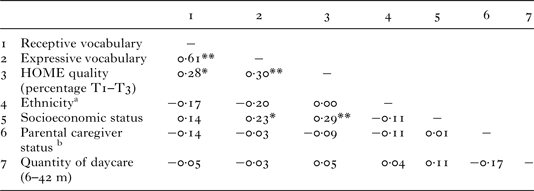
Pearson correlations were calculated for all variables (see Table 2). Receptive and expressive vocabulary were significantly associated (r(75) = ·61, p < ·01). Home quality significantly correlated with receptive (r(75) = ·28, p < ·05) and expressive vocabulary (r(75) = ·30, p < ·01), and with SES (r(75) = ·29, p < ·01). SES was furthermore significantly positively associated with expressive vocabulary (r(75) = ·23, p < ·05). All other correlations were non-significant.
Correlations between receptive and expressive vocabulary, quality of home environment, quantity of daycare attendance, and family characteristics (N = 77)

notes: ª 0 = Chilean majority, 1 = Mapuche minority.
b 0 = one parent, 1 = two parents; * p < ·05, ** p < ·01.
Predicting vocabulary acquisition
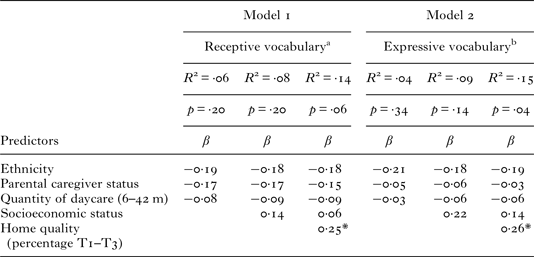
Two three-stage hierarchical multiple regression analyses were conducted with receptive and expressive vocabulary as outcome variables, respectively. Ethnicity, parental caregiver status, and quantity of daycare attendance were entered at stage one of the regression to control for demographic background variables. SES was entered at stage two, and the quality of the home environment at stage three. The variables were entered in this order according to the Family Investment Model. At stage one the demographic background variables neither significantly predicted receptive vocabulary [F(3,73) = 1·57, p = ·20], nor expressive vocabulary [F(3,73) = 1·13, p = ·34]. At stage two, SES did not contribute significantly to the prediction of receptive vocabulary [F(4,72) = 1·54, p = ·20] or expressive vocabulary [F(4,72) = 1·79, p = ·06]. Including quality of the home environment to the model at stage three explained an additional 6% of the variance in receptive and expressive vocabulary. The quality of home environment was a marginally significant predictor of receptive vocabulary [F(5,71) = 2·25, p = ·06] and a significant predictor of expressive vocabulary [F(5,71) = 2·55, p < ·05], above and beyond SES and the demographic variables. Together the five predictors accounted for 14% of the variance in receptive vocabulary and for 15% of the variance in expressive vocabulary. Table 3 shows the results of the hierarchical multiple regression analyses.
Hierarchical regression analyses predicting receptive and expressive vocabulary from quality of home environment (N = 77)

notes: ª Test de Vocabulario en Imágenes = Spanish version of Peabody Picture Vocabulary Test (Dunn, Padilla, Lugo, & Dunn, Reference Dunn, Padilla, Lugo and Dunn1986);
b Expressive One-Word Picture Vocabulary Test – four – Spanish Bilingual Edition (Nancy, Reference Nancy2013); * p < ·05.
Testing the mediation models
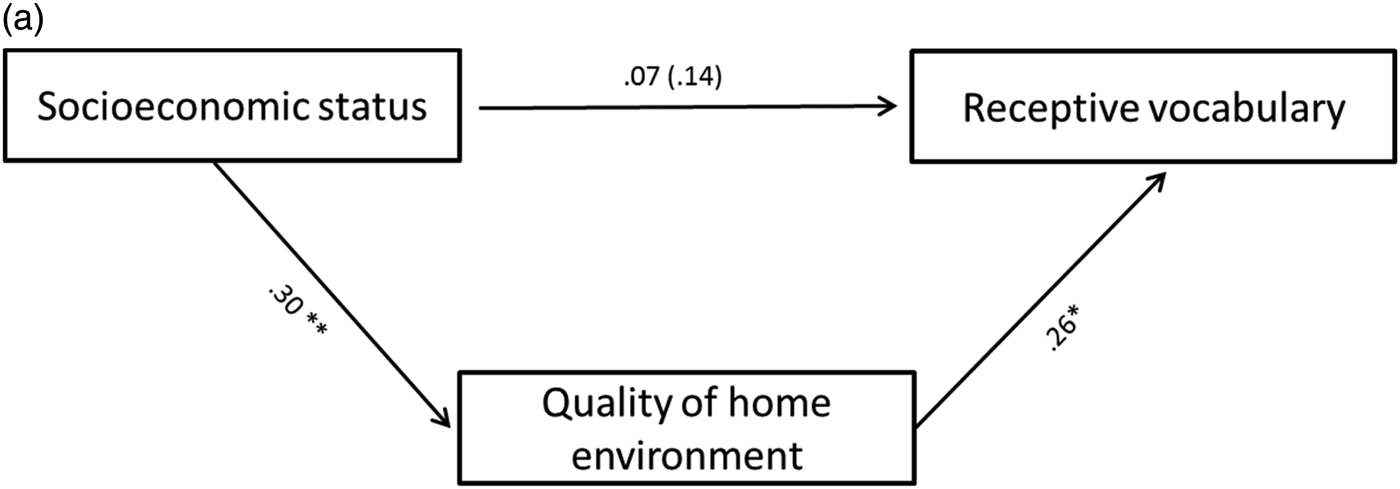
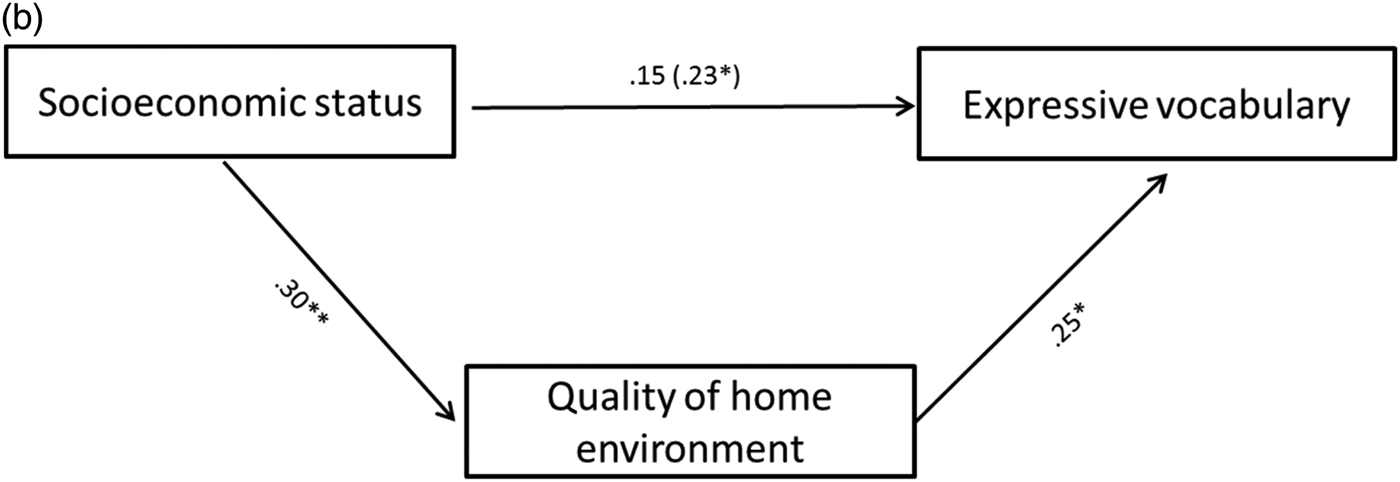
Next, we tested whether the quality of the home environment fully or partially mediated the relation between SES and receptive and expressive vocabulary acquisition, respectively. As Figures 1a and 1b illustrate, the standardized regression coefficient between SES and quality of home environment was significant, as was the standardized regression coefficient between quality of home environment and both receptive and expressive vocabulary acquisition. A simple association between SES and vocabulary acquisition is not required in order to test mediation hypotheses (Hayes, Reference Hayes2009). We examined the significance of this indirect effect (the indirect effect of X on Y is defined as the product of the X→M path and the M→Y path) using the previously described bootstrapping procedures by Preacher and Hayes (Reference Preacher and Hayes2004, Reference Preacher and Hayes2008). We found that the direct relationship between SES and both receptive and expressive vocabulary diminished when the quality of the home environment was included in the model, indicating partial mediation. The first mediation analysis (see Figure 1a) revealed that the indirect effect from SES to receptive vocabulary through quality of home environment was significant [β = ·08, SE = 0·05, 95% CI, BCaCI (0·01, 0·21)]. The bootstrapped standardized indirect effect was .08, and the 95% Bias Corrected and Accelerated Confidence Interval ranged from 0·01 to 0·21. The lower and upper limit of the Confidence Interval did not pass through zero, which means that the indirect effect is statistically significant. The mediator thus accounted for roughly half of the total effect of SES on receptive vocabulary acquisition. The second mediation analysis (see Figure 1b) demonstrated that the indirect effect from SES to expressive vocabulary through quality of home environment was significant as well [β = ·08, SE = 0·04, 95% CI, BCaCI (0·01, 0·18)], and accounted for roughly one-third of the total effect between SES and expressive vocabulary acquisition.
The mediating role of quality of home environment in the relation between socioeconomic status and receptive vocabulary (N = 77). Numbers represent standardized coefficients (β). The coefficient prior to the parentheses depicts the association between SES and receptive vocabulary, controlling for quality of home environment, whereas the coefficient within the parentheses reflects the total effect (direct effect + indirect effect) without controlling for the mediator. * p < ·05; ** p < ·01.

The mediating role of quality of home environment in the relation between socioeconomic status and expressive vocabulary (N = 77). Numbers represent standardized coefficients (β). The coefficient within the parentheses reflects the total effect (direct effect + indirect effect) without controlling for the mediator, and the coefficient prior to the parentheses depicts the association between SES and expressive vocabulary, controlling for quality of home environment. * p < ·05; ** p < ·01.

DISCUSSION
Our findings advance the understanding of how SES and the quality of the home environment relate to preschool children's vocabulary acquisition in a non-Western context. We investigated the associations between receptive and expressive vocabulary, quality of home environment, SES, ethnicity, parental caregiver status, and quantity of daycare. We found associations between the quality of the home environment, SES, and vocabulary acquisition. In contrast, ethnicity, parental caregiver status, and quantity of daycare did not explain variations in vocabulary acquisition. As expected, participating preschool children in Chile with higher-quality home environments showed higher receptive and expressive vocabulary scores. The effect of the quality of home environment on vocabulary development remained above and beyond the effects of ethnicity, SES, parental caregiver status, and quantity of daycare attendance. Previous research has shown a positive relation between quality of home environment and language outcomes for children in Western countries (Bus et al., Reference Bus, van IJzendoorn and Pellegrini1995; Rodriguez & Tamis-LeMonda, Reference Rodriguez and Tamis-LeMonda2011). We are the first to find similar results in a bi-ethnic low-SES sample in a novel Latin American context, consisting of indigenous Mapuche minority and Chilean majority families in Chile. Our findings support the universal effects assumption that entails cross-cultural similarities in developmental processes despite mean-level differences, and suggests that the quality of home environment matters for children's vocabulary acquisition in Chile, as it does for children in Western countries.
We also investigated whether quality of the home environment mediated the relation between SES and receptive and expressive vocabulary. As expected, we found that the association between SES and both receptive and expressive vocabulary was partially mediated by quality of the home environment. Low-SES mothers in our sample provided less enriching home environments to their children (e.g. less cognitive and linguistic stimulation, less learning materials), which resulted in lower vocabulary outcomes. Our findings thus support the Family Investment Model (Conger & Donnellan, Reference Conger and Donnellan2007), which highlights the importance of financial, educational, and occupational resources and parental investments in their children as pathways for child development. According to our results, SES indirectly affects children's language learning outcomes through the provision of an adequate language learning environment at home. The mediating role of the quality of the home environment in the relation between SES and vocabulary acquisition is in line with prior research conducted in Chile (Coddington et al., Reference Coddington, Mistry and Bailey2014). If replicated, the home environment can open up crucial avenues for intervention by offering more linguistic opportunities for low-SES children.
The included covariates ethnicity, parental caregiver status, and daycare attendance did not predict receptive or expressive vocabulary. Mapuche minority children and Chilean majority children did not differ in their receptive and expressive vocabulary. The absence of these differences seems consistent with prior findings indicating that the majority of the Mapuche are largely indistinguishable from their Chilean compatriots due to adaptation to the dominant culture and urbanized life style (Caniguan, Reference Caniguan2012). In our sample, one-parent caregiving was not significantly negatively associated with children's vocabulary acquisition as the literature – mostly based on Western samples – suggests. This could be explained by the fact that, contrary to the situation in Western countries, single mothers in Chile rarely live on their own. Multigenerational households are very common, especially among low-SES groups in which immediate and/or extended family members live collectively under one roof. These circumstances may naturally compensate for the absence of non-resident fathers in terms of linguistic stimulation. Likewise, quantity of daycare attendance between 6 and 42 months did not contribute to preschool children's vocabulary acquisition. The large scale and nationally representative sample of the ELPI study in Chile did not find significant associations either between daycare attendance and receptive language performance (Contreras & González, Reference Contreras and González2015). Possibly, the quality of daycare may be more important than the quantity of daycare when it comes to explaining individual differences in vocabulary acquisition of low-SES children, as has been shown in several international large-scale studies (Love et al., Reference Love, Harrison, Sagi-Schwartz, van IJzendoorn, Ross, Ungerer and Chazan-Cohen2003; NICHD ECCRN, 2002).
Strong points of the study include the so far under-studied Latin-American cultural context of both indigenous Mapuche ethnic minority families and ethnic majority families in Chile, in combination with the longitudinal design, the use of observational and performance measures, and the inclusion of both receptive and expressive language outcomes. There are also some limitations. First, the indigenous sample might not be representative of the general Mapuche population in Chile that also includes more isolated communities of Mapuche in remote rural areas who are still more affiliated with their traditions and native language. Second, 30% of the original sample, which was recruited at the initiation of the longitudinal study in 2012, was lost, and drop-out mothers were younger and from the lowest SES level. Finally, the quality of the daycare environment was not included in this study, which limits our understanding of how daycare programs impact children's linguistic development.
In agreement with the Family Investment Model, our findings underline the crucial role of family processes in predicting individual differences in preschool children's vocabulary acquisition (Conger & Donnellan, Reference Conger and Donnellan2007). The fact that these results were obtained by testing the full mediation model in a non-Western bi-ethnic sample suggests that these family processes might be universal. Theories do need to be mindful of culture-specific processes, however, such as the wider social networks that play a larger role in non-Western communities than in Western countries, and thus might mitigate the effects of risk factors such as single parenthood. Further, the current study provides evidence that theoretical models of the negative influence of socioeconomic adversity also applies to variations within low-SES populations, suggesting that even marginal increments in SES can benefit family functioning and child language acquisition. Inasmuch as family SES is difficult to modify, our study points to family processes as an important pathway for interventions directed at the improvement of linguistic development in low-SES children. Indeed, a review of home interventions in developing countries revealed that improving young children's cognitive stimulation and learning opportunities has a significant impact on their cognitive functioning (Walker et al., Reference Walker, Wachs, Gardner, Lozoff, Wasserman and Pollitt2007). Such interventions do need to be analyzed carefully, however, to uncover potential cultural factors that need to be taken into account. In conclusion, the current study confirms existing theoretical frameworks regarding family processes and child development, and builds on empirical work pointing towards parents as crucial agents in attempts to improve child language acquisition, not only in Western countries, but also in the cultural context of Latin America. Undoubtedly, more research is needed in non-Western populations to further explore the universality of the mechanisms behind vocabulary acquisition, particularly in at-risk populations.