Introduction
Haemonchus contortus (order Strongylida) is a common parasitic nematode that infects small ruminants and causes significant economic losses worldwide. The order Strongylida is divided into four suborders (Durette-Desset & Chabaud, Reference Durette-Desset and Chabaud1993) that are distinguished by morphological characteristics, such as the mouth and caudal bursa, as follows: the Ancylostomatina (hookworms), Strongylina (strongyles), Trichostrongylina (trichostrongyles) and Metastrongylina (lungworms).
An understanding of the genetic variation within and among H. contortus populations can facilitate deeper comprehension of transmission patterns and establishment of a control strategy (Yin et al., Reference Yin, Gasser, Li, Huang, Zou, Zhao, Wang, Yang, Zhou, Zhao, Fang and Hu2013). The blood-feeding activity of adult worms causes anaemia, oedema, diarrhoea and even death (Gasser et al., Reference Gasser, Bott, Chilton, Hunt and Beveridge2008). There is high variation among breeds in their resistance to haemonchosis, with a significant advantage to locally adapted breeds (Besier et al., Reference Besier, Kahn, Sargsion, Van Wyk, Gasser and Von Samson-Himmelstjerna2016). Molecular phylogenies of the phylum Nematoda, based on the internal transcribed spacer 2 (ITS2), have been proposed recently (Kampfer et al., Reference Kampfer, Strumbauer and Ott1998). Attempts to develop phylogenetic classification of the group using cladistic methods have, until recently, been restricted to the family Trichostrongylidae (Hoberg & Lichtenfels, Reference Hoberg and Lichtenfels1994), and the superfamily Trichostrongyloidea (Durette-Desset et al., Reference Durette-Desset, Hugot, Darlu and Chabaud1999). Molecular studies have been numerous among these groups (Gasser & Newton, Reference Gasser and Newton2000), but have used mostly the ITS1 and ITS2 regions of rDNA for diagnostic purposes (Audebert et al., Reference Audebert, Durette-Desset and Chilton2000; Dallas et al., Reference Dallas, Irvine and Halvorsen2000), with some phylogenetic reconstructions (Hoste et al., Reference Hoste, Chilton, Beveridge and Gasser1998; Chilton & Gasser, Reference Chilton and Gasser1999) limited to the intragenic level. Genetic variability of H. contortus from sheep and goats, using the mitochondrial DNA cytochrome oxidase subunit I gene (mtDNA COI) sequences revealed high rates of gene flow among populations (Hussain et al., Reference Hussain, Periasamy, Nadeem, Babar, Pichler and Diallo2014). A major high-level molecular phylogenetic study on the Strongylida, based on ITS2 sequences, was limited to the suborder Strongylina (Chilton et al., Reference Chilton, Gasser and Beveridge1997). Other studies focusing on domestic and wild animals reported high genetic variation and relatively low host specificity for H. contortus in Brazil and Italy (Cerutti et al., Reference Cerutti, Citterio, Bazzocchi, Epis, D'Amelio, Ferrari and Lanfranch2010; Brasil et al., Reference Brasil, Nunes, Bastianetto, Drummond, Carvalho, Leite, Molento and Oliveira2012). Population genetic investigations of H. contortus have been conducted in a wide range of topographical locales worldwide, including Australia, Brazil, Europe, Malaysia and the USA (Blouin et al., Reference Blouin, Yowell, Courtney and Dame1995; Troell et al., Reference Troell, Engstrom, Morrison, Mattsson and Hoglund2006; Hunt et al., Reference Hunt, Knox, Le Jambre, McNally and Anderson2008). However, to our knowledge, genetic variability of H. contortus in Egypt has not yet been considered. Thus, in the present study, we investigated genetic variation within and among H. contortus in Egypt, employing the ITS2 of nuclear ribosomal DNA and the mtDNA COI gene as markers.
Materials and methods
Collection of adult worms
Fifteen adult male H. contortus worms were collected from sheep in three geographical regions in Egypt (Cairo, Giza and Qalubia). Both the abomasum and its contents were examined carefully and individual adult male worms were collected and identified by microscopic examination of spicules, according to the procedures outlined by Whitlock (Reference Whitlock1960) and MAFF (1986). The worms were preserved in 70% ethanol and stored at −20°C, until DNA extraction was performed.
Molecular analysis
Adult worm specimens were cut into fine pieces, and then ground in a sterile mortar, in which liquid nitrogen was used to disrupt the cells. DNA extraction kits (Qiagen) were used for extraction of DNA from the worm pellets, according to the manufacturer's protocols. The H. contortus DNA extracts were stored at −20°C. The primer sets used in the polymerase chain reaction (PCR) assay to amplify partially the ITS2 and COI gene of the H. contortus genome were, respectively, ITSF: 5′-ACGTCTGGTTCAGGGTTGT-3′, ITSR: 5′-TTAGTTTCTTTTCCTCCGCT-3′ and COIF: 5′-CCTACTATAATTGGTGGGTTTGGTAA-3′, COIR: 5′-TAGCCGCAGTAAAATAAGCACG-3′, according to Stevenson et al. (Reference Silvestre, Sauve, Cortet and Cabaret1999) and Kanzaki & Futai (Reference Kanzaki and Futai2002).
PCR was performed in a total volume of 50 μl containing 1 × PCR buffer (20 mm Tris–HCl, pH 8.4, and 50 mm KCl), 1.5 mm MgCl2, 0.2 mm deoxynucleoside triphosphate mixture (dATP, dCTP, dGTP and dTTP), 100 pmol of each primer, 2.5 units (U) Thermus aquaticus (Taq) polymerase, 0.1 μg of extracted parasite genomic DNA and nuclease-free sterile double-distilled water up to 50.0 μl. The resulting mixture was then subjected to a precise thermal profile in a programmable thermocycler (Biometra) as follows: for ITS2 an initial denaturation was made at 94°C for 120 s; 35 cycles at 94°C for 40 s, 36°C for 40 s and 72°C for 60 s; then followed by a final extension at 72°C for 600 s. For the COI gene an initial denaturation was made at 95°C for 120 s; 35 cycles at 95°C for 50 s, 55°C for 45 s and 72°C for 60 s; then the final extension at 72°C for 600 s. The resulting PCR amplicons (10–15 μl) were analysed using 1.5% agarose gel electrophoresis, as described by Sambrook & Russell (Reference Sambrook and Russell2000). The DNA bands were visualized after gel staining with ethidium bromide (0.5 μg/ml) against GeneRuler 100 bp Plus ready-to-use DNA ladder (molecular weight marker) (Fermentas).The PCR amplicons of the proper predicted size were gel purified using a DNA gel purification kit (ABgene).
The PCR DNA amplicon products were directly sequenced with the same primers used to generate PCR amplicons, using the BigDye Terminator v.3.1 Cycle Sequencing Kit on an automatic sequencer (3500 Genetic Analyzer; Applied Biosystems) (Sanger et al., Reference Sanger, Nicklen and Coulson1977).
The resulting nucleotide sequence data of the selected regions of ITS2 and the COI gene of H. contortus from local Egyptian sheep were compiled and submitted to GenBank (accession numbers KF176320 and KT826575). These sequence data were compared to those of other related family isolates accessed via GenBank. The nucleotide sequences were aligned using the ClustalW (1.82) program of the European Bioinformatics Institute.
Phylogenetic analysis
Phylogenetic analysis of the partial 361 bp length of ITS2 and 709 bp length of the COI gene of H. contortus included multiple and pairwise sequence alignments constructed using the ClustalW algorithm. Furthermore, the phylogenetic tree was constructed using the neighbour-joining method of the MegAlign program from the Laser Gene Biocomputing Software Package (DNASTAR, Madison, Wisconsin, USA).
Results
Agarose gel electrophoretic analysis of the PCR amplicons indicated that amplified DNA fragments encoding the ITS2 and COI gene corresponded to the expected lengths of about 361 bp and 709 bp, respectively.
Sequence comparisons of the partial genomic sequences of H. contortus ITS2 and the COI gene were performed for accurate, robust genotyping, and sequence alignment was performed using the multiple-alignment algorithm in the MegAlign program with sequences of 14 reference genotypes retrieved from GenBank. The sequences of the species under investigation in the present study showed no variation with 15 other sequences of worms from Egyptian sheep, and little variation with published ITS2 sequences. Analysis of the nucleotide sequence to establish the phylogenetic relationship with the genomic groups of PCR amplicons from ITS2 revealed a single open reading frame (ORF). A homology search revealed sequence similarity between this ORF and other published sequences. Therefore, the sequenced fragment of the local Egyptian strain under investigation was identified as the ITS2, as the location of the ITS2 is conserved throughout the subfamily.
In order to understand further the population structure, a comparison was performed of the partial genomic sequences (235 bp) of the Haemonchus COI gene obtained from sheep of various geographical areas in Egypt with 22 reference genotype sequences from other countries, retrieved from GenBank. Sequences from worms of Egyptian sheep showed little variation among each other, based on published reports, ranging in difference from seven to ten substitutions. On the other hand, sequences originating from Egypt showed great variation from sequences originating from other countries.
The percentage nucleotide identity between the Egyptian Haemonchus isolates and those of other ITS2 relatives in GenBank ranged from 98.3 to 99.6%, with a divergence range from 0.4 to 1.3%, indicating how closely related the species were. Our results showed that ITS2 sequence identity was recorded with the reference H. contortus intergenic spacer, ITS, isolate 15 (98.7%). Comparison of the local Egyptian H. contortus sequence with that of other Haemonchus isolates showed single or triplet mismatches or substitutions. Divergence and identity between the isolate of Egyptian Haemonchus and those of known Haemonchus strains worldwide have been reported previously. The isolate of the present study showed typical identity (99.6%) with HQ844231, KC998714, JQ342246 and JN128898, and 0.4% divergence, whereas the percentage identity with EU084684 was lowest at 98.3% and 0.9% divergence. The isolates of the present study showed highest identity with those of H. contortus isolated in Pakistan, including KJ724402 (94.9% identity and 4% divergence).
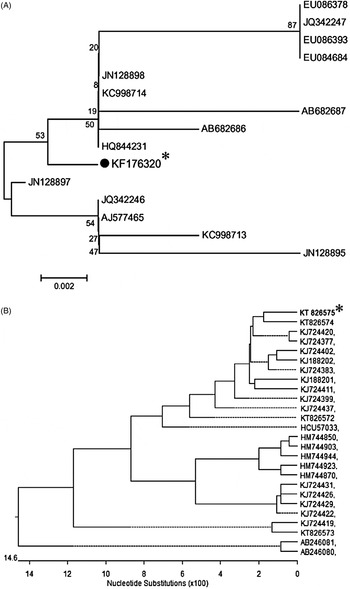
Phylogenetic analysis of aligned ITS2 and COI gene sequences of these Egyptian H. contortus families showed distinct clusters that revealed close ancestral genetic relationships with those retrieved from GenBank (fig. 1A and B). The phylogenetic tree was constructed to calculate and examine the evolutionary relationships of the sequences, in which the length of the horizontal line was proportional to the estimated genetic distance between the sequences.
Phylogenetic trees of Haemonchus contortus isolated from Egyptian sheep and other related isolates generated from (A) ITS2 and (B) the COI gene. Sequences were analysed using the ClustalW (1.82) program and neighbour-joining method of the MegAlign program. Genetic distances are indicated below the tree; * indicates the specific GenBank numbers of H. contortus.

Discussion
Although parasitological examination of sheep faeces is considered the gold standard for detection of trichostrongylid eggs, the technique can sometimes lack sensitivity and cannot identify the worm species (Lichtenfels et al., Reference Lichtenfels, Pilitt and Hobere1994). A considerably more efficient approach entails amplification of a specific genetic region, using a technique such as PCR, one of the most advanced tools in recognizing almost all pathogens of veterinary importance (Learmount et al., Reference Learmount, Conyers, Hird, Morgan, Craig, Von Samson-Himmelstjerna and Taylor2009). To address the shortcomings of the conventional diagnostics of parasitic gastroenteritis, many PCR assays have been created for specific, sensitive and rapid recognition and characterization of H. contortus.
Haemonchus contortus samples subjected to PCR expressed a 361 bp fragment of the ITS2, which is a stable, conserved region among trichostrongyloid genomes. The PCR assay can reliably distinguish and characterize H. contortus infections from those induced by other trichostrongyloids (Gharamah et al., Reference Gharamah, SitiAzizah and Rahman2012). The PCR products obtained in the present study were purified and sequenced for proper confirmation. Alignment results revealed 100% homology among the three groups of sequenced Egyptian isolates, which suggests that the adult worms isolated from all animals were identical. On the other hand, PCR used in the present study amplified a segment from a highly conserved H. contortus gene (ITS2), which was used for the sequence alignment. The level of variation in ITS2 of the H. contortus species between sites was low. This value was 0.43% between H. placei from Uzbekistan and H. placei of bovine animals from Australia (Stevenson et al., Reference Stevenson, Chilton and Gasser1999), whereas among H. contortus isolates from various locations, this value reached 0.86%. Comparative sequence analysis revealed 99.6% homology with the H. contortus 18S ribosomal RNA gene (accession no. HQ844231.1), 99.6% homology with the H. contortus field variant 2 5.8S ribosomal RNA gene (accession no. KC998714.1) and 99.2% homology with the H. contortus field variant 15 (accession no. KC998713.1). Previous studies have confirmed that the causative worm isolated from cases of parasitic gastroenteritis in sheep is H. contortus, which has been identified phylogenetically and is consistent with other reports of H. contortus worldwide. Over the past few years, methods of molecular taxonomy have been applied to the study of polymorphism. Haemonchus contortus and H. placei are more closely related to each other than to other species (Jacquiet et al., Reference Jacquiet, Humbert, Comes, Cabaret, Thiam and Cheikh1995). Stevenson et al. (Reference Stevenson, Chilton and Gasser1999) conducted a comparative study of various sites of the ITS2 in H. contortus and H. placei, and revealed only three differences in nucleotide sequences of ITS2. To clarify the objectivity of these conclusions, we conducted a comparative study of DNA samples of H. contortus collected from hosts inhabiting different regions. This comparison, in our view, will facilitate examination of intraspecific variability of DNA segments and aid in improving the effectiveness of molecular applications that determine species taxonomy of parasitic nematodes. The ITS region is suitable for molecular diagnosis across a diverse range of trichostrongyloid nematodes (Gasser et al., Reference Gasser, Chilton, Hoste and Stevenson1994).
Nematodes such as Haemonchus species possess high levels of prolificacy, in addition to a high rate of infection and direct life cycle without an intermediate host, thus leading to a large effective population size with wide genetic variability (Prichard, Reference Prichard2001). The mitochondrial DNA genome has a higher rate of substitution than that of nuclear DNA, making it possible to resolve differences between closely related individuals (Anderson et al., Reference Anderson, Blouin and Beech1998; Blouin, Reference Blouin1998, Reference Blouin2002).
The present results show genetic diversity among populations of H. contortus, including those from sheep in Egypt. The COI gene sequences exhibited a high frequency of major differences, including insertions in 60 positions, deletions in four positions and substitutions in 56 positions. These results are consistent with those of many investigators, including Brasil et al. (Reference Brasil, Nunes, Bastianetto, Drummond, Carvalho, Leite, Molento and Oliveira2012) in Brazil and Hussain et al. (Reference Hussain, Periasamy, Nadeem, Babar, Pichler and Diallo2014) in Pakistan, who have reported variation in COI gene sequences among Haemonchus species from various hosts worldwide.
The high level of genetic diversity observed in Egyptian sequences is typical of trichostrongylids (Blouin et al., Reference Blouin, Yowell, Courtney and Dame1995; Braisher et al., Reference Braisher, Gemmelli, Grenfell and Amos2004; Silvestre et al., Reference Silvestre, Sauve, Cortet and Cabaret2009), and is thought to be a consequence of both parasite-related and host-related factors. Parasite-related factors include high biotic potential, large population size, short life cycle and high infection rate, as well as high mutation rates observed in these highly polymorphic nematodes and persistence of the infective stage in the host environment that facilitates cross-species migration (Blouin et al., Reference Blouin, Yowell, Courtney and Dame1995; Brasil et al., Reference Brasil, Nunes, Bastianetto, Drummond, Carvalho, Leite, Molento and Oliveira2012; Hussain et al., Reference Hussain, Periasamy, Nadeem, Babar, Pichler and Diallo2014). These findings are also consistent with those of Riggs (Reference Riggs2001), who attributed the differences in diversity parameters among Haemonchus species to variations in their prolificacy, prepatent period, host preponderance and evolutionary rate. Host-related factors include: (1) differences in ruminant species; (2) the presence of H. contortus among heterologous hosts, such as sheep, goats and cattle that share common pastures, thereby promoting transmission of infection from one host species to another; (3) absence of anthelmintic selection and subsequent potential infection in intensively managed flocks; and (4) intense gene flow across subpopulations resulting from the transfer of hosts (Akkari et al., Reference Akkari, Jebali, Gharbi, Mhadhbi, Awadi and Darghouth2013).
In conclusion, for the first time, we obtained data on the DNA structure of Haemonchus nematodes collected from Egyptian sheep. Further investigations of Haemonchus nematodes in other ruminants in Egypt are required. The application of molecular techniques such as PCR and sequencing could lead to accurate methods for the detection of various genotypes. Sequence information facilitates a better understanding of the evolution and dissemination of Haemonchus in the field. Furthermore, knowledge of the genotypes present in Egypt will guide the application of efficient control strategies.
Financial support
Sincere and grateful thanks are extended to the Science and Technology Development Fund (STDF) for financial support under project number 3825.
Conflict of interest
None.