Introduction
At the dawn of the new millennium, religion and religious actors are taking centre stage. A proliferating body of literature has documented their sway over local politics and their increased role in world politics.Footnote 1 However, most studies on the role of religion in International Relations (IR) take an institutional, actor-oriented perspective. While they have provided valuable insights, they ignore religion's alternative role as an organising principle for world politics.
This study offers a starting point for a remedy by presenting this neglected aspect of religion and locating it within a struggle for organising the world. I also introduce the concept of couriers of systemic challenge – those actors who interpret religion as a source of global order and act to realise this vision – and argue that we may gain a better understanding of the operation and appeal of some radical transnational Islamist groups, particularly al-Qaeda (AQ) and Hizb ut-Tahrir (HT), by also viewing them as attempts to render religion the dominant and constitutive element in world politics. After all, such actors, while representing only a fraction of all religious actors, doctrines, and constituencies, do challenge the state-based order.Footnote 2
These groups may represent a unique challenge but hardly a new phenomenon given a millennia-old struggle between agents of dissimilar organising principles over the shape and organisation of world politics. Recall that prior to the Peace of Westphalia, religion had a critical role in shaping the political landscape; afterwards, it was largely relegated to a secondary position. While the new order made space for religion to operate in states' domestic arenas, it was kept subordinate to the logic of the state system. Religion remained a legitimate (though in the dominant secularist view, undesirable) and in fact pervasive source for state identity, informing traditions and institutional forms as well as policies in numerous countries;Footnote 3 but when it came to ordering the globe, the ‘rules of the game’ were strictly state-based.
The current phase of this enduring struggle is taking place against the background of the state's weakening control in various spheres, and the ascendance of globalisation. To some extent, this religious challenge is a response to the poor condition of the state, the destabilising effects of advancements in technology on the fabric of societies, and the failure of the Western-implanted nation-state to convey a strong social identity and moral purpose in many post-colonial states. Technological progress, facilitating the dissemination of ideas with greater ease and unprecedented scope, may make this challenge more potent in comparison to previous challenges, but the roots of the challenge build on the age-old appeal of religion.
Despite its benefits, the conceptualisation I propose has its drawbacks. By focusing on the competition between state and religion, we blur the important role of other factors that account for the shape global politics has taken; some of these factors, such as globalisation, are understood here as providing enabling conditions, or considered as affecting the variables in question. Similarly, the historical narrative I offer reifies the prominence of the European-centred perspective, and consequently sidelines non-Western alternative narratives and modes of organisation that existed in those parts of the world still not under European domination.Footnote 4 That Christianity's chief theological competitor, Islam (embodied politically in the Ottoman Empire), began to experience the long, slow decline of its political power in the generation after Westphalia may provide qualified support to the European storyline,Footnote 5 but it does not eliminate the need to follow Adam Watson's work on international societies throughout history,Footnote 6 this time from a perspective that gives ontological primacy to organising principles.
AQ is a valuable subject for examination given the inclination to view it as a terrorist organisation, a challenger to domestic orders in Muslim states, a response to US foreign policies and a major threat to US national security. Undoubtedly, these factors are relevant, but they tend to obfuscate AQ's role as a courier of the religious logic. Viewing AQ as a courier will allow us a more comprehensive understanding of the organisation not only by adding an important missing lair but also by shedding more light on the factors that have already been identified as driving AQ. In contrast, examining HT demonstrates that actors promoting an alternative logic for organising the world do not have to rely solely on violent means and could mix it, often for utilitarian reasons, with non-violent methods. Violence has an important role in HT's vision, and subversive acts are already part of its tool kit, but its actions at this stage focus on propagating its ideas and building a social movement. As a result, the number of HT followers throughout the world is exponentially greater than that of AQ.
Note that the article's focus on two Islamist movements does not imply that challengers to the Westphalian system may emerge only from Islam. Challengers may be associated with diverse religious creeds or alternative organising principles (for example, a transnational communist movement in pursuit of a communist world order, or a state in a quest for empire).
The rest of the article is divided into four sections. First, I discuss the concept of organising principles – what they are, how different principles may relate, and the role of couriers in promoting distinct interpretations of organising principles and in taking action to make these principles dominate. In the second and third sections I examine AQ and HT, respectively, as entities that embody the recent religious challenge to the Westphalian order. I conclude with a discussion of ideas for future research as well as the article's relevance to the study of systemic change.
Organising principles and their agents
International Relations scholars have paid relatively little attention to the ways in which religion influences states.Footnote 7 The few who have sought to integrate religion into IR theory usually view the Westphalian-based system as a norm and explore how religion and religious actors fit into this system as an intervening factor.Footnote 8 Such studies offer invaluable insights on the relationship between religion and politics, but they miss the potential of religion to become the basis for a new world order.Footnote 9
While taking a comprehensive look at violent religious actors, Mark Juergensmeyer argued over a decade ago that there is a ‘cold war’ between secular and religious nationalism, viewed as competing frameworks of social order.Footnote 10 But his account focused on national communities and social order within modern nation-states rather than on universal political order and a new paradigm for world politics. Recently, Juergensmeyer took his argument one step farther and asserted that religious challengers to the secular states form a global rebellion. Yet, he bases his conclusion on an aggregate of conflicts that take place within domestic contexts: most rebelling groups reject the secular nature of their Western-implanted nation-state, seek to inject it with religious elements, and ultimately create a new synthesis of religion and state.Footnote 11 Juergensmeyer rarely refers to the implication of such a synthesis for international politics and consequently envisions an increased role for religion in states but hardly a revolution of the world order. Similarly, Gilles Kepel argues that ascending religious movements are seeking to change the social order, but his analysis underscores that this variety of movements are embedded within the state-based order. Their fight is with secularism and modernity, not the Westphalian order.Footnote 12
Interestingly, both authors acknowledge AQ as a deviation from the common model of Islamist movements; but they do not take this argument very far. Kepel argues that AQ's objective is to sweep Islamists to power in Muslim countries throughout the world. According to this account, AQ attributes the failure of prior Islamists' efforts to US support for local Muslim regimes and targets the US as a means for building Muslim solidarity and mobilisation against ‘apostate’ regimes.Footnote 13 Thus, rather than a force opposing the state-based order, AQ represents an alternative route to changing domestic conditions within the existing order through transnational action.
Going further, some observers have maintained that Islamist revivalist movements challenge the Westphalian order. Pointing to AQ's global aspirations, Philpott determines that it challenges the secularised political order in which the Westphalian synthesis is embedded.Footnote 14 Nelly Lahoud maintains that the individualist interpretation of religion that characterises all jihadi groups is antithetical to any political order (and thus sows the seeds of these groups' demise).Footnote 15 Broadening the scope of challengers, Bassam Tibi sees all Islamist groups as revolting against the prevailing international order of nation-states.Footnote 16 He asserts that the challenge takes place at the state level, where these movements seek unity of religion and state (in contrast to the secular nation-state), and at the international level, with a goal of expanding dar al-Islam over the entire globe.Footnote 17 This article continues where Tibi, Lahoud, and Philpott left off: I underscore religion's potential to serve as the basis for a new world order and argue that we should view AQ as one entity in a category of identifiable couriers of a religious logic vying to reorganise the globe.
In taking such a step, this article establishes an additional linkage between the work of the English School and the literature on security studies, specifically that which deals with terrorism. English School scholars have paid little attention to the impact of terrorist activities on the international society, seeing it as largely inconsequential for its development.Footnote 18 Indeed, Andrew Hurrell notes that the privatisation of violence and security affect global order,Footnote 19 yet he determines that terrorist organisations, even religious ones, are almost exclusively nationalistFootnote 20 and thus practically irrelevant to the organisation of world politics. Scholars who have showed greater interest in the question of terrorism seem, nonetheless, more interested in establishing that states are the predominant perpetrators of terrorism, or in warning that states (particularly Western powers led by the United States) use terrorism as an excuse to undermine international rules, norms, and institutions,Footnote 21 than in exploring with rigour how terrorism directly relates to the English School agenda. Unsurprisingly, these accounts neglect the role of religion.
But by challenging states' monopoly over the use of coercive means, terrorism inherently poses a challenge to the fundamental principles of the international society and is therefore relevant for the English School. Often this challenge is limited by the terrorist organisation's aspiration to achieve statehood for its constituency,Footnote 22 yet in some cases terrorism, when it is generated by alternative visions of world order such as those religions can offer, constitutes a challenge to the state-based order. Even if small in number, such groups should be important subjects for research, by virtue of their increasingly destabilising effects on world order and their link to the enduring struggle over its design. Therefore, by shedding light on the interpretation of religion as an organising principle for world politics and linking strands of religious terrorism to world order, this article hopes to open new avenues for English School research.
The first step is to define ‘organising principles’. Organising principles represent the fundamental authority structure of the world order. They constitute actors within a system (states, religious communities), standards for determining the legitimacy of the actors' existence (belief in God, meeting a ‘standard of civilisation’), and their form. They also set parameters for actors' operation: their geographical jurisdiction, the goals they pursue, the legitimate means of control, the scope of actors' intervention in humans' daily life, the bundle of principles and values that are considered appropriate and those that actors seek to actively promote. Organising principles articulate the source of universal authority, the status of the units comprising it, and the manner in which they relate. Organising principles also shape the role and rules of all other, underprivileged entities that exist within the system (such as the Catholic Church in a state-based order).
The Westphalian state-based system has provided the primary organising principle for world politics since roughly the middle of the seventeenth century.Footnote 23 Although dominant for nearly four centuries, the Westphalian system has not been stagnant; it has evolved gradually until reaching its current shape,Footnote 24 absorbing some disparity between the ideal type and the occasional violations of the system's fundamental principles on the ground.Footnote 25 Nevertheless, the Westphalian model shows remarkable longevity and considerable power and resilience. The principles it embodies gradually spread – not always in a benign manner – outside of its European core, eventually covering the whole globe.Footnote 26
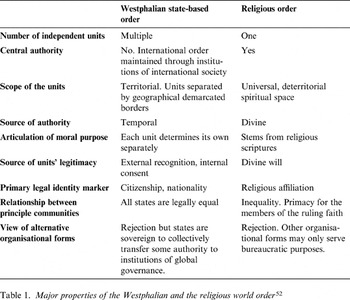
In its capacity as an organising principle, the Westphalian system is characterised by a lack of central authority. It values the political fragmentation of the global terrain as the most effective institutional arrangement to attain particularistic goals while maintaining general order. Consequently, whereas in hierarchical systems conceptions of social, individual, and political life are imposed from above, in the Westphalian model the system's units determine the goals people under their authority seek to advance, and they independently shape political life within the unit.
The system is also characterised by the hegemonic status of one specific organisational form, while pledging to preserve pluralism among these like-units. Only states are recognised as rightful members in the international society, thus excluding alternatives for organising the political space in a decentralised system. This organisational uniformity is translated to some interests that all states share, but overall states are free to conceive their notions of collective good and state interests independently. Although in reality hierarchy between states does exist, it results from changing distributions of material and ideational capabilities (balance of soft power); in principle, all units enjoy equal legal rights.
The Westphalian system is not only decentralised and pluralistic; it also constitutes actors in the system by dividing the world into independent entities without overlapping authorities. Such a division shapes the nature of the system and is designed to reduce friction among the units by clarifying authority rights. The carving of the global terrain into mutually exclusive units also sets the quest for peaceful coexistence as one of the fundamental goals of the system.Footnote 27
Sovereignty, defined by John Ruggie as ‘the institutionalization of public authority within mutually exclusive jurisdictional domains’, is the principle most identified with the Westphalian order.Footnote 28 Westphalian sovereignty is the property of numerous entities, and it sets rules for the relationship among the diverse (state) actors in the system. What is most unique is that it is coupled with territoriality. State sovereignty is attached to a territorial possession over which a state (with the recognition and acceptance of other states) holds authority. Thus, the principle of sovereignty creates an inside-outside distinction: states have authority within their boundaries, giving each the exclusive right to intervene coercively in activities within its own territory,Footnote 29 but no authority outside their borders. Derivative from that is the principle of non-intervention: states' freedom internally is accompanied by an obligation to refrain from intervening in the domestic affairs of other states.
On its face, religion, by anchoring authority in a divine entity rather than the state, offers an alternative to the state system. But there could be exceptions. One is a religion that is strongly attached to the private sphere and prescribes only values, beliefs, and guidance for personal behaviour, but does not spill over into the public domain where politics, power, and control are at play. In another, religion, specifically the Judeo-Christianity tradition, creates prediscursive dispositions and cultural instincts, serving as the foundation for a secular public order and democratic political institutions.Footnote 30 Another perspective may confirm the superiority of God's sovereignty but locate it in a separate and higher sphere that is not part of this world.
However, when religions offer rules for society, they provide an opening for groups of believers to interpret them as a guide for the political management of the public sphere, some on a broader scale than others. Monotheistic religions, with their emphasis on the oneness of God, are particularly prone to broad interpretations that envision a global religious order. Such an order is universal and hierarchical in its nature.Footnote 31 Unlike the international society, which allows for multiple ‘truths’ to coexist, in a religious order the source of authority is one, and it demands exclusivity, denying the existence of any other truth but its own (although religious doctrines might acknowledge that other faiths hold partial truths).Footnote 32
In theory, a religious order could consist of various entities representing different creeds. The affinity between different religions and the logic they represent is much greater than that between a religion and a state. However, proponents of religious order tend to associate such order with the hegemony of one religion that imposes its creed on the whole system. They often want more than an order based on shared religious values; they highlight the differences among religions and seek to establish the superiority of their own ‘truth’.
A religious order, though deterritorialised, may allow divisions of the global terrain, but the purpose of creating territorial units is administrative only, not political. Such units are constrained within a rigid hierarchical order that offers them very little independence to determine what good to pursue and the means to achieve it. They are no more than contractors implementing a vision imposed from above.
A religious order conflicts with the Westphalian order because the religious source of authority is higher than any temporal claimant to authority. Therefore, the state can never be accepted as a source of authority. Because a divine order can accept no constraints or limits, it also negates physical borders, seen as arbitrary creations. Religion circumvents the territorial divide by seeking to unite people around a set of rules applied on a non-territorial basis.
Despite the potential conflict between religion and the Westphalian order, most religious actors are comfortable with coexistence between the two, adhering to interpretations of religion and its role in temporal life that support such coexistence. Protestantism even advocated Westphalia's dethronement of the temporal powers of Rome as a matter of principle. But any such interpretation signifies the abandonment of religion as an organising principle on the global stage. Relegating religion to domestic politics has been the most common form of accommodation, an arrangement that the Westphalian order welcomed.Footnote 33 Religion could shape states' identities, political systems and policies, but it was subordinated to the state logic; the principles for the operation of the Westphalian order override religious imperatives whenever the two come into conflict. Nevertheless, although the hegemonic status of the state-based system makes religious order nearly unimaginable, the potential to serve as an organising principle is inherent in the most prominent religions; and while it could lie dormant for generations, its vitality can never be fully vanquished. It may resurface when a critical mass of religious states emerges, or as this article emphasises, through the rebellion of non-state actors who refuse to accept the legitimacy of the Westphalian state even as a temporary compromise that necessity dictates.
The Westphalian system and its religious competitor are only two of the organising principles history has presented. Some gained dominance, while others remained a theoretical alternative, failing to gain ground and be implemented. Empire was the dominant form of political organisation in Rome's heydays, subordinating its religious competitor, the young Catholic Church.Footnote 34 Before the emergence of the Westphalian system, city-states and city-leagues also constituted alternative organising principles. In the twentieth century, communism became a new challenger contending for primacy. It offered an alternative view of world politics as a class struggle and a vision of a more just and differently organised world to replace what it saw as an abusive bourgeois-serving order. Communism was carried on the wings of a powerful Soviet state but failed to lead a successful revolution in world politics. The Soviet Union was socialised into the state system, relegating communism to domestic politics and thus submitting it to the fundamental principles of international society.Footnote 35 Later, when the Cold War drove the Soviet Union to expand its sphere of influence, partly though exporting its value system, the Soviet effort was largely focused on transforming states' domestic systems without subverting the hegemony of the Westphalian system (although one may wonder whether a Soviet triumph would not have opened the door for a revival of a communist challenge to the international order).
The enduring primacy of the Westphalian logic is quite unique in the history of the world. By their nature, organising principles aspire to hegemonic status, but they rarely achieve such a position. Competition between dissimilar organising principles is not a duel that is decided in one decisive stroke. Rather, it is a slow, long, and complex process that features various arrangements and changes in power relations between competing ideas. The competition between religion (Christianity) and Empire (the Roman Empire and the Holy Roman Empire) led to a variety of arrangements with shifts in supreme authority corresponding to material and ideational changes. Medieval Europe featured overlapping authorities with the Church, lords, kings, emperor, and towns vying for authority, and occupants of a territory subjected to a multiplicity of higher authorities. Under such a system it was impossible to distinguish between what we would term these days as ‘international’ and ‘domestic’; actors participated in both.Footnote 36 Authority relations among the various actors were often idiosyncratic, contextual, and arbitrary rather than an outcome of specific roles assigned to categories of actors, or of predetermined relationships between the holders of such roles. This heteronomyFootnote 37 was not by design but the chaotic result of different organising principles fruitlessly vying through diverse actors for primacy, unable to break a deadly stalemate, until eventually the state emerged victorious.
Ironically, the state was a latecomer, though a powerful one, to this conflict of organising principles. Elements of sovereign statehood had been accumulating for three centuries prior to Westphalia.Footnote 38 It benefitted from the rivalry between much older contenders to primacy – Empire and Religion – but the collapse of the old order was accelerated by conflict between competing interpreters and interpretations within Christianity. The Reformation's challenge to the Catholic Church created a crisis of pluralism leading to religious wars that could not be resolved by force and resulted in the exhaustion of all participating actors. Instead of a clear triumph by one of the competing actors, the resolution reflected the actors' limitations and gave rise to the state as an alternative organising principle that accommodates a multiplicity of claims to authority by anchoring authority in territoriality and exclusivity. It is paradoxical that although both Protestants and Catholics agreed that religious loyalty precedes and overrides loyalty to states and rulers,Footnote 39 the solution to European crises was to separate the temporal authority from the spiritual.Footnote 40
However, even when a struggle between organising principles appears to be decided, elements of the old order do not disappear overnight and may not vanish at all. Religion was integrated into the new order, maintaining considerable regenerative power. The newly formed international society maintained strong religious elements such as holding a Christian culture prerequisite for inclusion. Far from being defeated, for the next two hundred years religion was still a constitutive element of the emerging state-based society.Footnote 41 Yet, for the state to evolve and flourish, religion had to become privatised and nationalised.Footnote 42 State-building, necessary for the rise of the modern state, modern nationalism, and the rise of modern international society, required modifying the concept of religion in the West from a ‘community of believers’ to a ‘body of beliefs’. Thus, religious beliefs, conscience, and sensibility were privatised by the secularisation of politics, and the disciplinary role of religion was taken over by the state.
But the ‘disciplining of religion’ was much less effective outside of Europe. Even as the West extended its reach and ideas to the rest of the world, the imperial project experienced varying levels of success in its efforts to destroy the social-political dimension in non-Christian religions, and to cement the separation of private belief from public practice and observance.Footnote 43 After all, religious histories were part of local heritages, religious institutions frequently remained the most effective systems of communication within nations, and religious leaders were often more socially devoted, efficient, and intelligent than were government officials.Footnote 44 In addition, their links to colonialism gave secular nationalism and the Westphalian system a bad reputation outside the West. The new order met particular difficulties in its encounter with Islam. As Jack Miles persuasively argues, at least some Muslims have always seen the world order as a religious one,Footnote 45 contributing to the prominence of Islamist groups in the emerging challenge to Westphalian order. Combined with the failure to produce strong states, the result has been the ubiquitous presence of strong religions and weak states throughout much of the developing world.
While religion never completely disappeared from public life, its resurgence on a global scale is relatively new. Scott Thomas views this resurgence as a reflection of deep and widespread disillusionment with a modernity that reduces the world to what can be perceived and controlled through reason, science, and technology and leaves out the sacred, whether religious or spiritual.Footnote 46 States are representative and the embodiment of modernity that gradually left to obscurity the religious sources that had provided the foundations and content of ideas about world order. The Western neglect or intentional abandonment of the religious created a state-based logic that lacks a ‘soul’. The Western state attempted not only to tame religious faith but to exclude it from political life.Footnote 47 This may have been a pyrrhic victory because when modernity failed to meet the evolving needs and expectations of people seeking spiritual meaning, not just material rationality, this failure was manifested in part by the perception of the failure of the state. Meanwhile, since the conception of the rational state excluded its religious elements, the perception that the state had failed did not taint religion, allowing it to appear as a viable alternative to the failure of the ‘soulless’ state.
Numerous religious actors around the globe have been empowered. Most assume the prominence and inevitability of the state, focusing on change within their own secular nation-states, and do not press further to challenge the Westphalian system.Footnote 48 However, the appearance of enabling conditions – the compression of time and space and the enormous increase in the ability of non-state actors to build capabilities, all under the aegis of globalisation – at a time when the state appears to falter on its promises also opened new possibilities for a revival of the religious challenge to world order. What was now needed for the revival of the religious quest for primacy was agency: actors who would interpret the role of religion as a universal system for world politics and would organise to promote this vision.
The focus on such actors is imperative. As ideas, organising principles possess robust constitutive power to shape actors and rules for interaction. But principles do not have life or power of their own. While I choose to give organising principles ontological primacy in order to highlight an important feature of world politics, this picture would be incomplete without entrepreneurs of ideas. Ideas are enacted by particular people who ‘discuss, persuade, preach, pressure, order, cajole, and shoot, who organize themselves into lobbies, armies, networks, and parties, who vie against all the same sort of people, performing the same sorts of activities, on behalf of an opposing program, but who eventually win the international revolution’.Footnote 49 Thus, the outcome of a battle of organising principles depends on more than the intrinsic appeal of those ideas; the material and organisational resources held by the ‘couriers of ideas’Footnote 50 and the coalitions they form must be accounted for as well.
Two caveats must be noted. First, couriers of a challenge to a global political order are not completely detached from the order they seek to overthrow; they are in fact constituted, at least partially, by this order. They understand who they are and what they stand for, not merely in relation to the organising principles that gave rise to them, but also by contrast to the dominant alternative. Furthermore, operating within a certain order, challengers also draw on its resources. Indeed, AQ takes advantage of the technological advancements and means of mass communication that are fruits of modernity while rejecting the values that provided the nesting ground for these tools. Second, these couriers do not compete only with the units of an alternative order (that is, religious actors vs. state actors); they also compete with other groups that may share some of the courier's beliefs and values and yet subscribe to a different understanding of the role they should play in the political order. Thus AQ also struggles with other religious groups, such as the Muslim Brotherhood, who hold diverging conceptions about the role of the divine in mundane political life.Footnote 51 In the following sections I will discuss AQ and HT, two actors who seek to promote Islam as an organising principle for world politics and that embody the emerging religious challenge to the Westphalian order.
Major properties of the Westphalian and the religious world orderFootnote 52

Al-Qaeda as a courier of the religious logic
Most religious actors operate within the normative framework of the international society. They are part and parcel of its fabric. They play a significant role in shaping states' identities, interests, and policies, but they accept the superiority of the state-based order, if not always in principle at least de facto. In contrast, couriers of a universal religious order challenge and seek to undermine the society of states.
I argue that AQ can be seen as an agent promoting one particular and especially extreme understanding of Islam as an alternative organising principle for world politics. Most scholars study it as a terrorist group with expansive yet ‘traditional’ objectives such as ejecting US forces from the Middle East, eliminating American influence in the region, and toppling Arab regimes.Footnote 53 I do not deny the many ‘regular’ aspects of the group's objectives. Yet I suggest that when one examines its attitude toward the constitutional normative principles of the existing system, its views of the rules that derive from and promote these principles, and the ideological vision of its preferred world order, it becomes clear that AQ represents a courier of systemic challenge, seeking to replace the state-based order with a religious one.Footnote 54
In advocating an alternative order based on religion, AQ's ideology conflicts with the underlying logic of the current international order. AQ leaders hold a divinely-centred worldview that sees Allah as the sole source of authority and the Islamic shari'ah as the only guide for behaviour. God's authority is universal; it cannot be constrained by state borders. Therefore, whereas many Islamic groups seek to make religion supreme within their national boundaries, for AQ this is insufficient. Taking over particular states in the name of Islam is important because the emerging Caliphate needs a nucleus;Footnote 55 but Islamic Emirates represent only a transitory phase on the road to the formation of a worldwide Islamic empire.
The incompatibility of AQ's religious order with the Westphalian order goes beyond the claim of both God and state to ultimate authority. The Westphalian synthesis accepts diversity of legitimating principles of state authority (manifested in different types of regimes) and goals among units, and in its basic form does not prioritise universal goals.Footnote 56 Moreover, in this order the legitimacy of many states has been based on recognition by other states, not on any higher authority. For AQ, not only is a political division of the world that is not sanctioned by the shari'ah illegitimate, even the temporary legitimacy of units in the system is tied to their adherence to religious imperatives. The existence of territories not under Islamic rule (normally referred to as Dar al-Harb) is understood as a reality that may persist over a long period, but by no means is it accepted as legitimate. This reality reflects a transitory phase, until eventually these territories come under Muslim rule.
AQ's efforts to shape a discourse around religion and away from the terms used in a state-centred ontology are emblematic of its rejection of the Westphalian order. One indication that AQ does not view the world through a state-based map is the way in which it names its franchises. In its messages, AQ speakers sometimes refer to names of nation-states because this is the prevailing language and one it must use to relate to a broad audience; but when it names its franchises, it seeks to tie them to geographic anchors (‘al-Qaeda in the land of the two rivers’, ‘al-Qaeda in the Islamic Maghreb’, ‘al-Qaeda in the Arabian Peninsula’). Thereby AQ avoids names that could be interpreted as granting legitimacy to the Westphalian system and to authorities in the particular states it targets.
Although it sometimes uses language reminiscent of traditional non-state vs. state conflicts, calling for the overthrow of regimes and resistance of foreign invaders in an effort to force their retreat, the overall theme AQ presents is of a worldwide religious war. Battles may take place within the state system, but it is an all-out war that knows no boundary and is based on religious affiliation; as Osama bin Laden declared, ‘this war is fundamentally religious’, pitting the Zionist–Crusader alliance against Muslims.Footnote 57
Many of bin Laden's statements propagate AQ's political objectives without any references to a religious world order. This apparent duality could be viewed as reflecting an attempt to use mundane symbols to mobilise support. Moreover, even without employing religion explicitly, these statements represent grievances and proposed solutions that are imbedded in a religious worldview. For example, bin Laden repeatedly played the theme of self-defence as a justification for resistance, utilising in this way a discourse that has considerable potential to appeal to a broad audience. Nevertheless, self-defence is still anchored in a religious worldview: it is defined in Islamic terms and is used to encourage the community of Muslims to fulfil what AQ sees as their religious obligation to join in ‘defensive jihad’.
AQ leaders even protest attempts to frame the conflict in non-religious terms: ‘mispresentation and defeatism had reached a stage in which some have said that our fight against the Jewish occupiers and the criminal Christians is not a religious fight, but only a conflict over the lands they occupied and the homes they seized unlawfully’.Footnote 58 In AQ's view, we are witnessing nothing less than an anti-Islamic alliance waging a campaign to eradicate Islam from the face of the earth.Footnote 59
In this religious war, there is no room for compromise or peaceful coexistence. Despite the common use of a language of self-defence from an alleged onslaught on Islam, in AQ's vision interfaith coexistence between equals is not possible. In reality, that implies that conflict is inevitable. In fact, the current events only reflect a phase in a cosmic struggle between the forces of truth, represented by the Muslim ummah, and the agents of falsehood,Footnote 60 which is bound to end in Islam's victory. AQ's ultimate objective, then, is to spread Islam's rule and to make Allah's word Islam supreme. As the late leader of AQ in Saudi Arabia Yousef al-Ayiri asserted, ‘Muslims can have only one goal: converting all humanity to Islam and effacing the final traces of all other religions, creeds and ideologies.’Footnote 61 The religious mission of spreading Islam globally, and the derivative need to bring all non-Muslim countries to submit to Islam, are also articulated in AQ's official publications and in numerous treatises and statements, often those directed at Muslims.Footnote 62
To achieve these objectives, AQ acknowledges, violence will be needed; since the peaceful call for people to embrace Islam is likely to face resistance, jihad, understood as the use of force, will be required.Footnote 63 Only jihad will enable people to appreciate the truthfulness of monotheism without impediments and to see the system of Islam, its justice and righteousness to humanity, in its totality. It will continue until infidelity is exterminated in its entirety. ‘This is because infidelity is like cancer or even worse, so when an infidel does not convert to Islam or is not submissive to the laws of Islam then it is necessary to extirpate him so that the society in which he exists is not corrupted.’Footnote 64
Far from the international society's aspiration to limit violence and promote coexistence and even cooperation through dialogue and tolerance between diverse state actors, AQ's worldview promises intimidation and violence in the name of God until victory is achieved. As asserted in a statement by Abu Yahya al-Libi:
Then the duty of the nation of Islam is not to go along with the nonbelieving nations, to sweet-talk them, to work to please them, to try to find common ground with them, or to search for the basis of coexistence that brings them together, or to expend efforts and waste one's whole life trying to convince them to accept reality and surrender to it. We were not created for this, nor were we ordered by this. God created us and brought us so that we can transform whomever he wants from worshiping people to worshiping God, from helplessness to hopefulness, and from the injustice of other religions to the justice of Islam. He sent us with his religion to his creation for us to invite them into it. For those who accept this from us, we accept this from them. For those who refuse it, we will fight them to the end.Footnote 65
God and state's competing claims for legitimate authority are inseparable from the conflict over sovereignty. Westphalian sovereignty, the most central element of the state-based order, stands in direct opposition to the view espoused by AQ in which sovereignty is the property of God alone. In this view, neither the artificial institution that is the state, nor men can claim sovereignty. Any attempt to locate sovereignty elsewhere amounts to equating oneself to God.
Because religious imperatives are superior to states' raison d'état, acts that are considered legitimate exercise of state sovereignty are often rejected by AQ as contradicting the shari'ah, whereas policies that conflict with the rules of coexistence within the international society and violate the fundamental principle of non-intervention may be viewed as religious requirements. Indeed, AQ opposes states' prerogatives such as the exclusive right to declare war and the right to devise and implement their own domestic and foreign policies. It rejects the designation of states as the only legitimate users of coercive means, negates restrictions (contained in international law) on the application of force, in particular the international norm against the use of weapons of mass destruction and the norm of sparing the lives of non-combatants.Footnote 66
According to AQ, only the shari'ah may stipulate the conditions for a legitimate war. While AQ accepts self-defence as a legitimate cause for war, it applies for Muslims only. AQ also does not see any need for international legitimacy for war, or any international intervention or mediation to stop an ongoing war if war is considered legitimate from an Islamic standpoint. ‘We do not wait for legitimacy to be granted to our offensive or defensive jihad from any religion besides Islam, for a law by a global organization, international legitimacy, regimes that have colluded with worldly customs.’Footnote 67 Moreover, in its view, the use of force is justified not only for self-defence but also as a means to expand Islamic rule.
AQ's view is also a repudiation of the function of war as an institution of international society – that is, in those cases when war is conceived as a tool to promote a greater good for the society of states. Contrary to the role of war as a check on power and a mechanism to restore order in international society, in AQ's worldview war serves to promote Islamic justice; rather than facilitating coexistence in a pluralist international society, AQ's war challenges the primacy of states and seeks to overthrow the state-based order.
Even when it uses self-defence as the justification for fighting, AQ does not subscribe to the narrow understanding common among members of the international society (and manifested in international law). Rather, AQ relies on an Islamic conception that it interprets in an extreme manner and stretches considerably. AQ broadens the concept of attack on Islam to increase the scope of operations that Muslims must undertake even without the sanction of political authorities. Foreign occupation of a Muslim land has been the traditional justification for jihad, but foreign occupation is seen beyond Iraq and Afghanistan. It even goes beyond Saudi Arabia, allegedly conquered by the United States to include every territory once under Muslim control. This leads to a long list of jihad arenas stretching from Spain to East Timor.Footnote 68
AQ also views alleged oppression and persecution of Muslims outside the territory of Islam, manifested in the hindering of the propagation of Islam or the perception that Muslims living among unbelievers are being discriminated against, as legitimising war. In AQ's view, practically any restriction on Muslims can be interpreted as an attempt to limit the proclamation of Islam, including measures to curb the operation of movements such as HT in various Western countries and the ban on the Muslim headscarf in France. Defence of the honour of Islam, particularly of the Quran and the Prophet Muhammad (mostly following the publication of the Danish cartoons), were also introduced as justifying usurping states' prerogatives and the initiation of jihad.Footnote 69
Not surprisingly, AQ also objects to the designation of the state as the only authority to legitimately use force. The superiority of God and his shari'ah limits leaders’ authority and justifies its appropriation when their acts conflict with religious imperatives. AQ's extreme view of what the shari'ah demands and its denial of the legitimacy of alternative understandings of Islamic rulings amplifies its challenge further,Footnote 70 lowering significantly the bar for appropriating leaders' prerogatives.
On the question of war initiation, AQ believes that when the shari'ah mandates jihad, Muslim leaders must respond even if prudence, interests, and international norms gravitate against war. If a leader fails to meet such imperatives, the true believer must appropriate his right to declare war and assume that responsibility himself. Viewing the rulers of Muslim states as apostates, AQ calls upon Muslims to abandon their rulers and to fight in the cause of God. AQ itself seeks to lead the people by example. Note that for AQ, jihad is more than an instrument to spread Islam or protect Muslims. It is the embodiment of faith and, as such, it cannot depend on the whims and calculations of a Muslim leader or be suspended due to international norms.
AQ also opposes the principle of sovereign equality because it implies equality between Muslim and non-Muslim states, as well as between Muslims and non-Muslims. For AQ, there is no possibility of equality in virtues and rights between religions and between civilisations. Indeed, when it comes to the right to launch a war, a non-Muslim attack on a Muslim state is regarded as an act of aggression, while a Muslim attack on a non-Muslim country is considered the fulfilment of the ummah's divinely prescribed goals.
AQ's perspective regarding what constitutes legitimate causes for war and how it should be conducted also reflects its total rejection of international law – a prominent institution of the international society – and the UN.Footnote 71 International law embodies the role of man-made law in regulating interstate relations, and the UN regularly fulfils legislative functions. But legislating is God's privilege as the creator of all things, and under the principle of Tawhid, which affirms God's supremacy and strictly prohibits sharing authority with any other entity or institution, no other is allowed to assume this right.Footnote 72 Its importance cannot be overstated: usurping the right to legislate is punishable by death.
AQ renounces international law, the UN, other international organisations, and all international conventions not only as the creation of men, and thus contravention of the principle of Tawhid; it also argues that they are shaped by non-Muslim states, reflect Western norms that are antithetical to Islam, and serve Western interests, particularly in their onslaught against Islamic countries and Muslim people.Footnote 73 Moreover, in its view, they are designed to relegate Muslims and Islam to submissiveness and to drive them away from God and his religion.
Naturally, the limitations on exercising states' sovereignty weigh more heavily on Muslim states. AQ challenges the right of Muslim states to make agreements that allow the presence of non-Muslim military forces on Muslim land, or to grant these forces permission to operate from Muslim territory, particularly against another Muslim state.Footnote 74 In addition, the network does not accept states' rights to extend recognition of the sovereignty of other states. Since a territory that was once Muslim can never become non-Muslim, regardless of states' decisions, Muslim states are prohibited from recognising a non-Muslim state wherever a Muslim entity established control in the past.Footnote 75 Unsurprisingly, plans to settle the Israeli-Palestinian conflict through any compromise enrage AQ spokesmen and lead the group to vehemently condemn not only Saudi Arabia, the Palestinian Authority, and other Arab regimes, but also Hamas.Footnote 76 As al-Zawahiri declares, ‘the recovery of every land which was once a land of Islam is a personal duty of every Muslim. Therefore, as Muslims, we cannot possibly concede to Israel so much as a hand-span of Palestine … and all the international resolutions which bit chunks of it and allowed the presence of Israel on it … are null and void, non-binding resolutions, which aren't worth so much as a mosquito's wing on the scale of Islam.’Footnote 77
AQ's position on the Israeli-Palestinian conflict demonstrates how its convictions regarding what actions Islam mandates undermine international society's institution of diplomacy, an institution anchored in the wish to settle conflicts by non-violent means through negotiations and compromise. In AQ's view, religious imperatives cannot be negotiated or subject to any compromise.
Hizb ut-Tahrir as a courier of the religious logic
HT is another example of a courier of the religious logic for organising world politics, though its mode of operation and ideas concerning how to effect change differ considerably from AQ's. HT was founded in Jordanian-ruled East Jerusalem in 1952 by Sheikh Taqiuddin al-Nabhani, a Palestinian cleric who believed that Islam could be revived if it was restored as a comprehensive guide for daily life in the framework of an Islamic state – the Caliphate. In the following years, HT expanded to Egypt, Lebanon, and Syria. Additional branches were later established in dozens of countries. Currently HT operates in more than forty countries, mostly in Central Asia (where the collapse of the Soviet Union allowed for HT penetration), Western Europe (since the 1970s), and the Middle East. Membership in HT is rapidly growing and thought to be in the millions.
The leadership of HT is based in Jordan, but the movement also maintains headquarters in London, taking advantage of the relative freedom Europe offers to oversee HT activities in Muslim countries where HT is more restricted. HT is banned in all Arab countries except Lebanon, Yemen, and the UAE. The movement is also prohibited in some non-Muslim countries, including Germany, Russia, the Netherlands, Denmark, and China. HT maintains a strong presence online as well, using this medium to spread its ideas and compensate for the limitations that states impose on its operation. As an indication of the breadth of its operations, one of its main websites is available in seven languages (Arabic, Turkish, Russian, English, German, Urdu, and Danish).
According to HT, the history of the world is a story of conflict between truth, represented by Islam, and falsehood – the infidels, ‘the Kufr’. This struggle is cosmic, eternal, and will continue until the Day of Judgment when Islam emerges triumphant. The state system is another phase in this conflict. In fact, it is the highest stage in a historical onslaught on Islam. As a result, HT's programme for change cannot be accommodated within the framework of the state system. Moreover, the order it seeks to establish requires the demise of this system, to be replaced by the Islamic state as the vehicle through which Islam and Muslims will undertake their universal mission. For HT, the reestablishment of the Caliphate is a prerequisite for the restoration of the ummah's purpose and the realisation of its universal goals. Only under the Caliphate will the Islamic ummah be in a position to realise its godly ordained destiny to oversee mankind according to the shari'ah.Footnote 78
Jihad takes a central role in the Caliphate and further supports the need for a strong entity in possession of armed forces.Footnote 79 HT does not distinguish between violent and spiritual jihad and rejects the distinction between offensive and defensive jihad,Footnote 80 deeming these distinctions manifestations of a scheme to prevent the Islamic ummah from rising and realising its mission. Jihad is therefore an imperative. It cannot be reduced to material causes or a response to policies of the US and other states; rather, its fundamental purpose is to fight and eradicate disbelief. It will remain a duty so long as there remain disbelievers who refuse to submit to the Islamic ruling.Footnote 81
In contrast to al-Qaeda's obsession with the ‘far enemy’ (the US), HT first advocates the targeting of the ‘near enemy’, the rulers that pretend to be Muslims. Before a universal change from a state-based to an Islamic order can take place, the rulers of Islamic countries must be removed in order to facilitate the establishment of the Caliphate. Only then will Islam be able to spread throughout the world.
The creation of a universal Islamic state is incompatible with the pluralism of the state system. HT does not advocate a different configuration of capabilities, or merely a quantitative change in the number of states in the international society. The Caliphate it seeks has imperial aspirations. It could not settle for serving as just one pole in a multipolar system, or even for the status of a superpower in a state-based order. The entity HT advocates is a revisionist power, seeking to alter the status quo radically by eliminating all other states and bringing them together under one universal Islamic empire. In fact, the foreign policy of the Caliphate is based solely on the goal of spreading Islam, and it will employ force or the threat of force to overcome physical obstacles on its way to achieving its objectives.
The wish to destroy the state system is a natural outgrowth of HT's rejection of the system's legitimacy. HT does not accept the anchoring of political life in a secular institution such as the state, or the division of the global terrain into independent states bounded by man-made rules and norms. A number of reasons stand behind this rejection. First, HT's worldview is divinely centred. The reference point for all aspects of life is religious; the Islamic shari'ah provides the tools and prescriptions for every aspect of behaviour. Any political division of the world that is not sanctioned by the shari'ah is thus illegitimate. Second, division of the world into states breaks the Muslim world into numerous entities, where only one Muslim empire should exist. HT speakers argue that the West conspires to split the ummah in this way in order to weaken the Muslim community and prevent Muslims from realising their religious and political destiny.Footnote 82 Consequently, the indivisibility of the ummah and its primacy over arbitrary physical and territorial divisions serves as the foundation of every call to Muslims to assist their brethren in conflicts throughout the world.Footnote 83 The territorial divisions, the attempt to anchor people's identity in national affiliation and to establish loyalty to states, are perceived as an obstruction of the divinely ordained order in which the source of people's identity and loyalty is their religion.
State sovereignty is flatly rejected by HT because it implies that the source of authority is the people, when sovereignty cannot lie in any source other than God.Footnote 84 Any attempt to locate sovereignty elsewhere amounts to equating oneself to God and must result in the punishment of death. Moreover, it implies authority to devise domestic and foreign policies and a monopoly over the legitimate use of force and actions that in HT's view must be subordinated (particularly in Muslim states) to the rulings of the shari'ah. Thus, for example, Muslim states must not grant a non-Muslim state permission to maintain military bases and airports on its territory or sign border agreements, because the stabilisation of territorial rights implies the suspension of jihad.Footnote 85
HT rejects singling out the state as the only authority to legitimately declare or decide against war. When the shari'ah calls for jihad, Muslims and Islamist groups are obligated to respond even if state authorities decline to do so. Similarly, only the shari'ah, not international law or the UN, can determine the legitimacy of war. The decision to commence war must be subordinated to religious requirements, thus leaving decision-makers little independence. Accepting international norms regarding what constitute legitimate causes for war would amount to subversion of God's decrees and a major sin. Moreover, HT's principled position on the role of Islam inherently negates the goal of peaceful coexistence among independent states, one of the most important reasons for establishing the rules of war. More practically, because the spread of Islam, by force if necessary, was ordained by God, the Caliphate cannot be bound by such restrictions.
HT also rejects international law. Its opposition is principled: only God is sovereign to create law; therefore any law that cannot be linked directly to the Qur'an and the shari'ah is a manifestation of unbelief. International law, like any other man-made law, is invalid. It is also renounced as the creation of non-Muslim states and a reflection of Western norms that are antithetical to Islam. Similarly, HT denounces the UN, rejecting the basic premises upon which the institution is constructed. It views the UN as another manifestation of a conspiracy to perpetuate a world order serving the evil wishes of the ‘infidels’ and preserving the alleged submission of Muslims to the capitalist system. HT's rejection of the UN reflects its overall attitude toward any international organisation or institution that is not derived fully from the shari'ah, such as the International Court of Justice, the International Monetary Fund, and regional organisations like the Arab League.Footnote 86
Contrary to AQ, HT declares itself a non-violent group. While it is clear that violence does not constitute a major element in HT's activities at this stage and that it focuses on building a mass social movement, its commitment to non-violence is dubious. It proclaims it aspires to peacefully overthrow regimes in Muslim states, but it declines to use accepted channels for political change, instead supporting acts of subversion and claiming that it would take power peacefully by persuading influential members of the elite to overthrow the government.Footnote 87 Violence is more pronounced in HT's programme for spreading Islam's domination throughout the world, but even then, jihad is undertaken as a last resort after the calls to accept Islam are rejected; jihad is carried out not by the movement but by the Caliphate.
In addition, although HT never takes the lead, some of its members have participated in coup attempts throughout the Muslim world, including in Jordan, Egypt, Syria, Tunisia, and Iraq. Thereby, HT raises the suspicion that it is simply seeking to preserve some deniability.Footnote 88 In addition, HT emphasises in its pamphlets that the killing of leaders of Muslim countries is of such tremendous significance that it justifies the killings of those who support them, even if their numbers are in the millions;Footnote 89 and evidence suggests that members of HT are actively assisting violent groups in Central Asia.Footnote 90 HT also serves as an incubator for even more extreme groups and ideologies and offers a bridge to jihadi ideology.Footnote 91 Some former HT members have even landed among the upper echelons of jihadi groups.Footnote 92 Groups have also splintered to form more radical and violent entities. The best-known example is that of the al-Muhajirun organisation, established in Britain in 1996 by Omar Bakri Mohammed, which facilitated military training and participation in armed jihad in Afghanistan and Kashmir for British youth and was linked to terrorist plots in Britain.
Despite its alleged peacefulness, HT does not hide its support for jihad to repel aggressors encroaching on Muslim land. An expansive notion of ‘Muslim land’ results in a long list of legitimate objects for violent attacks even prior to the reestablishment of the Caliphate, among them Australia (for its alleged conquest of East Timor), China, Russia, India (not only for Kashmir, but because all northern India was once under Muslim control), the US, Britain, Serbia, Croatia, Greece, Romania, Bulgaria, Spain (Andalusia), Italy (Sicily), the Philippines, Myanmar, and Israel.Footnote 93 Thus, even if one believes HT's claims of peacefulness, this is not a principled rejection of violence but only a conditional one. HT is simply waiting for certain circumstances to materialise before violence will be unleashed.
Conclusion
Looking at the world through the prism of competition over its organisation illuminates important features of international relations while offering a unique look at the challenge posed by transnational actors such as AQ and HT. In many ways these are fringe elements that represent a small minority among a plethora of Muslim groups, yet the resources dedicated to confront AQ attest to the way the level of threat (or perceived threat) to US national security can be disproportional to its source's size. Moreover, these groups are useful examples to my central point that there are alternative ways to conceptualising world order and that we should acknowledge that theological approaches to world affairs embody blueprints for such alternatives.
While these two couriers of the religious logic have their roots in Islamic traditions, and the imposition of the state-based order on Islamic lands renders Islamist groups natural candidates to rebel against this order, one must acknowledge that theoretically comparable groups may exist in other religions as well. Christianity may have lost its appetite for political hegemony with Westphalia, but since religions are given life and interpretation by humans, the future appearance of a radical interpretation of Christianity cannot be dismissed altogether. Success of radical Islamic groups may even accelerate such an event by increasing anxiety and creating a sense that Christianity is under attack. If states prove insufficient to stop the tide of Islamic radicalism, non-state religious groups may seek to fill the gap.
Identifying additional cases across time, religions, and logics for organising world politics could help us to understand what systemic challengers have in common and the ways in which they are dissimilar. Currently a number of other groups present with ambiguous relationships to the Westphalian order. Is the Muslim Brotherhood a nationally based entity compatible with the Westphalian order, or a courier of a Sunni world order? Similarly, is Hezbollah a Lebanese movement or the embodiment of a more comprehensive Shiite order? The first step is therefore to identify the full universe of cases. We may then contrast systemic challengers to movements that appear to have accepted the state system, in order to better understand the conditions under which religious groups take one form rather than another. However, the disagreement among scholars about the characterisation of Islamist groups – for example, not all agree that the Justice and Development Party in Turkey and Hamas in the Gaza Strip have indeed accepted the state-based order – attests to the complexity of this task.Footnote 94 Thinking about groups' ideologies, attitudes toward the fundamental principles of the international society, the views regarding states' rights and duties that derive from these principles, and their attitudes toward the institutions of the international society could be fruitful for pursuing this endeavour.
Further studies should also explore the susceptibility of couriers, before and after gaining territorial possessions, to the socialising power of the state logic. It could be especially instructive to investigate the nature and evolution of theocratic states: are they another type of revolutionary state likely to be socialised into the Westphalian order, or couriers threatening the state system? Variations among theocracies could be particularly revealing.
The possibility that agents of alternative world order nest, develop, and find shelter within the Westphalian system before emerging as challenges to its existence has been an implicit source of apprehension about a multitude of communist parties and Islamist movements. The provocative notion that Western states' efforts to export their democratic value systems represents a precursor for a new world order of democratic global governance, erected at the expense – even instead of – the Westphalian order, is equally intriguing.
The framework I present could contribute to the study of systemic change. Systemic changes are changes in the organising principles for world politics. They are advanced by actors that challenge the existing order. We must improve our understanding of particular actors' roles in the demise of political orders, but the task is even more complex because systemic changes involve another stage beyond the collapse of the old order – the evolution of a new one. Although jihadis see ‘world disorder’ as a step toward establishing the new order of God's rule,Footnote 95 the actors that bring about the collapse of a system would not necessarily dictate the order that would replace it.Footnote 96
Religious forces are prominent in the current assault on the Westphalian order but they are not the only forces of change operating. The forces of globalisation, changing norms of governance and rights, and other factors have been revolutionising the international system, even unintentionally creating the enabling conditions that assist religious NGOs to challenge the state system. Therefore, even if religious forces could bring about Westphalia's demise, they would still have to compete with some of those forces over the shape of the future order. Religion is thus only one alternative; one could recognise alternative methods of rule and a wealth of focal points for self-identification ranging from global government to a return to tribalism. Whether religion is the strongest alternative depends, aside from considerations of efficiency, on people's favoured values, and whether a religious order is a better match for these values. Religious entrepreneurs highlight religion's emphasis on justice as a pivotal reason for its broad appeal. However, one of religion's main weaknesses in the scramble to shape global order is that its couriers tend to present universal aspirations that threaten those outside the favoured community of believers. In the case of AQ, its extremism reduces its ability to make significant inroads even among coreligionists. In Iraq, it even provoked a crippling backlash from Sunni tribes.
One can imagine an order that emphasises religion without giving primacy to any one creed. The common rejection of the Danish cartoons by representatives of all monotheistic religions illustrates the commonalities among actors across religions. A pluralist religious order could materialise, even featuring ‘mutual empowerment’, but this would require a courier and would also necessitate that the religious entrepreneurs currently operating avoid attempts to impose one exclusive interpretation throughout the globe. So far, the main couriers of religious logic are Islamist and loath to accept religious coexistence on a basis of equality. Moreover, they mark other religions, not just the state-based order, as their targets. Therefore, their envisaged world order will be unacceptable to members of other creeds.
Ideological differences among religious actors of the same faith may also hinder the advance of a religious order. For example, AQ and HT differ on a variety of questions such as religious pluralism within Islam, attitudes towards Shiites, and the acceptability of excommunication. On all these aspects, HT presents a less extreme stance. Fierce ideological and personal competition among systemic challengers and within their ranks may exhaust their resources and reduce their ability to overthrow the Westphalian system.
Advocating thinking about systemic change should not be construed as a suggestion that AQ and HT are likely to be successful in producing a new world order, nor even in overpowering the state system. Indeed, movements repudiating the Westphalian system have risen from time to time, yet the challenges proved weak and had little impact.
Similarly, AQ, while capable of causing considerable damage, is unlikely to amass enough power to violently overthrow the current international system. Some may go further and dismiss AQ's ideology as the empty rhetoric of individuals with a much narrower agenda who simply seek political power, or suggest that political and organisational considerations will force systemic challengers to moderate their rigid and uncompromising ideology. There is indeed a duality in the statements of AQ leaders. Often they feature particular and seemingly mundane political causes. But this is hardly surprising; particular political grievances are genuine reasons for AQ's actions. They also resonate with the audience AQ seeks to mobilise better than complex theological discourse does. But the specific problems highlighted in these statements are compatible with the broader agenda and are embodied in a broader worldview that ties all grievances together and gives them particular meaning. Indeed, theological treatises, especially those written by Ayman al-Zawahiri and Abu Yahya al-Libi, offer such insights into AQ's worldview.
Moreover, while a cynical view that focuses on the attainment of political power may be appealing, the resilience of AQ's leaders and their resolve to continue the struggle despite enormous adversity and without even considering political compromises suggests that their words should be taken seriously.
HT presents some other questions. Realistically, though it has a much larger group of followers and may amass greater social power, the magnitude of its task is still daunting and even in its rosiest scenario it is unlikely to succeed in the near future. Despite these factors, one must remember that the construction of the Westphalian order took a long time and that even long processes are worthy of scholarly attention. The case of HT confirms the importance of studying how social movements use social power to expand their ranks and promote an alternative social order. This is hardly a new and controversial statement. It is unique only in tying social change to the goal of remaking political order worldwide in the name of a religious logic.
Failures of couriers of alternative logics are telling because they do not stem only from the weakness of the challengers; they also point to the prowess of the state-based order. Despite initial rhetoric against the territorially based system of states, territorially bounded communities have repeatedly proved susceptible to the socialising power of the international society. The Westphalian system has demonstrated remarkable resilience and ability to adapt in the face of difficult challenges.Footnote 97 States' actions in the aftermath of 9/11 attest to the resilience of the international society; in the face of challenges, states seek to reinforce their control. Indeed, the operation of counter-order forces can shake up a weakening state-based order and lead to its regeneration.Footnote 98
And yet, to argue for the inevitability of the state system would be a mistake. The growing scholarly occupation with the prospects of world government and the expansion of world society indicate that for many scholars the Westphalian synthesis is anything but inevitable. We should therefore welcome engagement with the various ways and diverse agents that may be involved in the process of change. HT's current reliance on non-violent means and mass mobilisation may be surprisingly compatible with the work of other social groups that promote the consolidation of a world society.
While it is possible that political considerations and organisational needs will mitigate religious zeal, forcing moderation and adaptation to the international system, one cannot simply assume that this will be so. Misperceptions and overconfidence have led past leaders, groups, and states to pursue suicidal policies. Moreover, the harsh methods of rule used by Islamist extremists, and self-imposed restrictions on interaction with foreign actors rather than forcing accommodation, could lead to aggressive policies partly in order to externalise resentment against the group's or regime's failures.
Furthermore, even if these groups ultimately fail, cases of failure may still offer important lessons. Given that technological progress will make the production of extremely lethal weapons easier, not more difficult, that societies are likely to become more exposed and vulnerable, and that the means for social mobilisation will only improve, looking at AQ and HT as couriers of alternative organising principles is important for students of security studies.
Note that the identification of couriers of religious logic does not imply that all known methods of dealing with radical movements would completely lose their relevance. Such groups are not unitary actors, and not all their echelons share the same motivation and ideological rigidity. While the leadership of a group like AQ is unlikely to be open to accommodations, exploring such a possibility must not be rejected. There is more promise in pursuing policies designed to affect the rank and file of the organisation, which may be less committed to the cause and motivated by worldly causes such as financial rewards and social status. Either by offering incentives (for example, employment) or sowing fear and dissent, followers could be separated from the radical elite. Uneducated members who were brainwashed by radical ideology could be offered a non-confrontational view of Islam and its rules. Indeed, even if groups like AQ and HT pose a challenge to the international society, there are a range of ways to confront them and their various elements.
Yet it is not clear that confrontation is the ideal response to all couriers of alternative logics for organising the world. After all, if the rationale for the existence of the state is that it represents the good of its members, then maybe anti-systemic forces should lay out their vision for the human race so that we could see whether an alternative organisational form would advance human interests more skilfully and effectively. Indeed, such a claim is one of the fundamental justifications for enhancing global governance or even for establishing a world government. By denying anti-systemic entities the ability to campaign in favour of their alternative solution, states may be inhibiting the good of their people. At least in the cases of AQ and HT, the answer to this question appears to be negative. Despite the meaningful differences between the two groups, their programmes guarantee war, the institutionalisation of inequality between people, the elimination of democracy, and significant restrictions on personal freedom. This is hardly an appealing solution to the bulk of the earth's population.