1. Introduction
How do experiences of state and non-state violence shape opinions on social movements in the context of elections? Extant literature suggests that state violence can be effective in dampening support for the anti-regime movement (Olzak, Reference Olzak2002; Lyall, Reference Lyall2009) or even providing more support for the state (García-Ponce and Pasquale, Reference García-Ponce and Pasquale2015). However, such effects are limited to scenarios in which non-compliance with the regime is extremely costly and where reprisals are widespread; once the state's repressive threat dissipates, anti-regime sentiments remain even decades later (Zhukov and Talibova, Reference Zhukov and Talibova2018; Rozenas and Zhukov, Reference Rozenas and Zhukov2019). When state repression sufficiently antagonizes the population, it backfires and creates additional support for the opposition (Hess and Martin, Reference Hess and Martin2006; Blattman, Reference Blattman2009; Sutton et al., Reference Sutton, Butcher and Svensson2014; Ives and Lewis, Reference Ives and Lewis2020). For non-state political violence instigated by the opposition, the literature suggests that attitudes tend to shift against the movement in face of violence. Average citizens typically disapprove of violence in social movements and are less likely to support the movement (Simpson et al., Reference Simpson, Willer and Feinberg2018; Muñoz and Anduiza, Reference Muñoz and Anduiza2019) and pro-movement candidates, even if the state is responding with police violence (Wasow, Reference Wasow2020). Although Enos et al. (Reference Enos, Kaufman and Sands2019) found that non-state violence can induce previously disenfranchised and marginalized groups to participate in the political process, it is not suggested that the mobilization arose from support for the protesters per se. A common mechanism is that of delegitimation: citizens find the use of violence alienating and become less likely to be receptive to the movement's political demands.
When the current literature sheds light on the effects of political violence on political outcomes, it is primarily built on experiences from developing countries, historical events, or when the threat of reprisal in expressing dissent is significant. Moreover, the presence of political violence caused by both the state and the opposition, in the context of a developed economy, or in an urban setting, is currently understudied.
In this research note, we provide empirical evidence that despite parts of the movement turning violent, indiscriminate regime violence benefited the pro-democracy opposition in Hong Kong's 2019 municipal election. The election, held amid the anti-extradition protests, was mostly free and fair.Footnote 1 Specifically, we compile an original geocoded data-set of tear gas round reports to proxy for violent confrontations and repression. We show that constituencies with more confrontations feature higher pro-democracy vote shares than constituencies with fewer confrontations. We find evidence of a mobilization gap: protests turning violent, when met with indiscriminate repression, de-mobilized pro-government voters. To causally identify the effect of violent confrontations on pro-democracy support, we first leverage a unique geographic feature as an instrument in our spatial two-stage least squares (S-2SLS) analysisFootnote 2: the presence of Yoshinoya outlets (a Japanese restaurant in Hong Kong), a popular target of damage by the protesters. Second, using data on protester mobilization, we show that indiscriminate state repression in violent confrontations, rather than protester mobilization, boosted opposition support. Lastly, we suggest that even with parts of the movement turning violent, these clashes failed to delegitimize the protest movement, due to the difference in the specificity of violence and the construction of an in-group identity.
2. Hong Kong: background, protests, and the district councils
Hong Kong is a highly developed city ruled by the People's Republic of China (PRC). Politically, the PRC assumed sovereignty of Hong Kong in 1997 (“the handover”) and now rules Hong Kong as a Special Administrative Region (SAR), a semi-autonomous territory that is offered nominal autonomy in most matters except defense and diplomacy, including taxation, final adjudication, and elections.Footnote 3 There are two major political camps: the establishment pro-Beijing camp and the opposition pro-democracy camp. The main cleavage of political contention is structured broadly along attitudes toward the Beijing government and the degree of desired direct representation in government (Ma, Reference Ma2007).Footnote 4 Although nearly all seats on the municipal level (District Councils) are directly elected, the legislature and the executive branch are not fully democratic. The head of the executive branch and over two-thirds of the legislative seats are selected by various predominately pro-Beijing interest groups.
The 2019 protests originated with the introduction of the extradition bill, which would have allowed the extradition of anyone in Hong Kong to all jurisdictions in the world, most notably the PRC mainland. The bill was immensely unpopular as some feared it would erode Hong Kong's independent judiciary. This led to a peaceful protest with hundreds of thousands of protesters on 9 June 2019. With the government forcing through the second reading of the bill, violent clashes ensued on 12 June. The escalating violence resulted in the bill's suspension and eventual withdrawal in September. The protests since evolved into calls for investigations of police brutality and universal suffrage. Increasingly violent clashes featured the police employing tear gas, “non-lethal” munitions and live rounds on protesters, and some of the protesters resorted to damaging and setting fire to metro stations and government facilities, while some attacked individuals and businesses that were deemed supportive of the regime.
These violent confrontations were at odds with Hong Kong's pre-movement attitudes. The city's prosperity and economic success contributed to a widespread preference for stability; the majority denounced any use of violence or even disruption to traffic in protests.Footnote 5 In 2014, Hong Kong saw its first large-scale sustained wave of pro-democracy protests, the Umbrella Movement (UM). During the movement, protests were largely peaceful and featured movement leaders denouncing violent factions (Yuen, Reference Yuen2018). The movement ultimately failed to extract any concessions from Beijing, and the pro-Beijing camp won over two-thirds of the seats in the 2015 municipal elections. One reason was public discontent with protest disruptions. Those who were exposed to protest sites were more likely to vote against the pro-democracy camp (Wang and Wong, Reference Wang and Wong2021).
In our research note, we examine how these clashes affected Hong Kong's 2019 election of the District Councils. The District Councils in Hong Kong play a largely consultative role. In total, there are 452 elected seats in single-member plurality districts, each serving four-year terms. In the 2019 election, all seats were contested by the opposition pro-democracy camp. It called for the unconditional release of all protesters, violent and peaceful, and an independent commission of enquiry into police brutality, two of the key “five-demands” from the protestFootnote 6; this implies the voters mostly approved of the protest if they voted for the pro-democracy camp. The electorate delivered an emphatic win for the opposition camp, which captured over 57 percent of the votes and over 80 percent of the seats. This was a net 17 percent increase in the popular vote for the opposition camp relative to 2015, and the territory-wide turnout surged to a historic high of 71 percent (Ramzy and K Bradsher, Reference Ramzy2019). There has been no known study that explores the relationship between political violence and the pro-democracy camp's historic win in the election.
3. Data and research design
The unit of analysis is each one of the 452 District Council single-member constituencies, and we estimate the effects of confrontations on the vote share received by pro-democracy candidates in each of the constituencies. Measurement and identification are two common challenges to studying political violence's impact on elections, and we explain our strategy below.
In terms of measuring the incidence and intensity of police violence, we proxy the intensity of violent confrontations by an original data-set containing the number of reports of the release of tear gas on HKMap (HKMap.live), a popular tool used by the protesters and ordinary citizens to provide real-time geographic information regarding police action, including the presence of a single police car or officer. One unique feature of Hong Kong's confrontation was the police's heavy use of tear gas rounds, which was highly observable and indiscriminate. We visualize the frequency of tear gas release in Figure 1. Not only did the application provide highly accurate street-level coordinates of such reports, we argue that the app is unlikely to introduce substantial bias into our analysis since constituencies at the District Council level are extremely small due to Hong Kong's very high population density. The majority of constituencies only contain a few blocks of streets; the median size of constituencies is 0.25 square kilometer, roughly the size of New York City's Grand Central Station. This generates substantial variation even among neighboring and similar constituencies.
Frequency of tear gas reports.

In terms of identification, our goal is to examine the effect of tear gas reports, proxy of conflict and repression intensity, on the vote share received by pro-democracy candidates in the district council election. One key issue in the study of political violence is selection bias, as repression might target places that are inherently more anti-regime or differ on other attributes. While a difference-in-difference (DiD) design would have ideally accounted for constituency-level fixed effects, this design is infeasible for two reasons. First, over a third of seats (155 out of 421) in 2015 were uncontested by pro-democracy candidates. Second, some of the constituency lines were re-drawn from the previous election in 2015, partly due to the creation of 31 new seats. In our ordinary least squares (OLS) models, we conduct placebo tests using previous election results (Tables A.17 and A.20). The point estimates are non-significant and very close to zero. However, the placebo tests on OLS models are necessary but insufficient to rule out selection bias. For example, the levels of pro-Beijing incumbency differ between those with tear gas reports and those without. To this end, we used two-stage least squares (2SLS) and spatial two-stage least squares (S-2SLS). In each set of models, we examine the effect of the presence of tear gas reports, a binary variable, and the log number of tear gas reports, which reflect the intensity of violent confrontations, on the pro-democracy vote share.Footnote 7 In the models, we include two sets of control variables in the analysis. The first one is whether there is a pro-Beijing incumbent running to control the support base of the constituency. The second one is the percent of newly registered voters and a set of observed district demographics: median income, median age, education levels, and percent of private housing.Footnote 8
In terms of the instrument, Yoshinoya is a popular Japanese fast-food restaurant, and the outlets are not significantly correlated with the demographic characteristics of the different constituencies, including age, income, education, and housing type.Footnote 9 Since early July, Yoshinoya was one of the few businesses that provided high profile support to the regime. The exclusive franchisee of Yoshinoya in Hong Kong openly supported the police force and dismissed one employee who satirized the police on the official Facebook page. As a result, the opposition launched a mass boycott of the restaurant, while a fraction of protesters began actively targeting the outlets for vandalism (Lee et al., Reference Lee, Yuen, Tang and Cheng2019; Tsang, Reference Tsang2019). We expect the presence of Yoshinoya to be highly related to police-civilian confrontations, while not having a direct relationship with the pro-democracy vote share. Moreover, to account for potential spatial interdependence of the instrument that may lead to asymptotically biased estimates, we use spatial two-stage least squares (S-2SLS) estimation (Betz et al., Reference Betz, Cook and Hollenbach2020) in our main results. This allows us to estimate the causal effect of the violent clashes on the constituency pro-democracy vote share and the spillover effects on geographically contiguous constituencies.Footnote 10
To ensure our empirical results of the instrumental variables are robust, we show in Appendix E that the instrument is highly relevantFootnote 11 and provide evidence supporting the exclusion restriction: t-tests showing no significant differences in the demographic features (e.g., median age, median income, and education level which may directly or indirectly have bias on the voting preferences) between constituencies that have a Yoshinoya outlet and constituencies that do not (Table A.15); placebo tests using two previous election outcomes as the dependent variables, with the point estimates of the treatment effect being close to 0 and not being significant (Tables A.18, A.19, A.21, and A.22). In addition to providing evidence in support of the validity of our instrument, we provide the following robustness checks: alternative coding and transformation of the independent variable (Table A.4), the exclusion of extreme values in the independent variable (Table A.5), and estimation using various matching procedures (Appendix D). To account for possible alternative explanations, we show in Appendices C.1 and C.2 that police repression increased pro-democracy vote shares after controlling for protester mobilization and population density. To account for unobserved heterogeneity across legislative districts that may be correlated with both vote share and tear gas usage, we include fixed effects on the legislative district level, for which there were five and reflect the geographical region of the constituency in Hong Kong, each with different political and socio-economic features. We then standardize all non-binary variables. Descriptive statistics, further information on variable creation, and geographical visualizations of the variables can be found in Appendix A.
There are two important caveats to our empirical analysis. First, the police also employed a host of other repressive means, such as rubber bullets, bean-bag bullets, and (in a few cases) live rounds, but these weapons were less common and much less visible than tear gas firings.Footnote 12 Second, while we provide evidence that police repression increased pro-democracy support even after controlling for protester mobilization, we still cannot fully separate the police's repression from the violent responses of radical protesters. Therefore, the firing of tear gas on protesters, peaceful and violent, is a bundled treatment of police repression and the at times violent response from the protesters.
4. Results and mechanism
In Tables 1 and 2, we present the main empirical findings of our research note: the presence of police-civilian conflict and police repression increases the pro-democracy vote share. The IV model in column (3) of Table 1 suggests that, at the point estimate, the presence of tear gas reports has a positive 6.9 percentage point effect on the pro-democracy vote share. To put this estimate in the context of the election: there were 27 constituencies in Hong Kong that saw reports of tear gas within the constituency and have a pro-democracy winning margin of under 6.9 percent; the pro-democracy camp only won 126 seats in 2015, and there are 452 directly elected seats in 2019. The intensity of conflict also matters: specifically, results from Table 2 suggest that the log of the transformed variable of tear gas report has a positive effect.
Presence of tear gas reports leads to higher pro-democracy support (binary measure)

Note: Yoshinoya is the instrumental variable. S-2SLS refers to spatial two-stage least squares estimations, and the W matrix for spatial models based on contiguous neighbors. Cluster standard errors are reported in parentheses.
*p < 0.1, **p < 0.05, ***p < 0.01 (two-tailed test).
Higher intensity of tear gas reports leads to higher pro-democracy support (log measure)

Note: Yoshinoya is the instrumental variable. S-2SLS refers to spatial two-stage least squares estimations, and the W matrix for spatial models based on contiguous neighbors. Cluster standard errors are reported in parentheses.
*p < 0.1, **p < 0.05, ***p < 0.01 (two-tailed test).
On the spillover effect, results from Tables 1 and 2's spatial ρy and Figure 2Footnote 13 suggest that while police repression and violent conflict have a positive effect on pro-democracy vote share in the constituency, it decreases pro-democracy support in the constituencies far from the tear gas releases.
Effect of tear gas reports on pro-democracy vote share is decreasing in distance from centroid of constituency.

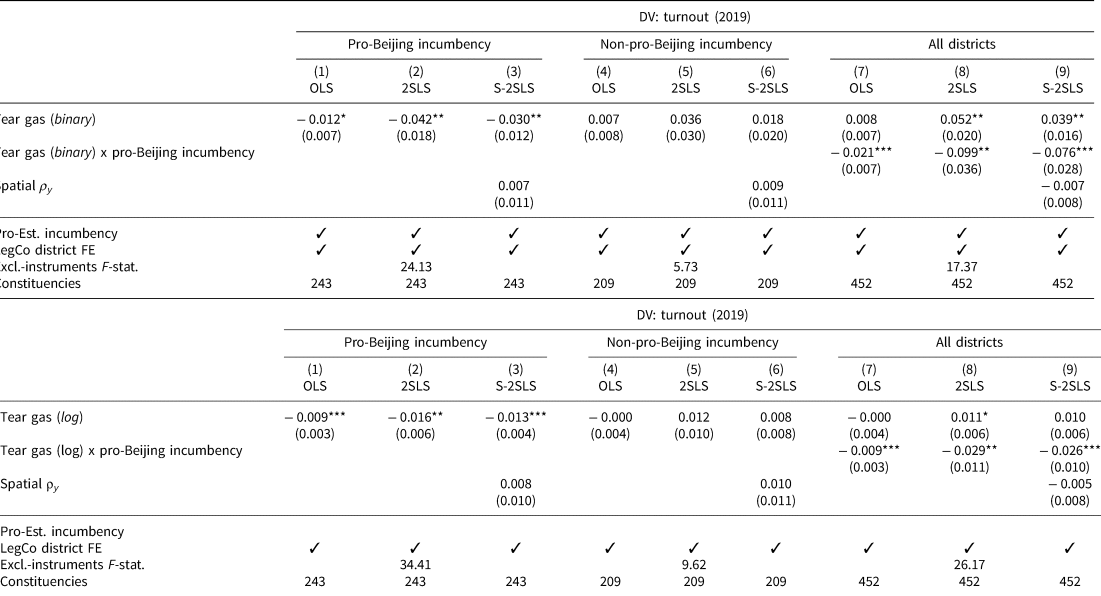
How did these confrontations benefit political candidates who support the protests in nearby constituencies? We show that there is evidence of a conflict-turnout gap between pro-government and anti-government supporters in the election. In terms of the overall turnout, there is no evidence in support of a general increase in turnout from the clashes and conflict-prone constituencies are not associated with a lower turnout rate. However, the presence of a pro-Beijing incumbent, indicative of higher latent pro-Beijing support, is associated with a significantly lower turnout rate in the presence of conflict. In Table 3, we show that constituencies with pro-Beijing incumbents that feature more intense repression and conflict see a stronger depression in turnout in the models. In the S-2SLS models, we find a significant depressive effect in pro-Beijing incumbent constituencies but a smaller and non-significant spillover effect. The distribution of logged tear gas reports and the relative depressive effects is visualized in Figure 3.
Tear gas reports associated with relatively lower turnout rate in constituencies with pro-Beijing incumbents running.

Pro-Beijing incumbency associated with lower turnout in conflict constituencies: OLS and IV

Note: Yoshinoya is the instrumental variable. S-2SLS refers to spatial two-stage least squares estimations, and the W matrix for spatial models based on contiguous neighbors. Cluster standard errors are reported in parentheses.
*p < 0.1, **p < 0.05, ***p < 0.01 (two-tailed test)
5. Discussion
In this section, we provide two explanations to explain our findings. While pre-movement attitudes were largely hostile to even disruption from protests, state repression in the face of movement violence benefits the pro-protest opposition political candidates overall. This is driven by a strong positive within-constituency effect that overcame the negative spillover effect. The two possible explanations are the difference in the violence's specificity and the construction of an in-group identity.
First, police violence was often indiscriminate while protester violence was often specific. This potentially explains the (larger) positive in-constituency effect and the (smaller) negative spillover effects. The police releasing tear gas in one of the most densely populated cites inflicted substantial collateral damage to residents nearby, while the violent protesters’ attacks on individuals, businesses, infrastructures, and government buildings did not usually inflict physical harm to most bystanders. In late 2019, the Hong Kong police force released over 10,000 tear gas rounds, with more than 2,000 rounds in one day at the peak.Footnote 14 Even among pro-Beijing voters, there was substantial backlash against the police for their use of tear gas in proximity to residents due to its diffusive nature (Lee et al., Reference Lee, Yuen, Tang and Cheng2019). Consequently, civilians, regardless of political affinity, were much more exposed to police violence relative to protester violence in conflict-prone areas. At the same time, civilians living in non-conflict constituencies still bore the cost of protester vandalism, such as the severe curtailment of the metro's operating hours and stations. Yet, they were less likely to experience the effects of police repression first-hand. This may explain the effects of the violent clashes on the pro-democracy vote: a positive effect within the constituency but a (smaller) negative effect on the neighboring constituencies. Moreover, our finding that state repression dampens pro-regime supporters’ turnout echos previous findings (Rodon and Guinjoan, Reference Rodon and Guinjoan2022) that state political violence also antagonizes those who were originally less supportive of the protest cause, rather merely reinforcing the views of movement sympathizers.
Second, such exposure to state violence also contributes to the construction of an in-group identity. The shared experience of state repression increases solidarity among the repressed, not just pity for police targets (Thachil, Reference Thachil2019; Zhu et al., Reference Zhu, Cheng, Shen and Walker2022). Evidence suggests the development of such an identity in Hong Kong during the protests: the proportion of the general public who identified with an exclusive Hong Kong identity rose from 40 percent in late 2018 to 55 percent in late 2019 against options for an exclusive Chinese identity or a mixed identity.Footnote 15 Given the development of such identity, Hong Kong's police force was increasingly perceived as the PRC local coercive apparatus by a segment of the population. Previous research showed that the exposure to violence increases in-group trust and group-based voting (Lupu and Peisakhin, Reference Lupu and Peisakhin2017; Nair and Sambanis, Reference Nair and Sambanis2019), while voters penalize political forces associated with perpetrators of indiscriminate violence in the long term (Rozenas et al., Reference Rozenas, Schutte and Zhukov2017).
Our research note makes three contributions. First, it speaks to the wider literature on public attitudes from police violence and repression. Newly democratized Latin American states, where exposure to police violence is stratified on class and racial lines (González, Reference González2020; Magaloni and Rodriguez, Reference Magaloni and Rodriguez2020), saw difficulties in generating consensus regarding public support for police reform. In Hong Kong's case, exposure to police violence was relatively widespread and indiscriminate. Such widespread exposure might explain the emphatic win for anti-police candidates. This provides corroborating evidence that the indiscriminate nature of police violence matters in determining cross-cleavage support for police accountability. Second, it highlights the importance to consider the specificity of violence in determining how political violence alters political attitudes, which is particularly germane given Hong Kong's high population density. Third, our research note provides evidence to understand why the highly specific anti-government violence failed to dampen public support for Hong Kong's 2019 anti-extradition protests in the local election, defying confident predictions from Chinese state media.Footnote 16
Our research note has implications on understanding how political violence from social movements affects public support. While peaceful civil resistance (Chenoweth et al., Reference Chenoweth, Stephan and Stephan2011) might have led to greater pro-movement gains at the polls, clashes that lead to civilians experiencing indiscriminate state repression can dampen regime support even if elements of the movement turn violent. This might have been why both peaceful and violent wings co-exist in many resistance movements. Our findings seemingly suggest that political violence may be a part of political resistance.
Supplementary material
The supplementary material for this article can be found at https://doi.org/10.1017/psrm.2022.50. To obtain replication material for this article, please visit https://doi.org/10.7910/DVN/HWCCOX
Acknowledgments
The authors are listed in alphabetical order. Both contributed equally to this article. We thank Edmund Cheng, Zoe Ge, Junyan Jiang, Sergi Pardos-Prado, Ye Wang, Evan Welsh, Stan Wong, participants at the NYU CPE Working Group, the editors and the two anonymous reviewers for their helpful comments. We also thank all relevant parties for making the data available. We claim all remaining errors as our own.