Police legitimacy—that is, the recognition of the right of the police to exercise power (Bottoms and Tankebe Reference Bottoms and Tankebe2012; Braga et al. Reference Braga, Christopher Winship, Tyler and Meares2014)—has become an increasingly important topic for policymakers and scholars. In the United States, the shooting of Michael Brown in 2014 heightened the debate, leading to recommendations by the President’s Task Force on 21st Century Policing (2015) for police departments to improve police legitimacy. Consistent evidence from survey-based research shows that procedural justice is a key mechanism for building legitimacy (Tyler Reference Tyler2017a).
Procedural justice concerns public subjective assessments of how legal authorities use power (Hough, Jackson, and Bradford Reference Hough, Jackson, Bradford, Tilley and Sidebottom2017). It has four important dimensions: dignity and respect; voice; impartial decision making; and trustworthiness (Tyler Reference Tyler2003). These dimensions have been shown to be central to the procedural component of the legitimacy dialogue, which, according to Bottoms and Tankebe (Reference Bottoms and Tankebe2012), is an iterative claim-response process. The dialogue nature and the character of communications between officers and citizens provide an opportunity to build audience legitimacy. For example, recent research has shown that when an officer actively listens to a citizen’s side of the story, making them feel heard (the dimension of voice), they are likely to feel treated with dignity and respect and that the officer’s decision was impartial, which, finally, will result in increased levels of citizen-police trust (Mastrofski, Jonathan-Zamir Moyal, and Willis Reference Mastrofski, Jonathan-Zamir, Moyal and Willis2016). When citizens perceive or experience fair treatment, they are more likely to defer to an officer’s decision and comply with his or her requests (Lind and Tyler Reference Lind and Tyler1988; Reisig Reference Reisig2007; Sunshine and Tyler Reference Sunshine and Tyler2003; Tyler Reference Tyler2003; Tyler and Wakslak Reference Tyler and Wakslak2004). However, a botched legitimacy dialogue can have deleterious consequences (see, for example, Lowrey-Kinberg and Buker Reference Lowrey-Kinberg and Sullivan Buker2017).
A substantial body of research has emerged that seeks to discover and understand mechanisms that can improve police legitimacy. For example, some studies have attempted to understand police–citizen interactions by manipulating the officer’s verbal responses—intended to manipulate the levels of objective fairness in the interaction. These studies have had mixed results when such methods have been used in traffic stops. While an Australian study showed a “procedural justice script” produced increased perceptions of legitimacy, a later replication in Scotland has shown that a virtually identical manipulation caused decreased perceptions of legitimacy (Mazerolle, Antrobus, Bennett, and Tyler Reference Mazerolle, Antrobus, Bennett and Tyler2013; MacQueen and Bradford 2015; Reference MacQueen and Bradford2017). This might lead to the conclusion that the dialogue may not always be the mechanism influencing perceptions of legitimacy (National Academies of Sciences, Engineering, and Medicine 2018).
Enter wearable technologies in the form of body-worn cameras (BWCs). These devices have been suggested to be a promising tool for improving transparency and accountability within policing (Ariel, Farrar, and Sutherland Reference Ariel, Farrar and Sutherland2015), both key pillars in building perceptions of institutional legitimacy (Beetham 1991; Bottoms and Tankebe Reference Bottoms and Tankebe2012). BWCs have previously been shown to improve police and citizen behavior during contacts, enhance evidence collection, and to provide feedback for police training (Ariel et al. Reference Ariel, Farrar and Sutherland2015; Drover and Ariel Reference Drover and Ariel2015; Maskaly et al. Reference Maskaly, Donner, Jennings, Ariel and Sutherland2017; White Reference White2014). However, the link between officers wearing BWCs and changes in perceptions of police legitimacy remains generally underexplored (Hyatt, Mitchell, and Ariel Reference Hyatt, Mitchell and Ariel2017). Until now, evidence regarding the effects of BWCs on police legitimacy has been indirect and often studied via circumstantial evidence (Hedberg, Katz, and Choate Reference Hedberg, Katz and Choate2017); studies directly examining the effects of BWCs on citizens’ legitimacy perceptions are, overall, lacking. There are early indications that BWCs are linked to enhanced police legitimacy (White, Todak, and Gaub Reference White, Todak and Gaub2017); however, these studies are based on observational, correlational research designs, rather than controlled experiments, thus a host of confounding variables may be attributed to the proposed causal link between BWCs and police legitimacy.
In this study, we sought to fill this gap in the literature, by examining whether BWCs can be causally linked to more procedural justice and, in turn, to enhanced perceptions of police legitimacy. We examined the effect of Uruguayan traffic officers wearing BWCs during routine traffic stops on citizens’ subsequent perception of police legitimacy. A two-arm, crossover randomized controlled trial was conducted in which complete shifts were randomly assigned to either the treatment (all officers wore BWCs) or control (no officers wore BWCs). Post-stop perceptions of police legitimacy were assessed using independently administered, telephone-based survey instrument of a stratified random sample of the registered drivers of each vehicle that had been recorded as having been stopped during the study period. Thus, this study was designed to compare stopped driver perceptions of officers wearing BWCs to officers that do not. We found that the BWCs improved citizen perceptions of police legitimacy as well as overall satisfaction. By linking the presence of an active BWC unit during a traffic stops with the post-interaction, self-reported data from the subject of that stop, we were able to directly consider the effects of BWCs on the subject’s perception of these dimensions.
In the following sections, we begin by summarizing the literature on procedural justice in policing, what is known about the potential causal mechanisms between procedural justice and perceptions of police, and the limited number of randomized controlled trials examining procedural justice. Then we turn to the BWCs literature, focusing on evidence of a change in legitimacy and satisfaction attributable to BWCs. We will argue that BWCs serve as an instrument that affects the procedural justice behavior of officers, which in turn translates into an effect on elevated perceived police legitimacy and satisfaction from the encounter by the subjects of the stops. We then present the design and implementation of the present study, its analytical approach, and results. We conclude with a discussion of the findings, potential policy applications, and suggest opportunities for future research. We found that BWCs can change perceptions of police behavior—at least in the context of overall satisfaction and reported perceived legitimacy in traffic police engagements with the public.
LITERATURE REVIEW
Police Legitimacy: A Brief Overview
Since the seminal work of Weber et al. (Reference Weber, Runciman and Matthews1978) on comparative forms of legitimate domination, social scientific analyses have focused on understanding the structure of institutional legitimacy. Among the most important contributions are works by Beetham (1991) and Coicaud (Reference Coicaud2002), who, independently, developed a threefold structure comprising legality,shared values, and consent. Building on both contributions, Bottoms and Tankebe (Reference Bottoms and Tankebe2012, 129) argued that police legitimacy is best conceptualized “always as dialogic and relational in character […] rather than as a single transaction; it is more like a perpetual discussion, in which the content of power-holders’ […] claims will be affected by the nature of the audience response.” The authors later developed four dimensions of police legitimacy: distributive justice, lawfulness, procedural justice, and effectiveness (Bottoms and Tankebe Reference Bottoms, Tankebe, Du Bois-Pedain, Ulväng and Asp2017; Tankebe Reference Tankebe2013). The third, procedural justice, has received the most attention in recent years (Nagin and Telep Reference Nagin and Telep2017), and it is the most salient component within the context of our study, although it is conceptually useful to define each of these dimensions.
Distributive justice can be understood in two senses: either the fair distribution of resources across different citizens or groups, or the perceived fairness of outcomes a person receives in comparison with what others receive (Natapoff Reference Natapoff2006; Bottoms and Tankebe Reference Bottoms, Tankebe, Du Bois-Pedain, Ulväng and Asp2017; Tankebe Reference Tankebe2013). It, therefore, “deals with the fairness of individuals’ shares […] both shares of benefits […] and shares of burdens or harms” (Johnston Reference Johnston2011, 68). In contexts in which citizens have knowledge about the decisions other citizens receive from legal authorities, they form judgments about the fairness of the outcomes received and their judgments can shape their views about the legitimacy of the authorities. Thus, in their qualitative study of prisons in the United Kingdom, Sparks and Bottoms (Reference Sparks and Bottoms1995) found that perceptions of the fairness of outcomes as well as procedural justice were important for prison legitimacy.
Lawfulness. According to this dimension, citizens will view the police as legitimate if they behave in accordance with formal legal requirements for proper conduct (Trinkner, Jackson, and Tyler Reference Trinkner, Jackson and Tyler2017a). Beetham (1991, 68) argues that many power-holders draw their legitimacy from the law. As such, Bottoms and Tankebe (Reference Bottoms and Tankebe2012) add that we can learn a great deal about the role of lawfulness in legitimacy perceptions by considering instances of “blatant illegality,” including misconduct and corruption in everyday interactions with citizens. Thus, the component of lawfulness is encapsulated in the notion of the rule of law in police work, although police ethnographies show that, for a variety of reasons, officers sometimes fail to obey legal limits to their authority (see Herbert Reference Herbert1998; Skolnick and Bayley Reference Skolnick and Bayley1988).
The third component of the Bottoms and Tankebe (Reference Bottoms and Tankebe2012) dimensions of legitimacy is procedural justice, which has received the most attention in recent years. It refers to perceptions of the fairness of processes that police officers—or, more broadly, legal authorities—use when they interact with citizens. It is, therefore, concerned with the texture of police–citizen interactions (see Jonathan-Zamir and Harpaz Reference Jonathan-Zamir and Harpaz2018). The most important contributions to criminological understanding of procedural justice come from Tom Tyler’s work, starting with his book Why People Obey the Law (1990). Tyler found, in various studies in California and later in New York, that in forming their views about the legitimacy of police authority, citizens focused disproportionately on the quality of their interactions and much less on the outcomes they received from the police (Sunshine and Tyler Reference Sunshine and Tyler2003; Tyler Reference Tyler1990). If citizens feel as though they were treated with dignity and respect and the decision by the officer was fair, they will trust the decision of the officer (Tyler and Bies Reference Tyler, Bies and John1990), and the officer will be viewed as legitimate (Tyler and Wakslak Reference Tyler and Wakslak2004). There are several observational studies that confirm this finding (see, e.g., Mastrofski, Snipes, and Supina Reference Mastrofski, Snipes and Supina1996; Paternoster et al. Reference Paternoster, Brame, Bachman and Sherman1997; Sunshine and Tyler Reference Sunshine and Tyler2003; Tyler and Fagan Reference Tyler and Fagan2008; Tyler and Wakslak Reference Tyler and Wakslak2004). One manifestation of this legitimacy is cooperation of the public with the law, which is necessary for society to function smoothly (see Morlino and Montero Reference Morlino and Montero1995). However, the stack of evidence thus far has been on surveys that show willingness of participants to cooperate with police as a result of more procedurally just interactions, rather than actual levels of cooperation.
Finally, there is police effectiveness. This concerns the ability of the police to provide security. According to Loader (Reference Loader2006, 209):
Security inheres […] in the capacity of individuals and groups to feel at ease with the threats that their environment poses, such that they do not, on an every- day basis, have to think about how safe they are, or routinely concern themselves with the effectiveness of the security measures that are in place, or constantly be bothered with whether and how these may need to be bolstered. To be secure, as opposed to simply safe, is to be comfortable in, and with, one’s environment and hence free from the burdens of recurring security work.
Some studies have shown that, in some contexts, effectiveness weighs more prominently than procedural justice when people form impressions of the police legitimacy (e.g., Bradford Reference Bradford2014; Tankebe Reference Tankebe2009). However, what makes Loader’s approach appealing is its ability to capture threats to people’s safety from multiple sources, including legal authorities themselves. There is evidence to show that police officers can sometimes be the source of threat to people’s safety through harassment behavior, intimidation, and violence (e.g., Willis Reference Willis2015).
Thus, police legitimacy is multidimensional, comprising: how lawfully police behave and secure public safety; their ability to apply fair procedures when dealing with citizens; as well as producing outcomes that are perceived to be equal. At the same time, most studies looking at legitimacy are observational in design (Engel Reference Engel2005; Gau and Brunson Reference Gau and Brunson2015; Murphy, Hinds, and Fleming Reference Murphy, Hinds and Fleming2008; Tyler, Fagan, and Geller Reference Tyler, Fagan and Geller2014). Only a handful of studies use randomized controlled trials to study the effects of police behavior on legitimacy outcomes. These include the Queensland Community Engagement Trial (Mazerolle, Antrobus, Bennett, and Tyler Reference Mazerolle, Antrobus, Bennett and Tyler2013) and the Scotland Community Engagement Trial (MacQueen and Bradford Reference MacQueen and Bradford2015), which involved use of “procedural justice scripts” by officers conducting breath-testing at roadblocks. A third study, conducted in Adana, Turkey, used traffic stops of speeders as the intervention (Sahin, Braga, Apel, and Brunson Reference Sahin, Braga, Apel and Brunson2017). The Queensland study found that the procedurally just traffic stops improved the citizens’ perceptions of both the individual and the police agency overall (Mazerolle et al. Reference Mazerolle, Antrobus, Bennett and Tyler2013). However, in the Scotland study, citizens’ perceptions of police legitimacy diminished with procedurally just police contact (MacQueen and Bradford Reference MacQueen and Bradford2015). Additionally, the authors concluded that while the interactions did not improve the overall opinions of Police Scotland, this might be attributed to the already high public opinion of Police Scotland (MacQueen and Bradford Reference MacQueen and Bradford2017).
Body-Worn Cameras and Police Legitimacy
Studies on the link between procedural justice and police legitimacy have operationalized the “treatment” in the context of either procedural justice scripts, training, or both (e.g., Hasisi and Weisburd Reference Hasisi and Weisburd2011). In terms of training, researchers provided preparation sessions on the theoretical components of procedural justice—dignity and respect, voice, impartial decision making, and trustworthiness—in order to materialize these dimensions in practical police terms. The police officers would then practice these learned dimensions when interacting with members of the public, with the aim of increasing the perceived fairness of the interaction. Similarly, in some studies, scripts or structured conversational approaches were used for interactions as well; these scripts or approaches also focused on procedural justice components such as those discussed above (on training in procedural justice, see the state-of-the-art review by Langley and Ariel (2019)).
We believe that an alternative to such training methods or scripted procedures is the use of BWCs, for three prominent reasons. First, BWCs are appealing in the context of police legitimacy, because their utilization has been linked to other benefits for policing (detailed below). Accordingly, if BWCs can lead to officers behaving more fairly when interacting with members of the public—which by implication would then increase police legitimacy—then a single instrument (BWCs) can lead to simultaneous advantages to policing. Second, police training can be expensive, especially for large police departments (see, e.g., Orrick Reference Orrick2002; Nottinghamshire Police 2012), which can translate into a significant budgetary constraint (see also Skogan, Van Craen, and Hennessy Reference Skogan, Van Craen and Hennessy2015). On the other hand, if BWCs lead to procedural justice as a supplementary benefit at no additional cost other than the cost of implementing the BWCs program, this alternative ought to be entertained (for an excellent review of these issues, see Piza Reference Piza2018a, Reference Piza2018b). The magnitude of the effect of BWCs in this context is a third factor. If the treatment effect of BWCs is larger for the purpose of engendering procedural justice—compared to other mechanisms such as training, scripts, checklists, etc.—then BWCs are a tool that deserves closer study, either alone or in combination with other methods (on the benefits of scripts in the context of BWCs, see Ariel et al. Reference Ariel, Sutherland and Sherman2017, but more explicitly McClure et al. Reference McClure, La Vigne, Lynch, Golian, Lawrence and Malm2017).
The hypothesis that BWCs can lead to procedurally fair behavior, which in turn will cause an increase in police legitimacy, requires clarification. So far, the two main theories that have been put forward to explain how BWCs influence police–public encounters are deterrence theory and self-awareness theory (Ariel et al. Reference Ariel, Sutherland and Sherman2017; White Reference White2014). Insofar as deterrence is applicable, it is assumed that the perceived likelihood of apprehension increases with the use of BWCs, as misconduct caught on camera is more likely to lead to adverse consequences for an officer who broke the rules. Materialization of punishment for inappropriate behavior can occur only when a complaint can be corroborated; in reality, eyewitness testimony, CCTV footage, injuries sustained by the suspect, or admitted noncompliance, are required for a judiciary body or internal affairs to consider the case. Therefore, when the officer is equipped with a BWC that records engagement with the member of the public, a grievance or noncompliance is substantially more likely to be captured. In deterrence theory terms, BWCs elevate the probability of a sanction threat, which correspondingly leads to officer preferences toward compliance (Nagin Reference Nagin2013; Nagin, Cullen, and Jonson Reference Nagin, Cullen and Jonson2018; Pogarsky, Piquero, and Paternoster Reference Pogarsky, Piquero and Paternoster2004).
The second theoretical framework that has been posited in the context of BWCs is public self-awareness theory (see Farrar and Ariel Reference Farrar and Ariel2013; Hyatt et al. Reference Hyatt, Mitchell and Ariel2017). The theory hypothesizes a similar effect as deterrence, but from a more psychosocial approach within a wider social desirability context: being watched or observed causes us to behave differently. When we become aware of an observer of our behavior and conduct, it ignites a cognitive and emotional process that alters our actions (Geller and Shaver Reference Geller and Shaver1976; Joinson Reference Joinson2001); a broad and mature line of research suggests that we act differently when we are not alone (see review in Morin Reference Morin2011). In this respect, the presence of a camera is an established and well-validated manipulation of self-awareness, used in many different experimental settings (e.g., Duval and Wicklund Reference Duval and Wicklund1972; Yao and Flanagin Reference Yao and Flanagin2006). The awareness of the presence of a camera prompts certain morally or socially accepted behaviors, as rational actors are mindful of the repercussions of being filmed while not complying with codes of practice. As Ariel and Sutherland (Reference Ariel and Sutherland2017:13) recently commented:
When you are aware that someone is video-recording you, you behave differently, you become more self-conscious and think more about your actions. We might recognize this from standing in front of an audience, giving a lecture, talking on Skype or being filmed when at a social event.
Research supports these contentions about the interplay between deterrence and self-awareness effects of BWCs on police–public encounters. Recent literature reviews of the available evidence, by Cubitt et al. (Reference Cubitt, Lesic, Myers and Corry2017), Lum et al. (Reference Lum, Koper, Merola, Scherer and Reioux2015), Maskely et al. (2017), Piza (Reference Piza2018a, Reference Piza2018b), and White (Reference White2014) for example, have collectively shown that the use of BWCs is one of the most heavily studied topics within policing, specifically because of these salient points. For example, studies unearthed a host of benefits of BWCs in the context of police–public encounters. BWCs were found to have a suppression effect on police use of force (Ariel, Farrar, and Sutherland, Reference Ariel, Farrar and Sutherland2015; Ariel et al. Reference Ariel, Sutherland, Henstock, Young, Drover, Sykes, Megicks and Henderson2016; Henstock and Ariel Reference Henstock and Ariel2017; Jennings et al., Reference Jennings, Lynch and Fridell2015; Ready and Young Reference Ready and Young2015; however cf. Grossmith et al. Reference Grossmith, Owens, Finn, Mann, Davies and Baika2015; Owen, Mann, and McKenna Reference Owens, Mann and Mckenna2014), and on complaints against the police (Ariel et al. Reference Ariel, Sutherland and Sherman2017; Jennings, Lynch, and Fridell Reference Jennings, Lynch and Fridell2015; Katz, Kurtenbach, Choate, and White Reference Katz, Kurtenbach, Choate and White2015). In a series of before-after comparisons, assaults on officers were also found to have been reduced by a magnitude of more than 60 percent (Ariel et al. Reference Ariel2018b). Collectively, the literature seems to agree that deterrence and self-awareness theories explain these results.
At this junction procedural justice theory becomes relevant as well. How does this approach, coupled with legitimacy theory and accountability, interplay with deterrence theory? It is not immediately clear, but we believe there is a strong link between the normative approach (i.e., legitimacy theory) and a utilitarian approach (i.e., deterrence theory)—a link that had been underplayed in the literature (however, see Bottoms Reference Bottoms and Krambia-Kapardis2019, 27). We defend the view that a BWC placed in a forum where power-holders and members of the public interact sends out an “accountability cue” (Ariel et al. Reference Ariel, Sutherland and Sherman2017), which is generally an aspect of social context that eliminates feelings of anonymity. These cues trigger people—citizens and officers alike—to become aware that their actions can be ascribed to them at an individual level (van Bommel, van Prooijen, Elffers, and Van Lange Reference van Bommel, van Prooijen, Elffers and Van Lange2012, 927). Consequently, BWCs lead to self-awareness on the part of officers that supervisors, juries, or colleagues can watch and scrutinize their behavior, and this leads to more accountable behavior.
The expected behavior from an “accountable officer” at the scene is to exhibit a professional approach, to demonstrate fairness, dignity, and respect toward members of the public—using a proportional force only when necessary (see Canton and Eadie Reference Canton and Eadie2008; on broader contextual research see Feys, Verhage, and Boels Reference Feys, Verhage and Boels2018). An officer is more likely to materialize these expectations when he is wearing a BWC (see Fallik, Deuchar, and Crichlow Reference Fallik, Deuchar and Crichlow2018). In turn, the mechanism that leads the officer to act lawfully, make citizens feel safe, make decisions that are comparably just, and to use procedures that are fair, can be borne out of the threat of a punishment for noncompliance with police procedures.
Of course, one would always prefer power-holders to have an intrinsic motivation to be fair and just (see Tyler Reference Tyler and Parisi2017b). Insofar as internal reinforcements can be enhanced, it will likely lead to long-lasting results (see for example Grant Reference Grant2008; Finkelstien Reference Finkelstien2009) as well as an enabling rather than coercive environment (Adler and Borys Reference Adler and Borys1996). However, internal change is difficult to achieve, and experience worldwide suggests that power-holders are not immediately concerned with the moral rightness of their powers (Jonathan-Zamir and Harpaz Reference Jonathan-Zamir and Harpaz2018). Instead, a degree of threat or punishment for not achieving these goals seems to be a necessary condition for achieving a normative approach (see Hough et al. Reference Hough, Jackson, Bradford, Myhill and Quinton2010).
Accordingly, BWCs “force” transparency and improve accountability within policing, given the “credible threats” (Jervis et al. Reference Jervis, Lebow and Stein1989, 3; Nagin Reference Nagin2013) that they produce: the police are self-aware not only of the fact that they are being watched but also of the consequences associated with noncompliance. This psychosocial mechanism can be construed as a mere “nudge” to act in a way that the officer knows he should be acting. Yet a nudge is not always enough; a proper threat may be needed (French Reference French2011). It seems necessary to engender the view that “getting away” with rule-breaking is not conceivable if one is being videotaped and one is conscious that the behavior is in fact videotaped. In turn, the credibility of the apprehension for acting unfairly, racially motivated, or unprofessionally that comes with the presence of BWCs “forces” the officer to obey the rules and exhibit fairness and procedural justice—both key aspects in enshrining perceptions of institutional legitimacy (Beetham 1991). This process is manifested when officers engage with members of the public in a manner most of us would perceive as more accountable, fair, and satisfying.
The evidence from the BWCs experiments reviewed above thus far supports this basic model but mainly in the context of police use of force and complaints (although the latter can be viewed as a proxy of police legitimacy as well). However, there is little published evidence on the effect of BWCs in the context of legitimacy and procedural justice. Data on the perceptions of those who encounter officers wearing BWCS is necessary to complete the puzzle. But the stack of evidence on the possible effects of BWCs on these perceptions is primarily observational and correlational, which introduces a myriad of design issues. The inability to properly control for extraneous, contemporaneous, or confounding variables jeopardizes the internal validity as well as the external validity of these studies (Cook and Campbell Reference Cook and Campbell1979). A misfortunate example of poor research design in this context is the Israel Police’s internal assessment of the introduction of BWCs into policing (IPS 2017). The pilot report concluded that BWCs would increase police legitimacy—but without any comparison groups, based on a non-representative, small sample of respondents and by using non-validated instruments. Still, other, more rigorous studies tell the same “story.” For example, White, Todak, and Gaub (Reference White, Todak and Gaub2017) conducted telephone interviews with 249 citizens in Spokane (WA) who had a recent BWC-recorded police encounter. Even though the majority of respondents were not aware of the BWCs during their encounter (a similar issue was reported by McClure et al. Reference McClure, La Vigne, Lynch, Golian, Lawrence and Malm2017), they nevertheless were satisfied with how they were treated during the police encounter and expressed positive attitudes toward BWCs.
In a similar way, Lawrence, Peterson, and Thompson (Reference Lawrence, Peterson and Thompson2018) conducted a repeated cross-sectional survey with citizens in Milwaukee. They showed that while the public knowledge of BWCs grew substantially each year of the study and that the majority of members of the public held positive views of BWCs, responses varied across race (with African-American respondents exhibiting lower overall expectations about how well BWCs could improve police-community relations or officer accountability). A comparable variation in respondents’ attitudes toward BWCs was reported by Crow, Snyder, Crichlow, and Smykla (Reference Crow, Snyder, Crichlow and Smykla2017), in their study with two Florida counties: non white participants were less likely to perceive the benefits of BWCs.
Direct assessment of procedural justice in the context of BWCs was exhibited in McCluskey et al. (Reference McCluskey, Uchida, Solomon, Wooditch, Connor and Revier2017), who conducted systematic social observations of procedural justice in the Los Angeles Police Department (LAPD), before and after the introduction of BWCs. Although there are known issues with systematic social observations more generally (McCall Reference McCall1984), as well as concerns about inferring causality from pre test/post test only designs (see Farrington et al. Reference Farrington, Gottfredson, Sherman and Welsh2002), the instructive study of McCluskey et al. analyzed 555 encounters and showed that BWCs increased measures of procedural justice during police-public encounters. The study suggests that the use of BWCs is correlated with an intensified application of the various components of procedural justice—but most crucially the behavioral display of these components as measured by a third party, rather than the perceived manifestations by the member of the public or the officer. As the authors concluded, the “results reported […] confirm a statistically reliable change in the pattern of police delivery of procedural justice to citizens in the data” (14).
Finally, the question of accountability as a result of wearing BWCs was measured by Lee, Taylor, and Willis (Reference Lee, Taylor and Willis2018). The study reports findings from a survey and interviews with 907 police detainees across four Australian jurisdictions. The study concluded that “the majority of respondents expressed clear beliefs that police BWCs could increase the accountability of police [….] Sub-themes of accountability expressed included that officers could not so easily ‘lie,’ that they would ‘behave more ethically,’ be less likely to ‘abuse their power,’ and be less likely to resort to ‘violence’” (15). We are particularly drawn to these qualitative observations, as they lay out a vivid depiction of the survey data presented in other studies on BWCs and police legitimacy: the devices have the potential to change the ways in which officers communicate and behave when interacting with members of the public.
One notable exception to the causal inference issues of previous studies regarding the effect of BWCs on perceptions of legitimacy is a recent study by Demir et al. (Reference Demir, Apel, Braga, Brunson and Ariel2018). This was a direct test of the hypothesis that placing BWCs on traffic officers improves perceptions of legitimacy. The controlled experiment, conducted in Turkey under rigorous settings, showed that, relative to stops by officers without BWCs, motorists stopped by officers with BWCs reported improved perceptions of procedural justice in the encounter and perceptions of legitimacy of traffic officers and the police more generally. These findings suggest that BWCs can ensure procedurally just encounters and improve public perceptions of police legitimacy more broadly.
RESEARCH DESIGN AND METHODS
Research Setting
Apart from the Demir et al. (Reference Demir, Apel, Braga, Brunson and Ariel2018) study, the available evidence is primarily observational. The present study aims to fill this void by examining citizen perceptions about traffic officers wearing BWCs compared to officers without them in the Latin American country of Uruguay. We collaborated with the Uruguay police in a national experiment on the effect of BWCs on policing, particularly in the area of traffic policing. The Republic of Uruguay is located in South America, with approximately 3.5 million inhabitants, from a wide range of socioeconomic levels but with a limited range of ethnicities compared to other Latin-American nations. The majority of its population is white (88 percent), 47.1 percent are Roman Catholic, and the country rates high for most social and development indicators, such as liberal social laws, well-developed social security, health, educational systems, and relatively strong GDP per capita ($20,300; CIA 2016).
According to the US State Department (2016), Uruguay experiences high crime levels compared to the United States, particularly violence, burglaries, and robberies. In terms of traffic accidents, the World Health Organization (2014) ranks Uruguay seventy-eighth worldwide, with 667 deaths in 2014 alone. Poor illumination, pavement markings, and road surfaces are contributing factors to traffic accidents. Similarly, a reduced amount of timely police patrol availability in rural areas is a concern, especially in primary roads between the capital Montevideo and tourist destinations, like Punta del Este, due to heavy tourist traffic and speed-related accidents.
Out of the nineteen independent jurisdictions of the Republic of Uruguay, we collaborated with five regions of the Uruguay National Traffic Force (UNTF), who volunteered to take part in a study on BWCs. The five regions comprised both urban and rural areas of Uruguay. The typical city in Uruguay has about 50,000 to 100,000 residents. The first region is the Area Metropolitan. This area contains Montevideo, which has 1,500,000 inhabitants. Area Metropolitan is the largest region of the five, containing both urban and rural areas. Area Metropolitan is patrolled from one police station due to its size. The smallest region is Rocha, on the southern coast of Uruguay with approximately 25,000 residents. The next smallest region is Canelones, which has approximately 30,000 inhabitants in seven towns. The area is primarily rural. Maldonado is the most spread out, with 100,000 residents inhabiting over twenty-five towns and cities. The final region, Soriano, is on the western coast of Uruguay with 150,000 residents.
Data and Procedures
We were provided access to a population of drivers that were either stopped by traffic officers wearing BWCs or traffic officers not wearing BWCs. The study lasted approximately a year in the five participating regions, and in total 7,836 drivers were ticketed. We randomly selected drivers from this pool of ticketed drivers, and conducted telephone surveys with them, as more fully described below.
The treatment officers were assigned a Reveal Media© front-facing BWC, which allowed citizens to directly observe the camera affixed to the officer. This screen allows citizens to see themselves as they are being, an added reminder that the officer is wearing a BWC and videotaping the interaction. In many ways, this type of camera circumvents the issue of notification raised by Ariel et al. (Reference Ariel, Sutherland, Henstock, Young, Drover, Sykes, Megicks and Henderson2016) and subsequently tested by McClure et al. (Reference McClure, La Vigne, Lynch, Golian, Lawrence and Malm2017): whether the policy dictates disclosure or the officers in fact remember to inform the member of the public that they are being observed is inconsequential from the citizen’s perspective, because they can actively view themselves being recorded.
As opposed to control conditions that were deemed as “business as usual,” officers that were assigned to treatment conditions had multiple directives. They were advised to turn on their cameras for every police/citizen interaction. Traffic officers were not allowed any discretion as to when the camera could be turned on or off. The camera was turned on and kept on during every police/citizen contact. Officers were instructed to give a scripted verbal warning to every contacted person at the beginning of the traffic stop. The intent of the statement was to make every citizen aware that they were being videotaped by the police officer. The officers were instructed that if they issued a ticket, they were required to record on the ticket issued to the driver, the following text: “digital evidence recording number _____.” Traffic officers were also required to keep a log documenting the digital evidence recording number for every recorded inspection, creating two records of digital evidence—on the ticket issued to the driver and in an internal police log of inspections. Finally, they were required to return to their base before the end of the shift, download the videos from the day’s activities, and charge the camera battery.
Allocation to Treatment and Control Conditions
In order to test the effect of BWCs on perceptions of legitimacy, we designed a crossover randomized field trial in which the unit of analysis is a temporal cluster, when all traffic officers patrolled the participating jurisdictions at times with the BWCs, and at times without their BWCs, thus serving as their own controls—i.e., a crossover trial with more than one switch between conditions, for each officer. It thus was a repeated measurements design, such that each officer received both treatment and control conditions during the different time periods, which means officers “crossed-over” from one treatment condition to the control condition during the course of the trial.
A major consideration in favor of a crossover design is that it could yield a more efficient comparison of treatments than a parallel design (for example, randomly allocating officers into either treatment or control conditions). For example, fewer officers are required to attain the same level of statistical power or precision. By making police shifts (e.g., a 08:00–17:00 shift) the unit of analysis, the sample size available can be increased significantly, allowing much smaller effect sizes to be detected but with relatively fewer traffic officers. As recently reviewed by Ariel, Sutherland, and Sherman (Reference Ariel, Sutherland and Sherman2018a), a trial with 1,000 shifts is sufficient to detect small effects (d = 0.178) with an alpha of 0.05, power of 80 percent for a two-tailed statistical test (with no covariates and thus no variance explained by covariates), but those 1,000 shifts could be generated by as few as sixty officers, as in the Rialto BWCs experiment (Ariel et al. Reference Ariel, Farrar and Sutherland2015). In contrast, with a study of approximately 128 officers and no covariates to increase the statistical power of the test, a study is unlikely to detect effect sizes below d = 0.50—which is quite large in experiments in policing (see Telep and Weisburd Reference Telep, Weisburd, Weisburd, Farrington and Gill2016).
Randomly assigning shifts as the unit of analysis is not a perfect solution, given the potential spillover effect (Ariel, Sutherland, and Sherman Reference Ariel, Sutherland and Sherman2018a; Ariel et al. Reference Ariel, Lawes, Weinborn, Henry, Chen and Brants2019a; Reference Ariel, Newton, McEwan, Ashbridge, Weinborn and Brants2019b). The same officers were randomly assigned to use the cameras and also randomly assigned not to use the cameras. However, it represents a least-worst option (what is sometimes called the maximin rule (see Rawls Reference Rawls2009, 72)). The issue with contamination when using shifts is that the same officers experience both treatment and control shifts, so there is the likelihood that behavioral modifications due to treatment conditions can be carried over into control conditions. If BWCs affect behavior, then a learning mechanism may be at play in which officers adapt their overall behavior (and possibly attitudes), and this broader change affects control conditions as well (Ariel et al. Reference Ariel, Sutherland, Henstock, Young, Drover, Sykes, Megicks and Henderson2016; Ariel, Farrar, and Sutherland Reference Ariel, Farrar and Sutherland2015, 528; Maskaly and Donner Reference Maskaly and Donner2015, 221).
Despite the potential for intraparticipant contamination that characterizes any crossover design, it was still preferred over other designs for two reasons. First, when BWCs were present, the officers were in different contexts from when they were absent—regardless of their prior experience in both conditions. Officers in a shift-based experiment, while serving during control shifts did not wear BWCs. Officers were certainly aware that their actions and conduct were under surveillance in both treatment and control shifts. However, awareness of potential surveillance is not equal to actual surveillance in terms of the “credible deterrent threat” suggested by Jervis et al. (Reference Jervis, Lebow and Stein1989, 3). In control shifts, detection of rule breaking (by either citizens or officers) is less likely because the cameras are not present. In the treatment condition, every recorded interaction could be viewed and audited. The degree to which an accountability cue was activated, and consequentially a deterrence was materialized, is not the same. An unrecorded interaction does not necessarily lead to similar costs, but a recorded incident of incivility, unprofessionalism or violating rules of conduct could lead to adverse consequences for the officer.
Second, if there was contamination in this crossover design, then it prejudiced the study against detecting a statistically significant difference, because it increases the statistical noise due to the pooled standard variation of the two study conditions in the denominator of the statistical test. Admittedly, this scenario could mask a stronger effect size of the intervention, but it does not inflate the Type I error. In the absence of the ability to randomly assign discrete clusters of spatiotemporal units, our design can therefore be viewed as the most fitting given the operational challenges. Accordingly, the unit of randomization was not the individual officers: officers who were trained to use BWCs were allocated into treatment conditions (i.e., police shifts), whereas control conditions were assigned to officers that were not equipped with BWCs.
Finally, the random assignment eliminated selection biases. Random allocation of the temporal clusters was communicated on a bimonthly basis to the department by the research team. During any given treatment cluster, a line manager ascertained that BWCs were taken from a specially designated docking station. This procedure was meticulously maintained throughout the entire experimental period, and there were zero deployments of BWCs that we could measure during control conditions.
Implementation of Telephone Surveys
A representative sample of drivers stopped during the ten-month experiment were surveyed by a civilian company to determine their perceptions of officers during their traffic stop. The surveys were conducted approximately thirty days after their traffic stop, using a K-sampling procedure: the starting point was chosen at random from the batch of drivers stopped during the preceding month (in all five jurisdictions combined), and then every twenty-fifth driver thereafter was interviewed. Our power calculations—assuming a 95 percent confidence level, a 5 percent margin of error, and an estimated six hundred drivers ticketed per month—called for a sample of approximately three hundred participants in total with equal weighting of each study condition. However, only 217 were willing to participate in the survey—122 under the treatment condition and ninety-five under the control condition.
Main Measures
The survey instrument was divided into three parts (see Supplemental Appendix). The first section was designed to determine whether the person the surveyor was speaking to was the driver of the vehicle, if they remembered whether the officer was wearing a BWC, and how satisfied and safe they felt during the encounter, across several items. The subsequent section of survey questions examined the driver’s perceptions of procedural justice, and specifically respect, voice, impartial judgment, and trust. The questions centered on the idea that if citizens felt the procedure or process they were subjected to during the traffic stop was respectful, impartial, and the citizen felt like their concerns were heard, then they would view the officer as trustworthy (Tyler, 2006). The questions focused on whether the driver felt the officer was concerned with their well-being and treated them the same as any other citizen. The third set of questions related to the use of BWCs, and these were directed only at drivers in the treatment group.
Accordingly, we used standard legitimacy-based survey items that have been explored repeatedly in previous studies in this research area (e.g., Hasisi and Weisburd Reference Hasisi and Weisburd2011; Tankebe Reference Tankebe2009; Tyler, Schulhofer, and Huq Reference Tyler, Schulhofer and Huq2010).
Procedural Justice. Each dimension of procedural justice was measured by a single-item, Likert-type scale—Voice: “The police did not listen to what I had to say before making a decision” (Mazerolle et al. 2016); Explanation: “The officer explained fully what would happen after stopping me”; Respect: “I was treated with respect” (Sahin et al., Reference Sahin, Braga, Apel and Brunson2017); Trustworthiness: “The police showed concern for my well-being”; and Impartiality: “The decisions of the officer were based on the facts of the case, not personal biases.” With the exception of “Voice,” the higher the score, the more favorable the perception. In the case of “Voice,” a higher score represented a less favorable perception.
Distributive Justice was measured with a single item: “I was treated the same way any other driver would have been treated” (Sahin et al. Reference Sahin, Braga, Apel and Brunson2017). It was measured by a single-item Likert-type scale of 1 (“strongly disagree”) to 5 (“strongly agree”). The higher the score, the greater the perception of distributive justice.
Lawfulness. Consistent with Bottoms and Tankebe’s (Reference Bottoms and Tankebe2012) arguments on measuring unlawfulness, we aimed to capture incidents of corruption. In Uruguay, payment of a “spot fine” is euphemism for bribery. We therefore asked the drivers: “Has the officer asked you to pay the ticket ‘on the spot.’” The response category was binary: 1 = Yes and 2 = No.
Effectiveness. This captures drivers’ feelings of safety (see Tankebe Reference Tankebe2009). It was measured using a single item: “How safe did you feel when the police officer spoke to you?” with a Likert-type scale of 1 (“strongly disagree”) to 5 (“strongly agree”). The higher the score the more favorable the judgment of safety.
Overall Quality of Interaction. This was measured with a single item Likert-type scale: “How would you rate the overall interaction you had with the traffic officer?” The higher the score the more favorable the assessment of the overall quality of interaction with police.
Statistical Procedure
We first applied a series of between-groups comparisons between treatment and control conditions using independent sample t-tests. These statistical tests allowed us to compare drivers’ experiences of officers with and without BWCs for each item. We then measured the magnitude of the differences using Cohen’s d (Cohen Reference Cohen1988).
We then modeled the overall quality of the interaction as a function of the elements of legitimacy, based on the conceptualization of Bottoms and Tankebe (Reference Bottoms and Tankebe2012). We were not granted access to subject-level information (e.g., sociodemographic characteristics of the drivers, the type of traffic violation they committed, or the characteristics of the police officers). Instead, we applied a two-step ordinary least squares regression model that included, first, procedural justice (a scale built as an average of the four elements of procedural justice), distributive justice, and effectiveness, and second, the treatment effect. Lawfulness was not included in the model, as there was an insufficient number of observations of reported misconduct (see below).
RESULTS
Between-Group Comparisons
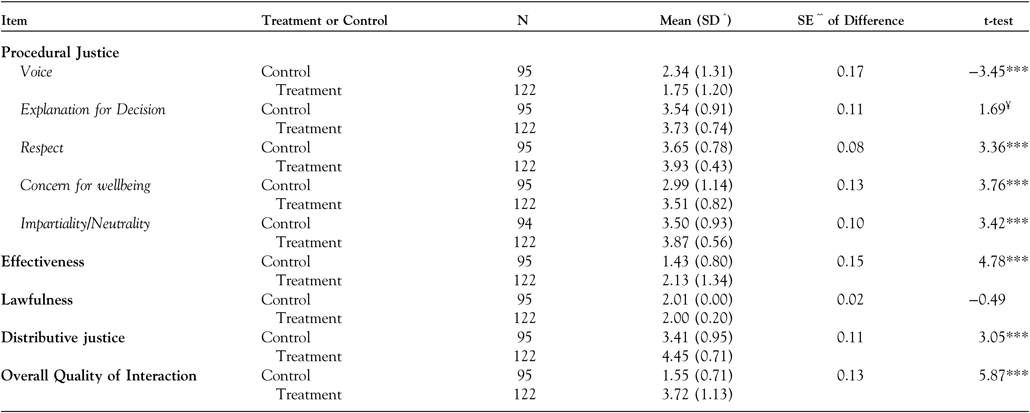
Our first set of questions asked citizens about their opinion of the treatment they received from the officer. These questions assessed drivers’ perceptions about how well the officer listened to them, whether they felt they were treated differently than other citizens, and whether the officer displayed concern for the citizen’s well-being. The results are displayed in Table 1. We start by considering our principal focus: procedural justice. Three key findings are noteworthy here.
Descriptive statistics for treatment and control groups and independent-sample t-tests

ˆSD = Standard Deviation; ˆSE = Standard Error; *p ≤ 0.05, **p ≤ 0.01, ***p ≤ 0.001; ¥p=0.096
First, the results showed statistically significant differences between drivers exposed to BWC officers (M = 1.75, SD = 1.20) and non-BWC officers (M = 2.34, SD = 1.31) [t = −3.45, p ≤0.001] in mean perceptions of the extent to which officers offered them a voice. Given the way we coded voice, this finding suggests that drivers who did not interact with BWC traffic officers were more likely to say the officers denied them an opportunity to have a say for themselves.
Second, we found marginally significant differences between the two groups in terms of explanation for decisions. That is to say, on average BWC officers (M = 3.73, SD = 0.74) were perceived to have explained decisions better than non-BWC officers (M = 3.54, SD = 0.91), t = 1.69, p = 0.096. The third finding about procedural justice is that officers who used BWCs were more likely than their non-BWC counterparts to be seen as acting respectfully (BWC: M = 3.93, SD = 0.43; non-BWC: M = 3.65, SD = 0.78, t = 3.36, p ≤ 0.001), show concern for the well-being of the driver (BWC: M = 3.51, SD = 0.82; non-BWC: M = 2.99, SD = 1.14, t = 3.76, p ≤ 0.001), and demonstrate impartiality or neutrality in their decision making (BWC: M = 3.87, SD = 0.56; non-BWC: M = 3.50, SD = 0.93, t = 3.42, p ≤ 0.001).
On the other dimensions of police legitimacy, the results in Table 1 show that drivers who interacted with BWC traffic officers reported feeling safer than drivers who interacted with non-BWC traffic officers [(M = 2.13, SD = 1.34) (M = 1.43, SD = 0.80); t = 4.78, p ≤ 0.001]. The same was found for distributive justice: drivers who interacted with BWC traffic officers (M = 3.74, SD = 0.64) were more likely to report greater distributive justice than drivers who interacted with non-BWC traffic officers (M = 3.41, SD = 0.95; t = 3.95, p ≤ 0.001). However, there was no statistically significant difference between the drivers in terms of experiences of police unlawfulness (t = −0.49; p>.05).
Our next set of findings focused on overall global assessments of the interactions between the drivers and the traffic officers. We found that drivers who interacted with non-BWC officers (M = 1.55, SD = 0.71) were less likely to express satisfaction with the police than drivers who interacted with officers equipped with body cameras (M = 3.72, SD = 1.13; t = 5.87, p ≤ 0.001).
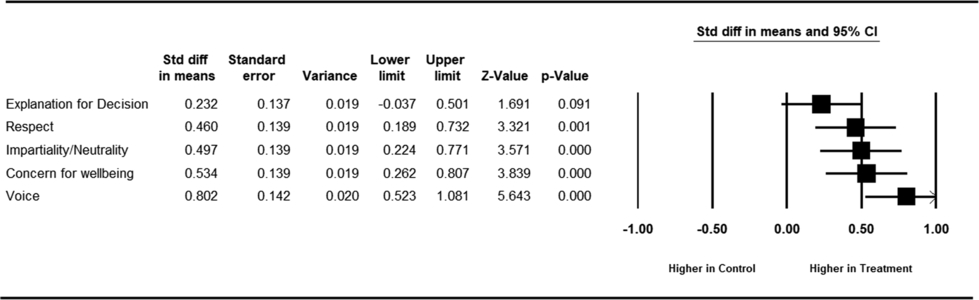
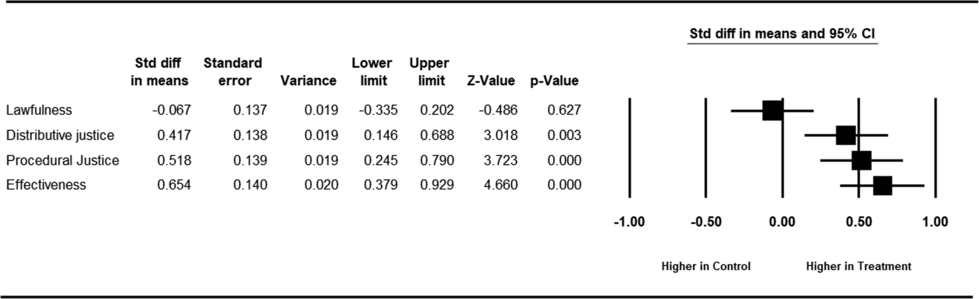
In order to measure the magnitude of these between-group differences, effect sizes were computed using standardized mean differences (Cohen Reference Cohen1988). We first looked at the comparison between treatment and control conditions in terms of the different elements of procedural justice and then the four elements of legitimacy in Bottoms and Tankebe’s (Reference Bottoms and Tankebe2012) conceptualization. These analyses are presented in Figures 1 and 2 below. Attention should be drawn to the forest plots (Figure 1). Each point estimate represents the magnitude of the difference between the groups. Anything to the right of the null line (0.00) implies that the difference favors the treatment group, and to the left of the line indicates that the control group “performed” better—i.e. perception scores were more favorable. The further away the point estimate is from the null line, the larger the magnitude of the difference. Horizontal lines that cross the point estimates represent the 95% confidence intervals, and when they cross through the vertical null line it indicates that the effect is not statistically significant.
Procedural Justice – Effect Sizes

Four Dimensions of Police Legitimacy – Effect Size

In order to evaluate the meaning of these results, an effect size of 0.2 is defined as small, 0.5 as medium, and a large effect size as 0.8 and above. To some scholars, an effect size estimate of 0.20 may be seen as a small effect (Cohen Reference Cohen1988), while for others an effect size of .10 “could easily be of practice significance” (Cook and Campbell Reference Cook and Campbell1979, 45; Lipsey and Wilson Reference Lipsey and Wilson2000, 109). As Cohen (Reference Cohen1988, 25) and Weisburd et al. (Reference Weisburd, Lum and S. M.2003) argued, these criteria are merely a starting point. Even smaller effect sizes could prove to be meaningful in our context (Ariel Reference Ariel2012). Therefore, the difference between the control group and the experimental groups (and as a result, the effect size) is not hypothesized to be large (see Demir et al. Reference Demir, Apel, Braga, Brunson and Ariel2018). The directionality of the effect sizes reflects the statistical tests. What the figures show, still, is the relative effect size of each dimension.
As shown, the largest effect size detected relates to voice (d = 0.802, 95 percent CI 0.523, 1.081), followed by concern for well-being (d=0.534, 95 percent CI 0.262, 0.807), impartiality and neutrality (d=0.497, 95 percent CI 0.224, 0.771), and finally respect (d=0.460, 95 percent CI 0.189, 0.732). At the bottom of the list we find explanation for the decision to stop (d=0.232, 95 percent CI -0.037, 0.501).
Figure 2 shows the four elements of legitimacy. For the purpose of this element, we created a scale for procedural justice comprised of the different features of this dimension. As shown, effectiveness appears to carry more weight than procedural justice and distributive justice—at least in the context of BWCs and traffic police in Uruguay. However, for all factors, BWCs led to medium-to-large effect sizes. In terms of (un)lawfulness, the effect size is marginal and non-significant (d=−0.067, 95 percent CI -0.335, 0.202), which is likely due to the virtually nil reporting of “on the spot” bribery payments.
Modeling Overall Satisfaction
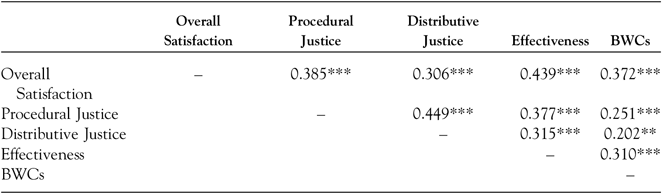
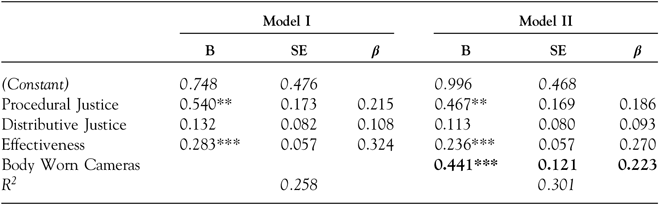
The OLS regression models are presented in Table 3 below, whereas Table 2 presents the bivariate Pearson correlations as an indication of the strength of the relationship between the model coefficients. We found no indications of multicollinearity. We found statistically significant bivariate correlations between all dimensions, with the strongest positive association detected between procedural justice and distributive justice (r=0.449, p ≤ 0.001). Interestingly, we found that the correlation between effectiveness and the dependent variable—overall satisfaction—was stronger than the correlation between procedural justice and the dependent variable (r=0.439, p<0.001; r=0.385, p ≤ 0.001, respectively). BWCs were positively associated with overall satisfaction, procedural justice, distributive justice, and effectiveness (r=0.372; r=0.251; r=0.202, r=0.310, respectively, all statistically significant at p < .001 level).
Bivariate Pearson Correlations (N=217)

*p < 0.05; **p < 0.01; ***p < 0.001
Predicting Overall Satisfaction

Dependent Variable: Overall Satisfaction interaction from Interaction;
*p < 0.05; **p < 0.01; ***p < 0.001
Table 3 presents the unstandardized coefficients and their respected standard errors (SE), as well as the standardized Beta coefficients. The table presents the two models—first without the treatment effect and then again, when the treatment of effect included in the model. As shown, both models yielded a modest overall explanation power, with the variance explained in model I exceeding R2=0.26 and in model II R2=0.30 (see for example Cohen Reference Cohen1988, ch. 9). Both overall models are also statistically significant [(F(213,3)=24.65, p ≤ 0.001) (F(212,4)=22.88, p ≤ 0.001), respectively]. Whereas the bivariate correlation coefficients alluded to effectiveness as correlating most strongly with the dependent variable, regression model I illustrates that, when controlling for procedural justice and distributive justice, indeed effectiveness weighed more heavily (β=0.324; p ≤ 0.001). When we introduced into model II the treatment effect, effectiveness remained the most salient predictor of overall satisfaction (β=0.270), followed by the effect of BWCs (β=0.223). Notice that in both models, distributive justice does not appear to predict overall satisfaction, as this term was not statistically significant.
DISCUSSION AND CONCLUSION
Max Weber famously defined the state as that community which “successfully upholds the claim to the monopoly of the legitimate use of physical force in the enforcement of its order” (Weber et al. Reference Weber, Runciman and Matthews1978, 54). In recent years, the legitimacy of state institutions globally has come under much pressure. The police are the “state made flesh” on the streets, and public experiences with them can provide key information about otherwise abstract principles that underpin the state (Punch Reference Punch2000; Bayley Reference Bayley2006). Body-worn cameras have emerged as a key tool to ensure police conduct that builds legitimacy. The goal of this research was to test the effects of the use of such cameras by traffic officers on drivers’ perceptions of police legitimacy in Uruguay.
The study revealed four key findings. First, police BWCs caused improvements in perceptions of procedural justice. We found that drivers who interacted with officers with BWCs were more likely to report being listened to before the officers made decision in their case, to be treated with respect, and to feel that officers expressed sincere concern for their well-being. They were also more likely to say the traffic officers demonstrated neutrality in handling their cases.
Second, the cameras also improved perceptions of distributive justice—that is, perceived equality of treatment—although not to the same magnitude as procedural justice. This finding suggests to us that, as a result of BWCs, officers attend to balanced distribution of resources and outcomes across different groups in Uruguay. This finding is interesting in the context of Uruguay, which is a relatively homogenous society in terms of religion, ethnicity, and political views (Cabella and Porzecanski Reference Cabella, Porzecanski, Simon, Piché and Amélie2015). We were unable to assess this finding across different sociodemographic backgrounds of the study participants, as we were not granted access to drivers’ characteristics (due to data-sharing restrictions). However, we suspect that perceived distributive justice is enhanced when drivers know officers, equipped with a tool that increases accountability and transparency, had to apply the law unconditionally.
Third, we found evidence to show that the cameras had positive effects on perceived police effectiveness—specifically, on driver sense of safety. Drivers who interacted with traffic officers wearing body cameras were more inclined to say they felt safe. It sometimes happens that police behavior threatens the safety of citizens whether through harassment, assault, or use of lethal force—and it appears that BWCs strike out, or at least reduce, these concerns. Conceived as such, police cameras have a deterrent effect on police behavior such that the police use their authority in ways that make citizens feel safer. It appears that, among the drivers surveyed, the cameras were successful in producing this effect and, indeed, they appeared to have made the drivers feel more secure. One plausible mechanism that explains this effect is the removal of anonymity from the police–public engagement—which is a fundamental ingredient of accountability and transparency. The two parties—the driver and the officer(s)—are not alone anymore, so misconduct or noncompliance is less probable. In this context, BWCs are also able to break or overcome the infamous police code of silence (see also Skolnick and Fyfe Reference Skolnick and Fyfe1993, 10); commented that the “law enforcement code of silence, covering all of the things that an officer learns but cannot discuss, leads to a natural reticence to disclose any information about a fellow officer.” Therefore, BWCs can disrupt this code, and lead officers to behave in ways that—at least from the citizen’s perspective—are both fair and safe.
Fourth, we found no evidence to support an effect of BWCs on (un)lawful policing. To our knowledge, no prior studies have specifically examined the effects of these cameras on bribe payments. Perhaps the closest are studies on complaints against police officers (see more recently Braga et al. Reference Braga, Coldren, Sousa, Rodriguez and Alper2017). This effect was observed in multiple BWCs studies. In Rialto (CA) during a randomized controlled trial, complaints against officers wearing BWCs dropped by 88 percent (Ariel, Farrar, and Sutherland Reference Ariel, Farrar and Sutherland2015). Another quasi-experiment in Mesa Police Department showed a 40 percent reduction in citizen complaints against officers wearing BWC during the study period (Mesa Police Department 2013). However, our study did not reveal that for serious misconduct (e.g., bribery). BWCs offer a solution—but neither did it falsify this claim either, as the reported occurrence of bribery during our experimental period was virtually nil; virtually none of our participants admitted to being involved in an illegal transaction with the police officer. While corruption is substantially less prevalent in Uruguay compared to other Latin American nations (Buquet and Piñeiro Reference Buquet and Rafael2014; Canache and Allison Reference Canache and Allison2005), it is still a possibility. It is therefore likely that our sample size, albeit having a probability sample that, in principle, ought to be representative of ticketed drivers in Uruguay, was not large enough to capture a relatively rare event. Another logical explanation is that drivers were afraid to admit taking part in unlawful transactions, as paying a bribe—even when demanded by an officer—is nevertheless a serious offense. More research in this area is therefore needed.
Finally, while dimensions of fairness were improved due to BWCs, the overall interaction under treatment conditions was more favorable compared to control conditions as well. This is perhaps unsurprising; the link between satisfaction from police–public encounters and fairness is generally well-developed, and we expected a positive association between these two dimensions. However, the magnitude of the BWCs’ effect in this context was unexpected. There is a well-supported assumption that perceptions of legitimacy correlate with increased satisfaction from the encounter (Murphy, Hinds, and Fleming Reference Murphy, Hinds and Fleming2008; Sunshine and Tyler Reference Sunshine and Tyler2003; however, cf. Murphy and Cherney Reference Murphy and Cherney2011). For example, Hinds and Murphy (Reference Hinds and Murphy2007, 27) were able to show, based on their postal survey in Australia (n=2,611) that “people who believe police use procedural justice when they exercise their authority are more likely to view police as legitimate, and in turn are more satisfied with police services.” Mazerolle et al. (Reference Mazerolle, Antrobus, Bennett and Tyler2013, 55) showed using experimental data that satisfaction was directly related to perceptions of procedural justice; this finding suggests that, at least in the Uruguayan context, that performance-based, instrumental factors influence citizen satisfaction with police.
Our findings join this growing line of research on the link between legitimacy and satisfaction, but with one important distinction: BWCs introduce additional benefits to policing at no additional cost, i.e., reduction of assaults, complaints, use of force, and arrests, with an increase in charges, convictions, and efficiencies in the legal system (Lum et al. Reference Lum, Stoltz, Koper and Scherer2019). Whereas previous legitimacy studies required relatively expensive training, mentoring, tracking of implementation—and possibly a decay over time—BWCs provide a myriad of benefits, including an enhancement of legitimacy and satisfaction, as our study shows. Hence, at least in the context of BWCs in traffic policing in Uruguay, our study contradicts the finding of Skogan (Reference Skogan2006) that police may have little to gain from positive BWCs encounters with the public and a lot to lose from negative BWCs encounters. We would still however like to see more studies in this area, in different contexts, before making strong claims.
A Technical Yet Salient Artifact: BWCs with Front-Facing Screens
Unlike previous experiments reviewed above (however, cf. Mitchell et al. Reference Mitchell, Ariel, Firpo, Fraiman, del Castillo, Hyatt, Weinborn and Sabo2018), the apparatus in the present experiment had the distinctive characteristic of showing the stopped individual a live video of him/herself in real time. This feature might have contributed to the pattern of results. For example, the driver might have been on better behavior while looking in the “mirror.” This might have caused the officer to react more positively and in turn the individual might have felt better about the interaction. This possible mechanism is logical, given what we know about the strong predictive power of suspects’ demeanor in explaining the use of force in aggressive police-public engagements (Engel et al. Reference Engel, Sobol and Worden2000; Hine, Porter, Westera, and Alpert 2016; Reisig et al. Reference Reisig, McCluskey, Mastrofski and Terrill2004; cf. Terrill and Mastrofski, Reference Terrill and Mastrofski2002). If this is the case, then “self-awareness” of both the officer and the driver might be contributing to improved police-public interaction, not just that of the officer. Our article assumes that the effect “rests” on the police, but of course it takes “two to tango.” More research is therefore needed to understand the interactive effect of BWCs on all parties involved in police–public engagements.
Furthermore, we echo the conclusion expressed by one of the participants in the study of Lee et al. (Reference Lee, Taylor and Willis2018, 15) about the need for additional organizational infrastructure in order to facilitate accountability, because “the cameras alone are unlikely to stop an officer going ‘overboard’ unless they clearly understand that such behavior is likely to have negative outcomes.” While Sutherland et al. (Reference Sutherland, Ariel, Farrar and De Anda2017) have shown that the effect of BWCs can be long-lasting, how well departments will deal with “bad cops caught on tape,” and the extent to which the existing institutions within the police or other judicial bodies will use the footage to change culture, is currently unknown. We can only suspect that if standard operating procedures do not dictate adverse consequences for misconduct caught on tape, then BWCs would not lead to change. Alternatively, if BWC footage is featured in decisions to reprimand these kinds of police officers, we suspect that BWC’s would have a prominent place in modern policing.
Limitations
While traffic policing represents an area of law enforcement that sees some of the most “action,” it is limited to one kind of policing. Therefore, as the present experiment provides important insights into the immediate benefits of traffic police engaging drivers with BWCs, first, our field trial only assesses the effects of police-public encounters in these kinds of encounters with ordinarily normative members of the public.
Second, the causal mechanism by which BWCs would increase legitimacy are entirely based on the interaction with the police officer. Yet, the survey was measured around thirty days after the traffic stop. This raises internal validity concerns, because the effect might then be diluted or interact with other factors. For example, the longer the lag between the intervention and the measurement, the more likely that participants would express global rather than specific perceptions about police legitimacy. This also differs from past studies examining procedural justice directly after a traffic stop (see for example Demir et al. Reference Demir, Apel, Braga, Brunson and Ariel2018). To emphasize, this does not mean the detected effects are not meaningful. Rather, this lag between the intervention and the measurement may lead to a lower bound of the true effect (as the differences between the treatment and control groups’ perceptions may decline over time). Future research should consider a quicker turnaround of the outcome measurement.
Finally, we share the concern expressed by Nagin and Telep (Reference Nagin and Telep2017) that, thus far, we have seen no legitimizing behavioral modifications following procedural justice interventions. Enshrining high levels of satisfaction and perceived public legitimacy is an aspiration any law enforcement department should have—as behaving fairly is an end for itself, even if it does not carry any utilitarian outcomes. At the same time, we cannot rule out the proposition that reporting more legitimacy without the benefits of a maintaining a legitimate department—i.e., more cooperation with the police, more law abiding, or increasing compliance with the law—is a requirement at least from a theoretical perspective. We have already seen the behavioral modifications as a result of BWCs in police-public encounters such as in terms of use of force and complaints; it is time to see similar adjustments in the context of legitimacy.
SUPPLEMENTARY MATERIAL
To view supplementary material for this article, please visit https://doi.org/10.1017/lsi.2019.13