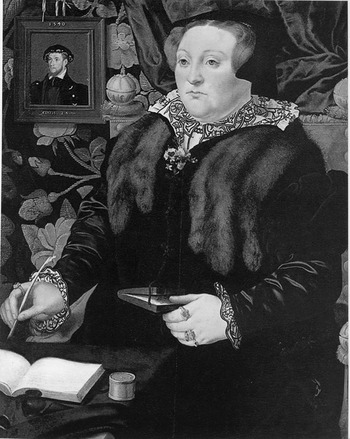
In 1558, Mary Neville, Lady Dacre commissioned Hans Eworth, a leading Flemish painter resident in England, to paint her portrait (fig. 1). The occasion was almost certainly to record the success of her long campaign to secure restoration of the Dacre titles for her surviving son Gregory. They had forfeited to the crown in 1541 when her husband, Thomas Lord Dacre, was executed for murder. Seated in an armchair at her desk, Lady Dacre dominates the picture spatially and expressively. The contrast with the small portrait of her husband at the rear of the scene could not be more striking and underscores her triumph in rescuing their children from the consequences of his crime. Dacre's rich black gown and dark fur mantle signify her status as a respectable, wealthy widow, the embroidered sleeves and collar of her chemise providing the only contrast to the dark colors. She is wearing minimal jewelry—rings and a simple chain necklace barely visible at the opening of her collar. To indicate her piety she is holding an open prayer book in her left hand.
Challenging the image of Lady Dacre as a conventional devout widow, however, is the object she is holding in her other hand—a quill pen. The pen was, in fact, the weapon she had used to conduct her seventeen-year-long struggle for restoration of the Dacre titles. Eworth's portrait, the first of an English aristocratic woman writing or about to write, thus memorialized her success in deploying a skill long considered inappropriate for women. Furthermore, in commissioning the portrait, Lady Dacre was as careful about what was omitted from the painting as about what was included. It omits any reference to the fact that she married
—Mary Neville, Lady Dacre, 1558. Permission of the National Gallery of Canada, Ottawa.

twice after her first husband's execution and was the mother of six children by her third spouse. In a culture ambivalent about the remarriage of widows, these facts would have undercut the image she was fashioning of herself as a devout, noble widow dedicated to her first husband's memory and the future of their children.
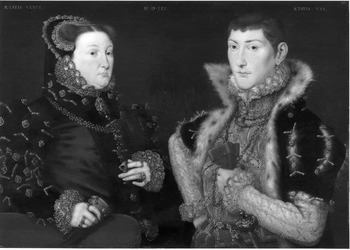
The following year Lady Dacre ordered another painting from Eworth, this one a joint portrait of herself and Gregory, the Dacre heir (fig. 2). Once again, she
—Mary Neville, Lady Dacre and her son Gregory, Lord Dacre, 1559. Permission of the National Portrait Gallery, London.

dominates the picture, presenting herself as serious and formidable, while Gregory appears to be something of a fop. In fact, their contemporary, William Camden, described him as “a little crack-brained.”Footnote 1 Gregory died without heirs in 1593, and the Dacre title passed to his sister Margaret, who carried it to the Lennard family.Footnote 2
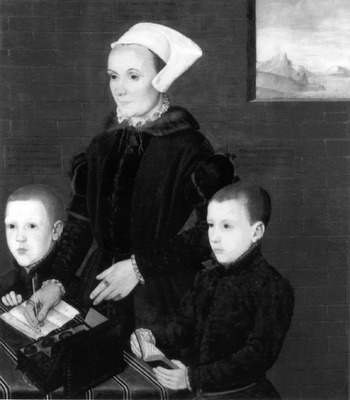
Eworth's portraits of Lady Dacre constitute a dramatic and almost unique example of a pre-Elizabethan aristocratic woman consciously fashioning herself in paint. No evidence indicates that aristocratic women commissioned any of the portraits of women that Hans Holbein produced during his years at the English court. Rather, his paintings are of wives whose husbands commissioned them as companion pieces to their own portraits. The only other pre-Elizabethan portrait of a woman with a pen is not of an aristocratic woman at all but of Alice Barnham, the wife of a leading citizen of London and member of the Drapers’ Company, who served as both an alderman and sheriff (fig. 3). The painting, completed in 1557 by an unknown artist and identified by Lena Orlin, shows Mistress Barnham with her two children and a pen in her hand.Footnote 3 Orlin has not found any evidence explaining why Mistress Barnham commissioned it.
—Alice Barnham, 1557. Permission of the Denver Art Museum.

Although Lady Dacre's portraits were unique forms of female self-fashioning in paint, she was not the only Yorkist or early Tudor aristocratic woman to define herself in art. This article will demonstrate to the contrary that between 1450 and 1550 scores of the wives and widows of knights and noblemen commissioned tombs and stained glass whose location, effigies and painted images, epitaphs, and heraldry recorded their chosen identities. In combination with their wills, the tombs, stained glass, and private chapels they built constitute underutilized sources for studying their subjectivity.
My analysis challenges the implications of the extended, often heated, debate among literary critics about the nature and history of the self and subjectivity before 1600. Whether they meant to or not, an influential group of early modern literary scholars have raised questions about whether one can legitimately talk about these dimensions of the human personality in the pre-Elizabethan period by tracing their accounts of the origin of the history of the subject or self to Elizabethan and early Stuart drama. Their analysis connected a developed sense of self and subjectivity—what Catherine Belsey has called the “autonomous subject of liberal humanism”—with a particular cultural and political moment and implied that it did not exist earlier.Footnote 4 Many of them also used late sixteenth- and early seventeenth-century writers as the point of departure for their discussions of the origin of the female subject.Footnote 5
Without denying that significant cultural and ideological changes in the late sixteenth and early seventeenth centuries did affect the way that English women and men understood themselves, literary scholars as diverse as David Aers, Stephen Greenblatt, and Meghan Matchinske have argued convincingly that the sense of the self and subjectivity—defined as the project of shaping one's life to express and conform to that self—did not suddenly spring forth in the age of Shakespeare.Footnote 6 Historian Natalie Davis has also dissented from the view that connects individualism and subjectivity causally. In her 1986 article, “Boundaries and the Sense of Self,” Davis maintains in contrast that in sixteenth-century France subjectivity emerged from people's sense of themselves in relationship to God, their patrons, and their families and lineages. She considers the most important of these groups to be the patriarchal family. More than any other social unit, it stimulated those within its boundaries toward self-discovery, self-presentation, and strategies for achieving some personal autonomy and self-expression.Footnote 7 The trajectory Davis outlines represents a significant revision of the theory that traces the evolution of the self to the emergence of autonomous individualism and is far more pertinent to the period considered here.
Taking Davis as a starting point, this article defines the subjectivity of aristocratic Yorkist and early Tudor women as the product of their ongoing struggle to shape their identities and exercise some measure of autonomy within the confines of an intensely patriarchal society. Of the institutions that constrained them, their families and lineages, reinforced by the common law, were undoubtedly the most powerful. This study moves beyond Davis by drawing on a rich body of textual and material evidence—wills, tombs, stained glass, and epitaphs—to demonstrate that this class of women accumulated sufficient personal and material resources to fashion their identities. The discussion begins by briefly elucidating those resources.Footnote 8
In a period when 94 percent of the daughters of noblemen and knights married at least once, aristocratic women accumulated power as they moved through the uxorial cycle.Footnote 9 As wives, they ran large households; supervised the management of their husbands’ estates; and cultivated networks of their family, friends, and clients. Whatever men thought about female capacities in the abstract, their frequent absences from home meant that they had little choice about treating their wives as their de facto, if junior, partners in the family business. No matter how loyal and able their domestic servants and estate officials, no one shared their interests as closely as their wives.
Bearing children reinforced women's position, since their offspring created an additional dimension to their and their husbands’ common interests. Between the mid-fifteenth and mid-sixteenth centuries, 91 percent of the wives of noblemen and knights bore at least one surviving child.Footnote 10 On average they gave birth to 4.42 children, but many of them produced much larger numbers. Almost 40 percent of the women had five or more offspring. Mothers supervised the care of young children and organized the key transitions in their lives: finding desirable households in which to place them in adolescence, petitioning for positions for them at court, and arranging their marriages.
Aristocratic women reaped the full reward for their contributions to their marital families when their husbands died. Like wifehood and motherhood, widowhood was a stage in the majority of their lives: 70 percent of 751 male testators who married at least once had surviving wives.Footnote 11 Widowhood freed them from the disabilities of coverture, the common-law doctrine that a husband covered his wife's legal identity during their marriage. Coverture deprived wives of legal rights, such as the right to enter into an enforceable contract or write a will, normally allowed to men and unmarried women. Thus, as widows, women continued to perform tasks that they had first undertaken as wives with new authority. In addition, they assumed heavy responsibilities as executors of their husbands’ wills and guardians of their minor and unmarried children. More than three-quarters of 523 Yorkist and early Tudor noblemen and knights with surviving wives selected them as executors or supervisors of their estates; in 35 percent of these cases they named the women their sole executors.Footnote 12 In addition, 86 percent of 111 men with noninheriting, minor children in the same period chose their wives as their guardians.
Complementing these heavy tasks, aristocratic widows controlled an enormous amount of wealth. Eighty-four percent of the 523 men with surviving wives left them property in addition to the jointures or dowers required by law that gave them a life interest in a portion of their deceased husbands’ land. Although these additional gifts usually consisted of movable goods, 11 percent of the men included real estate among their extra bequests. Furthermore, if they were heiresses, widows controlled their inheritances and the income it yielded for the first time. Finally, as executors and guardians, they managed income from land and cash designated for the support and education of their children. Although most of the land they held passed to their husbands’ heirs when they died, they could usually bequeath much, if not all, of their movable property as they wished. Their wealth enabled them to maintain the style of living they had enjoyed during their marriages and preserved their position as important figures in their families.
Women's longevity compared to men's was the final factor empowering them to define themselves and act on those definitions. Sixty-three percent of 351 Yorkist and early Tudor aristocratic widows survived their first husbands by more than ten years; 37 percent by more than twenty years.Footnote 13 During their long widowhoods, they accumulated large amounts of cash, spending it on plate, jewelry, and other luxury items, and purchasing land to add to the family estates or bequeath to their noninheriting children. Many of them remarried and survived second, third, and even fourth husbands, accumulating still more land, goods, and power along the way. Long before they died, many emerged as full-scale matriarchs dominating large, complex families.Footnote 14
Freed from the disabilities of coverture and controlling huge amounts of wealth, aristocratic widows transformed the last task facing them—arranging the disposition of their bodies and the care of their souls after their deaths—into an opportunity to proclaim and memorialize identities that they chose for themselves and by which they wanted to be remembered. Their commissions of tombs, stained-glass windows, chapels, and almshouses involved careful, self-conscious decisions about the churches in which they wanted to be buried and with whom; where their monuments and chapels were to be located; how their tombs and stained glass were to be designed; and how they were to be identified in the epitaphs and heraldic shields engraved on their tombs or mounted on tablets on adjacent walls. When completed, the women's projects expressed female subjectivity in materials and forms that their creators expected to last for generations.
The remainder of this article will document the extent and character of women's activity building tombs that displayed their chosen identities. The evidence comes from information about 413 aristocratic couples whose monuments or records about their monuments in their wills and antiquarian sources have survived. For 226 of these couples, women's wills indicate where they wanted to be buried. For seventy-one of the couples, the women actually built and/or financed their own or their husbands’ tombs; in seventy-two additional cases they almost certainly did so. Commissioning these tombs was frequently connected to founding perpetual chantries, that is, endowments established to finance prayers for the souls of persons specifically named by the donor. Chantries took the form of simple altars, new chapels intended to become mausoleums for successive generations of the donor's family, or endowed almshouses that required the beneficiaries to pray for the founders and their families. Seventy-six women in the group of 413 commissioned chantries or almshouses. Many of them were also tomb builders.
The widows’ first decision was to specify where they wanted to be buried and with whom. Their decision would result in a permanent representation of how they saw themselves and how they wanted to be remembered. Although both elite women's and men's senses of themselves were rooted in their families, for men this identity was less complicated because they remained members of their natal families throughout their lives. For women, however, the issue was far more complicated because they collected families as they moved through their life cycles. At a minimum, they had two families, those into which they were born and those into which they married. Since half or more of them remarried at least once, they accumulated more than one marital family. Fifteen of the women had three husbands; two of them had four. The wills of remarried widows indicate that they maintained ties to their natal kin and all of their husbands’ families and natal kin throughout their lives. But when they decided where and with whom to be buried, they made a public statement about the family with which they wanted to be identified forever.
The importance of marriage in shaping aristocratic women's lives meant that in the 226 cases in which aristocratic widows indicated where they wanted to be buried, three-quarters chose the same tomb or church as one of their husbands, most often in the parish church where his principal estate was located.Footnote 15 In about two-thirds of these cases, the women had been married only once, and their decisions were relatively clear-cut. But eight of the widows married only once were heiresses whose choices departed from the norm, highlighting the only factor that could compete with marriage in shaping aristocratic widows’ self-definition. Six of the heiresses were buried with their spouses in their natal parishes. In these couples the wives were the major sources of their wealth, and they lived on estates the women had inherited.Footnote 16 Two other heiresses were buried with their husbands in chantry chapels their fathers had built.Footnote 17
The other widows in the group of 226 who requested burial with their husbands were married more than once. They had to indicate, therefore, the spouse with whom they wanted to be most closely identified forever. A number of factors influenced their decisions: they tended to favor first husbands, the husbands with whom they had their first children or first sons, their highest-ranking spouses, and men with whom they had relatively long marriages. They rarely alluded to emotional factors. Of sixty-five women in this group, twenty-five chose burial with their first husbands. In twenty-one of these cases, the men were also the fathers of their first children, clearly a factor of overwhelming importance.
The forty remaining women married more than once asked to be buried with their second, third, or fourth husbands. Many of their choices seem to have been based on the same factors that influenced women who chose burial with their first husbands. But the comparative rank of their husbands also affected their decisions: over a quarter of the remarried women requested burial with their highest-ranking spouse. In fact, only two widows of noblemen chose burial with a nonnoble husband. In both these cases, the men they preferred were the fathers of their only children. Unlike first-time brides, widows were almost always free to select their husbands when they remarried; the comparatively high number of women who chose burial with their second, third, or fourth spouses may reflect their greater emotional attachment to them, although evidence on this subject is almost nonexistent. In one case, Dame Agnes Say made clear that she wanted to be buried with the second of her four husbands, Sir John Fray, because he was the father of her two favorite daughters.Footnote 18
The final group of widows, about a quarter of the group of 226, wanted to be buried apart from all their husbands. Fourteen of them selected churches associated with their deceased spouses or marital families, often in parishes where they were living on dower property. Their choice was a matter of convenience. Thus, Dame Jane Fitzwilliam asked to be buried in the London parish where she was living on property her third husband had bequeathed her. He was buried a goodly distance away in Northamptonshire.Footnote 19
Thirteen others were heiresses who identified most strongly with their lineages and desired to be buried in their natal parishes or with the kin from whom they inherited. After devoting her long life and considerable energies to advancing the Pastons’ fortunes, for example, Margaret Paston asked to be buried with her ancestors at Mautby.Footnote 20 Elizabeth, Lady Fitzwarren, and Maud, Lady Willoughby, were both buried with relatives—a brother and uncle, respectively—from whom they inherited their property, although each of them had married three times.Footnote 21
Five noninheriting women also preferred to be buried with their natal kin, often explicitly expressing pride in their lineages. Elizabeth Neville, Lady Latimer, daughter of Richard Beauchamp, earl of Warwick, understandably chose burial in the magnificent chapel her father had built in St. Mary’s, Warwick.Footnote 22 Lady Anne Grey preferred burial in her natal parish, Albury, Hertfordshire, to burial with either of her husbands. She directed her executors to construct a tomb “declaring a memorial of the stock that I came of.”Footnote 23
Sixteen women who chose burial apart from any of their husbands selected religious houses for their final resting places. The small number—sixteen in a group of 226—stems from a number of convergent factors. The first is the overwhelming importance members of the aristocracy attached to parish churches as symbols of their and their families’ political, economic, and social status.Footnote 24 But it also reflects the declining importance of monasticism in Yorkist and early Tudor piety.Footnote 25 In addition, some women were not interred in the religious houses of their choice because of the shortage of space. Elizabeth Barnardiston, to give one example, was not buried at Walsingham Abbey, as she desired, even though she was living there when she wrote her will and appointed the prior as her sole executor. Instead, she was laid to rest in her parish church at Kedington.Footnote 26
Women's selection of the location of their tombs was the foundation of the images they fashioned for themselves for posterity. Except for those who sought burial in religious houses, all their choices connected them to one of their families. Their next task was to purchase sites within the church and direct the design of their monuments. This process involved selecting the materials to be used for the tombs and effigies, deciding which heraldic shields to include on their monuments, and choosing the wording of their epitaphs. Commissioning stained-glass windows involved similar choices. In making their decisions, aristocratic widows almost always chose the most expensive design and best locations they could afford. Throughout, they looked to the future and the past, representing themselves as they wanted to be remembered forever and enhancing the reputation of their ancestors and descendants.
In the fifteenth and sixteenth centuries, the vast majority of people were buried in churchyards. Interment inside churches was a privilege for which the nobility and gentry paid. Their bodies were entombed in vaults beneath their monuments, which stood on sites they or their families had purchased. From the spiritual point of view, the closer the tomb was to the high altar, the more desirable its location, because the souls of the deceased benefited from proximity to the Eucharist.Footnote 27 Unless their families had already built chapels or their husbands were already buried in the churches they selected, widows sought locations in the chancel of the church, the area where the altar stood and the mass was performed, at the east end of the church or the east end of the aisles adjacent to it. Since the cost of the site depended on how close it was to the high altar, tombs functioned as a perpetual reminder of the women's wealth.Footnote 28 In 1519, for example, Dame Anne Sulyard Bourchier asked to be buried with her first husband, Sir John Sulyard, at Wetherden “in the south aisle adjoining to the chancel … before an image of St. Anne standing at the south end of the said aisle.”Footnote 29 Elizabeth Barnardiston's tomb at Kedington, where the church has no aisles, is immediately adjacent to the right side of the chancel.Footnote 30 The importance members of the aristocracy attached to the location of their tombs is exemplified in Dame Elizabeth Fitzwilliams's 1548 will. Having chosen St. Paul's Cathedral, London, rather than her parish church as her burial site, Dame Elizabeth was worried about the location of her tomb being “mete and convenient.” Her will noted that her executors “have before this time by my commandment viewed and seen [the possibilities] for that purpose” and presumably had discussed the results of their visit with her.Footnote 31
An even more expensive option was for the women to construct a separate chapel or chantry for their and/or their husbands’ tombs. Once again, they located them as close as possible to the high altar. The east end of the north and south aisles alongside the chancel was a favorite choice. Dame Margaret Bedingfield (d. 1513) founded the chapel bearing her family name, where she was subsequently buried, at the east end of the south aisle in her parish church at Oxborough, Norfolk. Initially the chapel opened from the chancel, making it as close as possible to the high altar.Footnote 32 Lady Anne Danvers (d. 1531) erected a chantry at the east end of the southern aisle in her church at Thatcham, Berkshire. She and her husband, Sir William (d. 1502) were buried under an archway between the chapel and the chancel.Footnote 33
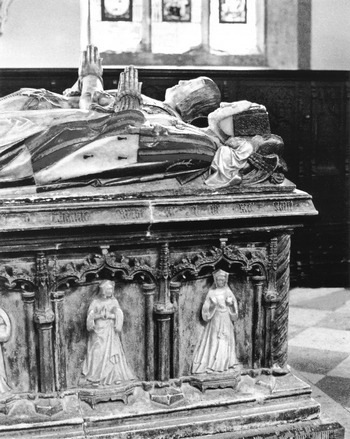
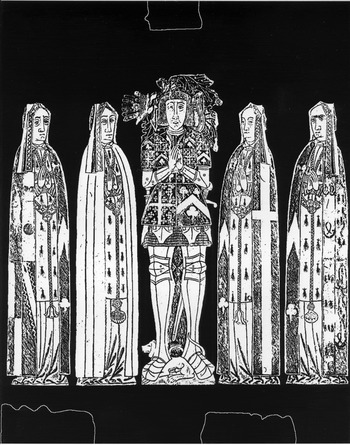
After they had purchased a site for their tombs, aristocratic widows hired craftsmen to build them according to a design on which they agreed. Most monuments took the form of tomb chests with images and inscriptions. The images took a number of forms: effigies of stone or marble, figures engraved in brass tablets, or carvings cut into the stone itself. The most expensive tombs had marble effigies resting on marble slabs. In addition, the sides frequently contained sculpted figures that represented the deceased couple's children. Alternatively, effigies engraved into brass sheets, a less expensive alternative, were set into indentations in the marble or stone slab on top of the monument (figs. 4 and 5).
However prominent they were on funerary monuments and however important they seem to modern viewers, most authorities agree that the sculpted and engraved effigies were not portraits in the modern sense.Footnote 34 Rather, they interpret the deceased as idealized figures in the prime of life that represent how they hoped to appear at the resurrection.Footnote 35 Surviving contracts indicate that patrons had little to say about the effigies they were ordering.Footnote 36 They were much more specific about two other personal features of the monuments, their inscriptions and heraldic shields. Women's wills often contain detailed instructions about the shields, epitaphs, or both. Here they engaged in two forms of conscious self-fashioning.
Escutcheons or shields showing the family arms were as essential an element on aristocratic tombs as the effigies. They were unique to each individual: a married or widowed woman's arms were not the same as either her father's or husbands’. Like effigies they were either sculpted or engraved depending on the material used to construct the tomb. Escutcheons identified the deceased, represented her lineage, and proclaimed her status. By the late fifteenth century, heralds of the royal
—Sir Richard and Lady Jane Knightley, Fawsley, Northhamptonshire. Permission of Bee Gee Photos, United Kingdom.

household had a monopoly over the granting and verification of arms.Footnote 37 They also controlled the funerals of armorial families, thus ensuring that the shields
—Sir Richard Fitzlewis (d. 1528) and his four wives, Ingrave, Essex (moved from West Hornden Essex). Permission of the Monumental Brass Society, United Kingdom.

displayed on tombs were correct. Consequently heralds and the courts considered the shields on tombs reliable evidence for determining lineages and their rank.Footnote 38 After Sir John Talbot of Albrighton died in 1549, for example, his second wife and widow Elizabeth built a monument with his escutcheon that was the major evidence used to settle a dispute about the lands and title of the Shrewsbury earldom in 1857–58.Footnote 39
While the crown had a monopoly on the design of heraldic shields, women could decide which family arms to display on their monuments. For example, Margaret Mautby Paston stated explicitly in her will that she wanted the four corners of her tomb at Mautby to display her and her husband's arms and three sets of arms representing different branches of her natal family. In addition, she wanted the Mautby arms sculpted alone in the center of the tomb over the motto, “In God is my trust.”Footnote 40 Thomasine Hopton put up her arms on the south aisle of Yoxford church, where she lived in her dower house and where she buried two of her daughters. She herself was interred with her husband in his family's parish church at Blythborough, as she had requested.Footnote 41
Women were explicit about connecting their arms with their high status. Lady Katherine Grey (d. 1505) directed her executors to “make a tomb over me with a stone and therein to be set pictures of my two husbands after their honor and my picture in a winding sheet between them both, with two scutcheons of their arms and mine jointly together at every end of the same stone, with a scripture thereto accordingly. And a plate to be set in the wall over my tomb and therein mine arms and such scripture as to mine executors and friends seem best and convenient to be made, shewing what I was.”Footnote 42 Elizabeth Scrope, Lady Scrope of Masham and Upsall (d. 1518), directed her executors to “lay a stone over my grave with three images, the one of my lord and husband, another of me, and the third of my said daughter Alice, with our arms on the said stone, and scripture making mention what we were.”Footnote 43 In most cases, their choice of arms centered on their marital families, but, as Margaret Paston's directions indicate, natal families dominated some women's understanding of who they were and how they wanted to be remembered.
However great the importance aristocratic women attached to the heraldic shields on their tombs and chapels, epitaphs were the most personal feature on their monuments. Epitaphs served both religious and secular purposes: they identified the person or couple being commemorated, recorded the family's ownership of the monument, and asked God to have mercy on their souls or begged for the prayers of onlookers.Footnote 44 The simplest and most common form for tomb chests was an inscription carved into the sides of the chest just under the slab on top. These tended to be short and formulaic. Thus, the Knightley tomb at Fawsley, Northamptonshire read simply, “Pray for the souls of Richard Knightley and Joan his wife which Richard died the 8th day of December in the year of our lord 1534 and which Joan died __ day of the month __ in the year of our lord 1550” (fig. 4).
Tombs with brass inscriptions provided more opportunity than those of stone for long texts. Such texts implored those who read them to pray for the souls of the dead, emphasized the high birth and status of the deceased, and occasionally included long descriptions of them. In some cases texts were set in the top surface of the tomb chest, usually with pictures of the deceased and her or his family, but others were mounted on tablets on an adjacent wall. Their wills often directed such details of the brasses as the texts of scrolls coming out of the effigies’ mouths and the choice of saints to appear on them.
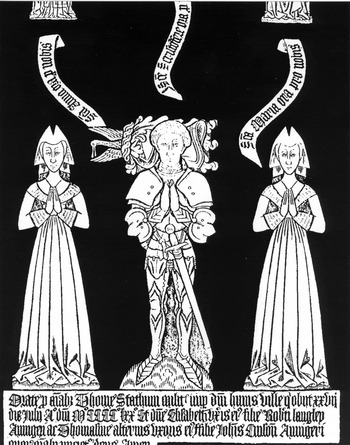
The brass that Dame Elizabeth Stathum ordered for her husband's marble tomb at Morley, Derbyshire is a good example. It showed Sir Thomas standing between his two wives with scrolls coming out of their mouths. His scroll reads, “Saint Christopher pray for us,” and points to a figure of the saint with Jesus on his shoulder. His first wife, Thomasine, stands on his left (from the viewer's perspective) and directs the same words to the Virgin, who is shown on a throne with Jesus on her lap. Elizabeth, the patron of the tomb, stands on her husband's right and directs the same prayer to St. Anne, who is shown with a small figure of the Virgin (fig. 6).Footnote 45
Lady Anne Danvers's (d. 1539) commissions at Dauntsey, Wiltshire were even more ambitious. Dissatisfied with the conventional tomb with brass effigies and a simple epitaph that she had commissioned for herself and her husband after he died, she constructed a second, canopied tomb for herself in the chancel of her parish church. It enclosed a brass showing her kneeling at a prayer desk with her petition, “Lord have mercy on me.” Underneath the image, a long epitaph dwelled on the vanity of worldly possessions, talent, and high rank, recorded her marriage and her position as her father's heir, and closed with her hopes for her soul.Footnote 46
Above the tomb she constructed a window that displayed an image of and prayer to the Virgin as well as pictures of St. Dorothy and Dame Anne's name saint, St. Anne. It also portrayed her husband kneeling in armor under his coat of arms and a scroll asking the Virgin to pray for them. A similar picture showed Dame Anne wearing her coat of arms on her dress with a scroll petitioning Mary to intercede to God for them.Footnote 47 Despite her deprecation of worldly possessions, Anne Danvers spent a fortune portraying her high status and publicly testifying to her faith.
As these epitaphs and windows illustrate, aristocratic women's bodies and souls constituted equally important elements in the identities they sought to immortalize. On the one hand, at least until the break with Rome, they represented themselves in traditional pious terms, petitioning for prayers for their souls and those of their nearest kin. On the other hand, the souls for which they petitioned were not generic Christian souls but, rather, the souls of members of distinguished lineages memorialized in costly tombs located in the most prominent places in their churches. In their understanding, no contradiction existed between their earthly and immortal selves.
Although the spiritual aspirations expressed in their epitaphs were unquestionably
—Sir Thomas Stathum (d. 1470) and his two wives, Morley, Derbyshire. Permission of the Monumental Brass Society, United Kingdom.

orthodox—indeed, they had to be in order to be included in their tombs—within those limits aristocratic women could make choices that expressed their religious views more individualistically than the conventional requests for mercy and/or prayers. Margaret Lady Beauchamp included careful directions in her will about the tablets she wanted on the wall near her tomb: “I will that there be made a tablet of the birth of our lord and the three kings to be set upon the wall over my body when it be buried. Also an image of alabaster three quarters of a yard in length of St. John the Evangelist with the chalice in his hand to be set over me in likewise.”Footnote 48 The elaborate program of Dame Anne Danvers's tomb and window is an outstanding example of a widow constructing her secular and spiritual identity.
Dame Anne Danvers was not the only woman to include her favorite saints on her monuments. Margaret Choke included images of St. Sunday and St. Gregory as well as the conventional pictures of the couple and their arms on the window she constructed at Long Ashton Somersetshire.Footnote 49 Sybil Danvers (d. 1511) paid for pictures of St. Anne, the Trinity, and St. Barbara on the church windows at Waterstoke, Oxford, and Dame Constance Ferrers included prayers to Saints Katherine and George on the window she constructed at Baddesley Clinton, Warwickshire.Footnote 50
Wills provide additional evidence of the ways in which orthodox aristocratic women shaped their religious identities. Virtually all their testaments began conventionally by commending their souls to God, the Virgin, and the whole company of saints. But many testators defined their religious persona with more idiosyncratic statements. For example, Dame Elizabeth Cutte noted her “special devotion” to Saints Elizabeth, Paul, Anthony, and John the Baptist and appealed to them for intercession as well as to Mary.Footnote 51 Others specified the particular masses they wanted sung for them instead of leaving the choice to their priests or executors. Dame Elizabeth Brown (d. 1487) requested that thirteen trentals of St. Gregory be sung for her and her parents.Footnote 52 Dame Anne Arundell (d. 1508) paid for a mass to be sung for her and her close kin at Scala Celi in Rome.Footnote 53 Elizabeth, countess of Oxford's requests included fifty masses of the Trinity, fifty of the Holy Ghost, fifty of the Five Wounds, and fifty requiem masses.Footnote 54
Long before the break with Rome and spread of reform, a small but steady stream of women—less than a dozen in the group studied here—directed their executors to avoid the “pomp and pride of the world” when they arranged their funerals. In 1480 Anne, duchess of Buckingham, ordered her executors “as soon in as secret wise as they goodly and conveniently may … [to] carry and lay my said body in the said college church [of Pleshy], setting all pomp and pride of the world apart.”Footnote 55 That impulse continued through the break with Rome but before the liturgy and religious practice had changed significantly. Thus, Dame Margery Waldegrave (1540) wanted to be buried with “no pompous burial nor no month's mind” and ordered that there should be “no common assembly of poor people nor common dole nor dinner to be kept.”Footnote 56 These women and those who expressed similar wishes consciously rejected elaborate ceremonies that flaunted their class position and wealth.Footnote 57 How modest these women actually wanted their funerals to be is unclear, however. Dame Katherine Bray (d. 1508) wrote explicitly, “And as touching the funeral obsequies and ceremonial business about my body, I will that in my burying … all things be done in soberness and temperance … as it maybe be most to the honor of god and profit to my soul … all worldly pomp and superstitious vanity clear set aside.” Having said that, she left £100—enough to support a minor gentry family for a year—to pay for her funeral.Footnote 58
After the break with Rome, aristocratic widows’ ability to define themselves through their religious choices expanded dramatically. As late as 1560, however, most of those studied for this project continued to repeat orthodox Catholic formulas in their wills and to build tombs with traditional effigies and prayers. However, a small group took advantage of the chance to refashion themselves spiritually and openly espouse reform. They replaced the traditional commendation to God, the Virgin, and the whole company of saints with invocations reflecting a belief in justification by faith alone. The prayer opening Dame Bridget Willougby's 1558 will was characteristic: “I bequeath my soul to Almighty God my maker, believing assuredly to be saved only by the merits of Christ's passion, who suffered death upon the cross to redeem me and all the world from everlasting death and damnation.”Footnote 59 Dame Anne Brooke, who described herself as “a sinful wretch,” asked “forgiveness, mercy, and grace of my naughty life … trusting to his [i.e., God’s] great goodness and mercy through the worthy merits of the bitter passion of our most loving and benign savior Jesus Christ, not only to have remission of my sins, but also undoubtedly to have the everlasting life.”Footnote 60 Still another convert to reform, Dame Jane Calthorpe (d. 1549), included an overtly Protestant epitaph, a quotation from the “Order of Burial of the Dead” in the Book of Common Prayer, on her memorial brass.Footnote 61
Cumulatively, then, the evidence of tombs and stained-glass windows demonstrates that aristocratic widows took advantage of the resources and relationships they acquired during their long lives to define themselves and represent their chosen identities on their final monuments. They made their decisions and acted on them in the context of institutional structures—most importantly law, family, and church—that both constrained them and created the internal contradictions and spaces that allotted them a measure of autonomy and power of self-definition. In a highly patriarchal society, they were both subjected and the subjects of their own lives.