Introduction
Dispersal allows species to persist in the face of spatial and temporal heterogeneity (Southwood Reference Southwood1962; den Boer Reference den Boer1990) and as such, is central to understanding metapopulation and metacommunity processes. Dispersal has been modelled traditionally as a fixed trait of species; however, accumulating evidence suggests that this may be the exception rather than the norm (Clobert et al. Reference Clobert, Ims and Rousset2004). In fact, fixed strategies may be expected mainly when changes in habitat quality are unpredictable, or if habitat quality cannot be readily assessed (Bowler and Benton Reference Bowler and Benton2005). Under other conditions, most organisms will likely exhibit condition-dependent dispersal, in which cues about habitat quality (e.g., resource availability), or social factors (e.g., mate availability, conspecific density, or conspecific relatedness), influence an individual's propensity to disperse (Ims and Hjermann Reference Ims and Hjermann2004). This general strategy allows individuals to respond to the risks and benefits associated with dispersal over the short term (Bowler and Benton Reference Bowler and Benton2005). Condition-dependent dispersal can be enforced by natural selection when reliable cues about expected variation in local conditions are available to individuals prior to dispersal (Clobert et al. Reference Clobert, Le Galliard, Cote, Meylan and Massot2009). Because variation in environmental parameters is often temporally auto-correlated (Halley Reference Halley1996), it might be expected that most organisms would show condition-dependent dispersal (Clobert et al. Reference Clobert, Le Galliard, Cote, Meylan and Massot2009).
Organisms exhibiting condition-dependent dispersal may respond directly to habitat-related dispersal cues, or more slowly and indirectly, such that a particular cue triggers a change to the organism's internal state that leads it to become a “disperser” (Ims and Hjermann Reference Ims and Hjermann2004). There are even a growing number of examples in which conditions experienced by the mother or grandmother trigger development of dispersing or nondispersing offspring (MacKay and Wellington Reference MacKay and Wellington1977; Massot and Clobert Reference Massot and Clobert2000; further examples in Ims and Hjermann (Reference Ims and Hjermann2004)).
Aerial dispersal behaviour in spiders, called “ballooning”, involves individuals releasing silk threads that keep them aloft by producing friction against moving air (Humphrey Reference Humphrey1987). This behaviour is associated with great mobility in spiders (Bell et al. Reference Bell, Bohan, Shaw and Weyman2005), and consequently they are among the first invertebrates to arrive at new habitats generated by natural or anthropogenic disturbance (Crawford et al. Reference Crawford, Sugg and Edwards1995; Mrzljak and Wiegleb Reference Mrzljak and Wiegleb2000; Coulson et al. Reference Coulson, Hodkinson and Webb2003).
Spatial (Bonte et al. Reference Bonte, Borre, Lens and Maelfait2006), biotic (Weyman and Jepson Reference Weyman and Jepson1994; Weyman et al. 1994, Reference Weyman, Jepson and Sunderland1995; Bonte et al. Reference Bonte, Borre, Lens and Maelfait2006), and climatic factors (Vugts and Van Wingerden Reference Vugts and Van Wingerden1976; Greenstone Reference Greenstone1990; Thomas et al. Reference Thomas, Brain and Jepson2003) influence aerial dispersal behaviour in spiders. Of particular note, Weyman et al. (Reference Weyman, Sunderland and Fenlon1994) found that food limitation increased the propensity of linyphiids in the genus Erigone Audouin (Araneae: Linyphiidae) to balloon, and furthermore, Bonte et al. (Reference Bonte, Deblauwe and Maelfait2003) found that temperature and feeding level during development interacted to affect propensity of Erigone atra Blackwall to balloon. De Meester and Bonte (Reference De Meester and Bonte2010) found that increased conspecific density at the time of dispersal increased predispersal behaviours in this linyphiid, and that presence of silk from other ballooners increased ballooning events. Their results suggest that conditional dispersal occurs in some spiders, depending on conspecific density.
We examined how several factors thought to have potential as useful cues might influence aerial dispersal behaviour in the six-spotted fishing spider, Dolomedes triton (Walckenaer) (Araneae: Pisauridae). Dolomedes triton is a large-bodied, semi-aquatic, cursorial species that inhabits the surface and margins of spatially isolated, ephemeral bodies of water in much of North America (Carico Reference Carico1973). The species has been well studied (Zimmermann and Spence Reference Zimmermann and Spence1989, Reference Zimmermann and Spence1992, Reference Zimmermann and Spence1998; Figiel and Miller Reference Figiel and Miller1994; Spence et al. Reference Spence, Zimmermann and Wojcicki1996; Kreiter and Wise Reference Kreiter and Wise2001) and juvenile dispersal is a conspicuous aspect of its natural history.
Temporal variability in habitat tends to increase dispersal in spiders (Weyman et al. Reference Weyman, Sunderland and Jepson2002; Entling et al. Reference Entling, Stämpfli and Ovaskainen2011), and thus relatively high juvenile dispersal rates are expected in D. triton. However, because the transient phase of their dispersal is passive, aerially dispersing individuals of D. triton would seem to have a small chance of successfully arriving at another suitable body of water, especially where ponds are isolated. Where this risk associated with aerial dispersal is high, condition-dependent dispersal might also be predicted in this species.
We tested the importance of several abiotic factors, indicators of habitat quality, and conspecific density in determining propensity for ballooning by D. triton spiderlings. First, we examined whether wind speed and temperature affect the proportion of a female's offspring that exhibit aerial dispersal behaviour. Second, we examined whether spiderling age affects aerial dispersal propensity. If D. triton spiderlings disperse aerially in direct response to local habitat conditions, we might expect them to begin to disperse aerially only late in the first active instar, after they have been able to assess local conditions. Conversely, if abiotic factors are more important in determining propensity to balloon or if local habitat quality can be rapidly assessed, we might expect them to disperse readily at any age given optimal abiotic conditions. Third, we studied whether cues that might reflect local habitat condition affected the proportion of offspring dispersing aerially. These cues were feeding level of the mother or egg sac number (the ability to make 2nd egg sacs indicating high local food availability). Finally, we investigated whether juvenile dispersal rates were density-dependent, varying with spiderling density or number of eggs in an egg sac, in order to examine whether conspecific density, which might have negative implications such as potential resource competition or risk of cannibalism, or positive implications such as a larger supply of potential mates, affects aerial dispersal propensity in D. triton.
Materials and methods
Spider collection and rearing
We obtained spiderlings from egg sacs of adult females of D. triton collected from sites in central Alberta, Canada (Table S1) 6–29 July 2004 and throughout the summer of 2005. Most D. triton females produce one or two egg sacs in a lifetime in Alberta (Spence et al. Reference Spence, Zimmermann and Wojcicki1996). Females carry their egg sacs in their chelicerae, and feed very little until the spiderlings are ready to emerge from the egg sac. At that point, a mother spider hangs her egg sac above the water in emergent vegetation and stays nearby for a few days. Under field conditions, the emerging 2nd instar spiderlings remain in a nursery web constructed around the egg sac for several days without feeding before they gradually disperse, some of them by ballooning, from the area of the egg sac.
After their collection, females were held in the laboratory at 22 °C at a photoperiod of 19L:5D and fed ad libitum with flesh flies (Sarcophaga bullata (Parker; Diptera: Sarcophagidae)). We kept females with egg sacs individually in jars or plastic tubs (0.5–1.0 L), each with ∼5 cm of water in the bottom, a floating Styrofoam platform to stand on, and several blades of grass to support construction of nursery webs. Male and female spiders that were collected without egg sacs or as penultimate stage juveniles in 2005 were kept individually in clear plastic vials (diameter 2.5 cm, height 10 cm, 50 dram) with 1 to 2 cm of water in the bottom and tilted ∼30° so that spiders could easily leave the water surface (see Zimmermann and Spence Reference Zimmermann and Spence1998). Once penultimate instars had moulted into adults, males and females from the same pond were mated. Once these latter females had produced egg sacs, we moved them to 1 L tubs to provide room for nursery web construction.
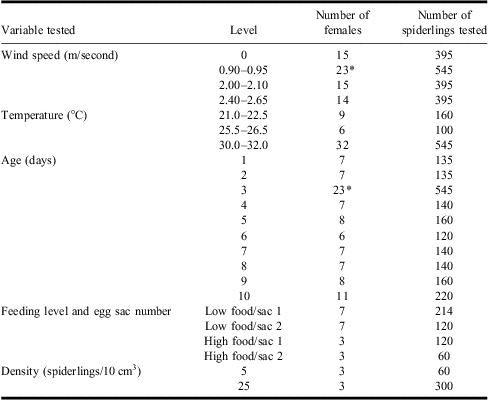
We tested unfed spiderlings that hatched from the egg sacs for determinants of aerial dispersal as described below. The first group of tests used spiderlings from females that had already mated or produced egg sacs when collected, and the second group of tests used females that moulted into adults and were mated in the laboratory, so that we knew their entire adult feeding history. Sample sizes for all tests are presented in Table 1.
Sample sizes of numbers of spiderlings tested for aerial dispersal behaviour, and numbers of different females that produced the tested spiderlings, for each level of each variable tested.
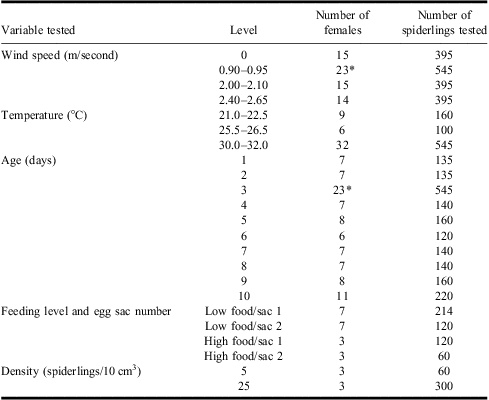
*Note that results from offspring of one of these females were not included in any analyses because they all behaved as if unhealthy: moving slowly in circles, rather than exhibiting normal behaviour.
Wind speed, temperature, and age
We conducted tests of aerial dispersal behaviour by placing five spiderlings at a time into a vial sunk into a 26 × 26 × 9 cm platform placed on a large box. When they ran up and out of the vial and explored the platform, spiderlings were exposed to air movement generated by a fan placed 20 cm from the vial. Apparently upon sensing the wind, some exhibited various preballooning and ballooning aerial dispersal behaviours. These included: (1) tiptoeing: raising the abdomen high above the prosoma and releasing silk; (2) tiptoe-ballooning: letting go of the substrate and being carried away by silk strands released during tiptoeing; (3) drop-ballooning: dropping from the substrate on a silk line, and then producing another thread used to balloon once the first thread is severed; and (4) spanning: running along silk threads released in either the tiptoe or drop position, but which have attached with a sticky end to a distant substrate, thus forming a “bridge” between substrates (see Richter Reference Richter1970; Coyle Reference Coyle1983; Eberhard Reference Eberhard1987; and Morse Reference Morse1993 for additional description of these behaviours). We classified spanning as an aerial dispersal behaviour since, although shorter-distance than ballooning, it is often a preballooning behaviour (Morse Reference Morse1993). We recorded spiderling behaviour for 7 minutes for the five individuals in each trial. If spiderlings failed to emerge from the vial during the first minute, we lifted them out onto the platform using a small paintbrush, and if they left the platform by walking, we lifted them back onto it and continued observation of aerial dispersal behaviour. We did not return spiderlings that left aerially to the platform. We tested no spiderling more than once. When possible, we tested spiderlings at the levels of the variables not being examined in that particular experiment that appeared to maximise take-off conditions in preliminary trials.
Using the apparatus described above we tested the influence of wind speed, temperature, and spiderling age on propensity of D. triton juveniles to balloon. Spiderlings were held at the specified temperatures for 1 hour before all tests. For experiments about wind speed, we exposed 3-day-old spiderlings to four wind speeds, as measured immediately above all areas of the platform with an Air Velocity Meter (TSI Model 1650, TSI Inc., Shoreview, Minnesota, United States of America). Each of the four fan settings was associated with a nonoverlapping range of wind speeds as follows: 0 (fan off), 0.90–0.95, 2.00–2.10, and 2.40–2.65 m/second. These spanned the wind speeds within which spider ballooning is thought to be possible (Humphrey Reference Humphrey1987; Greenstone Reference Greenstone1990). We tested the effect of temperature on ballooning behaviour at a wind speed of 0.95 m/second at 21.0–22.5 °C, 25.5–26.6 °C, or 30–32 °C. Potential effects of age on aerial dispersal behaviour were tested on spiderlings between 1 and 10 days old at a wind speed of 0.95 m/second. This age range spanned the usual aerial dispersal window for D. triton, that is, from hatching up until the age by which most spiderlings have left the nursery web and started to hunt.
Food limitation, egg sac number, and density
We paired spiders collected from the same pond that had previously moulted into adults in the laboratory, and subsequently assigned mated females to one of the two following feeding groups: “high food” (fed ad libitum; females usually ate 3–4 flies per day except when carrying their egg sacs), or “low food” (fed one fly every 3–4 days, and fewer while carrying their egg sacs). The low food level was slightly lower than that used in Spence et al. (Reference Spence, Zimmermann and Wojcicki1996), and which resulted in females producing significantly fewer eggs per egg sac than females fed ad libitum (but still usually producing two egg sacs).
We conducted experiments to test possible effects of maternal food limitation, egg sac number, and spiderling density in an improved wind tunnel (see Supplementary Appendix 1). We compared dispersal propensity among 4-day-old spiderlings from the two maternal feeding groups. Because all females in each feeding group produced both first and second egg sacs, we were able to test spiderlings from each of four groups: low food/first egg sac; low food/second egg sac; high food/first egg sac; and high food/second egg sac (Table 1). As above, we held and tested groups of five spiderlings at 30–33 °C before testing for aerial dispersal behaviour.
We tested for possible effects of spiderling density on aerial dispersal behaviour using spiderlings from the second egg sacs of three females in the low food group because the most spiderlings were available from this group. We kept spiderlings at one of two densities: low (5 spiderlings/10 cm3) or high (25 spiderlings/10 cm3) (n = 60 and 300, respectively) for 1 hour before testing them for aerial dispersal behaviour using all spiderlings (either 5 or 25 individuals) from each group for these tests, which we conducted at ∼22.5–24.0 °C. The low density level was roughly comparable to densities found in natural nursery webs, whereas the high density level was five times higher than this, and caused spiderlings to come in very frequent contact with one another.
Data analysis
Because we could not consider the behaviour of siblings to be independent (Massot and Clobert Reference Massot and Clobert2000), we considered the mothers of the spiderlings, and not the spiderlings themselves, as replicates. In each experiment we tested as many spiderlings as possible from a certain female, five at a time (except in the high density treatment of the density trials, in which case we tested 25 at a time), and then calculated the proportion of offspring exhibiting any aerial dispersal behaviour for each female under each set of conditions. We compared the mean proportions of spiderlings exhibiting dispersal behaviour under each set of experimental conditions using t-tests, one-way or two-way analysis of variance (ANOVAs) (where appropriate), and nonparametric Kruskal–Wallis tests when the residuals were nonnormal. We used nonparametric Nemenyi posthoc tests to partition and understand significant overall effects (Nemenyi 1963, as cited in Zar Reference Zar1999). At the set of conditions that included the highest number of females (22 females, number of spiderlings tested ranging from 10–70, tested at wind speed 0.90–0.95 m/second, 30 °C, 3 years of age), we analysed the correlation between the number of spiderlings in an egg sac and the proportion of spiderlings from that egg sac exhibiting aerial dispersal behaviour. We used chi-square tests to determine whether offspring from different females dispersed aerially in different proportions, and whether this varied by age.
Results
We observed several dispersal behaviours in addition to the tiptoeing and tiptoe-ballooning observed by Graham (Reference Graham2002) in D. triton spiderlings. These included spanning (Morse Reference Morse1993) and drop-ballooning (Coyle Reference Coyle1983; Barth et al. Reference Barth, Komarek, Humphrey and Treidler1991). Some spiderlings displayed several of these behaviours, for example, dropping, hanging for a few seconds, and then climbing back up to the platform and tiptoe-ballooning. Many spiderlings began spanning and then returned to the platform to balloon.
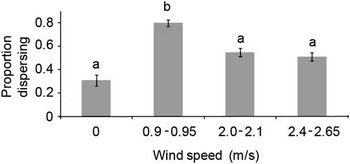
Wind speed significantly affected the mean proportion of spiderlings exhibiting aerial dispersal behaviour (χ 20.05,3 = 61.48, P < 0.001). Nemenyi posthoc tests revealed that a significantly higher mean proportion of spiderlings exhibited aerial dispersal behaviour at 0.90–0.95 m/second than at the other three wind speeds tested (Fig. 1). With no wind (i.e., 0 m/second) almost all dispersal behaviour was tiptoeing, since there was no wind to lift ballooning or spanning threads. At 2.40–2.65 m/second, and to some extent at 2.00–2.10 m/second, many spiderlings crouched and hung onto the ballooning platform rather than moving around and attempting to balloon, although still at least half of the spiderlings tested exhibited aerial dispersal behaviour.
Mean (±SE) proportions of spiderlings from 15 (395 spiderlings), 23 (545 spiderlings), 15 (395 spiderlings), and 14 (395 spiderlings) females exhibiting aerial dispersal behaviour at wind speeds of 0, 0.90–0.95, 2.00–2.10, and 2.40–2.65 m/second, respectively (χ 20.05,3 = 61.480, P < 0.001).

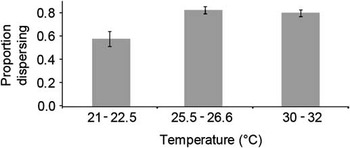
Temperature significantly affected the mean proportion of spiderlings exhibiting aerial dispersal behaviour (χ 20.05,2 = 10.05, P = 0.007; Fig. 2). Nemenyi posthoc tests did not indicate significant differences between mean proportions exhibiting dispersal behaviour at specific temperatures, although mean proportions were greatest at the two highest temperatures.
Mean (±SE) proportions of spiderlings exhibiting aerial dispersal behaviour from 9 (160 spiderlings), 6 (100 spiderlings), and 32 (545 spiderlings) females exhibiting aerial dispersal behaviour at temperatures of 21.0–22.5°C, 25.5–26.5°C, or 30.0–32.0°C, respectively (χ 20.05,2 = 10.054, P = 0.007).

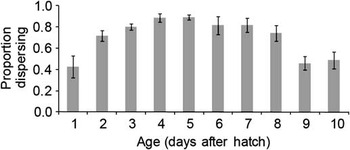
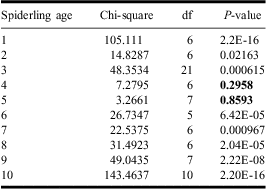
Spiderling age also significantly affected the mean proportion of spiderlings exhibiting dispersal behaviour (χ 20.05,9 = 38.24, P < 0.001; Fig. 3). Although Nemenyi posthoc tests did not indicate significant differences between specific ages, maximum proportions dispersing were noted on days 4 and 5, and proportions were notably lower on days 1, 9, and 10. On days 9 and 10 cannibalism between spiderlings began to occur, since they were not fed before being tested for aerial dispersal behaviour. The proportion of a female's offspring exhibiting aerial dispersal behaviour at a given age varied among females (Table 2), except at ages of 4 and 5, which was the time when proportions dispersing were highest.
Mean (±SE) proportions of spiderlings (n ranging from 120–545) from 6–23 females exhibiting aerial dispersal behaviour at ages of 1–10 days after hatch (χ 20.05,9 = 38.237, P < 0.001).

Results of chi-square tests for differences among females in proportion of offspring dispersing at different spiderling ages.
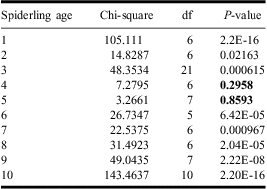
Notes: At each age, the number of females from which offspring were tested = df + 1.
Sample sizes of spiderlings tested per female at each age ranged from 5–30, but were usually from 10–20.
Nonsignificant P-values, which indicate no difference between females in proportion of offspring aerially dispersing, are in bold.
There was no significant correlation between the number of eggs in an egg sac and the proportion of spiderlings from that egg sac that exhibited aerial dispersal behaviour (Pearson's r = 0.18, P = 0.42; Fig. S2). We also observed no significant effect of maternal feeding treatment (F 1,15 = 0.27, P = 0.61), egg sac number (F 1,15 = 2.15, P = 0.16), nor interaction between these variables on the mean proportion of spiderlings exhibiting aerial dispersal behaviour (F 1,15 = 0.15, P = 0.38; Fig. S3). There was no significant effect of density on the proportion of spiderlings that exhibited aerial dispersal behaviour (t 0.05,2 = 1.02, P = 0.32).
Discussion
While higher temporal habitat variability appears to be associated with more dispersal in spiders (Weyman et al. Reference Weyman, Sunderland and Jepson2002; Entling et al. Reference Entling, Stämpfli and Ovaskainen2011) and insects (Southwood Reference Southwood1962), habitat fragmentation and isolation tends to decrease aerial dispersal in spiders (Bonte et al. Reference Bonte, Borre, Lens and Maelfait2006). Graham (Reference Graham2002) found that nearly half (341/700) of D. triton spiderlings ballooned, and in the present study well over 50% of all spiderlings exhibited at least one type of aerial dispersal behaviour. This high overall rate of aerial dispersal was found at each set of experimental conditions in our study, except for in spiderlings tested at ages 1, 9, and 10 days after hatching, which exhibited somewhat lower dispersal propensity (42–49%). Given these consistently high dispersal rates, we suggest that habitat isolation has not been as strong a force in the evolution of the D. triton dispersal strategy as have been factors tending to increase dispersal, which may include temporal habitat instability, kin competition, or cannibalism.
As expected, we found that abiotic factors influenced aerial dispersal in D. triton. Both temperature and wind speed significantly affected the proportion of spiderlings exhibiting aerial dispersal behaviour. Spiderlings exhibited higher dispersal activity with increasing temperature, as also found in studies of Lycosidae (Richter Reference Richter1970), and in studies correlating temperature with the number of spiders caught in the air (Freeman Reference Freeman1946; Vugts and Van Wingerden Reference Vugts and Van Wingerden1976; Bishop Reference Bishop1990). Warm temperatures increase the activity of poikilothermic spiders, which likely increases the frequency with which they display preballooning behaviours. In addition, solar heating of the earth's surface causes thermalling, which creates conditions ideal both for takeoff, and for long distance dispersal by ballooning, since the vertical component to the wind can carry spiderlings high enough (Glick Reference Glick1939) to enter low level jets, in which they may be blown long distances in relatively short times (Drake and Farrow Reference Drake and Farrow1988). As well, warmer temperatures over long periods of time are associated with the demise of ephemeral aquatic habitats. Any or several of these relationships could promote selection for ballooning at high temperatures.
Our data also support the widely held hypothesis that wind speed has a significant effect on spider ballooning behaviour (Richter Reference Richter1970; Vugts and Van Wingerden Reference Vugts and Van Wingerden1976; Barth et al. Reference Barth, Komarek, Humphrey and Treidler1991; Weyman Reference Weyman1995; Topping and Sunderland Reference Topping and Sunderland1998) and suggest that ballooning behaviour will be most frequent at wind speeds near 1 m/second. However, it was interesting that over 50% of spiderlings tested exhibited aerial dispersal behaviour even at the highest wind speed tested (2.40–2.65 m/second), which is close to the 2.6–3.0 m/second supposed to be the upper limit for spider ballooning (Humphrey Reference Humphrey1987; Greenstone Reference Greenstone1990). Warm temperatures and light wind speeds, that is, the conditions under which we observed the highest proportions of spiderlings ballooning, tend to arise when the atmospheric condition (nonideally convective) is thought to allow ballooning spiders to achieve the greatest distance (Reynolds et al. Reference Reynolds, Bohan and Bell2007).
Spiderling age significantly affected aerial dispersal propensity, with fewer spiderlings dispersing on average on the 1st, 9th, and 10th days after hatching than at other ages. Between days 2 and 8, however, proportions of spiderlings aerially dispersing were fairly constant, suggesting that there is a 7-day window of time within this instar, beginning shortly after moulting, during which appropriate abiotic conditions can promote aerial dispersal in D. triton. Length of the 2nd instar in D. triton is 13.7 ± 0.94 days for males and 16.1 ± 1.42 days for females (Zimmermann and Spence Reference Zimmermann and Spence1998; note that spiderlings moult once in the egg sac and this latter paper erroneously refers to the first posthatch instar as the 1st instar). Thus, our data suggest that aerial dispersal tendency begins to drop off several days before the end of the first active juvenile stage. Cannibalism began to occur in spiders 9–10 days old, suggesting that yolk reserves had been depleted by this age, and spiderlings needed to eat. These results suggest that D. triton spiderlings do not base aerial dispersal decisions directly on food availability, since a decrease in aerial dispersal behaviour coincided with the onset of hunting. The timing of the dispersal window, ending just at the onset of hunting, raises the possibility that evolutionary pressure to avoid cannibalism among kin may have been important in shaping the D. triton dispersal strategy.
We found no evidence of a maternal feeding effect on aerial dispersal behaviour in juveniles of D. triton, which was consistent with Bonte et al.'s (Reference Bonte, Borre, Lens and Maelfait2006) study of maternal feeding history on aerial dispersal tendency in Pardosa monticola (Clerck) (Araneae: Lycosidae). Additionally, there were no differences in aerial dispersal propensity between spiderlings of 1st and 2nd egg sacs, nor between offspring of low food versus high food mothers, although the small sample size of high food mothers weakens this conclusion. Thus, ballooning in D. triton does not seem to be conditional, depending on assessment of local food conditions.
Likewise, there was no evidence that conspecific density affects aerial dispersal in D. triton. A fivefold increase in spiderling density did not affect the proportion that showed ballooning behaviour (although sample sizes were small for this experiment). Furthermore, the number of eggs in an egg sac was not correlated with proportion of offspring from the sac exhibiting aerial dispersal behaviour. This contrasts with the results of similar experiments in which De Meester and Bonte (Reference De Meester and Bonte2010) found that conspecific density at the time of dispersal increased the same aerial dispersal behaviours measured in our study, in the spider E. atra. Differences in results may reflect the fact that E. atra is a highly dispersive (even as an adult) agrobiont species, while D. triton balloons primarily in the second instar, and following that remains at the same pond or stream. It is possible that 2nd instar density is uncorrelated with potential levels of competition during later stages when food might become more limited.
Although there has been controversy about the effect of density on dispersal (see Clobert et al. Reference Clobert, Ims and Rousset2004), it is unusual to find no effect. Density-dependence is predicted to be less likely to evolve in temporary and unpredictable habitats (Ims and Hjermann Reference Ims and Hjermann2004), and indeed, the proportions of dispersers observed are equivalent to or higher than those suggested by Halley et al. (Reference Halley, Thomas and Jepson1996) as the optimal frequency of dispersal in unpredictable habitats. Quite unexpectedly, there was no evidence in our work that tendency to disperse varies adaptively in relation to the several most obvious signals about food availability or the level of possible competition for food or of cannibalism at a site. Thus, condition-dependent dispersal in this spider species has apparently not evolved in response to resource shortages per se.
Genetic variation explained a small but significant proportion of variation in latency to tiptoe in the linyphiid spider E. atra (Bonte et al. Reference Bonte, Deblauwe and Maelfait2003a), and Bonte and Lens (Reference Bonte and Lens2007) found different heritabilities of dispersal motivation at different wind speeds. In D. triton we found a very interesting pattern of variation in dispersal tendency among offspring from different females tested at one set of conditions: there was no significant between-female variation at the age of peak dispersal (4–5 days), and increasing between-female variation with increasing time before or after this peak dispersal window (Table 2). Thus, although the mean proportion of spiderlings dispersing was high from days 2 to 8, and there was inter-female variation in dispersal in this time range, the inter-female variation in dispersal vanished at days 4 to 5, suggesting that this is the most important dispersal window, in which offspring produced by any D. triton individual will disperse aerially in large proportions.
We found no evidence for several discrete dispersal strategies; rather, dispersal in the offspring of every female followed the general pattern in Figure 3. This differs from the simple functional dimorphism common among semi-aquatic insects (see Andersen Reference Andersen2000) that use the same habitat as D. triton (and which have therefore likely faced similar selective pressures), and is in fact, much more similar to the planktonic dispersal strategy of marine invertebrates. As consistent with Morse's (Reference Morse1993) study of the spider Misumena vatia (Clerck) (Araneae: Thomisidae), we found no evidence for negative correlation between reproductive output and dispersal tendency of the offspring, as reported for many insects that exhibit dispersal dimorphism (Zera and Denno Reference Zera and Denno1997).
In summary, large proportions (often exceeding 50%) of D. triton spiderlings exhibited aerial dispersal behaviour in the laboratory during the second instar. We noted inter-individual variation in the proportion of a female's offspring that exhibits aerial dispersal behaviour, but this variation decreased the nearer the spiderlings were in age to 4–5 days old. Dolomedes triton does not seem to have a dispersal dimorphism, nor does it exhibit a tradeoff between reproductive output and dispersal. Abiotic factors affected aerial dispersal tendencies of spiderlings, with warm temperatures and low wind speeds associated with highest propensity to balloon. The environmental cues that increase aerial dispersal behaviour in this spider likely provide information about aeronautic conditions (Vugts and Van Wingerden Reference Vugts and Van Wingerden1976; Humphrey Reference Humphrey1987) as opposed to habitat conditions. D. triton is remarkably versatile, and can successfully balloon at wind speeds close to what is thought to be the upper limit for spiders (Humphrey Reference Humphrey1987).
Age affected spiderling aerial dispersal tendency, and the associated behaviours were most common between the ages of 2–8 days in the second instar, dropping off at the same time as spiderlings began to eat for the first time. During this window D. triton spiderlings used a variety of behaviours associated with aerial dispersal.
Contrary to expectations of condition-dependent dispersal (Clobert et al. Reference Clobert, Ims and Rousset2004), we found no evidence that signals about local food availability or about conspecific density, a negative indicator of potential levels of resource competition or cannibalism, or conversely, a positive indicator of potential future mate supply, affect decisions about dispersal in juveniles of D. triton. It appears that D. triton expresses a fixed dispersal strategy that includes more than half of the progeny of each female undertaking high-risk movement away from the natal pond during the first active juvenile stage. Thus, models incorporating dispersal as a fixed trait should quite adequately describe dispersal in D. triton populations. This and the patchy nature of their ephemeral habitats suggest this species as a useful model organism for future metapopulation studies.
Acknowledgements
We thank J. Tylianakis, S. Hoover, D. Stouffer, the Tylianakis laboratory, and two anonymous reviewers for helpful comments on the manuscript, and C. Coux for translating the abstract. This study was supported by Undergraduate Student Research Awards to C.M.F. over two years and a Discovery Grant to J.R.S. from the Natural Sciences and Engineering Research Council of Canada. L. DeHaas, A. Dechene, J. Jacobs, A. Brown, E. Esch, M. Pedruski, and M. Frost provided field and laboratory assistance.
Supplementary materials
For supplementary materials referred to in this article, please visit http://dx.doi.org/doi:10.4039/tce.2012.92 and http://www.journals.cambridge.org/tce2013001